


 by Tom Gurney
Tom Gurney BSc (Hons) is an art history expert with over 20 years experience
Page Created: / Page Updated:
Email: tomgurney1@gmail.com / Phone: +44 7429 011000
Vilhelm Hammershøi Paintings: Introduction
Vilhelm Hammershøi’s paintings are often introduced through pale Copenhagen rooms, but his practice was wider than that familiar image suggests. He made portraits and figure studies, views of streets and monumental buildings, landscapes, harbour subjects and interiors ranging from sunlit spaces to rooms lit by candles. What connects these categories is not a single mood. It is a sustained attention to structure, tonal relationships, light and the consequences of changing one element within a repeated motif.
The Vilhelm Hammershøi Digital Archive (ViHDA) makes this range unusually easy to examine. Led by SMK, the five-year project brought conservators, scientists, imaging specialists and art historians together to study about 140 paintings, using methods including infrared reflectography, X-radiography and material analysis.[1] Its current public works listing contains 133 researched paintings. That number describes the platform’s present scope, not Hammershøi’s complete oeuvre.
At a Glance
- Current censusViHDA’s current census contains 133 researched paintings, all recorded as works in oil.
- Leading motifsPortrait is its largest motif group with 38 records, followed by 35 interiors.
- Other subjectsLandscapes, figures, architecture and marine subjects form substantial parts of the researched selection.
- Serial methodHammershøi repeatedly varied rooms, doorways, sitters, viewpoints and lighting conditions.
- Technical evidenceTechnical imaging reveals underdrawing, altered contours and objects added or removed during painting.
- ColourRestrained colour did not mean an absence of colour: greys were built from carefully differentiated warm, cool and chromatic mixtures.
Contents
- Introduction
- What Did Hammershøi Paint?
- Portraits and Figures
- Rooms and Interiors
- Copenhagen Architecture
- Landscapes and Marine Subjects
- Serial Variation and Repeated Motifs
- Paint Layers, Revisions and Technical Research
- Six Paintings to Navigate the Practice
- What the Researched Works Directory Counts
Selected Vilhelm Hammershøi paintings
What Did Hammershøi Paint?
The 133 records currently published by ViHDA divide into 38 portraits, 35 interiors, 21 landscapes, 20 figures, 14 architectural subjects, four marine paintings and one record without a motif label.[4] These categories are practical finding aids rather than rankings of artistic importance. A painting can also sit conceptually between them. A woman placed within a room might be catalogued as an interior or a figure, while a city view can be both an architectural study and an investigation of atmosphere.
The census makes two points especially clear. First, portraiture was not a marginal prelude to the celebrated rooms: it remained a major strand of Hammershøi’s work. Second, interiors belong within a broader habit of reducing a subject to a controlled arrangement of masses, intervals and tonal shifts. The same exactness appears in a face set against a spare ground, in a façade seen almost frontally, and in low horizons crossed by trees. SMK’s overview of ViHDA accordingly treats technical evidence and art-historical context together, allowing materials, changes and motifs to inform one another.[2]
Portraits and Figures
Hammershøi painted himself, relatives, fellow artists and other members of his circle. The portraits often limit accessories and descriptive setting, concentrating attention on head, posture, clothing and the space surrounding the sitter. Figure paintings can be more explicitly concerned with an action or pose: reading, sewing, knitting, sweeping, standing or turning away. Those distinctions help explain why ViHDA separates 38 portraits from 20 figure subjects, even though the boundary is sometimes porous.
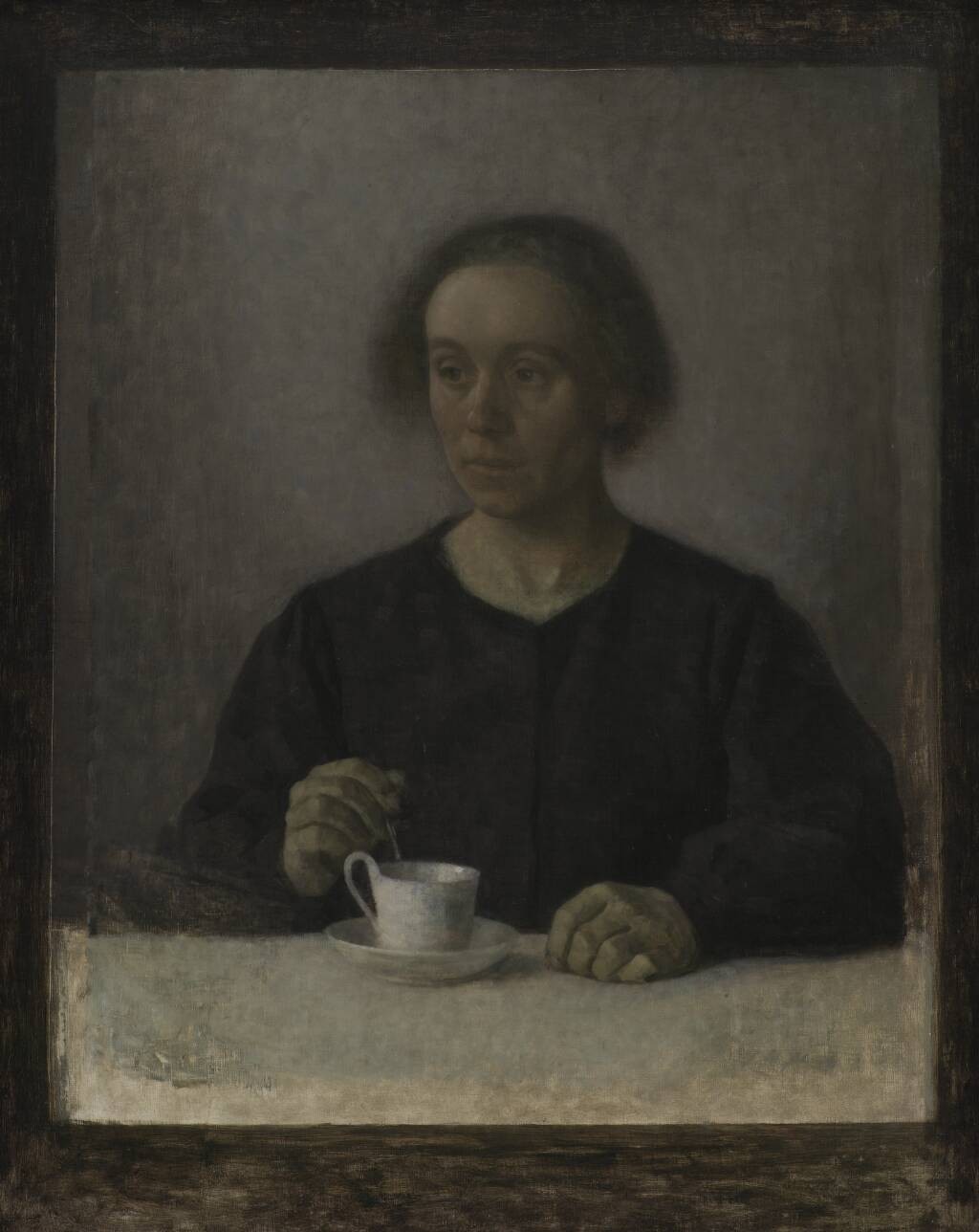
Ida Hammershøi appears across both kinds of painting. She was the artist’s wife, a frequent sitter and later a steward of his works and records; she should not be recast as his co-author. In the 1907 Ida Hammershøi, the Artist’s Wife, with a Teacup, the direct pose, tabletop and cup make a portrait out of closely balanced horizontals and verticals. ViHDA identifies this SMK canvas as the first version, distinct from a more finished picture at ARoS and a smaller study whose whereabouts are unknown.[10] The broader role of the sitter is explored in the guide to Ida Hammershøi.
Rooms and Interiors
Hammershøi’s interiors are not views of one unchanging home. He worked at several Copenhagen addresses, and the rooms at Strandgade 30, Strandgade 25 and Bredgade 25 must remain distinct. Within each home, however, he returned to particular doors, windows, wall panels, chairs, tables, stoves and framed pictures. The repeated architecture gave him a stable framework in which a shift of viewpoint or light could transform the entire image.
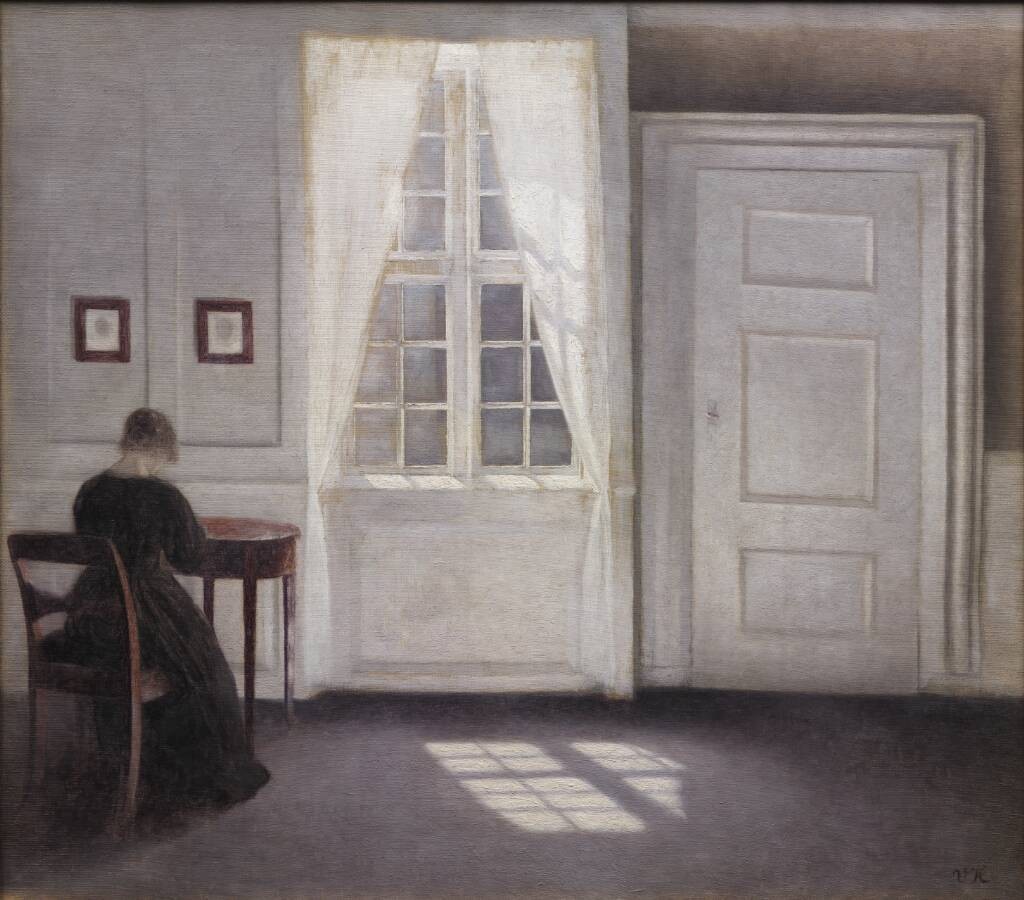
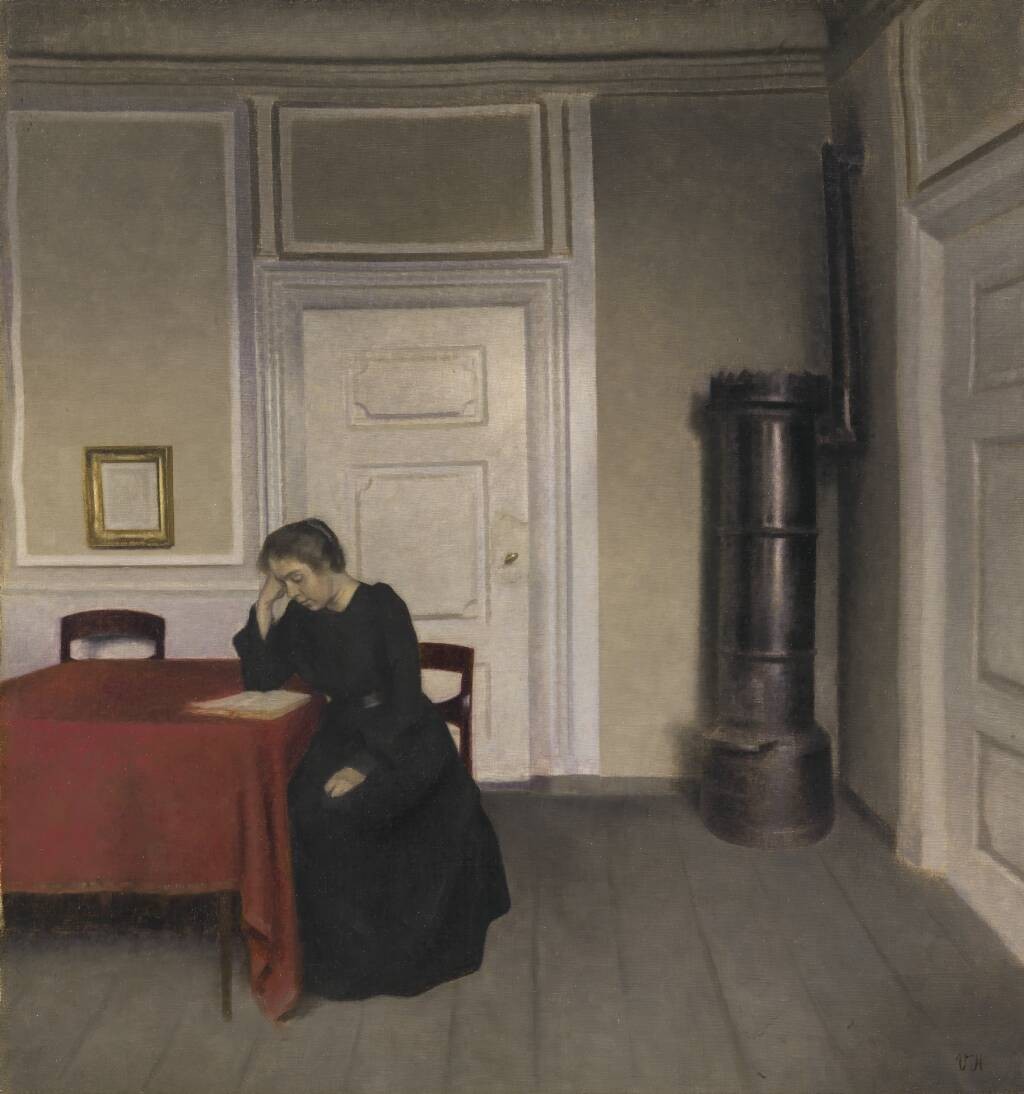
The 1901 Interior in Strandgade, Sunlight on the Floor makes daylight itself an organising shape. ViHDA’s examination of this exact SMK painting, KMS3696, records a thin paint structure, much of it worked wet-in-wet, over warm grey and greenish-brown preparatory tones. The reflection on the floor may have been moved slightly and reduced in height.[5] In the 1902 Strandgade room with Ida, KMS3697, the dark stove and red-covered table create a different set of weights within a related domestic vocabulary.[6]
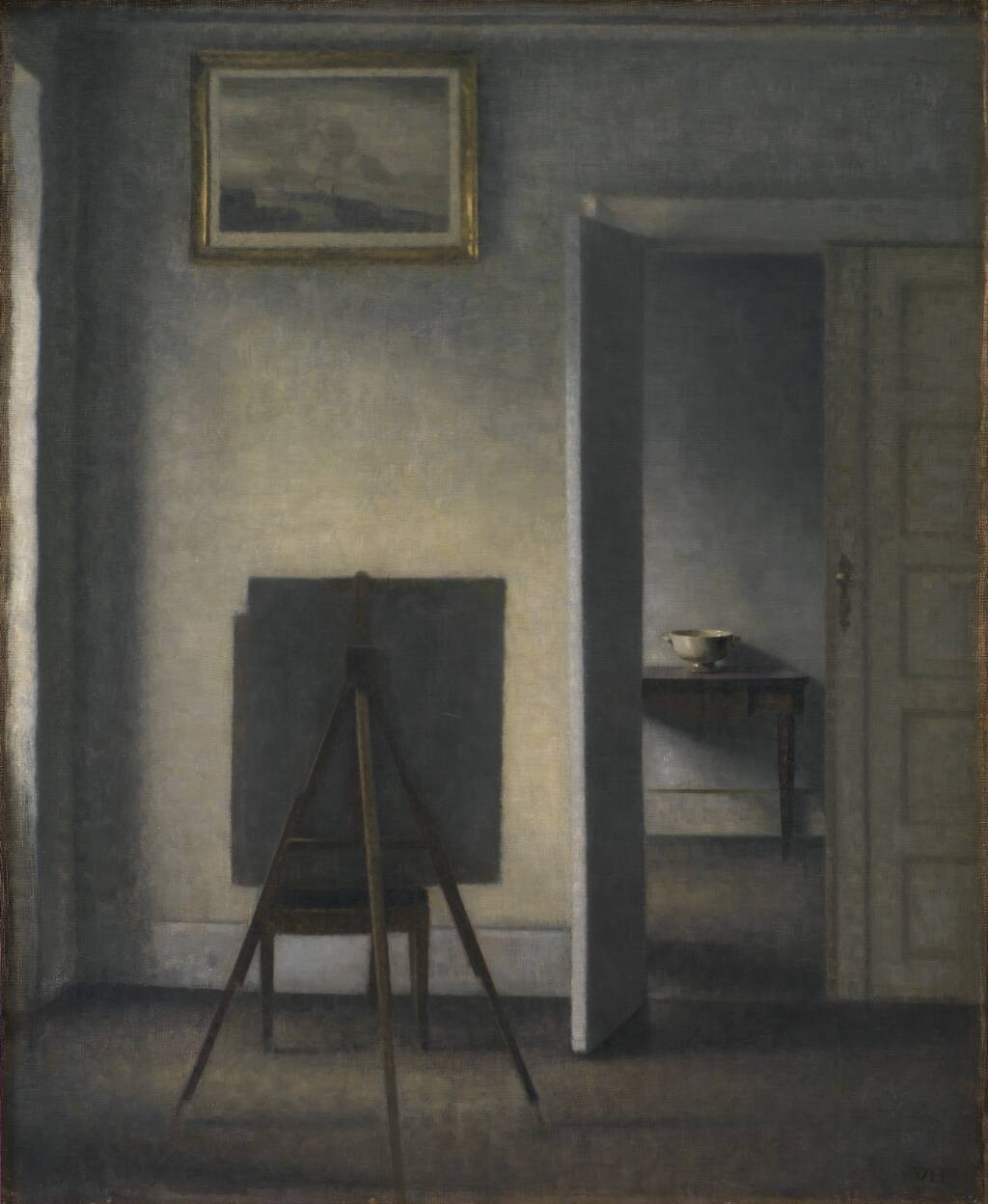
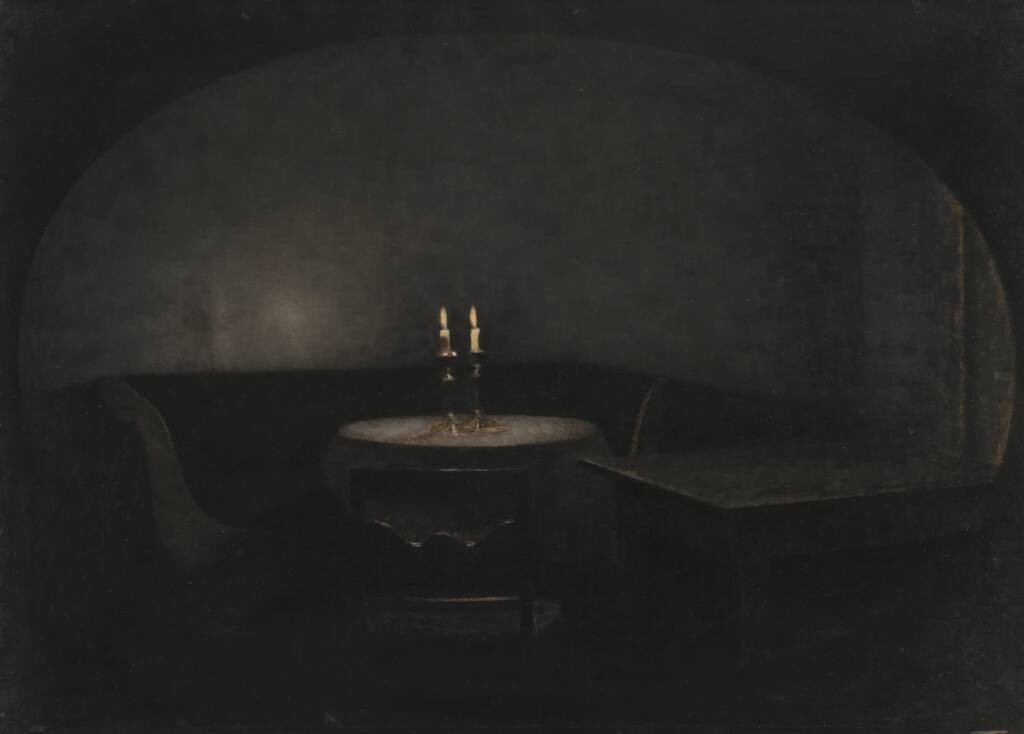
Later interiors change the terms again. Interior. Artificial Light of 1909 replaces daylight with two candles and spreads their limited illumination across furniture and wall. The 1910 Interior with the Artist’s Easel turns studio equipment into a protagonist without showing the painter. These are not interchangeable images of “quiet”. Each is a precisely dated object with its own room, light source, sequence of decisions and technical history. The Strandgade interiors guide follows those differences through the apartment itself.
Copenhagen Architecture
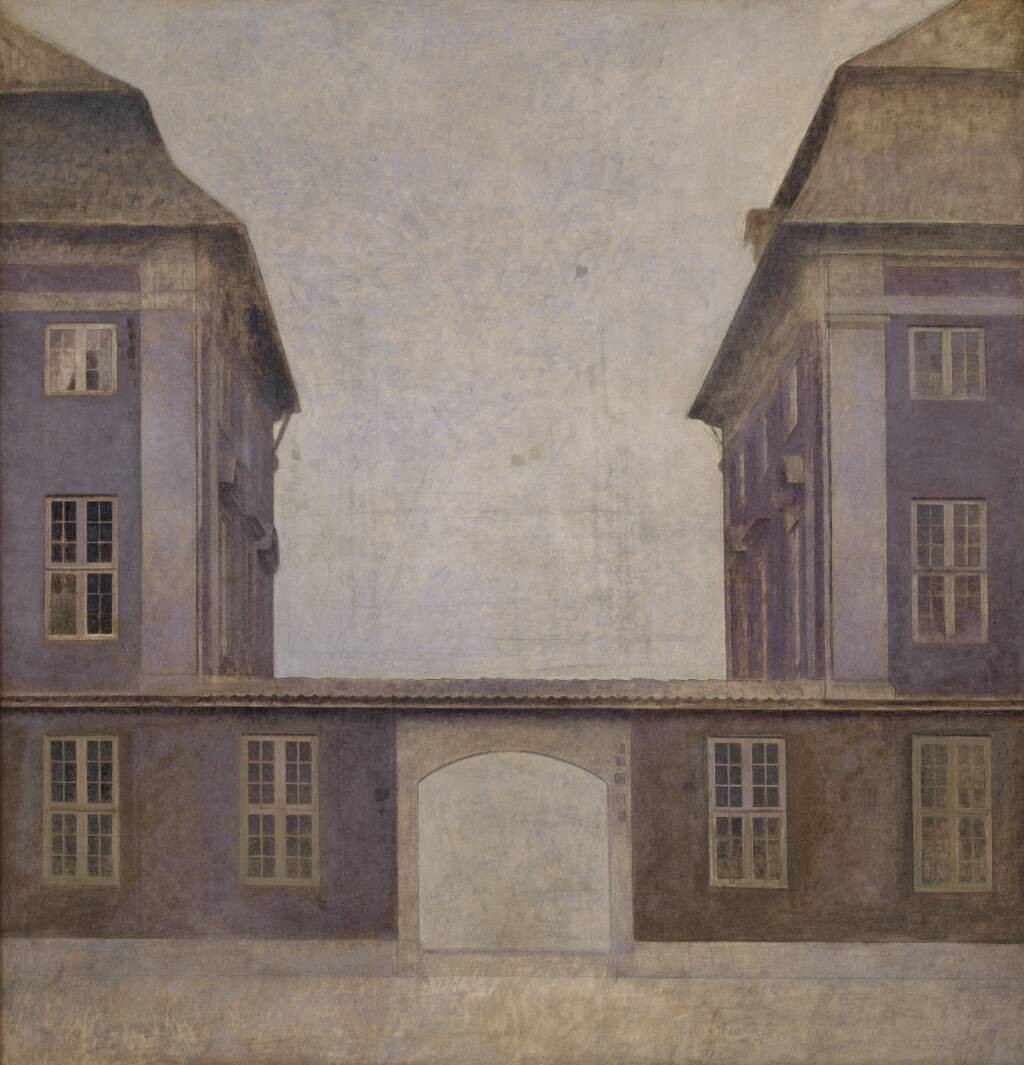
Hammershøi also looked outward to Copenhagen’s churches, palaces, canals and commercial buildings. Many of these paintings favour a frontal or carefully squared view, limited street incident and weather that softens contrasts. Architecture becomes a system of planes and openings, much as doors and panelling do inside. His visits abroad added subjects in London and Rome, yet Copenhagen remained central to this strand of the work.
The 1902 Buildings of the Asiatic Company, seen from St. Annæ Street, Copenhagen is especially instructive because its incompleteness is part of its identity. ViHDA describes KMS6657 as a preliminary work for another picture and finds masts and yards indicated in pencil between the buildings. Large areas remain at the underpainting stage; the canvas was abandoned when Hammershøi sought a composition with more foreground.[9] It must therefore not be treated as the finished version of the subject. The relationship between streets, harbour buildings and domestic viewpoints is developed in Hammershøi’s Copenhagen and architecture.
Landscapes and Marine Subjects
ViHDA’s 21 landscapes include lakes, woodland, farmland, avenues and seasonal views, while its four marine records turn to canals, docks and sailing boats.[4] Compared with the interiors, these works exchange the room’s fixed uprights for horizons, banks, rows of trees and broad fields of sky. Repetition still matters: the researched selection includes studies and larger treatments of related places, among them Gentofte Lake and the country around Gundsømagle.
These pictures caution against reducing Hammershøi to enclosed space or grey walls. A narrow tonal range could serve open air as effectively as a domestic room, while greens, browns and blues could be moderated without disappearing. Landscape also offered different kinds of interval: distance between trunks, movement along a road, or the empty breadth separating foreground from horizon. Marine paintings place spars, hulls and quays against water and air, bringing linear structure into a more exposed setting.
Serial Variation and Repeated Motifs
Repetition in Hammershøi’s art is best understood as a method of variation, not simple duplication. Returning to a room allowed him to change the angle of sight, open or close a door, introduce a figure, remove furniture or wait for another quality of light. The resulting paintings may share recognisable components while differing substantially in scale, emphasis and spatial rhythm. SMK’s account of three recently donated interiors similarly stresses how recurring Bredgade motifs form distinct variations rather than copies.[11]
Technical evidence makes the process visible within individual canvases. In Interior with the Artist’s Easel, imaging and close examination show that the open door and the table with a bowl were initially placed farther left; the easel may not have belonged to the first version of the composition.[7] The painting therefore contains variation within itself as well as belonging to a wider family of easel interiors. Related pictures held by the Getty and Lillehammer are separate works, not alternative titles for KMS7444.
The same care is needed with similar Strandgade titles. KMS3696 is the 1901 sunlight interior, whereas KMS3697 is the 1902 room with Ida and a red table covering. Their closeness in date and location does not collapse their identities. When measurements differ between museum and technical records, both should be retained: for example, SMK’s current object record gives KMS3697 as 63.5 by 60 centimetres, while ViHDA records 63.9 by 60 centimetres.[6] Such small discrepancies are documentary evidence, not a reason to merge objects.
Paint Layers, Revisions and Technical Research
Hammershøi’s finished surfaces can look inevitable, but the paintings preserve substantial evidence of construction and change. ViHDA’s programme combined visual examination with multiband imaging, X-radiography, canvas analysis and methods for identifying elements and ground layers.[1] SMK’s presentation of the findings emphasises that this research can reveal preparation, pigment choices and revisions that are invisible in ordinary viewing.[3] The evidence complicates any idea that restraint came from a single formula.
KMS3696 was built with relatively thin layers. Warm and greenish preparatory colours contribute beneath greys, whites and browns, while brush direction generally follows the room’s vertical and horizontal divisions.[5] In KMS8677, the paint progresses broadly from dark to light; the square table at the right foreground was introduced late enough to overlap the chair and central table.[8] Neither case supports a story of effortless minimalism. Both show sequences in which a limited arrangement was adjusted as painting continued.
The teacup portrait offers different revisions. ViHDA detects the shape of a sugar bowl beneath the tablecloth paint, a lowered neckline and a slight change to Ida’s hand. Her face was worked largely wet-in-wet, while later background paint sharpened the outline of her head and shoulders.[10] KMS6657 exposes another stage because it remains incomplete: lean underpainting, uncovered canvas texture and pencilled ship details record a composition before full resolution.[9]
These discoveries should be distinguished from interpretation. Imaging can demonstrate that an outline moved or an object lies below the visible surface; it cannot by itself prove a mood, private intention or psychological narrative. The guide to light, colour and technique examines how preparatory layers, pigments and brushwork created the paintings’ unusually calibrated tonal fields.
Six Paintings to Navigate the Practice
The selected works provide a compact route across subjects, dates and working decisions. Begin with KMS3696, the 1901 Strandgade sunlight interior, to see how a beam across the floor can organise an otherwise spare room.[5] Compare it with KMS3697 from 1902, where Ida and the saturated table covering alter the balance of the interior.[6] The pair demonstrates why a shared address does not imply a repeated composition.
Move next to KMS7444, painted in 1910, where easel, doorway and distant table connect making art with the domestic setting.[7] KMS8677, dated 1909, offers a near-contemporary contrast in which two candles establish the light and a late-added foreground table compresses the space.[8] Together they show that late interiors could diverge strongly in illumination and organisation.
KMS6657 extends the comparison outdoors. Its unfinished state reveals an architectural view still being negotiated, rather than a polished endpoint.[9] Finally, KMS3352 brings portrait, tabletop still life and revision into the same canvas. The six works are deliberately varied: four interiors, one architectural painting and one portrait. They do not claim to be a list of the artist’s “best” pictures, but they make his central procedures legible through exact, well-documented objects.
What the Researched Works Directory Counts
The researched works directory covers all 133 paintings currently published in ViHDA’s filtered 1878–1916 listing.[4] Its records can be searched by title, date and motif, with internal links attached to the six paintings discussed in depth here. It is complete within that named source snapshot, not a catalogue raisonné and not evidence that Hammershøi made only 133 paintings.
That distinction matters because ViHDA was created around works selected for systematic technical study. The project reports examining about 140 paintings across museum and private collections, while its public listing and this directory currently resolve to 133 unique records.[1] Future research, attribution changes or additions to the platform could alter the available count. ViHDA also distinguishes access to faithful artwork reproductions, released with the Public Domain Mark, from technical images and research data made available under separate reuse terms.[12]
Researched works directory
This directory covers the 133 paintings currently published by the Vilhelm Hammershøi Digital Archive (ViHDA). It is a researched platform census, not a complete catalogue raisonné of the artist's oeuvre.
| Name | Date | Medium |
|---|---|---|
| A Bakery Shop. Study | 1888 | Painting |
| A Greek Relief. Louvre | 1892 | Painting |
| Amalienborg Square | 1896 | Painting |
| An Ancient Relief. Study | 1878 – 1881 | Painting |
| An Old Woman | 1886 | Painting |
| An Old Woman Standing by a Window | 1885 – 1886 | Painting |
| Artemis | 1893 – 1894 | Painting |
| Bedroom | 1890 | Painting |
| Church of Christiansborg Palace, Copenhagen | 1910 | Painting |
| Church of Sankt Petri, Copenhagen | 1906 | Painting |
| Double Portrait. Vilhelm and Ida Hammershøi | 1892 | Painting |
| Evening in the Drawing Room. Strandgade 30 | 1904 | Painting |
| Evening in the Sitting Room. | 1904 | Painting |
| Evening Interior. Artificial Light. Ida and Frederikke Hammershøi | 1891 | Painting |
| Farm. Refsnæs | 1900 | Painting |
| Five Portraits. Study | 1901 | Painting |
| Frederiksborg Castle | 1893 | Painting |
| From Christianshavns Canal | 1905 | Painting |
| From Frederiksholms Kanal | 1893 | Painting |
| From Kvæsthusbroen | 1908 | Painting |
| From the British Museum. London, Winter | 1906 | Painting |
| From the Church Santo Stefano Rotondo in Rome | 1902 – 1903 | Painting |
| From The Greenlandic Trade Dock. Christianshavn | 1908 | Painting |
| From the Old Christiansborg Palace | 1907 | Painting |
| Hammershøi's palette | Uncertain/Unknown | Painting |
| Head of a Woman. Study for Artemis | 1893 | Painting |
| Houses. Arresødal near Frederiksværk | 1904 | Painting |
| Interior | 1898 | Painting |
| Interior in Louis Seize style. Rahbeks Allé | 1897 | Painting |
| Interior. 'The Four Rooms'. Strandgade 25 | 1914 | Painting |
| Interior. A Young Man Reading | 1898 | Painting |
| Interior. Artificial Light | 1909 | Painting |
| Interior. Attic Room with Table and Chair | 1883 – 1885 | Painting |
| Interior. Frederikke and Anna Hammershøi | 1884 | Painting |
| Interior. From The Great Hall of Lindegården | 1909 | Painting |
| Interior. Ida Hammershøi at a Sewing Table | Uncertain/Unknown | Painting |
| Interior. Living Room in Louis-Seize-Style. Rahbeks Allé 26 | 1893 – 1896 | Painting |
| Interior. Looking out on the Exterior. Strandgade 30 | 1905 | Painting |
| Interior. Strandgade 30 | 1901 | Painting |
| Interior. Strandgade 30 | 1902 | Painting |
| Interior. Strandgade 30 | 1905 | Painting |
| Interior. Study in Sunlight. Strandgade 30 | 1906 | Painting |
| Interior. Sunshine in the Drawing Room III | 1903 | Painting |
| Interior. The Music Room. Strandgade 30 | 1908 | Painting |
| Interior. The Old Stove. Albertinelyst | 1888 | Painting |
| Interior. The Tall Windows | 1913 | Painting |
| Interior. With Empire Sofa. Strandgade 30 | 1907 | Painting |
| Interior. With Four Etchings. Strandgade 30 | 1904 | Painting |
| Interior. With Table, Cupboard and Windsor Chair. Strandgade 25 | 1913 | Painting |
| Interior. With the Artist's Easel | 1910 | Painting |
| Interior. With the Artist's Easel. Bredgade 25 | 1912 | Painting |
| Interior. Woman knitting | 1889 | Painting |
| Interior. Woman Reading | 1910 | Painting |
| Interior. Woman Reading. Bredgade 25 | Uncertain/Unknown | Painting |
| Interior. Woman Sitting Behind a Table | 1910 | Painting |
| Interior. Woman Sweeping | 1899 | Painting |
| Job | 1887 | Painting |
| Job. Study | 1887 | Painting |
| Landscape. At Lyngby Lake | 1888 | Painting |
| Landscape. Early Spring | 1909 | Painting |
| Landscape. Gentofte | 1906 | Painting |
| Landscape. Grønsund, Falster | 1890 | Painting |
| Landscape. Gundsømagle near Roskilde | 1885 | Painting |
| Landscape. Gundsømagle near Roskilde | 1886 | Painting |
| Landscape. Kongevejen near Gentofte. Study | 1892 | Painting |
| Landscape. Near Fortunen | 1901 | Painting |
| Landscape. Near Lejre | 1905 | Painting |
| Landscape. Ryet near Farum Lake | 1896 – 1897 | Painting |
| Landscape. Summer. Near Lejre | 1905 | Painting |
| Landscape. Søndermarken Park in Winter | 1895 – 1896 | Painting |
| Landscape. The Rowan Avenue at Snekkersten | 1906 | Painting |
| Landscape. With a Farmhouse | 1878 – 1879 | Painting |
| Landscape. Young Forest, Trørød, Summer | 1907 | Painting |
| Morning Toilette. Study. Strandgade 25 | 1914 | Painting |
| Nude Female Model | 1884 | Painting |
| Nude Female Model | 1910 | Painting |
| Open Doors. Strandgade 30 | 1905 | Painting |
| Portrait of a Young Girl. Anna Hammershøi | 1885 | Painting |
| Portrait. Anna Hammershøi | 1883 | Painting |
| Portrait. Anna Hammershøi. Profile | Uncertain/Unknown | Painting |
| Portrait. Daniel Jacobson Salter | 1901 | Painting |
| Portrait. Elisabeth Dorothea Rentzmann | Uncertain/Unknown | Painting |
| Portrait. Elisabeth Wandel | 1890 | Painting |
| Portrait. Fini Henriques | Uncertain/Unknown | Painting |
| Portrait. Frederikke Hammershøi | Uncertain/Unknown | Painting |
| Portrait. Frederikke Hammershøi. Study | 1894 | Painting |
| Portrait. Henry Madsen. Study | 1904 | Painting |
| Portrait. Henry Madsen. Study | 1904 | Painting |
| Portrait. Ida Hammershøi | 1894 | Painting |
| Portrait. Ida Hammershøi with a Teacup | 1907 | Painting |
| Portrait. Ida Ilsted | 1890 | Painting |
| Portrait. Ida Ilsted. Study | 1890 | Painting |
| Portrait. Ida Ilsted. Study | 1890 | Painting |
| Portrait. J.F. Willumsen. Study for Five Portraits | 1901 | Painting |
| Portrait. J.F. Willumsen. Study for Five Portraits | 1901 – 1902 | Painting |
| Portrait. Karen Malm | 1914 | Painting |
| Portrait. Karl Madsen | 1890 | Painting |
| Portrait. Kristian Zahrtmann | 1889 | Painting |
| Portrait. Kristian Zahrtmann | 1889 | Painting |
| Portrait. Svend Hammershøi | 1881 | Painting |
| Portrait. Svend Hammershøi | 1892 | Painting |
| Portrait. Svend Hammershøi | 1903 – 1904 | Painting |
| Portrait. Svend Hammershøi. Study for Five Portraits | 1901 | Painting |
| Portrait. Thora Bendix, née Anne Victoria Sundberg | 1896 | Painting |
| Portrait. Thora Bendix. Study | 1896 | Painting |
| Portrait. Thorvald Bindesbøll. Study | 1904 | Painting |
| Portrait. Woman. Possibly Frederikke Juncker-Jensen | 1878 – 1881 | Painting |
| Portrait. Woman. Profile | 1888 | Painting |
| Seated Female Nude | 1889 | Painting |
| Self- Portrait | 1891 | Painting |
| Self-Portrait | 1890 | Painting |
| Self-Portrait | 1914 | Painting |
| Self-Portrait. Spurveskjul, Frederiksdal | 1911 | Painting |
| Self-Portrait. Spurveskjul, Frederiksdal | 1911 | Painting |
| Standing Female Model | 1909 – 1910 | Painting |
| Street in London. Montague Street at the British Museum | 1905 – 1906 | Painting |
| Study of a Model. A Woman seen from the Back | 1888 | Painting |
| Sunbeams or Sunshine. "Dust motes dancing in the sunbeams" | 1900 | Painting |
| The Buildings of the Asiatic Company, seen from St. Annæ Street | 1902 | Painting |
| The Cello Player. Henry Bramsen | 1893 | Painting |
| The Coin Collector. Strandgade 30 | 1904 | Painting |
| The Garden Room. Frederiksberg Allé | 1887 | Painting |
| The Tuesday Forest | 1893 | Painting |
| Three Sailing Boats. Christianshavns Canal | 1905 | Painting |
| Tree Trunks. Arresødal near Frederiksværk | 1904 | Painting |
| View of Christiansborg Palace. Late Autumn | 1890 – 1892 | Painting |
| View of Gentofte Lake . 'Sunshower' | 1903 | Painting |
| View of Gentofte Lake . 'Sunshower'. Study | 1903 | Painting |
| View of Jægersborg Allé. Study | 1892 | Painting |
| White Doors. Strandgade 30 | 1899 | Painting |
| Woman Knitting. Frederikke Hammershøi | 1889 | Painting |
| Young Beechwood. Arresødal near Frederiksværk | 1904 | Painting |
| Young Girl Sewing. Anna Hammershøi | 1887 | Painting |
Frequently Asked Questions
He made portraits, figure studies, interiors, architectural views, landscapes and marine subjects. The current ViHDA selection records all six groups, with 38 portraits and 35 interiors as its two largest motif categories.[4] Those totals describe the researched platform rather than the proportions of every work Hammershøi ever made.
Repeated rooms provided a stable set of doors, windows, furniture and wall divisions that could be transformed through viewpoint, light, figures and omission. Technical study shows that he also revised arrangements while painting, as in KMS7444, where the doorway and table moved and the easel may have entered after the first version.[7]
No. Grey is prominent, but technical descriptions record whites, blacks, browns, blues, reds, yellows, greens and mixtures that shift between warm and cool. In KMS3696, purplish and greenish greys interact with warmer shadows and brown-black forms.[5] Restraint came from relationships among colours, not from removing colour altogether.
No. They are the 133 unique paintings in ViHDA’s current public works listing.[4] The archive arose from a defined technical-research project, and its own account says that about 140 paintings were examined.[1] The directory is therefore comprehensive for its stated platform snapshot but makes no complete-oeuvre claim.
Infrared and X-ray methods can disclose drawing, earlier positions and concealed forms beneath the visible paint.[1] In Hammershøi’s works, that evidence shows decisions such as moving architectural elements, adding furniture late or painting over a sugar bowl.[7][8][10] It explains how the composition developed, while leaving questions of mood and meaning open to interpretation.
Discussion
Use this evidence-led guide as a starting point for close looking rather than a final verdict.
Share an observation about Vilhelm Hammershøi Paintings or a source that adds useful context.
Reader Insights
Which portrait, interior or architectural painting best complicates a familiar account of Hammershøi?
Where do serial repetition and visible revision work together rather than as opposites?
Which ViHDA record would you compare next, and why?
Join the Conversation
Add your reading below, keeping observations specific and evidence clear.
References
- About the Vilhelm Hammershøi Digital Archive, SMK – National Gallery of Denmark, accessed 31 August 2026.
- ViHDA, SMK – National Gallery of Denmark, accessed 31 August 2026.
- Groundbreaking New Research Sheds Light on Vilhelm Hammershøi’s Materials and Working Methods, SMK – National Gallery of Denmark, accessed 31 August 2026.
- ViHDA Current Works Listing, 1878–1916, SMK – National Gallery of Denmark, accessed 31 August 2026.
- Interior. Strandgade 30, 1901, SMK – National Gallery of Denmark, accessed 31 August 2026.
- Interior. Strandgade 30, 1902, SMK – National Gallery of Denmark, accessed 31 August 2026.
- Interior. With the Artist’s Easel, SMK – National Gallery of Denmark, accessed 31 August 2026.
- Interior. Artificial Light, SMK – National Gallery of Denmark, accessed 31 August 2026.
- The Buildings of the Asiatic Company, Seen from St. Annæ Street, SMK – National Gallery of Denmark, accessed 31 August 2026.
- Portrait. Ida Hammershøi with a Teacup, SMK – National Gallery of Denmark, accessed 31 August 2026.
- SMK Receives Three Paintings by Vilhelm Hammershøi, SMK – National Gallery of Denmark, accessed 31 August 2026.
- Use This Data, SMK – National Gallery of Denmark, accessed 31 August 2026.