 by Tom Gurney
Tom Gurney BSc (Hons) is an art history expert with over 20 years experience
Page Created: / Page Updated:
Email: tomgurney1@gmail.com / Phone: +44 7429 011000
Ida Hammershøi with a Teacup: Introduction
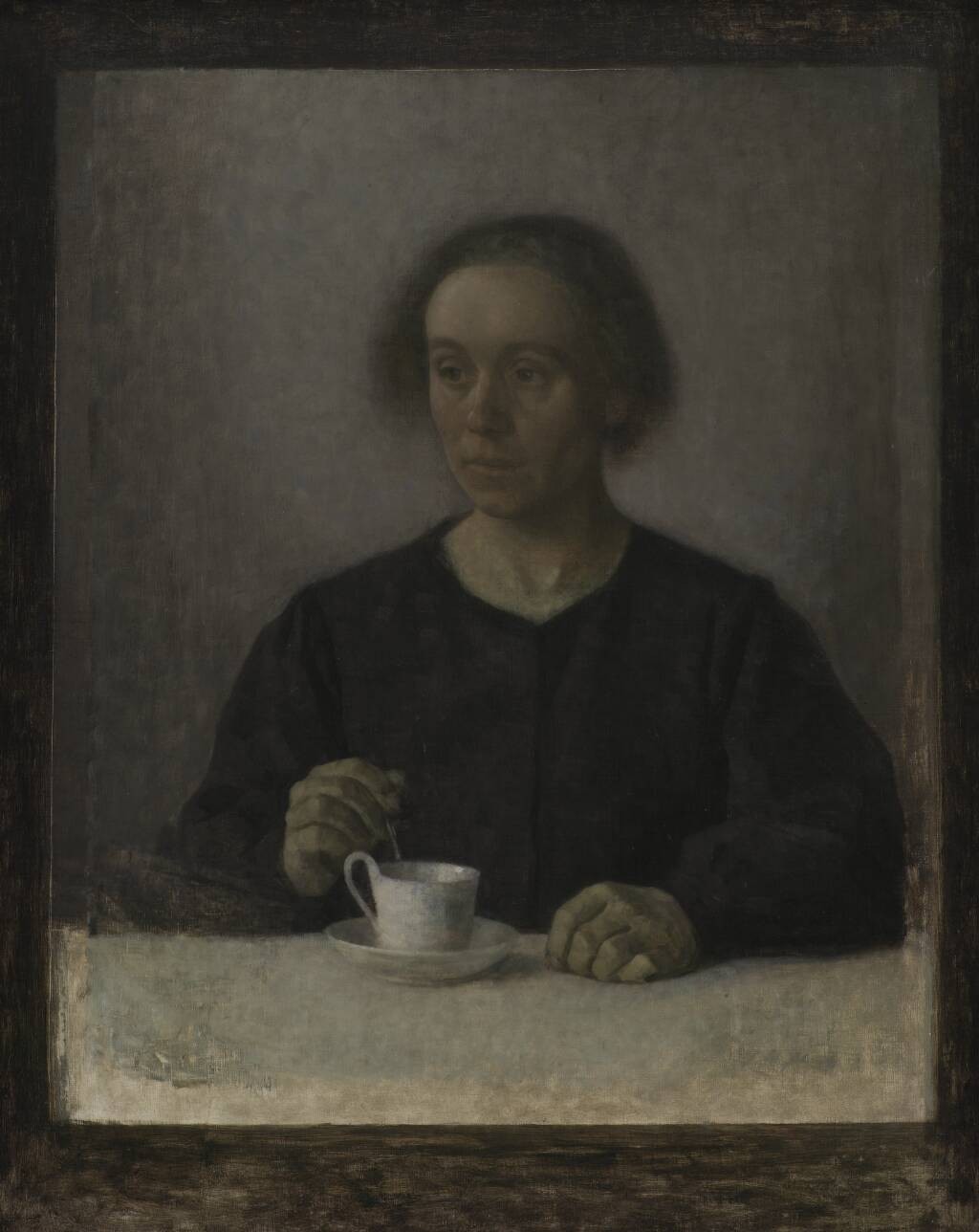
Vilhelm Hammershøi’s Ida Hammershøi, the Artist’s Wife, with a Teacup brings a domestic action close to the picture plane. Ida sits behind a pale-covered table, almost square to the viewer but looking aside. One hand rests on the cloth; the other is raised beside a white cup and saucer. Her dark dress joins the shadowed lower half of the portrait, while face, hands and crockery emerge as measured areas of light.
Painted in 1907, the work is held by SMK – National Gallery of Denmark as KMS3352. It is an oil painting on canvas measuring 91 × 73.5 centimetres.[1] The Vilhelm Hammershøi Digital Archive (ViHDA) identifies it as survey 297 in the Bramsen sequence and preserves unusually detailed evidence about its materials, altered details and relationship to two other teacup portraits.[2]
That precise identity is essential. KMS3352 is the first full-sized version, not the more finished 1907 portrait now at ARoS and not a smaller study whose present location is unknown.[2] Its seemingly settled arrangement is also less final than it appears: technical examination reveals that Hammershøi reconsidered the still-life objects, Ida’s neckline and the position of her hand while developing the image.
At a Glance
- ArtistVilhelm Hammershøi (1864–1916)
- Date and medium1907, oil on canvas[1]
- CollectionSMK – National Gallery of Denmark, KMS3352[1]
- Dimensions91 × 73.5 cm[1][2]
- Research identityViHDA survey 297, corresponding to Bramsen 297[2]
- Versionthe first full-sized teacup portrait, distinct from Bramsen 298 at ARoS and a missing smaller study[2]
Vilhelm Hammershøi in context
Contents
- Introduction
- The Exact First Version
- What the Portrait Shows
- Cup, Hand and Withheld Narrative
- A Painted Border and a Compressed Setting
- From Wet Paint to Hidden Corrections
- Ida, the Letters and Cautious Context
- Donation to SMK and the Separate Versions
The Exact First Version
SMK’s current English title, Ida Hammershøi, the Artist’s Wife, with a Teacup, and ViHDA’s Portrait. Ida Hammershøi with a Teacup name the same object. The inventory number KMS3352, date, measurements and Bramsen number remove the ambiguity that a shortened title can create. Hammershøi repeatedly returned to familiar people, rooms and arrangements; resemblance alone is not enough to establish that two records describe one canvas.
ViHDA reports that KMS3352 was the first version of another portrait painted in 1907. The second, associated with Bramsen 298, measures 79 × 63.5 centimetres, is described as more highly finished and belongs to ARoS in Aarhus. Bramsen and the later scholarship cited by ViHDA also mention a much smaller study measuring 36.5 × 29 centimetres, but its whereabouts are unknown.[2] Those measurements, locations and catalogue numbers should travel with any comparison.
The distinction affects interpretation as well as cataloguing. Features visible in the ARoS painting cannot be used to complete uncertain passages in KMS3352, and the missing study cannot be assumed to preserve an earlier state simply because it is smaller. The SMK canvas has its own physical history. Its broad painted border, thin foreground and underlying corrections are evidence within this particular work.
What the Portrait Shows
Ida fills most of the upright format. Her head rises into a shallow field of grey, and her shoulders spread across the width below. The neutral background supplies no identifiable furnishings or architectural detail. Unlike the adjoining rooms explored in the Strandgade interiors, this setting is compressed to figure, table and a few objects. It remains domestic, but it does not describe a complete household space.
The head is nearly frontal, though Ida’s gaze moves away from direct contact with the viewer. Her expression is not a reliable record of a feeling. Hammershøi gives close access to the disposition of her features while withholding any event beyond the small action at the table. The resulting reserve is constructed by pose and composition; it should not be converted into a factual claim that Ida was sad, lonely or psychologically absent.
Her dark clothing forms the largest continuous mass. Against it, the face and exposed neck create a muted interval rather than a brilliant highlight. The two hands then lead the eye downwards. One lies firmly on the tabletop, fingers curled and separated by narrow shadows. The other hovers over the cup, connecting sitter and still life without the broad gesture of a narrative painting.
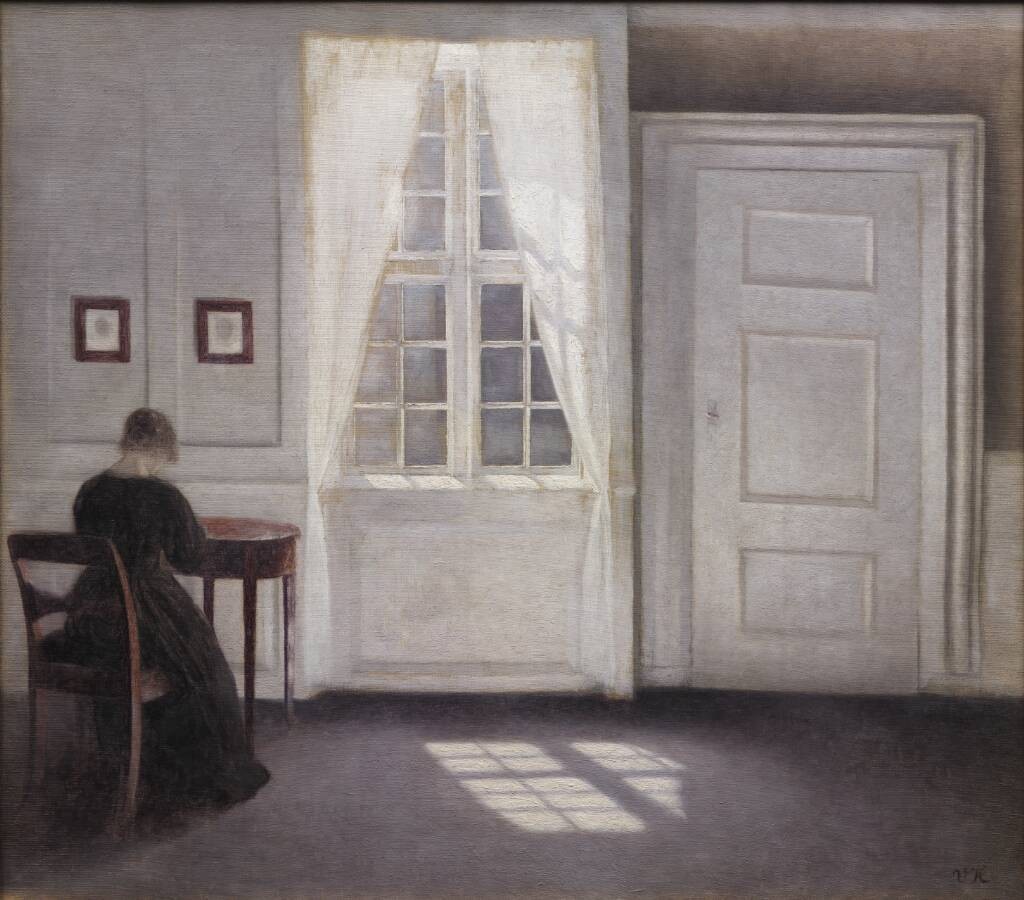
This direct presentation differs from Ida’s back-turned appearances in Interior in Strandgade, Sunlight on the Floor and A Room in the Artist’s Home in Strandgade. Those paintings place her within sequences of doors, walls and furniture. KMS3352 instead brings her body close and gives the table edge almost the force of a second frame.
Cup, Hand and Withheld Narrative
The cup is a modest object but a decisive point of contrast. Its pale body and handle are set against the dress, and its saucer makes a low oval on the cloth. Small highlights are concentrated here; ViHDA finds almost no impasto elsewhere, apart from the brightest touches on the cup.[2] The crockery therefore registers as a firmer, sharper interruption within the soft tonal field.
Bramsen’s 1918 description, reproduced by ViHDA, says that Ida sits at a white-covered table and stirs a cup of tea.[2] The visible raised hand supports that straightforward identification. It does not, however, establish what moment the action represents. Tea might suggest routine, hospitality, nourishment or a pause, but the picture supplies no visitor, clock or episode that would decide among them.
The resting hand prevents the action from becoming brisk. Its weight anchors the figure to the horizontal table, while the other hand is held in a smaller, less stable position beside the cup. The contrast creates a quiet tension between rest and movement. That is a formal observation, not evidence that the sitter was reluctant, fatigued or lost in thought.
Hammershøi’s wider paintings often make ordinary objects carry compositional work without turning them into coded symbols. In KMS3352 the cup gives scale, separates the hands and marks the pale foreground. Its usefulness to the design is demonstrable; a private meaning attached to it is not.
A Painted Border and a Compressed Setting
The dark surround is part of Hammershøi’s painted image rather than merely the later decorative frame attached to the object. ViHDA notes that he painted this border around Ida and later used a comparable device on a self-portrait.[2] The band narrows the visible field so that the portrait appears contained within its own dark threshold.
This inner framing changes the balance of the composition. At the sides it presses close to Ida’s arms; above, it leaves a wider grey interval around her head; below, it meets the pale tablecloth across a strong horizontal. The effect is not identical to looking through a doorway. A doorway implies continuation into another room, whereas the border stops the scene and emphasises its status as a made image.
The paint itself complicates the apparent solidity of that device. ViHDA records very thin, locally transparent paint in both the foreground and the dark border. The white industrial ground remains perceptible through the tablecloth and in many border passages. Fine highlights along the left and top edges were scratched through the dark paint to expose the pale layer beneath.[2] Light at the boundary was therefore produced partly by removing or incising paint, not only by laying a lighter colour on top.
Pinholes at the four corners may have been caused by paper strips used to mask the composition, although the archive presents this as a possibility rather than a certainty.[2] Together with the painted band, they suggest practical attention to the limit of the image. The border is both a visual enclosure and a materially worked zone.
From Wet Paint to Hidden Corrections
KMS3352 was painted on an industrial canvas with a relatively coarse plain weave and a thin white ground. ViHDA identifies a transparent light-brown underpaint beneath the tablecloth and local black underpaint within the figure. The visible face and clothing were modelled largely wet-in-wet, with smooth strokes moving from dark towards light. Hair paint is thin and somewhat transparent, while the dark-grey dress varies in opacity.[2]
The sequence was not uniform across the picture. The figure, including head and hair, was established before the final background layer. Hammershøi then brought denser background paint up to the head and shoulders, overlapping slightly to clarify their outline. At the base of the neck, paint defining the neckline overlaps the dress.[2] Figure and setting were consequently adjusted in relation to one another rather than filled into permanently fixed boundaries.
Three corrections are especially informative. A sugar bowl remains discernible beneath the pale-grey tablecloth paint on the left. The V-shaped neckline was lowered to reveal more of Ida’s neck. The hand resting on the table also appears to have been shifted slightly upwards.[2] Each change modifies a different category of element: still life, costume and anatomy.
The concealed bowl shows that subtraction could be achieved by painting over an object rather than physically removing it from the room. Altering the neckline changed the transition between skin and dress, and raising the hand recalibrated its relation to the table edge. These are concrete decisions about visibility and placement. They do not expose a secret story, but they demonstrate that the economy of the finished scene was produced through revision.
For a broader explanation of wet-in-wet handling, underpaint and imaging evidence, see Hammershøi’s light, colour and technique. Technical study makes the portrait more specific without making every intention recoverable. It can show what changed, while the reason for a particular change may remain uncertain.
Ida, the Letters and Cautious Context
Ida Ilsted Hammershøi was Vilhelm’s wife and his most frequent sitter. They married in 1891 and lived at a succession of Copenhagen addresses; portraits and interiors register her presence across much of his mature career.[3] Their early double portrait, painted in Paris during the winter following their wedding, confirms that the couple’s paired representation began long before the 1907 teacup canvas.[4] The Ida Hammershøi guide follows that history without recasting her as the co-author of Vilhelm’s paintings.
ViHDA’s contextual comment relates KMS3352 to letters saying that Ida spent an extended period in hospital in 1906. On that basis, the archive suggests that she appears to be convalescing in the portrait.[2] This is an attributed art-historical reading, not a diagnosis. The cited correspondence documents hospital care, but the object page does not establish a particular condition, and painted appearance cannot independently provide one.
The distinction matters because pose, complexion and a cup of tea can easily be made to carry more medical meaning than the evidence allows. It is reasonable to note that the portrait was produced after the period described in the letters and that a museum research record connects the two. It is not reasonable to label a disease, treat the cup as a prescribed remedy or assume that every formal restraint records physical weakness.
The wider biography of Vilhelm Hammershøi provides chronology, but the painting retains its own limits. Ida is a named person with a documented history, not an anonymous emblem. At the same time, naming her does not grant access to her thoughts during the sitting. Responsible looking holds both facts together.
Donation to SMK and the Separate Versions
ViHDA records that Ida donated KMS3352 to SMK in 1916.[2] That transfer gives her an active place in the object’s history after it was painted. It also establishes why the first version, rather than the ARoS canvas, belongs to Denmark’s national gallery. The museum’s present record fixes the work there under KMS3352.[1]
Donation should not be confused with authorship. Ida was the sitter, the artist’s wife and, through actions such as this gift, a steward of works associated with Vilhelm’s legacy. The painted corrections remain evidence of his working process unless documentary evidence indicates otherwise. Nothing in the technical record shows that she directed the removal of the sugar bowl, the lowered neckline or the altered hand.
The three-version distinction brings the page back to the object in front of us. KMS3352 is the large first portrait with a dark painted surround, a reduced still life and visible underlying changes. Bramsen 298 at ARoS is a separate, more finished work. The small 1907 study is known through catalogue references but has not been located.[2] Keeping them apart allows this portrait’s particular balance—direct presence, ordinary action and carefully revised restraint—to be seen without borrowing certainty from its relatives.
Researched works directory
This directory covers the 133 paintings currently published by the Vilhelm Hammershøi Digital Archive (ViHDA). It is a researched platform census, not a complete catalogue raisonné of the artist's oeuvre.
| Name | Date | Medium |
|---|---|---|
| A Bakery Shop. Study | 1888 | Painting |
| A Greek Relief. Louvre | 1892 | Painting |
| Amalienborg Square | 1896 | Painting |
| An Ancient Relief. Study | 1878 – 1881 | Painting |
| An Old Woman | 1886 | Painting |
| An Old Woman Standing by a Window | 1885 – 1886 | Painting |
| Artemis | 1893 – 1894 | Painting |
| Bedroom | 1890 | Painting |
| Church of Christiansborg Palace, Copenhagen | 1910 | Painting |
| Church of Sankt Petri, Copenhagen | 1906 | Painting |
| Double Portrait. Vilhelm and Ida Hammershøi | 1892 | Painting |
| Evening in the Drawing Room. Strandgade 30 | 1904 | Painting |
| Evening in the Sitting Room. | 1904 | Painting |
| Evening Interior. Artificial Light. Ida and Frederikke Hammershøi | 1891 | Painting |
| Farm. Refsnæs | 1900 | Painting |
| Five Portraits. Study | 1901 | Painting |
| Frederiksborg Castle | 1893 | Painting |
| From Christianshavns Canal | 1905 | Painting |
| From Frederiksholms Kanal | 1893 | Painting |
| From Kvæsthusbroen | 1908 | Painting |
| From the British Museum. London, Winter | 1906 | Painting |
| From the Church Santo Stefano Rotondo in Rome | 1902 – 1903 | Painting |
| From The Greenlandic Trade Dock. Christianshavn | 1908 | Painting |
| From the Old Christiansborg Palace | 1907 | Painting |
| Hammershøi's palette | Uncertain/Unknown | Painting |
| Head of a Woman. Study for Artemis | 1893 | Painting |
| Houses. Arresødal near Frederiksværk | 1904 | Painting |
| Interior | 1898 | Painting |
| Interior in Louis Seize style. Rahbeks Allé | 1897 | Painting |
| Interior. 'The Four Rooms'. Strandgade 25 | 1914 | Painting |
| Interior. A Young Man Reading | 1898 | Painting |
| Interior. Artificial Light | 1909 | Painting |
| Interior. Attic Room with Table and Chair | 1883 – 1885 | Painting |
| Interior. Frederikke and Anna Hammershøi | 1884 | Painting |
| Interior. From The Great Hall of Lindegården | 1909 | Painting |
| Interior. Ida Hammershøi at a Sewing Table | Uncertain/Unknown | Painting |
| Interior. Living Room in Louis-Seize-Style. Rahbeks Allé 26 | 1893 – 1896 | Painting |
| Interior. Looking out on the Exterior. Strandgade 30 | 1905 | Painting |
| Interior. Strandgade 30 | 1901 | Painting |
| Interior. Strandgade 30 | 1902 | Painting |
| Interior. Strandgade 30 | 1905 | Painting |
| Interior. Study in Sunlight. Strandgade 30 | 1906 | Painting |
| Interior. Sunshine in the Drawing Room III | 1903 | Painting |
| Interior. The Music Room. Strandgade 30 | 1908 | Painting |
| Interior. The Old Stove. Albertinelyst | 1888 | Painting |
| Interior. The Tall Windows | 1913 | Painting |
| Interior. With Empire Sofa. Strandgade 30 | 1907 | Painting |
| Interior. With Four Etchings. Strandgade 30 | 1904 | Painting |
| Interior. With Table, Cupboard and Windsor Chair. Strandgade 25 | 1913 | Painting |
| Interior. With the Artist's Easel | 1910 | Painting |
| Interior. With the Artist's Easel. Bredgade 25 | 1912 | Painting |
| Interior. Woman knitting | 1889 | Painting |
| Interior. Woman Reading | 1910 | Painting |
| Interior. Woman Reading. Bredgade 25 | Uncertain/Unknown | Painting |
| Interior. Woman Sitting Behind a Table | 1910 | Painting |
| Interior. Woman Sweeping | 1899 | Painting |
| Job | 1887 | Painting |
| Job. Study | 1887 | Painting |
| Landscape. At Lyngby Lake | 1888 | Painting |
| Landscape. Early Spring | 1909 | Painting |
| Landscape. Gentofte | 1906 | Painting |
| Landscape. Grønsund, Falster | 1890 | Painting |
| Landscape. Gundsømagle near Roskilde | 1885 | Painting |
| Landscape. Gundsømagle near Roskilde | 1886 | Painting |
| Landscape. Kongevejen near Gentofte. Study | 1892 | Painting |
| Landscape. Near Fortunen | 1901 | Painting |
| Landscape. Near Lejre | 1905 | Painting |
| Landscape. Ryet near Farum Lake | 1896 – 1897 | Painting |
| Landscape. Summer. Near Lejre | 1905 | Painting |
| Landscape. Søndermarken Park in Winter | 1895 – 1896 | Painting |
| Landscape. The Rowan Avenue at Snekkersten | 1906 | Painting |
| Landscape. With a Farmhouse | 1878 – 1879 | Painting |
| Landscape. Young Forest, Trørød, Summer | 1907 | Painting |
| Morning Toilette. Study. Strandgade 25 | 1914 | Painting |
| Nude Female Model | 1884 | Painting |
| Nude Female Model | 1910 | Painting |
| Open Doors. Strandgade 30 | 1905 | Painting |
| Portrait of a Young Girl. Anna Hammershøi | 1885 | Painting |
| Portrait. Anna Hammershøi | 1883 | Painting |
| Portrait. Anna Hammershøi. Profile | Uncertain/Unknown | Painting |
| Portrait. Daniel Jacobson Salter | 1901 | Painting |
| Portrait. Elisabeth Dorothea Rentzmann | Uncertain/Unknown | Painting |
| Portrait. Elisabeth Wandel | 1890 | Painting |
| Portrait. Fini Henriques | Uncertain/Unknown | Painting |
| Portrait. Frederikke Hammershøi | Uncertain/Unknown | Painting |
| Portrait. Frederikke Hammershøi. Study | 1894 | Painting |
| Portrait. Henry Madsen. Study | 1904 | Painting |
| Portrait. Henry Madsen. Study | 1904 | Painting |
| Portrait. Ida Hammershøi | 1894 | Painting |
| Portrait. Ida Hammershøi with a Teacup | 1907 | Painting |
| Portrait. Ida Ilsted | 1890 | Painting |
| Portrait. Ida Ilsted. Study | 1890 | Painting |
| Portrait. Ida Ilsted. Study | 1890 | Painting |
| Portrait. J.F. Willumsen. Study for Five Portraits | 1901 | Painting |
| Portrait. J.F. Willumsen. Study for Five Portraits | 1901 – 1902 | Painting |
| Portrait. Karen Malm | 1914 | Painting |
| Portrait. Karl Madsen | 1890 | Painting |
| Portrait. Kristian Zahrtmann | 1889 | Painting |
| Portrait. Kristian Zahrtmann | 1889 | Painting |
| Portrait. Svend Hammershøi | 1881 | Painting |
| Portrait. Svend Hammershøi | 1892 | Painting |
| Portrait. Svend Hammershøi | 1903 – 1904 | Painting |
| Portrait. Svend Hammershøi. Study for Five Portraits | 1901 | Painting |
| Portrait. Thora Bendix, née Anne Victoria Sundberg | 1896 | Painting |
| Portrait. Thora Bendix. Study | 1896 | Painting |
| Portrait. Thorvald Bindesbøll. Study | 1904 | Painting |
| Portrait. Woman. Possibly Frederikke Juncker-Jensen | 1878 – 1881 | Painting |
| Portrait. Woman. Profile | 1888 | Painting |
| Seated Female Nude | 1889 | Painting |
| Self- Portrait | 1891 | Painting |
| Self-Portrait | 1890 | Painting |
| Self-Portrait | 1914 | Painting |
| Self-Portrait. Spurveskjul, Frederiksdal | 1911 | Painting |
| Self-Portrait. Spurveskjul, Frederiksdal | 1911 | Painting |
| Standing Female Model | 1909 – 1910 | Painting |
| Street in London. Montague Street at the British Museum | 1905 – 1906 | Painting |
| Study of a Model. A Woman seen from the Back | 1888 | Painting |
| Sunbeams or Sunshine. "Dust motes dancing in the sunbeams" | 1900 | Painting |
| The Buildings of the Asiatic Company, seen from St. Annæ Street | 1902 | Painting |
| The Cello Player. Henry Bramsen | 1893 | Painting |
| The Coin Collector. Strandgade 30 | 1904 | Painting |
| The Garden Room. Frederiksberg Allé | 1887 | Painting |
| The Tuesday Forest | 1893 | Painting |
| Three Sailing Boats. Christianshavns Canal | 1905 | Painting |
| Tree Trunks. Arresødal near Frederiksværk | 1904 | Painting |
| View of Christiansborg Palace. Late Autumn | 1890 – 1892 | Painting |
| View of Gentofte Lake . 'Sunshower' | 1903 | Painting |
| View of Gentofte Lake . 'Sunshower'. Study | 1903 | Painting |
| View of Jægersborg Allé. Study | 1892 | Painting |
| White Doors. Strandgade 30 | 1899 | Painting |
| Woman Knitting. Frederikke Hammershøi | 1889 | Painting |
| Young Beechwood. Arresødal near Frederiksværk | 1904 | Painting |
| Young Girl Sewing. Anna Hammershøi | 1887 | Painting |
Frequently Asked Questions
SMK – National Gallery of Denmark in Copenhagen preserves the first full-sized version under inventory number KMS3352.[1] Ida Hammershøi donated it to the museum in 1916.[2]
It was painted in 1907 in oil on canvas and measures 91 × 73.5 centimetres.[1][2] ViHDA identifies it as survey 297 in the Bramsen catalogue sequence.
No. KMS3352 is Bramsen 297 and the first version. The more finished 1907 portrait at ARoS is Bramsen 298 and measures 79 × 63.5 centimetres; a further small study measuring 36.5 × 29 centimetres is currently unlocated.[2]
ViHDA records the form of a painted-over sugar bowl beneath the tablecloth, a lowered V-shaped neckline and a slight upward adjustment to the hand resting on the table.[2] It also shows that later background paint refined the outline of Ida’s head and shoulders.
No. ViHDA relates the picture to letters documenting an extended hospital stay in 1906 and suggests a convalescent context.[2] The source does not give a diagnosis, and neither Ida’s appearance nor the teacup can establish one.
Discussion
Use this evidence-led guide as a starting point for close looking rather than a final verdict.
Share an observation about Ida Hammershøi with a Teacup or a source that adds useful context.
Reader Insights
Which detail most changes your reading of Ida Hammershøi with a Teacup?
How do scale, surface or the current technical evidence shape the encounter?
What remains uncertain when visual inference is separated from documented fact?
Join the Conversation
Add your reading below, keeping observations specific and evidence clear.
References
- SMK Open, Ida Hammershøi, the Artist’s Wife, with a Teacup, KMS3352, accessed 31 August 2026.
- SMK, Vilhelm Hammershøi Digital Archive, Portrait. Ida Hammershøi with a Teacup, accessed 31 August 2026.
- The Hirschsprung Collection, “Vilhelm Hammershøi”, accessed 31 August 2026.
- SMK, Vilhelm Hammershøi Digital Archive, Double Portrait. Vilhelm and Ida Hammershøi, accessed 31 August 2026.