 by Tom Gurney
Tom Gurney BSc (Hons) is an art history expert with over 20 years experience
Page Created: / Page Updated:
Email: tomgurney1@gmail.com / Phone: +44 7429 011000
Hammershøi's Strandgade Interiors: Introduction
Vilhelm Hammershøi did not paint one definitive Strandgade interior. He returned to a set of rooms, altered their contents and looked again from another position or in another light. At Strandgade 30 in Christianshavn, the apartment that he shared with his wife Ida from 1898 to 1908 became both home and sustained pictorial subject. SMK's Vilhelm Hammershøi Digital Archive associates roughly 66 interiors with this residence, made from various rooms and viewing angles.[1] That number matters less as a record to be admired than as evidence of prolonged, systematic attention.
Across the series, a door may be open, closed or cropped; a table may command the centre or disappear; Ida may sit, stand or be absent. These are not neutral records of domestic decoration. They are deliberately arranged paintings in which architecture, furniture, daylight and a human figure take turns carrying the composition. Strandgade 30 must also be kept distinct from the couple's later addresses: Bredgade 25 supplied interiors from 1909 to 1913, while Strandgade 25 was their home from 1913 until Hammershøi's death in 1916.[2][3]
At a Glance
- ResidenceHammershøi and Ida lived at Strandgade 30 from 1898 until 1908.
- Interior censusViHDA records around 66 interiors made from its different rooms and viewpoints.
- ArchitectureDoors, windows and wall divisions provide the series with a flexible geometry.
- FurnitureFurniture was selected and repositioned to serve each individual composition.
- IdaIda frequently appears, but her turned back does not prove a particular emotion.
- Object distinctionKMS3696 and KMS3697 are separate paintings with different dates, formats and structures.
Contents
- Introduction
- Strandgade 30 and Its Rooms
- Repetition Without Duplication
- Doors, Windows and Routes for the Eye
- Daylight Across Floor and Wall
- Ida Facing Away
- Furniture as Movable Structure
- KMS3696 and KMS3697 Compared
- What Technical Research Adds
Strandgade 30 and Its Rooms
The address was a seventeenth-century merchant house, rather than a purpose-built studio. Hammershøi and Ida moved there in 1898 after living briefly in a newer property on Aaboulevarden. The Hirschsprung Collection notes their preference for older buildings with history and patina, while ViHDA records that they left Strandgade 30 in 1908 when renovation became necessary.[1][4] Age offered visible material: tall doors, panelling, uneven tonal surfaces and a sequence of connected spaces.
One room facing the inner courtyard became a particularly productive station. In the study for KMS3696, ViHDA describes several frontal arrangements made there, with selected furniture and a figure set against the wall, window and door at different times of day.[5] The word selected is crucial. Hammershøi treated the room as an adjustable field, not an inventory. Its fixed architectural frame set limits; everything within those limits could be weighed, removed or shifted.
The result is an unusual meeting of domestic familiarity and formal experiment. A reader interested in the wider relationship between his homes and the city can follow the Copenhagen and architecture guide. Within Strandgade 30 itself, however, the main story is concentration: a decade spent discovering how much a familiar room could change without ceasing to be recognisable.
Repetition Without Duplication
Repeated motifs allow differences to become legible. A white door seen for the tenth time is no longer mere background; its changed angle, brightness or position alters the balance of the whole. The same applies to Ida's dark dress, an oval table, a chair or the black stove. Their recurrence creates a visual vocabulary, while each painting builds a new sentence from it.
This is why the interiors are better understood as variations than replicas. The Hirschsprung Collection characterises them as carefully staged combinations of furniture, doors and windows, their strict geometry softened by a hazy technique.[4] The National Gallery's separate 1899 Interior offers material evidence of this staging: its account states that Hammershøi reduced a table that had occupied much more of the foreground and added Ida late in the painting.[6] Even an apparently settled scene could therefore emerge through revision.
The larger guide to Hammershøi's paintings shows how this habit of returning also operates across portraits, landscapes and architectural subjects. At Strandgade, repetition is unusually concentrated because room, furniture, sitter and painter were all close at hand. Small decisions become conspicuous when the underlying components remain familiar.
Doors, Windows and Routes for the Eye
Hammershøi's doors do more than identify a domestic setting. Their vertical edges divide the canvas; their openings disclose another interval of floor or wall; their panels create smaller rectangles inside the painted rectangle. A doorway can promise continuation without supplying a narrative event. The eye crosses a threshold even when no person does.
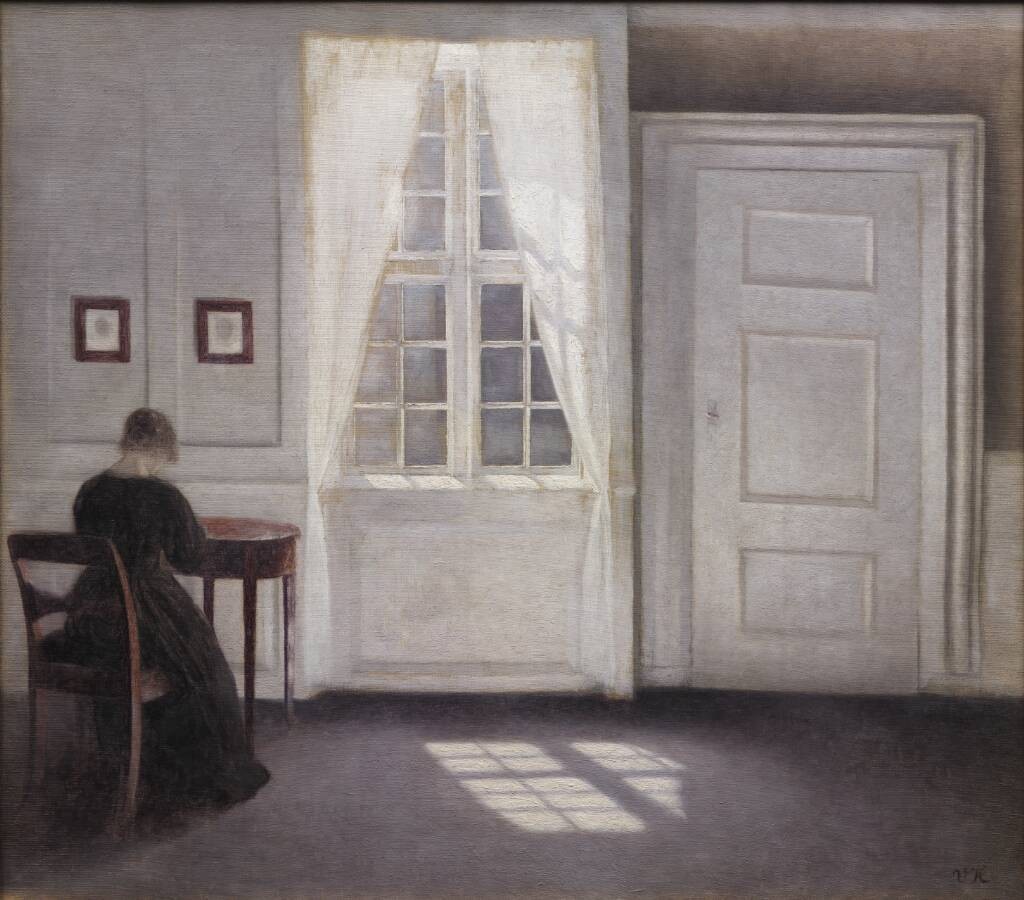
Windows perform a different task. They admit light, but often withhold the outside view. In KMS3696, the courtyard-facing window is an active source rather than a landscape framed on the wall. Curtain, glazing bars and panelling turn illumination into a measured sequence of pale shapes. Window and door stand near each other, yet their functions diverge: one brings light into the room, while the other marks a possible route through it.
These structural lines never become a rigid diagram. Edges soften, greys vary and brushwork prevents the architecture from feeling mechanically ruled. What initially looks sparse is densely calibrated. The viewer is guided by intervals between uprights, by bands of floor and by the changing value of adjacent whites. This balance between construction and atmosphere is explored further in Hammershøi's light, colour and technique.
Daylight Across Floor and Wall
The exact work used here, Interior in Strandgade, Sunlight on the Floor, is SMK KMS3696, painted in 1901. It measures 46.5 by 52 centimetres and is therefore slightly wider than it is high.[5][7] A window and white curtain occupy the left, with a pale door beside them. Ida, most probably the seated woman, turns away at a small oval mahogany table. Two framed pictures hang above, while sunlight strikes the boards as a conspicuous patch.
Light does not merely beautify the room. It establishes direction, joins window to floor and sets a bright counterweight against the dark figure and furniture. ViHDA notes that Hammershøi painted this courtyard-facing position at different times of day.[5] The changing angle of illumination could thus reorganise a stable wall more decisively than moving a chair.
Close examination complicates the tempting description of a purely grey picture. The floor contains purplish greys; the darker wall shifts through greenish grey and brown; warm, yellowish greys articulate shadows among the whites. Narrow strokes generally follow vertical and horizontal architecture, while the reflection on the floor breaks that discipline.[5] Hammershøi's restraint is therefore an ordering of colour, not its absence.
Ida Facing Away
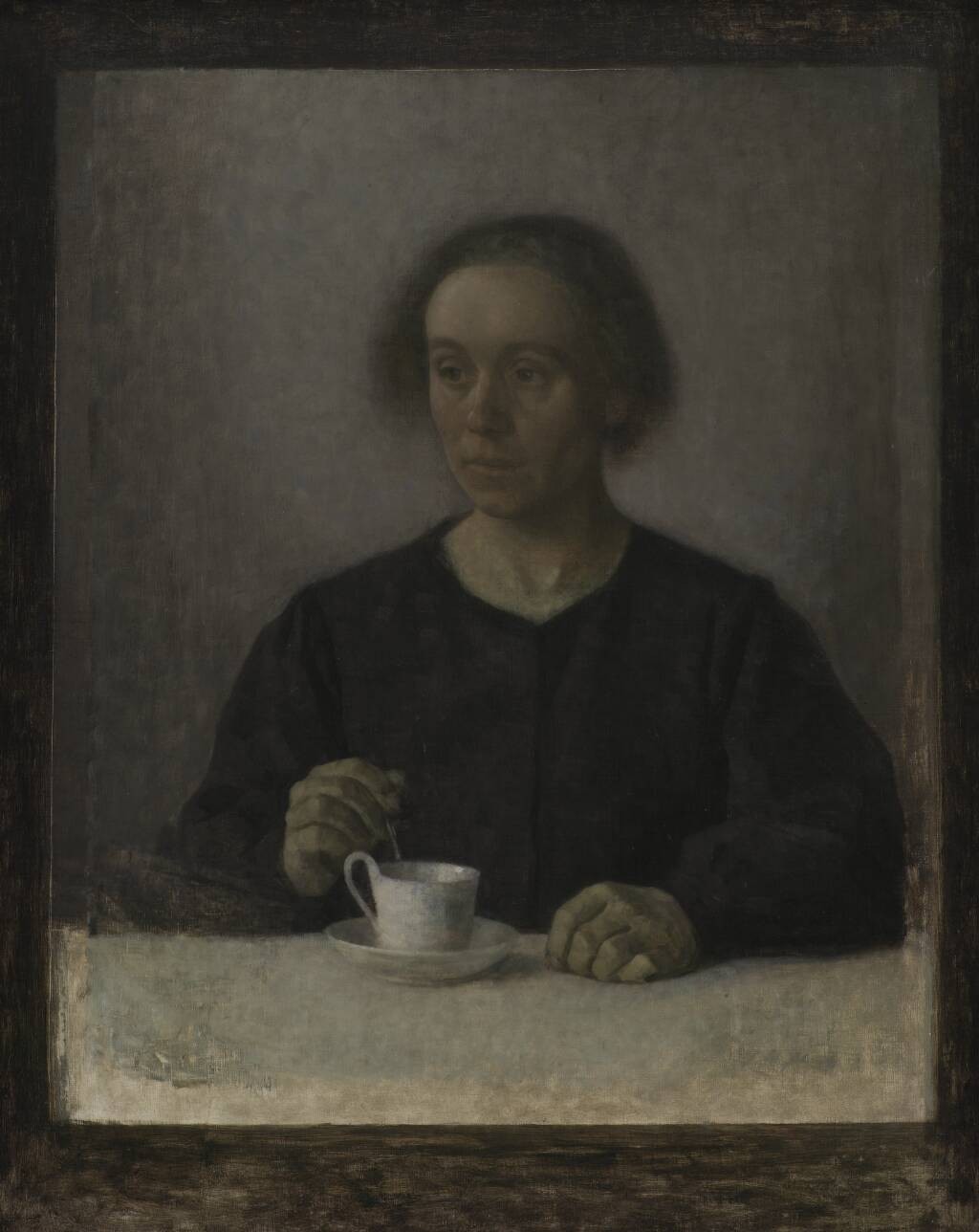
Ida's repeated presence gives the rooms scale and concentration. A seated back supplies a dark, rounded mass against pale planes; a standing figure can echo a door's upright; the direction of her attention sends the viewer towards a table, wall or unseen object. These are observable compositional effects. They do not establish that she is lonely, estranged or psychologically inaccessible.
The distinction is important because a turned figure invites projection. In the National Gallery's 1899 painting, the institution identifies Ida as the model but remains cautious about what she is doing, suggesting that she may be reading something beyond our sight.[6] KMS3696 is more securely described through pose and placement: a dark-clothed woman, probably Ida, sits with her back towards us.[5] More about her roles as wife, frequent sitter and later steward of works appears in the Ida Hammershøi guide.
Nationalmuseum's Interior with a Reading Lady, dated about 1900, confirms that Hammershøi explored the pairing of an interior and a woman absorbed in reading during this period.[8] Its catalogue metadata does not identify it as the same room or object. Similarity of motif is useful for comparison, but it is not grounds for merging paintings or addresses.
Furniture as Movable Structure
Tables, chairs, pictures and stoves give the interiors their changing weights. A round or oval tabletop can interrupt a field of straight lines. A chair creates an oblique accent or blocks a passage. The stove rises as a dark cylinder against pale walls. Removing an object may expose more floor, while moving it by a modest distance can redirect the entire balance.
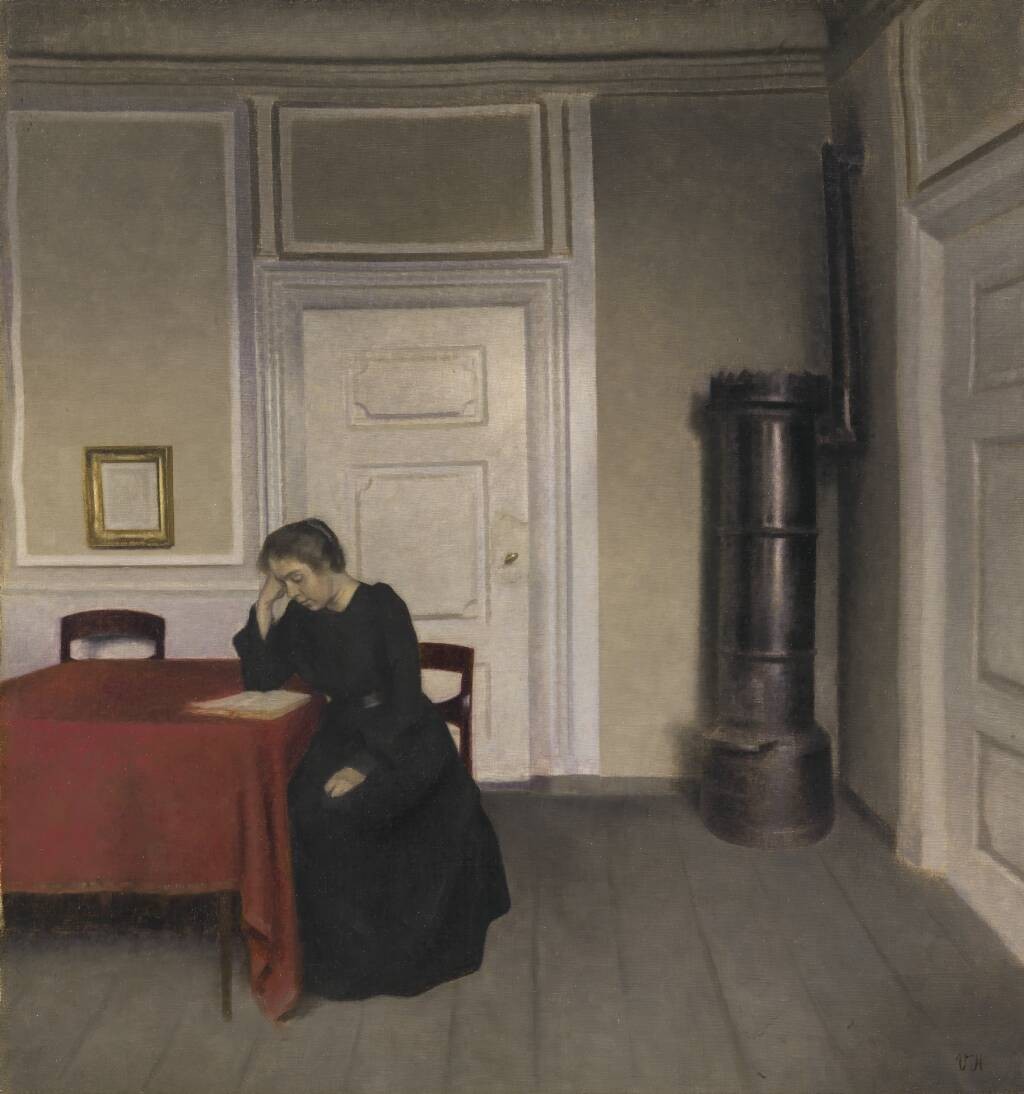
The National Gallery explicitly says that Hammershøi adjusted real objects for his compositions.[6] This makes sparseness an active choice. The rooms were not necessarily lived in as bare tableaux; the painting presents a curated arrangement. In KMS3696, mahogany furniture remains subordinate to the illuminated floor. In KMS3697, by contrast, the table and its brown-red covering become central, providing what ViHDA calls a significant optical marker against the artist's whiter Strandgade interiors.[1]
KMS3696 and KMS3697 Compared
The two SMK paintings are close in place but not interchangeable. KMS3696 is the 1901 landscape-format Interior in Strandgade, Sunlight on the Floor. KMS3697 is the 1902 A Room in the Artist's Home in Strandgade, Copenhagen, with the Artist's Wife, a taller composition centred on Ida reading at a covered table.[1][5] Inventory numbers, dates and current titles keep repeated rooms from dissolving into a generic “Strandgade interior”.
Their measurements reinforce the difference. KMS3696 is consistently recorded at 46.5 by 52 centimetres. For KMS3697, SMK's current object data gives 63.5 by 60 centimetres, whereas ViHDA gives 63.9 by 60 centimetres.[1][7][9] Both figures should remain visible rather than being silently averaged. The four-millimetre height variation concerns documentation, not the identity of the work.
KMS3696 turns on the relation between a visible window and sunlit floor. Its seated figure is pushed left of centre, joined to the small oval table. KMS3697 places Ida nearer the middle, half turned as she reads, with white doors and a black stove shaping the room around her. Its brown-red tablecloth introduces a concentrated colour signal that the 1901 painting does not possess.[1] One picture opens towards daylight; the other gathers attention around figure, book and table.
What Technical Research Adds
Technical examination replaces vague claims about effortless stillness with evidence of method. In KMS3696, pencil or black-crayon lines mark architectural features, including window bars and panelling. Thin paint was applied largely wet-in-wet, generally working from darker passages towards lighter ones. Raking light suggests that the sunlit reflection may have been shifted slightly right and reduced in height.[5] This is a modest correction, but it shows that even the apparent fall of light was adjusted within the picture.
KMS3697 has its own sequence. A faint linear drawing appears in the doorframe behind Ida; the figure, table and stove were painted before the walls and floor; and a possible brass plate around the doorknob was covered.[1] These findings do not tell us what the scene “means”. They show how Hammershøi built and revised it.
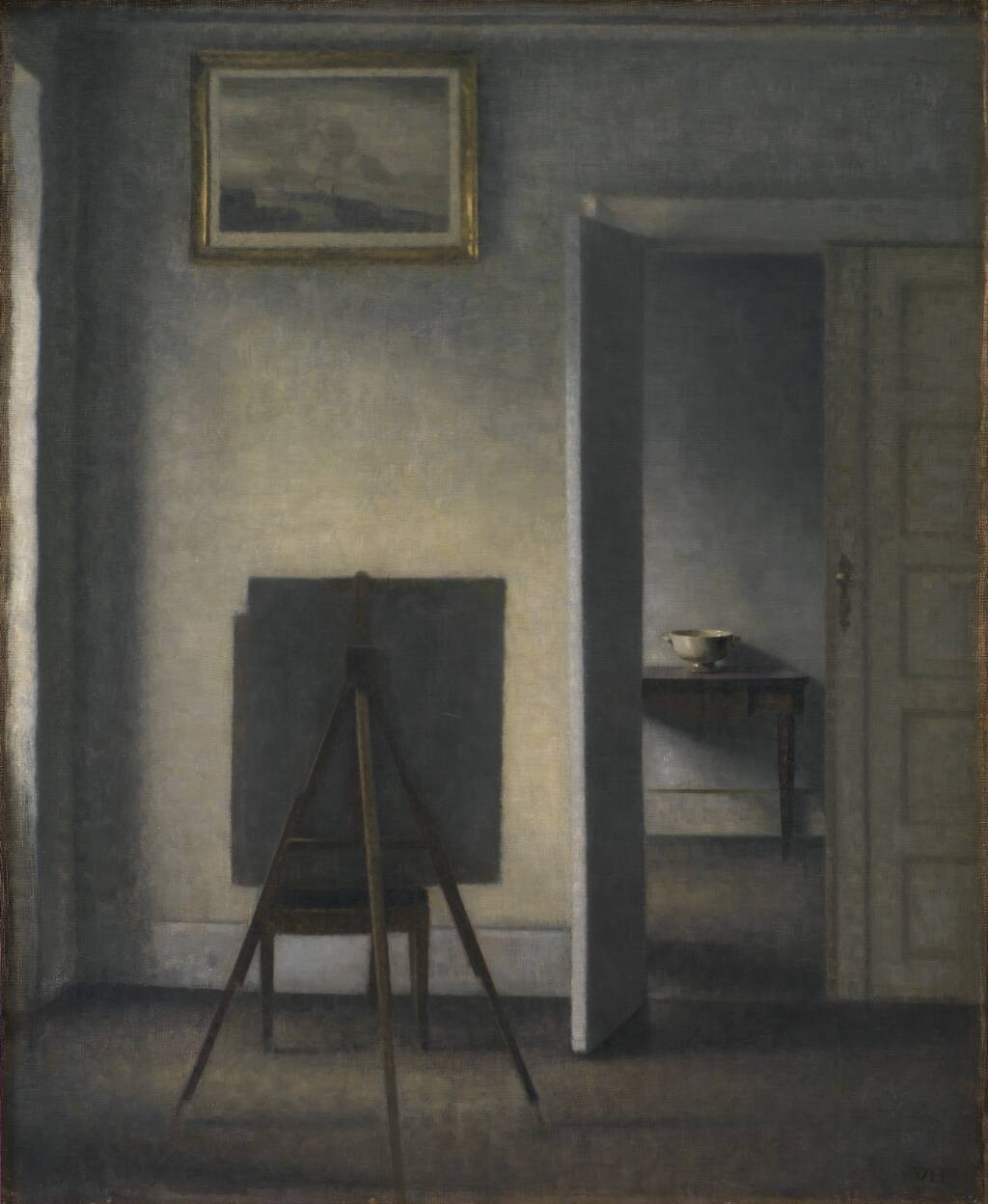
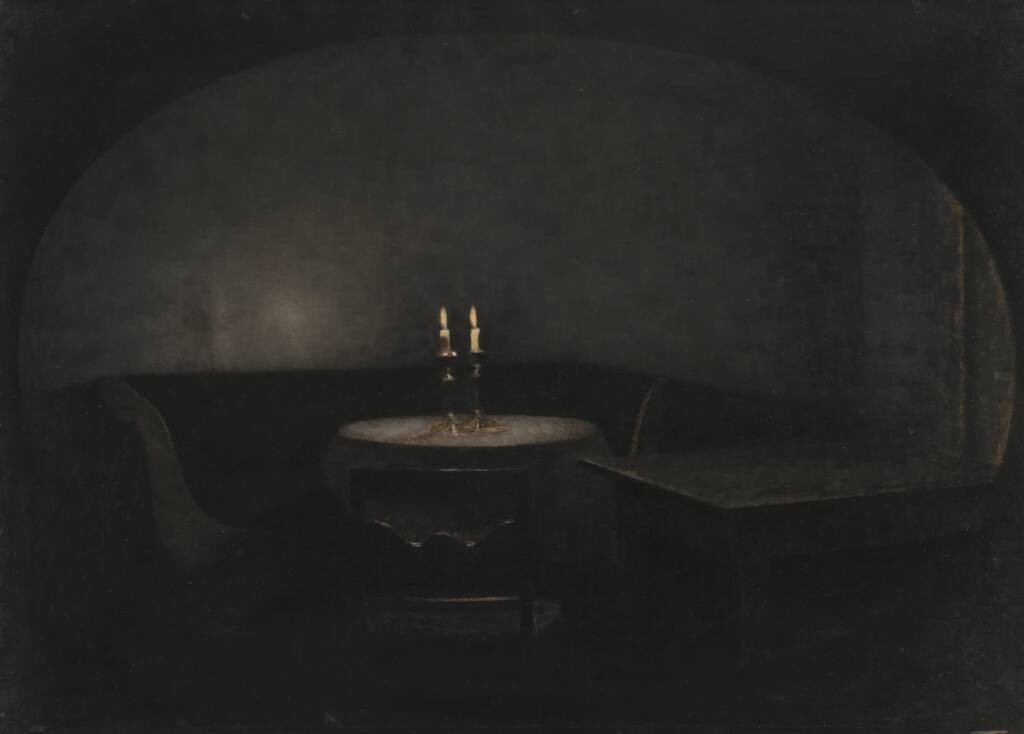
Later rooms continued the serial approach under changed architectural conditions. Interior with the Artist's Easel belongs to Bredgade 25, not either Strandgade address, while Interior. Artificial Light changes the governing illumination from daylight to candles.[2] Seen from that longer perspective, Strandgade 30 was not a formula that Hammershøi endlessly copied. It was the place where he demonstrated how architecture could remain fixed while a painting's internal relationships changed.
Researched works directory
This directory covers the 133 paintings currently published by the Vilhelm Hammershøi Digital Archive (ViHDA). It is a researched platform census, not a complete catalogue raisonné of the artist's oeuvre.
| Name | Date | Medium |
|---|---|---|
| A Bakery Shop. Study | 1888 | Painting |
| A Greek Relief. Louvre | 1892 | Painting |
| Amalienborg Square | 1896 | Painting |
| An Ancient Relief. Study | 1878 – 1881 | Painting |
| An Old Woman | 1886 | Painting |
| An Old Woman Standing by a Window | 1885 – 1886 | Painting |
| Artemis | 1893 – 1894 | Painting |
| Bedroom | 1890 | Painting |
| Church of Christiansborg Palace, Copenhagen | 1910 | Painting |
| Church of Sankt Petri, Copenhagen | 1906 | Painting |
| Double Portrait. Vilhelm and Ida Hammershøi | 1892 | Painting |
| Evening in the Drawing Room. Strandgade 30 | 1904 | Painting |
| Evening in the Sitting Room. | 1904 | Painting |
| Evening Interior. Artificial Light. Ida and Frederikke Hammershøi | 1891 | Painting |
| Farm. Refsnæs | 1900 | Painting |
| Five Portraits. Study | 1901 | Painting |
| Frederiksborg Castle | 1893 | Painting |
| From Christianshavns Canal | 1905 | Painting |
| From Frederiksholms Kanal | 1893 | Painting |
| From Kvæsthusbroen | 1908 | Painting |
| From the British Museum. London, Winter | 1906 | Painting |
| From the Church Santo Stefano Rotondo in Rome | 1902 – 1903 | Painting |
| From The Greenlandic Trade Dock. Christianshavn | 1908 | Painting |
| From the Old Christiansborg Palace | 1907 | Painting |
| Hammershøi's palette | Uncertain/Unknown | Painting |
| Head of a Woman. Study for Artemis | 1893 | Painting |
| Houses. Arresødal near Frederiksværk | 1904 | Painting |
| Interior | 1898 | Painting |
| Interior in Louis Seize style. Rahbeks Allé | 1897 | Painting |
| Interior. 'The Four Rooms'. Strandgade 25 | 1914 | Painting |
| Interior. A Young Man Reading | 1898 | Painting |
| Interior. Artificial Light | 1909 | Painting |
| Interior. Attic Room with Table and Chair | 1883 – 1885 | Painting |
| Interior. Frederikke and Anna Hammershøi | 1884 | Painting |
| Interior. From The Great Hall of Lindegården | 1909 | Painting |
| Interior. Ida Hammershøi at a Sewing Table | Uncertain/Unknown | Painting |
| Interior. Living Room in Louis-Seize-Style. Rahbeks Allé 26 | 1893 – 1896 | Painting |
| Interior. Looking out on the Exterior. Strandgade 30 | 1905 | Painting |
| Interior. Strandgade 30 | 1901 | Painting |
| Interior. Strandgade 30 | 1902 | Painting |
| Interior. Strandgade 30 | 1905 | Painting |
| Interior. Study in Sunlight. Strandgade 30 | 1906 | Painting |
| Interior. Sunshine in the Drawing Room III | 1903 | Painting |
| Interior. The Music Room. Strandgade 30 | 1908 | Painting |
| Interior. The Old Stove. Albertinelyst | 1888 | Painting |
| Interior. The Tall Windows | 1913 | Painting |
| Interior. With Empire Sofa. Strandgade 30 | 1907 | Painting |
| Interior. With Four Etchings. Strandgade 30 | 1904 | Painting |
| Interior. With Table, Cupboard and Windsor Chair. Strandgade 25 | 1913 | Painting |
| Interior. With the Artist's Easel | 1910 | Painting |
| Interior. With the Artist's Easel. Bredgade 25 | 1912 | Painting |
| Interior. Woman knitting | 1889 | Painting |
| Interior. Woman Reading | 1910 | Painting |
| Interior. Woman Reading. Bredgade 25 | Uncertain/Unknown | Painting |
| Interior. Woman Sitting Behind a Table | 1910 | Painting |
| Interior. Woman Sweeping | 1899 | Painting |
| Job | 1887 | Painting |
| Job. Study | 1887 | Painting |
| Landscape. At Lyngby Lake | 1888 | Painting |
| Landscape. Early Spring | 1909 | Painting |
| Landscape. Gentofte | 1906 | Painting |
| Landscape. Grønsund, Falster | 1890 | Painting |
| Landscape. Gundsømagle near Roskilde | 1885 | Painting |
| Landscape. Gundsømagle near Roskilde | 1886 | Painting |
| Landscape. Kongevejen near Gentofte. Study | 1892 | Painting |
| Landscape. Near Fortunen | 1901 | Painting |
| Landscape. Near Lejre | 1905 | Painting |
| Landscape. Ryet near Farum Lake | 1896 – 1897 | Painting |
| Landscape. Summer. Near Lejre | 1905 | Painting |
| Landscape. Søndermarken Park in Winter | 1895 – 1896 | Painting |
| Landscape. The Rowan Avenue at Snekkersten | 1906 | Painting |
| Landscape. With a Farmhouse | 1878 – 1879 | Painting |
| Landscape. Young Forest, Trørød, Summer | 1907 | Painting |
| Morning Toilette. Study. Strandgade 25 | 1914 | Painting |
| Nude Female Model | 1884 | Painting |
| Nude Female Model | 1910 | Painting |
| Open Doors. Strandgade 30 | 1905 | Painting |
| Portrait of a Young Girl. Anna Hammershøi | 1885 | Painting |
| Portrait. Anna Hammershøi | 1883 | Painting |
| Portrait. Anna Hammershøi. Profile | Uncertain/Unknown | Painting |
| Portrait. Daniel Jacobson Salter | 1901 | Painting |
| Portrait. Elisabeth Dorothea Rentzmann | Uncertain/Unknown | Painting |
| Portrait. Elisabeth Wandel | 1890 | Painting |
| Portrait. Fini Henriques | Uncertain/Unknown | Painting |
| Portrait. Frederikke Hammershøi | Uncertain/Unknown | Painting |
| Portrait. Frederikke Hammershøi. Study | 1894 | Painting |
| Portrait. Henry Madsen. Study | 1904 | Painting |
| Portrait. Henry Madsen. Study | 1904 | Painting |
| Portrait. Ida Hammershøi | 1894 | Painting |
| Portrait. Ida Hammershøi with a Teacup | 1907 | Painting |
| Portrait. Ida Ilsted | 1890 | Painting |
| Portrait. Ida Ilsted. Study | 1890 | Painting |
| Portrait. Ida Ilsted. Study | 1890 | Painting |
| Portrait. J.F. Willumsen. Study for Five Portraits | 1901 | Painting |
| Portrait. J.F. Willumsen. Study for Five Portraits | 1901 – 1902 | Painting |
| Portrait. Karen Malm | 1914 | Painting |
| Portrait. Karl Madsen | 1890 | Painting |
| Portrait. Kristian Zahrtmann | 1889 | Painting |
| Portrait. Kristian Zahrtmann | 1889 | Painting |
| Portrait. Svend Hammershøi | 1881 | Painting |
| Portrait. Svend Hammershøi | 1892 | Painting |
| Portrait. Svend Hammershøi | 1903 – 1904 | Painting |
| Portrait. Svend Hammershøi. Study for Five Portraits | 1901 | Painting |
| Portrait. Thora Bendix, née Anne Victoria Sundberg | 1896 | Painting |
| Portrait. Thora Bendix. Study | 1896 | Painting |
| Portrait. Thorvald Bindesbøll. Study | 1904 | Painting |
| Portrait. Woman. Possibly Frederikke Juncker-Jensen | 1878 – 1881 | Painting |
| Portrait. Woman. Profile | 1888 | Painting |
| Seated Female Nude | 1889 | Painting |
| Self- Portrait | 1891 | Painting |
| Self-Portrait | 1890 | Painting |
| Self-Portrait | 1914 | Painting |
| Self-Portrait. Spurveskjul, Frederiksdal | 1911 | Painting |
| Self-Portrait. Spurveskjul, Frederiksdal | 1911 | Painting |
| Standing Female Model | 1909 – 1910 | Painting |
| Street in London. Montague Street at the British Museum | 1905 – 1906 | Painting |
| Study of a Model. A Woman seen from the Back | 1888 | Painting |
| Sunbeams or Sunshine. "Dust motes dancing in the sunbeams" | 1900 | Painting |
| The Buildings of the Asiatic Company, seen from St. Annæ Street | 1902 | Painting |
| The Cello Player. Henry Bramsen | 1893 | Painting |
| The Coin Collector. Strandgade 30 | 1904 | Painting |
| The Garden Room. Frederiksberg Allé | 1887 | Painting |
| The Tuesday Forest | 1893 | Painting |
| Three Sailing Boats. Christianshavns Canal | 1905 | Painting |
| Tree Trunks. Arresødal near Frederiksværk | 1904 | Painting |
| View of Christiansborg Palace. Late Autumn | 1890 – 1892 | Painting |
| View of Gentofte Lake . 'Sunshower' | 1903 | Painting |
| View of Gentofte Lake . 'Sunshower'. Study | 1903 | Painting |
| View of Jægersborg Allé. Study | 1892 | Painting |
| White Doors. Strandgade 30 | 1899 | Painting |
| Woman Knitting. Frederikke Hammershøi | 1889 | Painting |
| Young Beechwood. Arresødal near Frederiksværk | 1904 | Painting |
| Young Girl Sewing. Anna Hammershøi | 1887 | Painting |
Frequently Asked Questions
ViHDA records around 66 interiors made between 1898 and 1908 from various rooms and viewing angles in the apartment.[1] The figure describes works linked to this residence; it should not be treated as the total number of interiors across Hammershøi's career.
No. The Hirschsprung Collection states that he lived at seven Copenhagen addresses.[4] Strandgade 30 was the home associated with the major 1898–1908 series; Bredgade 25 and the later Strandgade 25 are different buildings and periods.[2][3]
Ida was the frequent model, and sources identify her securely in several works. For KMS3696, ViHDA says she was most likely the seated woman.[5] Identification should follow the evidence for each object rather than being assumed from a turned back or dark dress.
Doors divide the surface into vertical units and establish routes between visible and unseen spaces. Their repeated use allows small changes—open or closed, central or cropped, bright or shaded—to reshape the viewer's progress through each composition without requiring a narrated event.
Discussion
Use this evidence-led guide as a starting point for close looking rather than a final verdict.
Share an observation about Hammershøi's Strandgade Interiors or a source that adds useful context.
Reader Insights
Which work most clearly turns an ordinary room, face or building into a newly measured pictorial structure?
Where do Copenhagen, Ida, training or exhibition history productively alter your reading?
Which source or surviving object would you investigate next?
Join the Conversation
Add your reading below, keeping observations specific and evidence clear.
References
- SMK, Vilhelm Hammershøi Digital Archive, Interior. Strandgade 30 (KMS3697), accessed 31 August 2026.
- SMK, Vilhelm Hammershøi Digital Archive, Interior with the Artist's Easel, accessed 31 August 2026.
- SMK, Vilhelm Hammershøi Digital Archive, The Buildings of the Asiatic Company, seen from St. Annæ Street, accessed 31 August 2026.
- The Hirschsprung Collection, Vilhelm Hammershøi, accessed 31 August 2026.
- SMK, Vilhelm Hammershøi Digital Archive, Interior. Strandgade 30 (KMS3696), accessed 31 August 2026.
- The National Gallery, London, Interior, accessed 31 August 2026.
- SMK Open, Interior in Strandgade, Sunlight on the Floor (KMS3696), accessed 31 August 2026.
- Nationalmuseum, Interior with a Reading Lady, accessed 31 August 2026.
- SMK Open, A Room in the Artist's Home in Strandgade, Copenhagen, with the Artist's Wife (KMS3697), accessed 31 August 2026.