 by Tom Gurney
Tom Gurney BSc (Hons) is an art history expert with over 20 years experience
Page Created: / Page Updated:
Email: tomgurney1@gmail.com / Phone: +44 7429 011000
Interior with the Artist's Easel: Introduction
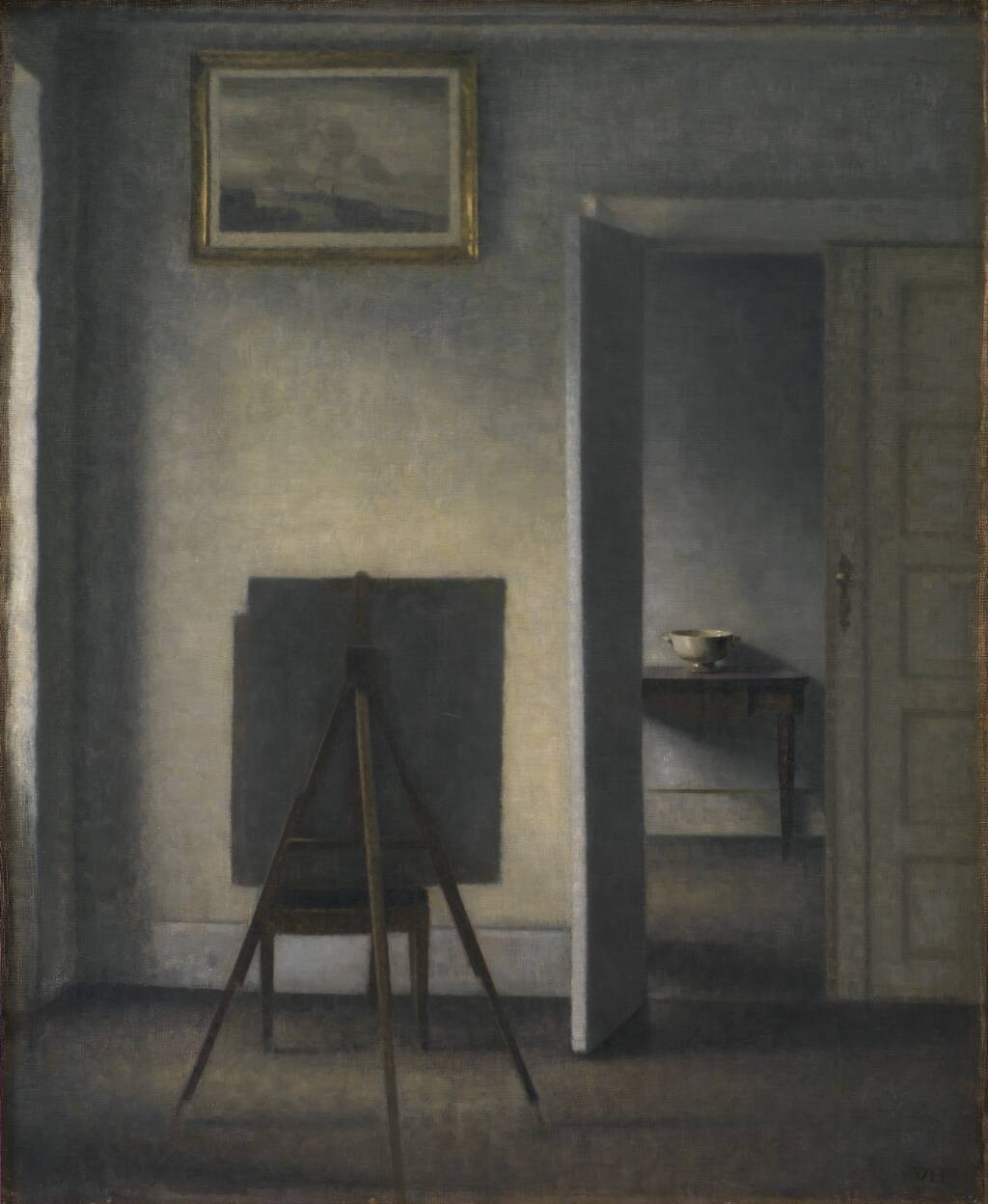
Vilhelm Hammershøi’s Interior with the Artist’s Easel places the apparatus of painting inside a room that has itself become the subject of a painting. An easel stands before a pale wall, its canvas turned away from us. To the right, an open doorway gives access to a darker adjoining room, where a small handled bowl rests on a table. There is no figure, yet the easel makes artistic work materially present.
The picture was painted in 1910 at Bredgade 25, Copenhagen, the home Hammershøi shared with his wife Ida from 1909 to 1913. It belongs to SMK – National Gallery of Denmark and carries the inventory number KMS7444. SMK’s current object record gives the medium as oil on canvas and the dimensions as 84 × 69 cm.[1] The Vilhelm Hammershøi Digital Archive (ViHDA), which identifies it as survey 341 in the Bramsen sequence, records a slightly different measured size of 84.2 × 69.5 cm.[2]
That exact identity matters because Hammershøi returned to this arrangement in other canvases. The related Getty and Lillehammer pictures are separate objects, not alternative names for KMS7444. Within the SMK painting itself, technical study also reveals an earlier arrangement under the surface. The finished room is therefore both an image of the artist’s working space and the result of substantial reconsideration.
At a Glance
- ArtistVilhelm Hammershøi (1864–1916)
- Date and medium1910, oil on canvas[1]
- CollectionSMK – National Gallery of Denmark, KMS7444[1]
- Dimensions84 × 69 cm in SMK’s record; 84.2 × 69.5 cm in ViHDA[1][2]
- Research identityViHDA survey 341, corresponding to Bramsen 341[2]
- Settingthe Hammershøis’ apartment at Bredgade 25, Copenhagen[2]
Vilhelm Hammershøi in context
Contents
- Introduction
- The Exact Object and Its Measurements
- A Room Organised Around an Easel
- Doorway, Chair, Bowl and Framed Print
- What the Surface Reveals About Revision
- Was the Easel Added After the First Arrangement?
- Three Related Pictures, Not One Interchangeable Image
- Bredgade 25 and the Late Interiors
The Exact Object and Its Measurements
SMK’s English title is Interior with the Artist’s Easel, while ViHDA displays the closely related form Interior. With the Artist’s Easel. Both records identify the same 1910 painting, KMS7444. The minor difference in punctuation does not indicate a second work. Inventory number, date, owner and survey number together fix the object more securely than a generic title such as Interior could do.
The two institutional measurements should also remain visible rather than being blended into a single apparently definitive size. SMK states 84 cm high by 69 cm wide; ViHDA’s examination gives 84.2 by 69.5 cm.[1][2] Such small variations can result from recording conventions or the precision of a particular examination. They do not create an identity problem, but stating both prevents false exactness.
ViHDA describes an industrially prepared, fine basket-weave canvas with a thin off-white ground. Its technical record also notes an original wooden stretcher and paint extending across a surface where the texture of the canvas remains perceptible.[2] These material facts place the visible greys, yellows, browns and greens on a physical support rather than treating the picture’s muted appearance as an immaterial atmosphere.
A Room Organised Around an Easel
The easel occupies the lower left half of the composition. Its three legs spread across the floor, while the dark reverse of the canvas makes a broad rectangular interruption against the wall. Because the painted face points away, the object withholds whatever image may be on it. Hammershøi presents the means of representation without displaying the work supposedly being made.
That reversal gives the painting a self-reflexive structure. We look at Hammershøi’s canvas while confronting the back of another canvas inside it. The inner rectangle is not a miniature picture to be decoded; it is an opaque plane that stresses position, scale and support. The easel also joins the room’s geometry. Its sloping legs cut across the wall and floor, countering the upright door frame, the horizontal skirting board and the rectangular framed print above.
SMK’s object commentary interprets the easel as a marker of the absent artist in a room that served as both home and studio.[1] That reading is persuasive without requiring the room to become a literal self-portrait. No person appears, and nothing proves that Hammershøi has only just stepped away. The stronger claim is visual: the equipment introduces making into a domestic interior and makes the painter’s viewpoint unusually conspicuous.
For a broader account of how interiors sit beside portraiture, landscape and architecture, see Hammershøi’s paintings. KMS7444 is distinctive within that practice because the tool used to produce pictures becomes one of the objects subjected to his ordering eye.
Doorway, Chair, Bowl and Framed Print
The easel does not act alone. A dark chair is closely aligned with it, so legs, uprights and the reverse of the canvas overlap into a compact group. The chair offers no occupant. Instead, it reinforces the sense that useful objects have been placed according to the demands of the composition. Their dark forms gather weight at lower left while the doorway opens a competing vertical interval on the right.
One leaf of the double door projects into the nearer room. Beyond it, a table stands against the wall and carries a pale handled bowl. The bowl is the smallest strongly lit object in the image. Its curved rim and highlights briefly interrupt a world dominated by straight edges. It also marks depth: the eye passes the nearer easel, crosses the angled door leaf and finds the vessel in the farther space.
The framed print high on the wall completes a loose progression of rectangles: picture frame, reversed canvas and doorway. ViHDA cautiously identifies the print as probably J. F. Clemens’s engraving after C. A. Lorentzen of the Battle of Copenhagen in 1801, an impression of which is also held by SMK.[2] “Probably” is important here; the identification is an informed institutional proposal, not an absolute certainty.
Colour differentiates these elements without turning the room into a bright arrangement. ViHDA records yellowish whites and greys in the walls, olive and dark yellow-grey across the floor, brown and olive tones in the easel and chair, purplish brown on the distant tabletop, and greyish yellow with white accents in the bowl.[2] The light, colour and technique guide places those restrained relationships within Hammershøi’s wider working method.
What the Surface Reveals About Revision
ViHDA’s visual examination and imaging show that the present design lies over a different but related arrangement. In the earlier state, the open door and the table bearing the bowl were positioned farther to the left. Parts of that first scheme appear to have reached different degrees of completion before Hammershøi established the visible solution.[2]
This finding changes how the doorway can be read. Its current location is not simply a transcription of fixed architecture from a chosen viewpoint. Hammershøi moved a major vertical opening within the painted field and repositioned the table beyond it. The alteration recalibrated the balance between the dense easel group and the right-hand passage, as well as the route by which the eye enters the second room.
The record also warns against treating every darker preparatory passage as straightforward underpainting for the current image. Some material beneath the visible design may instead be paint belonging to the abandoned composition.[2] In other words, a lower layer does not automatically provide the first step of one uninterrupted plan. It may preserve the remains of a substantially reconsidered version.
The visible paint was generally worked from darker areas towards lighter ones, with wet-in-wet handling in walls and floor. Short strokes tend to run horizontally, although their direction varies more across the floor. Wall paint was used to refine contours around the easel, chair and framed print. ViHDA further notes that adjacent paint sometimes meets or slightly overlaps these objects, but the evidence can mean that an element was painted early or that its place was reserved.[2] The precise order is not always recoverable.
Was the Easel Added After the First Arrangement?
ViHDA says the easel was potentially absent from the initial version.[2] That is a carefully limited conclusion. The hidden placement of door and table is supported by examination, while the easel’s status is expressed as a possibility. It would be too strong to say that imaging proves Hammershøi completed an empty room and then decisively added the studio equipment at the end.
Nevertheless, the possibility matters. If the easel entered during revision, the painting’s self-reference was not necessarily its starting premise. The canvas could have moved from one Bredgade interior arrangement towards a more pointed meditation on artistic work. Even if the easel was planned earlier than the surviving evidence can demonstrate, its final position was resolved in relation to a doorway and table that had already shifted.
This measured distinction between observation and inference is central to close reading. The technical record establishes change; it does not supply a complete diary of decisions. What can be said with confidence is that KMS7444 was constructed through adjustment rather than copied in a single pass. Hammershøi’s apparent restraint was compatible with decisive reorganisation.
Three Related Pictures, Not One Interchangeable Image
ViHDA records at least two further versions of the easel composition. One is the J. Paul Getty Museum’s 1912 Interior with an Easel, Bredgade 25, associated with Bramsen 354. Another entered Lillehammer Kunstmuseum in 2024 and was not listed by Bramsen.[2] They share a motif, but each is an independent canvas with its own date, dimensions, ownership history and surface.
The 1912 date makes the Getty picture later than the 1910 SMK work. It should not be used to fill visual gaps in KMS7444, nor should features from the Lillehammer painting be imported into a description of the SMK image. Repetition was one of Hammershøi’s means of testing a room: distance, daylight, furniture and small inclusions could change while the architectural premise remained recognisable.
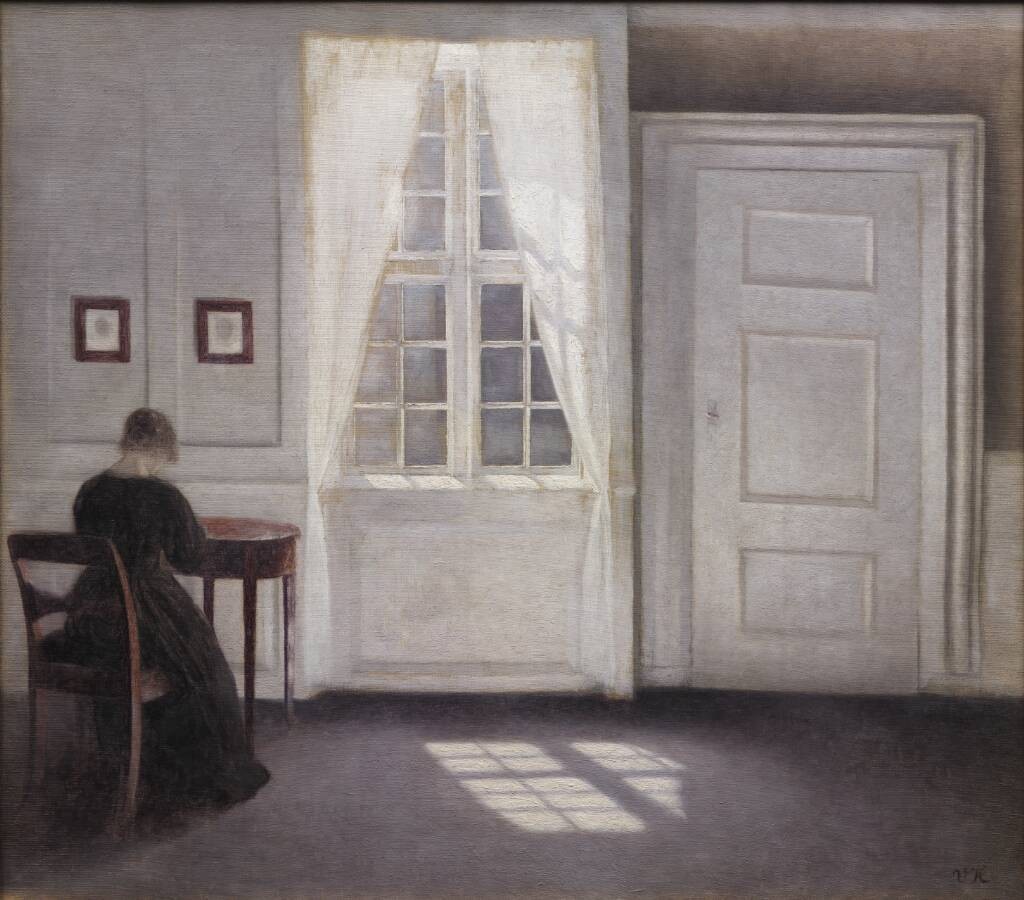
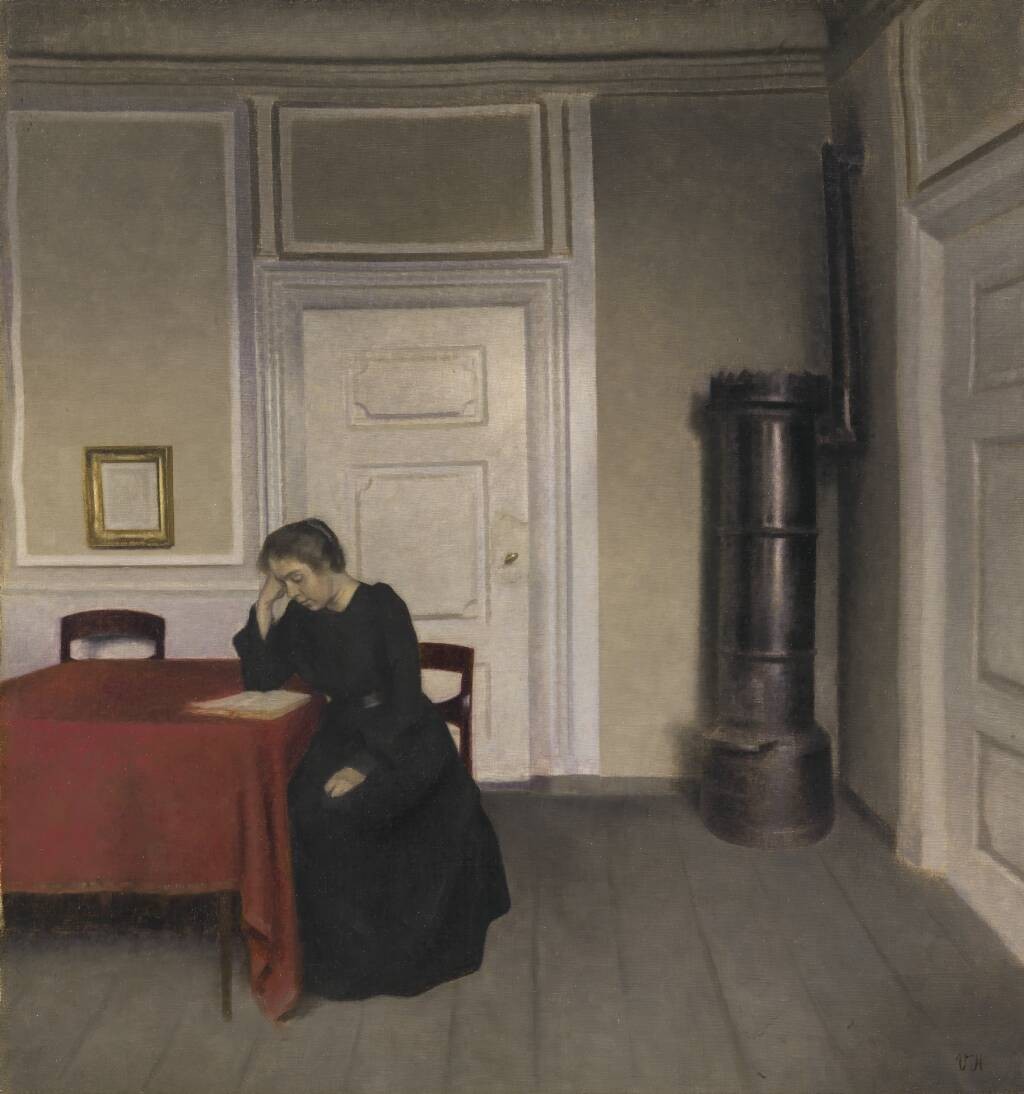
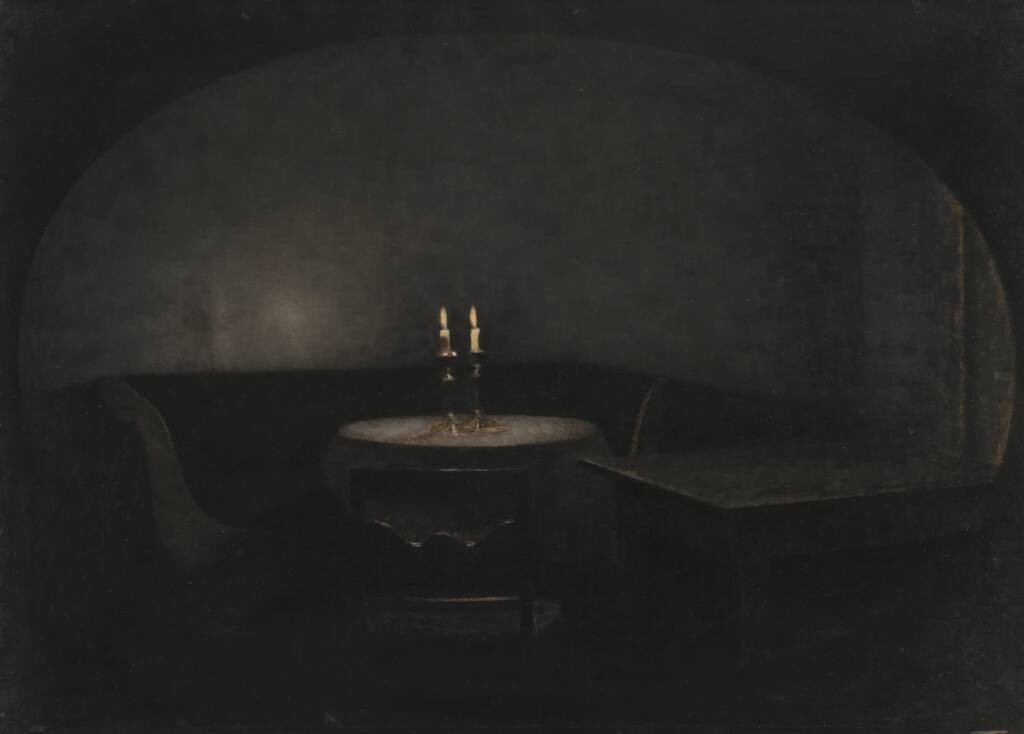
Serial treatment also occurs elsewhere in his art. The daylight of Interior in Strandgade, Sunlight on the Floor and the red-covered table in A Room in the Artist’s Home in Strandgade belong to different exact objects at an earlier address. Interior. Artificial Light offers a near-contemporary contrast governed by candles. These works illuminate recurring habits without becoming substitutes for one another.
Bredgade 25 and the Late Interiors
Hammershøi and Ida lived at Bredgade 25 between 1909 and 1913.[2] This chronology separates KMS7444 from the famous Strandgade interiors and from the couple’s later home at Strandgade 25. The Copenhagen and architecture account traces these moves and the distinct pictorial settings they supplied.
An SMK interior dated 1911, recently donated to the museum, depicts the same Bredgade room and double doors from a changed position. There the doorway sits centrally, a closed piano appears beyond, and the wall print occupies the adjoining room rather than the nearer one.[3] Seen beside KMS7444, it demonstrates that familiar architecture did not impose a fixed arrangement. Viewpoint and furniture could be redistributed to generate a new relation among rooms.
KMS7444 therefore belongs to a late practice of deliberate variation. Its significance does not depend on calling the room silent, lonely or mysterious, since those are responses rather than documented conditions. The painting is more concretely remarkable for making an inhabited working environment legible through objects, intervals and revisions. Easel, chair, open door, distant table and bowl form the visible settlement of choices that could have been—and, beneath the surface, once were—otherwise.
Researched works directory
This directory covers the 133 paintings currently published by the Vilhelm Hammershøi Digital Archive (ViHDA). It is a researched platform census, not a complete catalogue raisonné of the artist's oeuvre.
| Name | Date | Medium |
|---|---|---|
| A Bakery Shop. Study | 1888 | Painting |
| A Greek Relief. Louvre | 1892 | Painting |
| Amalienborg Square | 1896 | Painting |
| An Ancient Relief. Study | 1878 – 1881 | Painting |
| An Old Woman | 1886 | Painting |
| An Old Woman Standing by a Window | 1885 – 1886 | Painting |
| Artemis | 1893 – 1894 | Painting |
| Bedroom | 1890 | Painting |
| Church of Christiansborg Palace, Copenhagen | 1910 | Painting |
| Church of Sankt Petri, Copenhagen | 1906 | Painting |
| Double Portrait. Vilhelm and Ida Hammershøi | 1892 | Painting |
| Evening in the Drawing Room. Strandgade 30 | 1904 | Painting |
| Evening in the Sitting Room. | 1904 | Painting |
| Evening Interior. Artificial Light. Ida and Frederikke Hammershøi | 1891 | Painting |
| Farm. Refsnæs | 1900 | Painting |
| Five Portraits. Study | 1901 | Painting |
| Frederiksborg Castle | 1893 | Painting |
| From Christianshavns Canal | 1905 | Painting |
| From Frederiksholms Kanal | 1893 | Painting |
| From Kvæsthusbroen | 1908 | Painting |
| From the British Museum. London, Winter | 1906 | Painting |
| From the Church Santo Stefano Rotondo in Rome | 1902 – 1903 | Painting |
| From The Greenlandic Trade Dock. Christianshavn | 1908 | Painting |
| From the Old Christiansborg Palace | 1907 | Painting |
| Hammershøi's palette | Uncertain/Unknown | Painting |
| Head of a Woman. Study for Artemis | 1893 | Painting |
| Houses. Arresødal near Frederiksværk | 1904 | Painting |
| Interior | 1898 | Painting |
| Interior in Louis Seize style. Rahbeks Allé | 1897 | Painting |
| Interior. 'The Four Rooms'. Strandgade 25 | 1914 | Painting |
| Interior. A Young Man Reading | 1898 | Painting |
| Interior. Artificial Light | 1909 | Painting |
| Interior. Attic Room with Table and Chair | 1883 – 1885 | Painting |
| Interior. Frederikke and Anna Hammershøi | 1884 | Painting |
| Interior. From The Great Hall of Lindegården | 1909 | Painting |
| Interior. Ida Hammershøi at a Sewing Table | Uncertain/Unknown | Painting |
| Interior. Living Room in Louis-Seize-Style. Rahbeks Allé 26 | 1893 – 1896 | Painting |
| Interior. Looking out on the Exterior. Strandgade 30 | 1905 | Painting |
| Interior. Strandgade 30 | 1901 | Painting |
| Interior. Strandgade 30 | 1902 | Painting |
| Interior. Strandgade 30 | 1905 | Painting |
| Interior. Study in Sunlight. Strandgade 30 | 1906 | Painting |
| Interior. Sunshine in the Drawing Room III | 1903 | Painting |
| Interior. The Music Room. Strandgade 30 | 1908 | Painting |
| Interior. The Old Stove. Albertinelyst | 1888 | Painting |
| Interior. The Tall Windows | 1913 | Painting |
| Interior. With Empire Sofa. Strandgade 30 | 1907 | Painting |
| Interior. With Four Etchings. Strandgade 30 | 1904 | Painting |
| Interior. With Table, Cupboard and Windsor Chair. Strandgade 25 | 1913 | Painting |
| Interior. With the Artist's Easel | 1910 | Painting |
| Interior. With the Artist's Easel. Bredgade 25 | 1912 | Painting |
| Interior. Woman knitting | 1889 | Painting |
| Interior. Woman Reading | 1910 | Painting |
| Interior. Woman Reading. Bredgade 25 | Uncertain/Unknown | Painting |
| Interior. Woman Sitting Behind a Table | 1910 | Painting |
| Interior. Woman Sweeping | 1899 | Painting |
| Job | 1887 | Painting |
| Job. Study | 1887 | Painting |
| Landscape. At Lyngby Lake | 1888 | Painting |
| Landscape. Early Spring | 1909 | Painting |
| Landscape. Gentofte | 1906 | Painting |
| Landscape. Grønsund, Falster | 1890 | Painting |
| Landscape. Gundsømagle near Roskilde | 1885 | Painting |
| Landscape. Gundsømagle near Roskilde | 1886 | Painting |
| Landscape. Kongevejen near Gentofte. Study | 1892 | Painting |
| Landscape. Near Fortunen | 1901 | Painting |
| Landscape. Near Lejre | 1905 | Painting |
| Landscape. Ryet near Farum Lake | 1896 – 1897 | Painting |
| Landscape. Summer. Near Lejre | 1905 | Painting |
| Landscape. Søndermarken Park in Winter | 1895 – 1896 | Painting |
| Landscape. The Rowan Avenue at Snekkersten | 1906 | Painting |
| Landscape. With a Farmhouse | 1878 – 1879 | Painting |
| Landscape. Young Forest, Trørød, Summer | 1907 | Painting |
| Morning Toilette. Study. Strandgade 25 | 1914 | Painting |
| Nude Female Model | 1884 | Painting |
| Nude Female Model | 1910 | Painting |
| Open Doors. Strandgade 30 | 1905 | Painting |
| Portrait of a Young Girl. Anna Hammershøi | 1885 | Painting |
| Portrait. Anna Hammershøi | 1883 | Painting |
| Portrait. Anna Hammershøi. Profile | Uncertain/Unknown | Painting |
| Portrait. Daniel Jacobson Salter | 1901 | Painting |
| Portrait. Elisabeth Dorothea Rentzmann | Uncertain/Unknown | Painting |
| Portrait. Elisabeth Wandel | 1890 | Painting |
| Portrait. Fini Henriques | Uncertain/Unknown | Painting |
| Portrait. Frederikke Hammershøi | Uncertain/Unknown | Painting |
| Portrait. Frederikke Hammershøi. Study | 1894 | Painting |
| Portrait. Henry Madsen. Study | 1904 | Painting |
| Portrait. Henry Madsen. Study | 1904 | Painting |
| Portrait. Ida Hammershøi | 1894 | Painting |
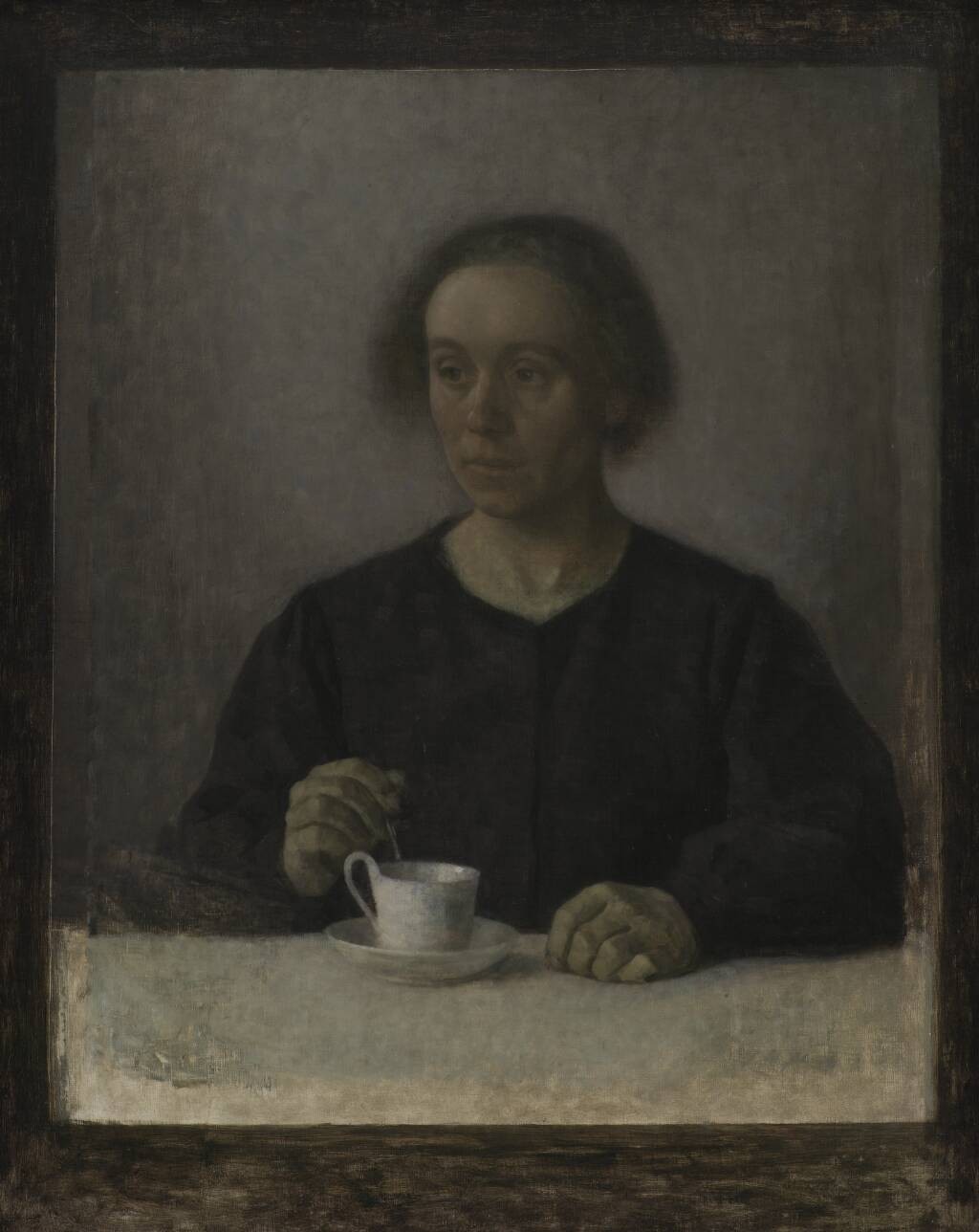
| Portrait. Ida Hammershøi with a Teacup | 1907 | Painting |
| Portrait. Ida Ilsted | 1890 | Painting |
| Portrait. Ida Ilsted. Study | 1890 | Painting |
| Portrait. Ida Ilsted. Study | 1890 | Painting |
| Portrait. J.F. Willumsen. Study for Five Portraits | 1901 | Painting |
| Portrait. J.F. Willumsen. Study for Five Portraits | 1901 – 1902 | Painting |
| Portrait. Karen Malm | 1914 | Painting |
| Portrait. Karl Madsen | 1890 | Painting |
| Portrait. Kristian Zahrtmann | 1889 | Painting |
| Portrait. Kristian Zahrtmann | 1889 | Painting |
| Portrait. Svend Hammershøi | 1881 | Painting |
| Portrait. Svend Hammershøi | 1892 | Painting |
| Portrait. Svend Hammershøi | 1903 – 1904 | Painting |
| Portrait. Svend Hammershøi. Study for Five Portraits | 1901 | Painting |
| Portrait. Thora Bendix, née Anne Victoria Sundberg | 1896 | Painting |
| Portrait. Thora Bendix. Study | 1896 | Painting |
| Portrait. Thorvald Bindesbøll. Study | 1904 | Painting |
| Portrait. Woman. Possibly Frederikke Juncker-Jensen | 1878 – 1881 | Painting |
| Portrait. Woman. Profile | 1888 | Painting |
| Seated Female Nude | 1889 | Painting |
| Self- Portrait | 1891 | Painting |
| Self-Portrait | 1890 | Painting |
| Self-Portrait | 1914 | Painting |
| Self-Portrait. Spurveskjul, Frederiksdal | 1911 | Painting |
| Self-Portrait. Spurveskjul, Frederiksdal | 1911 | Painting |
| Standing Female Model | 1909 – 1910 | Painting |
| Street in London. Montague Street at the British Museum | 1905 – 1906 | Painting |
| Study of a Model. A Woman seen from the Back | 1888 | Painting |
| Sunbeams or Sunshine. "Dust motes dancing in the sunbeams" | 1900 | Painting |
| The Buildings of the Asiatic Company, seen from St. Annæ Street | 1902 | Painting |
| The Cello Player. Henry Bramsen | 1893 | Painting |
| The Coin Collector. Strandgade 30 | 1904 | Painting |
| The Garden Room. Frederiksberg Allé | 1887 | Painting |
| The Tuesday Forest | 1893 | Painting |
| Three Sailing Boats. Christianshavns Canal | 1905 | Painting |
| Tree Trunks. Arresødal near Frederiksværk | 1904 | Painting |
| View of Christiansborg Palace. Late Autumn | 1890 – 1892 | Painting |
| View of Gentofte Lake . 'Sunshower' | 1903 | Painting |
| View of Gentofte Lake . 'Sunshower'. Study | 1903 | Painting |
| View of Jægersborg Allé. Study | 1892 | Painting |
| White Doors. Strandgade 30 | 1899 | Painting |
| Woman Knitting. Frederikke Hammershøi | 1889 | Painting |
| Young Beechwood. Arresødal near Frederiksværk | 1904 | Painting |
| Young Girl Sewing. Anna Hammershøi | 1887 | Painting |
Frequently Asked Questions
It belongs to SMK – National Gallery of Denmark in Copenhagen and has the inventory number KMS7444.[1] ViHDA records that SMK acquired it at a Christie’s auction in London in 1988.[2]
SMK’s object record gives 84 × 69 cm, while ViHDA’s technical examination records 84.2 × 69.5 cm.[1][2] Both refer to the same oil painting; the slight difference should be retained rather than silently rounded into one measurement.
No. The canvas inside the scene faces away from the viewer, presenting its dark reverse. This makes the support and the act of painting relevant without supplying a readable picture within the picture.
No. The Getty owns a related composition dated 1912 and associated with Bramsen 354, whereas KMS7444 is the 1910 SMK painting, survey 341.[2] A further separate version belongs to Lillehammer Kunstmuseum.
No. Examination establishes an earlier placement of the doorway and table, and ViHDA considers it possible that the easel was not in the first arrangement.[2] The available evidence does not fix every stage or prove that the easel was the last element applied.
Discussion
Use this evidence-led guide as a starting point for close looking rather than a final verdict.
Share an observation about Interior with the Artist's Easel or a source that adds useful context.
Reader Insights
Which detail most changes your reading of Interior with the Artist's Easel?
How do scale, surface or the current technical evidence shape the encounter?
What remains uncertain when visual inference is separated from documented fact?
Join the Conversation
Add your reading below, keeping observations specific and evidence clear.
References
- SMK Open, Interior with the Artist’s Easel, KMS7444, accessed 31 August 2026.
- SMK, Vilhelm Hammershøi Digital Archive, Interior. With the Artist’s Easel, accessed 31 August 2026.
- SMK, “Vilhelm Hammershøi donation”, accessed 31 August 2026.