 by Tom Gurney
Tom Gurney BSc (Hons) is an art history expert with over 20 years experience
Page Created: / Page Updated:
Email: tomgurney1@gmail.com / Phone: +44 7429 011000
Interior. Artificial Light: Introduction
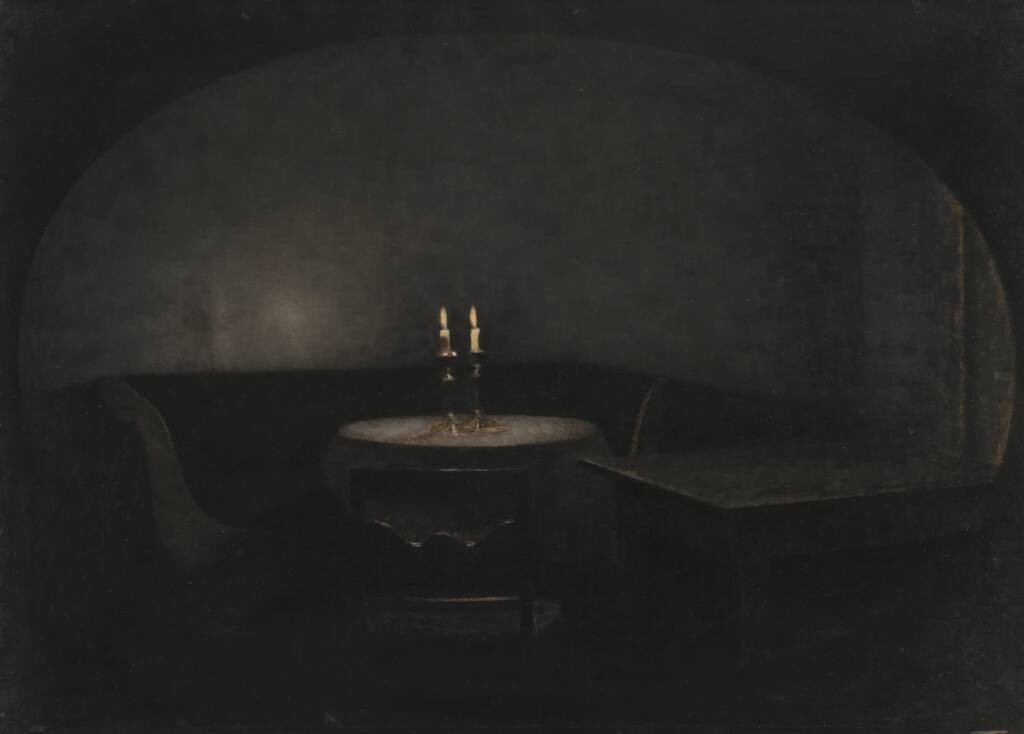
Vilhelm Hammershøi’s Interior. Artificial Light turns a sparsely furnished room into a study of visibility. Two lit candles stand close together on a round table. A pale sofa runs across the back wall, while a chair, the central table and a second table at the right emerge in different degrees from the surrounding darkness. No figure directs the scene. The eye has to assemble the space from small changes of tone, overlap and reflection.
The painting dates from 1909 and belongs to SMK – National Gallery of Denmark, where it is registered as KMS8677. SMK’s current collection record describes it as oil on canvas and gives its dimensions as 60 × 82.8 cm.[1] The Vilhelm Hammershøi Digital Archive (ViHDA), which identifies the work as survey 325 in the Bramsen sequence, records a closely differing width of 83.2 cm, with the same height of 60 cm.[2]
Its exact identity matters. KMS8677 is not the separate evening interior of 1891, despite the shared subject of a room seen after daylight has receded. Date, inventory number, dimensions and ownership distinguish the two pictures. In the 1909 canvas, close examination also shows that the table in the right foreground was a late addition. What appears at first to be an exceptionally reduced arrangement was reached through adjustment.
At a Glance
- ArtistVilhelm Hammershøi (1864–1916)
- Date and medium1909, oil on canvas[1][2]
- CollectionSMK – National Gallery of Denmark, KMS8677[1]
- Dimensions60 × 82.8 cm in SMK’s record; 60 × 83.2 cm in ViHDA[1][2]
- Research identityViHDA survey 325, corresponding to Bramsen 325[2]
- Principal lighttwo candles on a round central table[2]
Vilhelm Hammershøi in context
Contents
- Introduction
- The Exact Object and Its Measurements
- What the Candlelit Room Contains
- Two Flames and Uneven Illumination
- From Dark Layers Towards Light
- The Late Foreground Table
- Artificial Light as a Recurring Subject
- From Ida Hammershøi to SMK
The Exact Object and Its Measurements
SMK’s English title, Interior. Artificial Light, describes the subject without naming an address or occupant. Its punctuation is useful because it preserves the compact, almost classificatory character of the title, but the decisive identifier is KMS8677. Many Hammershøi pictures are called simply Interior, and several revisit related furniture or lighting conditions. A generic title alone cannot safely identify a particular canvas.
The two measurements should be retained rather than merged. SMK’s open record gives 60 cm high by 82.8 cm wide, whereas ViHDA’s technical examination records 60 by 83.2 cm.[1][2] The difference is only four millimetres in width and does not suggest two objects. It reflects separate institutional records or measuring precision. Stating both avoids creating a false single measurement.
ViHDA describes an industrial canvas with a relatively open plain weave, laid over a thin, off-white industrial ground. The original coniferous-wood stretcher was probably made to measure.[2] These material details matter because Hammershøi allowed the light ground and canvas texture to participate in the image. The room’s subdued surface was not produced by applying one uniform coat of darkness.
What the Candlelit Room Contains
The arrangement can be read from back to front. A long birchwood sofa stands against the rear wall, its top edge passing behind the candles. In front of it is a round table bearing the pair of candlesticks. A chair occupies the lower centre, its back catching just enough light to separate it from the table. At the right, a rectangular table advances towards the viewer and cuts across parts of the central furniture. The left side remains comparatively open, though the curved sofa arm and shifts in the wall tone keep it from becoming an undifferentiated void.
Hammershøi makes these objects legible without drawing hard contours around each one. The oval top of the round table is a pale horizontal interval. The sofa’s back is broader and darker, while the right-hand tabletop catches a weaker, oblique illumination. Overlap establishes depth: chair before central table, foreground table before chair and central table, sofa behind them all. The objects form a shallow sequence rather than a theatrical corridor into distant rooms.
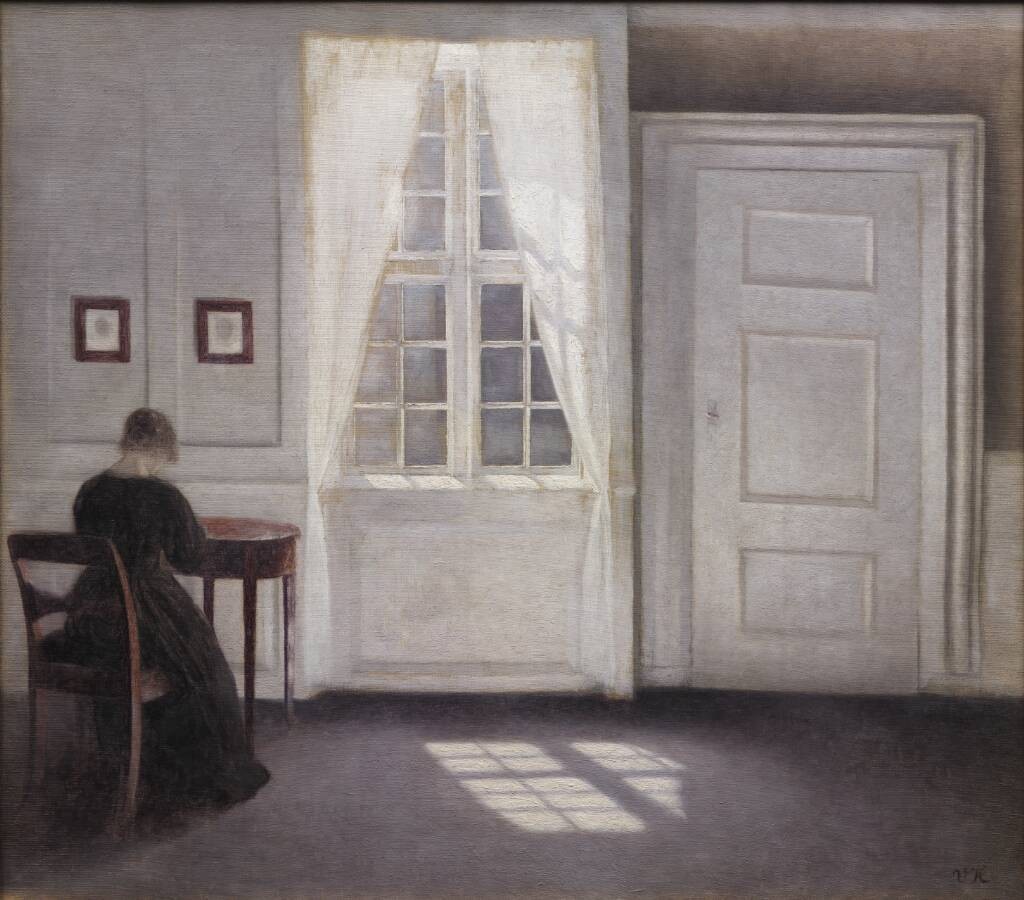
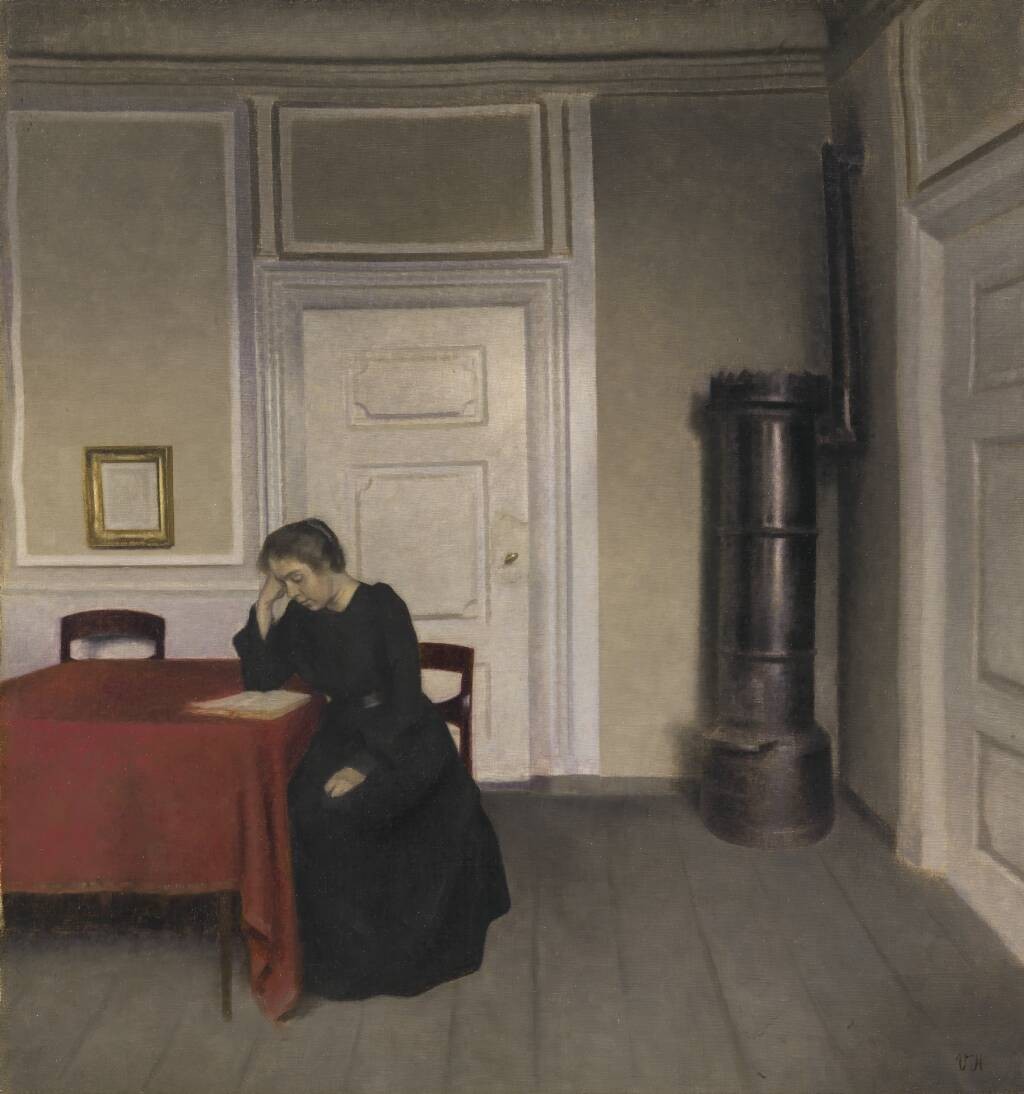
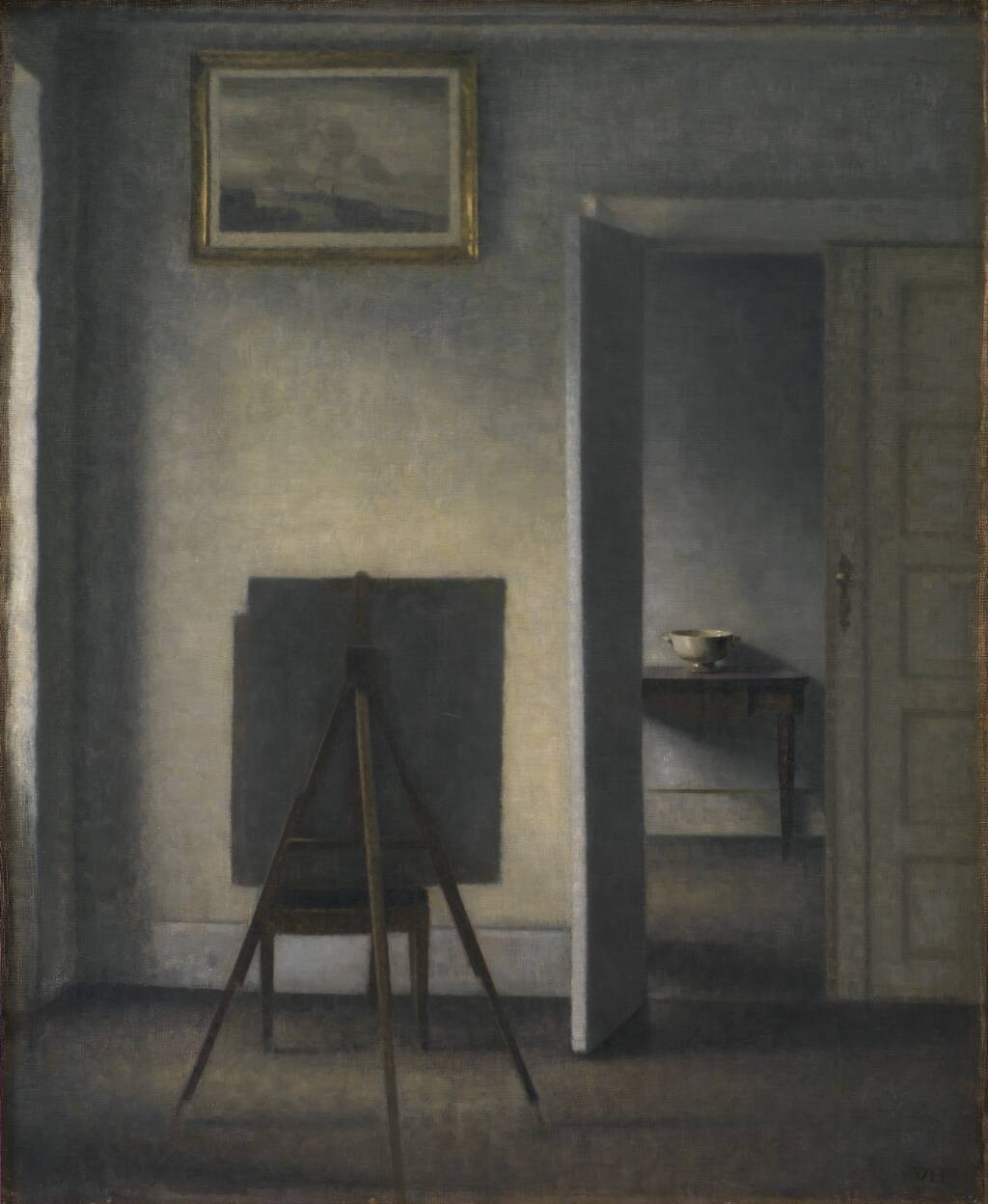
This distinguishes KMS8677 from the open-door structure of Interior with the Artist’s Easel. It also differs from the daylight reaching the floor in Interior in Strandgade, Sunlight on the Floor and the stronger colour accent in the 1902 red-table interior. Each is an independent object, not an interchangeable illustration of a single “Hammershøi room”.
Two Flames and Uneven Illumination
The candles sit very close together, slightly left of the painting’s horizontal centre. Their pale yellow flames and slender bodies make the brightest compact marks in the picture. Yet the light does not spread evenly. A muted patch opens across the wall to the left and above them, while the upper edge and corners remain dense. The candles therefore provide a point of orientation without explaining every tonal variation as a mechanically calculated pool of light.
The candlesticks, central tabletop, chair back and left sofa arm contain small highlights. ViHDA’s examination found that some of these were made by scratching into wet paint so that the pale ground became visible.[2] Light is thus represented partly by removal: a narrow exposed trace can register as a reflected edge. The candles themselves carry slightly more pronounced paint than most of the surface, but even there the handling remains controlled.
Nothing in the object record identifies the flames as religious emblems or establishes a symbolic programme.[1][2] They can sustain many associations for a viewer, but their demonstrable role is pictorial. They mark the central table, help separate adjacent furniture and give Hammershøi a reason to organise a dark room through minute differences of value. The light, colour and technique guide sets this concentration of illumination within his broader methods.
From Dark Layers Towards Light
Technical examination clarifies why the dim room remains readable. In much of the background, Hammershøi began with a dark layer applied mainly in vertical strokes, then placed greyer tones above it in predominantly horizontal, separated strokes. The sequence generally moved from dark towards light. On the brightest part of the wall, later strokes pass almost imperceptibly over the upper edge of the sofa, softening its outline.[2]
The central tabletop was built differently. Short, pale grey vertical strokes lie over a thin, transparent layer of brownish grey. Elsewhere the paint is so lean that the ground can be discerned through the central table, the right foreground table and the area at the far right of the composition.[2] Black, greys and several dark browns carry most of the scene; grey-yellow and brighter yellow are concentrated around the candles and candlesticks.
These findings prevent a simple equation between restricted colour and simple execution. The image depends on directions of brushwork, transparent passages, exposed ground and local layering. It also complicates any claim that the picture merely records how a room looked at one instant. Hammershøi built a coherent night interior from material decisions that unfolded in sequence. For the larger development of this practice, see the account of Hammershøi’s paintings.
The Late Foreground Table
ViHDA’s examination identifies the rectangular table on the right as a late addition. Its paint overlaps both the chair and the right side of the central table.[2] This is not a speculative reconstruction based only on appearance: the physical order of the layers supplies the evidence. No other visible correction is recorded, but this one change substantially affects the finished design.
Without that table, the pair of candles and the round tabletop would have held a more isolated central position. The added form occupies the lower-right quadrant, brings a broad diagonal edge into the composition and partially closes the space around the chair. Its top also catches enough light to echo the central oval without matching its brightness. The change redistributed weight rather than adding narrative information.
The revision helps explain the painting’s balance. Darkness is not an empty surround into which a few objects have been dropped. The foreground table connects the near edge of the canvas to the candlelit group, while its overlap makes the chair’s position easier to judge. Hammershøi’s decision narrowed one route into the room but strengthened the step-by-step recession from foreground furniture to table, sofa and wall.
Artificial Light as a Recurring Subject
ViHDA notes that Hammershøi remained interested in interiors painted by candlelight or other artificial illumination across his career, and it relates KMS8677 to The Coin Collector of 1904, survey 257.[2] That wider recurrence makes the year 1909 part of a sustained enquiry rather than a solitary experiment. It does not, however, make every evening room interchangeable.
The distinct 1891 interior belongs to an earlier moment in the artist’s biography. KMS8677 is fixed to 1909 and to its own support, measurements and provenance.[1][2] Comparisons are most useful when they show what changed: the number and placement of light sources, the visibility of furniture, the relation between figures and objects, and the amount of the room allowed to remain unresolved.
Here, two flames illuminate no human activity. There is no reader, musician or collector to provide a story. The physical evidence instead directs attention to how Hammershøi adjusted paint and furniture. The result can feel hushed or enigmatic, but those words describe responses. The securely documented achievement is more concrete: a room with very little illumination remains spatially intelligible.
From Ida Hammershøi to SMK
The painting’s early ownership continued within the artist’s household. ViHDA records that Ida Hammershøi sold it in 1918, two years after her husband’s death.[2] Her action belongs to her wider role as the later steward and disperser of works associated with their shared life. It should not be turned into evidence that she co-authored the painting or determined its imagery.
SMK acquired KMS8677 at auction in September 2012. The purchase was made possible as a donation from the Augustinus Foundation.[2] This relatively recent museum acquisition explains why the painting’s passage into the national collection is separated by almost a century from Ida’s sale. The current institutional record now connects the exact object, its public image and its technical study.[1][2]
That history also keeps interpretation anchored to a material painting rather than to the vague idea of a candlelit Hammershøi interior. KMS8677 has a specific canvas, changing ownership and examined surface. Its two lights may be visually slight, but the evidence gathered around them makes the picture unusually precise to discuss.
Researched works directory
This directory covers the 133 paintings currently published by the Vilhelm Hammershøi Digital Archive (ViHDA). It is a researched platform census, not a complete catalogue raisonné of the artist's oeuvre.
| Name | Date | Medium |
|---|---|---|
| A Bakery Shop. Study | 1888 | Painting |
| A Greek Relief. Louvre | 1892 | Painting |
| Amalienborg Square | 1896 | Painting |
| An Ancient Relief. Study | 1878 – 1881 | Painting |
| An Old Woman | 1886 | Painting |
| An Old Woman Standing by a Window | 1885 – 1886 | Painting |
| Artemis | 1893 – 1894 | Painting |
| Bedroom | 1890 | Painting |
| Church of Christiansborg Palace, Copenhagen | 1910 | Painting |
| Church of Sankt Petri, Copenhagen | 1906 | Painting |
| Double Portrait. Vilhelm and Ida Hammershøi | 1892 | Painting |
| Evening in the Drawing Room. Strandgade 30 | 1904 | Painting |
| Evening in the Sitting Room. | 1904 | Painting |
| Evening Interior. Artificial Light. Ida and Frederikke Hammershøi | 1891 | Painting |
| Farm. Refsnæs | 1900 | Painting |
| Five Portraits. Study | 1901 | Painting |
| Frederiksborg Castle | 1893 | Painting |
| From Christianshavns Canal | 1905 | Painting |
| From Frederiksholms Kanal | 1893 | Painting |
| From Kvæsthusbroen | 1908 | Painting |
| From the British Museum. London, Winter | 1906 | Painting |
| From the Church Santo Stefano Rotondo in Rome | 1902 – 1903 | Painting |
| From The Greenlandic Trade Dock. Christianshavn | 1908 | Painting |
| From the Old Christiansborg Palace | 1907 | Painting |
| Hammershøi's palette | Uncertain/Unknown | Painting |
| Head of a Woman. Study for Artemis | 1893 | Painting |
| Houses. Arresødal near Frederiksværk | 1904 | Painting |
| Interior | 1898 | Painting |
| Interior in Louis Seize style. Rahbeks Allé | 1897 | Painting |
| Interior. 'The Four Rooms'. Strandgade 25 | 1914 | Painting |
| Interior. A Young Man Reading | 1898 | Painting |
| Interior. Artificial Light | 1909 | Painting |
| Interior. Attic Room with Table and Chair | 1883 – 1885 | Painting |
| Interior. Frederikke and Anna Hammershøi | 1884 | Painting |
| Interior. From The Great Hall of Lindegården | 1909 | Painting |
| Interior. Ida Hammershøi at a Sewing Table | Uncertain/Unknown | Painting |
| Interior. Living Room in Louis-Seize-Style. Rahbeks Allé 26 | 1893 – 1896 | Painting |
| Interior. Looking out on the Exterior. Strandgade 30 | 1905 | Painting |
| Interior. Strandgade 30 | 1901 | Painting |
| Interior. Strandgade 30 | 1902 | Painting |
| Interior. Strandgade 30 | 1905 | Painting |
| Interior. Study in Sunlight. Strandgade 30 | 1906 | Painting |
| Interior. Sunshine in the Drawing Room III | 1903 | Painting |
| Interior. The Music Room. Strandgade 30 | 1908 | Painting |
| Interior. The Old Stove. Albertinelyst | 1888 | Painting |
| Interior. The Tall Windows | 1913 | Painting |
| Interior. With Empire Sofa. Strandgade 30 | 1907 | Painting |
| Interior. With Four Etchings. Strandgade 30 | 1904 | Painting |
| Interior. With Table, Cupboard and Windsor Chair. Strandgade 25 | 1913 | Painting |
| Interior. With the Artist's Easel | 1910 | Painting |
| Interior. With the Artist's Easel. Bredgade 25 | 1912 | Painting |
| Interior. Woman knitting | 1889 | Painting |
| Interior. Woman Reading | 1910 | Painting |
| Interior. Woman Reading. Bredgade 25 | Uncertain/Unknown | Painting |
| Interior. Woman Sitting Behind a Table | 1910 | Painting |
| Interior. Woman Sweeping | 1899 | Painting |
| Job | 1887 | Painting |
| Job. Study | 1887 | Painting |
| Landscape. At Lyngby Lake | 1888 | Painting |
| Landscape. Early Spring | 1909 | Painting |
| Landscape. Gentofte | 1906 | Painting |
| Landscape. Grønsund, Falster | 1890 | Painting |
| Landscape. Gundsømagle near Roskilde | 1885 | Painting |
| Landscape. Gundsømagle near Roskilde | 1886 | Painting |
| Landscape. Kongevejen near Gentofte. Study | 1892 | Painting |
| Landscape. Near Fortunen | 1901 | Painting |
| Landscape. Near Lejre | 1905 | Painting |
| Landscape. Ryet near Farum Lake | 1896 – 1897 | Painting |
| Landscape. Summer. Near Lejre | 1905 | Painting |
| Landscape. Søndermarken Park in Winter | 1895 – 1896 | Painting |
| Landscape. The Rowan Avenue at Snekkersten | 1906 | Painting |
| Landscape. With a Farmhouse | 1878 – 1879 | Painting |
| Landscape. Young Forest, Trørød, Summer | 1907 | Painting |
| Morning Toilette. Study. Strandgade 25 | 1914 | Painting |
| Nude Female Model | 1884 | Painting |
| Nude Female Model | 1910 | Painting |
| Open Doors. Strandgade 30 | 1905 | Painting |
| Portrait of a Young Girl. Anna Hammershøi | 1885 | Painting |
| Portrait. Anna Hammershøi | 1883 | Painting |
| Portrait. Anna Hammershøi. Profile | Uncertain/Unknown | Painting |
| Portrait. Daniel Jacobson Salter | 1901 | Painting |
| Portrait. Elisabeth Dorothea Rentzmann | Uncertain/Unknown | Painting |
| Portrait. Elisabeth Wandel | 1890 | Painting |
| Portrait. Fini Henriques | Uncertain/Unknown | Painting |
| Portrait. Frederikke Hammershøi | Uncertain/Unknown | Painting |
| Portrait. Frederikke Hammershøi. Study | 1894 | Painting |
| Portrait. Henry Madsen. Study | 1904 | Painting |
| Portrait. Henry Madsen. Study | 1904 | Painting |
| Portrait. Ida Hammershøi | 1894 | Painting |
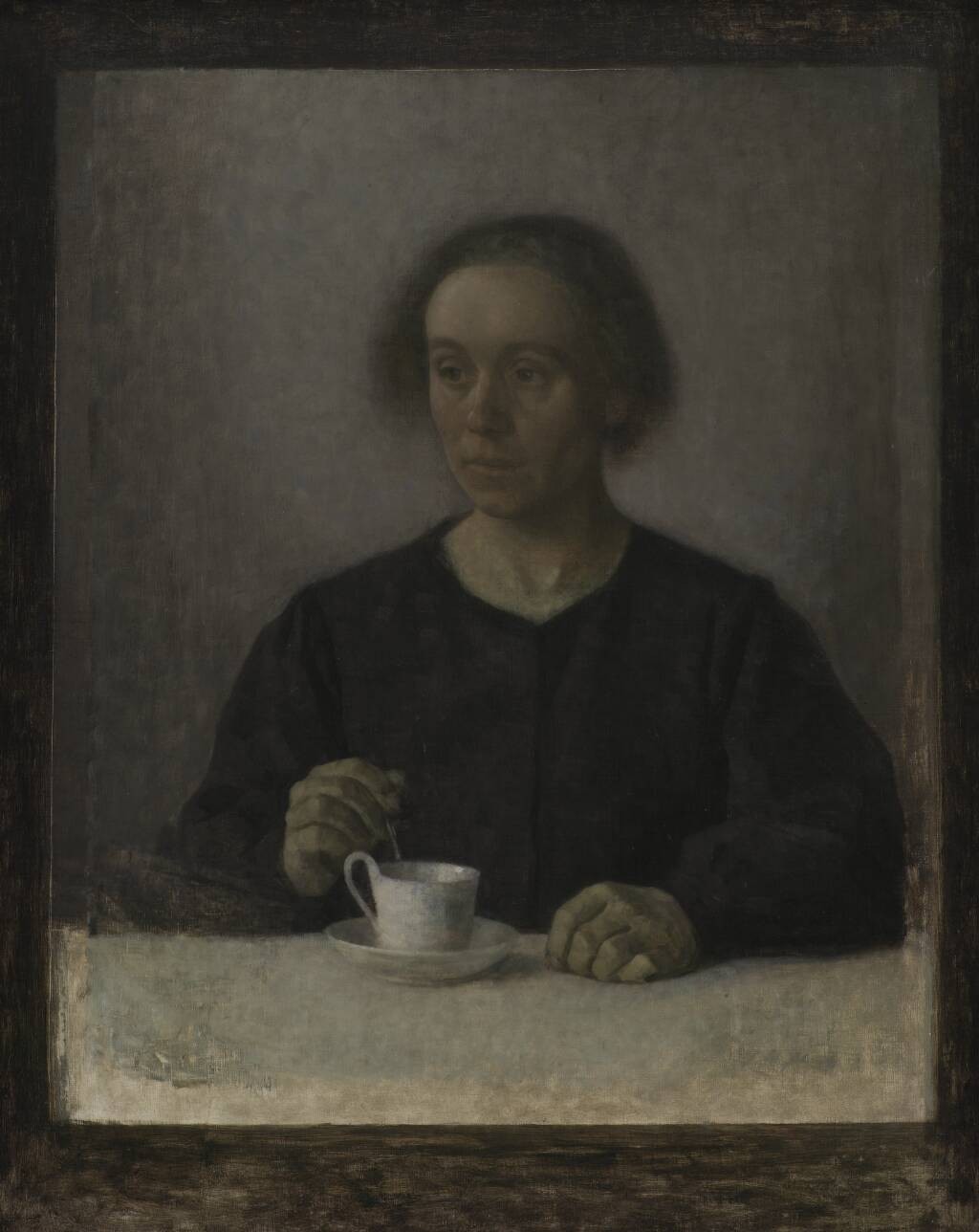
| Portrait. Ida Hammershøi with a Teacup | 1907 | Painting |
| Portrait. Ida Ilsted | 1890 | Painting |
| Portrait. Ida Ilsted. Study | 1890 | Painting |
| Portrait. Ida Ilsted. Study | 1890 | Painting |
| Portrait. J.F. Willumsen. Study for Five Portraits | 1901 | Painting |
| Portrait. J.F. Willumsen. Study for Five Portraits | 1901 – 1902 | Painting |
| Portrait. Karen Malm | 1914 | Painting |
| Portrait. Karl Madsen | 1890 | Painting |
| Portrait. Kristian Zahrtmann | 1889 | Painting |
| Portrait. Kristian Zahrtmann | 1889 | Painting |
| Portrait. Svend Hammershøi | 1881 | Painting |
| Portrait. Svend Hammershøi | 1892 | Painting |
| Portrait. Svend Hammershøi | 1903 – 1904 | Painting |
| Portrait. Svend Hammershøi. Study for Five Portraits | 1901 | Painting |
| Portrait. Thora Bendix, née Anne Victoria Sundberg | 1896 | Painting |
| Portrait. Thora Bendix. Study | 1896 | Painting |
| Portrait. Thorvald Bindesbøll. Study | 1904 | Painting |
| Portrait. Woman. Possibly Frederikke Juncker-Jensen | 1878 – 1881 | Painting |
| Portrait. Woman. Profile | 1888 | Painting |
| Seated Female Nude | 1889 | Painting |
| Self- Portrait | 1891 | Painting |
| Self-Portrait | 1890 | Painting |
| Self-Portrait | 1914 | Painting |
| Self-Portrait. Spurveskjul, Frederiksdal | 1911 | Painting |
| Self-Portrait. Spurveskjul, Frederiksdal | 1911 | Painting |
| Standing Female Model | 1909 – 1910 | Painting |
| Street in London. Montague Street at the British Museum | 1905 – 1906 | Painting |
| Study of a Model. A Woman seen from the Back | 1888 | Painting |
| Sunbeams or Sunshine. "Dust motes dancing in the sunbeams" | 1900 | Painting |
| The Buildings of the Asiatic Company, seen from St. Annæ Street | 1902 | Painting |
| The Cello Player. Henry Bramsen | 1893 | Painting |
| The Coin Collector. Strandgade 30 | 1904 | Painting |
| The Garden Room. Frederiksberg Allé | 1887 | Painting |
| The Tuesday Forest | 1893 | Painting |
| Three Sailing Boats. Christianshavns Canal | 1905 | Painting |
| Tree Trunks. Arresødal near Frederiksværk | 1904 | Painting |
| View of Christiansborg Palace. Late Autumn | 1890 – 1892 | Painting |
| View of Gentofte Lake . 'Sunshower' | 1903 | Painting |
| View of Gentofte Lake . 'Sunshower'. Study | 1903 | Painting |
| View of Jægersborg Allé. Study | 1892 | Painting |
| White Doors. Strandgade 30 | 1899 | Painting |
| Woman Knitting. Frederikke Hammershøi | 1889 | Painting |
| Young Beechwood. Arresødal near Frederiksværk | 1904 | Painting |
| Young Girl Sewing. Anna Hammershøi | 1887 | Painting |
Frequently Asked Questions
It belongs to SMK – National Gallery of Denmark and has the inventory number KMS8677.[1] SMK acquired it at auction in September 2012 with support provided as a donation by the Augustinus Foundation.[2]
SMK’s open record gives 60 × 82.8 cm, while ViHDA’s technical record gives 60 × 83.2 cm.[1][2] Both measurements refer to the same 1909 oil painting; the four-millimetre difference in width should be stated rather than concealed by rounding.
No. KMS8677 is the separate work dated 1909, identified by its SMK inventory number and ViHDA survey number 325.[1][2] Similar subject wording does not make the two interiors the same object.
No surviving evidence cited by SMK or ViHDA establishes that interpretation.[1][2] The candles demonstrably function as the picture’s principal lights; symbolic meanings remain possible viewer responses, not documented facts about Hammershøi’s intention.
He added the table in the right foreground at a late stage. Its paint overlaps the chair and the central table, so the layer sequence supports that conclusion.[2] The addition increases the lower-right weight and helps connect the near foreground to the candlelit centre.
Discussion
Use this evidence-led guide as a starting point for close looking rather than a final verdict.
Share an observation about Interior. Artificial Light or a source that adds useful context.
Reader Insights
Which detail most changes your reading of Interior. Artificial Light?
How do scale, surface or the current technical evidence shape the encounter?
What remains uncertain when visual inference is separated from documented fact?
Join the Conversation
Add your reading below, keeping observations specific and evidence clear.
References
- SMK Open, Interior. Artificial Light, KMS8677, accessed 31 August 2026.
- SMK, Vilhelm Hammershøi Digital Archive, Interior. Artificial Light, accessed 31 August 2026.