 by Tom Gurney
Tom Gurney BSc (Hons) is an art history expert with over 20 years experience
Published on June 19, 2020 / Updated on August 2, 2026
Email: tomgurney1@gmail.com / Phone: +44 7429 011000
Contents
- Introduction
- Rural Childhood And Shared Work
- A Postwar Image Without Battlefield Drama
- Relation To Homer's Other Childhood Scenes
- Why This Work Belongs In The Homer Cluster
- Annotated Details
Introduction
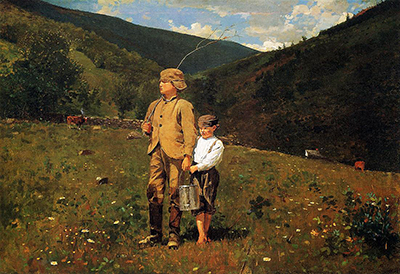
The painting shows two boys moving through a sunlit field with a metal bucket suspended between them. The older child carries a stick over his shoulder and stands between the younger boy and a bull positioned near a stone wall. Homer keeps the scene domestic and rural rather than dramatic. Nothing violent is happening, but the image is organized around a small act of care: one child helping another complete a task while quietly taking the more exposed position. [1]
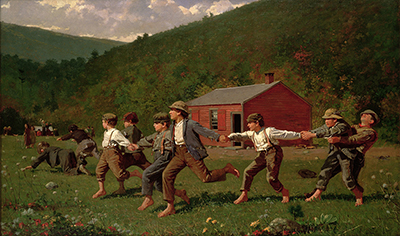
That is the reason this article is best more than a short object stub. Crossing the Pasture belongs to the rural-childhood side of Homer's 1870s work, alongside Snap the Whip, Boys in a Pasture, Weaning the Calf and, by broader comparison, Breezing Up. These works matter because they show Homer looking at children not simply as charming subjects, but as figures learning movement, skill, cooperation, risk and belonging. [2]
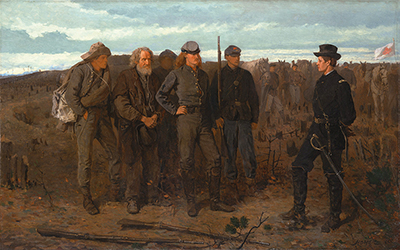
The Amon Carter interpretation is especially useful because it connects the painting to the aftermath of the Civil War without turning the picture into a blunt allegory. Homer had earned early professional visibility through wartime illustration and later made Civil War paintings such as Prisoners from the Front. In Crossing the Pasture, the war is not shown directly. Instead, the museum frames the rural subject as an indirect response to postwar hopes and anxieties, with the brothers' cooperation offering a tender image of unity after national division. [1]
Rural Childhood And Shared Work
The local paintings-hub packet identifies women, children, leisure and rural scenes as central to Homer's painting subjects in the late 1860s and 1870s. Crossing the Pasture fits that pattern, but it is not merely a pleasant farm image. Its subject is childhood as work and care. [2]
The boys are not resting like the figures in Boys in a Pasture. They are not playing a group game like the children in Snap the Whip. They are not steering a boat through wind like the young crew in Breezing Up. They are crossing a field with something to carry. The action is modest, but Homer makes the task legible: two bodies share one weight, and the older child adjusts himself to shield the younger one from possible danger. [1]
That protective arrangement gives the painting its emotional structure. The bull near the stone wall does not need to charge or threaten the boys to matter. Its presence changes the field from an open rural space into a place where confidence and caution must coexist. The boys' journey across the pasture becomes a lesson in how ordinary work can involve attention to another person's safety. [2]
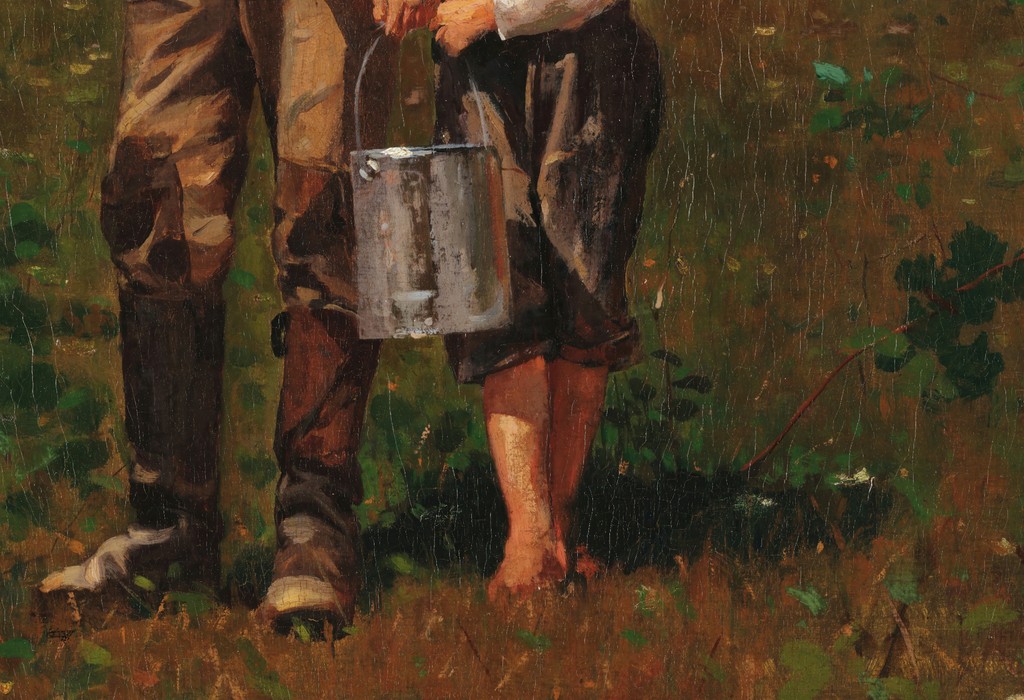
The metal bucket is important for the same reason. It is a simple farm object, but it turns the children into participants in rural labor rather than decorative figures placed in a landscape. Homer often found seriousness in ordinary actions. Here, the seriousness is not hardship on a grand scale. It is the way a small chore reveals age difference, trust and responsibility. [1]
Annotated Details from Crossing the Pasture
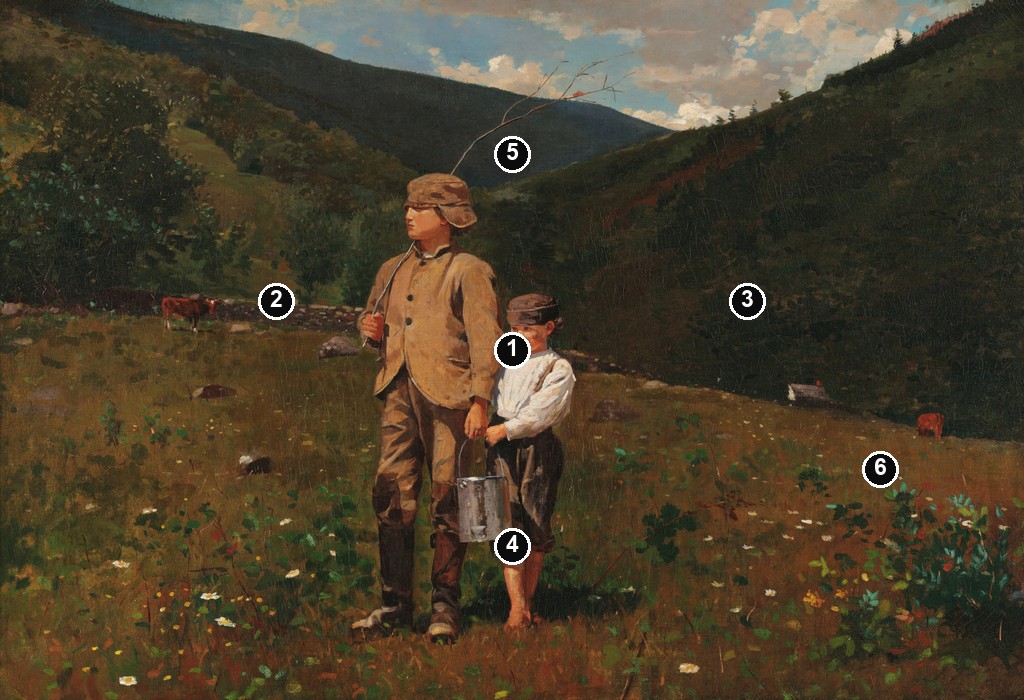
Details from CROSSING THE PASTURE
Close looking follows the composition through figure, setting, foreground and surrounding visual pressure.
Central Action
The central passage carries the first act of close looking, where pose, spacing and surrounding detail establish the main visual problem.
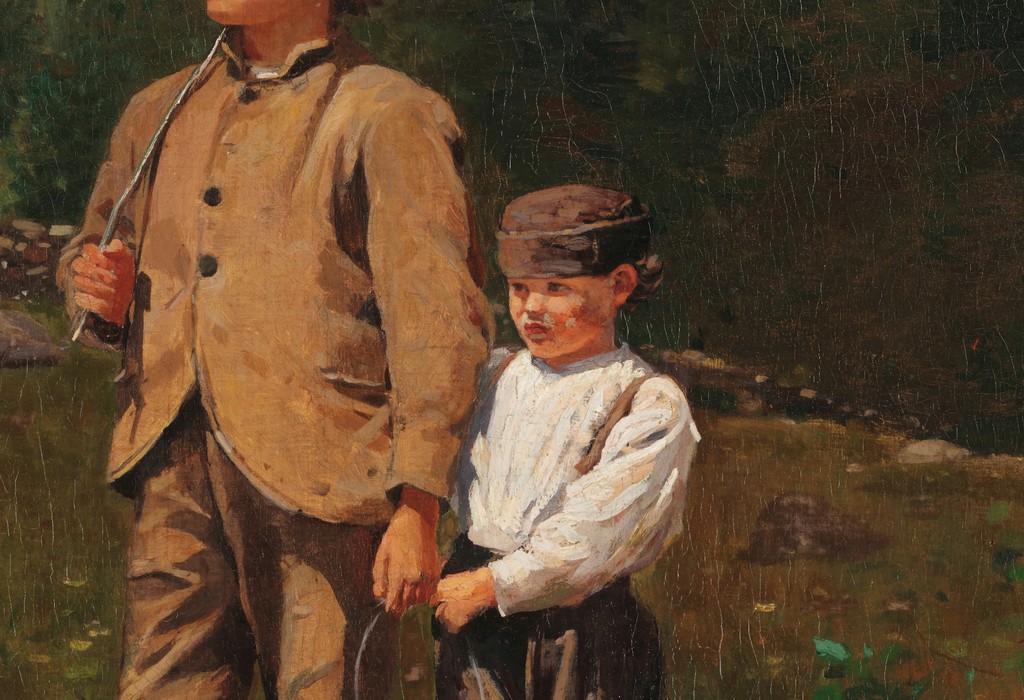
Left-Hand Structure
The left side helps frame the composition and shows how Homer balances incident against the broader setting.
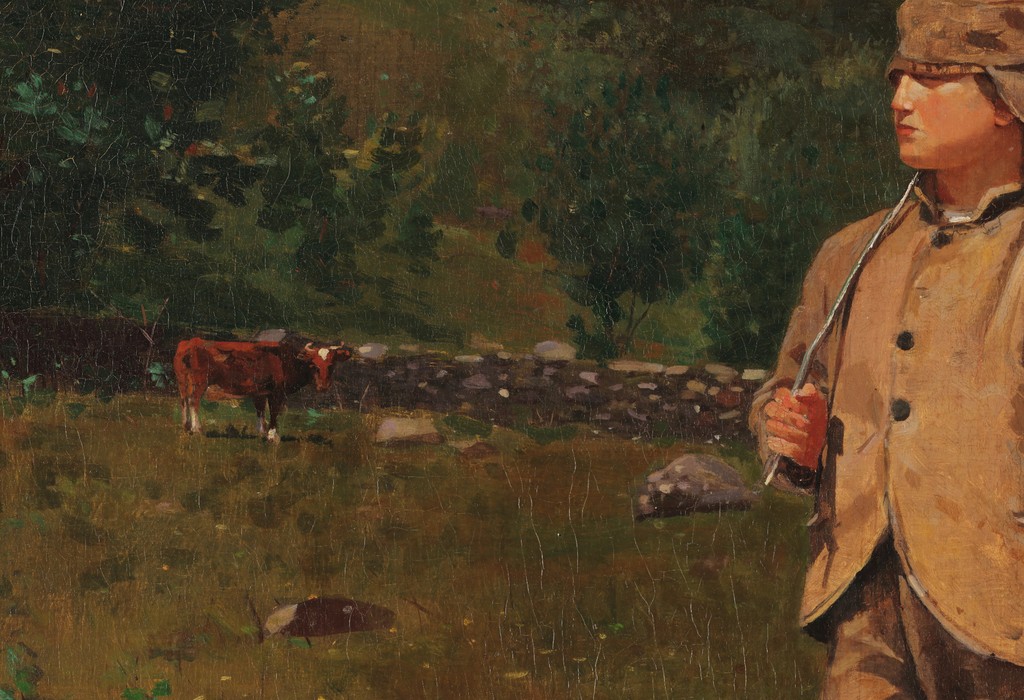
Right-Hand Structure
The right side answers the central group with a second visual pressure, often through movement, distance or environmental force.
Foreground Detail
The foreground gives the viewer a threshold into the image and often contains the practical evidence of work, risk or play.
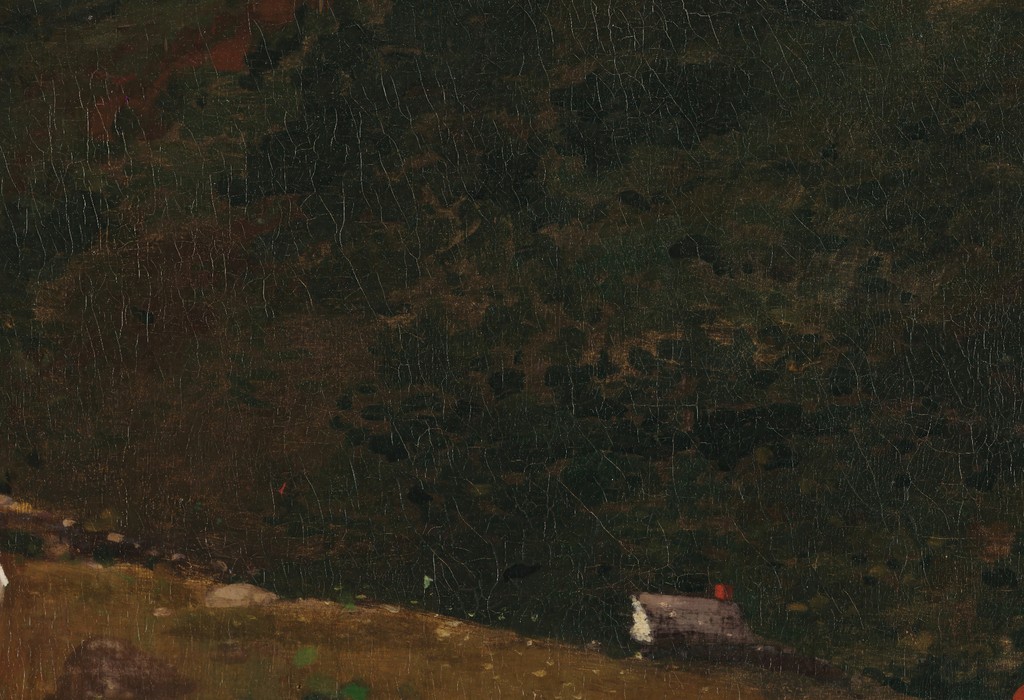
Background Distance
The background opens the picture into weather, landscape or social space, making the scene larger than the immediate figures.
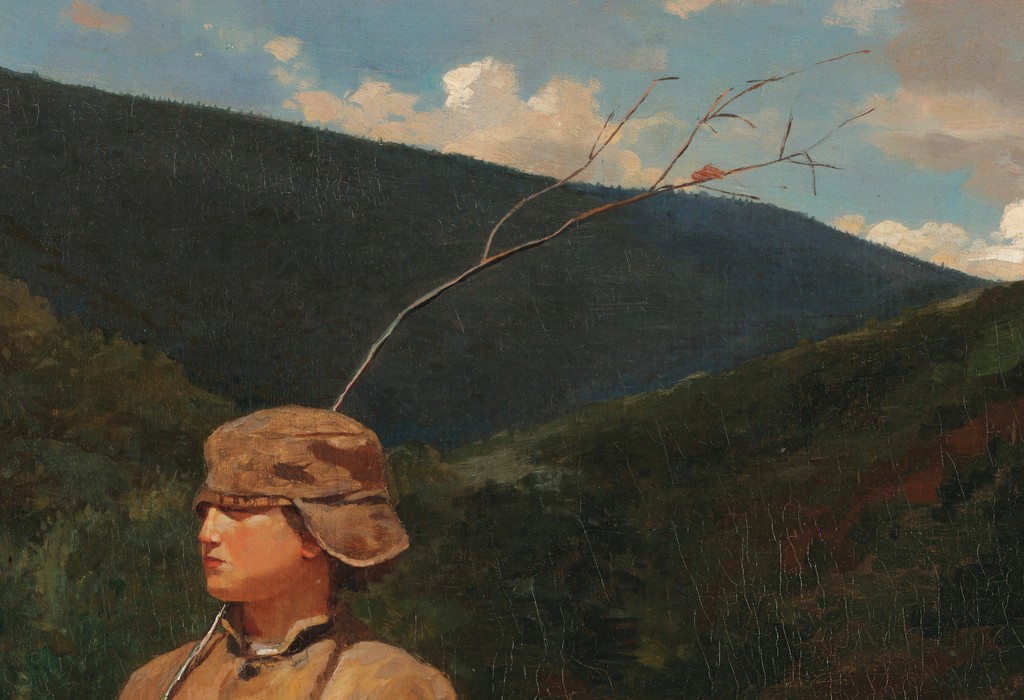
Edge Rhythm
A detail near the edge shows how the composition keeps the eye moving instead of closing around a single motif.
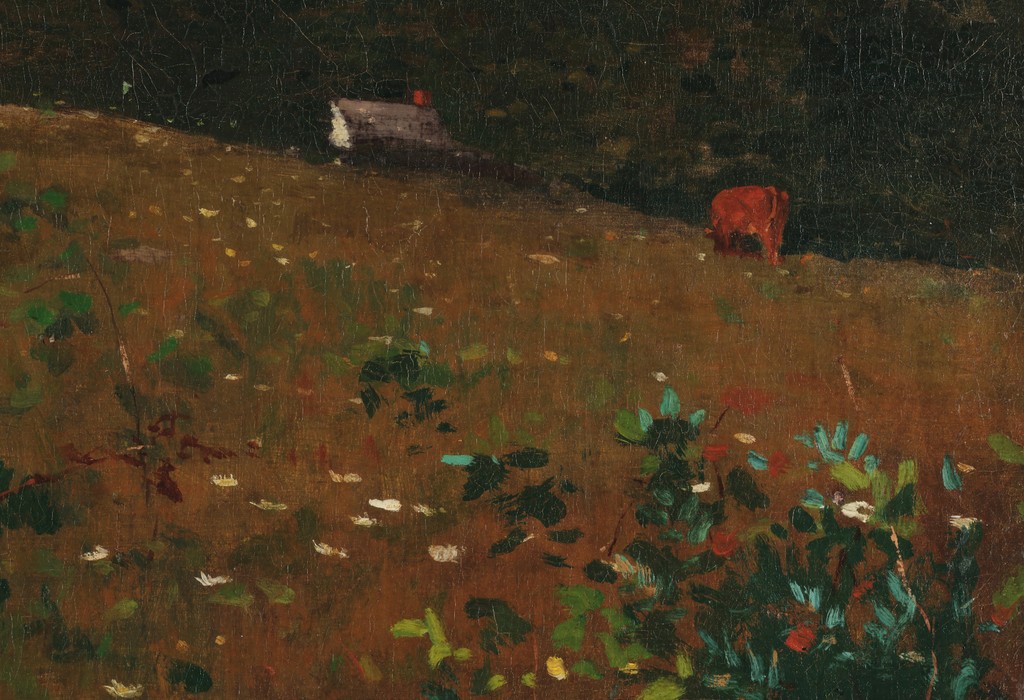
A Postwar Image Without Battlefield Drama
The date matters. Homer made the painting in 1871-1872, after the Civil War and during the period when his art frequently turned toward children, country spaces, leisure, coastal life and Reconstruction-era subjects. Many of these works appear calm at first glance. That calm can be real, but it also belongs to a society trying to imagine ordinary life after conflict. [2]
In this context, the brothers' shared task becomes meaningful without becoming overdetermined. The older boy's protective stance suggests care within a family. The younger boy's barefoot vulnerability makes the act of protection visible. The bucket between them makes cooperation physical. Read against the memory of a war that divided families and communities, the image can suggest a wish for support and repair. The safest wording is cautious: the painting offers a postwar rural image in which sibling unity and shared labor carry emotional pressure. [1]
That restraint is part of Homer's strength. He does not ask the viewer to decode a hidden message. He lets the scene's ordinary facts do the work. A field, a bucket, a wall, a bull and two children become enough to hold a larger feeling because they are observed with such plainness. [2]
Relation To Homer's Other Childhood Scenes
The strongest internal comparison is Snap the Whip. In that painting, children form a line that stretches, swings and nearly breaks apart. The subject is play, but the composition turns play into a test of community under strain. Crossing the Pasture is quieter and more intimate. There are only two children, and their connection is not a game but a shared burden. [1]
Boys in a Pasture offers another useful contrast. It shows boys at rest in grass, with the pasture functioning as a space of leisure and open time. Crossing the Pasture uses similar rural ground for a different purpose. The field is not just a place to lie down. It is a place to move through, to complete a task, and to keep watch. [2]
Weaning the Calf belongs in the same rural-childhood corridor because it also brings children into contact with farm work and animal life. In both paintings, Homer is interested in how children learn through physical situations: pulling, carrying, watching, balancing themselves against animals and land. The adult world is present through tasks even when adults are absent from view. [1]
Breezing Up broadens the comparison from farm labor to maritime skill. It shows young figures in a boat rather than boys in a pasture, but the shared subject is childhood as competence. Homer's children are often active participants in their environments. They do not merely symbolize innocence. They learn weather, work, tools, animals, rules and risk. [2]
Croquet Scene sits farther away in tone, but it helps clarify the range of Homer's postwar outdoor subjects. There, leisure is structured by a fashionable game and social spacing. In Crossing the Pasture, rural work is structured by cooperation and protection. Both paintings show Homer making ordinary activity pictorially serious. [1]
Why This Work Belongs In The Homer Cluster
Crossing the Pasture remains a concise support page, not a flagship and not a split. Its value is connective. It helps the Paintings route show that Homer's postwar career was not only about major war pictures or late marine struggle. It also included rural scenes where childhood, labor, family feeling and national recovery could meet in understated ways. [2]
The article links to Biography for the broader career sequence and to Paintings for the painted-work browse route. Its most useful thematic links are Snap the Whip, Boys in a Pasture, Weaning the Calf, Breezing Up and Croquet Scene. Those links let readers compare play, rest, work, skill and leisure across Homer's postwar figure subjects. [1]
Handled at the right scale, Crossing the Pasture becomes one of the quieter keys to Homer's 1870s. It shows how a simple rural crossing can carry more than anecdote: an older boy's watchfulness, a younger boy's dependence, a shared bucket, an animal nearby and a country still learning how to imagine unity after division. [2]
Discussion
Winslow Homer rewards close looking because his strongest images rarely close down into one easy meaning. Use the prompts below to test how the work changes as you move between subject, place, medium and history.
Reader Insights
First Look
What detail in Crossing the Pasture changes how the whole work feels?
Homer's Method
Where do you see Homer's balance between clear observation and unresolved meaning?
Cluster Context
Which related Homer work helps you read this page more carefully?
Join the Conversation
Share a thoughtful observation below, especially if a detail, source connection or related Homer page changed the way you read the work.
References
- Amon Carter Museum of American Art object record, Crossing the Pasture, Winslow Homer, 1871-1872, accession
1976.37: https://www.cartermuseum.org/collection/crossing-pasture-197637 - Local Winslow Homer Phase 1 approval brief, provisional URL decision matrix, medium-hub source packet, homepage/biography source packet, internal-link ledger, quote ledger, glossary ledger and Tom image-policy ledger dated 2026-07-20.
 Winslow Homer.jpg)