 by Tom Gurney
Tom Gurney BSc (Hons) is an art history expert with over 20 years experience
Published on June 19, 2020 / Updated on August 2, 2026
Email: tomgurney1@gmail.com / Phone: +44 7429 011000
Contents
- Introduction
- Waiting On The Shore
- Gloucester, Boats And Family Life
- Painting And Print Identity
- Why This Work Belongs In The Homer Cluster
Introduction
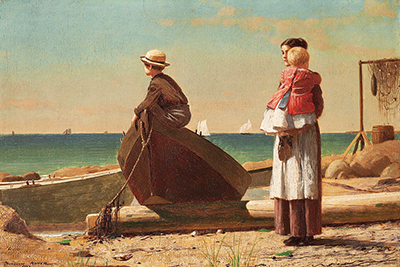
The scene is set on a sandy, working shore. A woman holds a baby while a young boy sits in the lifted end of a rowboat pulled up on the beach. Fishing nets, another boat, rocks, a barrel, scrubby grass and distant sails place the family in a coastal environment rather than a generalized domestic setting. The title points the viewer toward an absent figure: the father has not yet arrived. Homer builds the painting around that absence. [1]
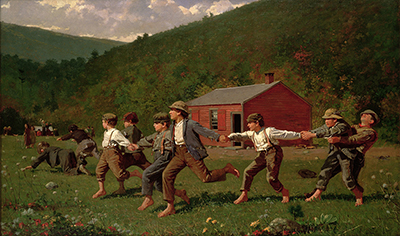
This is why Dad's Coming! deserves more than a brief catalogue note inside the Winslow Homer cluster. It belongs to the artist's 1870s world of children, boats, beaches, family expectation and maritime labor. It is quieter than Breezing Up, smaller than Snap the Whip and less severe than later fishing pictures such as The Fog Warning or The Herring Net. Yet it helps readers understand a key Homer pattern: the coast can look clear and sunlit while still holding uncertainty. [2]
Waiting On The Shore
The central action in Dad's Coming! is not physical labor, rescue or travel. It is waiting. The woman and children are on land, but the shore around them is organized by work at sea. The boats are pulled up, nets are visible, and sails mark the horizon. The family is close to the water without being on it. Homer makes the beach a threshold between domestic life and maritime livelihood. [3]
The title gives the scene its emotional structure. The viewer understands that the family is looking, listening or expecting someone to return. Homer does not need to show the father. His absence makes the figures' stillness more active. The mother holding the baby and the boy perched in the boat become signs of attention. The shore becomes a place where ordinary family life depends on what happens beyond the visible beach. [1]
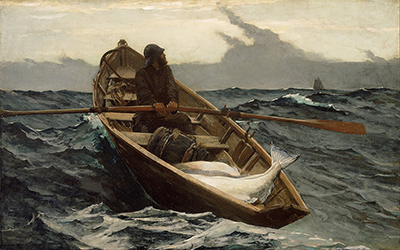
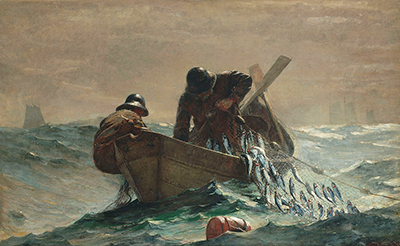
That structure links the painting to Homer's wider treatment of the sea. In some works, the viewer sees the person who must survive the water. In The Fog Warning, the fisherman is still offshore, turned toward a distant vessel and an encroaching weather problem. In The Herring Net, work happens in the dory itself. In Dad's Coming!, the danger or difficulty is not pictured directly. Instead, Homer shows the waiting side of maritime life. The family is not in peril, but its emotional life is shaped by the sea all the same. [2]
The small size of the panel helps the mood. Homer keeps the painting intimate. The figures do not become theatrical symbols. They remain a woman, a baby and a boy on a beach, surrounded by the ordinary equipment of a fishing community. The painting's power lies in how little it forces. A simple family scene becomes a marine subject because the missing father and the surrounding objects make the water present. [3]
Gloucester, Boats And Family Life
The local Homer source packets place the 1870s as a broad period of outdoor subjects, children, leisure, rural scenes, Gloucester material and developing watercolor practice. Dad's Coming! sits naturally within that environment, even though it is an oil painting rather than a watercolor. It shares subject territory with the Gloucester watercolors A Basket of Clams and Boys in a Dory: children near boats, shore tasks, harbor light and the early education of maritime life. [1]
The difference is emotional emphasis. A Basket of Clams shows children carrying a small burden on the beach, with signs of future risk nearby. Boys in a Dory places children inside a practical boat. Dad's Coming! keeps the children beside a mother and turns the boat into a perch and a marker of absence. The rowboat is not moving, but it still organizes the painting. It lifts the boy above the beach and connects him visually to the seaward horizon. [2]
The mother and baby deepen the subject. Homer is not simply painting boys at the shore. He is painting a family group whose adult male member is implied rather than shown. That makes the scene domestic and maritime at once. It also keeps the article from being treated as a minor child picture. The family is waiting inside an economy of boats, nets and return. [3]
This is one reason the painting links to Biography and Paintings, as well as to selected 1870s and marine pages. Homer had moved from illustration into public painting by this stage of his career, but he retained a strong sense of legibility. The viewer reads the situation quickly: family, beach, boat, horizon, waiting. The longer one looks, the more the quiet scene opens toward dependence, labor and risk. [1]
Painting And Print Identity
That print context is best used carefully. The article does not need to blur the NGA oil painting with later or related print records. The active URL is an artwork page for the oil on wood now at the National Gallery of Art. The Harper's Weekly engraving matters because Homer worked across painting, illustration and mass-circulation print culture, and because the subject evidently moved between painted and printed forms early in its history. But the painting remains the anchor. [2]
This distinction is useful for the wider cluster. The Prints page explains Homer's print and illustration career in broader terms. This article can mention the engraving as a related version route without turning into a print-history article. If later build work uses Philadelphia Museum of Art, Smithsonian American Art Museum or Art Institute of Chicago records for the wood engraving, those sources is best added as version support and clearly separated from the painting's object facts. [3]
The NGA exhibition history also records that the work was at times shown under the title Waiting for Dad. That alternate-title history is helpful because it confirms what the picture makes visible: anticipation is the subject. The article does not need to overbuild a title argument, but it can note that the painting has been historically understood through waiting as well as arrival. [1]
Why This Work Belongs In The Homer Cluster
Dad's Coming! is a support page, not a flagship. Its job is to make the 1870s coastal-family route clearer. A reader who arrives from Breezing Up can see that Homer's boating subjects were not only about movement and confidence. A reader who arrives from Snap the Whip can see another version of childhood shaped by force outside the child: not the speed of a game, but the uncertainty of return. A reader who arrives from later marine works can move backward and see how the emotional cost of sea labor enters Homer's art before the late seascapes become severe. [2]
The painting also helps balance the cluster's treatment of gender and family. Many famous Homer marine works center on men in boats, fishermen at work or figures facing weather and survival. Dad's Coming! shifts attention to those who remain on shore. The mother's posture, the baby, the boy in the boat and the shore equipment make a family image out of a marine economy. [3]
In the finished cluster, Dad's Coming! should sit near A Basket of Clams, Boys in a Dory, Breezing Up, Snap the Whip, The Herring Net and The Fog Warning. It shows Homer using a small coastal scene to hold an entire pattern of dependence: children, mother, boat, work, horizon and the hoped-for return of someone still beyond view. [1]
Discussion
Winslow Homer rewards close looking because his strongest images rarely close down into one easy meaning. Use the prompts below to test how the work changes as you move between subject, place, medium and history.
Reader Insights
First Look
What detail in Dad's Coming! changes how the whole work feels?
Homer's Method
Where do you see Homer's balance between clear observation and unresolved meaning?
Cluster Context
Which related Homer work helps you read this page more carefully?
Join the Conversation
Share a thoughtful observation below, especially if a detail, source connection or related Homer page changed the way you read the work.
References
- National Gallery of Art object record, Dad's Coming!, Winslow Homer, 1873, accession number
2001.97.1: https://www.nga.gov/artworks/79891-dads-coming - NGA Open Access/image policy route linked from the object record.
- Local Winslow Homer Phase 1 approval brief, provisional URL decision matrix, medium-hub source packet, homepage/biography source packet, internal-link ledger, quote ledger, glossary ledger and Tom image-policy ledger dated 2026-07-20.
 Winslow Homer.jpg)