 by Tom Gurney
Tom Gurney BSc (Hons) is an art history expert with over 20 years experience
Published on June 19, 2020 / Updated on August 2, 2026
Email: tomgurney1@gmail.com / Phone: +44 7429 011000
Contents
Introduction
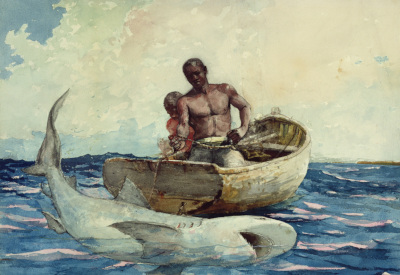
Winslow Homer's Shark Fishing is an 1885 watercolor on paper, now recorded as privately owned. The strongest quickly capturable institutional route is the Art Institute of Chicago's Winslow Homer: Behind the Scenes archive, where the work appears as a comparative illustration related to The Gulf Stream. That AIC resource gives the date, medium, dimensions and private-collection status: watercolor on paper, 13 5/8 x 20 inches, or 34.6 x 50.8 cm. [1]
Those facts are enough to rescue the article, but they also set the article's limits. Shark Fishing does not need to be handled like a fully sourced museum-collection flagship. It is better understood as a concise support page for Homer's tropical watercolors, Bahamas subjects, fishing imagery and later interest in danger at sea. [2]
The image shows a small boat in open water and a large shark drawn close to it. The human figure is not placed safely above the event. He is inside the strain of the scene, working from a fragile craft against an animal that almost matches the boat in visual force. The drama comes from scale and proximity: boat, body, water and shark are held close enough that the contest feels immediate. [3]
Nassau, Watercolor And Marine Risk
The likely context is Homer's Bahamas work of the mid-1880s. The subject is supported by later institutional print records as well as by local Homer packets that identify the Bahamas and Caribbean route as an important part of the artist's travel and watercolor practice. Smithsonian American Art Museum records an 1887 wood engraving titled A Peddler, A Nassau Gateway, Shark-Fishing - Nassau Bar, from The Century Magazine, February 1887. Brooklyn Museum holds another 1887 engraving record with Shark-Fishing on the verso. These records do not prove that the 1885 watercolor and the 1887 print are identical objects, but they confirm that shark fishing at Nassau was a documented Homer subject in this period. [4]
Watercolor is central to the work. The medium lets Homer make the sea active without overbuilding it. The water can be transparent, flashing, pale, deep or unstable within the same sheet. The boat remains legible, the shark remains forceful, and the scene keeps the speed of an observed encounter. That quickness is part of the subject. Shark fishing depends on response: pull, balance, weight, risk and timing. [5]
Between Work And Peril
The title names fishing, not attack. That is an important restraint. The shark is dangerous, but it is also the object of labor. The man is not simply a victim before nature; he is working with line, boat and body inside a difficult maritime economy. The scene belongs to a Homer pattern in which the sea is never only scenery. It is workplace, route, food source, danger and test. [1]
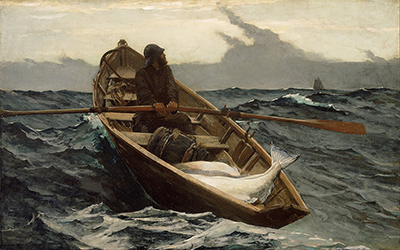
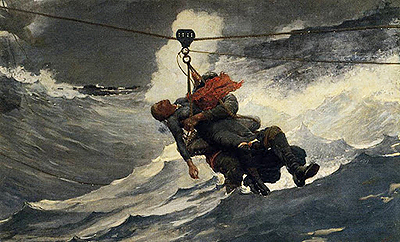
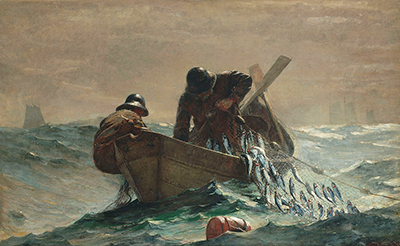
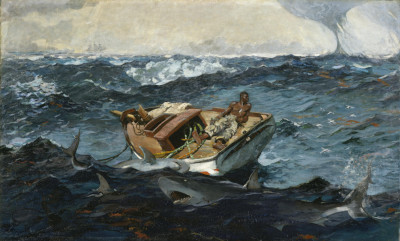
This makes Shark Fishing useful beside other Homer pages without overstating its importance. The Herring Net shows fishing labor in a larger and more fully sourced marine painting. The Fog Warning makes distance, weather and return central to a fisherman's risk. The Life Line turns marine danger into a rescue scene. The Gulf Stream gathers broken boat, sharks, waterspout, Caribbean geography and historical pressure into one of Homer's most complex late paintings. [2]
Shark Fishing is best linked to The Gulf Stream with care. AIC's archive places the 1885 watercolor in relation to that later painting, and the shared presence of shark, boat, tropical water and danger makes the comparison natural. But The Gulf Stream is not merely a larger version of this subject. It has a different date, medium, protagonist, composition and historical weight. Shark Fishing is more direct: a figure in a small boat confronts a shark as part of a fishing event. The Gulf Stream turns exposure at sea into a much larger unresolved condition. [3]
That is why this article stays concise. Its value is not in forcing a long interpretation from a limited source packet. Its value is in placing a vivid watercolor into the rescued Homer cluster and giving readers a clear route from Nassau fishing subjects to the late marine world. The work shows Homer thinking through a problem that would stay with him: how to make human labor, animal force and open water feel inseparable. [4]
Why This Work Matters
For readers, Shark Fishing is a sharp bridge between travel watercolor and marine peril. It does not have the institutional depth of The Gulf Stream, but it helps explain why sharks in Homer are not random sensational details. They belong to a visual field of boats, bodies, labor, weather, Caribbean water and survival. [5]
Handled that way, Shark Fishing becomes a useful support page: modest in length, clear about evidence, and connected to Homer's broader exploration of water as a place where work and danger meet. [1]
Discussion
Winslow Homer rewards close looking because his strongest images rarely close down into one easy meaning. Use the prompts below to test how the work changes as you move between subject, place, medium and history.
Reader Insights
First Look
What detail in Shark Fishing changes how the whole work feels?
Homer's Method
Where do you see Homer's balance between clear observation and unresolved meaning?
Cluster Context
Which related Homer work helps you read this page more carefully?
Join the Conversation
Share a thoughtful observation below, especially if a detail, source connection or related Homer page changed the way you read the work.
References
- Art Institute of Chicago archive, Winslow Homer: Behind the Scenes, resource detail for comparative illustration
Shark Fishing, 1885: https://archive.artic.edu/homer/resource/607 - Smithsonian American Art Museum object record,
A Peddler, A Nassau Gateway, Shark-Fishing - Nassau Bar, from The Century Magazine, February 1887, object number1996.63.213: https://americanart.si.edu/artwork/peddler-nassau-gateway-shark-fishing-nassau-bar-century-magazine-february-1887-37157 - Brooklyn Museum object record, A Peddler and A Nassau Gateway (recto); Shark-Fishing (verso), accession number
1998.105.210a-c: https://www.brooklynmuseum.org/objects/160240 - Wikimedia Commons file record, Winslow Homer - Shark fishing.jpg, used only for object-fact and image-route caution, not as production image clearance: https://commons.wikimedia.org/wiki/File:Winslow_Homer_-_Shark_fishing.jpg
- Local Winslow Homer provisional URL decision matrix, active URL baseline audit, medium-hub packet, homepage/biography packet, internal-link ledger and Tom image-policy ledger dated 2026-07-20.
 Winslow Homer.jpg)