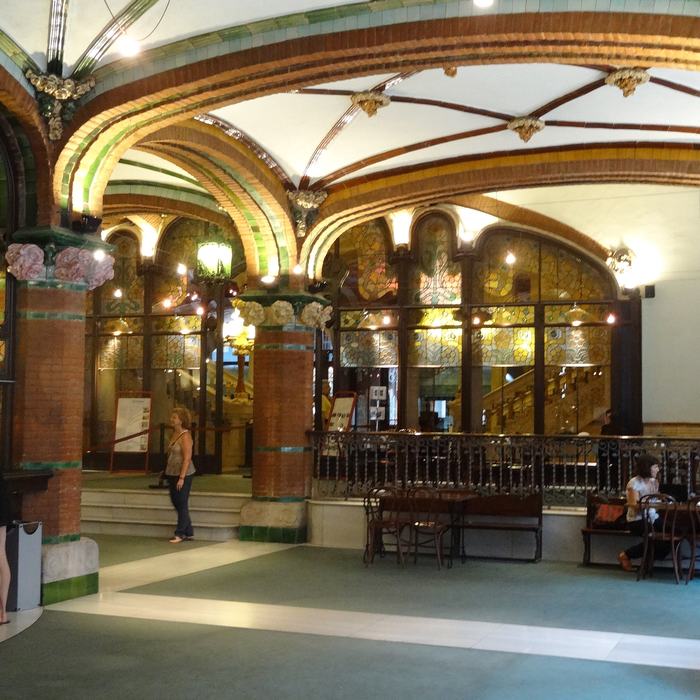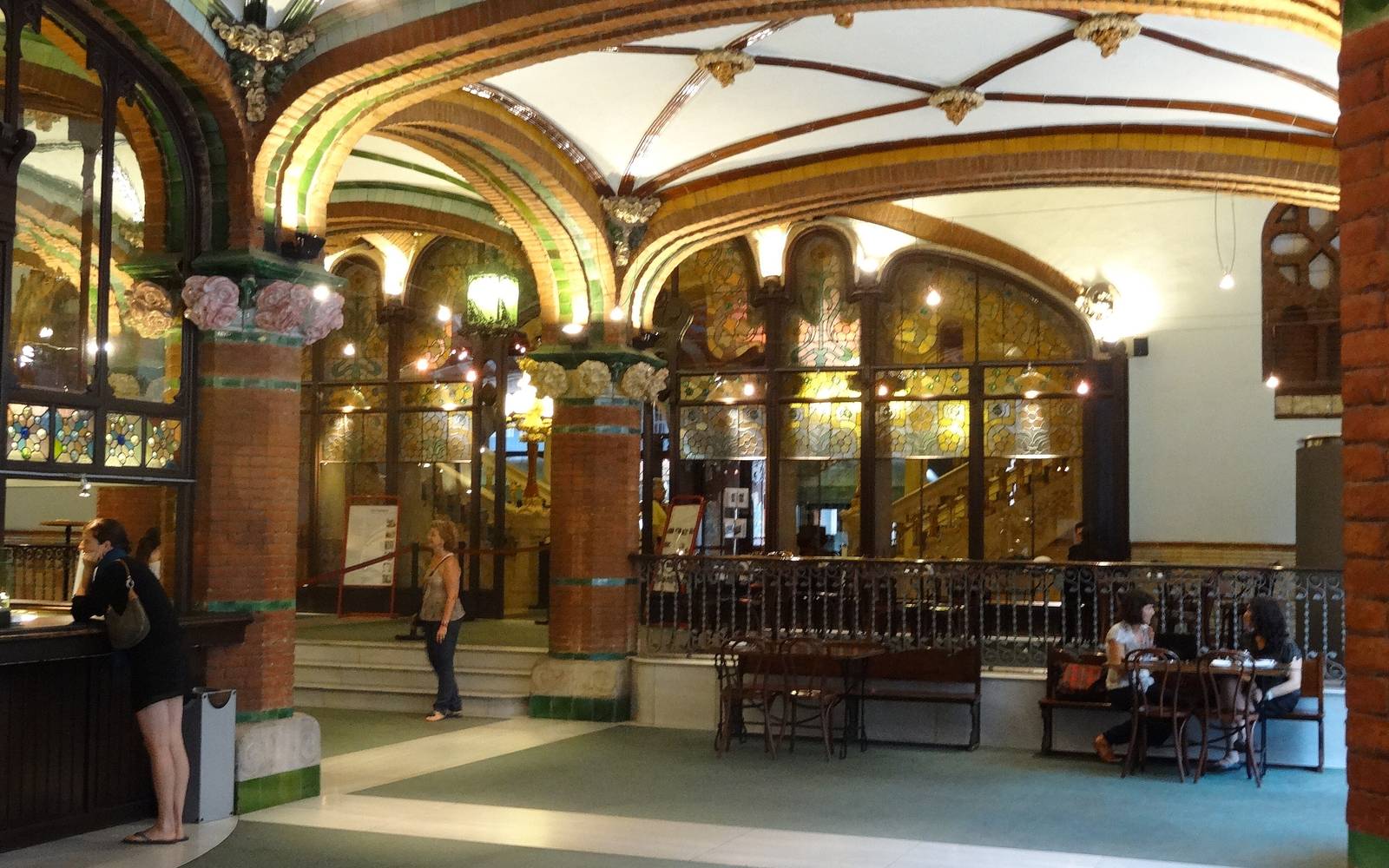
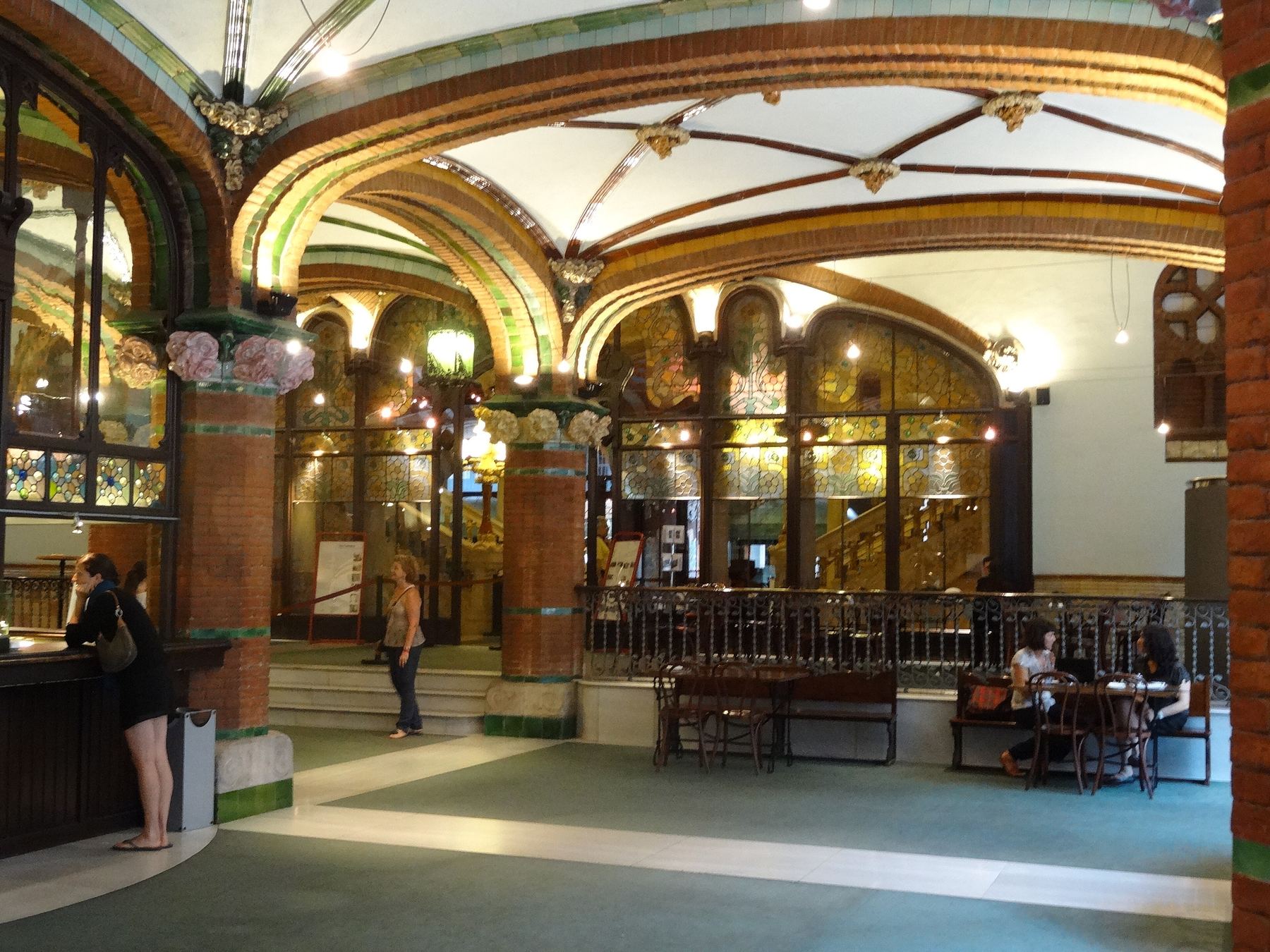
Image reference: interior of the Palau de la Música Catalana.
At a Glance
- Core periodapproximately 1884–1914, with different dates for different arts
- Principal centresBarcelona and Sitges, with important work across Catalonia
- Cultural aimto make Catalan culture modern, European and nationally distinctive
- Leading paintersRamon Casas, Santiago Rusiñol, Isidre Nonell, Joaquim Mir, Hermen Anglada Camarasa and Lluïsa Vidal
- Leading architectsAntoni Gaudí, Lluís Domènech i Montaner and Josep Puig i Cadafalch, with Josep Maria Jujol and many workshop collaborators
- Other major figuresAlexandre de Riquer, Gaspar Homar, Josep Llimona, Miquel Blay, Eusebi Arnau, Adrià Gual and Lluís Masriera
- Major mediapainting, architecture, sculpture, furniture, mosaic, ceramics, stained glass, metalwork, jewellery, posters, books and theatre design
- Related European fieldArt Nouveau, Jugendstil, the Vienna Secession, British Arts and Crafts and French Symbolism
- Essential cautionModernisme joined cultural renewal to industrial wealth, bourgeois patronage, class conflict and competing forms of Catalanism
Contents
- Where it fits
- More than Catalan Art Nouveau
- Naming modernity
- Paris contacts
- Sitges
- Els Quatre Gats
- Ramon Casas
- Four stages
- Essential works
- Artist directory
Where Catalan Modernisme fits
Lluís Domènech i Montaner
Key career periodAntoni Gaudí
Key career periodSantiago Rusiñol
Key career periodRamon Casas
Key career periodJosep Puig i Cadafalch
Key career periodIsidre Nonell
Key career periodJoaquim Mir
Key career periodLluïsa Vidal
Key career periodCatalan Modernisme was not one style and it was never only a way of decorating buildings. It was an argument about how Catalonia could become modern: artistically experimental, connected to Europe and culturally distinct. Painting, architecture, sculpture, furniture, jewellery, posters, publishing, theatre, music and language reform all participated. Their makers disagreed about politics, religion and the social purpose of art, so the plural—Modernismes—often describes the period better than a single visual formula.[1]
The familiar masterpieces remain indispensable, but they change when placed back inside that larger field. The curves of a Gaudí interior belong beside Ramon Casas's grey urban crowds, Santiago Rusiñol's melancholy gardens, Isidre Nonell's thickly painted Roma women, Lluïsa Vidal's scenes of women's lives, Josep Llimona's Symbolist sculpture and Gaspar Homar's marquetry. One generation opened Catalan painting to French modernity; another made it more chromatic, psychologically difficult and socially abrasive; architects and decorative artists transformed the same years into total environments.[2]
More than Catalan Art Nouveau
Keeping the Catalan word Modernisme prevents two common confusions. In English, “Modernism” normally covers a much larger twentieth-century history extending from abstraction to functionalist architecture. Art Nouveau is the closest international relation in architecture and design, but it does not fully contain Modernisme's writing, music, language politics or debates about national regeneration. Catalan makers participated in a European family while giving the term a wider cultural burden.
Barcelona at the beginning of the twentieth century was an industrial, modern and cosmopolitan metropolis of more than half a million inhabitants. Its demolished walls and the Eixample plan allowed rapid expansion toward factory suburbs. The new aesthetic became a durable sign of a culturally resurgent Catalonia, but it flowered in a city described by its own historical museum as both dynamic and socially conflictive.[3]
That setting matters because Modernisme joined creation to urban transformation. The orderly modern city promised circulation, sanitation and growth, yet urban redevelopment also served industrial capitalism and the management of working-class unrest. Art and design occupied this double system: they could imagine freer forms while helping property owners make the new bourgeois city more valuable and more visibly stratified.[4]
The movement was also broader in time than a single architectural fashion. A major international survey places its emergence in the 1880s and its continuation into the 1910s. Casas and Rusiñol stand at the beginning of modern painting, followed by Mir, Nonell and the young Picasso, while architects, printmakers and designers developed partly independent chronologies. A date useful for a journal may be too early for a hospital or church still under construction.[5]
This is why the article uses approximately 1884–1914 rather than enforcing an official lifespan. The first date captures a new cultural vocabulary; the second includes major architecture and the eve of the First World War. Individual careers run far beyond it, and no artist signed a contract to remain Modernista.
Naming the need to be modern
The word began as a declaration before it became a museum category. A Catalan text published in L'Avens in January 1884 insisted that the intellectual movement of Catalonia had to move with its century and cultivate essentially modern literature, science and art. “Modernista” therefore named an attitude toward the present rather than a pattern of floral line.[6]
The journal later standardised its name as L'Avenç. It combined artistic criticism with Catalan cultural assertion, concern for written language and the translation of international thought. Baudelaire, Ibsen, Maeterlinck and Nietzsche entered a field already shaped by Naturalism and political disagreement. By 1893 the periodical had become polemical, nationalist and at times anarchising: European renewal was understood as a way to regenerate Catalonia.[7]
Regeneration did not mean the same thing to everyone. One tendency, associated with Jaume Brossa, wanted culture to intervene in and transform society. An estheticist tendency associated with Rusiñol and Raimon Casellas defended art's autonomy from practical and bourgeois demands. The opposition was never absolute—Rusiñol's public festivals were cultural interventions—but it reveals why Modernisme could contain activist prose and the doctrine of art for art's sake.[8]
Language was itself a designed public medium. Spelling reform, typography, translation, criticism and publishing helped give modern Catalan culture an infrastructure. A magazine page, theatre programme or book cover could therefore be as consequential as a framed painting: it circulated arguments, connected specialists and trained readers to recognise novelty.
Paris was a contact zone, not a template
Paris offered academies, galleries, critics, mass entertainment, posters and international artists. Casas and Rusiñol worked there and absorbed aspects of Impressionism, Naturalism, tonal painting and Montmartre life. Yet their Barcelona modernity was never a complete French import. They selected grey atmosphere, cropped viewpoint, the street and café, then brought those decisions into a different language, market and political culture.
Their early pictures could puzzle viewers accustomed to polished narrative. A room might be quiet rather than anecdotal; a figure could be cut by the edge; weather could dissolve local colour; an ordinary crowd might replace heroic action. Such choices made modernity a way of seeing before Modernisme became the prestigious appearance of the Eixample.
Other routes complicated the exchange. Alexandre de Riquer studied British illustration and design; architects read Ruskin and Viollet-le-Duc; Wagnerian music, Belgian Symbolist theatre, Japanese prints and international exhibitions all entered Catalonia. “Europeanisation” was not submission to one centre. It was an active, sometimes anxious process of choosing what a modern Catalan culture could use.
Sitges: modernity as festival and shrine
The Festes Modernistes made this cultural range visible. Five events held in Sitges from 1892 to 1899 joined exhibitions, Catalan literature, French and Belgian music, translated theatre and symbolic ceremony. The 1893 festival included Maeterlinck's The Intruder in a translation associated with Pompeu Fabra; the 1894 event welcomed two paintings by El Greco to the Cau Ferrat; the 1897 festival presented La fada, with music by Enric Morera. Old master, modern translation and new Catalan production shared one stage.[9]
The Cau Ferrat began as Rusiñol's house and studio and became the movement's most concentrated environment. Painting, drawing, sculpture, ironwork, glass, ceramics, archaeology, furniture and collected objects occupied its rooms. Meetings and performances turned the house into the “Temple of Modernisme.” The title sounds devotional because art was deliberately being offered as an alternative system of value.[10]
Rusiñol was ideally placed to create that role. Painter, writer, collector and traveller, he lived intermittently in Paris between 1889 and 1895 and moved from Naturalism toward Symbolism. Between 1893 and 1899, Cau Ferrat became a movement centre. His authority rested not on a single manifesto but on his ability to connect objects, people, performances and places.[11]
The building also complicates the supposed opposition between modern and old. Rusiñol collected historic iron, glass and El Greco paintings while promoting contemporary work. He did not believe modern culture required historical amnesia. An old object could be removed from ordinary use, arranged within a new ensemble and made to signify artistic devotion.
That process was selective. The festivals distinguished the dedicated artist from the uncomprehending crowd and could turn aesthetic refinement into an elite identity. Their openness to international forms coexisted with a rhetoric of artistic pilgrimage. Modernisme sought a public, but it was often unsure whether that public should be transformed, educated, mocked or kept outside the shrine.
Music, theatre and the modern page
The movement's visual art is easier to preserve than its performances, but music and theatre changed how Modernisme occupied time. A translated play could bring a Belgian Symbolist atmosphere into spoken Catalan; a concert could set local composition beside Franck or other European work; an illustrated programme could prepare an audience before a note sounded. Performance made cultural modernisation collective and temporary. It required bodies in a room rather than monuments admired after their makers had gone.
Maeterlinck was important because his theatre replaced crowded incident with waiting, silence and unseen threat. Those qualities had visual equivalents in Rusiñol's empty gardens and Symbolist interiors, but influence did not travel in one direction. Scenery, poster, costume, typography, acting and music could cooperate to produce an environment whose unity resembled the total interior. Adrià Gual's work across graphics and theatre is exemplary of a generation for whom the border between page and stage was porous.
Music carried a different argument about nation. Enric Morera's participation in the Sitges festivals and his theatrical collaborations did not simply provide sound behind visual culture. Choral association, Catalan text and the reception of Wagner or Franco-Belgian composition offered ways to imagine a public joined through listening. The later Palau de la Música would monumentalise that possibility, but the cultural practice existed before its hall.
Translation was equally creative. Rendering international writing into Catalan demonstrated that the language could address difficult contemporary thought rather than remain confined to revivalist subjects. Spelling, type, paper, illustration and distribution made linguistic reform visible. Modernisme's national aspiration was therefore not a retreat into cultural purity: at its most ambitious, it tried to build a Catalan language capable of absorbing and disputing Europe.
The page also complicated the opposition between elite and mass culture. A luxurious art journal, an inexpensive programme, an advertisement and a literary volume reached different publics, but they shared printers, illustrators and typographic experiments. Repetition could spread a modern visual identity far beyond the owners of commissioned houses. The movement was encountered not only by entering a decorated room but by reading, watching, listening and carrying paper through the city.
Els Quatre Gats and performed bohemia
Barcelona acquired a different kind of centre in Els Quatre Gats. Open from June 1897 to July 1903 in Puig i Cadafalch's Casa Martí, the tavern adapted the example of Paris's Le Chat Noir. Casas, Rusiñol, Miquel Utrillo and Pere Romeu helped create an aura of bohemian experiment that later memory enlarged into legend.[12]
Its importance lay in the mixture. Architecture, chandeliers, painted panels, posters, menus, magazines, concerts, puppet shows and exhibitions formed a social interior. Established travellers met a younger generation that included Mir, Nonell and Picasso. Modern art was not simply displayed there; it became conversation, entertainment, publicity and self-caricature.
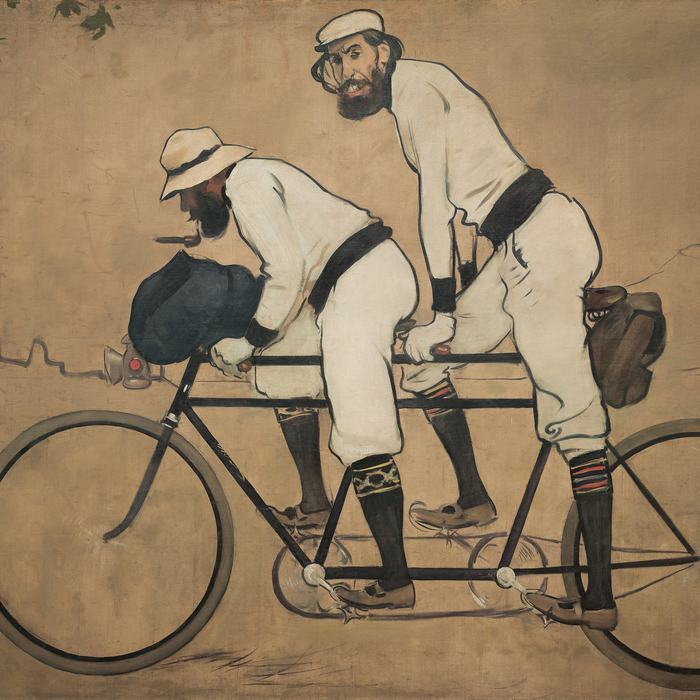
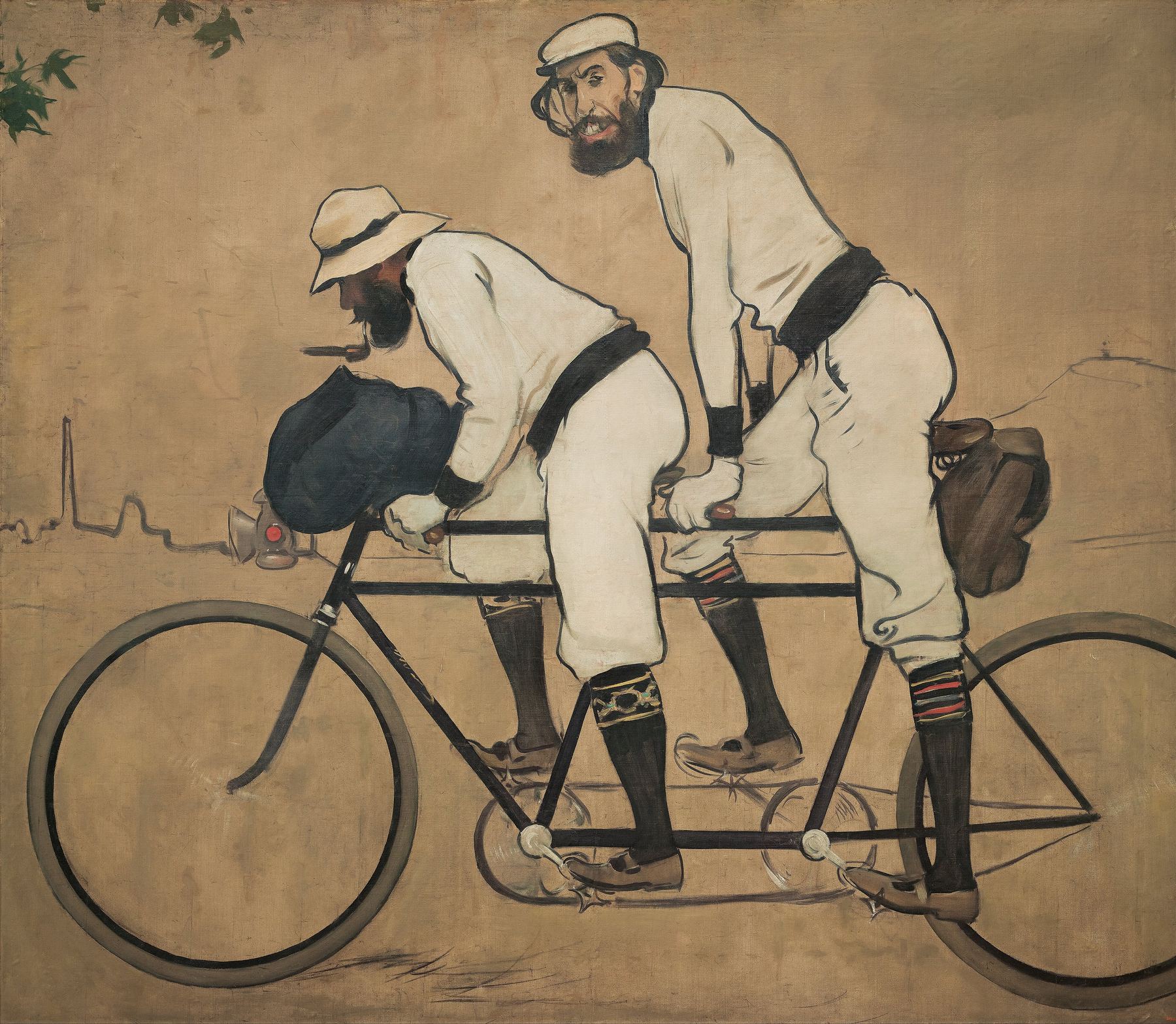
Casas's Ramon Casas and Pere Romeu on a Tandem was made for the tavern in 1897. The two men pedal across a huge, lightly described field with Barcelona reduced to a distant silhouette. Their forward lean, cut wheel and humorous solemnity bring oil painting close to poster design. In 1901, Casas replaced the tandem with an automobile: the movement's emblem updated itself from one modern vehicle to another.[13]
The picture is funny because bohemia here is staged, not innocent. Casas had bourgeois resources; the tavern needed customers; its rebellious identity relied on branding and print. That does not make the experiment false. It shows how quickly modern culture learned to turn artistic independence into an image that could circulate.
Ramon Casas: the city as an event
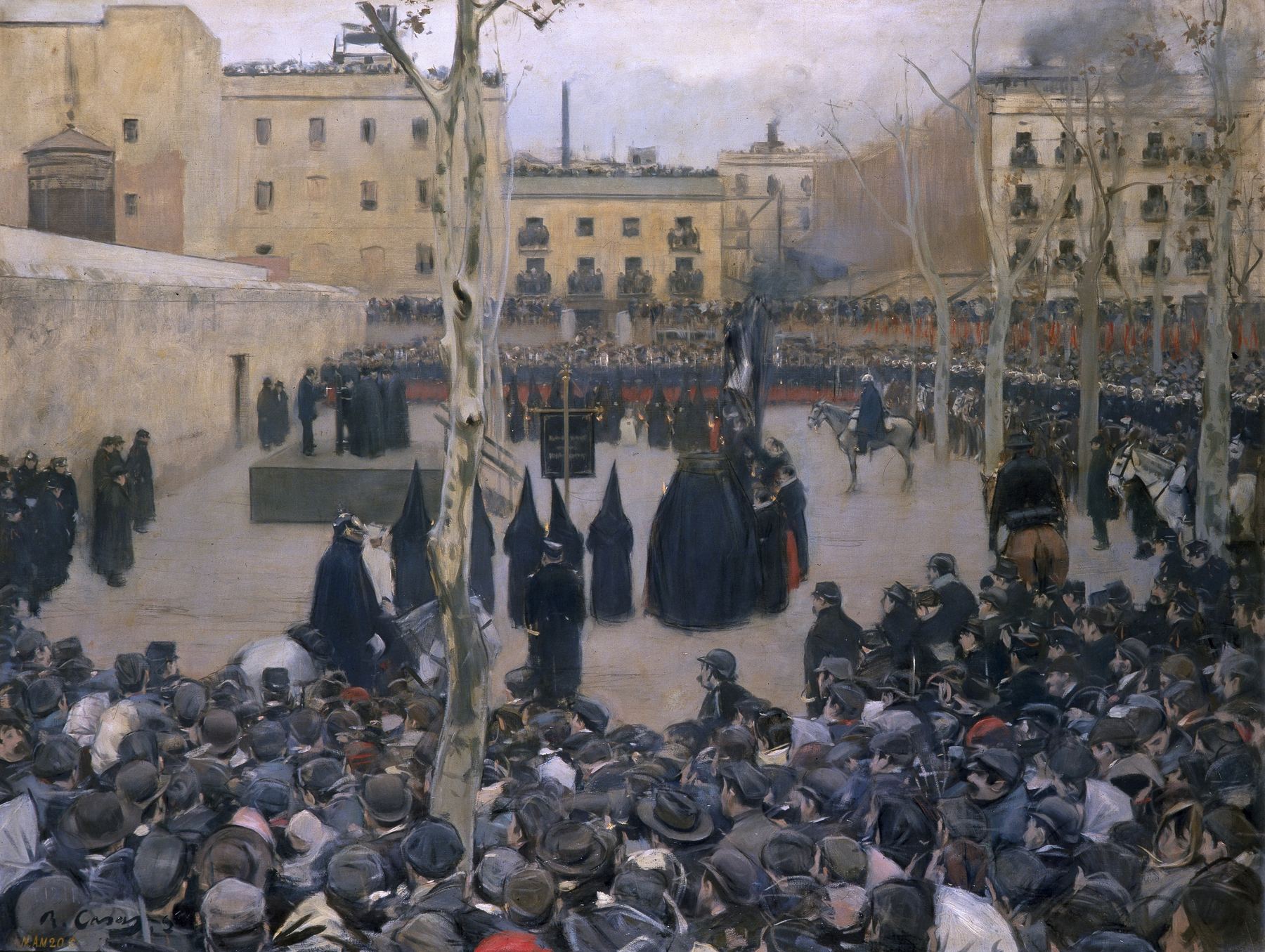
Casas's crowd paintings are very different from the tandem and equally central. In Garrot Vil, he represented a public execution he had witnessed in Barcelona in 1893. A high viewpoint spreads the crowd around the scaffold while industrial chimneys appear beyond. Instead of enlarging the condemned man into melodramatic hero or victim, Casas turns the whole gathering into a modern event observed with disquieting distance.[14]
That distance resembles journalism without becoming neutral. Heads, hats and shoulders form a social surface; the small centre of punishment is visible only through the ring that surrounds it. The viewer looks from above and cannot claim the moral purity of standing outside the spectacle. Casas makes public attention itself the subject.
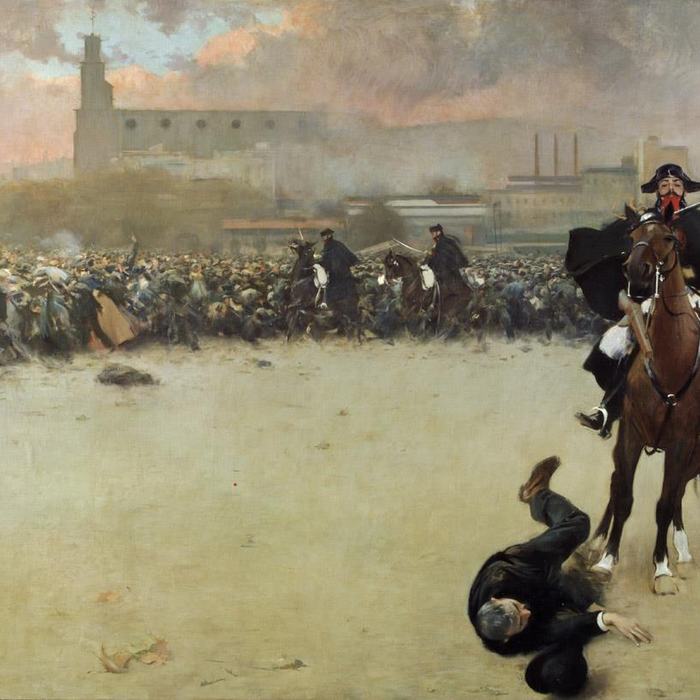
La Càrrega addresses state violence more directly. A mounted Civil Guard charges a fallen worker while the fleeing crowd is compressed toward the distance. The location is an invented Barcelona, and the great empty foreground acts like a field into which the viewer might step. The space is not passive: it magnifies the interval between force and collective retreat.[15]
Casas could therefore paint the stylish sitter, the advertiser, the cyclist, the crowd and the machinery of repression. Modernista painting is not defined by whether its politics are radical. It is defined here by a new problem: how can an image organise life that is immediate, massed, unstable and mediated by the press?
Official exhibitions helped determine which answers entered public memory. Barcelona's fine-art shows of 1891, 1892, 1894, 1896 and 1898 acquired paintings by Casas and Rusiñol and sculpture by Miquel Blay. By the international exhibition of 1907, Casas and Rusiñol received an honour room while Mir, Nonell and others appeared as a newer “postmodernist” generation. Institutions did not merely recognise the movement; they organised its generations and preserved particular works.[16]
Rusiñol: modernity turned inward
Rusiñol's painting often rejects the public crowd. Paris rooms, Sitges patios, ill figures and deserted gardens convert modern experience into silence. Walls, paths and clipped greenery can become psychological structures. A garden is cultivated nature, but in his hands it may look abandoned, ceremonial or close to death.
His movement from Naturalism toward Symbolism did not mean abandoning observed places. It changed what description was asked to hold. A tree, fountain or empty stair could sustain an emotional state without illustrating a story. Grey and green could make the modern world feel old, while carefully ordered space suggested that beauty survived only through withdrawal.
This inward direction clarifies the estheticist claim. Art offered shelter from commercial measure and social noise, yet Rusiñol's shelter depended on property, collecting, travel and public performance. The contradiction is productive: he turned retreat itself into a cultural spectacle.
The younger city: Mir, Nonell and painters of the margins
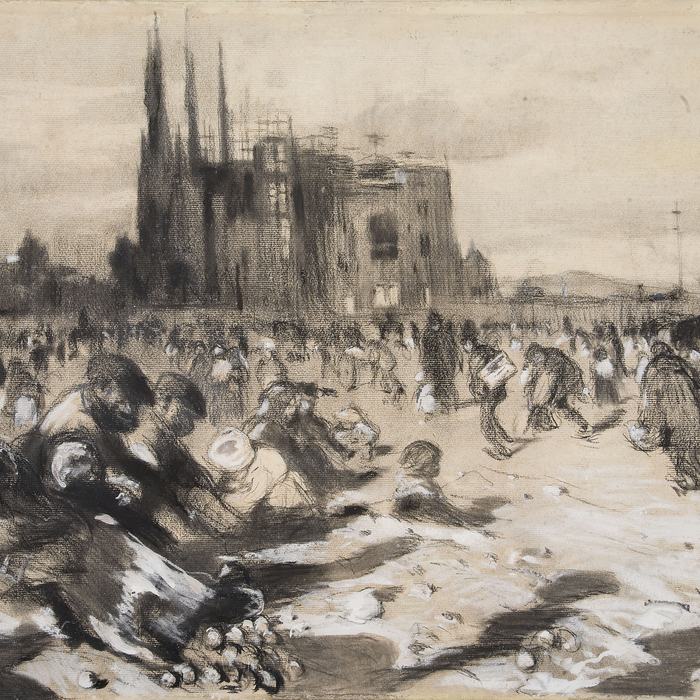
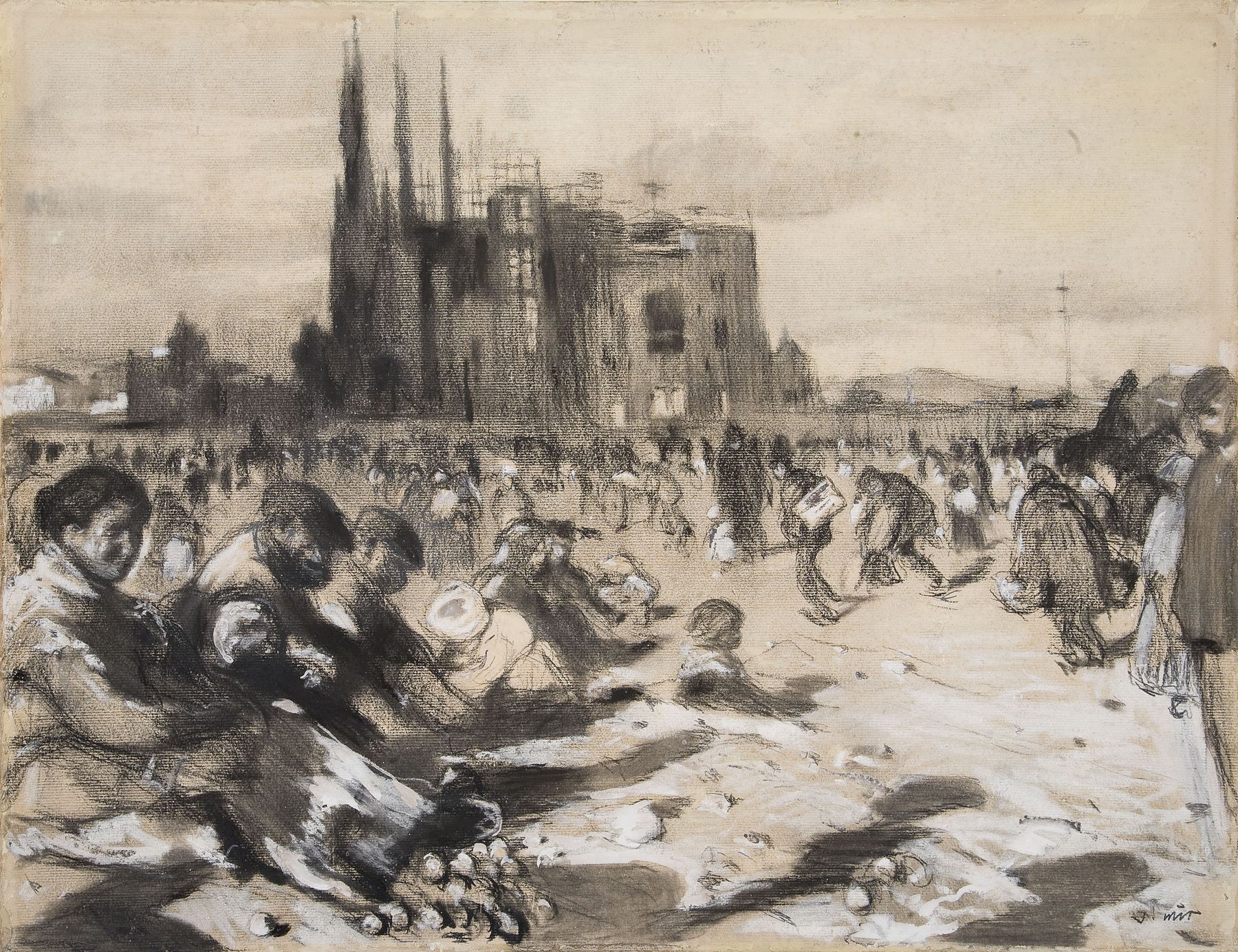
Joaquim Mir's The Cathedral of the Poor joins Barcelona's most ambitious religious building to those living near it. Painted around 1898 when Mir belonged to the Colla del Safrà, it places figures in the foreground before the rising Sagrada Família. The canvas was exhibited first at the fine-art exhibition and then at Els Quatre Gats, connecting official and bohemian circuits.[17]
The architecture does not simply uplift the people below. Mir divides the scene into massive construction and human foreground, making new monument and poverty occupy the same city. Yellowed earth, scaffolding and stone refuse the polished urban image. The painting asks whether cultural aspiration can be separated from the unequal ground on which it rises.
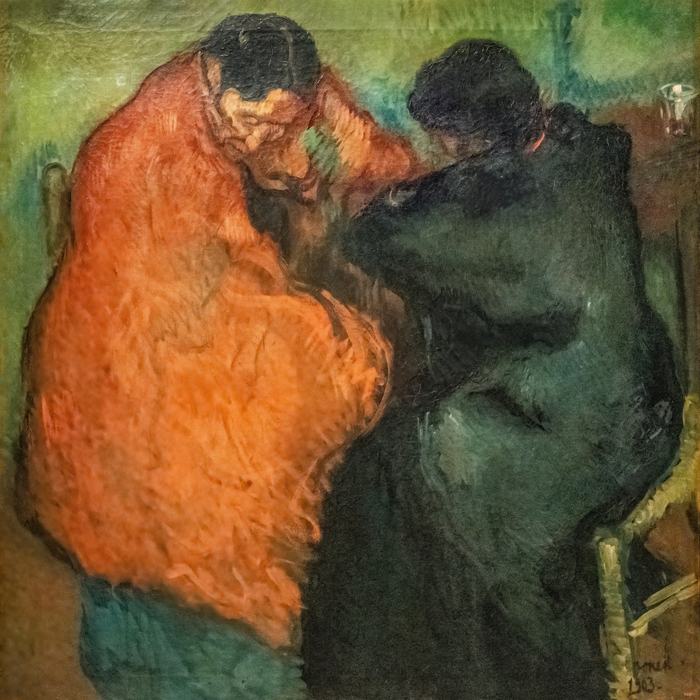
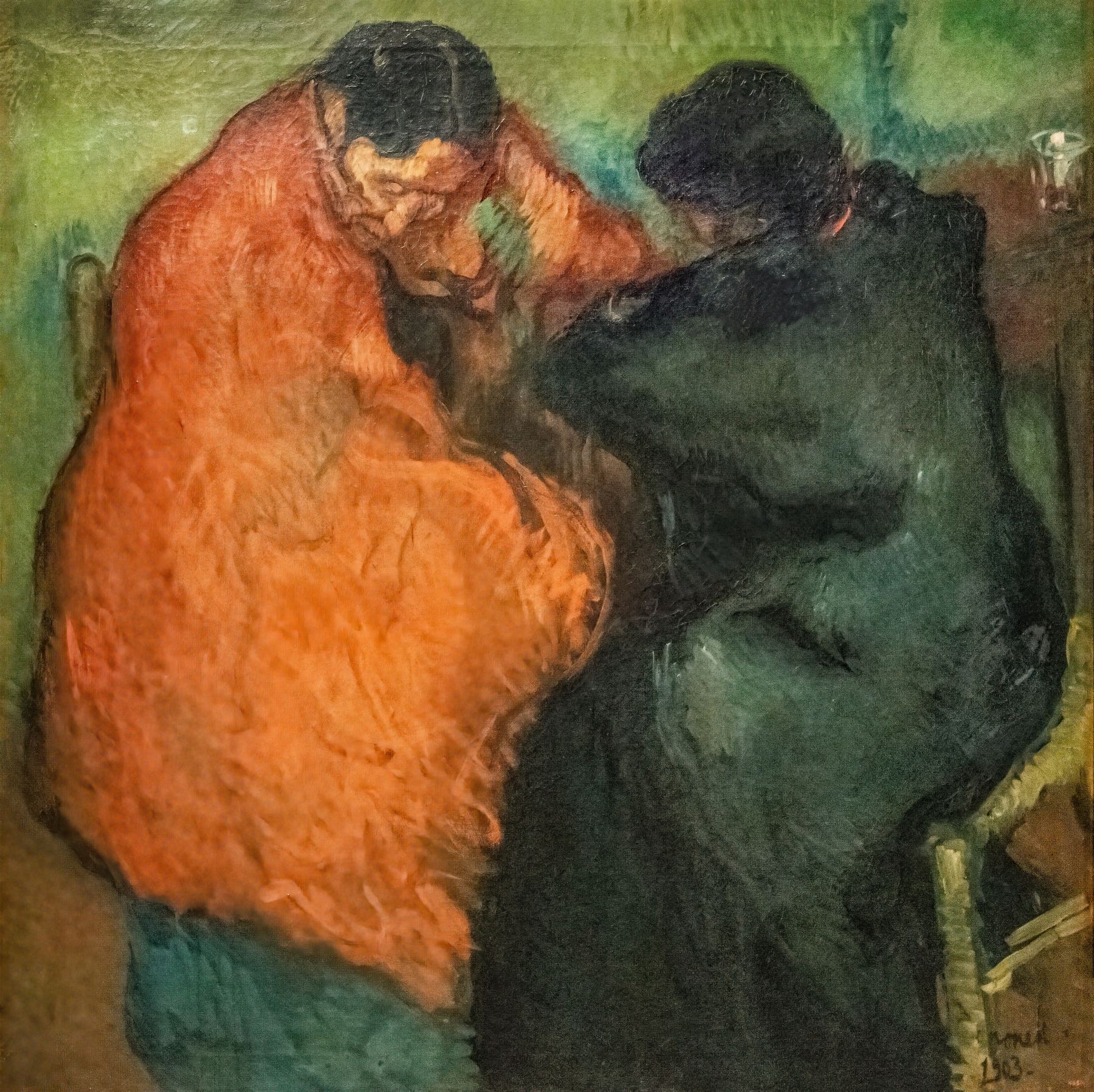
Isidre Nonell made that problem more intimate. After returning from Paris and settling in Barcelona in 1900, he concentrated on marginalised figures, especially Roma women. Two Roma Women of 1903 builds bodies through dense colour and bowed mass. Conservative critics and audiences reacted with hostility because the subjects and handling refused picturesque beauty.[18]
It is tempting to praise the work as transparent social truth. Recent MNAC interpretation warns against that comfort. The women are central in the picture but remain unidentified; their images tell viewers much about the artist and the museum's categories, not necessarily about their own lives. Gender, racialisation and class intersect, and the absence of individual voice remains part of what must be seen.[19]
Nonell's paint can dignify material presence while his serial subject can still turn people into a type. Both readings matter. Ethical looking does not require dismissing the work or congratulating it automatically. It asks what the heavy surface gives the sitters, what it withholds and why bourgeois scandal should not be mistaken for the women's agency.
Hermen Anglada Camarasa pursued another modernity through brilliant colour, Parisian night life and decorative intensity. Mir's later landscapes could approach chromatic dissolution. Ricard Canals, Marià Pidelaserra, Ramon Pichot and the young Picasso found separate routes. The younger generation renewed Modernisme by refusing to inherit one approved “Modernista look.”
Lluïsa Vidal and the view from women's lives
Lluïsa Vidal belonged to that younger generation as a painter, draftswoman and illustrator. Her portraits were valued for their grasp of emotional state, while genre scenes represented women's daily lives with a familiarity unavailable to the male observer. Outdoor festivals, village dances, beaches and streets appear through confident drawing, vibrant colour and active brushwork.[20]
Her career also exposes the movement's institutions. Training and professional networks were structured by gender, yet Vidal exhibited, taught and built a public identity. She later created an academy for women and joined feminist initiatives associated with Carme Karr and Francesca Bonnemaison. Recognition during her life did not prevent her subsequent marginalisation.
Restoring Vidal is not a matter of adding one woman to a male list. Her work changes the movement's field of vision. Women in Modernista art are often nymphs, saints, melancholy nudes, fashionable consumers or nameless sitters. Vidal makes them readers, workers, relatives, pupils and social subjects encountered within a woman's professional practice.
Sculpture between body, spirit and institution
Miquel Blay's The First Cold began with an old man and a young girl huddled on a bench. The marble joins close Naturalist observation to softened, unfinished passages associated with Rodin. The work does not discard academic skill; it turns different degrees of finish into emotional structure, moving from described flesh toward a less tangible image of suffering.[21]
Its subject could satisfy bourgeois concern for the poor while its technique signalled sculptural renewal. This double address is characteristic. Social misery became an arena for compassion, formal experiment and prestige. Viewers should ask whether idealised suffering reveals inequality or makes it safely beautiful.
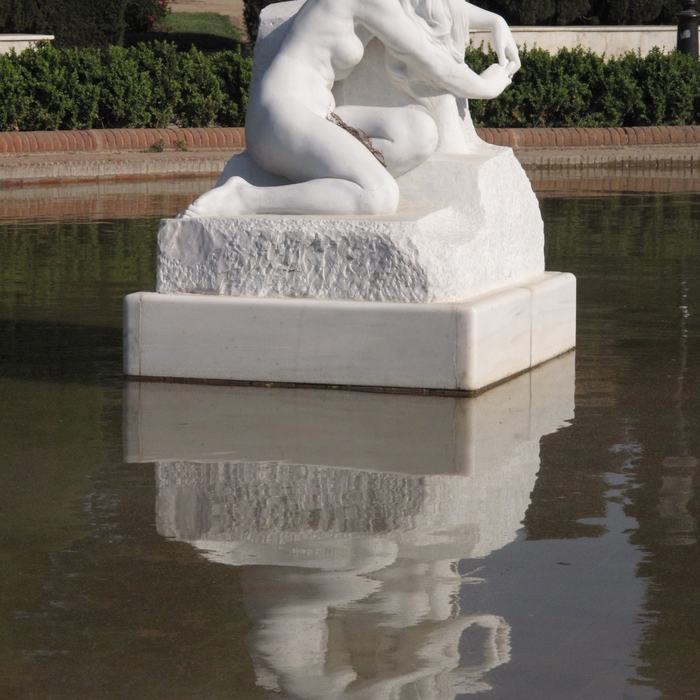
Josep Llimona's Desolation of 1907 offers a different fusion. A nude woman collapses into a closed curve, her polished marble body associated with Symbolist melancholy. Llimona co-founded the Cercle Artístic de Sant Lluc, a Catholic and conservative association whose early rules prohibited the nude. The later relaxation of that rule helped allow a flowering of Modernista sculpture.[22]
The episode dismantles a simple map in which modern equals secular and conservative equals old-fashioned. Catholic artists could pursue modern form while contesting other Modernistes' morality. The nude could be accepted when made chaste, allegorical and sorrowful. Formal innovation passed through institutions with rules about bodies.
Sculpture also entered façades, fireplaces, concert halls, hospitals and monuments. Eusebi Arnau, Miquel Blay, Pau Gargallo, Carles Mani and many modelers and carvers moved between autonomous object and architectural programme. Modernisme's attempt to overcome the hierarchy of arts depended on this mobility.
The city of many Modernismes
MNAC's critical account describes turn-of-the-century Barcelona as both the stage of bourgeois power and of class struggle. Luxury markets, mass consumption, fashion, spectacle, photography, posters and cinema operated beside repression and iconoclasm. Artists imagined that the dandy or bohemian could cross from elite salon to tavern, brothel, music hall and street.[23]
That fantasy produced genuine new subjects, but mobility was unequal. A wealthy painter could enter marginal spaces and leave; a servant, industrial worker or Roma sitter did not possess the same freedom. Modernisme is most illuminating when its crossings are studied without pretending they erased class.
It also contained conservative Modernismes. The Church and bourgeois institutions used modern technique to express hierarchy, charity and traditional power. A building could be technologically daring and socially paternalist; a picture of poverty could be formally new and commercially acceptable. “Modern” describes a changed cultural operation, not automatic political progress.
Follow Catalan Modernisme through four stages
–91
Naming modernity and remaking the city
New journals, exhibitions, Paris contacts and Barcelona's expansion create a field in which painters, architects, writers and designers can argue about what being modern in Catalonia should mean.
–99
Sitges, bohemia and cultural performance
The Festes Modernistes, Cau Ferrat and Els Quatre Gats turn modernity into a public performance, joining Symbolism, music, theatre, collecting, poster art and urban sociability.
–1907
The total work and competing Modernismes
Architecture, sculpture, furniture, jewellery, painting and craft converge in major domestic and civic commissions while Nonell, Mir, Vidal and others demonstrate that no single style defines the movement.
–14
Noucentista challenge and uneven endings
Noucentisme attacks bohemian excess and promotes civic order, yet Modernisme's workshops and buildings continue. Its end arrives at different times in different media and remains visible in later Catalan culture.
Architecture beyond the solitary Gaudí
Antoni Gaudí is the movement's best-known figure, but isolating him diminishes both his work and everyone else's. MNAC research places him inside specific client relationships, religious and political strategies, workshops and a city marked by bombs and class conflict. The legends of eccentric genius and “architect of God” were themselves later constructions.[24]
French museum scholarship reaches a complementary conclusion. Gaudí belongs historically to Catalan Modernisme and the European Art Nouveau constellation, yet his architecture remains intensely personal. His early relation to Joan Martorell and the parallel work of Domènech and Puig show a Catalan architectural field, not a miracle without context.[25]
What makes Gaudí exceptional is not floral ornament alone. His buildings integrate structural experiment, spatial sequence, furniture, colour, craft and symbolic programme. UNESCO emphasises the synthesis of architecture and design, traditional techniques and new construction. The total work is as much a system of forces and making as a surface style.[26]
Catenary arches, ruled geometry, inclined supports and models allowed him to rethink load and space. Trencadís—mosaic assembled from broken ceramic—converted fragments into continuous skin. Stained glass, iron, carved wood and fitted furniture made each project bodily and material. These practices linked advanced calculation to workshop knowledge.[27]
This integration belongs to the larger Catalan decorative-art culture. Artistic-industry exhibitions and multidisciplinary workshops placed furniture, jewellery, ceramics, glass and metal beside painting and sculpture, while European travel and publications widened the available models. Nature could organise every level of an interior, but historic form and industrial manufacture were equally important.[28]
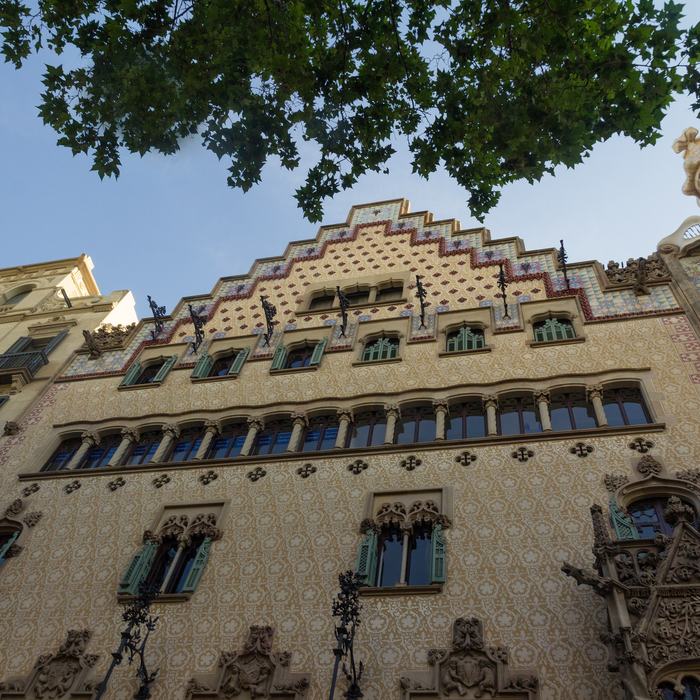
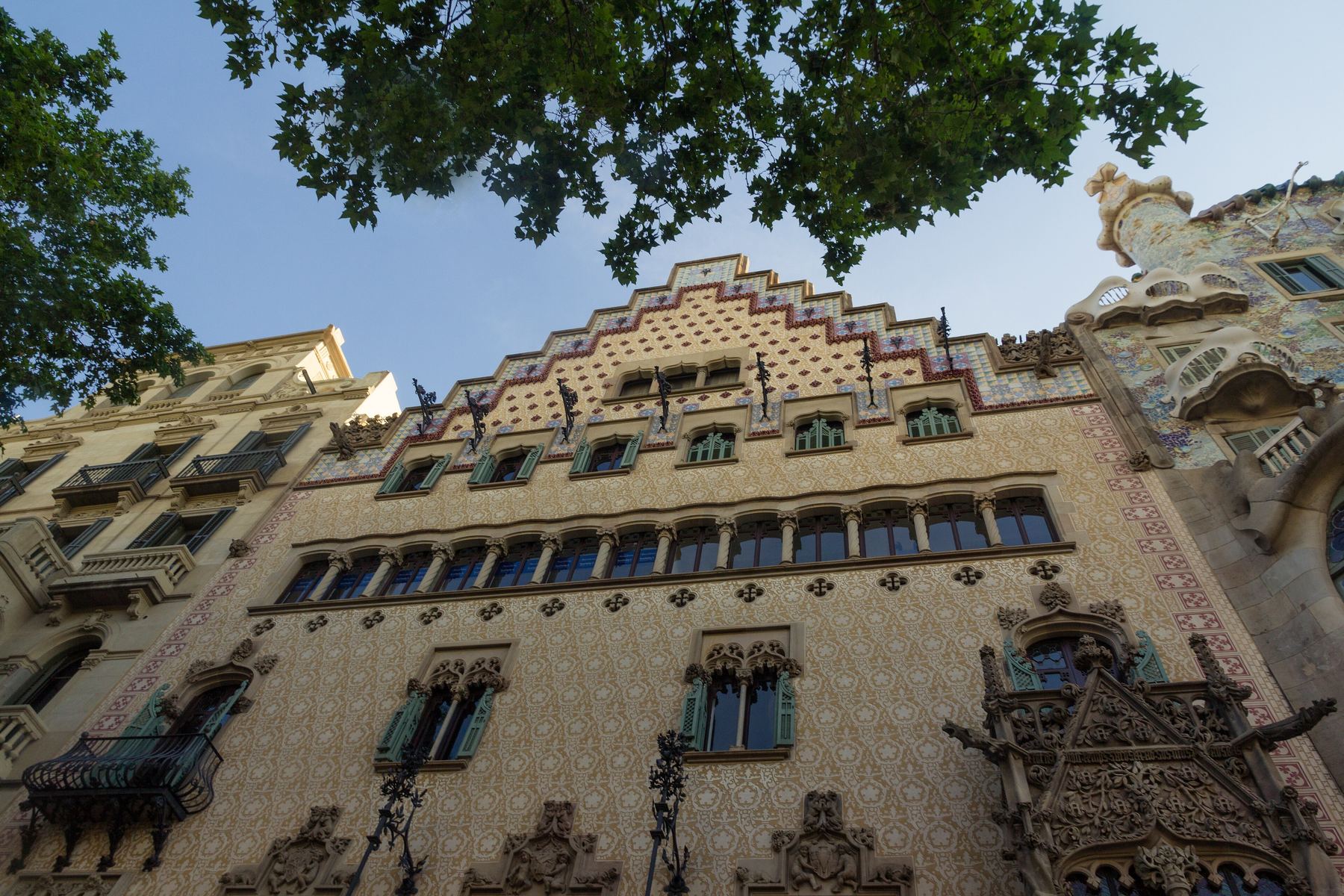
Comparison with Puig i Cadafalch's Casa Amatller makes the range unmistakable. Its stepped northern profile, Gothic-derived openings and concentrated surface differ from Gaudí's increasingly continuous forms, yet its architecture, furniture, mosaic, sculpture, glass and metal form an equally ambitious total environment. Modernisme supplied a field of competition, not a house style.[29]
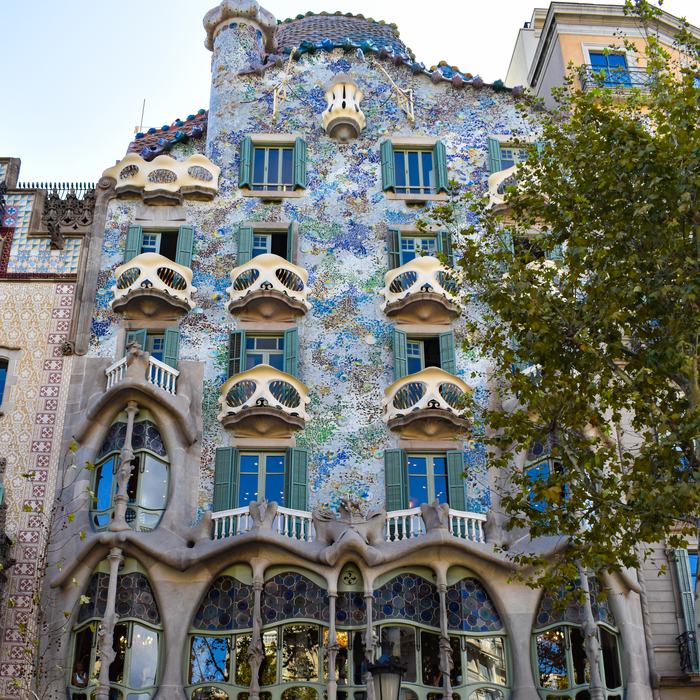
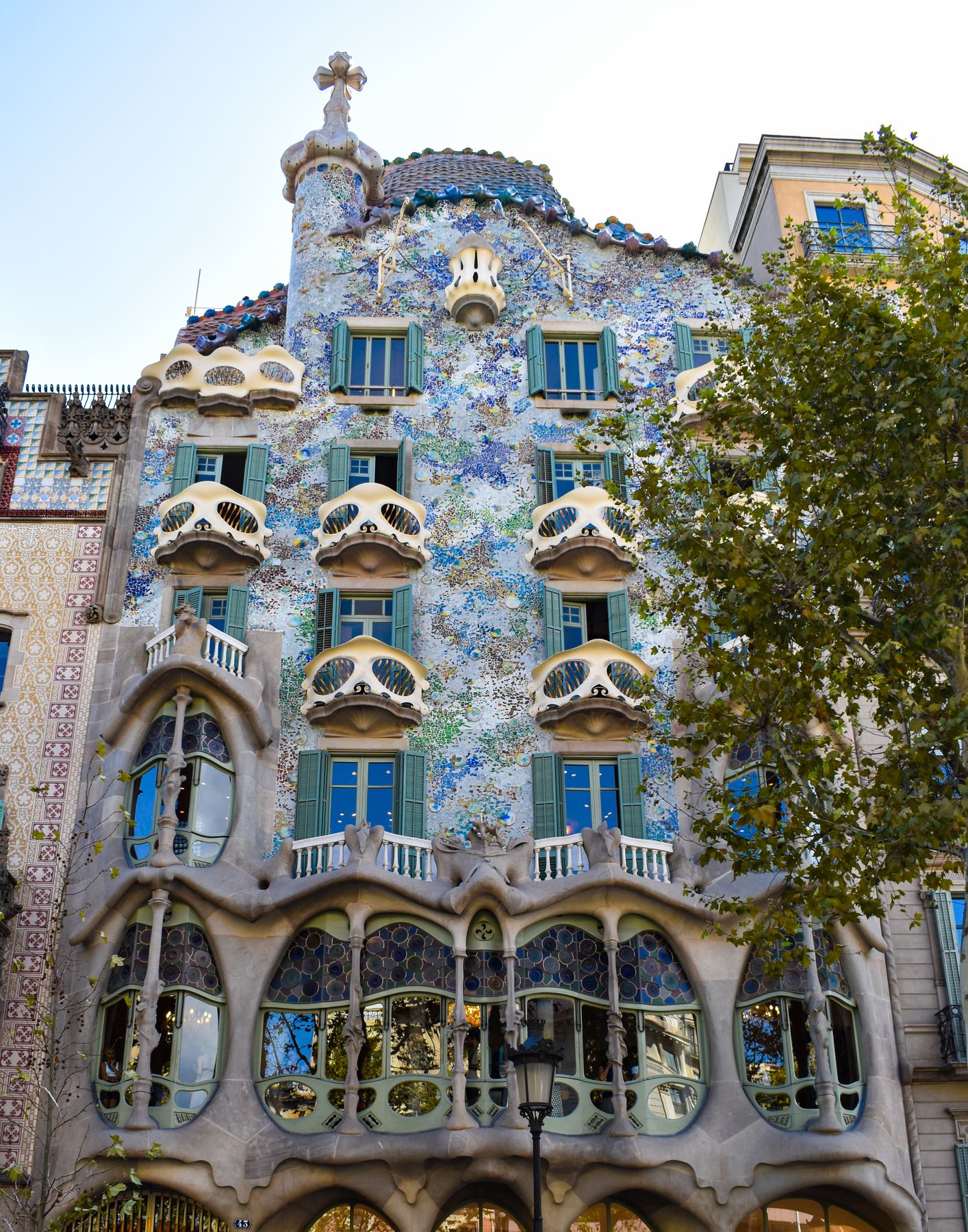
In Casa Batlló, an existing apartment building became an environment of curved wood, graded blue tile, glass, bone-like balconies and a roof open to many readings. Casa Milà moved farther from load-bearing façade through stone skin, iron balconies, free planning and an extraordinary roofscape. Its official study rightly treats construction, function and ornament as one problem rather than three separate achievements.[30]
Park Güell joined viaducts, water management, topography, trencadís and a planned residential estate. Its present identity as a beloved public park can hide its commercial failure: the intended elite development sold almost no plots. Organic harmony was also a real-estate proposition.
The Sagrada Família was an expiatory church rising in an expanding workers' city. Its structure and iconography cannot be separated from Catholic responses to modernity and social conflict. The project became more radical as it continued, but its incompletion also encouraged later generations to treat Gaudí's intentions as prophecy.
Domènech and the architecture of collective life
Lluís Domènech i Montaner offers a different union of rational construction and symbolic abundance. His Palau de la Música Catalana and Hospital de Sant Pau employed industrial technology, collaborative decoration and carefully planned social function. UNESCO identifies the concert hall's steel frame, light and spatial openness and the hospital's bold adaptation to care as new architectural types.[31]
Sant Pau began through the legacy of banker Pau Gil. Domènech studied modern European hospitals and organised specialised pavilions among gardens, connecting them by underground tunnels. Light, ventilation and open space served hygienist medicine, while diagonal planning and medieval emblems connected the new institution to historical Barcelona.[32]
The complex therefore works on two registers. It is a practical machine for care and an image of civic continuity. Brick, tile, mosaic and sculpture do not merely soften medical function; they help patients and visitors read a dispersed campus as an ordered whole. Yet philanthropy and beauty should not obscure the unequal society in which charitable medicine operated.
Built from 1905 to 1908 for the Orfeó Català, the Palau de la Música makes collective performance its subject. A metal structure covered with glass draws daylight into an urban site. Sculpture, mosaic, stained glass and wrought iron gather around the hall, so music appears within a visual and material chorus.[33]
Its abundance is not the opposite of technology. Steel permits openness; glass converts structure into light; applied arts give the technical frame historical and natural meaning. Domènech's architecture demonstrates why Modernisme cannot be reduced to either constructional rationalism or decorative fantasy.
Puig i Cadafalch and history made modern
Josep Puig i Cadafalch used medieval and northern European sources more openly. That does not make his work a retreat from modernity. As architect, historian and politician, he treated historical knowledge as material from which a contemporary Catalan identity could be built.
Casa Amatller, remodelled from 1898 to 1900 for the chocolate industrialist Antoni Amatller, deliberately disrupted the regular Eixample façade. Asymmetrical openings, a stepped gable and freely recombined Gothic forms made one property unmistakable. Inside, sculpture, sgraffito, glazed tile, metal, stained glass, furniture, marble, mosaic, parquet, gas and electricity formed a coordinated domestic world.
The preserved records restore names behind that unity: mosaicist Mario Maragliano, metalworker Manuel Ballarín, sculptor Eusebi Arnau, designer and cabinetmaker Gaspar Homar, glassmaker Joan Espinagosa and many workshop hands. Puig coordinated, but the house was collectively made.
One fireplace carving places an Indigenous queen and a European queen beside a ship to refer to cacao imported from South America for the Amatller business. The motif makes a wider economic network visible. Catalan industrial identity and domestic beauty were linked to commodities, overseas trade and colonial imagery.
The total interior and the labour of craft
Modernisme's most consequential design claim was the refusal to rank architecture above the arts that make it habitable. The house could include designed door, chair, lamp, floor, window, hearth, dish and jewel. Catalan decorative art became especially important because it overcame the academic separation of art and craft. Exhibitions and workshops joined traditional trades to new industry and new markets.
“Total work” must not become another way to credit one architect with everything. Josep Maria Jujol contributed drawing, painting, decoration and sculpture to Gaudí projects and developed an independent architecture of extraordinary material invention. French recognition of his career helps correct the tendency to call every collaborative surface simply “Gaudí.”[34]
Gaspar Homar is equally important. He worked through marquetry, metal, mosaic panels, textiles and furniture and organised production across specialised labour. His interiors show how a historical furniture type could be transformed by line, image and material rather than merely copied.[35]
Alexandre de Riquer carried Modernisme into books, posters and ex-libris. His library and travel made him an unusually informed interpreter of British illustration and design. Burne-Jones, Beardsley, Japanese prints and the Arts and Crafts movement entered Catalonia through a maker who combined international knowledge with local publishing.[36]
The poster placed these ambitions in the street. MNAC's holdings preserve more than seven hundred examples, with Casas and Riquer among the defining names. Casas's charcoal portraits created another printed and exhibitionary map of contemporary Catalan personalities. Graphic design joined elite connoisseurship to repeatable mass address.[37]
Lluís Masriera did something related in jewellery. Gold, translucent enamel, gems, insects, flowers, saints and idealised women connected his family workshop to international Art Nouveau. Some models were repeated at different levels of cost. The jewel could be a singular luxury object and the product of organised, partly mechanised manufacture.[38]
Even a beer jug participated. The ceramic service made for Els Quatre Gats combined a Catalan pottery enterprise with a design associated with Casas and the venue's identity. Repetition carried bohemian branding from wall and magazine to the hand of a customer.[39]
These objects reveal a productive contradiction. Modernistes celebrated the moral and expressive value of craft while operating within a modern market. A hand-cut marquetry panel, an editioned poster and a repeatable enamel brooch answered different consumers, but all converted artistic identity into material exchange.
Essential Catalan Modernisme works
Ramon Casas and Pere Romeu on a Tandem
Ramon Casas · 1897 · Casas turns two familiar figures and a new machine into a humorous emblem of urban sociability, advertising and modern speed.
Garrot Vil
Ramon Casas · 1894 · The execution itself is withheld: Casas makes the gathered crowd, police line and elevated viewpoint carry the work's unsettling public psychology.
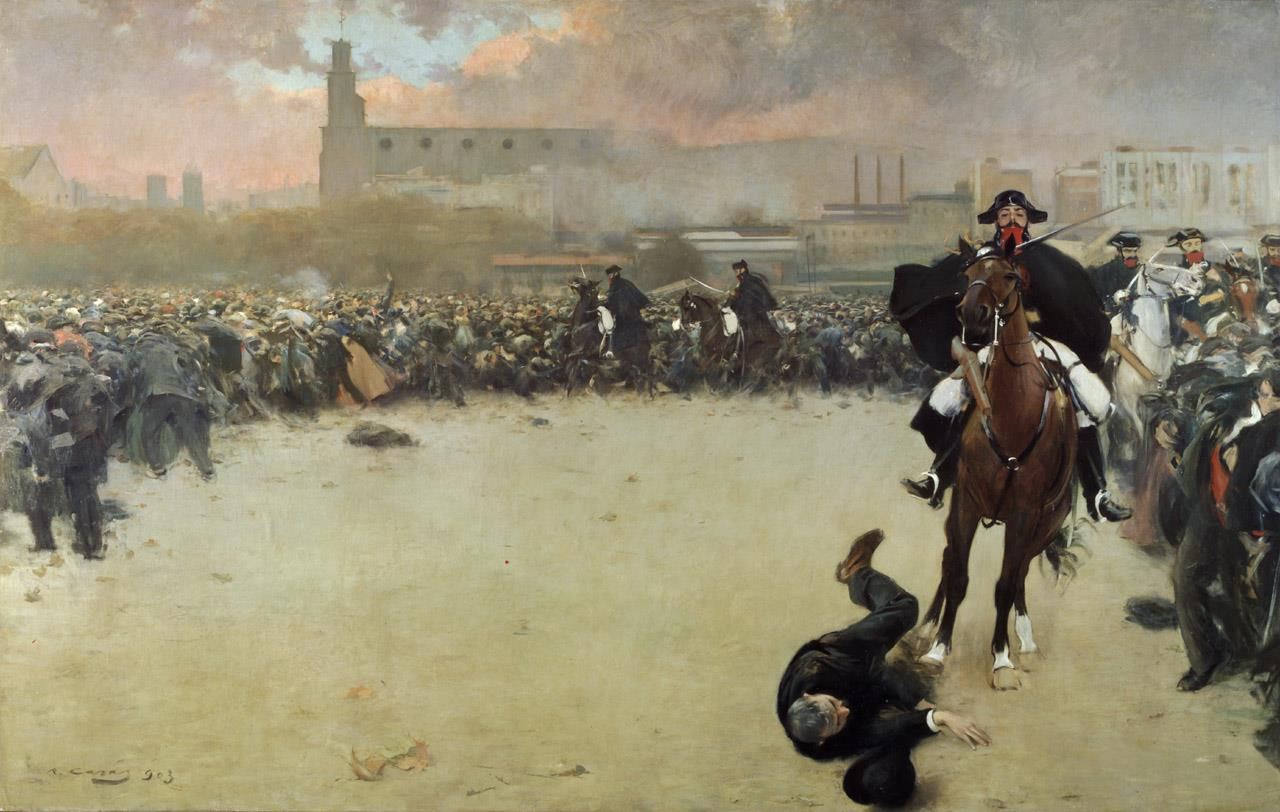
La Càrrega
Ramon Casas · 1899–1902 · A mounted guard cuts diagonally through a dispersed crowd, joining social observation to a forceful modern composition shaped by political conflict.
The Cathedral of the Poor
Joaquim Mir · 1898 · Mir sets an unfinished sacred building against people living at its margins, making colour and fractured light serve a difficult urban contrast.
Two Roma Women
Isidre Nonell · 1903 · Nonell's dense paint and compressed setting demand attention to named social exclusion while warning against treating Roma sitters as picturesque types.
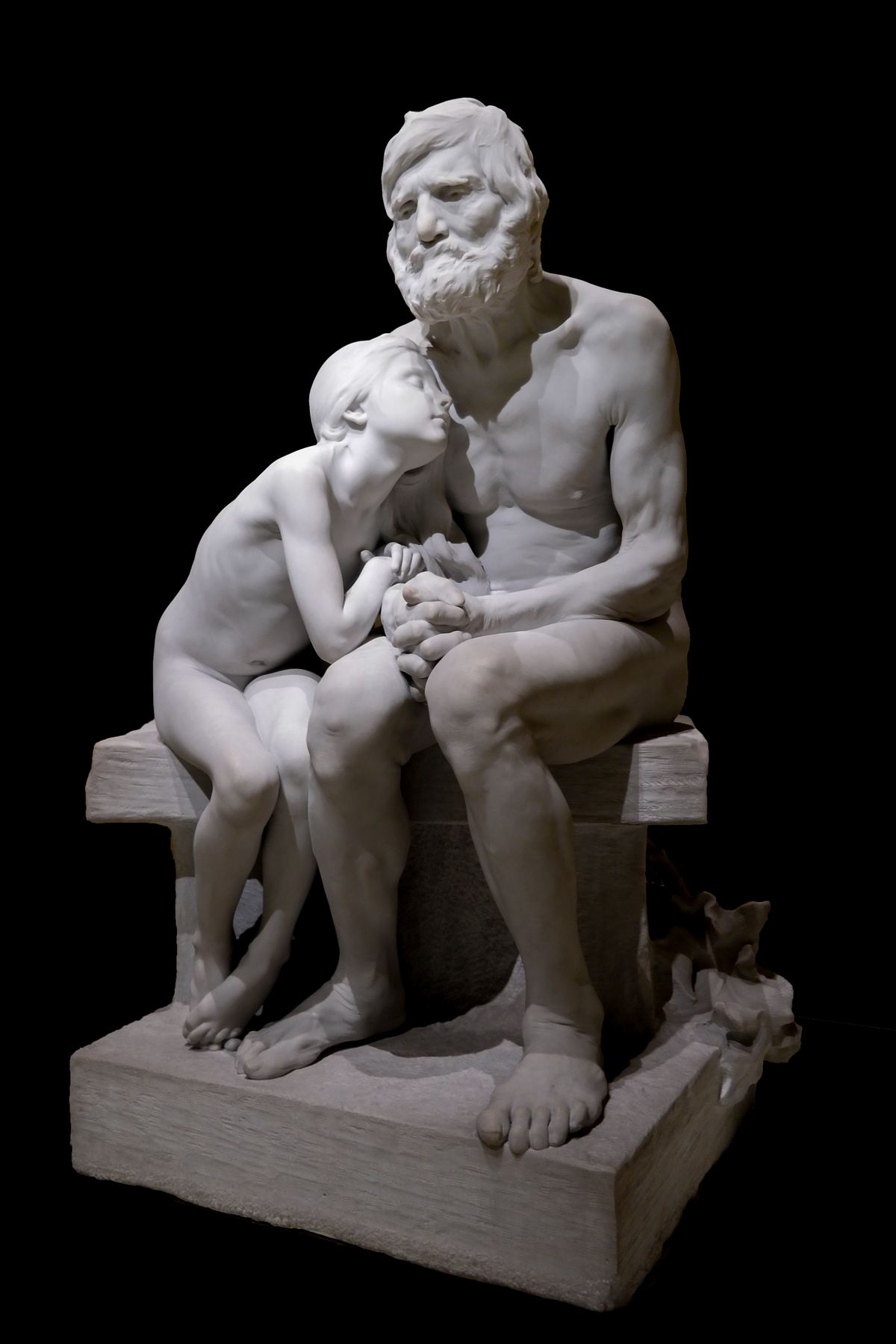
The First Cold
Miquel Blay · 1892 · Blay gives poverty and bodily vulnerability monumental sculptural presence, balancing naturalistic detail with a broader Symbolist emotional charge.
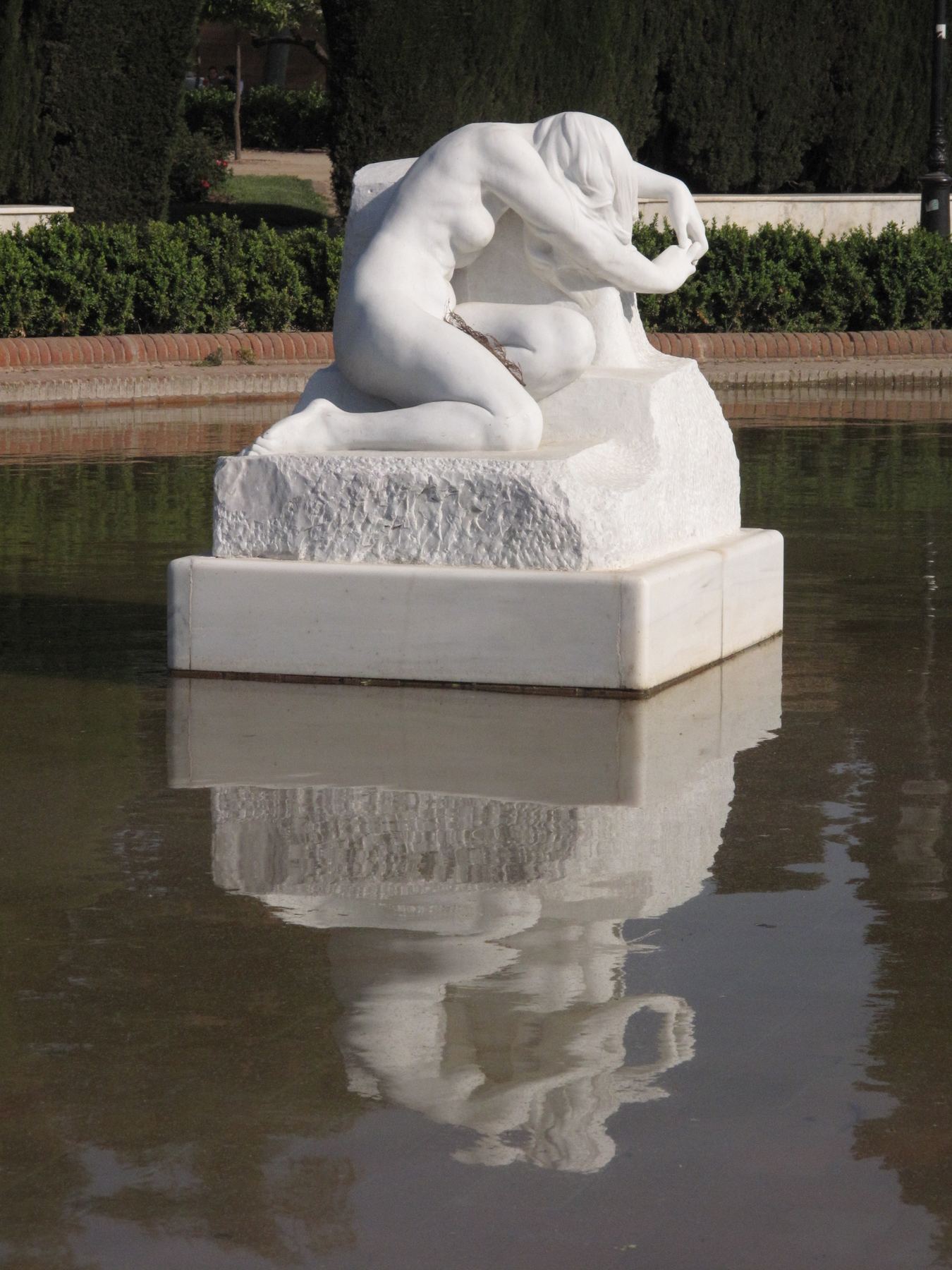
Desolation
Josep Llimona · 1907 · Llimona's inward, folded figure transforms grief into a concentrated sculptural rhythm whose apparent timelessness emerged from a specific cultural field.
Casa Amatller
Josep Puig i Cadafalch and collaborators · 1898–1900 · Puig i Cadafalch coordinates historical reference, modern construction and workshop craft in a façade and interior conceived as one collaborative environment.
Palau de la Música Catalana
Lluís Domènech i Montaner and collaborators · 1905–08 · Domènech combines structure, stained glass, mosaic, sculpture and music in a civic total work whose splendour depends on many specialist makers.
Casa Batlló
Antoni Gaudí and collaborators · 1904–06 · Gaudí and collaborating workshops remake an existing house through structure, light, ceramics, joinery and a façade that refuses a single fixed interpretation.
Beyond Barcelona
Barcelona's concentration of money, institutions and surviving masterpieces can make Modernisme appear metropolitan by definition. Its map was wider. Sitges supplied the movement's festivals and shrine; Reus, Terrassa, Mataró, Canet de Mar and other towns developed buildings and workshops; Olot shaped painters and sculptors; cooperative wineries carried late Modernista construction into agricultural regions.
Industrial colonies along the Ter and Llobregat linked factories, workers' housing, schools, shops and managerial order. Their surviving architecture records how industrialisation transformed Catalan landscapes beyond the capital. Modernista buildings within that system cannot be understood as picturesque rural exceptions; they belonged to the organisation of production and labour.[40]
The regional spread also changed form. Local materials, patrons, industries and building types mattered. A wine cooperative, cemetery, factory, theatre or seaside house did not need to resemble a Passeig de Gràcia mansion to participate in the period's union of identity, craft and modern construction.
The uses of the past
Modernisme repeatedly selected a past in order to make the present. Rusiñol's collection began with historic art and included two El Greco paintings acquired in Paris, ironwork and glass. The installation made those objects into ancestors of a modern artistic religion rather than neutral antiquities.[41]
Architects turned Romanesque and Gothic forms into national evidence, but they recombined them with steel, electricity and apartment economics. Saint George could identify Catalonia on a façade while a northern stepped gable signalled cosmopolitan comparison. Tradition was not the absence of invention; it was one of its materials.
This does not mean every medieval reference carried the same politics. Catholic continuity, conservative Catalanism, liberal nation-building and artistic primitivism could all value the past differently. The shared emblem should not be mistaken for shared ideology.
Patronage, labour and the price of beauty
Modernisme's great interiors required money and concentrated decision-making. Chocolate, textiles, banking, property and other businesses financed houses, while the Church, charitable boards, municipal bodies and cultural associations commissioned public work. Patronage made experiment possible and set boundaries around it.
Workshop collaboration widened authorship but did not erase hierarchy. Named master craftsmen worked beside employees, builders, apprentices and suppliers whose individual contributions may be difficult to recover. Domestic interiors also depended on servants who cleaned glass, polished metal, maintained textiles and made display possible.
The movement's images frequently cross class boundaries, but the conditions of viewing remained unequal. Casas observed execution and repression; Mir placed poverty before a basilica; Nonell painted marginalised Roma women; Blay idealised cold and age. Each work can disturb bourgeois comfort, yet each also entered an art market or institution capable of converting social difficulty into prestige.
The task is not to punish beauty for having a material history. It is to see more of what beauty organised: resources, bodies, labour, technologies, beliefs and exclusions. Modernisme becomes richer, not poorer, when the workshop and the worker return to the total work.
Why Modernisme ended more than once
By the first years of the twentieth century, cultural and artistic sectors across Europe were reacting against fin-de-siècle styles. In Catalonia, Noucentisme accused Modernisme of excessive decoration, irrationalism and weak structure and promoted classicism, Mediterranean order, civic discipline and stronger institutions. Avant-garde artists attacked inherited artistic roles from another direction.[42]
One conventional cultural span runs from the founding of L'Avenç in 1881 to the closure of Joventut in 1906. From about 1906–10, Noucentisme increasingly displaced Modernisme as the dominant programme. But buildings under construction, decorative workshops and individual careers continued. The dates describe changing authority, not a switch turned off.[43]
Younger painters had already exposed another ending. Mir, Nonell, Pidelaserra, Canals and Picasso rejected the complacent decorative style that critics still called Modernista, yet they renewed the original impulse to break with convention. A movement can end because its visual signs become fashionable while its dissatisfaction migrates elsewhere.[44]
Modernista houses were later remodelled; furnishings were dispersed; Art Nouveau was dismissed before preservation and tourism made it beloved. Gaudí was alternately eccentric, religious genius and precursor of abstraction. These afterlives tell us about later needs. They should not be read backwards as the movement's intended destination.
How to recognise—and question—Modernisme
Begin with integration, not curve. Ask whether architecture, furniture, image, lettering, colour and material have been coordinated. Then identify who did the coordinating and who carried out the work. A unified room may contain many authors.
Look for transformed history. A Gothic arch, saint, heraldic emblem or craft technique may be freely recombined with steel, electricity or a modern apartment. Revival and innovation can occupy the same object.
Test nature as structure and sign. Plant stems, bones, shells, insects and landscape rhythms may organise a railing, chair or façade. But not every Modernista work is organic: Casas's crowd or Nonell's figures may have no botanical ornament at all.
Follow circulation. Does the image belong to a poster, journal, café, exhibition, theatre or repeated product? Modernisme lived through media and sociability as much as through unique monuments.
Finally, ask who modernity served. Who commissioned the work, supplied its materials, built it, maintained it and appeared within it? Does national symbolism include social difference or cover it? The answers do not cancel formal achievement; they show what the form was doing in the world.
Where to see Catalan Modernisme
Displays and access arrangements change. Check current information before travelling.
- 01
Museu Nacional d'Art de Catalunya, Barcelona
the essential first destination for painting, sculpture, posters, furniture, jewellery and reconstructed interiors across the movement's competing tendencies.
Barcelona, Spain
Painting, sculpture, design and reconstructed interiorsVisit official website - 02
Museu del Cau Ferrat, Sitges
Rusiñol's studio-home preserves the union of collection, modern art, historic craft and cultural performance.
Sitges, Spain
Rusiñol, collecting and the Festes ModernistesVisit official website - 03
Museu de la Garrotxa, Olot
Casas's La Càrrega anchors a regional collection that connects social painting to the artistic culture of Olot.
Olot, Spain
Ramon Casas's La Càrrega and regional artVisit official website - 04
Museo Reina Sofía, Madrid
Garrot Vil reveals Casas as an analyst of the urban crowd rather than merely a fashionable portraitist.
Madrid, Spain
Ramon Casas's Garrot VilVisit official website - 05
Casa Amatller, Barcelona
the unusually complete interior makes Puig i Cadafalch's collaboration with sculptors, mosaicists, metalworkers, glassmakers and furniture designers legible.
Barcelona, Spain
A complete Puig i Cadafalch interiorVisit official website - 06
Palau de la Música Catalana, Barcelona
Domènech's concert hall demonstrates how steel, glass, light, sculpture, mosaic and music could form a public total work.
Barcelona, Spain
Domènech's civic total workVisit official website - 07
Recinte Modernista Sant Pau, Barcelona
the pavilion hospital joins hygienist function, gardens, urban planning and historical symbolism on an unmatched scale.
Barcelona, Spain
Architecture, gardens and urban planningVisit official website - 08
Barcelona's Gaudí sites
Casa Batlló, Casa Milà, Park Güell, Palau Güell, the Sagrada Família and the Colònia Güell crypt should be compared rather than treated as repetitions of one style.
Barcelona, Spain
Casa Batlló, Park Güell and the Sagrada FamíliaExplore our guide
Suggested books
- Mercè Doñate, Mariàngels Fondevila, Cristina Mendoza and Francesc Quílez, El modernisme a les col·leccions del MNAC. The best concise cross-media foundation, built around paintings, drawings, sculpture, furniture, jewellery, porcelain, posters, prints and ex-libris rather than architecture alone.[45]
- William H. Robinson, Jordi Falgàs and Carmen Belen Lord, eds., Barcelona and Modernity: Picasso, Gaudí, Miró, Dalí. A major 524-page exhibition study connecting the movement to the city's politics and to the later avant-gardes without collapsing those periods together.[46]
- François Loyer with Michel and Sylvia Saudan, Art Nouveau in Catalonia. Especially useful for architecture, materials and the distinction between Catalan constructional experiment and related European Art Nouveau practices.[47]
- Consol Oltra, Lluïsa Vidal: Pintora del modernisme. An essential restoration of a painter, teacher and feminist organiser whose portraits and genre scenes change the gendered account of the movement.[48]
- Mariàngels Fondevila and collaborators, Gaspar Homar: Moblista i dissenyador del modernisme. The strongest route into marquetry, mosaic, textile, furniture workshops and the bourgeois domestic interior.[49]
For a current object-based study of the most famous architect, the Musée d'Orsay and MNAC Gaudí catalogue is valuable precisely because it replaces isolated-genius mythology with clients, collaborators, furniture, models and working method.[50]
Major Catalan Modernisme artists and makers
| Name | Nationality | Key Works |
|---|---|---|
| Ramon Casas | Spanish | Ramon Casas and Pere Romeu on a Tandem · Garrot Vil · La Càrrega |
| Santiago Rusiñol | Spanish | Cau Ferrat · The Gardens of Aranjuez · Modernisme festivals |
| Isidre Nonell | Spanish | Two Roma Women · paintings of Roma sitters |
| Joaquim Mir | Spanish | The Cathedral of the Poor · Mallorca landscapes |
| Hermen Anglada Camarasa | Spanish | Parisian night scenes · Mallorca landscapes |
| Lluïsa Vidal | Spanish | The First Communion · portraits and domestic scenes |
| Antoni Gaudí | Spanish | Casa Batlló · Park Güell · Sagrada Família |
| Lluís Domènech i Montaner | Spanish | Palau de la Música Catalana · Hospital de Sant Pau |
| Josep Puig i Cadafalch | Spanish | Casa Amatller · Casa de les Punxes |
| Josep Maria Jujol | Spanish | Casa Batlló collaboration · Park Güell collaboration · Can Negre |
| Alexandre de Riquer | Spanish | posters and ex-libris · decorative arts |
| Gaspar Homar | Spanish | Casa Lleó Morera interiors · furniture and marquetry |
| Josep Llimona | Spanish | Desolation · sculpture for public and devotional settings |
| Miquel Blay | Spanish | The First Cold · Song of the People |
| Eusebi Arnau | Spanish | Palau de la Música sculpture · architectural sculpture |
| Adrià Gual | Spanish | theatre design · posters and Symbolist painting |
| Lluís Masriera | Spanish | enamel jewellery · decorative objects |
| Miquel Utrillo | Spanish | Pèl & Ploma · Els Quatre Gats networks |
| Ricard Canals | Spanish | Parisian genre scenes · portraits |
| Marià Pidelaserra | Spanish | Mallorca landscapes · urban and rural painting |
| Ramon Pichot | Spanish | Cadaqués scenes · Parisian paintings |
| Enric Morera | Spanish | La fada · choral and theatrical music |
| Carles Mani | Spanish | The Degenerates · expressive sculpture |
| Pau Gargallo | Spanish | Palau de la Música sculpture · early figure sculpture |
| Pablo Picasso | Spanish | Els Quatre Gats portraits · early Barcelona works |
Frequently Asked Questions
Not exactly. Its architecture and decorative arts belong to the European Art Nouveau field, alongside Jugendstil and the Vienna Secession. Modernisme also includes Catalan literature, language reform, music, theatre, painting and political-cultural debate, giving it a wider local meaning.
It distinguishes the movement from the much broader English term Modernism. It also preserves the historical claim embedded in the name: Catalan culture should move with its century and become at once modern, European and nationally distinctive.
Useful cultural markers run from L'Avens in the 1880s to the rise of Noucentisme around 1906–10. Architecture and design continued later, so approximately 1884–1914 is a practical artistic range rather than an official lifespan.
No single person led all its arts. Gaudí was its most internationally famous architect, but Domènech i Montaner and Puig i Cadafalch developed different architectures, while Casas, Rusiñol, critics, writers, designers and musicians organised other parts of the movement.
Integrated interiors, expressive materials, transformed medieval forms, nature-derived motifs, curved line, colour and collaboration between arts are common in design. Painting ranges from grey Parisian Naturalism to Symbolist gardens, dark expressive figures and intense colour, so no checklist covers every work.
They were five cultural events organised in Sitges between 1892 and 1899. Exhibitions, music, theatre, translation, literature and ceremony made Modernisme visible as a multi-art movement and helped turn Rusiñol's Cau Ferrat into its symbolic temple.
The Barcelona tavern connected architecture, posters, painting, magazines, concerts, theatre and exhibitions. It brought an older Paris-experienced generation together with younger artists such as Nonell, Mir and Picasso while turning bohemian identity into a memorable public image.
No. Radical regenerationists, esthetes, liberals, anarchising intellectuals, Catholic conservatives and different Catalanist positions coexisted. Modern technique could serve social criticism, artistic withdrawal, religious renewal or bourgeois prestige.
Modernista buildings and interiors depended on sculptors, mosaicists, carpenters, metalworkers, ceramicists, glassmakers, designers and builders. Naming only the architect turns a collectively made environment into a misleading one-person artwork.
No. Sitges was a major cultural centre, and important buildings, workshops and artistic communities appeared in Olot, Reus, Terrassa, Mataró, Canet de Mar and elsewhere. Industrial colonies and cooperative wineries further extended its geography.
Their material gravity challenged picturesque convention and conservative taste. Viewers should also recognise that the sitters are usually unnamed and that the paintings cannot disclose their own voices. Formal admiration must remain alert to gender, racialisation and class.
Noucentisme became the dominant Catalan cultural programme from about 1906–10, promoting classicism, Mediterranean order and institutional civic culture. Avant-garde practices offered another rejection. Neither transition erased Modernisme immediately or followed a single clean date.
Discussion
Choose one Modernista house and one painting of Barcelona's marginal or working population. What becomes visible when they are read together? Consider who commissioned each work, who made it, how bodies occupy its space and whether beauty reveals the city's inequality or helps its viewers look away.
Reader Insights
Set a painting beside a façade, interior, poster or jewel before treating Modernisme as one visual formula.
Look for the architects, sculptors, carpenters, mosaicists, glassmakers, metalworkers and patrons who produced each total environment.
Ask who benefited from bourgeois renewal, whose labour sustained it and how artists represented people excluded from its ideal city.
Join the Conversation
Which work best proves that Catalan Modernisme was more than architecture or a regional version of Art Nouveau?
References
- Art Modern, Museu Nacional d'Art de Catalunya (Catalan; consulted in Catalan), View Source
- Més sobre l'Art Modern, Museu Nacional d'Art de Catalunya (Catalan; consulted in Catalan), View Source
- Metrópoli y modernismo, Museu d'Història de Barcelona (Spanish; consulted in Spanish), View Source
- La ciutat moderna: urbanisme art i disseny, Museu Nacional d'Art de Catalunya (Catalan; consulted in Catalan), View Source
- Barcelona and Modernity: Gaudí to Dalí, Metropolitan Museum of Art, View Source
- Els mots modernisme i modernista en català, Enciclopèdia Catalana (Catalan; consulted in Catalan), View Source
- L'Avenç, Gran Enciclopèdia Catalana (Catalan; consulted in Catalan), View Source
- Modernismo: la revolución llega a la literatura, Patrimoni Cultural Generalitat de Catalunya (Spanish; consulted in Spanish), View Source
- Festes Modernistes de Sitges, Gran Enciclopèdia Catalana (Catalan; consulted in Catalan), View Source
- Museo del Cau Ferrat, Museus de Sitges (Spanish; consulted in Spanish), View Source
- Vida y obra: Santiago Rusiñol, Museus de Sitges (Spanish; consulted in Spanish), View Source
- Els 4 Gats, Ajuntament de Barcelona (Catalan; consulted in Catalan), View Source
- Ramon Casas i Pere Romeu en un tàndem, Museu Nacional d'Art de Catalunya (Catalan; consulted in Catalan), View Source
- Garrote vil, Museo Nacional Centro de Arte Reina Sofía (Spanish; consulted in Spanish), View Source
- La càrrega, Visitmuseum Generalitat de Catalunya (Catalan; consulted in Catalan), View Source
- Vers la modernitat: les exposicions de Belles Arts de Barcelona, Museu Nacional d'Art de Catalunya blog (Catalan; consulted in Catalan), View Source
- La catedral dels pobres, Museu Nacional d'Art de Catalunya (Catalan; consulted in Catalan), View Source
- Dues gitanes, Museu Nacional d'Art de Catalunya (Catalan; consulted in Catalan), View Source
- Dues gitanes: feminist interpretation, Museu Nacional d'Art de Catalunya (Catalan; consulted in Catalan), View Source
- Lluïsa Vidal: Modernisme Painter, Museu Nacional d'Art de Catalunya, View Source
- Els primers freds Miquel Blay, Museu Nacional d'Art de Catalunya (Catalan; consulted in Catalan), View Source
- Desconsol, Museu Nacional d'Art de Catalunya (Catalan; consulted in Catalan), View Source
- Art Modern collection redisplay dossier, Museu Nacional d'Art de Catalunya (Spanish; consulted in Spanish), View Source
- Gaudí, Museu Nacional d'Art de Catalunya, View Source
- Gaudí, Musée d'Orsay (French; consulted in French), View Source
- Works of Antoni Gaudí, UNESCO World Heritage Centre, View Source
- Antoni Gaudí, Patrimoni Cultural Generalitat de Catalunya (Catalan; consulted in Catalan), View Source
- Modernist itinerary, Museu Nacional d'Art de Catalunya, View Source
- La Casa Amatller, Fundació Institut Amatller d'Art Hispànic (Spanish; consulted in Spanish), View Source
- L'Arquitectura de La Pedrera de Gaudí, Fundació Catalunya La Pedrera (Catalan; consulted in Catalan), View Source
- Palau de la Música Catalana and Hospital de Sant Pau, UNESCO World Heritage Centre, View Source
- History of the Sant Pau Modernista Site, Recinte Modernista Sant Pau, View Source
- Palau de la Música Catalana film-set dossier, Palau de la Música Catalana (English and Catalan; consulted in English and Catalan), View Source
- Josep Maria Jujol architecte 1879-1949, Centre Pompidou (French; consulted in French), View Source
- Gaspar Homar moblista i dissenyador del modernisme, Museu Nacional d'Art de Catalunya (Catalan; consulted in Catalan), View Source
- Cobertes modernistes, Museu Nacional d'Art de Catalunya (Catalan; consulted in Catalan), View Source
- Dibuixos gravats i cartells, Museu Nacional d'Art de Catalunya (Catalan; consulted in Catalan), View Source
- Joieria d'artista, Museu Nacional d'Art de Catalunya (Spanish; consulted in Spanish), View Source
- The Els Quatre Gats beer jug, Museu del Disseny de Barcelona (Catalan; consulted in Catalan), View Source
- The memory of industrial colonies along the Ter, Patrimoni Cultural Generalitat de Catalunya, View Source
- Colección Santiago Rusiñol, Museus de Sitges (Spanish; consulted in Spanish), View Source
- Noucentisme(s) in the Art Modern redisplay dossier, Museu Nacional d'Art de Catalunya (Catalan; consulted in Catalan), View Source
- El món a cavall de dos segles, Enciclopèdia Catalana (Catalan; consulted in Catalan), View Source
- Modernisme, Gran Enciclopèdia Catalana (Catalan; consulted in Catalan), View Source
- El modernisme a les col·leccions del MNAC, Museu Nacional d'Art de Catalunya (Catalan; consulted in Catalan), View Source
- Barcelona and Modernity: Picasso Gaudí Miró Dalí, Cleveland Museum of Art and Yale University Press via Toledo Museum Library, View Source
- Art Nouveau in Catalonia, François Loyer Michel and Sylvia Saudan / WorldCat, View Source
- Lluïsa Vidal Pintora del modernisme, Consol Oltra / Museu Nacional d'Art de Catalunya (Catalan; consulted in Catalan), View Source
- Gaspar Homar moblista i dissenyador del modernisme, Mariàngels Fondevila / Rijksmuseum Research Library (Catalan; consulted in Catalan), View Source
- Gaudí catalogue de l'exposition, Musée d'Orsay and Hazan (French; consulted in French), View Source
- Catalan Modernisme image records, Wikimedia Commons: Ramon Casas and Pere Romeu on a Tandem (Public domain mark / PD-Art; Museu Nacional d'Art de Catalunya / Google Art Project / Wikimedia Commons), Garrot Vil (Public domain mark / PD-Art; Museo Reina Sofía / Wikimedia Commons), La Càrrega (Public domain mark / PD-Art; Museu de la Garrotxa / Wikimedia Commons), The Cathedral of the Poor (Public domain mark / PD-Art; Museu Nacional d'Art de Catalunya / Wikimedia Commons), Two Roma Women (CC BY-SA 4.0; underlying work public domain; Museu Nacional d'Art de Catalunya; Canaan / Wikimedia Commons), The First Cold (CC0 1.0; Dziuban / Wikimedia Commons), Desolation (CC BY-SA 3.0 ES; Enfo / Wikimedia Commons), Casa Amatller (CC BY-SA 4.0; Alexey Komarov / Wikimedia Commons), Palau de la Música Catalana (CC BY-SA 3.0; Cherubino / Wikimedia Commons), Casa Batlló (CC0 1.0; Spanish freedom of panorama; Julian Lupyan / Wikimedia Commons).