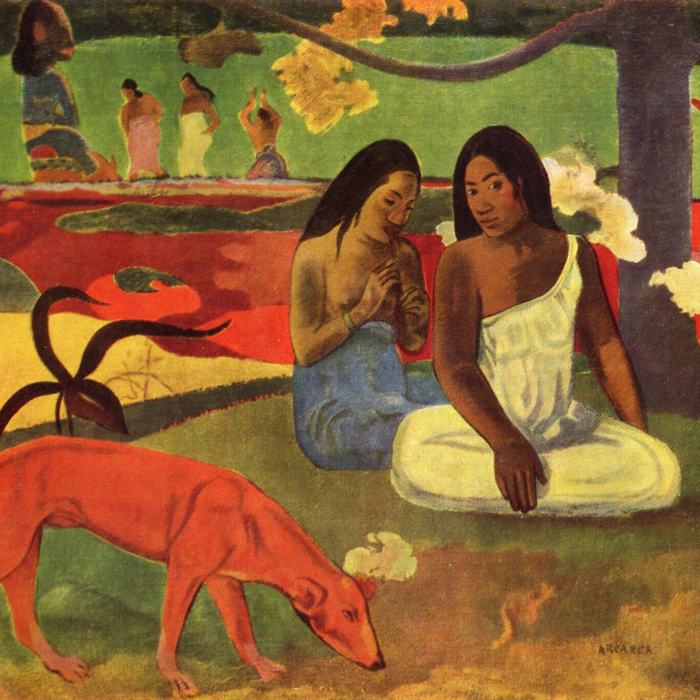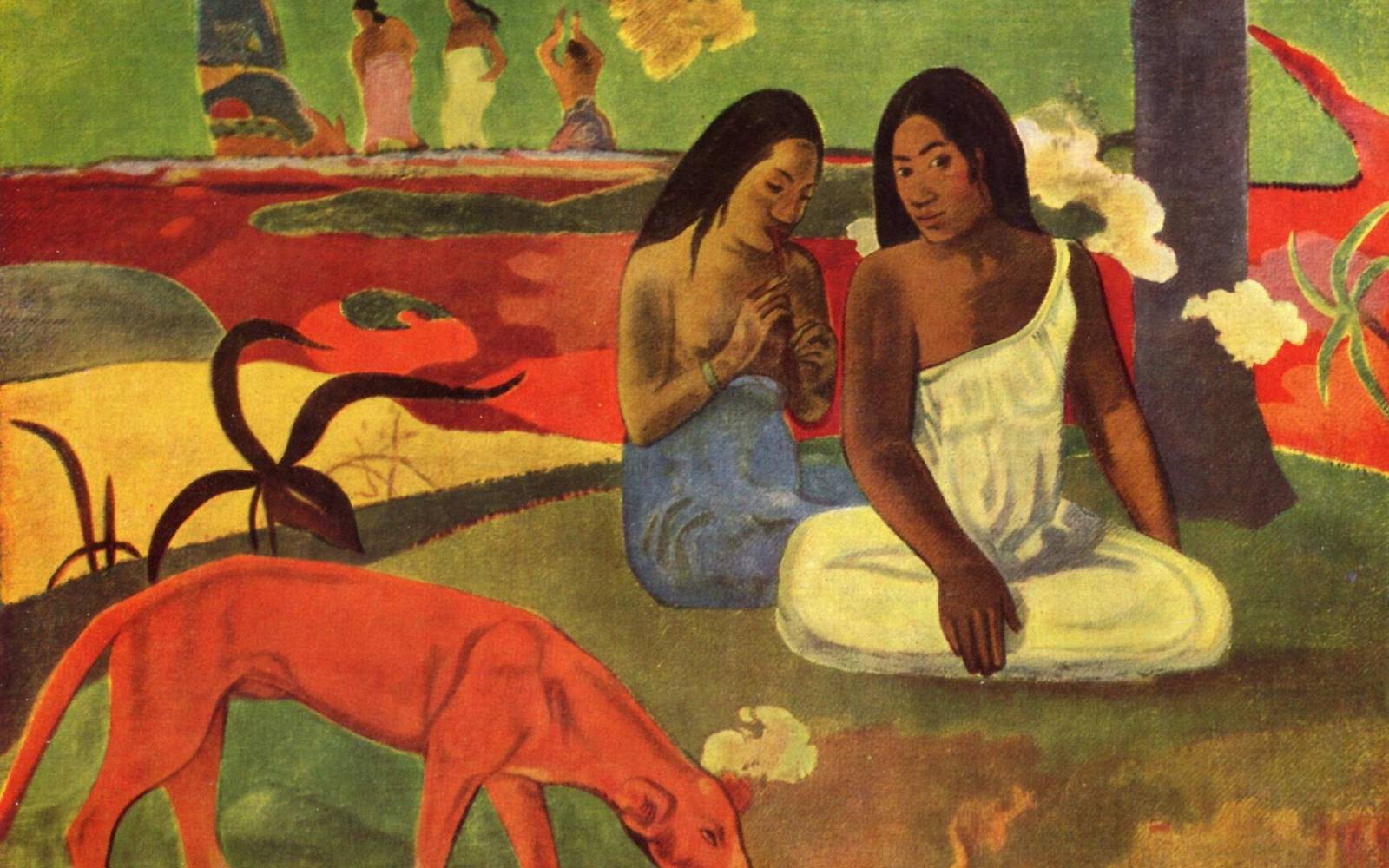
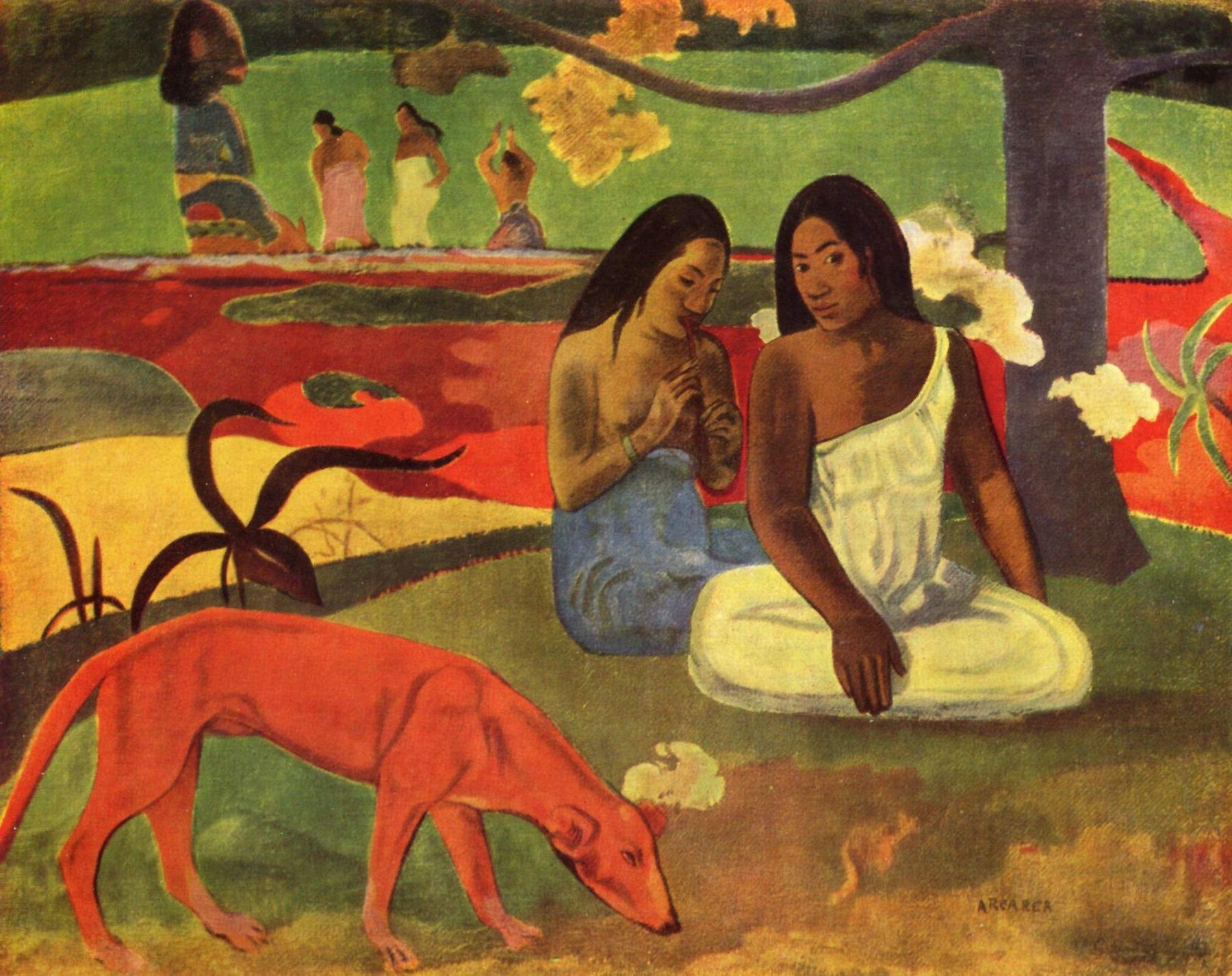
Image reference: Paul Gauguin’s Arearea. Its invented deity and colonial setting are examined below.
At a Glance
- Central periodapproximately 1885–1939, with earlier intellectual roots and a long critical afterlife.
- What it wasa Western modernist construction that associated varied arts and peoples with origins, instinct, authenticity, spirituality or escape from modern civilisation.
- What it was notone organised movement, one visual style, or a valid category for the cultures and works placed beneath it.
- Major settingsBrittany and French Polynesia; Paris; Dresden and Berlin; Moscow and St Petersburg; Zurich and New York.
- Artists often discussedGauguin, Rousseau, Matisse, Picasso, Modigliani, Brancusi, Kirchner, Pechstein, Nolde, Höch, Ernst, Goncharova and Larionov.
- Source traditionsspecific African, Oceanic and Indigenous arts; European folk, medieval and peasant arts; icons, lubki, archaeological objects, children's art and self-taught practice.
- Essential questionnot simply ‘Who influenced whom?’ but which object, by what route, with what original function, under what power relation, and with what transformation or loss?
Contents
- Where it fits
- Why the name needs explanation
- Modernity and empire
- Rousseau
- Gauguin
- Source objects
- Paris
- Four stages
- The 1984 debate
- Where to study it
Where Primitivism in modern art fits
Paul Gauguin
Key career periodHenri Rousseau
Key career periodHenri Matisse
Key career periodPablo Picasso
Key career periodErnst Ludwig Kirchner
Key career periodNatalia Goncharova
Key career periodHannah Höch
Key career periodMax Ernst
Key career periodPrimitivism in Modern Art is both a history of visual invention and a history of unequal looking. From the late nineteenth century, artists dissatisfied with academic naturalism and industrial society sought forms they imagined to be more direct, ancient, instinctive or spiritually whole. They found—or believed they found—them in African and Oceanic sculpture, Indigenous American arts, European folk and medieval traditions, children's drawings, self-taught painting and archaeological objects. Flat colour, altered proportion, forceful contour and constructed bodies became instruments for remaking modern art.
The category that gathered those encounters was never neutral. “The primitive” was an idea produced by the modern West, often through colonial conquest, racial hierarchy, ethnographic museums and markets that separated objects from the people who made and used them. A Fang reliquary guardian, a Baule portrait mask and a Russian popular print did not belong to one culture, time or purpose. They became “primitive” only inside a system that placed Western civilisation at the centre and converted difference into its imagined past.
For that reason, Primitivism was not a movement with a manifesto, fixed membership or single style. It was a recurring modernist attitude, most influential from about 1885 to the late 1930s. Paul Gauguin sought origins in Brittany and French Polynesia. Henri Rousseau was celebrated as a supposedly instinctive outsider. Matisse and Picasso encountered African sculpture in Paris; Brücke artists studied ethnographic collections and travelled through colonial systems; Russian painters turned to icons, shop signs and popular prints. Dada and Surrealism reworked the same field in new ways.
The results cannot be dismissed as one mistake. They include some of modern art's most consequential paintings, sculptures and collages. Nor can formal innovation excuse the erasures that helped produce it. The most useful account holds both truths together: it looks closely at what artists made while restoring names, functions, routes and power to the works they treated as sources. Primitivism is therefore best understood not as a timeless style, but as a problem modern art made for itself.[1]
Why the name needs explanation
For many early twentieth-century writers, “primitive” could mean original, simple, childlike, instinctive, prehistoric or supposedly outside civilisation. Those meanings contradicted one another, but they shared a hierarchy. The observer claimed the present and assigned someone else to an earlier stage of human development. Admiration did not remove that structure. To praise a people as innocent or naturally creative could deny them contemporaneity, education, political history and change.
Current museum guidance advises against using the word for a people or culture because it implies that European modernity is the measure of development. “Primitivism” remains necessary when identifying the documented Western discourse, but it should be explained, placed in historical quotation where appropriate and never allowed to become the editorial voice's label for source works.[2]
That distinction changes how the story is told. Rather than “African masks inspired Picasso,” a responsible account asks which African region or object type is involved, whether the work was actually a mask, what it did before it entered a collection, how it reached Europe and what the artist could have known. The answer may be incomplete. An incomplete, specific history is still more truthful than a confident generalisation.
Primitivism also contained several internal models. One was geographical: a distant people represented life beyond European industrial society. One was temporal: ancient, medieval or archaeological art represented an earlier human stage. One was social: peasants, children, patients or self-taught makers supposedly created without academic convention. One was psychological: the modern artist imagined an instinctive layer beneath rational consciousness. Artists moved between these models freely, which is why the term can connect unlike works without making them identical.
A modern escape built by empire
The apparent journey away from modernity depended on distinctly modern systems. Steamships, colonial administrators, missionaries, soldiers, scientific expeditions, international exhibitions, photographs, illustrated books, dealers and museums moved objects and images into European cities. A sculptor in Paris could imagine an encounter with an untouched origin while standing before an object displaced through commerce or conquest.
Museum classification reinforced the division. European paintings were generally treated as works of individual art, while African objects were placed in ethnographic departments as evidence of collective culture. The Victoria and Albert Museum's history of its African holdings shows how war, colonial rule, missionary activity and collecting shaped the material now divided between art, design and ethnography. It also emphasises that “Africa” names a continent of many regions, languages and artistic systems, not one style.[3]
By about 1905–14, African sculpture circulated through Parisian ethnographic displays and an expanding specialist market. Artists including Henri Matisse, André Derain, Maurice de Vlaminck, Picasso and others acquired or studied works. The encounter encouraged them to think beyond anatomical imitation: a face could be organised as powerful planes, a body could distribute symbolic emphasis rather than optical proportion, and sculpture could act as a social or spiritual presence rather than a copy of visible appearance.[4]
These were active transformations, not mechanical borrowings. Yet the unequal economy remains. Source makers were often unnamed; objects were detached from use; European artists received authorship and market value for formal discoveries. The task is not to pretend influence never happened, but to put the movement of form back inside the movement of objects and power.
Rousseau and the cultivated myth of innocence
Henri Rousseau offered the Parisian avant-garde a “primitive” artist without a distant voyage. A former toll collector with no conventional academy training, he developed ambitious portraits, city scenes, allegories and jungles through sustained practice. Critics mocked his flattened space and strange scale. Admirers including Picasso and Apollinaire converted the same qualities into proof of sincerity unspoiled by schooling.
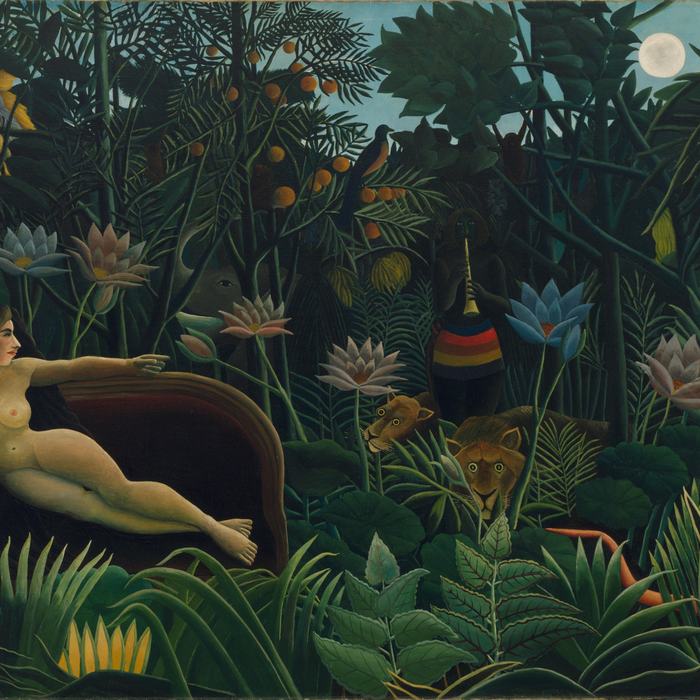
Rousseau never saw a tropical jungle. He used Paris's Jardin des Plantes, zoo displays, botanical studies, photographs, popular illustrations and stories from people who had travelled. His vegetation is built leaf by leaf into a theatrical screen. Animals stare from improbable distances, and human figures appear exposed within a world whose density is pictorial before it is geographical. MoMA's account places this deliberate construction beside the reputation that made him an emblem of self-taught modernity.[5]
Calling Rousseau naïve can identify his position outside academic training, but it can also reproduce the legend that he painted without thought. He submitted to exhibitions, cultivated contacts, revised motifs and pursued recognition. The celebratory banquet Picasso held in 1908 was affectionate and strategic: the avant-garde could honour Rousseau as an innocent father while defining its own sophistication through the act of recognition.
His case shows that Primitivism did not merely appropriate remote cultures. It also produced a role inside European society—the instinctive outsider—from which professional ambition and self-conscious invention were selectively removed.
Gauguin: invention, escape and colonial Tahiti
Paul Gauguin made the search for origins central to modern artistic identity. In Brittany during the late 1880s, he treated peasant Catholic life, carved crosses and regional dress as alternatives to metropolitan naturalism. Flat areas of saturated colour, heavy outlines and simplified bodies helped establish Synthetism: the picture synthesised observation, memory and imaginative meaning rather than copying an optical instant.
Gauguin then travelled to Tahiti in 1891 and returned to French Polynesia in 1895, later settling in the Marquesas. He presented these journeys as escape from European decadence. In reality, he moved within a French colony transformed by disease, missionary rule, commerce and administration. Imported cloth and Christian schooling were part of ordinary life. His paintings joined local sitters and landscape with photographs, temple reliefs, European religious art and imagined deities. The Met's biography makes clear that travel and self-fashioning were inseparable from the new market identity he created around his art.[6]
The portrait Merahi metua no Tehamana is a decisive test. Tehamana was approximately thirteen when Gauguin entered a sexual relationship with her. She wears a high-necked missionary dress. Behind her, the artist painted signs partly derived from the undeciphered rongorongo tablets of distant Rapa Nui, which he knew through published reproductions. They do not document Tehamana's personal tradition; they construct the ancient, mysterious Polynesia Gauguin wanted his European audience to see.[7]
The portrait is neither only a colonial document nor only an arrangement of colour. Tehamana's frontal presence, the rhythm of her dress and flowers, the doubled figures and written-looking signs make a psychologically charged image. But close looking must not turn her into another formal resource. Her age, the legal and social inequality of colonial Tahiti and Gauguin's departure belong to the work's history.
Contemporary artists have exposed the survival of such fantasies. Joiri Minaya's installations and patterned coverings analyse the tropical feminine body as a product of tourism, colonial botany and advertising. Her work is useful here because it changes the direction of interpretation: the “tropics” look back at the visual system that invented them.[8]
In Arearea of 1892, two women occupy an intensely coloured landscape while a dog crosses the foreground. Behind them, worshippers gather before a carved deity. The Musée d'Orsay notes that Gauguin invented this idol rather than recording a Tahitian original. The painting builds a synthetic sacred world from observed bodies, colour, borrowed poses and projected belief.[9]
That invention explains both Gauguin's importance and the ethical difficulty of his legacy. He rejected naturalism with extraordinary pictorial confidence, yet claimed imaginative authority over a culture whose actual modernity complicated his desired origin. The work asks to be read in two registers at once: as formal revolution and as colonial representation.
Restoring the lives of source objects
Modernist accounts often reproduce only the qualities an artist noticed: oval face, hollow eye, extended nose, hard contour. Source records reveal that such forms belonged to relationships rather than free-standing “solutions.”
A Fang nlo bieri figure from present-day Gabon or Equatorial Guinea guarded a reliquary container holding ancestral remains. Its concentrated body and polished surfaces connected lineage, protection and the continuing presence of ancestors. The Met's record identifies function and regional tradition, making the object more than a sculptural face waiting for European discovery.[10]
A Baule mblo face mask from Côte d'Ivoire was not simply worn by an anonymous dancer. It portrayed an admired, identifiable individual and appeared in paired performance, where movement, music, costume and audience activated the likeness. Its refined forehead, lowered eyes and scarification belonged to a local ideal of beauty and character.[11]
A Kongo nkisi nkondi power figure was likewise not complete when a woodcarver finished its body. A ritual specialist added medicines and charged substances; clients drove blades or nails in connection with oaths, healing or disputes. Sculpture, ritual knowledge and communal action collaborated. Removing the inserted materials or calling the figure an aggressive fetish can erase the legal and therapeutic work it performed.[12]
These examples are not offered as keys to every modernist painting. They establish a method. Formal comparison should follow, not replace, cultural identification. A source object has its own history even when no European artist ever saw it, and that history does not culminate in modernism.
Paris and the myth of a single breakthrough
Picasso's encounter with non-Western art is often narrated as an epiphany at the Musée d'Ethnographie du Trocadéro in 1907. He later described the museum's smell, fear and objects as protective weapons, linking the visit to Les Demoiselles d'Avignon. The episode matters, but memory turned a long development into one dramatic origin story.
Picasso had already encountered Iberian sculpture, Gauguin's work, reproductions, Romanesque painting and African objects circulating among Paris artists. He later collected works from several African and Oceanic traditions. Musée Picasso Paris presents this field as a continuing dialogue rather than a single quotation.[13]
Research on Picasso's 1906 transformation pushes the chronology earlier still. The monumental figures of Gósol developed through Iberian heads, Cézanne, archaic Mediterranean sculpture, Gauguin and other sources before the Trocadéro visit. The Reina Sofía's Spanish-language study also places the encounter inside colonial Europe, where source works were available because imperial systems had classified and moved them.[14]
In Seated Female Nude of 1908, the body is both massive and unstable. Facial planes, angular limbs and the relation of hollow to projecting form suggest Picasso's cumulative study of African, Iberian and Oceanic works alongside Cézanne. The Met avoids assigning the figure to one source; the painting's importance lies in the synthesis through which a body becomes a constructed volume rather than a continuous anatomical envelope.[15]
The Offering, also 1908, gathers three nudes into a cramped sculptural drama. The standing bearer extends a bowl towards the reclining figures. Heads and limbs are compressed, while the surrounding space behaves like solid material. Museu Picasso Barcelona relates the work to African sculpture and Cézanne within the development towards Cubism.[16]
That development was transformative, but “African influence” can remain too broad to explain it. Picasso did not absorb a continent. He encountered selected objects already displaced, interpreted and sold in Paris. Some came with minimal information; others acquired new attributions later. His pictures recombined several traditions so completely that exact one-to-one sources are often impossible to prove.
Provenance sometimes makes the network visible. An Mbete reliquary figure from the Republic of the Congo moved through the hands of a colonial collector and Paris dealers before entering Matisse's collection. Its cavities and bound forms had belonged to ancestral protection; in Paris it became art, commodity and studio resource. The Met's chain of ownership does not prove a specific painted borrowing, but it replaces a vague atmosphere of influence with an accountable route.[17]
The modernist achievement was not merely that European artists “recognised” these objects as art. Fang, Mbete or Baule makers did not need Paris to make their work aesthetic. What changed was the Western category and market around them. Ethnographic things became collectible masterpieces, while modernists used the encounter to challenge European conventions.
New York: markets and another relation to African heritage
African sculpture entered American modern-art discourse through exhibitions, publications and dealers. Alfred Stieglitz's 291 gallery displayed African works in 1914; Marius de Zayas produced stylised comparisons and helped build a market; collectors including Albert Barnes assembled significant holdings. The Met's reconstruction shows how photography, display and commerce helped change an object's status from ethnographic specimen to avant-garde art in New York.[18]
That recognition remained selective. The language of “pure form” could eliminate maker, history and use at the moment it conferred aesthetic value. It also allowed American modernists to treat African art as a resource without confronting contemporary Black life.
Alain Locke proposed a different relationship. A philosopher and influential interpreter of the Harlem Renaissance, he studied and collected African art as part of diasporic heritage. His plans for a Harlem Museum of African Art connected aesthetic education with institutional self-determination. The Met's profile records how his research and the Blondiau collection served a cultural project, not simply a white avant-garde search for formal renewal.[19]
Aaron Douglas likewise transformed African and Egyptian sources from within Black historical narration. In The Judgment Day, silhouetted figures, concentric circles and a trumpet-bearing angel organise biblical imagery around emancipation, migration and collective struggle. The National Gallery of Art traces the work to Douglas's illustrations for James Weldon Johnson and to his larger effort to make modern Black history monumental.[20]
The Harlem Renaissance was internally diverse and transatlantic, bringing writers, performers and artists into exchange across Africa, Europe, the Caribbean and the United States. To fold all of this into Primitivism would repeat the category's central error. Black artists' engagements with African heritage involved ancestry, Pan-African politics and self-representation under racism, even when they shared formal sources with white modernists.[21]
The modern head: Modigliani and Brancusi
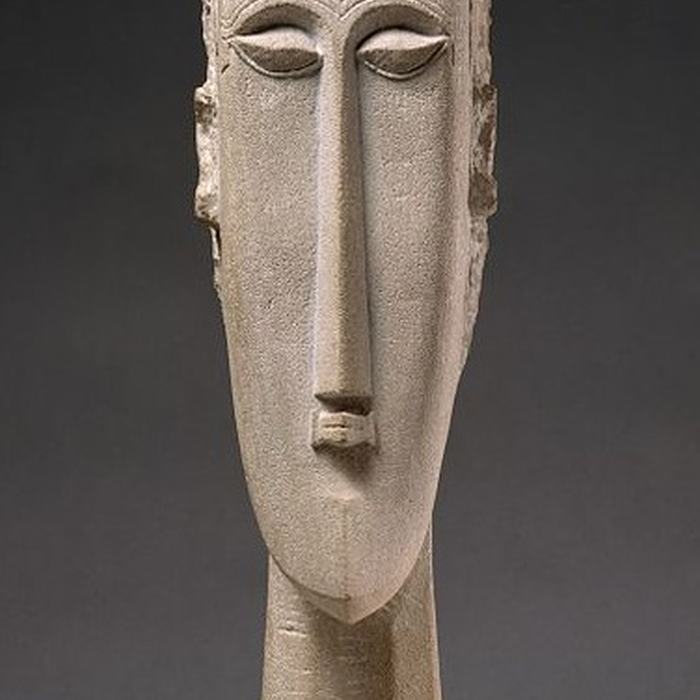
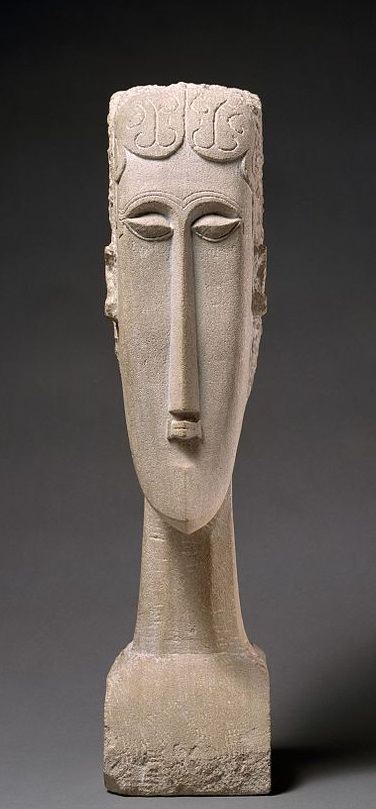
Amedeo Modigliani developed carved limestone heads between about 1909 and 1914, then carried their elongated necks, almond eyes and compressed features into painting. African sculpture was one source among Cycladic figures, Egyptian art, Khmer sculpture and exchange with Constantin Brancusi. The Met's Woman's Head shows why no single genealogy is sufficient: its symmetry suggests ritual calm, but the chisel marks, stone block and stylised profile belong to a modern sculptor actively composing across traditions.[22]
Brancusi's Blond Negress II makes the racial structure more visible. The highly polished bronze head converts features into an oval, projecting lips and a sweeping form that is at once abstract and caricatural. MoMA connects the series to colonial exhibitions and notes the dehumanising history of its title. The sculpture's radical reduction cannot be separated from the European fantasy through which a Black woman became an exotic type.[23]
This does not make every simplified head the same case. Modigliani's limestone, Brancusi's polished bronze and Picasso's constructed face differ in material, intent and reception. Primitivism is most illuminating when it identifies those differences rather than using “mask-like” as a universal visual adjective.
Suggested books
Primitivism and Modern Art by Colin Rhodes
Rhodes provides the clearest compact survey of how modern Western artists imagined the primitive across painting, sculpture and ideas. It is a strong first book because it connects formal change to the social anxieties that made origins and authenticity so attractive.[46]
Primitivism and Twentieth-Century Art: A Documentary History, edited by Jack Flam and Miriam Deutch
This anthology places artists' statements, early criticism and later revision beside one another. Reading the historical language directly makes its admiration, hierarchy and contradiction visible rather than smoothing them into a retrospective summary.[47]
The Myth of Primitivism, edited by Susan Hiller
Hiller's influential collection challenges the fantasy of a universal, timeless primitive and examines how anthropology, art history and contemporary practice produced the category. It is especially valuable after a general survey because it tests the assumptions on which that survey depends.[48]
Picasso Primitif
Published for the Musée du quai Branly–Jacques Chirac exhibition, this richly illustrated French catalogue explores Picasso's long engagement with non-Western arts. Its scale allows individual objects, collection histories and visual relationships to replace the simplified single-visit legend.[49]
Kirchner og Nolde: Ekspressionisme · Kolonialisme
The SMK catalogue uses Danish and international scholarship to examine Expressionism through ethnographic collections, colonial journeys and representation. It offers a focused case study in how a museum can reassess canonical artists without reducing their work to either celebration or indictment.[50]
Follow the history through four stages
–1904
Modern artists construct imagined origins
Gauguin’s Brittany and Polynesia and the reception of Rousseau turn folk, colonial and self-taught positions into alternatives to academic modernity.
–14
Paris and Dresden transform bodies and objects
Fauvism, Cubism, modern sculpture and Brücke Expressionism select from African, Oceanic, archaeological and vernacular sources moving through colonial museums and markets.
–39
Dada, Surrealism and Russian practice diverge
Performance, montage, collecting, icons, lubki and popular culture produce different encounters that cannot be reduced to one style or one source geography.
–today
Museums and contemporary artists reopen the story
Te Maori, the MoMA controversy, Magiciens de la terre and contemporary counternarratives shift attention towards provenance, living authorship and source-community agency.
Essential works in the history of Primitivism
These are modern works discussed in the history of the category—not source-culture objects recast as steps towards Western modernism.
Arearea
Paul Gauguin · 1892 · Observed people, synthetic colour and an invented deity make the painting a major example of how Gauguin joined visual invention to a projected colonial past.
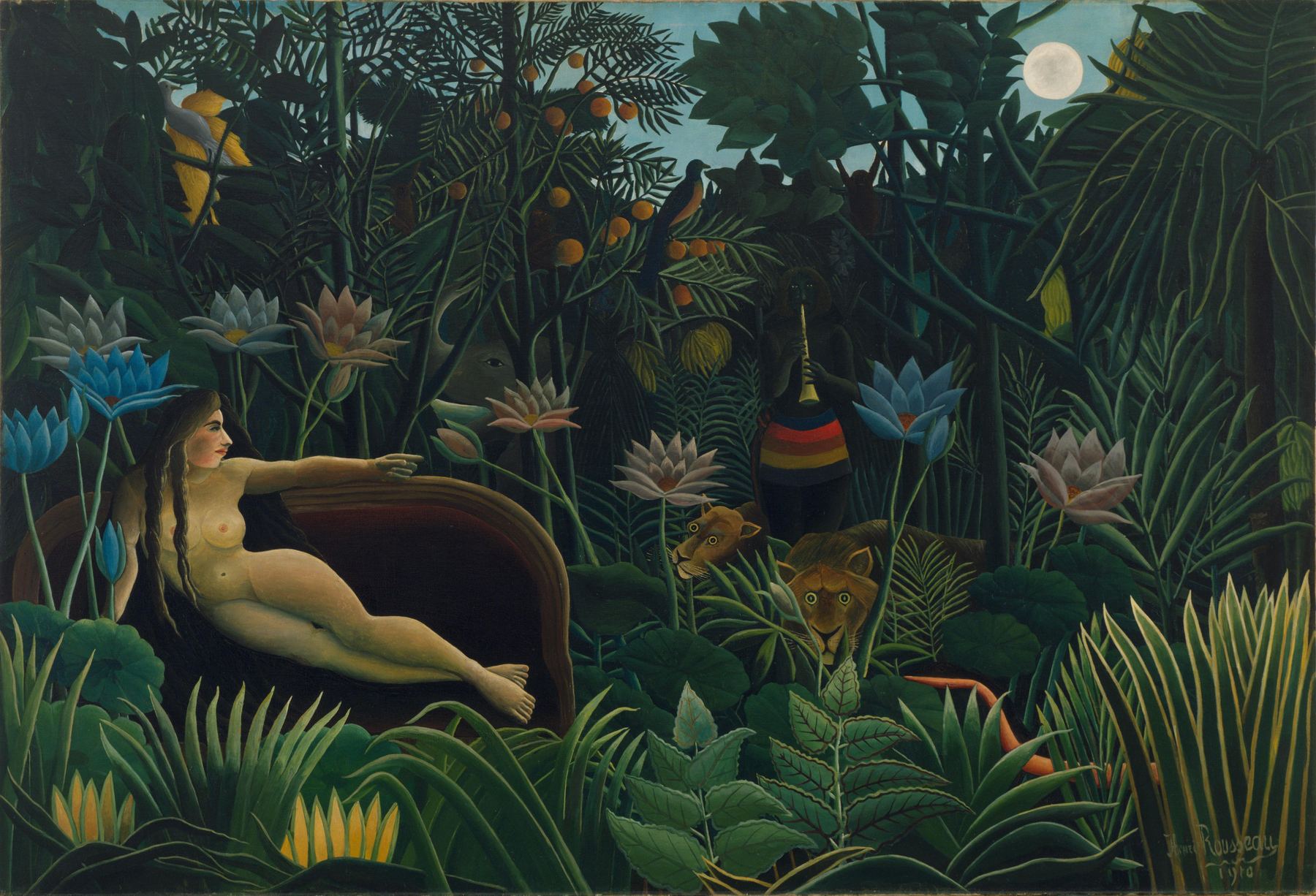
The Dream
Henri Rousseau · 1910 · Rousseau’s dense Paris-made jungle demonstrates that self-taught practice was deliberate and constructed, despite the avant-garde legend of instinctive innocence.
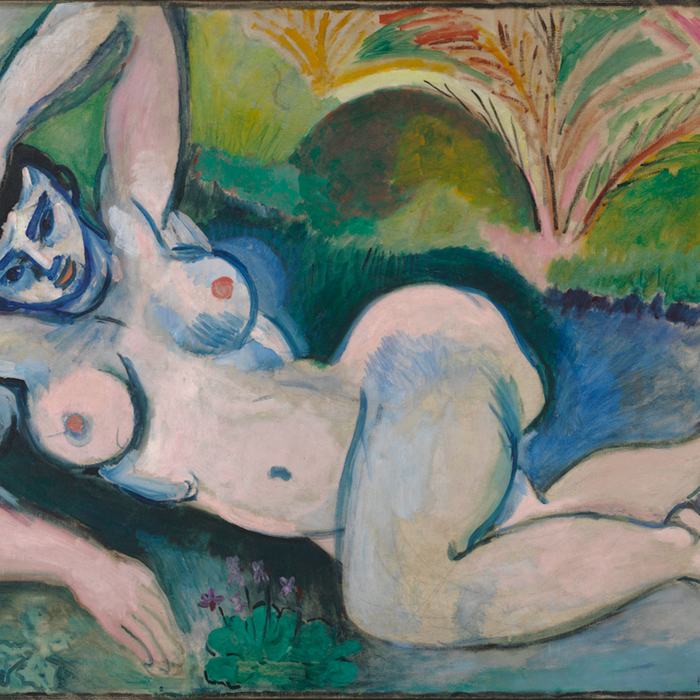
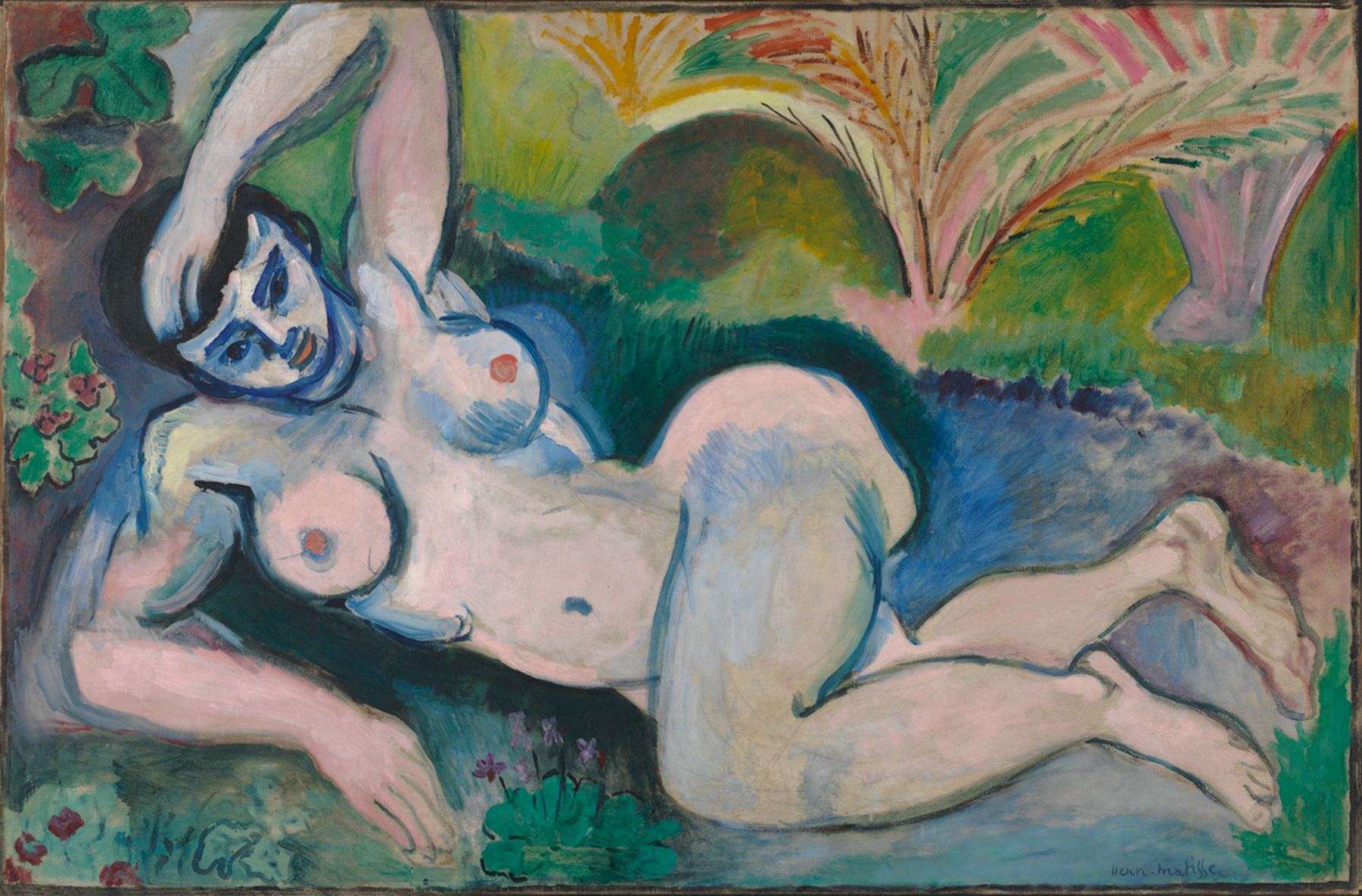
Blue Nude (Souvenir de Biskra)
Henri Matisse · 1907 · Matisse’s altered body and emphatic contour show how modern form could be remade through travel, colonial fantasy and multiple sculptural sources.
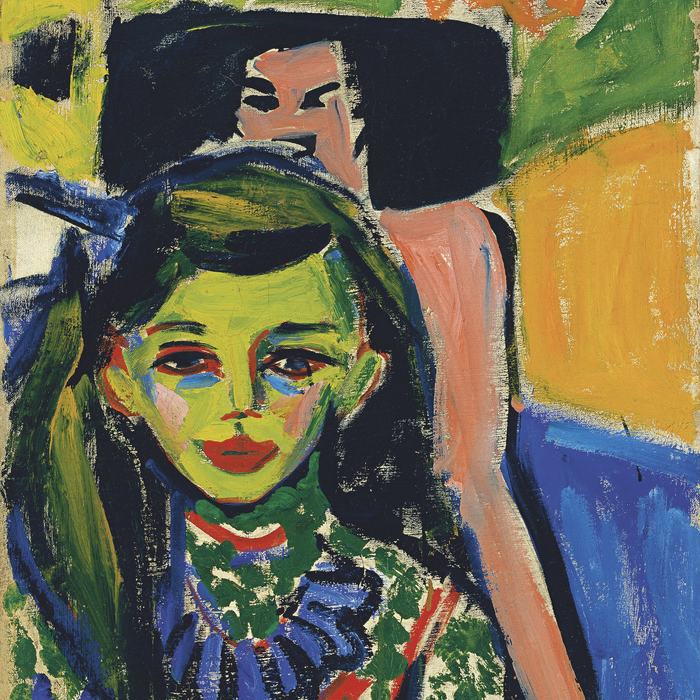
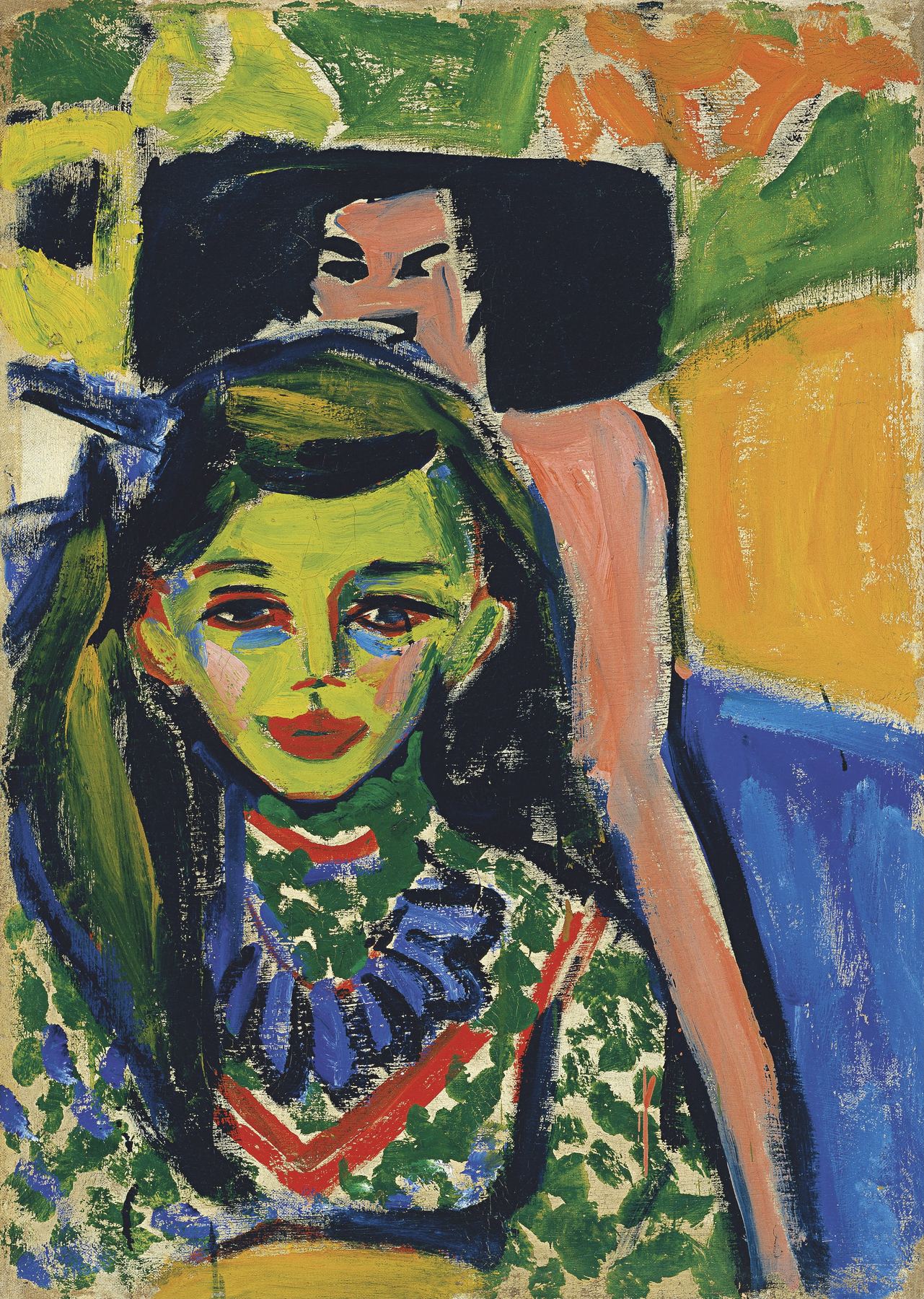
Fränzi in Front of a Carved Chair
Ernst Ludwig Kirchner · 1910 · Kirchner’s compressed colour, carved chair and representation of Fränzi bring formal experiment into the colonial and gendered setting now recovered by Brücke scholarship.
Woman's Head
Amedeo Modigliani · 1912 · Modigliani combines the stone block with African, Cycladic, Egyptian and modern sculptural sources rather than translating one supposedly universal type.
German Expressionism and colonial entanglement
Die Brücke formed in Dresden in 1905 and sought an art of direct life, strong colour and liberated bodies. Its members studied medieval German woodcuts, popular print, ethnographic objects, cabaret and urban streets. Woodcut's resistance and carving's simplified planes offered an alternative to polished academy technique.
The freedom they imagined was frequently projected onto other people. Brücke artists visited Dresden's ethnographic museum, attended staged colonial shows and drew Black performers and models. Recent Brücke-Museum research recovers named objects, unknown sitters and the routes by which stools or sculptures entered studios. It asks “whose expression” the pictures preserve when a modern artist's signature eclipses the person represented.[24]
Ernst Ludwig Kirchner filled studios with carved furniture, textiles and objects, making an environment in which art and life supposedly merged. His bathers and dancers reject academic modelling, but the category of the natural body often depends on racialised contrast between modern Europe and imagined elsewhere. A critical reading can acknowledge the paintings' colour and compressed space while asking how bodies were typed.
Danish museum scholarship has recently placed Kirchner and Emil Nolde “up for discussion,” comparing their attraction to ethnographic collections, colonial stereotypes and ideas of authenticity. This method does not add an external moral footnote; it treats colonialism as part of the visual conditions in which Expressionism formed.[25]
Max Pechstein travelled to Palau in 1914, hoping to find an integrated life beyond European civilisation. The First World War interrupted his stay. Palau had been incorporated into German New Guinea, and his journey depended on colonial shipping, administration and racial hierarchy. The Brücke-Museum's German account therefore replaces the artist's paradise narrative with the infrastructure that enabled it.[26]
Nolde travelled in 1913–14 with the German New Guinea medical-demographic expedition. He painted people and landscapes while officials investigated colonial populations. The Nolde Foundation's chronology establishes the official setting and itinerary. His vivid watercolours cannot be understood as independent field encounters outside power; the expedition framed whom he could see and how Europeans classified them.[27]
The movement's contradictions are not resolved by deciding that Expressionist works are either liberated or colonial. Antibourgeois rebellion and imperial privilege could coexist. An artist might criticise Europe's mechanised society while imagining colonised people as a timeless alternative to it.
Dada: montage, masks and the “other” Europe invented
During the First World War, Zurich Dada attacked the reason, nationalism and cultural refinement that had accompanied industrial slaughter. At Cabaret Voltaire, performers used sound poetry, masks, drums, costumes and invented ritual. African and Oceanic forms appeared as weapons against European sense.
Hannah Höch's long series From an Ethnographic Museum cut photographic fragments of museum objects together with fashion models, dancers and commodity images. The hybrid heads and bodies expose how mass media and ethnography turn women and colonised people into visual parts. Yet the collages also reuse the fragments they criticise. MoMA's account situates this ambivalence within Höch's sustained analysis of gender and modern representation.[28]
The exhibition Dada Africa reconstructed artists' access to masks, sculptures, poetry and performance. It showed that Dada's “African” language was often a composite assembled from museums and published transcriptions rather than a dialogue with one named culture. The borrowing expanded performance and collage while leaving source makers largely outside the avant-garde stage.[29]
This history matters because Dada's political attack on Europe did not automatically free it from European categories. Declaring admiration for the “other” can still make the admirer the author of what otherness means.
Surrealism, collecting and the marvellous
Surrealists inherited the idea that objects made beyond Western rationalism could disclose desire, dream and the marvellous. They collected African, Oceanic, Indigenous American and Asian works, displayed them beside modern art and circulated them through dealers and magazines. Max Ernst built a particularly wide-ranging collection while transforming printed images through collage, frottage and unexpected conjunction.[30]
Surrealist artists and writers often took anticolonial positions, notably around the 1931 Colonial Exhibition. That political opposition mattered. It did not necessarily restore cultural function to collected objects or remove fantasies of timeless magic. An object could be admired as evidence against bourgeois reason precisely by being detached from the people whose reason and history had shaped it.
The Musée du quai Branly's collecting history reveals how Fauve, Cubist, Dada and Surrealist artists and intellectuals participated in a changing Paris market. The same work could pass from ethnographic specimen to dealer stock, artist's possession and museum masterpiece. These changes affected interpretation and price, while the object's earlier biography could become harder to recover.[31]
Oceanic art presents the danger of generalisation especially clearly. The region encompasses thousands of islands and many distinct systems of ancestry, exchange, navigation, ceremony and authority. Works could dress bodies, embody deities, protect houses, record genealogy or act in performance. A museum guide to reading Oceanic art begins from this diversity rather than treating the Pacific as a reservoir of dreamlike form for Europe.[32]
Russian Neo-Primitivism
Russian Neo-Primitivism emerged around 1907–13 from a different combination of sources. Natalia Goncharova, Mikhail Larionov and related artists engaged Orthodox icons, lubki—cheap popular prints—painted shop signs, toys, embroidery, peasant carving, urban street culture and ancient Eurasian material. French Post-Impressionism mattered, but the movement's claim to native tradition was central.
The deliberately blunt contour, tilted perspective and awkward anatomy of Neo-Primitivist pictures challenged the imperial academy's hierarchy between fine art and vernacular production. MoMA's Russian avant-garde history places the tendency between Symbolism, French modernism and the rapid movement towards Rayonism and abstraction.[33]
Goncharova painted harvesters, religious cycles, factories, dancers and street subjects with forms that could recall icons and signboards. Her major exhibitions assembled sacred and profane imagery at provocative scale. The Russian Museum records both her study of folk sources and her role in moving the Russian avant-garde across painting, theatre and book design.[34]
Larionov collected popular prints and shop signs and made soldiers, barbers and provincial figures deliberately resistant to academic finish. His exhibitions turned disregarded visual culture into avant-garde argument. By 1912–13, he developed Rayonism, using intersecting lines of reflected light to move beyond the solid object.[35]
Russian Neo-Primitivism was not an untouched national essence. The Russian Empire contained its own centre-periphery relations, and educated urban artists selected vernacular production for metropolitan exhibitions. Yet its internal sources, icon debates and popular urban culture make it historically different from Gauguin's colonial Polynesia or a Paris collector's African sculpture. The State Russian Museum's collection chronology preserves that transition within a specifically Russian avant-garde sequence.[36]
From anonymous object to living community
As museums reclassified ethnographic material as art, they faced a basic question: could an institution change the label while leaving the old relation of authority intact? A carved ancestor displayed alone on a white wall might gain formal prestige, but it could lose the community, ceremony, language and obligations that had made it active.
The 1984 New York exhibition Te Maori offered an influential alternative. Māori elders, artists and organisers participated in how ancestral works were understood and received. Ceremonial practice and living continuity accompanied aesthetic display. Later museum scholarship identifies this as a turning point because Indigenous authority changed not only the information beside the object but the conventions of exhibition itself.[37]
This does not mean that every historic work can return to an intact original context. Many communities have changed, records are incomplete and objects have complex legal histories. It does mean that a museum need not speak as though source peoples have vanished while their art remains available for modernist appreciation.
The 1984 MoMA exhibition
The debate over Primitivism crystallised around the Museum of Modern Art's “Primitivism” in 20th Century Art: Affinity of the Tribal and the Modern. The vast 1984 exhibition brought together more than 150 modern works and over 200 objects from Africa, Oceania and North America. Sections addressed direct influences, broader conceptual affinities, Dada and Surrealism, and contemporary persistence. Its ambition was to demonstrate that the formal intelligence of works long confined to ethnography belonged inside the history of modern art.[38]
The installation often paired a modern work with a source object according to resemblance: a mask beside a painted head, a figure beside a sculpture, repeated contours across cultures. Such pairings were visually persuasive. They also controlled the question. The modernist artist appeared as a named, developing author whose intention required explanation. The source maker was frequently anonymous, the object's function abbreviated, and its history relevant principally when it reached the European studio.
Critic Thomas McEvilley argued that the exhibition universalised Western aesthetic categories while suppressing colonial power and cultural difference. MoMA's own retrospective history now presents the show as infamous and acknowledges the dispute that followed. The controversy became as consequential as the exhibition, helping redirect art history from a story of formal affinity towards provenance, context and asymmetrical agency.[39]
The lesson is not that visual resemblance is meaningless. Two works can share a striking solution to the face or body. The mistake is to treat resemblance as a complete history. Naming a source as Fang, Dan, Kota, Baule or Mbete does more than improve a caption. It opens different makers, places, uses and routes and prevents “Africa” from functioning as a single anonymous style. MoMA's later research on Picasso explicitly argues for these more specific African identities within accounts of modernism.[40]
The 1984 exhibition therefore remains indispensable in two ways. It documents how late twentieth-century museums tried to enlarge the modern canon, and it reveals the limits of enlargement when the canon's central narrative stays unchanged. It made source objects more visible while keeping European creativity as the main plot.
Beyond affinity: Magiciens de la terre and its limits
In 1989, curator Jean-Hubert Martin organised Magiciens de la terre across the Centre Pompidou and Grande Halle de la Villette. Instead of placing anonymous historic objects beside Western modernists, it presented one hundred living artists, approximately half from Western centres and half from elsewhere. The title, selection and concept attracted criticism, but the exhibition attempted to replace a geography in which contemporary art existed in the West and tradition existed everywhere else.[41]
Equal numbers did not produce equal conditions. Artists arrived through different markets, languages and curatorial frames, and “magician” could still exoticise. Yet living authorship altered the direction of encounter. Non-Western artists were no longer available only as precursors or sources for someone else's modernity.
Later exhibitions have made response itself a subject. Post-Picasso gathered contemporary artists—many African or diasporic—who contested, revised or repurposed Picasso's legacy. Their works show that influence does not end when a European artist borrows a form. The appropriated tradition can answer back, expose what was omitted and claim modernism as a shared but unequal field.[42]
Wifredo Lam and a two-way modernism
Wifredo Lam resists a simple opposition between Western modernist and non-Western source. Born in Cuba to a Chinese father and a mother of African and Spanish descent, he trained in Havana and Madrid, participated in European avant-garde circles and returned to the Caribbean in 1941. His work absorbed Cubism and Surrealism while engaging Afro-Cuban religion, plantation history and anticolonial politics.
In The Jungle of 1943, elongated hybrid figures press through sugar cane. Mask-like heads, blades, hooves and swollen forms create no ethnographic inventory. Lam used the formal language he had encountered through Picasso and Surrealism to confront the exotic image of Cuba sold to tourists and the violence of the sugar economy. The Reina Sofía's retrospective places him at the centre of an Atlantic modernism rather than at the periphery of Paris.[43]
Lam's position does not make questions of source or appropriation disappear. It changes their direction and stakes. Afro-Cuban religious imagery was part of a living society to which he was connected, though not reducible to a simple personal inheritance. European forms, African diasporic traditions and Caribbean history act upon one another.
Contemporary art reopens the diagram
Hank Willis Thomas has revisited Alfred H. Barr Jr.'s famous chart of modern-art movements. Barr's arrows make the rise of abstraction look like a self-contained sequence of European styles. Thomas overlays that diagram with colonial territories and systems, restoring the political world beneath apparently pure formal evolution. MoMA's account of the work shows how a familiar teaching image can hide the material routes that made influence possible.[44]
This intervention suggests a better diagram for Primitivism. It would have arrows not only from source object to European artist, but from colony to museum, missionary to dealer, exhibition to collector, photographer to publication, modernist picture to market and contemporary artist back to the canon. Some lines would carry force, others knowledge or money, and many would remain uncertain.
Rousseau's critical afterlife offers a smaller version of the same correction. Modern scholarship has moved away from the charming legend of a childlike customs officer unknowingly making masterpieces. MoMA's collected essays restore a painter who studied available images, negotiated Parisian institutions and deliberately built an art that could look unlike academic skill.[45]
Reassessment does not eliminate pleasure. Rousseau's leaves remain lush, Gauguin's colour remains forceful and Picasso's constructed bodies remain destabilising. It makes pleasure more exact. We see not only the modernist form, but the historical machinery and human relations inside its appearance.
How to look at Primitivism in modern art
Begin by slowing down the word “influence.” It can describe a documented object in a studio, a reproduction an artist owned, a general visual environment or a resemblance noticed decades later. These are different levels of evidence. Ask what can actually be established.
Next, identify the modern artist's transformation. Does a face become a set of opposing planes? Does the body reject anatomical continuity? Does flat colour invoke a religious or folk source? Does a rough woodcut announce refusal of academic polish? Formal analysis is not the enemy of historical criticism; it shows precisely what was selected.
Then look for what selection removed. A mask may once have moved with costume, music and audience. A reliquary figure may have guarded ancestors. A popular print may have circulated cheaply with readable text. The modern artwork might preserve contour while discarding performance, or adopt frontality while inventing a new sexual fantasy.
Finally, follow the route. Was the source encountered in a colonial exhibition, ethnographic museum, dealer's apartment, book, photograph or journey? Was the culture named? Did the artist collect the object? Who sold it, and who was absent from that exchange? Provenance can turn an abstract claim of affinity into a social history.
This four-part method—evidence, transformation, loss and route—avoids two weak conclusions. One says that borrowing alone explains a masterpiece. The other says that unequal borrowing makes close looking pointless. Primitivism demands both visual attention and historical accountability.
What Primitivism changed
Primitivism helped artists abandon the belief that advanced art must become ever more naturalistic. It legitimised flatness, frontal presentation, altered scale, non-optical colour, rhythmic repetition, rough carving and the active void. It expanded the materials and histories that modern artists could claim.
At the same time, it helped establish the modern artist as a privileged converter. Source works could be collective, anonymous and timeless; the European response became individual, dated and innovative. Museums, textbooks and markets reinforced this unequal division long after the colonial moment that produced it.
Its history is therefore not a ladder leading from “tribal” art to Cubism, Expressionism or abstraction. It is a network of encounters in which objects and ideas crossed unequal borders. Some artists studied carefully; some invented fantasies; many did both. Source cultures continued making, interpreting and changing art outside the modernist uses attached to selected works.
The most important legacy of recent scholarship is a change of grammar. African or Oceanic works are not background nouns modified by European action. Their makers, communities and histories become subjects. Modernists remain subjects too, but no longer the only people capable of intention.
Landmark exhibitions and debates
Six exhibitions that materially changed how Primitivism, source objects and modernist authorship were displayed or challenged.
Te Maori
Metropolitan Museum of Art, New York
Māori participation and ceremonial practice offered a living-community alternative to display founded on anonymous affinity.
“Primitivism” in 20th Century Art
Museum of Modern Art, New York
Its vast visual pairings enlarged recognition and provoked a decisive critique of the modernist centre, missing provenance and marginal source histories.
Magiciens de la terre
Centre Pompidou and Grande Halle de la Villette, Paris
One hundred living artists replaced the anonymous historic source object with contemporary authorship, while the title and curatorial frame remained contested.
Post-Picasso: Contemporary Reactions
Museu Picasso Barcelona
African and diasporic artists contested and repurposed Picasso’s legacy, showing that influence can answer back rather than travel in one direction.
Whose Expression?
Brücke-Museum, Berlin
Research into sitters, objects, colonial shows and travel asked whose expression the canonical Brücke image preserved.
Kirchner and Nolde: Up for Discussion
Statens Museum for Kunst, Copenhagen
The exhibition placed Expressionist colour, modernist freedom and colonial infrastructure inside one interpretive field.
Where to study art connected with Primitivism
Displays, loans and access arrangements change. Check current information before travelling.
- 01
Musée du quai Branly–Jacques Chirac
The museum holds major African, Asian, Oceanic and Indigenous American collections and extensive archives of the artists, intellectuals and dealers who helped move works into modern-art markets. Visit with attention to provenance and community interpretation as well as formal display.
Paris, France
Collection and research guideVisit official website - 02
Metropolitan Museum of Art
The Met makes it possible to compare strong object records for Fang, Baule, Kongo, Mbete and Oceanic works with modern paintings and sculptures. Its Heilbrunn essays and collection histories are particularly useful for reconstructing function and route.
New York, United States
Collection and research guideVisit official website - 03
Musée national Picasso–Paris
Picasso's own holdings and the museum's exhibitions reveal an encounter extending beyond one Trocadéro visit. The collection helps place African and Oceanic sources alongside Iberian, Romanesque, Cézannean and other strands in his development.
Paris, France
Collection and research guideVisit official website - 04
Musée d’Orsay
The Orsay's Gauguin holdings include major Polynesian works such as Arearea. They allow close study of Synthetist colour and composition while the museum's research distinguishes observed Tahiti from the artist's invented sacred world.
Paris, France
Collection and research guideVisit official website - 05
Brücke-Museum
The Brücke-Museum has made colonial context a sustained subject of collection research. Its displays and publications recover models, museum objects, travel and power within German Expressionism rather than adding them as an afterthought.
Berlin, Germany
Collection and research guideVisit official website - 06
Statens Museum for Kunst
SMK's Kirchner and Nolde project pairs important Expressionist work with a direct discussion of colonialism, ethnographic display and the two artists' different careers. It is a model for keeping visual achievement and critical history together.
Copenhagen, Denmark
Collection and research guideVisit official website - 07
State Russian Museum
The Russian Museum's avant-garde collections place Goncharova and Larionov within a sequence from icons, popular print and Neo-Primitivism to Rayonism and abstraction. That context prevents Russian practice from becoming a footnote to Paris.
St Petersburg, Russia
Collection and research guideVisit official website - 08
Museum of Modern Art
MoMA holds essential Rousseau, Picasso, Brancusi, Höch and other works. It also preserves the archive of its controversial 1984 Primitivism exhibition, making the museum a place to study both modernist canon formation and its revision.
New York, United States
Collection and research guideVisit official website
Artists connected with the history of Primitivism
This research directory identifies artists discussed in the history and critique of the category. It is not a membership list, and the artists did not share one position or relationship to the source traditions involved.
| Name | Nationality | Key Works |
|---|---|---|
| Paul Gauguin | French | Vision After the Sermon · Arearea |
| Henri Rousseau | French | The Dream · Tiger in a Tropical Storm |
| Henri Matisse | French | Blue Nude (Souvenir de Biskra) · Woman with a Hat |
| André Derain | French | Dance · Standing Nude |
| Maurice de Vlaminck | French | Houses at Chatou · The River Seine at Chatou |
| Pablo Picasso | Spanish | Les Demoiselles d’Avignon · The Offering · Seated Female Nude |
| Amedeo Modigliani | Italian | Woman’s Head · Standing Nude |
| Constantin Brancusi | Romanian | Blond Negress II · The Kiss |
| Ernst Ludwig Kirchner | German | Fränzi in Front of a Carved Chair · Berlin Street Scene |
| Max Pechstein | German | Palau Triptych · Under the Trees |
| Emil Nolde | German | Masks · Papuan Youths |
| Hannah Höch | German | From an Ethnographic Museum · Cut with the Kitchen Knife |
| Max Ernst | German | Oedipus Rex · Two Children Are Threatened by a Nightingale |
| Natalia Goncharova | Russian | Peasants Picking Apples · The Cyclist |
| Mikhail Larionov | Russian | Soldier in the Woods · Rayonist Composition |
| Aaron Douglas | American | The Judgment Day · Aspects of Negro Life |
| Wifredo Lam | Cuban | The Jungle · The Eternal Presence |
Frequently Asked Questions
It is a contested name for the ways mainly Western modern artists sought renewal in arts they imagined as earlier, instinctive, non-academic or outside industrial civilisation. It was an attitude and network of encounters, not one organised movement or style.
“Primitive” placed varied peoples and cultures at an earlier stage than the modern West. Even admiring uses could be paternalistic. The term remains useful for analysing that historic modernist construction, but it should not label source cultures in present editorial language.
Its central phase runs from the late nineteenth century through the 1930s. Gauguin and Symbolism established major precedents; Fauvism, Cubism, Expressionism, Dada, Surrealism and Russian Neo-Primitivism developed different forms of engagement.
No. It can involve flat colour, rough carving, altered proportion, frontal bodies, popular-print effects or hybrid collage, but no one feature defines it. The shared element is the modern artist's appeal to an imagined origin or alternative beyond academic civilisation.
No. Artists and writers had pursued similar ideas before him, notably Gauguin. Picasso's encounter with African, Oceanic, Iberian and other arts was exceptionally consequential for Cubism, but it belonged to a wider colonial, museum and market history.
No single object explains it. Picasso's transformation accumulated through Iberian sculpture, Romanesque art, Cézanne, Gauguin, African and Oceanic works and his own revisions. The Trocadéro visit was important but should not become a one-cause myth.
No. He built his jungle paintings from Parisian gardens, zoo and museum displays, printed imagery and imagination. Their artificial density is part of their achievement, not failed travel reportage.
Their radical colour and construction can be studied alongside the colonial conditions in which they were made. Viewers should distinguish Tahitian people and modern life from Gauguin's invented ancient paradise and acknowledge gender and age inequalities in his relationships.
No. Evidence, power, attribution, permission, knowledge and transformation differ from case to case. A useful analysis identifies the source, route and loss rather than assuming that every encounter is either innocent exchange or an identical offence.
It drew strongly on Russian icons, lubki, shop signs, peasant crafts and urban popular culture within the Russian Empire. French modernism mattered, but its cultural and political relations were not the same as European use of objects taken from overseas colonies.
Ethnographic museums, colonial exhibitions and dealers made source objects visible while often removing maker, function and history. Modern-art museums later elevated their formal qualities. Recent practice seeks fuller provenance, specific cultural identities and participation by living communities.
It assembled an unprecedented range of modern and source works and argued for formal affinity, but critics showed how its pairings centred named Western artists and marginalised source histories. The controversy permanently changed how Primitivism is researched and displayed.
Discussion
Reader Insights
Replace a broad label with a specific people, place, maker where known, object type and date before comparing form.
Ask what the source work did through ancestry, performance, exchange, law, healing or ceremony before it entered a modern collection.
Trace the museum, exhibition, dealer, photograph, publication or colonial journey that made the encounter possible.
Join the Conversation
When you encounter a modern work shaped by another artistic tradition, what most changes your understanding: identifying the specific source, learning the object's original function, following its route into a collection, or seeing how a contemporary artist answers the borrowing? Share the artwork and the piece of context that altered how you looked.
References
- Primitivism, National Galleries of Scotland, View Source
- Inclusive Language Style Guide: Primitive/primitivism, Van Gogh Museum, View Source
- Global Africa Collection at the V&A, Victoria and Albert Museum, View Source
- African Influences in Modern Art, Metropolitan Museum of Art, View Source
- Henri Rousseau, Museum of Modern Art, View Source
- Paul Gauguin 1848–1903, Metropolitan Museum of Art, View Source
- Merahi metua no Tehamana, Art Institute of Chicago, View Source
- The Banner Project: Joiri Minaya, Museum of Fine Arts Boston, View Source
- Arearea, Musée d'Orsay (French; consulted in French), View Source
- Male Reliquary Figure Nlo Bieri, Metropolitan Museum of Art, View Source
- Portrait face mask from a mblo performance, Metropolitan Museum of Art, View Source
- Power Figure Male Nkisi, Metropolitan Museum of Art, View Source
- Les influences de Picasso, Musée national Picasso-Paris (French; consulted in French), View Source
- Picasso 1906: La gran transformación, Museo Nacional Centro de Arte Reina Sofía (Spanish; consulted in Spanish), View Source
- Seated Female Nude, Metropolitan Museum of Art, View Source
- The Offering, Museu Picasso Barcelona, View Source
- Reliquary figure, Metropolitan Museum of Art, View Source
- African Art New York and the Avant-Garde, Metropolitan Museum of Art, View Source
- Alain LeRoy Locke, Metropolitan Museum of Art, View Source
- The Judgment Day 1939, National Gallery of Art, View Source
- The Harlem Renaissance and Transatlantic Modernism, Metropolitan Museum of Art, View Source
- Woman's Head, Metropolitan Museum of Art, View Source
- Blond Negress II, Museum of Modern Art, View Source
- Whose Expression? Die Künstler der Brücke im kolonialen Kontext, Brücke-Museum (German; consulted in German), View Source
- Kirchner og Nolde – til diskussion, Statens Museum for Kunst (Danish; consulted in Danish), View Source
- Max Pechstein, Brücke-Museum (German; consulted in German), View Source
- Emil Nolde Biografie, Stiftung Seebüll Ada und Emil Nolde (German; consulted in German), View Source
- Hannah Höch, Museum of Modern Art, View Source
- Dada Africa: Dialogue with the Other, Berlinische Galerie, View Source
- Max Ernst, Metropolitan Museum of Art, View Source
- Premiers collectionneurs artistes et intellectuels, Musée du quai Branly Jacques Chirac (French; consulted in French), View Source
- How to Read Oceanic Art, Metropolitan Museum of Art, View Source
- Revolution: Russian Avant-Garde 1912–1930, Museum of Modern Art, View Source
- День рождения Натальи Гончаровой, Russian Museum (Russian; consulted in Russian), View Source
- Сегодня день рождения создателя лучизма Михаила Ларионова, Russian Museum (Russian; consulted in Russian), View Source
- Коллекции Русского музея, Russian Museum (Russian; consulted in Russian), View Source
- Te Maori: New Display Conventions Pacific Art in New York, Metropolitan Museum of Art, View Source
- Primitivism in 20th Century Art fact sheet, Museum of Modern Art, View Source
- The Controversial Primitivism Exhibition, Museum of Modern Art, View Source
- Closing the Gap: Picasso and Narrating More Specific African Identities in Modernism, Museum of Modern Art post, View Source
- Magiciens de la terre, Centre Pompidou (French; consulted in French), View Source
- Post-Picasso: Reaccions contemporànies, Museu Picasso Barcelona (Catalan; consulted in Catalan), View Source
- Wifredo Lam, Museo Nacional Centro de Arte Reina Sofía (Spanish; consulted in Spanish), View Source
- Hank Willis Thomas's Colonialism and Abstract Art, Museum of Modern Art, View Source
- Henri Rousseau: Essays, Museum of Modern Art, View Source
- Primitivism and Modern Art, Colin Rhodes / Thames and Hudson, View Source
- Primitivism and Twentieth-Century Art: A Documentary History, Jack Flam and Miriam Deutch / University of California Press, View Source
- The Myth of Primitivism, Susan Hiller / Routledge, View Source
- Picasso Primitif, Musée du quai Branly Jacques Chirac / Flammarion (French; consulted in French), View Source
- Kirchner og Nolde: Ekspressionisme Kolonialisme, Statens Museum for Kunst / Hirmer (Danish; consulted in Danish), View Source
- Primitivism in Modern Art image records, Wikimedia Commons: Arearea (Public domain; Paul Gauguin, Arearea, 1892; Wikimedia Commons public-domain reproduction; cropped and compressed.), The Dream (Public domain; Henri Rousseau, The Dream, 1910; Google Art Project / Wikimedia Commons public-domain reproduction; cropped and compressed.), Blue Nude (Souvenir de Biskra) (Public domain; Henri Matisse, Blue Nude (Souvenir de Biskra), 1907; Wikimedia Commons public-domain reproduction; cropped and compressed.), Fränzi in Front of a Carved Chair (Public domain; Ernst Ludwig Kirchner, Fränzi in Front of a Carved Chair, 1910; Google Art Project / Wikimedia Commons public-domain reproduction; cropped and compressed.), Woman's Head (CC0 1.0; Amedeo Modigliani, Woman's Head, 1912; Metropolitan Museum of Art / Wikimedia Commons, CC0 1.0; cropped and compressed.).