



 by Tom Gurney
Tom Gurney BSc (Hons) is an art history expert with over 20 years experience
Published on June 19, 2020 / Updated on November 18, 2026
Email: tomgurney1@gmail.com / Phone: +44 7429 011000
Auguste Rodin’s Early Life
Before Auguste Rodin had a studio associated with his name, he worked on buildings whose occupants would probably never know who had modelled the ornaments. In Paris, the sculptural decoration of the mansion of the Marquise de Païva gave him work alongside people he had known as a student. In Brussels he contributed to the decoration of the stock exchange. These jobs taught him to fit a figure to a place and to make it legible from a distance. They also left him with a question he would spend years answering. What could he do with the same skill when a figure had to hold a viewer’s attention on its own? [1] [2]
An education in drawing
Rodin was born in Paris on 12 November 1840 and grew up in the city. As a teenager he attended the school usually called the Petite École, where the teaching of drawing and mathematics gave students a practical grounding for the decorative trades. The training connected familiar acts of looking, measuring and remembering with work that might eventually have to be made in clay or stone. The Metropolitan Museum of Art also traces his interest in anatomy to study with the animal sculptor Antoine-Louis Barye. It was an education well suited to someone who would spend much of his career asking how a form changes when turned or seen from a different distance. [2] [3] [4]
His three unsuccessful attempts to enter the École des Beaux-Arts mattered in a city where that institution offered recognised credentials and a network of contacts. He found work with sculptors and decorators. This gave him experience at a time when he had few chances to show sculpture of his own. The practical demands are visible in the kind of work the museums associate with his early career. A sculptor working on a façade had to think beyond the model on the bench. He had to consider the size of a building and the angle from which someone in the street could see the figure. [1] [2]
Drawing after the model was taken away
Horace Lecoq de Boisbaudran, one of Rodin’s teachers at the Petite École, trained students to reproduce a form after it had been removed from view. The Musée Rodin’s account gives a nose in profile as an early exercise. A pupil could rehearse its outline on paper or mentally until able to draw it from memory. More difficult forms followed. The exercise depended on close observation while the model was still present, since a remembered impression had to become a line with a particular direction and length. The profile of a nose was small enough to test that skill without the complication of the rest of a face. [9]
Lecoq also wanted pupils to observe models outside, walking, sitting or running among the shapes and colours of their surroundings. In this part of the training the pupil had to register a change as it happened. A sitter’s weight could pass from one foot to the other before the pencil reached the line of the supporting leg. Both exercises asked the pupil to retain something that had already passed from sight. One isolated a contour. The other asked the student to see what a body was doing in a particular space. In 1913 Rodin wrote the letter used as a preface to a collection of Lecoq’s teaching texts and said that much of what he had learnt there had stayed with him. The letter records the older sculptor’s own assessment of the training. [9]
Watch Rodin’s sculpture up close
Five films explore Rodin’s sculpture, from his use of classical models and the figures on his monumental doorway to the work of his studio.
Auguste Rodin – Challenging Beauty
Six sculptures show how Rodin adapted classical models.
Watch on YouTubeFaces and figures in early Paris
A photograph documented by the Musée Rodin shows him working on a bust of Father Eymard in 1863. Eymard had founded the Congregation of the Blessed Sacrament, with which Rodin was briefly associated following the death of his sister. The bust belongs to a period when a small portrait could give Rodin an opportunity to work closely on a face even while the decorative trade paid for much of his time. The sitter’s identity came from the particular person encountered in the course of the sculptor’s life. Later in his career, official portraits would often require him to work from descriptions and images of people who were already dead. [2] [4]
Around the same period he modelled The Man with the Broken Nose. The face gives the eye an uneven outline to follow, from the height of the brow down to the bent nose and broad beard. This early portrait also shows why the dates of a Rodin work can be hard to reduce to one year. The Musée Rodin dates the model to 1863–65 and the carving of a marble to 1874–75, and records a Salon acceptance in 1875. A sculpture made in one set of circumstances could reach the public years later, in a different material. [2]
Rodin met Rose Beuret in 1864. They became companions and had a son, Auguste. Their family life developed alongside his employment as an ornamentalist in Albert-Ernest Carrier-Belleuse’s studio. The early date of this employment varies within the Musée Rodin’s accounts, which place the start around 1863–64. The important sequence is clear. He entered a workshop where catalogue designs and architectural commissions could both be part of the business, and the work took him from Paris to Brussels in 1871. [1] [2] [5]
Making sculpture for buildings
Carrier-Belleuse’s commission for the Brussels stock exchange brought Rodin into a substantial public project. After leaving the employment of Carrier-Belleuse, he was able to continue working on the building through a partnership with the Belgian sculptor Joseph Van Rasbourgh. The Musée Rodin identifies work on a pediment with children above groups of caryatids representing trade and industry. On a building like this, sculptures served as points of emphasis within a larger arrangement. Someone looking from below might see first the outline of a raised arm or the slope of a shoulder, then the relation between that form and its neighbours. Rodin would later have to solve comparable problems when placing bodies on The Gates of Hell. [1] [5]
Other work brought him into contact with models made for repetition. The Musée Rodin describes decorative female figures of the early 1870s that vary the treatment of hair, drapery and accompanying figures. A model could be put to work again by shifting an accessory or combining it differently. The great portal was still years away. The habit of seeing a model as something that could have a second use came from activity already under way in the commercial studio. During the Belgian years Rodin also painted landscapes. The Musée Rodin’s research on its paintings places those works alongside copies and studies made during his training. [6] [7]
Italy and the Salon
Rodin travelled in Italy in the 1870s. The Musée Rodin places the landmark study trip in 1876 and emphasises his encounter with Michelangelo’s work. A figure in sculpture can hold itself upright, lean or relax through the way different parts of the body bear weight. For Rodin, looking at Michelangelo gave those possibilities a visible example on a large scale. He returned to the figure he had been developing with the Belgian model Auguste Neyt. Exhibited in Brussels in 1877 as Le Vainçu and in Paris as The Age of Bronze, it made the standing figure the focus of public attention. [2] [3] [8]
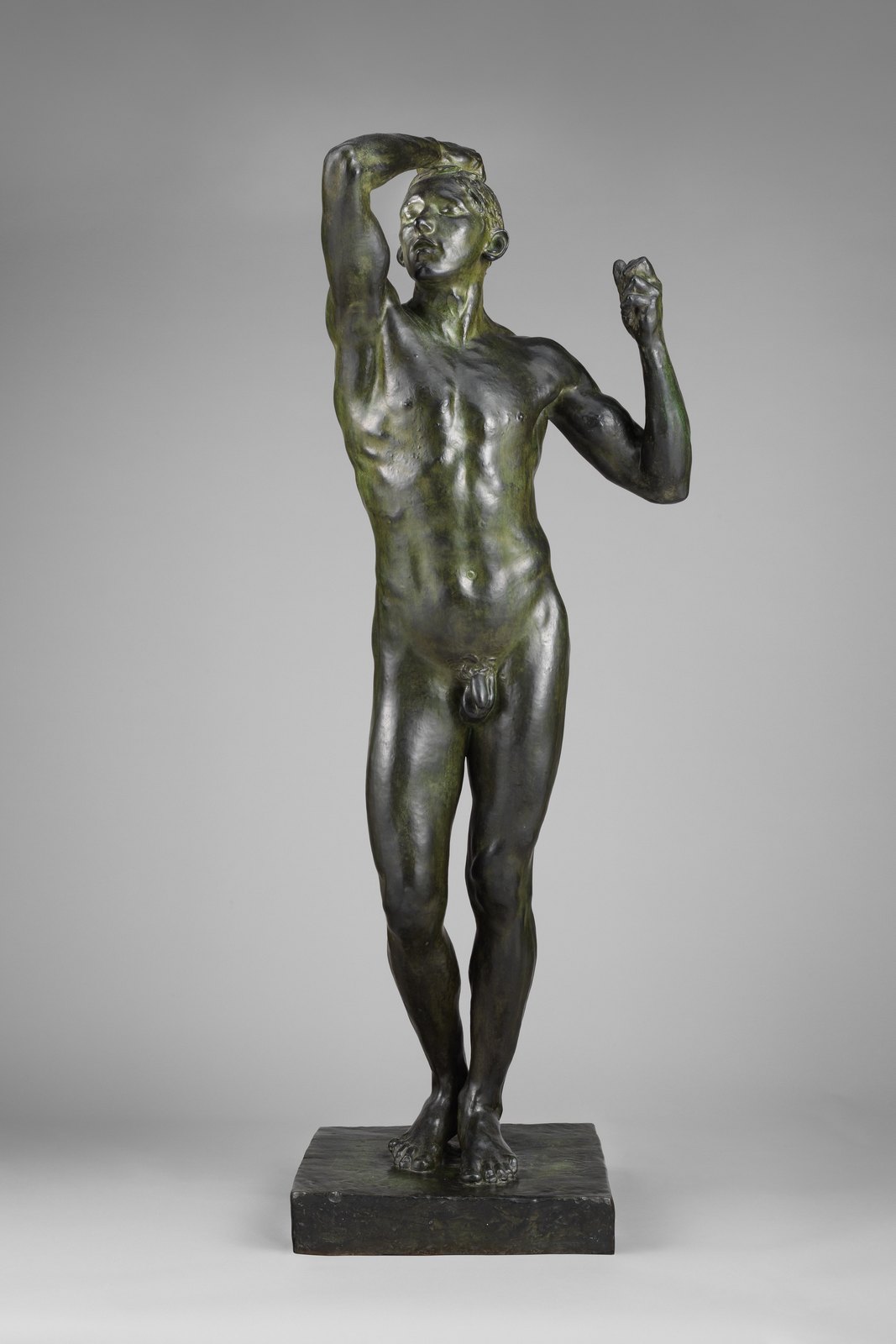
The Age of Bronze grew out of the period covered here. This is one of the Met’s bronze casts. The Metropolitan Museum of Art, Gift of Mrs. John W. Simpson, 1907, 07.127. Image source. CC0 / Public domain. Resized for the web.
The controversy over whether he had moulded directly from Neyt’s body forced Rodin to show what his modelling involved. Comparative photographs of the man and the sculpture helped him make his case. The state acquired the work in 1880, and that year commissioned a portal for a proposed museum of decorative arts. The years of small portraits, building ornament and repeatable designs had given Rodin a range of practical ways to approach the commission. Now he could use them to decide where one body ought to stand, what might happen if he repeated it, and what a viewer would see from the ground below. [2] [8]
Rodin artworks directory
Discussion
Look again at the images and ideas explored in Auguste Rodin’s Early Life. These editorial prompts invite your observations.
Reader Insights
After reading “An education in drawing”, what detail would you look for in the object or image?
What extra evidence would help you distinguish the artist’s choices from the effects of material, viewpoint or later display?
Join the Conversation
Share a detail, comparison or question about Auguste Rodin’s Early Life below.
References
- Musée Rodin. Sculpture and architecture. View source.
- Musée Rodin. 1840–2015. View source.
- The Metropolitan Museum of Art. Auguste Rodin (1840–1917). View source.
- Musée Rodin. Auguste Rodin et l’Égypte, chronologie croisée. View source.
- National Gallery of Art. Auguste Rodin. View source.
- Musée Rodin. Multiples, fragments, assemblages. View source.
- Musée Rodin. A catalogue of the paintings at the Musée Rodin. View source.
- National Gallery of Art. The Age of Bronze. View source.
- Musée Rodin. Rodin et l’antique, exhibition dossier, pp. 4–5. View source.

 Auguste Rodin.jpg)


