


 by Tom Gurney
Tom Gurney BSc (Hons) is an art history expert with over 20 years experience
Published on June 19, 2020 / Updated on November 18, 2026
Email: tomgurney1@gmail.com / Phone: +44 7429 011000
Auguste Rodin Timeline
Auguste Rodin’s career ran from the decorative workshops of Paris and Brussels to public monuments, international exhibitions and the creation of the Musée Rodin. This timeline follows the life alongside the works. A commission, a plaster model, a bronze cast and its installation often belong to different years. Those distinctions explain why the same sculpture appears at several points in the chronology. [1] [2]
1840–1857 — Paris and the Petite École
François-Auguste-René Rodin was born in Paris on 12 November 1840. From 1854 to 1857 he studied at the Imperial School of Special Drawing and Mathematics, commonly called the Petite École. Drawing offered a way to record proportions and the angle of a gesture without having to resolve them immediately in clay. The school’s training also belonged to a city where drawing and modelling were trades, applicable to everything from small ornaments to the figures on a façade. Rodin won a drawing prize there. He subsequently tried three times to enter the École des Beaux-Arts and was rejected. [1] [2]
1860s — Ornamental work, early portraits and Rose Beuret
By 1864 Rodin was working for Albert-Ernest Carrier-Belleuse, a sculptor whose workshop produced decorative objects and carried out architectural commissions. There he could see what happened when a model passed through the hands of several specialists. Rodin also pursued independent work. The early Man with the Broken Nose takes the broad modelling of a face as seriously as the marks of age and injury. The marble version was accepted by the Paris Salon in 1875, roughly a decade after the first model. The acceptance date belongs to that marble and to its public exhibition. [1] [2] [3]
Rodin met Rose Beuret in 1864. She became his companion and the sitter for portraits such as Mignon. Her presence in the chronology connects the studio portraits to the household Rodin would later establish at Meudon. Read more about Rodin’s early life and The Man with the Broken Nose. [1] [2]
1871–1877 — Brussels, Italy and The Age of Bronze
Rodin moved to Brussels in 1871 and worked in Belgium until 1877. The Brussels stock exchange gave him experience fitting sculptural groups to a building and its sightlines. He worked with Carrier-Belleuse and later partnered with the sculptor Antoine-Joseph Van Rasbourgh. His Belgian landscapes offer a view of another activity from these years. Small painted studies gave him space to work with the relation of a building to its surroundings at a very different scale from a public façade. [1] [3] [4]
A study trip to Italy in 1876 brought Rodin into direct contact with Michelangelo’s work. Later conversations recorded by Paul Gsell describe how he came to take seriously the tensions between a raised hip, a turning shoulder and the distribution of weight. The trip fell during the period in which he was developing the figure that became The Age of Bronze. He used the Belgian soldier Auguste Neyt as his model. The work was exhibited in Brussels and Paris in 1877, and its persuasive anatomy led to an accusation that it had been cast directly from a living body. Gaudenzio Marconi’s photograph of Neyt preserves separate evidence of the sitter and his pose. When you compare it with the sculpture, look for shifts of balance as well as similarities of outline. [1] [2] [5]
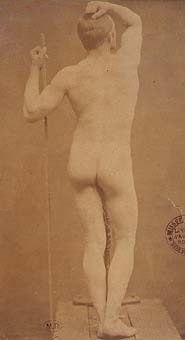
Marconi’s photograph records the model’s pose. Compare the position of the hips, feet and raised arm with the sculpture. Photographs by Gaudenzio Marconi, via Wikimedia Commons. Image source. Public domain. Resized for the web.
1878–1880 — Saint John and a commission for a doorway
Rodin developed Saint John the Baptist Preaching in 1878–80. In the full figure, the raised hand directs attention beyond the base while the placement of the feet makes the stride legible. A painted plaster of the bust appeared in 1879. Showing the head apart from the full body gave an audience a chance to read the face and turn of the neck before the full-length work was shown in 1880. The head and the full figure continued to have separate collecting histories. Rodin later developed The Walking Man from studies associated with the figure, retaining the possibilities of the stride in a headless and armless sculpture. [6] [7] [8]
In 1880 the French state acquired The Age of Bronze and commissioned a doorway for a planned Museum of Decorative Arts. This second decision gave Rodin a large architectural project of his own. Dante’s Inferno helped supply a cast of figures and stories. The doorway took shape over years through models, changes of position and decisions to develop particular figures separately. The intended museum was never built. The plaster and the later bronzes of The Gates of Hell therefore belong to a history that continued beyond the original building commission. [1] [2] [3] [9]
1880s — Figures leave the Gates and Claudel joins the studio
A seated figure above the doorway became The Thinker. The pair initially identified with Paolo and Francesca became The Kiss. Rodin’s treatment of Ugolino also changed during work on the door. The Musée Rodin traces a seated conception, envisaged opposite the lovers, through drawings and an early maquette. The later group gives the father a different relation to the children by bringing him down onto his hands and knees. What survives under one subject name can show more than one solution to the same compositional problem. [9] [10] [11]
Camille Claudel worked with Rodin in the 1880s while developing sculptures of her own. The relationship belongs to the history of both studios and both artists. Comparing Claudel’s Sakuntala with Rodin’s groups, for example, gives a more direct way to see what each could make of two bodies in contact. The Claudel and Rodin article follows her training, work and relationship with him in more detail. [1] [12]
1884–1895 — The Burghers of Calais
The Calais commission began in 1884–85 and the monument was inaugurated in 1895. Rodin took up the story of the six citizens who offered themselves to Edward III to end the siege of the town. The studies show choices being made at the scale of an individual hand, head, stance or piece of drapery. In the complete group there is no single face that explains what all six men feel. Each shoulders part of the story, and a spectator has to change position to see who looks outward, who lowers his head and who turns away. [1] [13]
The inauguration was one event in a longer history. Plasters had been exhibited before the bronze was installed, and later casts put the group in settings with different approaches and pedestals. The studies could also be preserved and cast independently. The Burghers of Calais article follows those changes of material and setting. [13]
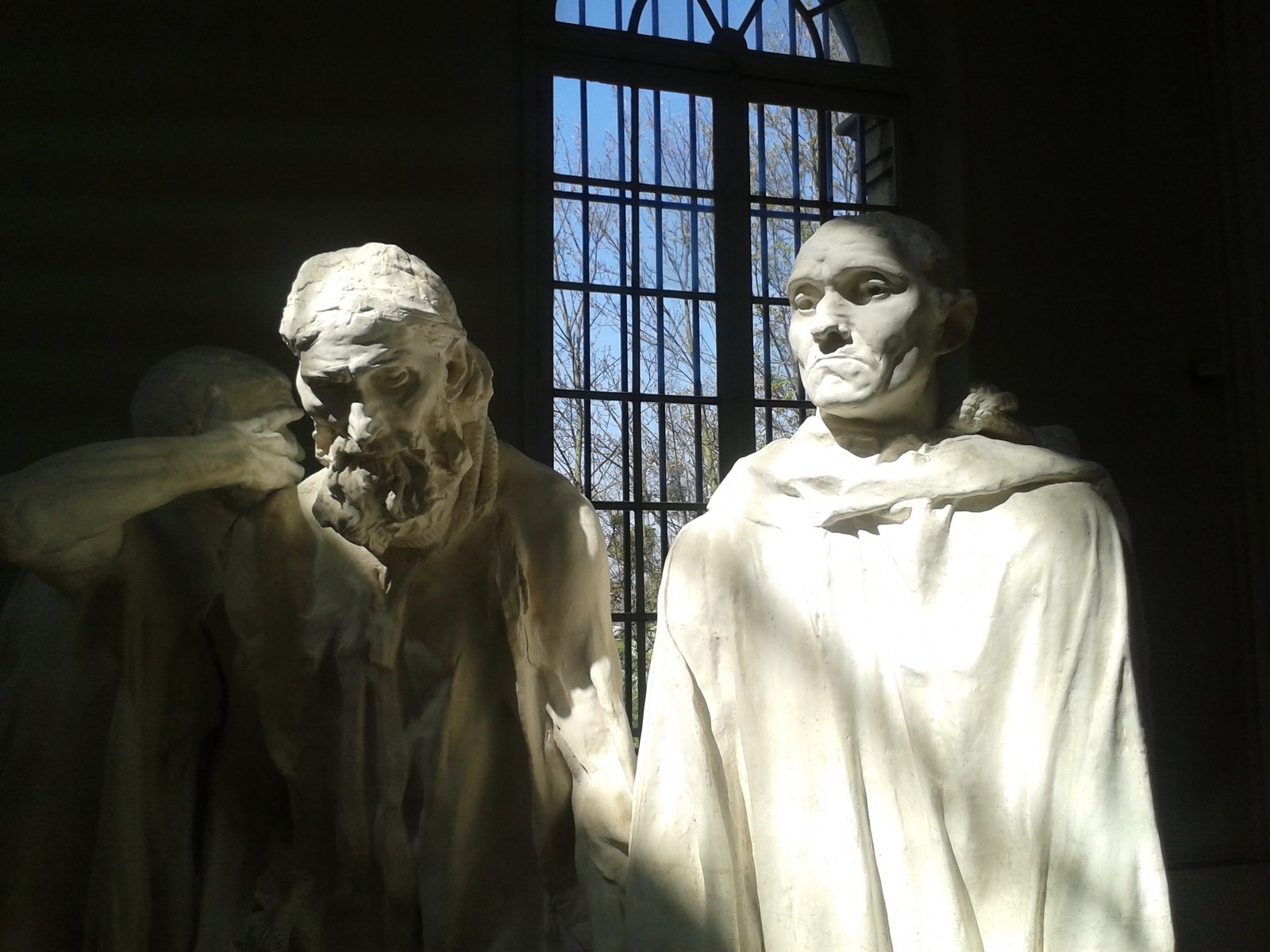
The detail shows the folds and gestures Rodin worked out for the public monument. Photograph by Adoc, Wikimedia Commons. Image source. CC BY-SA 4.0. Resized for the web.
Watch Rodin’s sculpture up close
Five films explore Rodin’s sculpture, from his use of classical models and the figures on his monumental doorway to the work of his studio.
Auguste Rodin – Challenging Beauty
Six sculptures show how Rodin adapted classical models.
Watch on YouTube1888–1898 — The state marble, Monet, Hugo and Balzac
The French state ordered a large marble of The Kiss in 1888. The Musée Rodin names Jean Turcan as the practitioner and dates the work of carving between 1888 and 1898. This is the Paris marble, distinct from the later commissions for Copenhagen and Edward Perry Warren. The state order turned a composition already seen independently of the door into a substantial work in Carrara stone. The large surface could subsequently furnish moulds and pointing plasters for other marbles. [10] [14]
In 1889 Rodin exhibited with Monet at the Galerie Georges Petit. The two artists had already exchanged works, and Rodin kept one of Monet’s Belle-Île paintings. A painting displayed beside a sculpture allows a viewer to compare the changes produced by moving in front of one with the changing view around the other. The exhibition placed both media before the same audience while each artist retained his own methods. [15]
Commissions for monuments to Victor Hugo and Honoré de Balzac occupied Rodin through much of the 1890s. The Hugo project produced a seated poet with allegorical companions, a separate standing proposal and a marble that would eventually stand in the Palais-Royal garden. The Balzac went through studies in which Rodin worked through physiognomy, stance and clothing before letting the robe determine most of the statue’s outline. The Société des Gens de Lettres rejected the monument after the plaster appeared at the 1898 Salon. At the same Salon the Paris marble of The Kiss presented a very different way to make a body legible in a large sculpture. [14] [16] [17]
1897–1903 — The album, the Alma exhibition and Berlin
In 1897 Maurice Fenaille supported publication of a numbered album of photogravures after Rodin’s drawings, with a preface by Octave Mirbeau. The album brought drawings associated with Dante to readers through an edition on paper. In 1900 the independent exhibition at the Pavillon de l’Alma offered a physical display of Rodin’s work alongside the events of the Universal Exposition. Visitors could see a plaster state of the Gates that omitted many figures familiar from the eventual bronze. The plaster was evidence of how Rodin chose to present the door at that moment. [1] [9] [18]
The exhibition also provided an occasion for collectors to see works they would commission for other settings. Carl Jacobsen ordered several works that October, including the Copenhagen Kiss. Warren’s marble, also commissioned in 1900, later went to Lewes. The shared group could now be looked at in several large marbles with separate histories. In 1903 Rodin exhibited nearly three hundred drawings at the Berlin Secession, giving work on paper the space and concentration of a large exhibition of its own. [19] [20] [21]
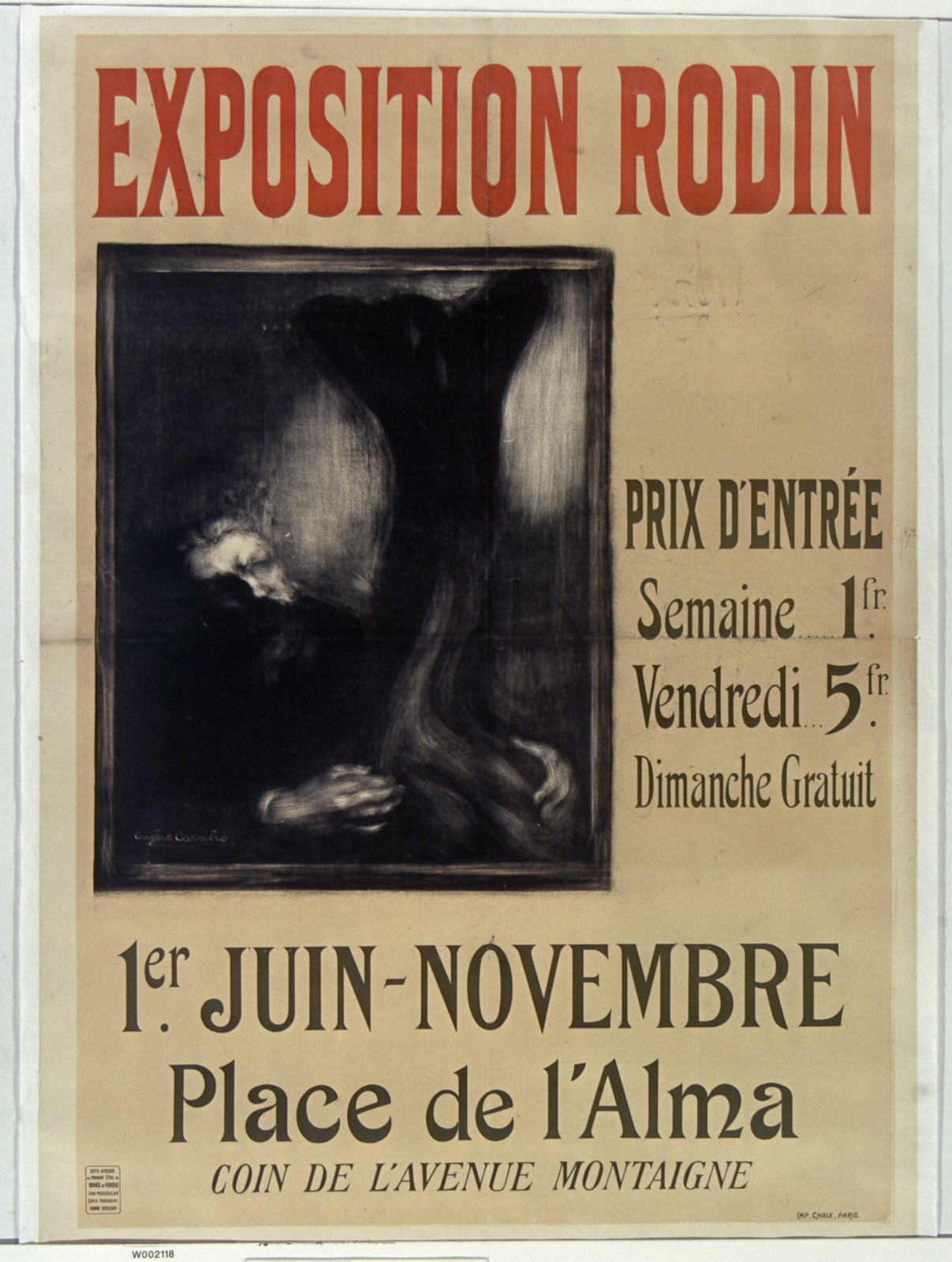
The poster names the Place de l’Alma and the Avenue Montaigne, locating Rodin’s independent exhibition in Paris. Eugène Carrière, Bibliothèque nationale de France, via Wikimedia Commons. Image source. Public domain. Resized for the web.
1904–1909 — Public sculpture and movement on paper
The Copenhagen marble arrived by February 1904. Jacobsen’s arrival letter discusses both the new marble and the other works needed to arrange a room for Rodin. In Paris, an enlarged bronze of The Thinker was placed outside the Panthéon in 1906 through public subscription. Both installations changed what viewers could compare. One brought the marble into a collection alongside other sculptures, while the other brought a figure conceived for the top of the Gates into an outdoor civic setting. [1] [11] [19]
In 1906 Rodin drew performers of the Royal Ballet of Cambodia during their visit to France. The series ranges from sheets that single out a dancer to studies that put several poses on the page. In the same later period he studied the Japanese performer Hanako, exploring differences between sustained expressions and moments of repose in drawings, masks and heads. In 1907 Rodin presented the enlarged Walking Man. These projects let viewers see movement through different means: a line across a page, a held expression and the spacing of two feet. In 1909 the marble monument to Victor Hugo was inaugurated at the Palais-Royal. [8] [16] [22] [23]
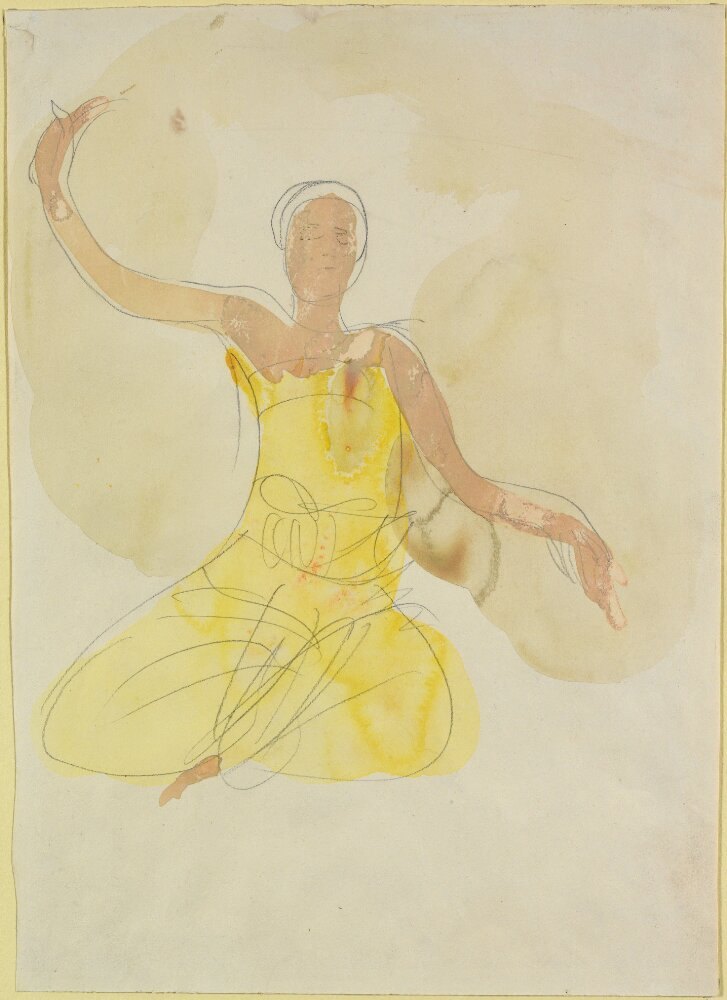
The Stockholm sheet gives one performer the space that the six-figure study divides among several poses. Nationalmuseum, Stockholm, via Wikimedia Commons. Image source. Public domain. Resized for the web.
1908–1915 — Hôtel Biron, books and collections abroad
The Hôtel Biron became another part of Rodin’s working life after he began using it in 1908. The rooms and garden gave him space to keep and see sculptures, plasters and collected objects. Meudon remained closely connected to his household and studio. Together, the two sites help explain how the eventual museum came to include works of his own and material he had acquired and kept around him. [1] [24]
In 1911 Paul Gsell published L’Art, the conversations in which Rodin talks through modelling, expression and movement. The volume preserves examples in which he describes a figure or demonstrates a pose to make a point. The Metropolitan Museum of Art opened a gallery devoted to Rodin in 1912. His architectural notes and studies appeared in Les Cathédrales de France in 1914. These publications and displays created different ways to encounter his work during his lifetime, through the sculptures themselves or through his account of how to look at them. [1] [3] [5] [25]
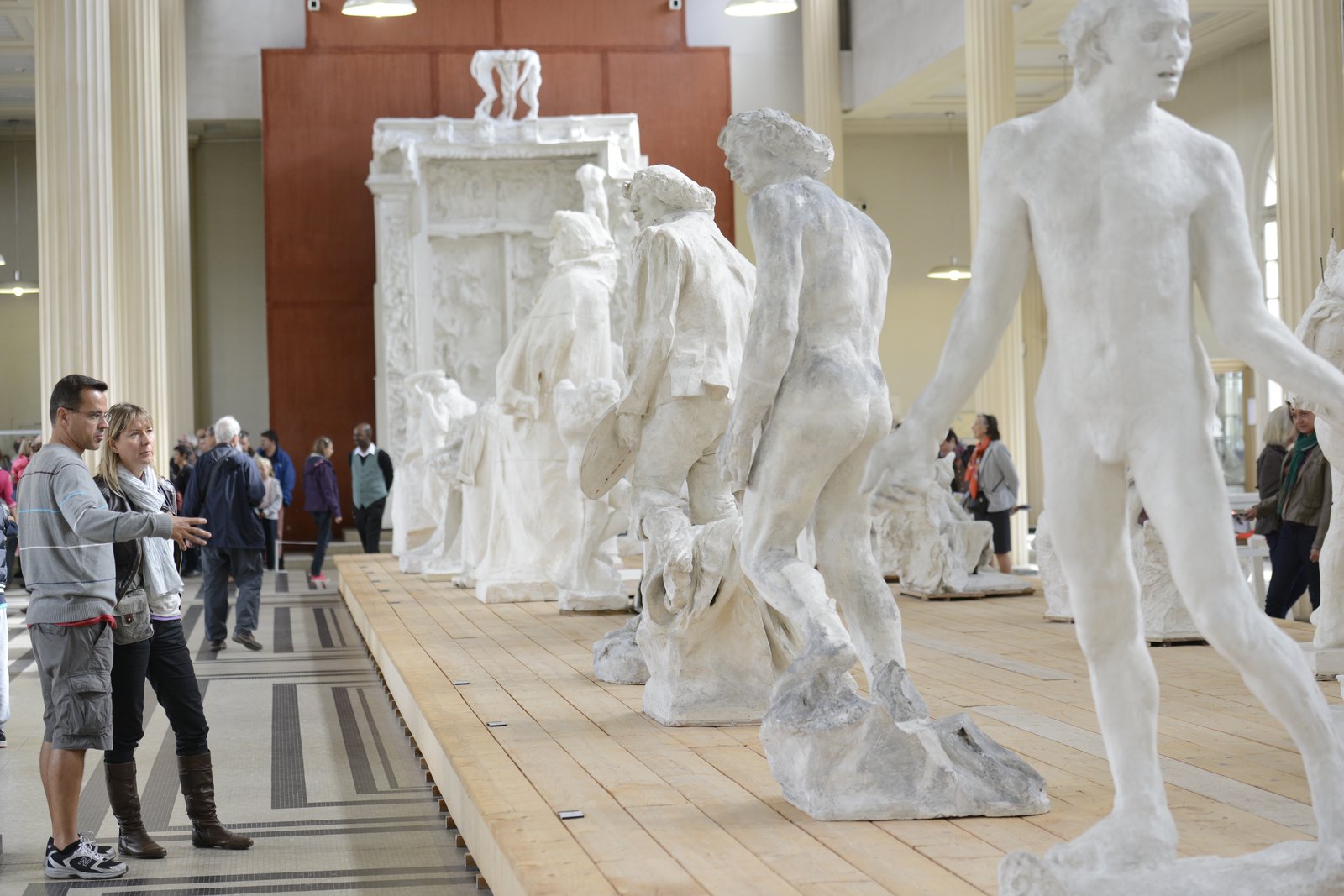
The Meudon site preserves the setting of Rodin’s later home and workshop. Photograph by VilleMeudon, Wikimedia Commons. Image source. CC BY-SA 4.0. Resized for the web.
1916–1917 — The donation and the graves at Meudon
In 1916 Rodin made donations to the French state that provided the basis for a museum at the Hôtel Biron. The agreement gave the state more than a representative selection of his finished works. Plasters, studio materials and collected objects made it possible to preserve evidence of his working life along with the sculptures already familiar from exhibitions. It also meant the history of casting could continue after his death. A work in bronze may consequently carry Rodin’s name and the date of its model while having been cast later. [1] [26]
Rodin and Rose Beuret married on 29 January 1917. She died on 14 February and he died on 17 November. They were buried at Meudon, where an enlarged Thinker stands above the grave. The figure that had been conceived for a doorway and later installed by public subscription acquired a further use as a grave monument. [1] [11]
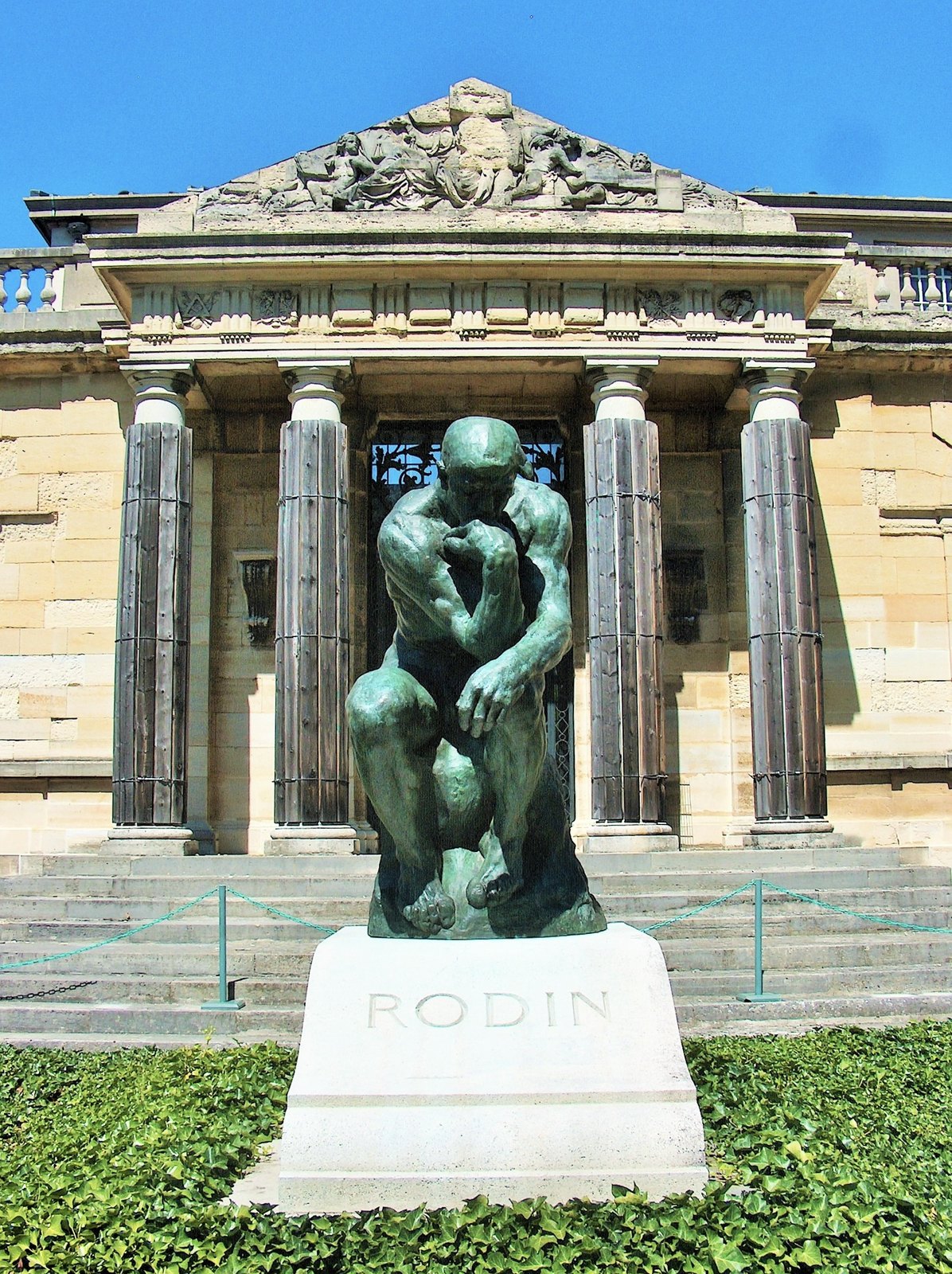
The Meudon setting shows the enlarged bronze serving as a grave monument. Photograph by Ibex73, Wikimedia Commons. Image source. CC BY-SA 4.0. Resized for the web.
1919–1929 — The museum and the first generation of posthumous casts
The Musée Rodin opened to the public in Paris in 1919. The collection established a way to follow the same subject between a fragment, a working plaster, a separate figure and a finished bronze or marble. The posthumous casts of the Gates brought the doorway into new collections even though the commission for the planned museum had never led to its installation in that building. [1] [9] [26]
The first decade of the museum also saw Rodin’s work find new institutional homes. The California Palace of the Legion of Honor opened in San Francisco in 1924 with the Rodin collection assembled by Alma Spreckels. The Rodin Museum in Philadelphia opened in 1929, based on the Mastbaum collection. If you are tracing an individual work past those dates, begin with its accession record. The date of a model tells you when the artist established the form; a casting or acquisition record locates the particular object that a visitor sees. For more on the two French sites, see Rodin’s Later Life and Legacy. [1] [26]
Rodin artworks directory
Discussion
Look again at the images and ideas explored in Rodin’s timeline. These editorial prompts invite your observations.
Reader Insights
Which public commission most changed how Rodin worked, and what in the timeline makes you think so?
How does the timeline help you distinguish a work modelled during Rodin’s lifetime from a bronze cast after his death?
Join the Conversation
Share a detail, comparison or question about Rodin’s timeline below.
References
- Musée Rodin. 1840–2015, chronology. View source.
- Metropolitan Museum of Art. Auguste Rodin (1840–1917). View source.
- Musée Rodin. Sculpture and architecture. View source.
- Musée Rodin. A catalogue of the paintings at the Musée Rodin. View source.
- Auguste Rodin and Paul Gsell. L’Art, 1911 edition. View source.
- Metropolitan Museum of Art. St. John the Baptist, bronze bust. View source.
- Musée d’Orsay. Saint Jean-Baptiste. View source.
- National Gallery of Art. The Walking Man. View source.
- Musée Rodin. The Gates of Hell. View source.
- Musée Rodin. Le Baiser, Paris marble and commission. View source.
- Musée Rodin. The Thinker. View source.
- Musée Camille Claudel. Her arrival in Paris and encounter with Auguste Rodin. View source.
- Musée Rodin. Monument aux Bourgeois de Calais. View source.
- Musée Rodin. Le Baiser, grand modèle, with associated pointing plasters. View source.
- Musée Rodin. Rodin and Monet. View source.
- Musée Rodin. Victor Hugo. View source.
- Musée Rodin. Monument to Balzac. View source.
- Musée Rodin. Mécènes, commanditaires et collectionneurs de Rodin. View source.
- Carl Jacobsen’s Correspondence Archive. Jacobsen to Rodin, 23 February 1904. View source.
- Christopher Skelton-Foord. Ned Warren’s ‘Jack in the Pulpit’, New College Notes, 2022. View source.
- Musée Rodin. La saisie du modèle, Rodin’s drawings. View source.
- Musée Rodin. Rodin and the Cambodian Dancers. View source.
- Metropolitan Museum of Art. Rodin’s Portraits of His Contemporaries. View source.
- Musée Rodin. The Hôtel Biron. View source.
- Metropolitan Museum of Art. Rodin at The Metropolitan Museum of Art. View source.
- Musée Rodin. The donation to the French state. View source.

 Auguste Rodin.jpg)


