



 by Tom Gurney
Tom Gurney BSc (Hons) is an art history expert with over 20 years experience
Published on June 19, 2020 / Updated on November 18, 2026
Email: tomgurney1@gmail.com / Phone: +44 7429 011000
Rodin’s Later Life and Legacy
The Musée Rodin began with an artist trying to keep his work together. By the time Auguste Rodin took rooms in the Hôtel Biron in 1908, examples of his sculpture had already travelled far from Paris. At the house in Meudon he still had plasters and objects collected over years of looking at art. The two places held different possibilities. The Paris mansion, with a garden and rooms large enough to show sculpture, could give the collection a public home. Meudon retained the traces of work in progress, even when an object known elsewhere in bronze survived there as a plaster. [1] [2] [3]
After the exhibition of 1900
Rodin’s own exhibition at the Pavillon de l’Alma in 1900 made it possible to see work from several periods together. Among the objects was the plaster of The Gates of Hell, which he displayed with many of the projecting figures removed. The exhibition offered a public view of a composition that was still subject to revision. After the pavilion was dismantled, it was erected again at Meudon. Its move left the show with a physical afterlife. A building used to present his work to the people who came to Paris could be returned to the place where he kept and worked on sculpture. [3] [4] [5]
A large version of The Thinker took another route to the public. A subscription begun in 1904 helped provide the bronze for Paris. Claude Monet contributed, and the sculpture was installed outside the Panthéon in 1906. Its placement made a body first developed for a doorway into a figure people could see in a public space without entering an exhibition. Other works travelled through collectors, foundries and museums. A gallery devoted to Rodin at the Metropolitan Museum of Art opened in 1912. Those developments ensured a wider audience even before the French state accepted the gifts that would establish his museum. [3] [6] [7]
Meudon and the workshop
At the Villa des Brillants, Rodin and Rose Beuret had a base outside central Paris. The garden offered room to see sculpture in daylight, where the shape of an outdoor object could be observed from changing distances. In 1908 Edward Steichen photographed the Balzac plaster outdoors at Meudon by moonlight. The surviving prints are a record of a particular collaboration. They also show how far a work could circulate while still in plaster. Prints went on view in New York in 1909 and appeared in Camera Work in 1911. A sculpture that had caused controversy at the Salon could reach another audience through images made in the grounds of Rodin’s home. [3] [8]
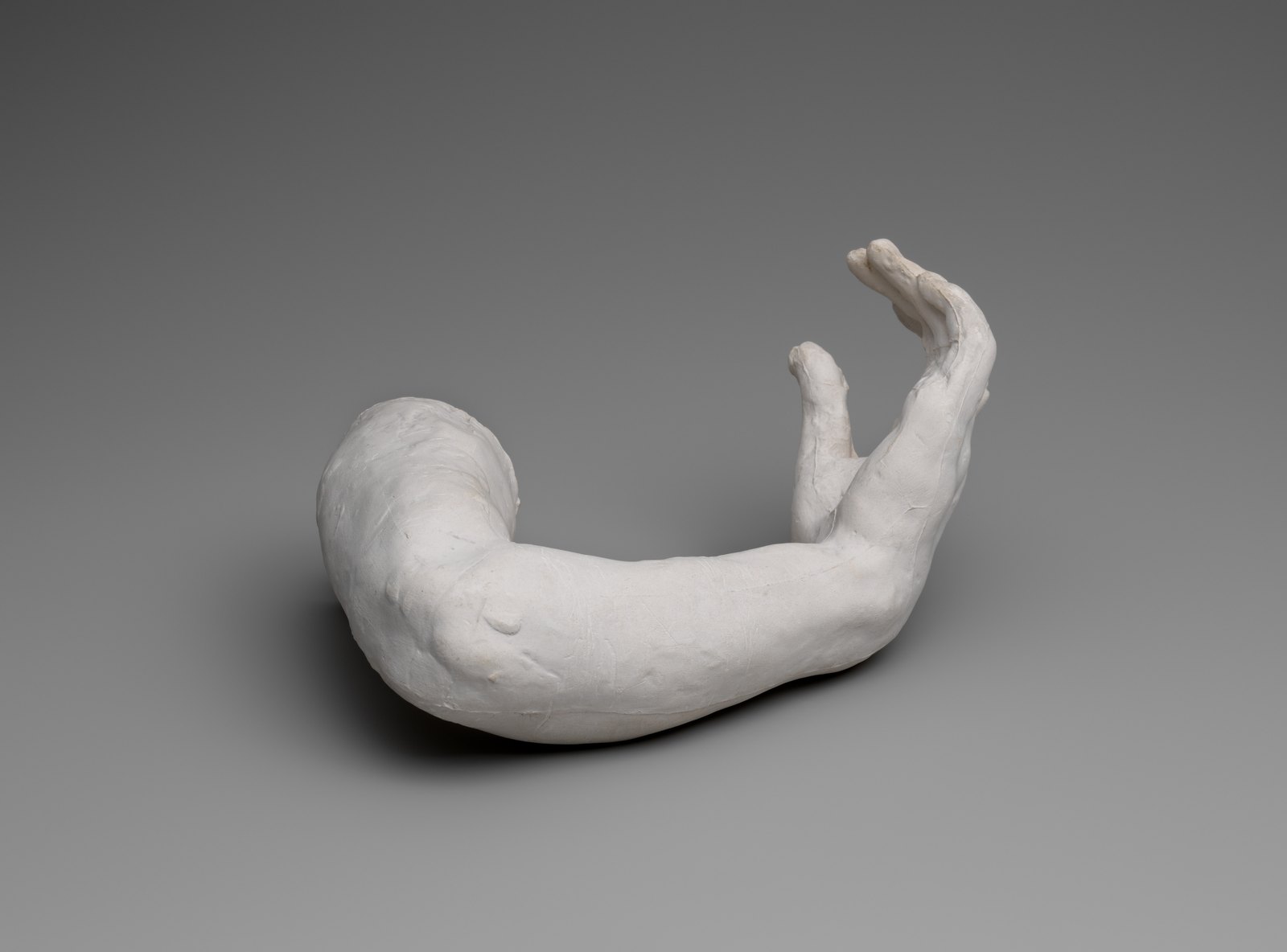
The Met’s plaster study for Meditation gives a comparison for the kind of fragment Rodin’s workshop kept as an object in its own right. The Metropolitan Museum of Art, Gift of Auguste Rodin, 1912, 12.12.9. Image source. CC0 / Public domain.
The studio material served a different kind of purpose. A plaster preserved a form after its clay model might no longer be usable. Some could be kept for enlargement or for a bronze casting. There were also unused studies and fragments through which one can trace choices that had disappeared from the finished work. They mattered to Rodin’s later practice because he could return to them. They matter to a museum because a sculpture left behind with its working materials tells a fuller story than the finished object does on its own. The assemblage that became The Walking Man, made from studies connected with Saint John the Baptist, is one particularly clear case of a form taking on a second life in the studio. [9] [13]
Watch Rodin’s sculpture up close
Five films explore Rodin’s sculpture, from his use of classical models and the figures on his monumental doorway to the work of his studio.
Auguste Rodin – Challenging Beauty
Six sculptures show how Rodin adapted classical models.
Watch on YouTubeThe Hôtel Biron
The Hôtel Biron had other tenants before it became Rodin’s museum. Its rooms housed artists including the sculptor Clara Westhoff, whose husband, the poet Rainer Maria Rilke, helped bring the property to Rodin’s attention. Rodin began renting rooms in 1908. By 1911 the French state had acquired the property. That acquisition put its future use in question while giving Rodin a public authority with whom he could negotiate. What he wanted was a place that could preserve his collection and show it together. As he envisaged it, the building would contain the sculptures and drawings he had made alongside antiquities he had collected. [1] [2]
That last part of the proposal gives the museum a character beyond that of a monument to an individual career. A Greek or Roman fragment could help a visitor see how Rodin had looked at sculptural bodies. The state of preservation of an ancient piece, with its missing arms or head, could also suggest what a modern sculptor might do deliberately with a partial figure. The surviving papers show the gifts becoming an institutional arrangement. The Musée Rodin’s archive records donations dated 1 April, 13 September and 25 October 1916. Their acceptance made provision for the Hôtel Biron and its garden as a museum. [1] [2] [10]
The archive also preserves a record of the debates in the National Assembly and the Senate over accepting the donations. Rodin’s choice of what to give was only one part of the process. The state still had to define what the new museum was for and how it would be run. The records of its constitution include correspondence and administrative papers that take the story beyond the sculptor’s own proposals for the building. [10]
The opening and the later bronzes
Rodin married Rose Beuret in January 1917. She died that year and he died in November. The Paris museum opened to the public on 4 August 1919. The Meudon site opened to the public in 1948. That difference in dates helps explain why the two places have their own histories of display, although both grew out of Rodin’s decision to keep his work and possessions together. They give visitors two ways of seeing how sculpture enters a collection: through the arrangements of a museum and through what remained in the artist’s working surroundings. [1] [2] [3]
Among the works the museum inherited was The Gates of Hell. Rodin agreed to its reconstruction in 1917, with earlier moulds and photographs informing the work. He died before a bronze was cast. The Paris bronze was made in 1928, and the Tokyo example has a separate casting and collection history. What continues after the artist’s death is therefore part of the history of seeing his work. A museum that preserves the plaster can show how differently the doorway appeared in 1900. An institution with a later bronze can show the depth and spread of the reconstructed relief. The survival of both is one consequence of the decisions Rodin made about what his collection should become. [4] [9] [11] [12]
Where the antiquities went in the new museum
Rodin’s first donation, on 1 April 1916, included his antiquities. The Musée Rodin’s research on the Egyptian collection records that Louvre curators inventoried those objects. Their work gave the state a description of what it would receive and gave the future museum a basis for deciding what could be shown. A decree of 12 March 1919 established the museum, several months before the Hôtel Biron opened to the public. The deeds, the inventory and the decree record different steps between Rodin’s proposal and a museum that people could visit. [10] [14]
The early display gave the antiquities a place in several parts of the site. Visitors met ancient marbles in the vestibule and by the stairs. A selection of Egyptian objects occupied a room on the first floor, while other Greek and Roman marbles were placed in the garden. The movement from the entrance to the upstairs room or out into the garden therefore mattered to how much of the collection a visitor would encounter. At the entrance the marbles set the context for Rodin’s own sculpture. The upstairs display allowed a closer encounter with a particular part of his collection. The arrangement gives a concrete example of how the new institution presented the things Rodin had studied alongside the sculptures he had made. [1] [14]
Rodin artworks directory
Discussion
Look again at the images and ideas explored in Rodin’s Later Life and Legacy. These editorial prompts invite your observations.
Reader Insights
After reading “After the exhibition of 1900”, what detail would you look for in the object or image?
What extra evidence would help you distinguish the artist’s choices from the effects of material, viewpoint or later display?
Join the Conversation
Share a detail, comparison or question about Rodin’s Later Life and Legacy below.
References
- Musée Rodin. The Hôtel Biron. View source.
- Musée Rodin. The Musée Rodin, the artist’s heir. View source.
- Musée Rodin. 1840–2015. View source.
- Musée Rodin, Meudon. The Gates of Hell, plaster. View source.
- Musée Rodin. Sculpture and architecture. View source.
- Musée Rodin. Rodin and Monet. View source.
- Musée Rodin. The Thinker. View source.
- Musée Rodin. Rodin and Steichen. View source.
- Musée Rodin. Sculptures. View source.
- Musée Rodin Archives. Constitution du musée. View source.
- Musée Rodin. The Gates of Hell. View source.
- National Museum of Western Art. The Gates of Hell, S.1959-0045. View source.
- Musée Rodin. Multiples, fragments, assemblages. View source.
- Musée Rodin. La donation à l’État français, the inventory and opening displays of Rodin’s antiquities. View source.

 Auguste Rodin.jpg)


