



 by Tom Gurney
Tom Gurney BSc (Hons) is an art history expert with over 20 years experience
Published on June 19, 2020 / Updated on November 18, 2026
Email: tomgurney1@gmail.com / Phone: +44 7429 011000
Rodin’s Style and Technique
In Auguste Rodin’s studio, a plaster figure could be the record of a decision and the beginning of another. A modeller had shaped it at a particular size, with the shoulder turned in one direction and the feet set at a particular distance apart. That arrangement could be preserved, enlarged or borrowed for a new composition. In finished works the signs of these decisions sometimes remain visible. Look at the waist of The Walking Man, where a torso meets legs modelled separately, or the base of The Cathedral, where two wrists emerge from stone that still bears tool marks. Much of Rodin’s style can be understood by following how a form was made and asking what the next change did to it. [1] [2]
What modelling made possible
A figure modelled in clay could be turned during work, and a passage could be pressed back or built up while the material was still workable. That mattered to a sculptor whose figures reward being seen from several sides. One angle might make a neck appear shortened, while on another side the same turn helps bring a shoulder forward. To see how much Rodin could make of such relations, consider The Age of Bronze. The broad sweep of the raised arm is easy to read against the air. Around the ribs, the slight change in fullness from one side to the other is quieter and takes more time to see. An object can carry both sorts of information at once. [3]
Plaster could keep a shape available after it had been modelled. A single form could be reproduced and examined in more than one position, while the existing version remained intact. The Musée Rodin traces some of these methods back to Rodin’s decorative work. In an ornamental workshop it was useful to be able to change the accessories or hair of a figure while keeping the underlying model. In his own practice he developed the same possibilities until a body could be part of an architectural relief in one configuration and a sculpture in its own right in another. Several figures on The Gates of Hell came out of this kind of reuse. [1] [4]
Joining and enlarging
The three bodies at the top of the Gates offer a particularly clear example. Each Shade turns into the group from a different position, although each uses the same figure. The repeated inclinations put pressure on the space at their centre. Change the number of figures or turn one away and the impression would be quite different. A comparable change can happen within a single body. The legs and torso of The Walking Man came from studies associated with Saint John the Baptist. Their join is visible, and its slight asymmetry helps the upright form seem as if it were bearing forwards. [1] [4] [5]
Scale was another opportunity to change a familiar form. The Musée Rodin documents Henri Lebossé’s enlargements for Rodin, including the larger Walking Man made from 1905 to 1906. An enlargement could carry a small adjustment of posture far enough to be seen clearly across a room. It also gives a fragment a different kind of physical presence. A modest plaster can be inspected on a shelf from above. A bronze over two metres tall brings its torso substantially closer to a viewer’s eye level. The enlarged figure asks you to register the width of a stride against the movement of your own body. [1] [5]
Making one plaster or making several
The Musée Rodin distinguishes a waste mould taken from a clay model from a piece mould that can be used repeatedly. In the first process a thin layer of coloured plaster takes the impression of the clay. Thicker white plaster strengthens the shell. When the mould is opened, the clay is pulled away from the sculpture’s impression in the shell. Once a plaster cast has been made inside it, the shell is chipped off. The coloured layer warns the mould maker that the tool is getting close to the surface of the cast. Both the clay model and the temporary mould are sacrificed to produce the plaster. [12]
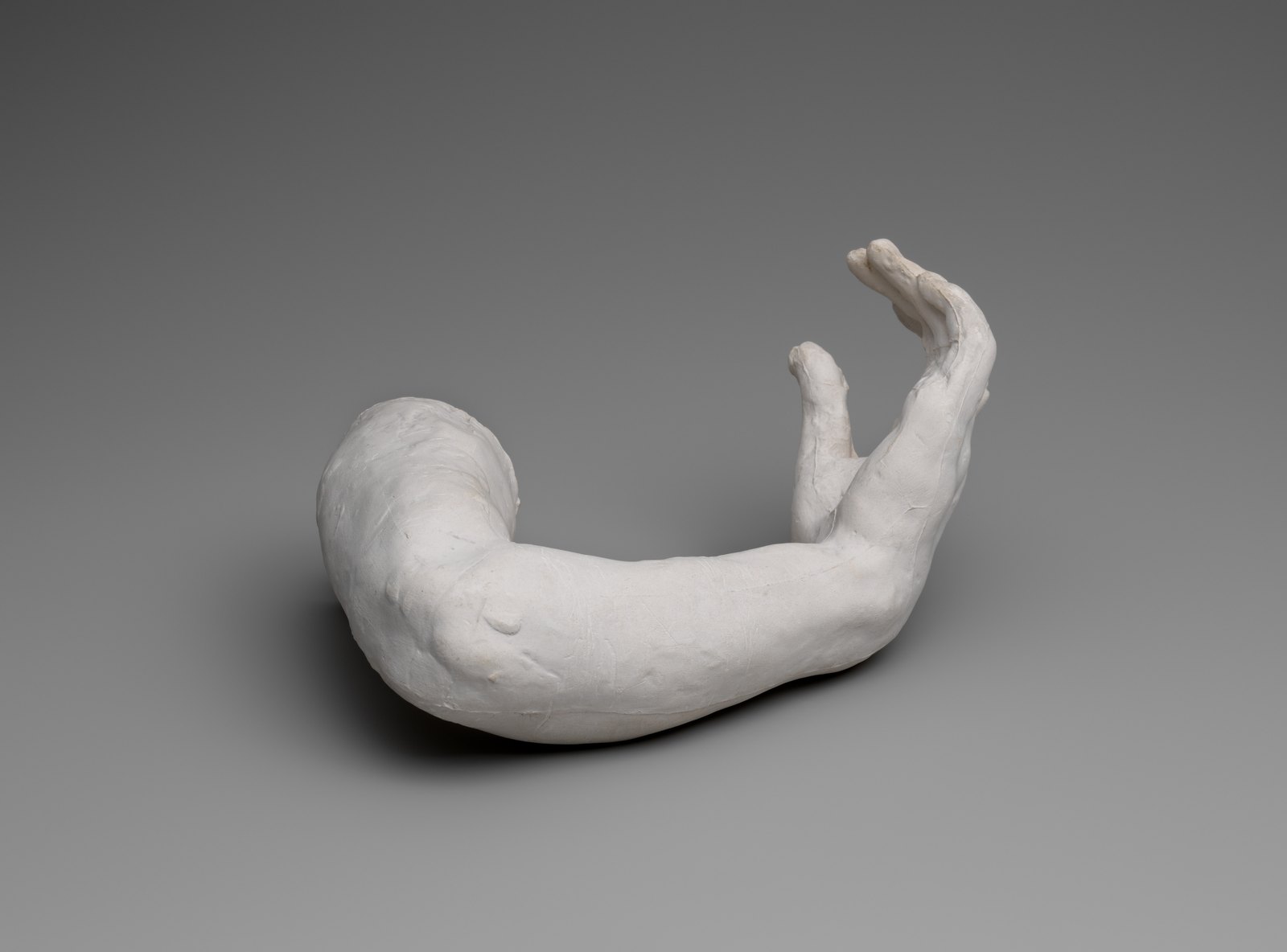
The Met catalogues this cast as a study of the left hand and arm of Meditation. It preserves the fragment as a separate object. The Metropolitan Museum of Art, Gift of Auguste Rodin, 1912, 12.12.9. Image source. CC0 / Public domain.
A reusable piece mould consists of individually fitted sections held in place during casting by an outer casing. Once the plaster has set, the sections can be taken apart and used again. When one section moves away from the shoulder or the side of a limb, the others can temporarily remain in place. That matters wherever a projecting part would prevent a rigid mould from sliding off in a single movement. The points where the sections meet can leave low raised lines on the new plaster. A mould maker normally trims those seams, but Rodin could leave them visible. Separate pieces could also be assembled with plaster when a work was too large to mould whole. The seam you see might therefore record where sections of the mould met, while a larger join can belong to how the sculpture itself was put together. [1] [12]
A reusable mould could also supply another clay version, which the studio could modify before making a further plaster. The distinction changes how a group of casts can be read. One plaster may preserve a pose faithfully, while another exists because Rodin wanted to change the relation of a limb to the body. This flexibility helps account for the number of individual plaster figures and fragments that appear alongside more complete groups in the museum’s collection. [1] [11] [12]
Watch Rodin’s sculpture up close
Five films explore Rodin’s sculpture, from his use of classical models and the figures on his monumental doorway to the work of his studio.
Auguste Rodin – Challenging Beauty
Six sculptures show how Rodin adapted classical models.
Watch on YouTubeMoving from plaster to marble
In the stone workshop, a model provided measurements a carver could transfer to the block. The Musée Rodin describes a pointing device that lets measurements taken from fixed positions reach the corresponding points in the stone. That method can preserve the size of the model. Using three compasses makes it possible to translate the distances at a different scale. The measurements guide the depth of cutting, after which the practitioner still has to form and finish the surface between the points. An exact description of a marble should identify the practitioner if the work’s records give one. Rodin’s authorship of the model and supervision were part of a process that could involve someone else at the block. [6] [7]
It is worth looking at what he asked the surface to do. The Philadelphia marble of Young Mother in the Grotto brings comparatively smooth bodies out of stone whose roughness suggests the sides of their shelter. The boundary between those surfaces lets you discover the figures as you follow them around the block. On some marbles the marks of tools can make the stone behind the figure especially apparent. Roughness can carry a distinct visual role, just as an unbroken polished surface can give the light room to travel down a limb. Differences between individual examples tell you as much as the general choice of material does. [2] [6] [8]
Passing through the foundry
Casting transfers a form to bronze. In the usual hollow construction, a core occupies the space inside the desired metal wall. Musée Rodin accounts describe sand casting and lost-wax casting as separate ways of producing this result. In sand casting a mould is formed around a model and opened or broken to remove the new piece. In lost-wax casting the wax version gives up its place in the mould to the metal. The methods leave their own demands for finishing, particularly when a complex work must be cast in sections. Surface treatment afterwards can bring a different emphasis to the same relief. A bronze’s patina changes the contrast between hollows and projecting areas of a figure. [9] [10]
The foundry and casting date belong to the specific object. A visible signature may identify Rodin as sculptor while a different inscription names its founder. Look at the chronology of The Gates of Hell. The reconstructed door whose bronzes we know took shape through decisions that began in 1880, and the Musée Rodin’s garden bronze was cast in 1928. That interval helps explain why a museum record can have several dates. They tell you about the work Rodin developed, the form available to a foundry and the example a visitor can see today. [4] [9] [10] [11]
Looking for decisions in the surface
There is no single finish that gives away a Rodin sculpture. He could use the uneven top of a torso to emphasise the turn of a body, or run light along the smooth backs of a pair of lovers. A plaster archive allows a visitor to see some of the forms he considered before arriving at a bronze or marble. A finished work brings the effects of scale, material and light together. One way to look at it is to choose a single place where there is an obvious change. Find where a wrist separates from the stone, a turn of the body meets the legs or a coat gathers beneath a face. That junction often gives you a place to begin asking how the figure took its form. [1] [2] [6]
Rodin artworks directory
Discussion
Look again at the images and ideas explored in Rodin’s Style and Technique. These editorial prompts invite your observations.
Reader Insights
After reading “What modelling made possible”, what detail would you look for in the object or image?
What extra evidence would help you distinguish the artist’s choices from the effects of material, viewpoint or later display?
Join the Conversation
Share a detail, comparison or question about Rodin’s Style and Technique below.
References
- Musée Rodin. Multiples, fragments, assemblages. View source.
- Musée Rodin. The Cathedral. View source.
- National Gallery of Art. The Age of Bronze. View source.
- Musée Rodin. The Gates of Hell. View source.
- Musée Rodin. The Walking Man. View source.
- Musée Rodin. Marble carving. View source.
- Musée Rodin. Catalogue raisonné des marbres et pierres taillés d’Auguste Rodin. View source.
- Philadelphia Museum of Art. Young Mother in the Grotto. View source.
- Musée Rodin. Bronze sand casting. View source.
- Musée Rodin. Lost-wax bronze casting. View source.
- Musée Rodin. Sculptures. View source.
- Musée Rodin. Moulding, including the head of Pierre de Wissant. View source.

 Auguste Rodin.jpg)


