


 by Tom Gurney
Tom Gurney BSc (Hons) is an art history expert with over 20 years experience
Published on June 19, 2020 / Updated on October 23, 2026
Email: tomgurney1@gmail.com / Phone: +44 7429 011000
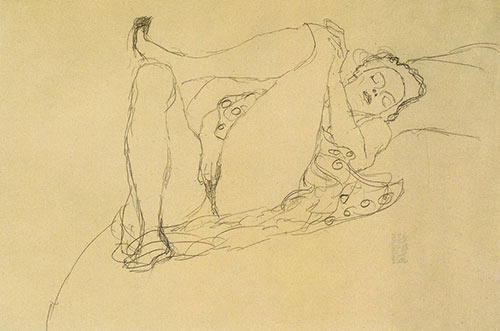
A reclining half nude from about 1914 to 1915
Gustav Klimt's Reclining Female Nude is more precisely identified as Liegender Halbakt nach rechts, or Half-Nude Reclining to the Right. It is a pencil drawing of a partly clothed woman whose bent legs and lifted arm form an unusually compact enclosure around her body. W&K Wienerroither & Kohlbacher dates the sheet to circa 1914–15. The narrow lines, open areas and curls of patterned fabric make an intimate subject into a carefully balanced arrangement rather than a miniature version of one of Klimt's richly coloured paintings.[1]
The catalogue number is particularly useful: Alice Strobl listed this drawing as 2404. Sotheby's identifies the same sheet as pencil on paper, measuring 37 × 54.9 centimetres, and records an estate stamp on its reverse. W&K gives slightly different measurements, 37.1 × 54.6 centimetres. These small published differences concern one recognisable drawing, not two versions. The estate mark should also be distinguished from an autograph signature: a stamp referring to Klimt's estate is not itself handwriting by the artist.[1][2]
How the bent legs organise the body
The head lies at the right, but the body does not simply extend horizontally across the sheet. One bent leg rises high into the upper half of the image, its long contour passing above the torso. The other descends nearer the left edge. Together these limbs make a tall, uneven structure inside a landscape-shaped sheet. The result is more compressed than the word reclining might suggest. Resting and stretching coexist, and the body seems to occupy several directions at once.
An arm reaches upward towards the elevated knee, helping to close the large shape above the abdomen. Below it, the other arm follows a much quieter course towards the intimate gesture between the thighs. These two actions are different in scale and emphasis. The raised arm joins the outer architecture of the pose, while the lower hand concentrates attention within it. Klimt does not need a surrounding room or a second figure to establish this contrast between expansive movement and inward focus.
At the bottom, a sweeping line suggests the support beneath the woman. It is not developed into a fully described piece of furniture. Instead, its curve carries the eye underneath the descending leg and back towards the head. The figure's arrangement is therefore supported twice: by the implied surface on which she reclines, and by the drawn curve that gathers her limbs into a single composition. The surrounding blank space keeps this support from becoming a competing subject.
The left side rewards especially close attention. Several lines meet around the ankle and foot, making that small area denser than the adjoining expanse of leg. The foot is a visual fastening point, although the pose above it remains fluid. At the opposite end, the head supplies another concentration of marks. Between these two accents, long and relatively spare contours allow the body to remain light. The drawing's balance depends as much on unequal detail as on the outline of the pose.
The face and the intimate gesture
The tilted face is neither a carefully shaded portrait nor an anonymous oval. Curving brows, closed eyes, a small nose and a parted mouth are selected with enough definition to give the head a particular presence. Looped hair follows its upper edge. Some surrounding lines run beyond the head, suggesting its relation to the reclining support without completing a pillow or furnishing. The face remains connected to the same linear system as the limbs, rather than being rendered in a separate, more illusionistic style.
The closed eyes withdraw the figure's gaze from the viewer. They do not, by themselves, tell us whether the woman was asleep, posing with her eyes shut or represented in an imagined state. Her hand makes the sexual subject explicit, but a description of the depicted action is different from knowledge of a model's actual sensations. Reading the image as an erotic representation does not require turning its expression into testimony about an encounter in Klimt's studio.
No sitter is named in the specialist or auction descriptions. Nor do similarities of hair or body type establish that she is the woman in another sheet. The separately catalogued drawing often called Mulher Sentada offers a useful comparison in its combination of exposed body and patterned clothing, but it should not supply this woman's identity. Here the lifted knee, reaching arm and sharply tilted face give the composition its own distinctive character.
Patterned clothing and open space
The garment does much more than partially cover the figure. Its circles and loops introduce a different pace of looking. Along a bare thigh, the eye can follow a long contour with little interruption; around the upper body, it must negotiate shorter curls, overlapping folds and repeated rounded motifs. This difference makes the exposed areas seem quieter even though they contain the drawing's most explicit subject. Pattern carries much of the apparent agitation, while the body is often described with restraint.
The fabric is not a mechanically repeated surface. Individual circles vary in size and spacing, and fold lines continually interrupt them. Near the shoulder and lower torso, pattern and garment edge become difficult to separate at a glance. One line may suggest a fold while its neighbour belongs to a motif. This ambiguity helps the cloth remain active without requiring colour. The marks can suggest the fullness of gathered fabric while also making a lively arrangement on the paper's flat surface.
ALBERTINA's discussion of Klimt's late erotic drawings emphasises a related tension between immediate observation and formal organisation. Its examples distinguish richly worked draperies from the bright, lightly defined body and give empty areas an active role. Those are other sheets, not this drawing, but the comparison helps explain why sparseness need not mean carelessness. In Strobl 2404, the broad open area within the bent limbs has a shape of its own, held in place by the surrounding contours.[3]
The pale sheet is therefore not merely a background waiting to be filled. It passes visually through the space around the figure and into areas representing her body. Klimt relies on a few boundaries to make us recognise where one ends and the other begins. The large unshaded thigh can feel substantial because its contour is so decisively placed, while a more densely marked fold can seem unstable. Full modelling with continuous shadow would produce a different relationship between body and surface.
A drawing rather than a painting in waiting
The composition can be appreciated within Klimt's wider practice of drawing without assigning it a role in a particular canvas. Its descriptive title identifies a direction and type of pose; it does not name a mythological figure or an allegory. The specialist and auction records used to identify it do not connect it to a specific painting. Its selective treatment is visually effective in its own right, whether or not further intentions once existed beyond the sheet.
That distinction matters when comparing the patterned garment with Klimt's paintings. A shared interest in ornament does not make this a preparatory study for The Virgin or The Bride. Here pattern is made from a small vocabulary of lines, and the surrounding space stays largely empty. The drawing does not need to borrow a painting's narrative to explain its internal relationships. The exposed body, concentrated face and restless fabric already establish a complete visual problem, addressed through the possibilities of pencil.
Exhibitions and the published collection history
The sheet had entered published circulation by 1972, when Alfred Werner reproduced it as number 85 in Gustav Klimt: One Hundred Drawings. The later Shapiro catalogue records its exhibition in Paris in 1984 and in the Rouen and Český Krumlov presentations of 1995–96. These are documented appearances rather than a claim to identify its first public showing. They also place the drawing in a history of collecting and exhibiting works on paper, beyond its original studio setting.[4]
Shapiro Auctions' 2019 catalogue identifies the former Serge Sabarsky Collection in New York, followed by Sotheby's New York sale of 8 May 2013, lot 422, and the London sale of 16 February 2017, lot 6. It then lists a private New York collection. The catalogue does not provide an uninterrupted history from Klimt's lifetime, and its New York credit describes the position published in 2019, not a verified location today. It also records this sheet as D105 in the Neue Galerie's 2007–08 Klimt exhibition.[4]
The museum dates that exhibition from 18 October 2007 to 30 June 2008. Organised by Renée Price, it brought together eight paintings and more than 120 drawings from the Lauder and Sabarsky collections. For this pencil sheet, such a setting offered a different kind of encounter from an isolated reproduction: a viewer could consider its economy of means alongside many other examples of Klimt's work on paper. Participation in that past exhibition does not make it a permanently displayed Neue Galerie object.[5]
Looking at the original and its reproductions
Sotheby's 2017 condition description calls the support cream wove paper. This is a useful physical observation, but the varying warmth of reproduced images should not be mistaken for an exact account of the sheet's present colour. A darker reproduction makes the pencil appear more forceful; a paler one gives greater prominence to the open spaces. Neither allows the viewer to reconstruct the order of every mark or determine the pressure with which Klimt drew it.[2]
As of 23 October 2026, a current public display has not been verified. The drawing's documented auction and gallery appearances do not identify its present beneficial owner or guarantee visitor access. Its clearest continuing appeal lies in the arrangement visible on the sheet: a body folded into a compact shape, a face that turns away from direct exchange, and a garment whose small restless loops answer the broad curves of the limbs. Intimacy and formal control remain inseparable in that encounter.
References
- W&K Wienerroither & Kohlbacher, “Half-Nude Reclining to the Right,” circa 1914–15; specialist object record and photograph, pencil on paper, 371 × 546 mm. . Accessed 23 October 2026. View source.
- Sotheby's, Erotic: Passion & Desire, London, 16 February 2017, lot 6, “Liegender Halbakt nach rechts”; object, verso mark, dimensions, literature, exhibitions and dated condition description. . Accessed 23 October 2026. View source.
- ALBERTINA, “Klimts autonome erotische Aktzeichnungen 1913–1917,” institutional discussion of other late erotic drawings, drapery, space and line. . Accessed 23 October 2026. View source.
- Shapiro Auctions, Spring Exceptional Fine & Decorative Art Auction, 18 May 2019, lot 106, house catalogue hosted by Bidsquare; Strobl 2404, published provenance and exhibition D105. . Accessed 23 October 2026. View source.
- Neue Galerie New York, “Gustav Klimt: The Ronald S. Lauder and Serge Sabarsky Collections,” historical exhibition, 18 October 2007–30 June 2008. . Accessed 23 October 2026. View source.