 by Tom Gurney
Tom Gurney BSc (Hons) is an art history expert with over 20 years experience
Page Created: 30 August 2026 / Page Updated: November 6, 2026
Email: tomgurney1@gmail.com / Phone: +44 7429 011000
Gustave Moreau Drawings and Watercolours: Introduction
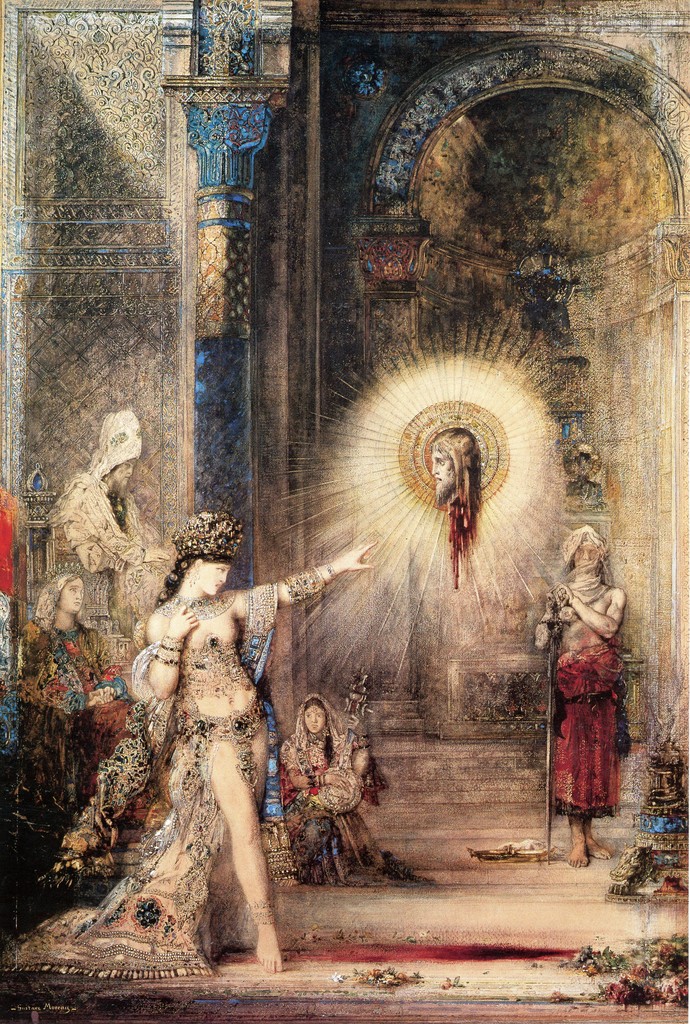
A large cartoon for Oedipus and the Sphinx carries a grid across its charcoal-and-white-chalk design: it is visibly a tool for translating a composition towards canvas. The 1876 Apparition, by contrast, is a finished watercolour more than a metre high, signed in gold and sold in the year it was made. These two sheets mark the breadth of Gustave Moreau’s art on paper. Drawing could test, measure, transfer and revise; watercolour could serve those tasks, but it could also become a public statement as ambitious as an oil painting.[1][2]
At a Glance
- Role of drawingDrawing was the structural basis of Moreau’s practice, from figure studies and compositional trials to tracings and full-size cartoons.
- MaterialsHis graphic materials included graphite, black pencil, charcoal, red chalk, pen and ink, tracing paper, watercolour, gouache and gold heightening.
- Italian studiesCopies and landscapes made during his Italian journey of 1857–59 formed a visual store that he continued to use.
- WatercoloursWatercolour was not one kind of object: Moreau made rapid colour ideas, detailed studies, commissioned illustrations and independent exhibition works.
- Fables projectThe La Fontaine Fables project, begun in 1879, became a sustained test of compact narrative invention.
- Museum holdingsThe Musée Gustave Moreau displays thousands of drawings and hundreds of watercolours, but those figures are not totals for everything that survives worldwide.
Selected Gustave Moreau works on paper
Contents
- Introduction
- Works on Paper as a Primary Practice
- Academic Figure Drawing and the Discipline of Line
- Italy: Copying, Looking and Landscape
- From Fragment to Full-Size Cartoon
- Watercolour, Gouache and Gold
- La Fontaine and the Enamel Ideal
- Private Experiment and the Meaning of “Unfinished”
- Six Sheets That Open the Graphic Oeuvre
- Display, Light and Responsible Looking
Works on Paper as a Primary Practice
Moreau’s drawings are sometimes discussed as explanations for his paintings, yet that description catches only one direction of travel. A sheet could indeed solve the position of a hand or provide a transferable outline. It could also preserve a landscape, analyse another artist’s construction, compare several poses, isolate an ornamental detail or pursue an image with no requirement to become an oil. Watercolour added further possibilities: translucency, dense gouache, sharp pen lines, metallic accents and saturated colour could be combined within one relatively small support.
The scale of the surviving material at Moreau’s house-museum makes this centrality tangible. Its 2023 press kit reports that approximately 4,830 drawings are mounted in glass display units with shutters that visitors can turn like pages. The same source describes a purpose-built cabinet for about 250 watercolours; the museum’s newer visitor trail gives the more precise display figure of 264.[3][4] These numbers refer to works presented in particular fittings, not to a settled count of Moreau’s entire graphic output.
This paper archive changes the view of Moreau’s paintings. A highly elaborated picture no longer looks like an inexplicable burst of decorative imagination. Behind it may stand dozens of separate choices about anatomy, contour, setting, scale and visual sources. Conversely, a swiftly brushed sheet need not be merely an incomplete version of something else. It may record a kind of thinking that Moreau valued precisely because it remained direct.
Academic Figure Drawing and the Discipline of Line
Moreau learned drawing within the academic culture of mid-nineteenth-century Paris. He studied in François-Édouard Picot’s private workshop before entering the École des Beaux-Arts. The Musée Gustave Moreau connects his graphic method to a Neoclassical search for controlled arabesque and to the examples of David, Ingres and Théodore Chassériau.[5] Such training made the human figure a field of repeated analysis rather than a shape improvised only when a final composition demanded it.
An academic study could separate a torso, limb or head from narrative. That isolation allowed Moreau to adjust weight, gesture and contour before reassembling the figure within a mythical scene. Other sheets bring several attempts together. A single page might carry lifted arms, a hand and drapery turns, showing how the artist searched through adjacent alternatives rather than advancing in one clean sequence. Animal studies performed a similar job for horses, serpents and other creatures.
His dry materials each offered a different kind of control. Graphite could describe a precise contour or remain faint enough for correction. Black pencil and charcoal could broaden into mass and shadow. Red chalk appears especially in work made before 1860, while pen and ink could fix an emphatic edge or patterned detail.[3][5] These media were often combined; their presence does not by itself tell us whether a sheet was early, late, private or intended for display.
Line remained active after preparation. Even when colour covered the support, Moreau could reassert edges around a figure or ornament. The result is not simply “drawing filled in.” A contour can hold a body still while colour unsettles the atmosphere around it. That friction between measured boundary and imaginative colour is one of the reasons his paper works deserve to be seen independently.
Italy: Copying, Looking and Landscape
The extended Italian journey of 1857–59 gave Moreau a disciplined programme of looking. He worked in Rome, Florence, Milan, Venice and Naples, copying Renaissance frescoes, paintings, drawings and ancient material. At the Villa Farnesina he made a tempera study after Sodoma; at the Academy of Saint Luke he copied Raphael’s putto on card. He studied Michelangelo, Leonardo, Veronese, Carpaccio and Poussin, among others, and used sketchbooks to examine Tuscan art across several periods.[5][6]
Copying was analytical. Repeating another artist’s design could reveal how a procession turns, how a body fits a shallow field or how colour directs a long narrative. These acts of attention produced a repertoire rather than a set of recipes. Moreau later drew upon it selectively, changing scale, subject and function as old forms entered new compositions.
Italy also loosened his attention from the figure. Around Rome he made landscapes in sepia and watercolour. The reception room at his Paris home later held Italian copies alongside landscapes and watercolours, preserving them within the working memory he constructed for himself.[5][7] A rapid view of terrain and a painstaking copy therefore belonged to the same wider education: one tested direct response to a place, the other sustained comparison with prior art.
This helps explain why landscape in Moreau’s mythic scenes rarely acts as neutral scenery. A rocky opening, distant temple or mass of vegetation may be invented, but it is informed by habits of observing and recomposing. The sheet was where those habits could remain visible before a setting became part of a dense painted world.
From Fragment to Full-Size Cartoon
No single chain describes every Moreau picture, but the archive preserves a recurring set of operations. An initial notation could establish the main encounter. More focused drawings then addressed figures, costumes, animals, architecture or plants. Tracing paper made a design portable, while squaring divided an image into a grid so that its proportions could be enlarged. The final paper stage might be a cartoon at the scale of the intended canvas.[3][5]
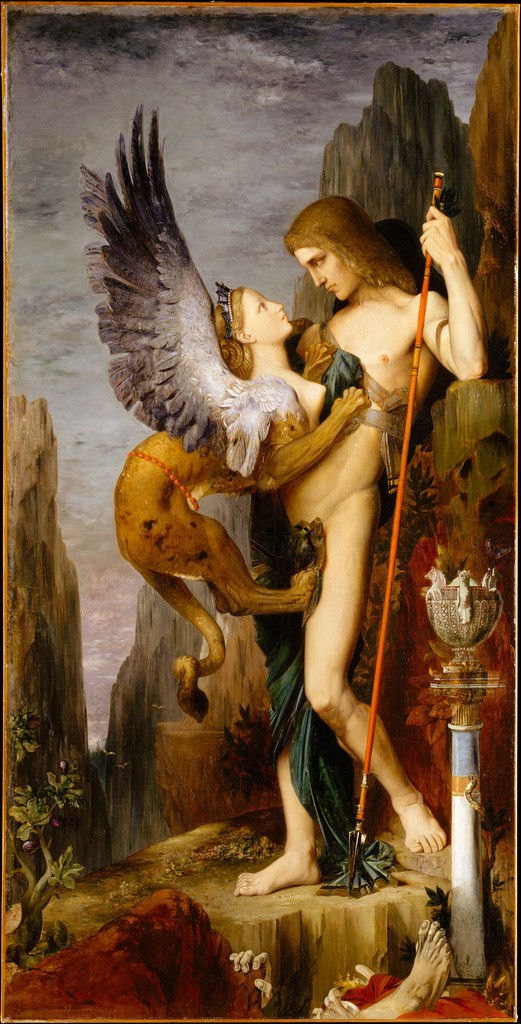
The cartoon for Oedipus and the Sphinx makes that process unusually legible. The Musée Gustave Moreau identifies it as charcoal and white chalk, squared for transfer. Its principal bodies have the same proportions as those in the 1864 Metropolitan Museum painting, yet several elements of the oil are absent: the hero’s spear, birds, an architectural column and a small confrontation between snake and butterfly.[1] Transfer was therefore not a mechanical end point. Moreau could preserve the central geometry while continuing to invent around it.
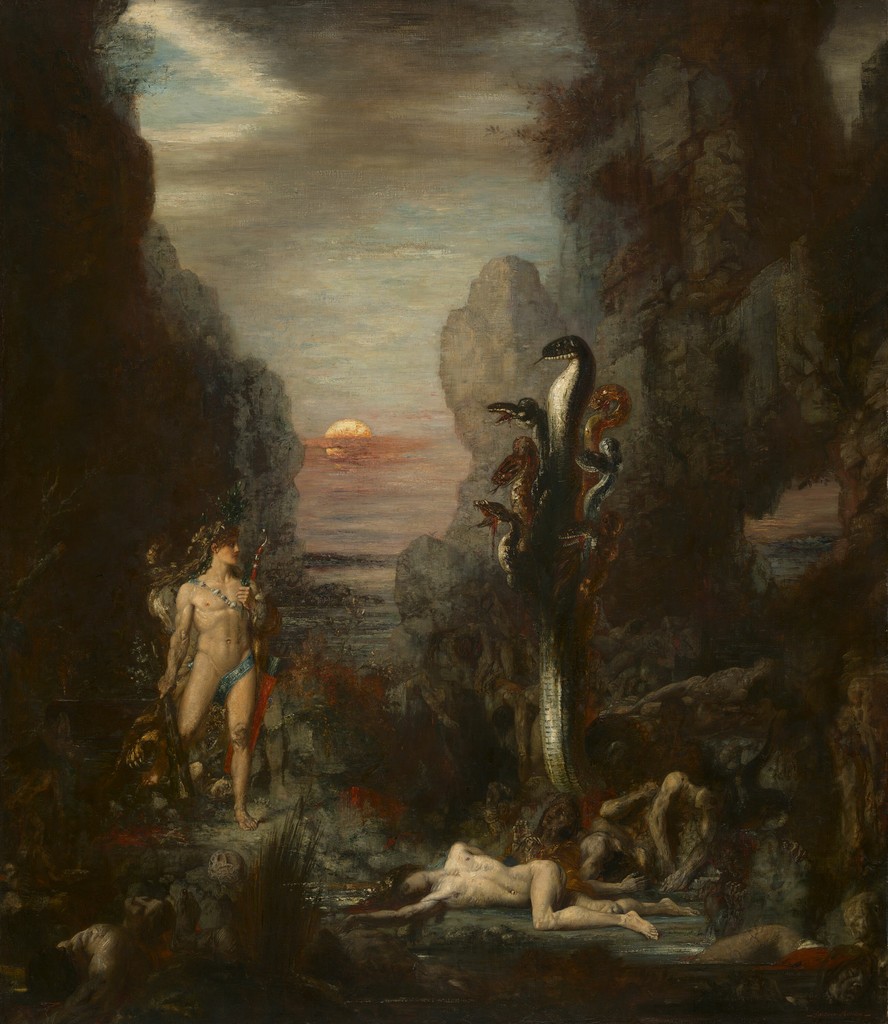
A preparatory drawing for Hercules and the Lernaean Hydra shows another kind of resolution. The Art Institute of Chicago catalogue records pen in brown and black ink, graphite, brown wash and white heightening on paper prepared with a pale wash. Moreau built light and darkness into the study while still changing the hero’s bodily type before the finished painting.[8] The sheet is preparatory, but it is also a highly considered object with its own tonal argument.
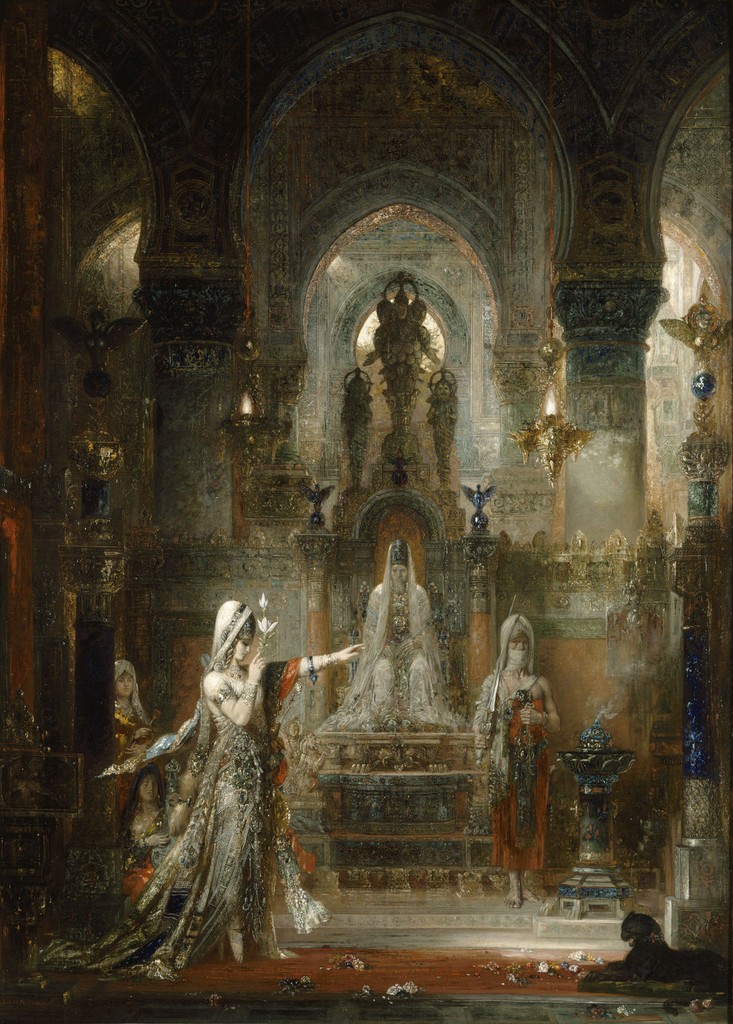
The Hammer Museum’s record for Salomé Dancing Before Herod notes that Moreau produced more than eighty preliminary sketches for that 1876 oil.[9] The figure is striking not as a promise that every study survives, but as evidence that abundance could underlie a single apparently poised performance. Preparation was a space for multiplication: many partial answers could be tested before a chosen configuration reached canvas.
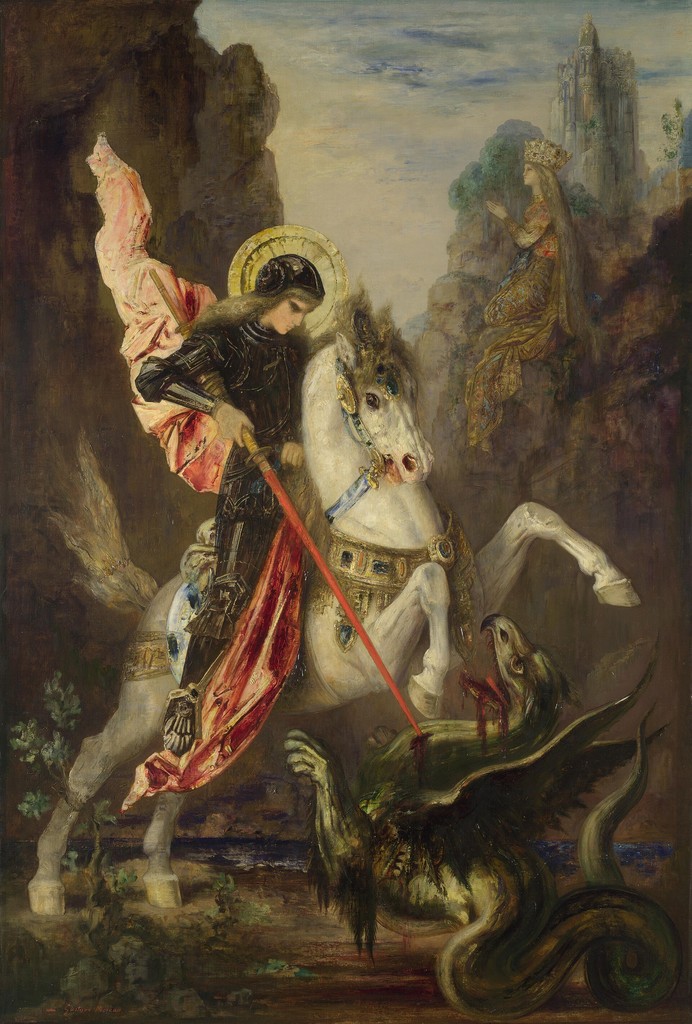
The long development of Saint George and the Dragon also depended on paper. The National Gallery relates the late painting to an earlier watercolour and to five known preparatory drawings.[10] Across such cases, the drawing does not merely sit “before” the painting. Designs migrate between sheets and supports, sometimes remaining available for reuse over decades.
Watercolour, Gouache and Gold
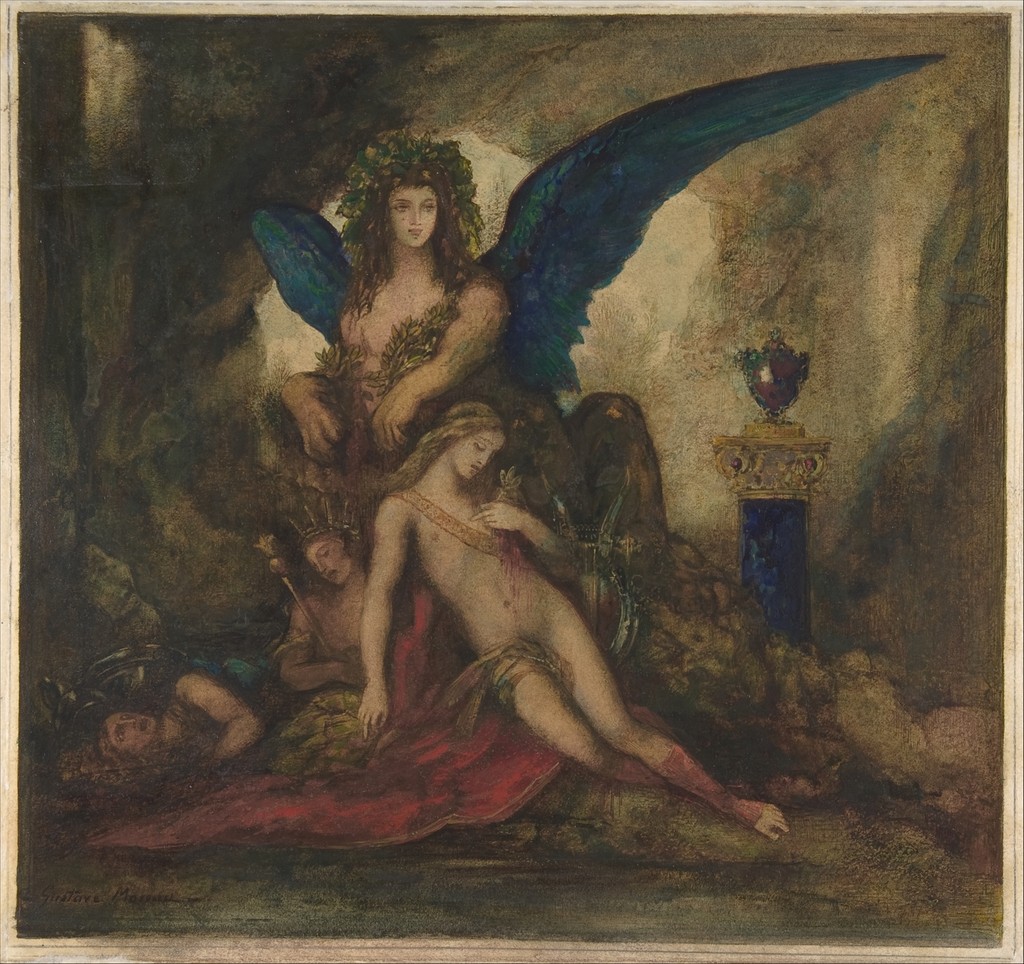
Watercolour could be transparent, but Moreau did not confine it to transparent washes. Gouache supplied opacity and concentrated colour; pen or graphite could stabilise edges; gold heightening could turn an inscription or detail into a point of light. Varnish could further change a surface. The Met’s Sphinx in a Grotto (Poet, King and Warrior), dated 1887–88, is explicitly described as watercolour and gouache on varnished paper.[11]
The active Apparition demonstrates the medium’s public scale and authority. Musée d’Orsay identifies it as the 1876 watercolour RF 2130, measuring 106 by 72.2 centimetres. The Louvre record confirms the same object in its Department of Graphic Arts and notes Moreau’s gold-lettered signature.[2][12] It is not the oil version held by the Musée Gustave Moreau, and its identity should never inherit that painting’s data.
Other sheets reveal different combinations. Bethsabée uses watercolour over graphite with pen and gouache highlights; the Louvre records that Moreau delivered it to the collector Charles Hayem in November 1890.[13] Les Plaintes du poète, dated about 1882, layers watercolour over graphite and includes gold gouache. Its inscription identifies it as a design for enamel.[14] Cléopâtre, a commissioned work paid for in 1883, combines watercolour with gouache heightening in a small vertical format.[15]
These examples prevent “watercolour” from becoming a synonym for spontaneity. Some sheets are compact but elaborate, made for collectors or connected to another luxury medium. Others retain the mobility and openness that Moreau found difficult to sustain in more laborious paintings. Their common support does not erase their different purposes.
La Fontaine and the Enamel Ideal
In 1879 Moreau began a cycle of sixty-four watercolours illustrating La Fontaine’s Fables. The commission required him to revisit brief narratives repeatedly without making each image follow one fixed design. Early Italian landscapes and animal studies now had practical relevance: a fable could demand a convincing creature, a swiftly defined setting and an emotional turn within a small field.[5]
The museum’s graphic displays include studies for this project, and the 2023 press kit describes sketches for the Fables among the watercolours kept in the revolving cabinet.[3] Calling all of them sketches, however, would obscure the range between exploratory material and highly developed illustration. The project demonstrates that small scale can concentrate invention rather than diminish it.
Enamel offered Moreau another model for pictorial intensity. The museum links his idea of painting as a rich art to enamel’s saturated colour.[5] The relationship was not only metaphorical. Les Plaintes du poète bears an inscription naming it as an enamel design, while the first owner of The Voices commissioned an enamel reproduction by Grandhomme and Garnier that appeared at the 1889 Paris Universal Exposition.[14][16]
Gold accents, compact format and crisp divisions of colour can invite an enamel comparison, but not every watercolour should be described this way. The value of the analogy lies in its object-specific evidence: certain sheets were imagined in relation to enamel, and others pursue a comparable intensity without being designs for translation.
Private Experiment and the Meaning of “Unfinished”
The Musée Gustave Moreau presents watercolour as a medium in which the artist permitted himself experiments that he did not show publicly. It also preserves late painted studies whose open handling attracted new attention in the twentieth century.[5] Those facts make privacy and freedom important, but they do not support the claim that all small watercolours were secret or that every loose mark anticipated abstraction.
Moreau sold and exhibited major works on paper. The Apparition entered a collection in 1876; Bethsabée and Cléopâtre were made for identifiable patrons.[2][13][15] The private laboratory existed alongside a market and public display. What changed from sheet to sheet was the degree of commitment, intended audience and relation to another work.
“Unfinished” is equally unstable. A quickly brushed colour trial, an abandoned composition and a complete preparatory drawing are not the same kind of object. A sparse sheet may have fulfilled its task. A densely finished watercolour may never have been intended as preparation. It is safest to begin with documented material and provenance, then describe visible handling as observation rather than treating looseness as a diagnosis.
Six Sheets That Open the Graphic Oeuvre
The Apparition is the essential first stop because it overturns the assumption that watercolour must be small or preliminary. Its tall format, gold signature and documented sale give it the status of a completed work, while its hovering head and patterned interior demonstrate how line and colour can sustain visionary uncertainty.[2][12]
The Oedipus and the Sphinx cartoon offers the opposite kind of clarity. Grid, charcoal and white chalk expose enlargement as a physical procedure; differences from the final oil prove that invention continued after the design had reached full size.[1] The AIC Hercules study narrows attention further, using layered ink, wash, graphite and heightening to organise an encounter through tonal contrast.[8]
Sphinx in a Grotto expands the medium in another direction. Its varnished watercolour-and-gouache surface and horizontal format distinguish it from the 1864 Oedipus painting even though both include a sphinx. The Met dates the sheet to 1887–88 and identifies it as object 67.187.30.[11] It should be approached as a separate late invention, not as an illustration of the earlier canvas.
Three intimate works show how finish and function diverge. The Voices, around 1880, is a watercolour and gouache on paper connected with Hesiod and the Muses; the Thyssen-Bornemisza Museum also records Moreau’s designed tortoiseshell frame and the later enamel translation.[16] Bethsabée joins graphite, pen, transparent colour and gouache within a collector’s sheet.[13] Les Plaintes du poète uses gold both materially and conceptually through its explicit enamel purpose.[14]
Together these objects resist a single hierarchy. The transfer cartoon is not less intelligent than the exhibited watercolour; the commissioned sheet is not necessarily less experimental than private material. They answer different problems. Follow them alongside Moreau’s biography to see how academic training, Italy, Salon practice and the artist-designed museum shaped the conditions in which this range could survive.
Display, Light and Responsible Looking
Works on paper are sensitive to light, which affects how and for how long museums can show them. The Musée Gustave Moreau’s four-sided watercolour cabinet was designed to keep its framed contents protected while allowing sheets to be viewed by turning the panels.[4] Display figures therefore describe an arrangement, not an invitation to expose every work continuously.
Current status should always be checked before a visit. The Louvre lists The Apparition as available by appointment in the graphic-arts study room, while the Met and Thyssen records currently mark Sphinx in a Grotto and The Voices as not on display.[11][12][16] These notices can change. A high-resolution image helps with line and material detail, but it cannot reproduce scale, surface sheen or the experience of a protected sheet under museum lighting.
Researched works directory
This searchable evidence census was assembled from public museum records and a reproducible Wikidata snapshot. It is not a catalogue raisonné, a claim to complete oeuvre coverage, or a substitute for Pierre-Louis Mathieu's printed catalogue, which was not consulted for this directory.
| Name | Date | Medium |
|---|---|---|
| Abstract Study | 1850 | Painting |
| Abstract Study | 1875 | Painting |
| Abstract Study | 1890 | Painting |
| Academic Study of a Man | 1847 | Painting |
| Achilles the Centaur Chiron | 1859 | Painting |
| Andromeda | 1867 | Painting |
| Andromeda | Date unknown | Painting |
| Angels Following the Magi | 1860 | Painting |
| Angels following the Three Magi | 1898 | Painting |
| Angels Throwing Flowers on the Vatican | 1850 | Painting |
| Aphrodite, 1871 | Date unknown | Painting |
| Apollo and Daphne | 1852 | Painting |
| Apollo and The Nine Muses | 1856 | Painting |
| Apollo and the Satyrs | 1850 | Painting |
| Apollo Victorious over Python | 1885 | Painting |
| Apollon and Marsyas | 1858 | Painting |
| Ariadne and Theseus | 1875 | Painting |
| Arion | 1891 | Painting |
| Athenians being Delivered to the Minotaur in the Cretan Labyrinth | 1855 | Painting |
| Autumn | 1885 | Painting |
| Bacchanal | 1850 | Painting |
| Bacchus on the Panther -cart. | Date unknown | Painting |
| Bathsheba | 1875 | Painting |
| Beheading of John the Baptist | 1872 | Painting |
| Bertrand and Raton | 1879 | Painting |
| Binding of Isaac | 1850 | Painting |
| Birth of Venus | 1870 | Painting |
| Briseis Departure | 1859 | Painting |
| centaur | Date unknown | Painting |
| Centaurs | 1850 | Painting |
| Chimera | 1850 | Painting |
| Chimeras | 1875 | Painting |
| Christ and the Two Thieves | 1870 | Painting |
| Christ at Gethsemane | 1850 | Painting |
| Christ at Gethsemane | 1875 | Painting |
| Christ at Lake Tiberias | 1850 | Painting |
| Christ at the Column | 1850 | Painting |
| Christ Blessing Hist Mother | 1850 | Painting |
| Christ Reliever | 1850 | Painting |
| Circe | 1850 | Painting |
| Cleopatra | 1850 | Painting |
| Cleopatra | 1887 | Painting |
| Danaé | 1858 | Painting |
| Darius, Fleeing after the battle of Arbela, Stops, Exhausted, to Drink from a Pond | 1853 | Painting |
| Darius Flight | 1850 | Painting |
| Dead Orpheus | 1850 | Painting |
| Dead Orpheus | 1890 | Painting |
| Dead Poet Carried by a Centaur | 1890 | Painting |
| Death Giving Laurels to the Winner of the Tournament | 1859 | Painting |
| Death of a Young Crusader | 1870 | Painting |
| Death of Moses | 1850 | Painting |
| Death of Sapho | 1850 | Painting |
| Death of Sapho | 1872 | Painting |
| Debauchery | 1850 | Painting |
| Dejanira (Autumn) | 1872 | Painting |
| Delilah | 1850 | Painting |
| Delilah | 1890 | Painting |
| Delilah | 1896 | Painting |
| Descent from the Cross | 1850 | Painting |
| Diana bathing | 1900 | Painting |
| Diomede devoured by his horses | 1865 | Painting |
| Diomedes Devoured by His Horses | 1865 | Painting |
| Diomedes Devoured by His Own Horses | 1870 | Painting |
| Œdipus the Wayfarer | 1888 | Painting |
| Draft for Sapho | 1850 | Painting |
| Eleonora Gonzaga, Duchess of Urbino | 1858 | Painting |
| Endymion | 1850 | Painting |
| Erigone | 1865 | Painting |
| Eve | 1850 | Painting |
| Eve | 1875 | Painting |
| Fairy in a Cave | 1850 | Painting |
| Fairy with Griffins | 1870 | Painting |
| Fairy with Griffins | 1876 | Painting |
| Fée aux griffons | 1876 | Drawing |
| Femme et licorne | 1890 | Painting |
| Francesco Maria della Rovere, Duke of Urbino | 1858 | Painting |
| Françoise de Rimini | 1850 | Painting |
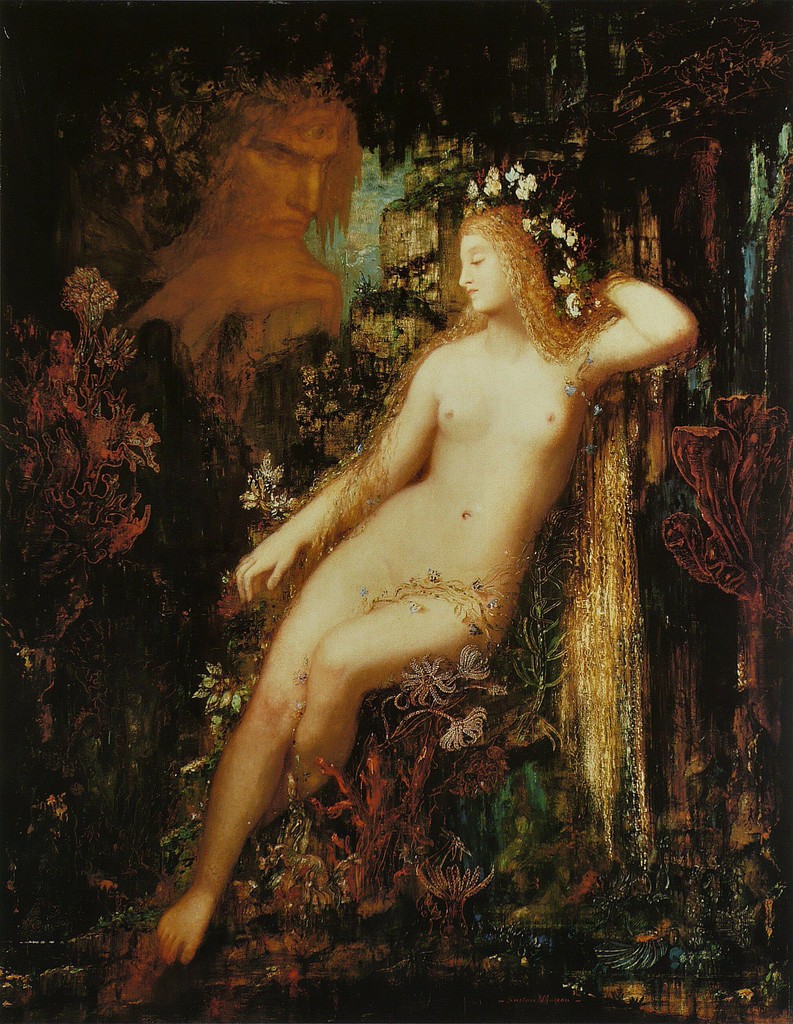
| Galatea | c. 1880 | Painting |
| Galathea | 1896 | Painting |
| Galathea | Date unknown | Painting |
| Ganymede | 1886 | Painting |
| Gardian Angel of the City | 1850 | Painting |
| Genius of Evil | 1850 | Painting |
| Genius of Evil | 1875 | Painting |
| Golgotha | 1870 | Painting |
| Hamlet | 1850 | Painting |
| Hamlet Giving Poison to the King | 1850 | Painting |
| Helen | 1850 | Painting |
| Helen | 1880 | Painting |
| Helen at the Scaean Gate | 1888 | Painting |
| Helen Glorified | 1893 | Painting |
| Helen on the Walls of Troy | 1850 | Painting |
| Helen on the Walls of Troy | 1875 | Painting |
| Helene | Date unknown | Painting |
| Hercule et les oiseaux du lac de Stymphale | Date unknown | Painting |
| Hercules and Omphale | 1856 | Painting |
| Hercules and the Ceryneian Hind | 1871 | Painting |
| Hercules and the Daughters of Thespius | 1850 | Painting |
| Hercules and the Lernaean Hydra | 1875–1876 | Painting |
| Hercules and the Nemean Lion | 1850 | Painting |
| Hercules and the Stymphalian Birds | 1872 | Painting |
| Hercules and Thespius Daughters | 1850 | Painting |
| Hercules at Lake Stymphalia | 1875 | Painting |
| Hercules between Vice and Virtue | 1850 | Painting |
| Hesiod and the Muse | 1870 | Painting |
| Hesiod and the Muse | 1875 | Painting |
| Hesiod and the Muse | 1891 | Painting |
| Hesiod and the Muses | 1860 | Painting |
| Hesiod and the Muses | 1882 | Painting |
| Hésiode enfant | 1860 | Painting |
| Horse Rider | 1854 | Painting |
| Horse Rider | 1870 | Painting |
| Horse Rider and Amazon | 1869 | Painting |
| Horse Riders and Horses | 1854 | Painting |
| Indian Women Poets | 1890 | Painting |
| Interior, Draft | 1850 | Painting |
| Jacob and the Angel | 1876 | Painting |
| Jacob and the Angel | 1878 | Painting |
| Jacob et l'Ange | 1878 | Painting |
| Jason | 1865 | Painting |
| Jason et Éros | 1891 | Painting |
| Judith | 1850 | Painting |
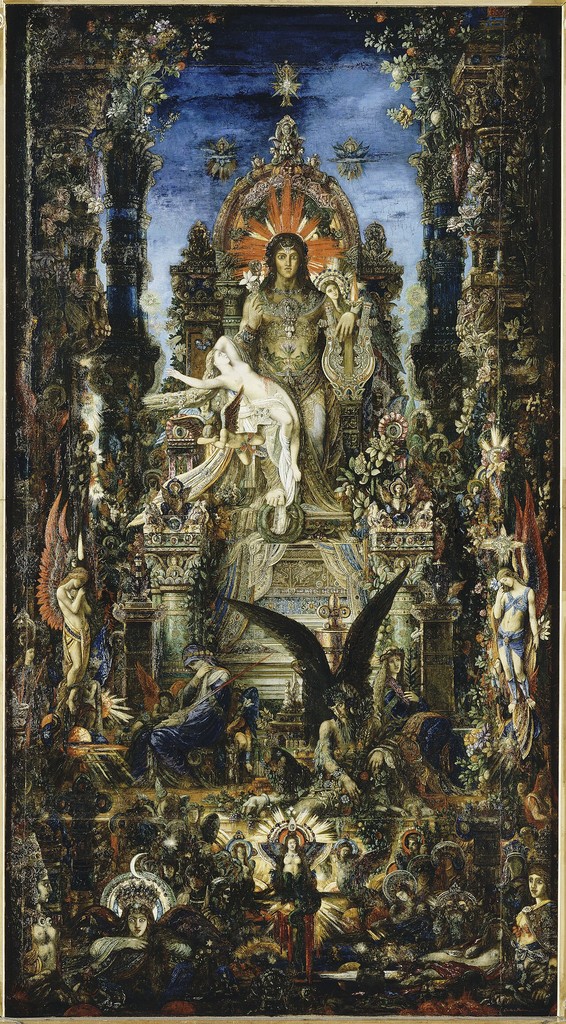
| Jupiter and Semele | 1889–1895 | Painting |
| King Canute and His Courtesans | 1850 | Painting |
| King David | 1878 | Painting |
| L'enlèvement d'Europe | 1872 | Painting |
| La Fée | Date unknown | Painting |
| La mort de Sapho | 1872 | Painting |
| La mort de Sapho | 1876 | Painting |
| La Villa Borghèse | Date unknown | Painting |
| Landscape | 1850 | Painting |
| Landscape, Draft | 1850 | Painting |
| Landscape (Neighborhood of Étampes) | 1850 | Painting |
| Le Bon Samaritain | 1865 | Painting |
| Le Cantique des cantiques | 1853 | Painting |
| Le Christ et Madeleine (Noli me Tangere) | 1889 | Painting |
| Le Grand Pan contemple les Sphères Célestes | 1897 | Drawing |
| Le Poète et la Sirène | 1893 | Painting |
| Le Soir | 1887 | Painting |
| Le Sphinx | 1886 | Painting |
| Leda | 1846 | Painting |
| Leda | 1850 | Painting |
| Leda | 1870 | Painting |
| Les Chimères | 1884 | Painting |
| Les Plaintes du poète | 1882 | Painting |
| Life of Humanity | 1875 | Painting |
| Life of Humanity | 1886 | Painting |
| Life of Humanity: Salvator Mundi | 1886 | Painting |
| Life of Humanity: The Golden Age, Adam - Evening - Sleep | 1879 | Painting |
| Life of Humanity: The Golden Age, Adam - Morning - Prayer | 1879 | Painting |
| Life of Humanity: The Golden Age, Adam - Noon - Extasy | 1879 | Painting |
| Life of Humanity: The Iron Age, Cain - Evening - Death | 1879 | Painting |
| Life of Humanity: The Iron Age, Cain - Morning - Work | 1879 | Painting |
| Life of Humanity: The Iron Age, Cain - Noon - Rest | 1879 | Painting |
| Life of Humanity: The Silver Age, Hesiod and Orpheus, Hesiod - Evening - Tears | 1879 | Painting |
| Life of Humanity: The Silver Age, Hesiod and Orpheus, Hesiod - Morning - Inspiration | 1879 | Painting |
| Life of Humanity: The Silver Age, Hesiod and Orpheus, Orpheus - Noon - Song | 1879 | Painting |
| Love Victorious over Death | 1850 | Painting |
| Lucretia and Tarquin | 1850 | Painting |
| Magdalene on Golgotha | 1850 | Painting |
| Magdalene on Golgotha | 1875 | Painting |
| Magdalene on Golgotha | 1880 | Painting |
| Magnolia | 1864 | Painting |
| Martyrdrom | 1850 | Painting |
| Messalina | 1850 | Painting |
| Messalina | 1874 | Painting |
| Messaline | 1874 | Painting |
| Mort de Sapho | 1900 | Painting |
| Moses Exposed | 1875 | Painting |
| Moses Exposed on the Nile | 1875 | Painting |
| Moses, in Sight of the Promised Land, Takes His Sandals Off | 1854 | Painting |
| Moses Rescued from the Nile | 1893 | Painting |
| Mystic Flower | 1890 | Painting |
| Narcissus | 1850 | Painting |
| Narcissus | 1885 | Painting |
| Narcissus | 1890 | Painting |
| Noces d’Alexandre et de Roxane | Date unknown | Drawing |
| Nude Study | 1850 | Painting |
| Nyx, Night Goddess | 1880 | Painting |
| Oedipus and the Sphinx | 1864 | Painting |
| Orestes | 1850 | Painting |
| Orestes | 1875 | Painting |
| Orestes and the Erinyes | 1875 | Painting |
| Orphés | 1865 | Painting |
| Orpheus | 1865 | Painting |
| Orpheus Head | 1850 | Painting |
| Orpheus on Eurydice's Tomb | 1890 | Painting |
| Pasiphaë | 1850 | Painting |
| Pasiphaë | 1880 | Painting |
| Pasiphaë, Grisaille | 1850 | Painting |
| Pauline Moreau as the Virgin | 1848 | Painting |
| Perseus and Andromeda | 1870 | Painting |
| Persian Poet | 1875 | Painting |
| Petrarch After the Triumph | 1850 | Painting |
| Phaéton | 1878 | Painting |
| Phoebus and Boreas | 1879 | Painting |
| Pietà | 1867 | Painting |
| Pietà | 1875 | Painting |
| Pietà | 1876 | Painting |
| Pietà | Date unknown | Painting |
| Pittacus the Tyrant in War Costume | 1883 | Drawing |
| Polyphemus | 1880 | Painting |
| Poney | 1870 | Painting |
| Portrait of Gustave Moreau by Himself | 1850 | Painting |
| Portrait of Gustave Moreau by Himself | 1890 | Painting |
| Postman and Horses | 1854 | Painting |
| Prometheus | 1868 | Painting |
| Prometheus | 1869 | Painting |
| Prometheus Thunderstruck | 1870 | Painting |
| Prometheus, Variant | 1870 | Painting |
| Rape of Deianira | 1850 | Painting |
| Rape of Deianira | 1872 | Painting |
| Return of the Argonauts | 1890 | Painting |
| Ruines de Rome : le Colisée vu des jardins de l'Angélicum des dominicains | 1858 | Painting |
| Saint Cecilia and the Angels of Music | 1850 | Painting |
| Saint Francis Kissing a Leper | 1850 | Painting |
| Saint George and the Dragon | 1889–1890 | Painting |
| Saint Jerome | 1850 | Painting |
| Saint Sebastian | 1850 | Painting |
| Saint Sebastian | 1870 | Painting |
| Saint Sebastian and the Angel | 1876 | Painting |
| Saint Sebastian and the Angels | 1850 | Painting |
| Saint Sebastian Succoured | 1885 | Painting |
| Saint Sebastian with Archers | 1875 | Painting |
| Saint-Sébastien et l'ange | 1876 | Painting |
| Saint Sébastien soigné par les saintes femmes | 1869 | Painting |
| Sainte Cecilia | 1850 | Painting |
| Salome | 1850 | Painting |
| Salome | 1872 | Painting |
| Salome | 1874 | Painting |
| Salome at the Prison | 1873 | Painting |
| Salomé au Jardin | 1878 | Painting |
| Salome Dancing | 1872 | Painting |
| Salomé Dancing Before Herod | 1876 | Painting |
| Salome Dancing in front of Herod | 1876 | Painting |
| Salome with the Head of John the Baptist | 1876 | Painting |
| Santa Cecilia (Moreau) | Date unknown | Painting |
| Sappho falling into the Abyss | 1867 | Painting |
| Semele | 1889 | Painting |
| Semele, Draft | 1889 | Painting |
| Singing Centaurs | 1850 | Painting |
| Slaves Thrown to the Morays | 1850 | Painting |
| Song of Songs (Cantique des Cantiques) | 1893 | Painting |
| Spanish Conversation | 1850 | Painting |
| Spring | 1850 | Painting |
| St. Sebastian | Date unknown | Painting |
| Study | 1850 | Painting |
| Study | 1874 | Painting |
| Study | 1875 | Painting |
| Study for Jupiter and Semele | 1889 | Painting |
| Study for Moses Taking Off His Sandals | 1854 | Painting |
| Study for Saint Cecilia | 1850 | Painting |
| Study for Salome | 1874 | Painting |
| Study for The Triumph of Alexander the Great | 1885 | Painting |
| Study from Nature | 1850 | Painting |
| Study of a red ibis | 1900 | Painting |
| Sultan | 1850 | Painting |
| Suzanne et les vieillards | 1895 | Painting |
| swinging girl | Date unknown | Painting |
| Tea Rose | 1850 | Painting |
| Temptation | 1890 | Painting |
| Tempting Demon | 1875 | Painting |
| The Angels of Sodome | 1872 | Painting |
| The Apparition | 1876 | Drawing |
| The Argonauts | 1885 | Painting |
| The Bad Rich | 1850 | Painting |
| The calvary | 1867 | Painting |
| The childhood of Sixtus V. | 1853 | Painting |
| The Chimera | 1867 | Painting |
| The chimera | Date unknown | Painting |
| The Chimeras | 1850 | Painting |
| The Crowning with Thorns | 1846 | Painting |
| The Daughters of Thespius | 1853 | Painting |
| The Dead Lyres | 1897 | Painting |
| The Decameron | 1850 | Painting |
| The Disciples in Emmaus | 1850 | Painting |
| The Dream Haunting the Mogul | 1881 | Painting |
| The Entombment | 1867 | Painting |
| The Good Samaritan | 1850 | Painting |
| The Infant Moses | 1877 | Painting |
| The Magi | 1860 | Painting |
| The Martyred Saint Sebastian | 1869 | Painting |
| The Mermaid and the Poet | 1895 | Painting |
| The Muses Leaving Their Father Apollo to Go and Light the World | 1868 | Painting |
| The Parca and the Angel of Death | 1890 | Painting |
| The Parcae | 1850 | Painting |
| The Pieridae | 1875 | Painting |
| The Pieridae | 1880 | Painting |
| The Pietà | 1867 | Painting |
| The Plague in Florence | 1870 | Painting |
| The Poet and the Siren | 1894 | Painting |
| The Prodigal Son | 1850 | Painting |
| The Prodigal Son | 1890 | Painting |
| The Rape of Europe | 1868 | Painting |
| The Rape of Europe | 1869 | Painting |
| The Shulamite | 1853 | Painting |
| The Sirens | 1850 | Painting |
| The Sirens | 1875 | Painting |
| The Sirens | 1882 | Painting |
| The Springs | 1856 | Painting |
| The Suitors | 1862 | Painting |
| The Toilette | 1887 | Painting |
| The Travelling Angels | 1875 | Painting |
| The Travelling Poet | 1890 | Painting |
| The Unicorn | 1885 | Painting |
| The Unicorns | 1888 | Painting |
| The Voices | 1867 | Painting |
| The Wandering Jew | 1870 | Painting |
| The Young Man and Death | 1856–1865 | Painting |
| Tomyris and Cyrus | 1850 | Painting |
| Triumph of Alexander the Great | 1873 | Painting |
| Triumphing Church | 1870 | Painting |
| Tyrtaeus | 1850 | Painting |
| Tyrtaeus Singing While Fighting | 1860 | Painting |
| Un Saint au désert | 1879 | Painting |
| Untitled | 1866 | Painting |
| Venice | 1850 | Painting |
| Venice | 1885 | Painting |
| Venus Rising from the Sea | 1866 | Painting |
| Victim | 1850 | Painting |
| Vue de Florence | 1858 | Painting |
| Walk in a Park | 1865 | Painting |
| Water Fairy | 1850 | Painting |
| Womand and Chimera | 1875 | Painting |
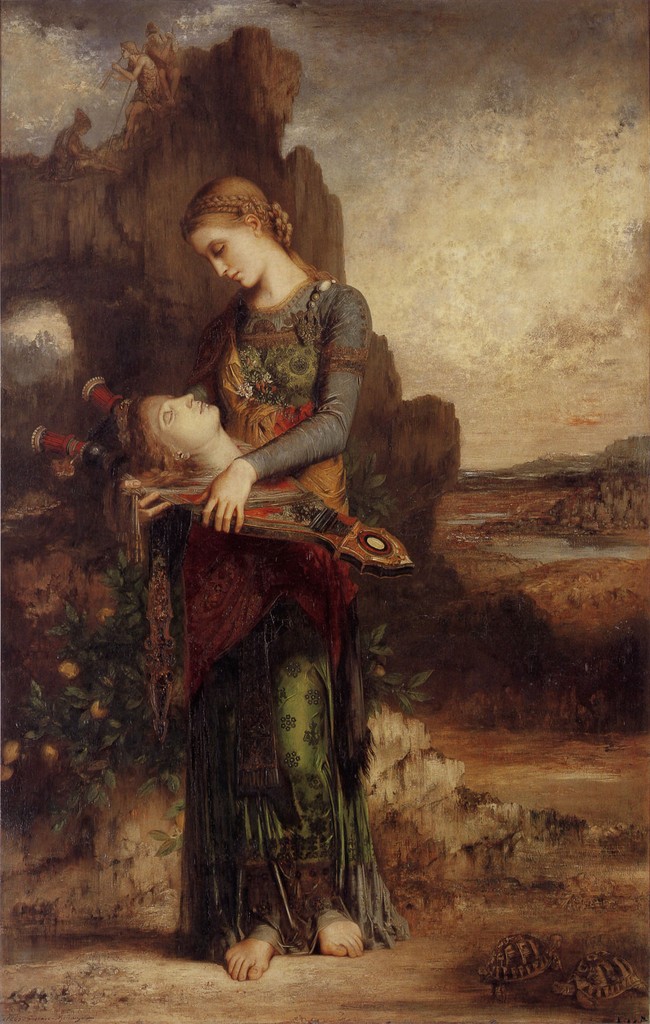
| Young Thracian Woman Holding Orpheus' Head | 1866 | Painting |
Frequently Asked Questions
There is no responsible single total in the sources used here. The Musée Gustave Moreau reports about 4,830 drawings in its shuttered display units and 264 watercolours in its current visitor trail, but those are presentation counts within one museum. Moreau’s works on paper also belong to the Louvre, Musée d’Orsay, Met, Art Institute of Chicago, Thyssen-Bornemisza and other collections.[3][4]
His recorded materials range from dry graphite, black pencil, charcoal and red chalk to ink, transparent colour and opaque gouache. He also drew on tracing paper and sometimes introduced gold heightening; Sphinx in a Grotto has a varnished surface. A precise material description should come from the record for the individual object.[3][11][14]
They allowed him to explore composition, anatomy, costume, animals and details separately, then move a chosen design through tracing, squaring and sometimes a full-scale cartoon. Surviving sheets show that he could still add or remove elements after transfer. Preparation was iterative rather than a rigid sequence followed identically for every picture.[1][5]
It was a series of sixty-four watercolours begun in 1879 to illustrate La Fontaine’s Fables. The cycle let Moreau vary figures, animals, settings and colour across many compact narratives. The museum preserves preparatory material and displays related sheets, but individual examples should be judged as studies or completed illustrations from their own records rather than from the project label alone.[3][5]
The Musée Gustave Moreau in Paris offers the richest encounter with his graphic practice through dedicated drawing units and a watercolour cabinet. The Louvre’s Department of Graphic Arts, Musée d’Orsay, Metropolitan Museum of Art, Art Institute of Chicago and Thyssen-Bornemisza also hold important examples. Because paper is light-sensitive, consult each institution’s current display or study-room information before travelling.[4][11][12][16]
Discussion
Use this evidence-led guide as a starting point for close looking rather than a final verdict.
Share an observation about Gustave Moreau Drawings and Watercolours or a source that adds useful context.
Reader Insights
Which material decision best defines Moreau's practice in this group of works?
Where do you see observation and invention working together rather than as opposites?
Which work would you add to the selected group, and what would it change?
Join the Conversation
Add your reading below, keeping observations specific and evidence clear.
References
- Musée Gustave Moreau, “Œdipus and the Sphinx [Œdipe et le Sphinx]”:, accessed 30 August 2026.
- Musée d’Orsay, “L’Apparition”:, accessed 30 August 2026.
- Musée Gustave Moreau, “English press kit 2023”:, accessed 30 August 2026.
- Musée Gustave Moreau, “Visitor trail”:, accessed 30 August 2026.
- Musée Gustave Moreau, “The Art of Gustave Moreau”:, accessed 30 August 2026.
- Musée Gustave Moreau, “Gustave Moreau in Italy”:, accessed 30 August 2026.
- Musée Gustave Moreau, “The Cabinet de Réception”:, accessed 30 August 2026.
- Art Institute of Chicago, Maineri to Miró: The Regenstein Collection since 1975:, accessed 30 August 2026.
- Hammer Museum, “Salomé Dancing Before Herod”:, accessed 30 August 2026.
- National Gallery, London, “Saint George and the Dragon”:, accessed 30 August 2026.
- Metropolitan Museum of Art, “Sphinx in a Grotto (Poet, King and Warrior)”:, accessed 30 August 2026.
- Louvre Collections, “L’Apparition”:, accessed 30 August 2026.
- Louvre Department of Prints and Drawings, “Bethsabée”:, accessed 30 August 2026.
- Louvre Department of Prints and Drawings, “Les Plaintes du poète”:, accessed 30 August 2026.
- Louvre Department of Prints and Drawings, “Cléopâtre”:, accessed 30 August 2026.
- Museo Nacional Thyssen-Bornemisza, “The Voices”:, accessed 30 August 2026.