 by Tom Gurney
Tom Gurney BSc (Hons) is an art history expert with over 20 years experience
Page Created: 30 August 2026 / Page Updated: November 6, 2026
Email: tomgurney1@gmail.com / Phone: +44 7429 011000
Oedipus and the Sphinx: Introduction
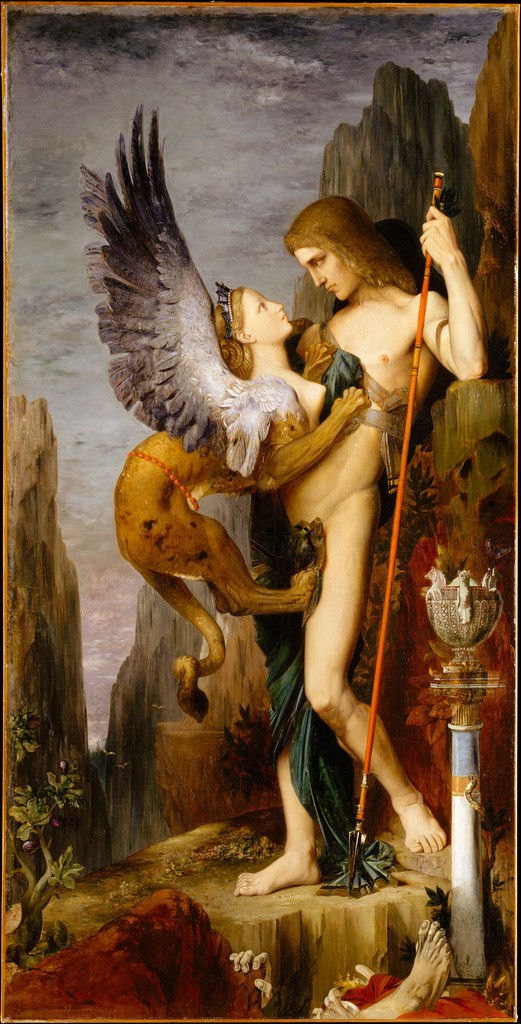
Gustave Moreau makes a familiar victory look dangerously undecided. His Sphinx does not wait at a distance to hear Oedipus answer her riddle: she has sprung onto him, hooked her claws into his body and brought her face level with his. The 1864 oil painting turns a feat of intelligence into an encounter that is physical, psychological and difficult to resolve at a glance.[1]
At a Glance
- Date and receptionOedipus and the Sphinx was painted in 1864 and shown at that year’s Paris Salon, where it decisively advanced Moreau’s reputation.
- Medium and collectionThe oil on canvas measures 206.4 × 104.8 cm and is Metropolitan Museum of Art object 21.134.1.[1]
- Central encounterOedipus and the winged Sphinx hold one another’s gaze while the monster grips his chest, side and leg.
- Earlier victimsHuman remains and abandoned emblems below them record the cost of earlier failures to answer the riddle.
- Laurel and endingLaurel forecasts Oedipus’s victory, yet the compressed pose suspends the ending rather than illustrating the moment after it.
- Preparatory cartoonA separate, nearly full-size squared cartoon survives at the Musée Gustave Moreau; it is a preparatory work, not the Met painting.[2]
Gustave Moreau in context
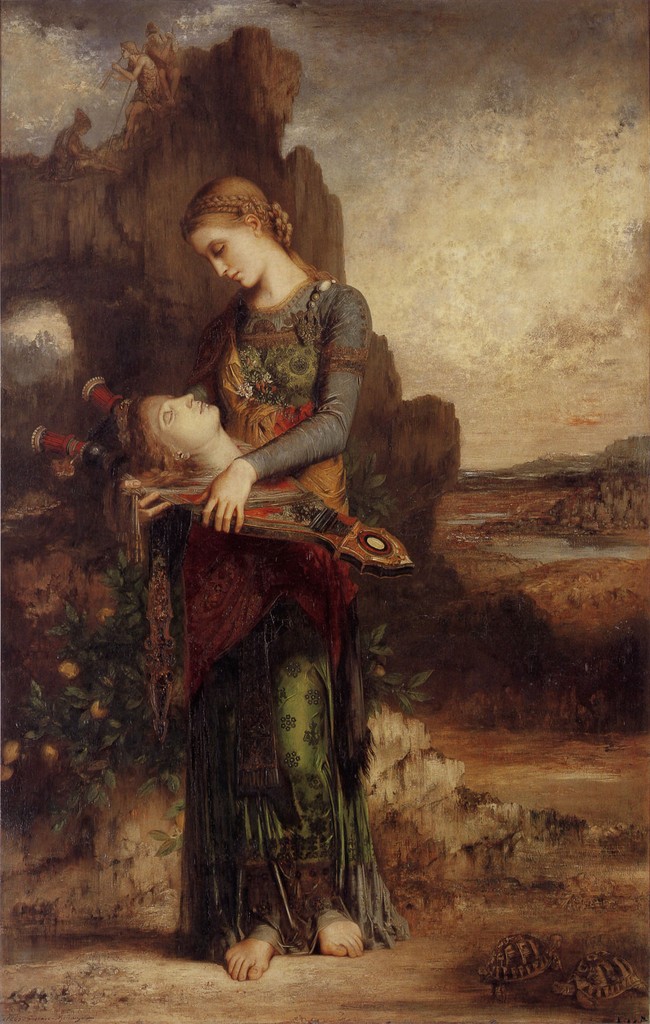
Orpheus
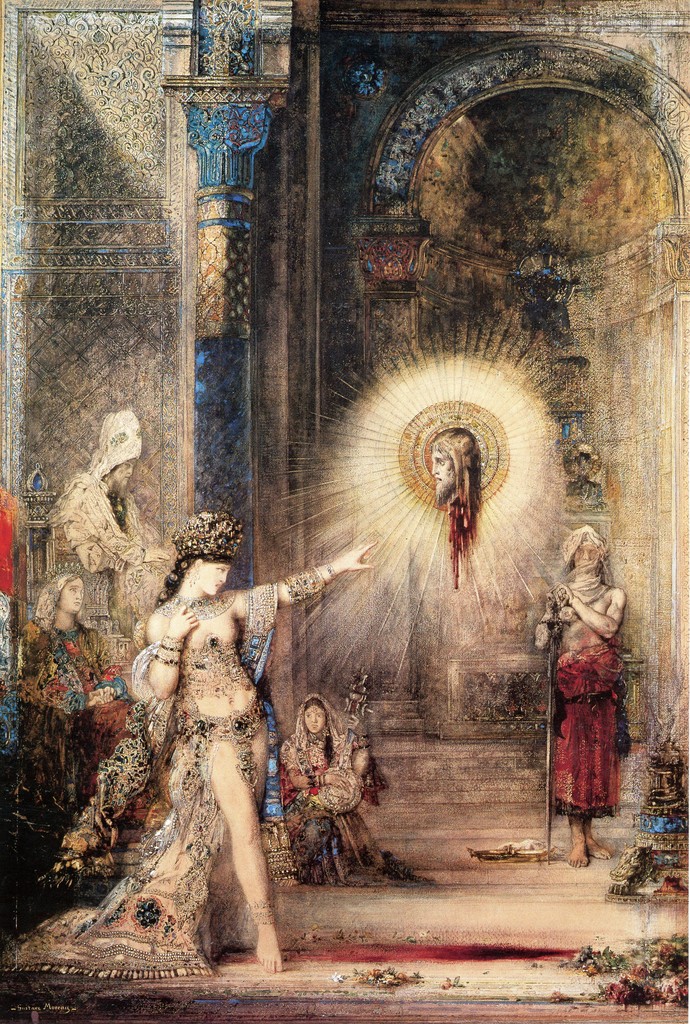
1865The Apparition
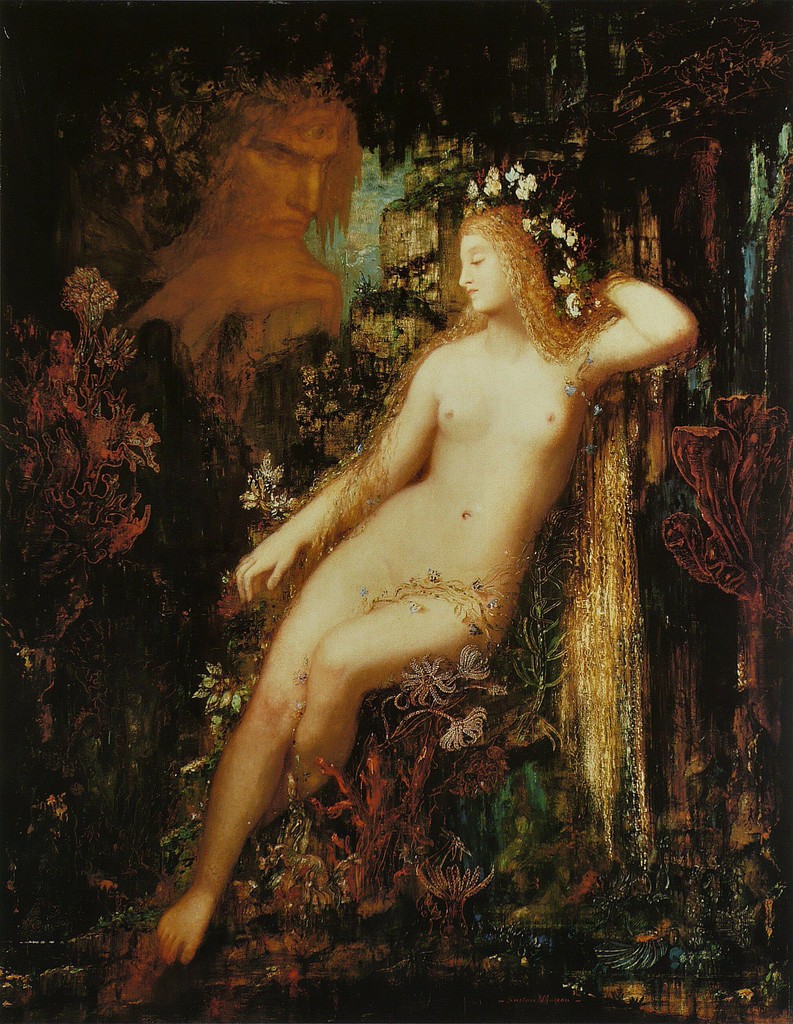
1876Galatea
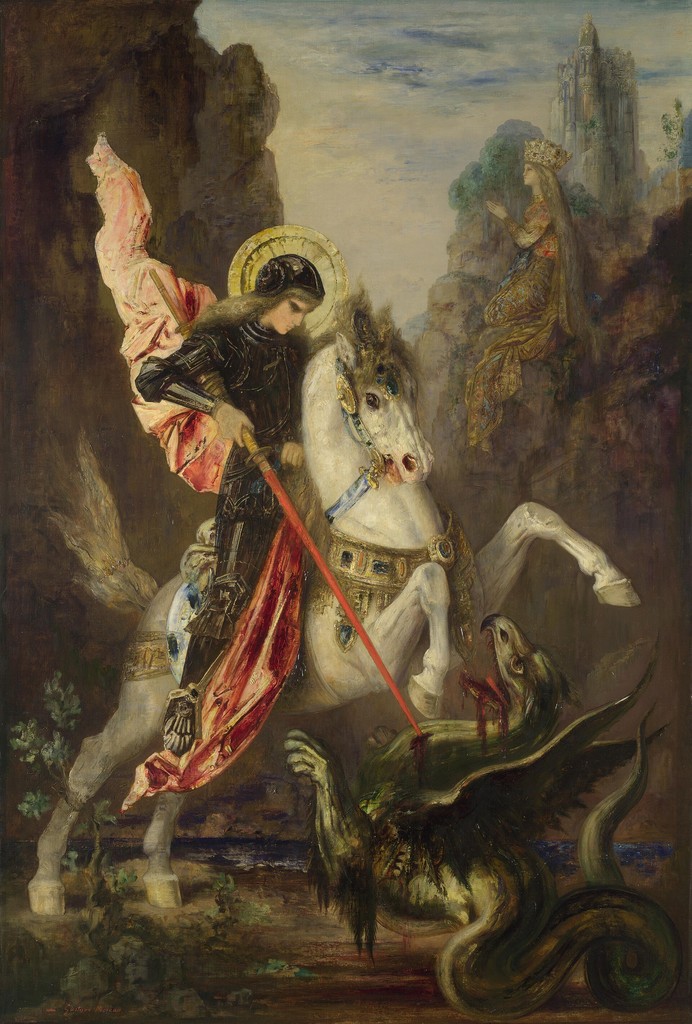
c. 1880Saint George and the Dragon
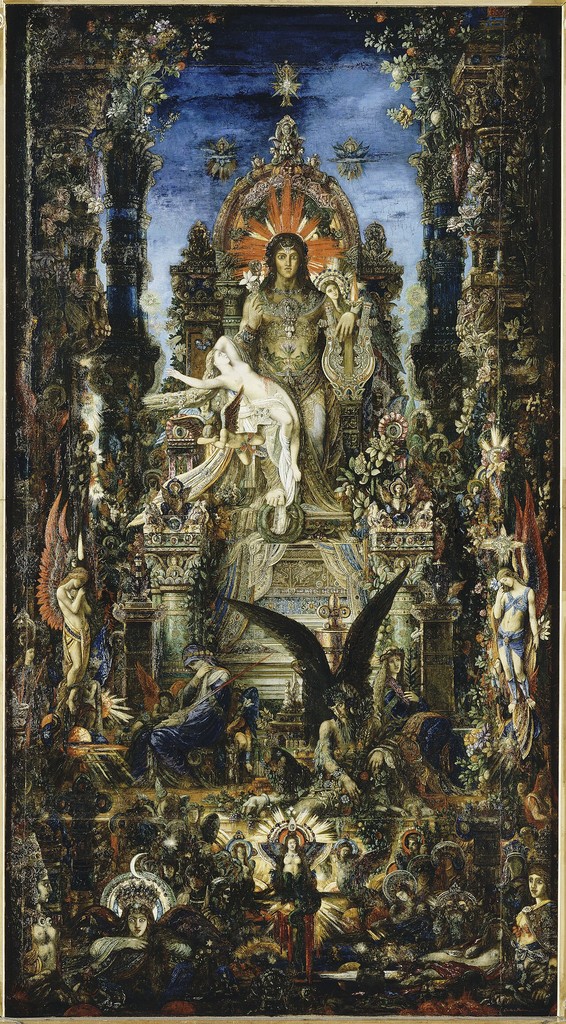
1889–90Jupiter and Semele
1894–95Contents
- Introduction
- Begin with the Gaze
- The Riddle and Its Cruel Sequel
- A Return to the Salon in 1864
- The Comparison with Ingres
- Victory Held in Suspension
- Body, Spirit and Gendered Readings
- Colour, Surface and Monumental Narrowness
- From Squared Cartoon to Finished Canvas
- Provenance, Present Home and Significance
Begin with the Gaze
The first route through the picture runs between two pairs of eyes. Oedipus stands in profile at the right, his head inclined towards the creature attached to him. The Sphinx turns upwards from the left, bringing her face close to his. Neither looks towards the path, the sky or the objects around them. Their concentration shuts out the landscape and makes the narrow space between their faces the painting’s centre.
That focus is reinforced by touch. As a visual observation, the Sphinx seems neither securely perched on a rock nor represented in free flight. One forepaw presses near Oedipus’s chest, another reaches around his side, and a hind paw grips his lower leg. Her animal body crosses his upright human one. Oedipus does not recoil, but his stillness is not casual: his spear rises beside him as a taut red vertical, and his visible hand closes around it above his shoulder.
Follow that spear down and the painting becomes less self-contained. At the foot of the ledge, a dead hand and feet project into view. Nearby are a crown and a laurel wreath, which the Met identifies as tokens of a king and a hero who failed before Oedipus.[1] They are not generic decorations. They turn the riddle into an immediate threat and make the present confrontation part of a sequence of deaths.
Other signs pull in opposite directions. Laurel at Oedipus’s feet and in his hand anticipates success, according to the Musée Gustave Moreau.[2] Yet the dark ravine on the left opens beneath the pair, while jagged rock walls press close behind them. At the right, a slender column supports an ornate vessel; beneath it, a snake rises towards a butterfly. These minute forms reward close looking, but they do not release the tension. The picture provides omens and trophies while withholding the action that would separate victor from victim.
The Riddle and Its Cruel Sequel
In the Theban myth, the Sphinx destroys travellers who cannot solve her question. Its familiar formulation asks which being moves on four legs in the morning, two at midday and three in the evening. Oedipus answers “man”: a human crawls in infancy, walks upright as an adult and relies on a staff in old age. He thereby saves Thebes, and the Sphinx dies.[3]
Moreau chooses the testing point before that result becomes visible. The spear may resemble the “third leg” in the answer, but the painting does not illustrate the stages of life. Instead, it sets the reasoning adult against a hybrid that combines a woman’s head and torso, wings, a lion-like body and grasping paws. Oedipus’s intelligence is being exercised under direct bodily pressure.
Knowing the rest of his story complicates any uncomplicated celebration. Oedipus will become king of Thebes and marry the widowed queen Jocasta, unaware that she is his mother and that he has already killed his father. The Met’s study of ancient monsters notes the irony: the man clever enough to solve the Sphinx’s problem cannot reason his way out of his own identity and fate.[3] Moreau need not depict that later catastrophe for it to shadow the hero’s predicted triumph.
A Return to the Salon in 1864
The painting marked Moreau’s conspicuous return to the Paris Salon. The Musée Gustave Moreau records the sensation it created, the attention of major critics and the caricatures it attracted. It was purchased by Prince Napoleon, and its reception greatly strengthened the standing of an artist who wanted to renew history painting rather than abandon it.[2]
That ambition helps explain the work’s combination of legibility and strangeness. The myth was recognisable, the figures were carefully drawn and the scale suited an important public canvas. Yet Moreau did not supply the sort of expansive, easily narrated action a spectator might expect from official history painting. He reduced the episode to a near-motionless pair and made the obstacle cling to the hero.
The Metropolitan Museum similarly treats the work as Moreau’s breakthrough at the 1864 Salon, at a moment when paintings of modern, everyday subjects were gaining prominence.[1] The contrast should not be simplified into a lone rejection of modern art. Moreau’s intervention was made inside a public exhibition system and through an old subject. Its novelty lay in converting inherited narrative into a concentrated mental and physical trial. For the wider career around this moment, see the Gustave Moreau biography.
The Comparison with Ingres
Both the house-museum and the Met publication connect Moreau’s canvas with Jean-Auguste-Dominique Ingres’s Oedipus and the Sphinx. Ingres developed his composition from 1808 and exhibited a version at the 1827 Salon; Moreau’s picture was inevitably viewed against that famous precedent.[2] The comparison is well supported, but it does not make Moreau’s work a simple copy.
Ingres places the hero in a more open exchange with a partially seen creature. Oedipus leans forward and gestures as though his answer is being stated. Moreau makes the Sphinx fully bodily and moves her to the centre, where she clamps herself to a much more vertical Oedipus. The Met publication describes Moreau’s episode as more eroticised and emphasises how the locked postures obscure the anticipated outcome.[3]
Moreau also changes what surrounding evidence does. The remains below are not only a warning at the edge of a dialogue; they make the Sphinx’s appetite present within the same narrow column of space as Oedipus’s exposed body. The spear and ledge hold him upright, but the creature occupies his torso. Where Ingres foregrounds an act of explanation, Moreau makes knowledge difficult to distinguish from endurance.
This relationship is best understood as a purposeful restaging. Moreau retained a classical subject and acknowledged a celebrated modern treatment, then adjusted scale, contact, emphasis and tempo. His version asks what happens when the riddle is no longer an exchange across space but a test delivered at skin’s distance.
Victory Held in Suspension
The composition contains clues to the ending without showing its completion. Laurel traditionally belongs to victory, and the house-museum reads its placement around Oedipus as a forecast that he will prevail.[2] His long body remains upright. The spear offers a stable line from ground to raised hand. The Sphinx, however, is not falling, retreating or admitting defeat. Her claws remain embedded and her stare holds.
This pause alters the emotional balance. The viewer may know the answer before looking, but knowledge supplies no immediate release. Moreau stretches the interval between question and consequence until it can hold attraction, repulsion, self-command and danger at once. Even the figures’ profiles resist easy judgement: they are intensely attentive, not arranged as a plainly noble face opposed to a plainly distorted one.
The Sphinx’s human and animal parts are crucial to that uncertainty. Ancient representations had long used such hybrid beings to negotiate beauty, fear, death and the boundaries of the human. The Met publication traces how the Theban Sphinx could be shown as both alluring and violent.[3] Moreau revives that ambiguity, but the painting does not require the viewer to adopt every moral or gender assumption historically attached to it.
Body, Spirit and Gendered Readings
The Musée Gustave Moreau presents several interpretations recorded around the painting. Its account describes the confrontation through oppositions—good and evil, spirit and physical force, and the two sexes—and cites the critic Ernest Chesneau’s gendered suggestion that the riddle might be “the enigma of woman”.[2] The Met publication likewise places the work within nineteenth-century readings that opposed male reason to a seductive, destructive female monster. It also quotes Moreau’s own account of a steadfast soul defying an attractive but material chimera.[3]
These are essential historical interpretations, not a single key that closes the picture. They tell us how Moreau and his period could encode intellect as masculine, matter as feminine, and bodily desire as danger. A present-day reading can identify that structure without treating it as universal truth. The image itself is less settled than a diagram of victorious reason: the supposed force of intellect is naked and gripped, while the so-called monster meets his gaze with a recognisably human face.
Sexual tension is therefore grounded in the composition, especially the contact at Oedipus’s chest, flank and groin, but its meaning remains open. It may intensify the conflict Moreau described between spiritual resolve and material temptation. It can also expose how that opposition depends on unequal ideas about sex and gender. The guide to Moreau’s symbolism, mythology and religion places such readings within his larger practice without turning every female figure into the same code.
Colour, Surface and Monumental Narrowness
The canvas is over two metres high but only a little more than one metre wide.[1] That tall proportion is not incidental. It stacks the remains, standing hero, attached Sphinx and enclosing cliffs, limiting lateral escape. Oedipus nearly spans the picture’s height, so his ordeal meets a standing viewer at bodily scale.
Visual observation shows that colour clarifies this compressed design. The hero’s warm, pale skin stands against brown-black rock and deep green drapery. The Sphinx’s lighter breast and darker wings alternate across him, making their two anatomies interlock. The red spear cuts a fine, continuous line through otherwise earthy colour. A green-grey sky recedes, but the ravine’s upright walls deny the spaciousness of an open landscape.
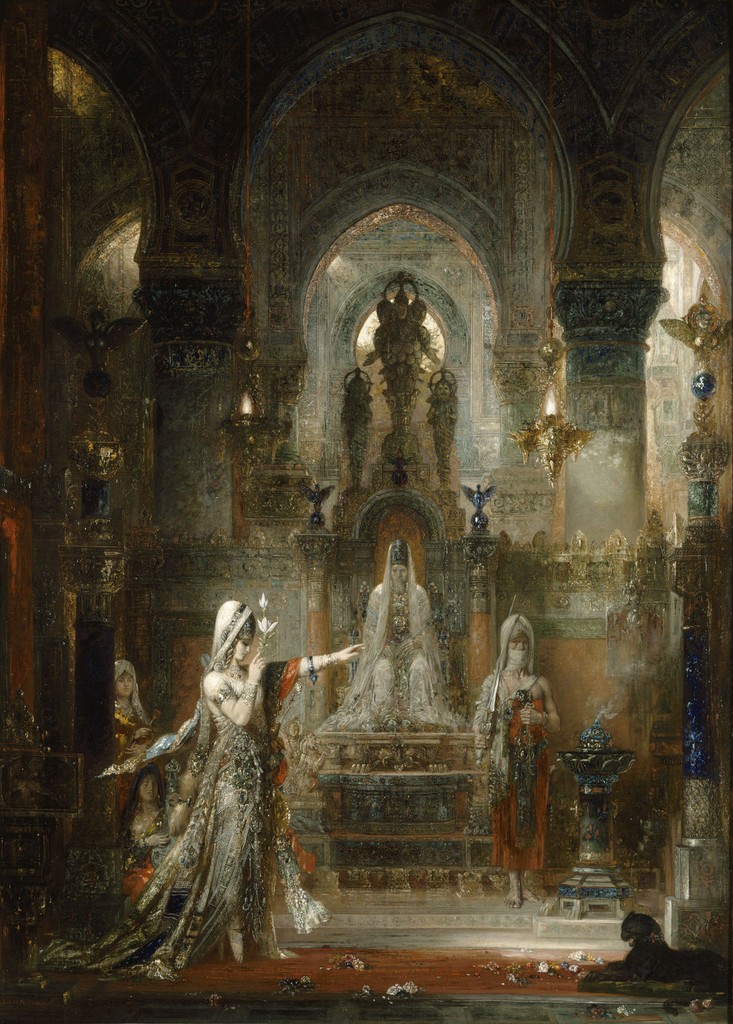
Detail is concentrated rather than evenly distributed. Feathers, hair, jewellery, the vessel and the fragments below invite close inspection; broad rock faces and sky keep those particulars from dissolving into pattern. The result differs from later, more densely ornamented interiors such as Salomé Dancing Before Herod. Moreau’s paintings vary in handling, and this work should not be used as a formula for them all.
From Squared Cartoon to Finished Canvas
The preparatory cartoon in Paris is almost the size of the Met painting: 204 by 104 centimetres. It is executed on card in charcoal and white chalk and visibly squared for transfer.[2] Its scale and grid make its practical relationship to the oil unusually clear. Even so, its museum record explicitly calls it one stage in the painting’s realisation and notes that it differs from the completed picture.
The principal figures already have the same proportions. What is absent demonstrates how much Moreau decided later. The cartoon omits the spear, though the museum notes that its shadow can be detected on Oedipus’s left biceps. It also lacks the birds departing into the rocky gorge, the column and antique vessel, the snake and butterfly, and several anatomical remnants in the foreground.[2]
Those additions alter the painting’s logic. The spear strengthens Oedipus’s upright axis. The fragments increase the stakes. The column introduces a human-made vertical beside the natural cliffs, while the snake and butterfly establish another tiny encounter between threat and fragility. Moving from cartoon to canvas was therefore not mere colouring-in. Moreau preserved the central bodily lock while extending the signs that frame it. The drawings and watercolours guide explains how cartoons, tracing and squaring functioned across his practice.
Provenance, Present Home and Significance
Prince Napoleon bought Oedipus and the Sphinx after its Salon appearance. The work later entered the Metropolitan Museum through the bequest of William H. Herriman in 1920; its accession number is 21.134.1.[1][2] The Met currently lists it at the Fifth Avenue building, but visitors should check the live object record before travelling because display locations can change.
The painting matters both as a public turning point and as an image later histories associate with the groundwork for pictorial Symbolism. The Met’s overview explains that Moreau and other older artists helped establish dreamlike, emotionally suggestive uses of biblical and Greek subjects before Symbolism emerged as a named movement in the 1880s.[4] Oedipus belongs to that prehistory without needing to be relabelled as the product of a formal group that did not yet exist. Its lasting force comes from the conversion of a known answer into an encounter that still feels unresolved.
Researched works directory
This searchable evidence census was assembled from public museum records and a reproducible Wikidata snapshot. It is not a catalogue raisonné, a claim to complete oeuvre coverage, or a substitute for Pierre-Louis Mathieu's printed catalogue, which was not consulted for this directory.
| Name | Date | Medium |
|---|---|---|
| Abstract Study | 1850 | Painting |
| Abstract Study | 1875 | Painting |
| Abstract Study | 1890 | Painting |
| Academic Study of a Man | 1847 | Painting |
| Achilles the Centaur Chiron | 1859 | Painting |
| Andromeda | 1867 | Painting |
| Andromeda | Date unknown | Painting |
| Angels Following the Magi | 1860 | Painting |
| Angels following the Three Magi | 1898 | Painting |
| Angels Throwing Flowers on the Vatican | 1850 | Painting |
| Aphrodite, 1871 | Date unknown | Painting |
| Apollo and Daphne | 1852 | Painting |
| Apollo and The Nine Muses | 1856 | Painting |
| Apollo and the Satyrs | 1850 | Painting |
| Apollo Victorious over Python | 1885 | Painting |
| Apollon and Marsyas | 1858 | Painting |
| Ariadne and Theseus | 1875 | Painting |
| Arion | 1891 | Painting |
| Athenians being Delivered to the Minotaur in the Cretan Labyrinth | 1855 | Painting |
| Autumn | 1885 | Painting |
| Bacchanal | 1850 | Painting |
| Bacchus on the Panther -cart. | Date unknown | Painting |
| Bathsheba | 1875 | Painting |
| Beheading of John the Baptist | 1872 | Painting |
| Bertrand and Raton | 1879 | Painting |
| Binding of Isaac | 1850 | Painting |
| Birth of Venus | 1870 | Painting |
| Briseis Departure | 1859 | Painting |
| centaur | Date unknown | Painting |
| Centaurs | 1850 | Painting |
| Chimera | 1850 | Painting |
| Chimeras | 1875 | Painting |
| Christ and the Two Thieves | 1870 | Painting |
| Christ at Gethsemane | 1850 | Painting |
| Christ at Gethsemane | 1875 | Painting |
| Christ at Lake Tiberias | 1850 | Painting |
| Christ at the Column | 1850 | Painting |
| Christ Blessing Hist Mother | 1850 | Painting |
| Christ Reliever | 1850 | Painting |
| Circe | 1850 | Painting |
| Cleopatra | 1850 | Painting |
| Cleopatra | 1887 | Painting |
| Danaé | 1858 | Painting |
| Darius, Fleeing after the battle of Arbela, Stops, Exhausted, to Drink from a Pond | 1853 | Painting |
| Darius Flight | 1850 | Painting |
| Dead Orpheus | 1850 | Painting |
| Dead Orpheus | 1890 | Painting |
| Dead Poet Carried by a Centaur | 1890 | Painting |
| Death Giving Laurels to the Winner of the Tournament | 1859 | Painting |
| Death of a Young Crusader | 1870 | Painting |
| Death of Moses | 1850 | Painting |
| Death of Sapho | 1850 | Painting |
| Death of Sapho | 1872 | Painting |
| Debauchery | 1850 | Painting |
| Dejanira (Autumn) | 1872 | Painting |
| Delilah | 1850 | Painting |
| Delilah | 1890 | Painting |
| Delilah | 1896 | Painting |
| Descent from the Cross | 1850 | Painting |
| Diana bathing | 1900 | Painting |
| Diomede devoured by his horses | 1865 | Painting |
| Diomedes Devoured by His Horses | 1865 | Painting |
| Diomedes Devoured by His Own Horses | 1870 | Painting |
| Œdipus the Wayfarer | 1888 | Painting |
| Draft for Sapho | 1850 | Painting |
| Eleonora Gonzaga, Duchess of Urbino | 1858 | Painting |
| Endymion | 1850 | Painting |
| Erigone | 1865 | Painting |
| Eve | 1850 | Painting |
| Eve | 1875 | Painting |
| Fairy in a Cave | 1850 | Painting |
| Fairy with Griffins | 1870 | Painting |
| Fairy with Griffins | 1876 | Painting |
| Fée aux griffons | 1876 | Drawing |
| Femme et licorne | 1890 | Painting |
| Francesco Maria della Rovere, Duke of Urbino | 1858 | Painting |
| Françoise de Rimini | 1850 | Painting |
| Galatea | c. 1880 | Painting |
| Galathea | 1896 | Painting |
| Galathea | Date unknown | Painting |
| Ganymede | 1886 | Painting |
| Gardian Angel of the City | 1850 | Painting |
| Genius of Evil | 1850 | Painting |
| Genius of Evil | 1875 | Painting |
| Golgotha | 1870 | Painting |
| Hamlet | 1850 | Painting |
| Hamlet Giving Poison to the King | 1850 | Painting |
| Helen | 1850 | Painting |
| Helen | 1880 | Painting |
| Helen at the Scaean Gate | 1888 | Painting |
| Helen Glorified | 1893 | Painting |
| Helen on the Walls of Troy | 1850 | Painting |
| Helen on the Walls of Troy | 1875 | Painting |
| Helene | Date unknown | Painting |
| Hercule et les oiseaux du lac de Stymphale | Date unknown | Painting |
| Hercules and Omphale | 1856 | Painting |
| Hercules and the Ceryneian Hind | 1871 | Painting |
| Hercules and the Daughters of Thespius | 1850 | Painting |
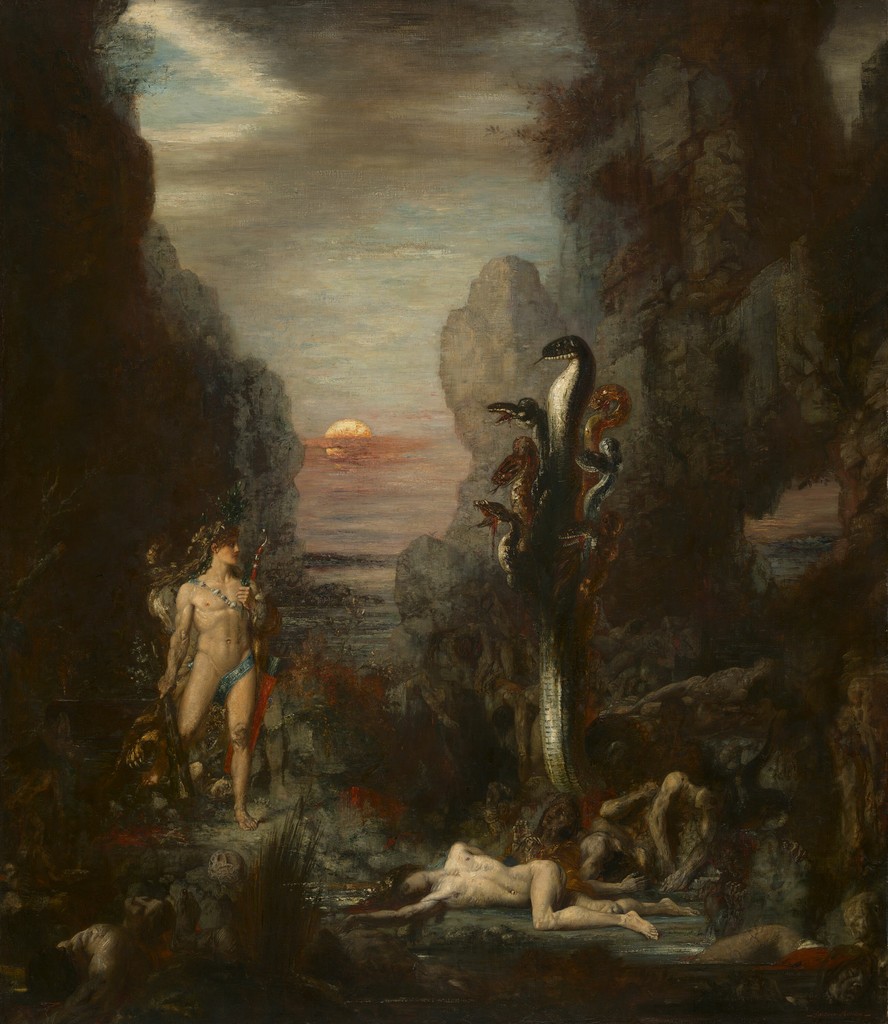
| Hercules and the Lernaean Hydra | 1875–1876 | Painting |
| Hercules and the Nemean Lion | 1850 | Painting |
| Hercules and the Stymphalian Birds | 1872 | Painting |
| Hercules and Thespius Daughters | 1850 | Painting |
| Hercules at Lake Stymphalia | 1875 | Painting |
| Hercules between Vice and Virtue | 1850 | Painting |
| Hesiod and the Muse | 1870 | Painting |
| Hesiod and the Muse | 1875 | Painting |
| Hesiod and the Muse | 1891 | Painting |
| Hesiod and the Muses | 1860 | Painting |
| Hesiod and the Muses | 1882 | Painting |
| Hésiode enfant | 1860 | Painting |
| Horse Rider | 1854 | Painting |
| Horse Rider | 1870 | Painting |
| Horse Rider and Amazon | 1869 | Painting |
| Horse Riders and Horses | 1854 | Painting |
| Indian Women Poets | 1890 | Painting |
| Interior, Draft | 1850 | Painting |
| Jacob and the Angel | 1876 | Painting |
| Jacob and the Angel | 1878 | Painting |
| Jacob et l'Ange | 1878 | Painting |
| Jason | 1865 | Painting |
| Jason et Éros | 1891 | Painting |
| Judith | 1850 | Painting |
| Jupiter and Semele | 1889–1895 | Painting |
| King Canute and His Courtesans | 1850 | Painting |
| King David | 1878 | Painting |
| L'enlèvement d'Europe | 1872 | Painting |
| La Fée | Date unknown | Painting |
| La mort de Sapho | 1872 | Painting |
| La mort de Sapho | 1876 | Painting |
| La Villa Borghèse | Date unknown | Painting |
| Landscape | 1850 | Painting |
| Landscape, Draft | 1850 | Painting |
| Landscape (Neighborhood of Étampes) | 1850 | Painting |
| Le Bon Samaritain | 1865 | Painting |
| Le Cantique des cantiques | 1853 | Painting |
| Le Christ et Madeleine (Noli me Tangere) | 1889 | Painting |
| Le Grand Pan contemple les Sphères Célestes | 1897 | Drawing |
| Le Poète et la Sirène | 1893 | Painting |
| Le Soir | 1887 | Painting |
| Le Sphinx | 1886 | Painting |
| Leda | 1846 | Painting |
| Leda | 1850 | Painting |
| Leda | 1870 | Painting |
| Les Chimères | 1884 | Painting |
| Les Plaintes du poète | 1882 | Painting |
| Life of Humanity | 1875 | Painting |
| Life of Humanity | 1886 | Painting |
| Life of Humanity: Salvator Mundi | 1886 | Painting |
| Life of Humanity: The Golden Age, Adam - Evening - Sleep | 1879 | Painting |
| Life of Humanity: The Golden Age, Adam - Morning - Prayer | 1879 | Painting |
| Life of Humanity: The Golden Age, Adam - Noon - Extasy | 1879 | Painting |
| Life of Humanity: The Iron Age, Cain - Evening - Death | 1879 | Painting |
| Life of Humanity: The Iron Age, Cain - Morning - Work | 1879 | Painting |
| Life of Humanity: The Iron Age, Cain - Noon - Rest | 1879 | Painting |
| Life of Humanity: The Silver Age, Hesiod and Orpheus, Hesiod - Evening - Tears | 1879 | Painting |
| Life of Humanity: The Silver Age, Hesiod and Orpheus, Hesiod - Morning - Inspiration | 1879 | Painting |
| Life of Humanity: The Silver Age, Hesiod and Orpheus, Orpheus - Noon - Song | 1879 | Painting |
| Love Victorious over Death | 1850 | Painting |
| Lucretia and Tarquin | 1850 | Painting |
| Magdalene on Golgotha | 1850 | Painting |
| Magdalene on Golgotha | 1875 | Painting |
| Magdalene on Golgotha | 1880 | Painting |
| Magnolia | 1864 | Painting |
| Martyrdrom | 1850 | Painting |
| Messalina | 1850 | Painting |
| Messalina | 1874 | Painting |
| Messaline | 1874 | Painting |
| Mort de Sapho | 1900 | Painting |
| Moses Exposed | 1875 | Painting |
| Moses Exposed on the Nile | 1875 | Painting |
| Moses, in Sight of the Promised Land, Takes His Sandals Off | 1854 | Painting |
| Moses Rescued from the Nile | 1893 | Painting |
| Mystic Flower | 1890 | Painting |
| Narcissus | 1850 | Painting |
| Narcissus | 1885 | Painting |
| Narcissus | 1890 | Painting |
| Noces d’Alexandre et de Roxane | Date unknown | Drawing |
| Nude Study | 1850 | Painting |
| Nyx, Night Goddess | 1880 | Painting |
| Oedipus and the Sphinx | 1864 | Painting |
| Orestes | 1850 | Painting |
| Orestes | 1875 | Painting |
| Orestes and the Erinyes | 1875 | Painting |
| Orphés | 1865 | Painting |
| Orpheus | 1865 | Painting |
| Orpheus Head | 1850 | Painting |
| Orpheus on Eurydice's Tomb | 1890 | Painting |
| Pasiphaë | 1850 | Painting |
| Pasiphaë | 1880 | Painting |
| Pasiphaë, Grisaille | 1850 | Painting |
| Pauline Moreau as the Virgin | 1848 | Painting |
| Perseus and Andromeda | 1870 | Painting |
| Persian Poet | 1875 | Painting |
| Petrarch After the Triumph | 1850 | Painting |
| Phaéton | 1878 | Painting |
| Phoebus and Boreas | 1879 | Painting |
| Pietà | 1867 | Painting |
| Pietà | 1875 | Painting |
| Pietà | 1876 | Painting |
| Pietà | Date unknown | Painting |
| Pittacus the Tyrant in War Costume | 1883 | Drawing |
| Polyphemus | 1880 | Painting |
| Poney | 1870 | Painting |
| Portrait of Gustave Moreau by Himself | 1850 | Painting |
| Portrait of Gustave Moreau by Himself | 1890 | Painting |
| Postman and Horses | 1854 | Painting |
| Prometheus | 1868 | Painting |
| Prometheus | 1869 | Painting |
| Prometheus Thunderstruck | 1870 | Painting |
| Prometheus, Variant | 1870 | Painting |
| Rape of Deianira | 1850 | Painting |
| Rape of Deianira | 1872 | Painting |
| Return of the Argonauts | 1890 | Painting |
| Ruines de Rome : le Colisée vu des jardins de l'Angélicum des dominicains | 1858 | Painting |
| Saint Cecilia and the Angels of Music | 1850 | Painting |
| Saint Francis Kissing a Leper | 1850 | Painting |
| Saint George and the Dragon | 1889–1890 | Painting |
| Saint Jerome | 1850 | Painting |
| Saint Sebastian | 1850 | Painting |
| Saint Sebastian | 1870 | Painting |
| Saint Sebastian and the Angel | 1876 | Painting |
| Saint Sebastian and the Angels | 1850 | Painting |
| Saint Sebastian Succoured | 1885 | Painting |
| Saint Sebastian with Archers | 1875 | Painting |
| Saint-Sébastien et l'ange | 1876 | Painting |
| Saint Sébastien soigné par les saintes femmes | 1869 | Painting |
| Sainte Cecilia | 1850 | Painting |
| Salome | 1850 | Painting |
| Salome | 1872 | Painting |
| Salome | 1874 | Painting |
| Salome at the Prison | 1873 | Painting |
| Salomé au Jardin | 1878 | Painting |
| Salome Dancing | 1872 | Painting |
| Salomé Dancing Before Herod | 1876 | Painting |
| Salome Dancing in front of Herod | 1876 | Painting |
| Salome with the Head of John the Baptist | 1876 | Painting |
| Santa Cecilia (Moreau) | Date unknown | Painting |
| Sappho falling into the Abyss | 1867 | Painting |
| Semele | 1889 | Painting |
| Semele, Draft | 1889 | Painting |
| Singing Centaurs | 1850 | Painting |
| Slaves Thrown to the Morays | 1850 | Painting |
| Song of Songs (Cantique des Cantiques) | 1893 | Painting |
| Spanish Conversation | 1850 | Painting |
| Spring | 1850 | Painting |
| St. Sebastian | Date unknown | Painting |
| Study | 1850 | Painting |
| Study | 1874 | Painting |
| Study | 1875 | Painting |
| Study for Jupiter and Semele | 1889 | Painting |
| Study for Moses Taking Off His Sandals | 1854 | Painting |
| Study for Saint Cecilia | 1850 | Painting |
| Study for Salome | 1874 | Painting |
| Study for The Triumph of Alexander the Great | 1885 | Painting |
| Study from Nature | 1850 | Painting |
| Study of a red ibis | 1900 | Painting |
| Sultan | 1850 | Painting |
| Suzanne et les vieillards | 1895 | Painting |
| swinging girl | Date unknown | Painting |
| Tea Rose | 1850 | Painting |
| Temptation | 1890 | Painting |
| Tempting Demon | 1875 | Painting |
| The Angels of Sodome | 1872 | Painting |
| The Apparition | 1876 | Drawing |
| The Argonauts | 1885 | Painting |
| The Bad Rich | 1850 | Painting |
| The calvary | 1867 | Painting |
| The childhood of Sixtus V. | 1853 | Painting |
| The Chimera | 1867 | Painting |
| The chimera | Date unknown | Painting |
| The Chimeras | 1850 | Painting |
| The Crowning with Thorns | 1846 | Painting |
| The Daughters of Thespius | 1853 | Painting |
| The Dead Lyres | 1897 | Painting |
| The Decameron | 1850 | Painting |
| The Disciples in Emmaus | 1850 | Painting |
| The Dream Haunting the Mogul | 1881 | Painting |
| The Entombment | 1867 | Painting |
| The Good Samaritan | 1850 | Painting |
| The Infant Moses | 1877 | Painting |
| The Magi | 1860 | Painting |
| The Martyred Saint Sebastian | 1869 | Painting |
| The Mermaid and the Poet | 1895 | Painting |
| The Muses Leaving Their Father Apollo to Go and Light the World | 1868 | Painting |
| The Parca and the Angel of Death | 1890 | Painting |
| The Parcae | 1850 | Painting |
| The Pieridae | 1875 | Painting |
| The Pieridae | 1880 | Painting |
| The Pietà | 1867 | Painting |
| The Plague in Florence | 1870 | Painting |
| The Poet and the Siren | 1894 | Painting |
| The Prodigal Son | 1850 | Painting |
| The Prodigal Son | 1890 | Painting |
| The Rape of Europe | 1868 | Painting |
| The Rape of Europe | 1869 | Painting |
| The Shulamite | 1853 | Painting |
| The Sirens | 1850 | Painting |
| The Sirens | 1875 | Painting |
| The Sirens | 1882 | Painting |
| The Springs | 1856 | Painting |
| The Suitors | 1862 | Painting |
| The Toilette | 1887 | Painting |
| The Travelling Angels | 1875 | Painting |
| The Travelling Poet | 1890 | Painting |
| The Unicorn | 1885 | Painting |
| The Unicorns | 1888 | Painting |
| The Voices | 1867 | Painting |
| The Wandering Jew | 1870 | Painting |
| The Young Man and Death | 1856–1865 | Painting |
| Tomyris and Cyrus | 1850 | Painting |
| Triumph of Alexander the Great | 1873 | Painting |
| Triumphing Church | 1870 | Painting |
| Tyrtaeus | 1850 | Painting |
| Tyrtaeus Singing While Fighting | 1860 | Painting |
| Un Saint au désert | 1879 | Painting |
| Untitled | 1866 | Painting |
| Venice | 1850 | Painting |
| Venice | 1885 | Painting |
| Venus Rising from the Sea | 1866 | Painting |
| Victim | 1850 | Painting |
| Vue de Florence | 1858 | Painting |
| Walk in a Park | 1865 | Painting |
| Water Fairy | 1850 | Painting |
| Womand and Chimera | 1875 | Painting |
| Young Thracian Woman Holding Orpheus' Head | 1866 | Painting |
Frequently Asked Questions
It shows Oedipus confronted by the Sphinx outside Thebes. She asks which creature moves on four legs in the morning, two at noon and three in the evening. Oedipus answers “man”, referring to infancy, adulthood and old age. Moreau pauses the story while the monster still grips him, before victory becomes visible.[1][3]
Moreau painted it in 1864 and exhibited it at the Paris Salon that year. Its reception advanced his reputation and marked a major return to public exhibition.[1][2]
The finished work is oil on canvas and measures 206.4 × 104.8 centimetres, or 81¼ × 41¼ inches. Do not confuse it with the separate 204 × 104 centimetre charcoal-and-chalk cartoon in Paris.[1][2]
There is no single compulsory interpretation. Moreau and nineteenth-century critics framed it through spirit and matter, intellect and appetite, good and evil, and gendered opposition.[2][3] Its composition also complicates those binaries: the predicted winner remains exposed and physically seized, while both beings share an unwavering gaze.
Discussion
Use this evidence-led guide as a starting point for close looking rather than a final verdict.
Share an observation about Oedipus and the Sphinx or a source that adds useful context.
Reader Insights
Which detail most changes your reading of Oedipus and the Sphinx?
How do scale, support, medium or present museum evidence shape the encounter?
What remains uncertain when visual inference is separated from documented fact?
Join the Conversation
Add your reading below, keeping observations specific and evidence clear.
References
- Metropolitan Museum of Art, “Oedipus and the Sphinx.”, accessed 30 August 2026.
- Musée Gustave Moreau, “Œdipus and the Sphinx [Œdipe et le Sphinx].”, accessed 30 August 2026.
- Kiki Karoglou, Dangerous Beauty: Medusa in Classical Art, Metropolitan Museum of Art Bulletin, Winter 2018, accessed 30 August 2026.
- Nicole Myers, “Symbolism,” Metropolitan Museum of Art, accessed 30 August 2026.