 by Tom Gurney
Tom Gurney BSc (Hons) is an art history expert with over 20 years experience
Page Created: 30 August 2026 / Page Updated: November 6, 2026
Email: tomgurney1@gmail.com / Phone: +44 7429 011000
Saint George and the Dragon: Introduction
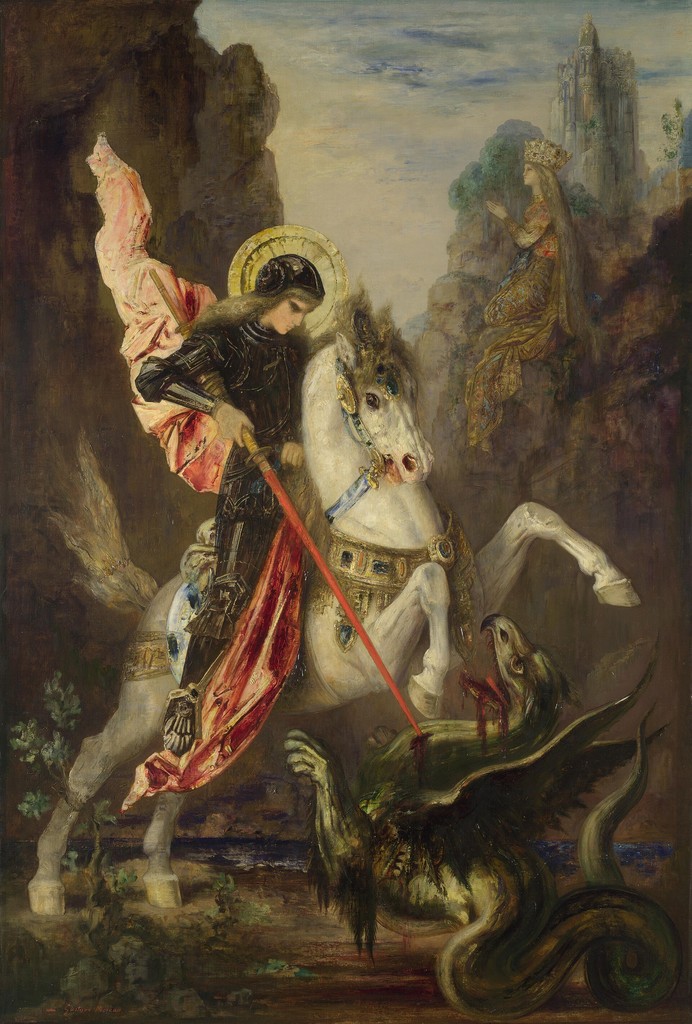
Gustave Moreau’s Saint George and the Dragon compresses rescue, combat and prayer into one upright image. In the picture, a pale horse surges above a coiling dragon as the young saint drives a red lance downwards. High on the rocks, the threatened princess watches with joined hands; behind her, a slender castle rises into the sky. The subject is medieval legend, but the painting’s visual ancestry ranges across Renaissance art, Byzantine icons, Late Gothic detail, and Indian and Persian miniatures. Moreau developed the design over roughly two decades before completing this 1889–90 commission.
At a Glance
- ArtistGustave Moreau
- Date1889–90
- MediumOil on canvas
- Dimensions141 × 96.5 cm
- CollectionNational Gallery, London; inventory NG6436
- DevelopmentRelated to a circa-1869 watercolour, a possible circa-1870 studio plan, X-ray evidence and five surviving preparatory drawings
Gustave Moreau in context
Orpheus
1865The Apparition
1876Galatea
c. 1880Saint George and the Dragon
1889–90Jupiter and Semele
1894–95Contents
- Introduction
- The Exact National Gallery Painting
- The White Horse and Youthful Saint
- Lance, Dragon and the Held Moment
- The Princess, Castle and Craggy World
- The Legend and Moreau’s Choice
- Raphael, Carpaccio and Italian Memory
- Byzantine Icons, Late Gothic Detail and Miniatures
- Flattened Space and a Heraldic Design
- A Design Developed over Two Decades
The Exact National Gallery Painting
The National Gallery records Saint George and the Dragon as a signed oil on canvas measuring 141 by 96.5 centimetres. Its inventory number is NG6436. Louis Mante commissioned the work in 1889, and Moreau completed it in 1890; the Gallery therefore gives the date as 1889–90.[1] This identity separates the London canvas from earlier watercolours and drawings that preserve stages of the design.
Moreau made the painting late in his career, after election to the Académie des Beaux-Arts but before he began teaching at the École des Beaux-Arts in 1892.[2] It nonetheless carries decisions rooted in his Italian journey of 1857–59 and perhaps in planning from around 1870. Calling it simply a late invention would miss that long memory. Calling it merely an enlarged early idea would overlook what changed when a private buyer commissioned the final oil.
The White Horse and Youthful Saint
On visual inspection, the horse is the painting’s largest area of light. Its body rises diagonally from lower left towards upper right, and one front leg lifts sharply above the dragon. The other bends close to the creature’s head. Moreau does not show a rider charging from a distance; horse, saint and monster are compressed into a narrow foreground where their bodies overlap.
The white horse is richly equipped. A broad ornamental band crosses its chest, jewelled blue and red fittings punctuate the bridle, and a circular ornament lies near the base of the neck. These trappings slow the reading of an animal in motion. Their controlled pattern makes the horse ceremonial as well as forceful. The eye alternates between the raised leg, alert face and measured bands of decoration.
Saint George leans slightly forward in dark armour. Long brown hair falls beside his face, while a gold disc sits behind his head. The National Gallery draws attention to his slender, youthful and androgynous appearance, which differs from the image of a heavily mature warrior.[1] In the picture, the bowed head and calm profile reduce any sense of rage. His pose suggests concentration: one hand manages the reins while the other directs the lance.
A pale rose cloak billows behind the saint and descends in a red-lined fold beside the horse. Visually, that fabric prevents the black armour from disappearing into the shadowed cliff. It also echoes the long downward stroke of the weapon. Moreau balances several opposed qualities—dark metal and soft cloth, a rearing animal and a composed rider, bodily action and a halo associated with sanctity.
Lance, Dragon and the Held Moment
Visually, the red lance cuts the composition on a steep diagonal. Its tip reaches the dragon at the open mouth, where red marks make the wound visible. The dragon’s upper body twists back below the horse, one claw lifted, while a long green tail coils across the lower right corner. Wings and a dark, bristling torso enlarge the creature without giving it the same vertical command as the rider.
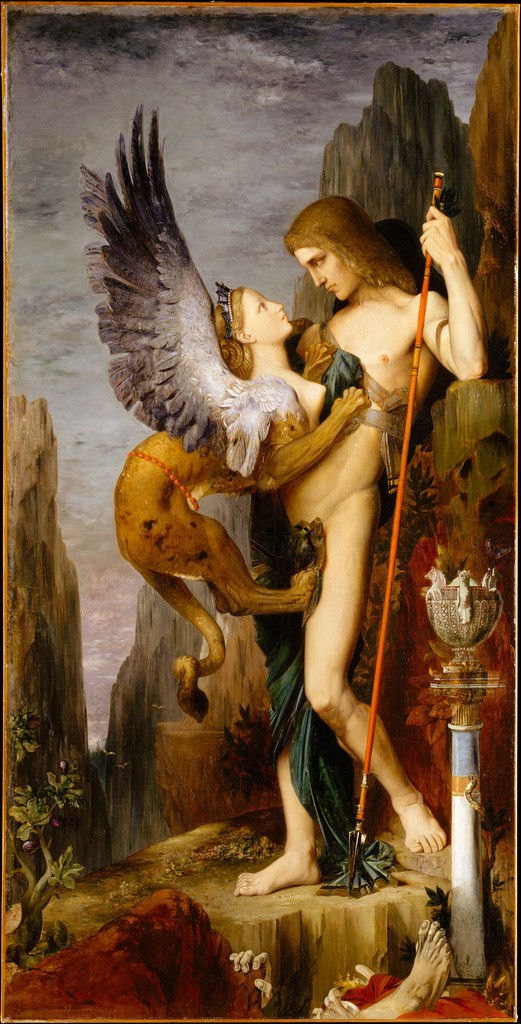
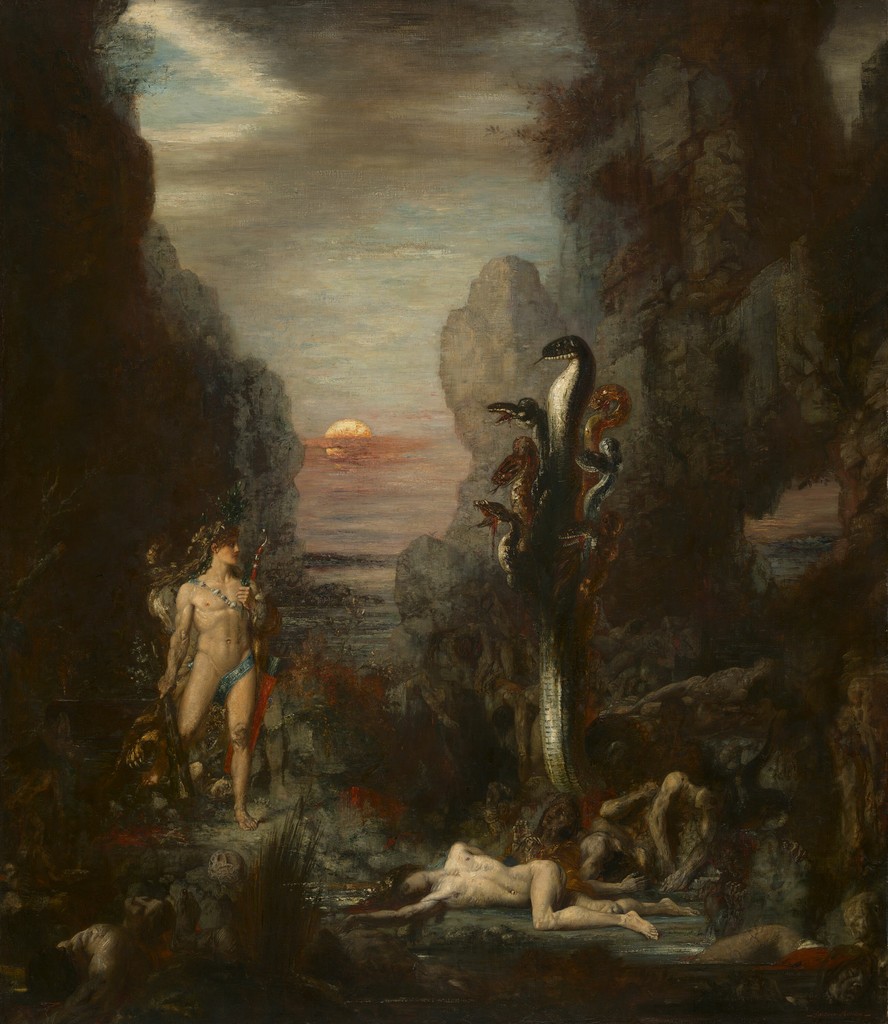
This is not a wide battlefield. The adversaries have almost no room between them. On visual evidence, the horse’s raised foreleg, the lance and the dragon’s lifted claw form a tight knot of possible movement. Yet the image feels suspended. The lance has struck, but neither creature has fallen; the saint remains poised rather than visibly straining. Like the confrontations in Oedipus and the Sphinx and Hercules and the Lernaean Hydra, the decisive interval becomes more important than a sequence of blows.
The monster is materially close to the lower edge and colouristically close to the earth. Its greens, browns and blacks blend with plants, rock and water. By contrast, horse, cloak and halo establish the saint’s brighter zone. This contrast makes an interpretation of elevation and baseness visually plausible, but it does not by itself prove an allegory. The stronger symbolic proposal belongs to the National Gallery and should be identified as such.
The Princess, Castle and Craggy World
In the image, the princess appears above the combat on the right, much smaller than saint or horse. She kneels or sits on a high rock, her hands together in prayer. A jewel-like crown and patterned robe distinguish her from the darker land. She does not flee, and George does not look towards her. Their separation keeps rescue from becoming a romantic meeting.
Behind the princess stands a narrow domed castle, placed against the sky as though it grows from the mountain. The National Gallery uses the historical description “‘Moorish’ castle” and compares the patterned cloak to a Middle Eastern carpet.[1] Those are specific observations in the museum’s source account, not grounds for treating the setting as an accurate view of one place.
Tall crags close the scene on both sides. The left mass is dark and abrupt; the rocks behind the princess recede through blue-green and brown. The Gallery relates these imaginary formations to Leonardo da Vinci, particularly The Virgin of the Rocks.[1] Moreau’s landscape functions less as navigable terrain than as a vertical frame. Its gaps reveal the sky, but its walls press saint, horse, dragon and princess into a compact emblem.
The Legend and Moreau’s Choice
In the familiar Christian legend, a dragon demands human sacrifices from a community. When a princess is selected as the next victim, Saint George kills the creature and saves her.[1] The story offers several moments a painter might choose: the condemned woman approaching the monster, the saint arriving, the physical struggle, the killing stroke, or the rescued community after victory.
Moreau chose the combat while the princess prays above it. The saint is already engaged, but the outcome has not been fully shown. That decision lets rescue and spiritual intercession occur simultaneously. The crown identifies the threatened woman’s status, the halo identifies the warrior as a saint, and the dragon supplies the legend’s danger. A viewer can read the episode without a crowded narrative sequence.
The composition also moves beyond literal storytelling. Moreau was committed to religious and mythological subjects at a time when Naturalism had become increasingly prominent in French art.[2] Here a legendary deed becomes an opposition between still concentration and animal violence. That transformation is visual before it is doctrinal: outline, height, colour and spacing make the saint’s action look like disciplined purpose rather than uncontrolled aggression.
Raphael, Carpaccio and Italian Memory
The National Gallery identifies a small Saint George by Raphael in the Louvre as a compositional source. Raphael’s example contributed the white horse and the armoured rider with helmet and flying cape.[1] Moreau did not copy the earlier painting as a complete arrangement. He enlarged the vertical format, altered the relationship between horse and monster, moved the princess to a high ledge and surrounded the combat with an imagined landscape.
Vittore Carpaccio supplied another kind of precedent. During his stay in Venice, Moreau closely studied and copied Carpaccio’s narrative paintings in the Scuola di San Giorgio degli Schiavoni, including the cycle devoted to Saint George.[3][4] Those works offered an extended account of the legend rather than Raphael’s compact mounted figure. Moreau could therefore draw upon both a single iconic encounter and a larger tradition of storytelling.
The Italian trip was an organised programme of copying, figure study and comparison, not a brief tour. Moreau examined Renaissance and pre-Renaissance art as well as ancient material, building a working archive for later use.[3] Saint George and the Dragon shows how long such study could remain active. More than thirty years after Venice, Carpaccio still mattered to a newly commissioned oil.
This does not make the painting a pastiche. Moreau’s art repeatedly combined recognisable models until their former functions changed. The Musée Gustave Moreau describes his practice as bringing diverse references into highly individual creations and notes how drawings, prints, photographs and museum study fed that process.[3] The London painting makes the principle unusually traceable because the National Gallery names several of its visual lineages.
Byzantine Icons, Late Gothic Detail and Miniatures
The painting’s gold halo, firm contour and reduced perspectival depth connect it to Byzantine, or Eastern Christian, icon painting in the National Gallery’s account. Icons frequently represent Saint George defeating the dragon, so the association reinforces both his sanctity and the recognisability of the subject.[1] The image is not itself a Byzantine icon. It adapts features of that tradition within a nineteenth-century oil made for a French collector.
The Gallery also relates the horse’s ornamental equipment, George’s halo and the princess’s crown to the detailed Late Gothic painting of Carlo Crivelli. That evidence helps explain why decoration is not confined to a backdrop. Jewels and metalwork distinguish the sacred actors and give small accents structural weight.
Indian and Persian miniatures form another documented part of Moreau’s visual field. The National Gallery connects the princess’s patterned clothing and the picture’s precious detail to his awareness of those works.[1] The Musée Gustave Moreau records that he consulted Indian and Persian miniature collections in the Bibliothèque Nationale.[3] These should be named as separate traditions, not collapsed into a vague “Eastern” influence or confused with Byzantine art.
The result is an assembly, not a hierarchy in which one source explains everything. Raphael helps clarify the horse and mounted saint; Carpaccio belongs to the legend’s Venetian pictorial history; icon painting contributes outline, halo and spiritual authority; Late Gothic art informs ornament; Indian and Persian miniatures offer further models of patterned precision. Moreau’s symbolism, mythology and religion emerge through the new relationships he creates among them.
Flattened Space and a Heraldic Design
The National Gallery calls the design heraldic and emphasises outline over deep perspective.[1] That description fits the way the principal bodies stack vertically. Dragon, horse, rider, halo, princess and castle rise in successive zones, while the landscape supplies only limited recession. The figures read almost like signs set against rock rather than occupants of a continuous open world.
Flattening strengthens the legend. The lance remains legible from George’s hand to the dragon; the halo forms a complete disc; the horse is immediately white; the princess is isolated high against the crag. Each element declares its role. At the same time, overlapping bodies create enough uncertainty to prevent the design from becoming static decoration. The horse’s legs and the dragon’s coils compete for the lower space.
The Gallery proposes that Moreau’s youthful warrior represents spiritual purity and may be overcoming crude animal appetite as he kills the dragon.[1] This is a useful, explicitly attributed interpretation. The contrast between haloed saint and earthbound monster supports it, as do the rider’s restraint and the creature’s open jaws. But “may” matters. The canvas still represents the rescue legend, and its symbols need not be reduced to a universal contest between spirit and flesh.
A Design Developed over Two Decades
The apparent unity of the finished picture emerged from a long process. A watercolour of the same subject in a private Stuttgart collection dates from about 1869. X-ray images show that the London painting’s early state relates to that sheet. The design may also appear in a plan of Moreau’s studio perhaps drawn around 1870, suggesting that some form of the composition remained present long before the Mante commission.[1]
Five preparatory drawings for the painting survive in the Musée Gustave Moreau.[1] Together with the X-ray and watercolour, they show revision across media rather than a single preliminary sketch mechanically enlarged. The relation is especially important because Moreau often used drawing, tracing and transfer to stabilise compositions while continuing to alter them. The drawings and watercolours guide explains those practices across his career.
Louis Mante’s 1889 commission gave the old idea a defined destination. Moreau completed the oil in 1890 and Mante bought it directly for 9,000 francs. Commission and prior development are not competing explanations. A design preserved from around 1869 could be reworked for a particular patron twenty years later, with the final dimensions, surface and details belonging to the late object.
This timeline also cautions against assigning every feature one date. The basic mounted combat may have deep roots, while the exact crown, trappings, landscape or paint handling could reflect later decisions. X-ray research can establish relationships beneath the visible surface, but it does not turn every revision into a fully dated step. The evidence supports duration and reworking; it does not support a complete year-by-year reconstruction.
Louis Mante and the National Gallery
Mante was a Marseille shipowner and collector. After his direct purchase from Moreau, the painting moved through several private collections. The National Gallery acquired it in 1976 from the London dealer Arthur Tooth and Sons Ltd.[1] Its current collection page lists it in the Main Collection under NG6436 and marks it as not on display. That status can change, so visitors should consult the record before travelling.
The painting’s London home creates a productive comparison with the earlier art that informed it, including Raphael’s work in the Louvre and Carpaccio’s Venetian cycle. It also preserves an unusually well-researched example of Moreau’s late painting practice: an old conception renewed through commission, composite source study and sustained revision.
Researched works directory
This searchable evidence census was assembled from public museum records and a reproducible Wikidata snapshot. It is not a catalogue raisonné, a claim to complete oeuvre coverage, or a substitute for Pierre-Louis Mathieu's printed catalogue, which was not consulted for this directory.
| Name | Date | Medium |
|---|---|---|
| Abstract Study | 1850 | Painting |
| Abstract Study | 1875 | Painting |
| Abstract Study | 1890 | Painting |
| Academic Study of a Man | 1847 | Painting |
| Achilles the Centaur Chiron | 1859 | Painting |
| Andromeda | 1867 | Painting |
| Andromeda | Date unknown | Painting |
| Angels Following the Magi | 1860 | Painting |
| Angels following the Three Magi | 1898 | Painting |
| Angels Throwing Flowers on the Vatican | 1850 | Painting |
| Aphrodite, 1871 | Date unknown | Painting |
| Apollo and Daphne | 1852 | Painting |
| Apollo and The Nine Muses | 1856 | Painting |
| Apollo and the Satyrs | 1850 | Painting |
| Apollo Victorious over Python | 1885 | Painting |
| Apollon and Marsyas | 1858 | Painting |
| Ariadne and Theseus | 1875 | Painting |
| Arion | 1891 | Painting |
| Athenians being Delivered to the Minotaur in the Cretan Labyrinth | 1855 | Painting |
| Autumn | 1885 | Painting |
| Bacchanal | 1850 | Painting |
| Bacchus on the Panther -cart. | Date unknown | Painting |
| Bathsheba | 1875 | Painting |
| Beheading of John the Baptist | 1872 | Painting |
| Bertrand and Raton | 1879 | Painting |
| Binding of Isaac | 1850 | Painting |
| Birth of Venus | 1870 | Painting |
| Briseis Departure | 1859 | Painting |
| centaur | Date unknown | Painting |
| Centaurs | 1850 | Painting |
| Chimera | 1850 | Painting |
| Chimeras | 1875 | Painting |
| Christ and the Two Thieves | 1870 | Painting |
| Christ at Gethsemane | 1850 | Painting |
| Christ at Gethsemane | 1875 | Painting |
| Christ at Lake Tiberias | 1850 | Painting |
| Christ at the Column | 1850 | Painting |
| Christ Blessing Hist Mother | 1850 | Painting |
| Christ Reliever | 1850 | Painting |
| Circe | 1850 | Painting |
| Cleopatra | 1850 | Painting |
| Cleopatra | 1887 | Painting |
| Danaé | 1858 | Painting |
| Darius, Fleeing after the battle of Arbela, Stops, Exhausted, to Drink from a Pond | 1853 | Painting |
| Darius Flight | 1850 | Painting |
| Dead Orpheus | 1850 | Painting |
| Dead Orpheus | 1890 | Painting |
| Dead Poet Carried by a Centaur | 1890 | Painting |
| Death Giving Laurels to the Winner of the Tournament | 1859 | Painting |
| Death of a Young Crusader | 1870 | Painting |
| Death of Moses | 1850 | Painting |
| Death of Sapho | 1850 | Painting |
| Death of Sapho | 1872 | Painting |
| Debauchery | 1850 | Painting |
| Dejanira (Autumn) | 1872 | Painting |
| Delilah | 1850 | Painting |
| Delilah | 1890 | Painting |
| Delilah | 1896 | Painting |
| Descent from the Cross | 1850 | Painting |
| Diana bathing | 1900 | Painting |
| Diomede devoured by his horses | 1865 | Painting |
| Diomedes Devoured by His Horses | 1865 | Painting |
| Diomedes Devoured by His Own Horses | 1870 | Painting |
| Œdipus the Wayfarer | 1888 | Painting |
| Draft for Sapho | 1850 | Painting |
| Eleonora Gonzaga, Duchess of Urbino | 1858 | Painting |
| Endymion | 1850 | Painting |
| Erigone | 1865 | Painting |
| Eve | 1850 | Painting |
| Eve | 1875 | Painting |
| Fairy in a Cave | 1850 | Painting |
| Fairy with Griffins | 1870 | Painting |
| Fairy with Griffins | 1876 | Painting |
| Fée aux griffons | 1876 | Drawing |
| Femme et licorne | 1890 | Painting |
| Francesco Maria della Rovere, Duke of Urbino | 1858 | Painting |
| Françoise de Rimini | 1850 | Painting |
| Galatea | c. 1880 | Painting |
| Galathea | 1896 | Painting |
| Galathea | Date unknown | Painting |
| Ganymede | 1886 | Painting |
| Gardian Angel of the City | 1850 | Painting |
| Genius of Evil | 1850 | Painting |
| Genius of Evil | 1875 | Painting |
| Golgotha | 1870 | Painting |
| Hamlet | 1850 | Painting |
| Hamlet Giving Poison to the King | 1850 | Painting |
| Helen | 1850 | Painting |
| Helen | 1880 | Painting |
| Helen at the Scaean Gate | 1888 | Painting |
| Helen Glorified | 1893 | Painting |
| Helen on the Walls of Troy | 1850 | Painting |
| Helen on the Walls of Troy | 1875 | Painting |
| Helene | Date unknown | Painting |
| Hercule et les oiseaux du lac de Stymphale | Date unknown | Painting |
| Hercules and Omphale | 1856 | Painting |
| Hercules and the Ceryneian Hind | 1871 | Painting |
| Hercules and the Daughters of Thespius | 1850 | Painting |
| Hercules and the Lernaean Hydra | 1875–1876 | Painting |
| Hercules and the Nemean Lion | 1850 | Painting |
| Hercules and the Stymphalian Birds | 1872 | Painting |
| Hercules and Thespius Daughters | 1850 | Painting |
| Hercules at Lake Stymphalia | 1875 | Painting |
| Hercules between Vice and Virtue | 1850 | Painting |
| Hesiod and the Muse | 1870 | Painting |
| Hesiod and the Muse | 1875 | Painting |
| Hesiod and the Muse | 1891 | Painting |
| Hesiod and the Muses | 1860 | Painting |
| Hesiod and the Muses | 1882 | Painting |
| Hésiode enfant | 1860 | Painting |
| Horse Rider | 1854 | Painting |
| Horse Rider | 1870 | Painting |
| Horse Rider and Amazon | 1869 | Painting |
| Horse Riders and Horses | 1854 | Painting |
| Indian Women Poets | 1890 | Painting |
| Interior, Draft | 1850 | Painting |
| Jacob and the Angel | 1876 | Painting |
| Jacob and the Angel | 1878 | Painting |
| Jacob et l'Ange | 1878 | Painting |
| Jason | 1865 | Painting |
| Jason et Éros | 1891 | Painting |
| Judith | 1850 | Painting |
| Jupiter and Semele | 1889–1895 | Painting |
| King Canute and His Courtesans | 1850 | Painting |
| King David | 1878 | Painting |
| L'enlèvement d'Europe | 1872 | Painting |
| La Fée | Date unknown | Painting |
| La mort de Sapho | 1872 | Painting |
| La mort de Sapho | 1876 | Painting |
| La Villa Borghèse | Date unknown | Painting |
| Landscape | 1850 | Painting |
| Landscape, Draft | 1850 | Painting |
| Landscape (Neighborhood of Étampes) | 1850 | Painting |
| Le Bon Samaritain | 1865 | Painting |
| Le Cantique des cantiques | 1853 | Painting |
| Le Christ et Madeleine (Noli me Tangere) | 1889 | Painting |
| Le Grand Pan contemple les Sphères Célestes | 1897 | Drawing |
| Le Poète et la Sirène | 1893 | Painting |
| Le Soir | 1887 | Painting |
| Le Sphinx | 1886 | Painting |
| Leda | 1846 | Painting |
| Leda | 1850 | Painting |
| Leda | 1870 | Painting |
| Les Chimères | 1884 | Painting |
| Les Plaintes du poète | 1882 | Painting |
| Life of Humanity | 1875 | Painting |
| Life of Humanity | 1886 | Painting |
| Life of Humanity: Salvator Mundi | 1886 | Painting |
| Life of Humanity: The Golden Age, Adam - Evening - Sleep | 1879 | Painting |
| Life of Humanity: The Golden Age, Adam - Morning - Prayer | 1879 | Painting |
| Life of Humanity: The Golden Age, Adam - Noon - Extasy | 1879 | Painting |
| Life of Humanity: The Iron Age, Cain - Evening - Death | 1879 | Painting |
| Life of Humanity: The Iron Age, Cain - Morning - Work | 1879 | Painting |
| Life of Humanity: The Iron Age, Cain - Noon - Rest | 1879 | Painting |
| Life of Humanity: The Silver Age, Hesiod and Orpheus, Hesiod - Evening - Tears | 1879 | Painting |
| Life of Humanity: The Silver Age, Hesiod and Orpheus, Hesiod - Morning - Inspiration | 1879 | Painting |
| Life of Humanity: The Silver Age, Hesiod and Orpheus, Orpheus - Noon - Song | 1879 | Painting |
| Love Victorious over Death | 1850 | Painting |
| Lucretia and Tarquin | 1850 | Painting |
| Magdalene on Golgotha | 1850 | Painting |
| Magdalene on Golgotha | 1875 | Painting |
| Magdalene on Golgotha | 1880 | Painting |
| Magnolia | 1864 | Painting |
| Martyrdrom | 1850 | Painting |
| Messalina | 1850 | Painting |
| Messalina | 1874 | Painting |
| Messaline | 1874 | Painting |
| Mort de Sapho | 1900 | Painting |
| Moses Exposed | 1875 | Painting |
| Moses Exposed on the Nile | 1875 | Painting |
| Moses, in Sight of the Promised Land, Takes His Sandals Off | 1854 | Painting |
| Moses Rescued from the Nile | 1893 | Painting |
| Mystic Flower | 1890 | Painting |
| Narcissus | 1850 | Painting |
| Narcissus | 1885 | Painting |
| Narcissus | 1890 | Painting |
| Noces d’Alexandre et de Roxane | Date unknown | Drawing |
| Nude Study | 1850 | Painting |
| Nyx, Night Goddess | 1880 | Painting |
| Oedipus and the Sphinx | 1864 | Painting |
| Orestes | 1850 | Painting |
| Orestes | 1875 | Painting |
| Orestes and the Erinyes | 1875 | Painting |
| Orphés | 1865 | Painting |
| Orpheus | 1865 | Painting |
| Orpheus Head | 1850 | Painting |
| Orpheus on Eurydice's Tomb | 1890 | Painting |
| Pasiphaë | 1850 | Painting |
| Pasiphaë | 1880 | Painting |
| Pasiphaë, Grisaille | 1850 | Painting |
| Pauline Moreau as the Virgin | 1848 | Painting |
| Perseus and Andromeda | 1870 | Painting |
| Persian Poet | 1875 | Painting |
| Petrarch After the Triumph | 1850 | Painting |
| Phaéton | 1878 | Painting |
| Phoebus and Boreas | 1879 | Painting |
| Pietà | 1867 | Painting |
| Pietà | 1875 | Painting |
| Pietà | 1876 | Painting |
| Pietà | Date unknown | Painting |
| Pittacus the Tyrant in War Costume | 1883 | Drawing |
| Polyphemus | 1880 | Painting |
| Poney | 1870 | Painting |
| Portrait of Gustave Moreau by Himself | 1850 | Painting |
| Portrait of Gustave Moreau by Himself | 1890 | Painting |
| Postman and Horses | 1854 | Painting |
| Prometheus | 1868 | Painting |
| Prometheus | 1869 | Painting |
| Prometheus Thunderstruck | 1870 | Painting |
| Prometheus, Variant | 1870 | Painting |
| Rape of Deianira | 1850 | Painting |
| Rape of Deianira | 1872 | Painting |
| Return of the Argonauts | 1890 | Painting |
| Ruines de Rome : le Colisée vu des jardins de l'Angélicum des dominicains | 1858 | Painting |
| Saint Cecilia and the Angels of Music | 1850 | Painting |
| Saint Francis Kissing a Leper | 1850 | Painting |
| Saint George and the Dragon | 1889–1890 | Painting |
| Saint Jerome | 1850 | Painting |
| Saint Sebastian | 1850 | Painting |
| Saint Sebastian | 1870 | Painting |
| Saint Sebastian and the Angel | 1876 | Painting |
| Saint Sebastian and the Angels | 1850 | Painting |
| Saint Sebastian Succoured | 1885 | Painting |
| Saint Sebastian with Archers | 1875 | Painting |
| Saint-Sébastien et l'ange | 1876 | Painting |
| Saint Sébastien soigné par les saintes femmes | 1869 | Painting |
| Sainte Cecilia | 1850 | Painting |
| Salome | 1850 | Painting |
| Salome | 1872 | Painting |
| Salome | 1874 | Painting |
| Salome at the Prison | 1873 | Painting |
| Salomé au Jardin | 1878 | Painting |
| Salome Dancing | 1872 | Painting |
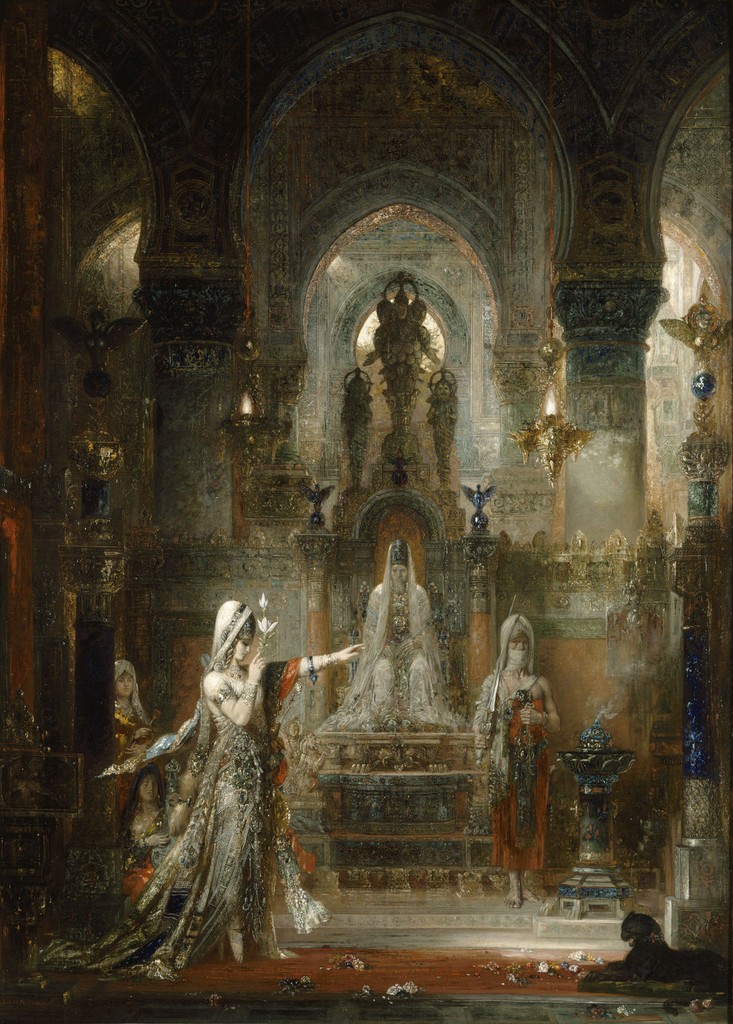
| Salomé Dancing Before Herod | 1876 | Painting |
| Salome Dancing in front of Herod | 1876 | Painting |
| Salome with the Head of John the Baptist | 1876 | Painting |
| Santa Cecilia (Moreau) | Date unknown | Painting |
| Sappho falling into the Abyss | 1867 | Painting |
| Semele | 1889 | Painting |
| Semele, Draft | 1889 | Painting |
| Singing Centaurs | 1850 | Painting |
| Slaves Thrown to the Morays | 1850 | Painting |
| Song of Songs (Cantique des Cantiques) | 1893 | Painting |
| Spanish Conversation | 1850 | Painting |
| Spring | 1850 | Painting |
| St. Sebastian | Date unknown | Painting |
| Study | 1850 | Painting |
| Study | 1874 | Painting |
| Study | 1875 | Painting |
| Study for Jupiter and Semele | 1889 | Painting |
| Study for Moses Taking Off His Sandals | 1854 | Painting |
| Study for Saint Cecilia | 1850 | Painting |
| Study for Salome | 1874 | Painting |
| Study for The Triumph of Alexander the Great | 1885 | Painting |
| Study from Nature | 1850 | Painting |
| Study of a red ibis | 1900 | Painting |
| Sultan | 1850 | Painting |
| Suzanne et les vieillards | 1895 | Painting |
| swinging girl | Date unknown | Painting |
| Tea Rose | 1850 | Painting |
| Temptation | 1890 | Painting |
| Tempting Demon | 1875 | Painting |
| The Angels of Sodome | 1872 | Painting |
| The Apparition | 1876 | Drawing |
| The Argonauts | 1885 | Painting |
| The Bad Rich | 1850 | Painting |
| The calvary | 1867 | Painting |
| The childhood of Sixtus V. | 1853 | Painting |
| The Chimera | 1867 | Painting |
| The chimera | Date unknown | Painting |
| The Chimeras | 1850 | Painting |
| The Crowning with Thorns | 1846 | Painting |
| The Daughters of Thespius | 1853 | Painting |
| The Dead Lyres | 1897 | Painting |
| The Decameron | 1850 | Painting |
| The Disciples in Emmaus | 1850 | Painting |
| The Dream Haunting the Mogul | 1881 | Painting |
| The Entombment | 1867 | Painting |
| The Good Samaritan | 1850 | Painting |
| The Infant Moses | 1877 | Painting |
| The Magi | 1860 | Painting |
| The Martyred Saint Sebastian | 1869 | Painting |
| The Mermaid and the Poet | 1895 | Painting |
| The Muses Leaving Their Father Apollo to Go and Light the World | 1868 | Painting |
| The Parca and the Angel of Death | 1890 | Painting |
| The Parcae | 1850 | Painting |
| The Pieridae | 1875 | Painting |
| The Pieridae | 1880 | Painting |
| The Pietà | 1867 | Painting |
| The Plague in Florence | 1870 | Painting |
| The Poet and the Siren | 1894 | Painting |
| The Prodigal Son | 1850 | Painting |
| The Prodigal Son | 1890 | Painting |
| The Rape of Europe | 1868 | Painting |
| The Rape of Europe | 1869 | Painting |
| The Shulamite | 1853 | Painting |
| The Sirens | 1850 | Painting |
| The Sirens | 1875 | Painting |
| The Sirens | 1882 | Painting |
| The Springs | 1856 | Painting |
| The Suitors | 1862 | Painting |
| The Toilette | 1887 | Painting |
| The Travelling Angels | 1875 | Painting |
| The Travelling Poet | 1890 | Painting |
| The Unicorn | 1885 | Painting |
| The Unicorns | 1888 | Painting |
| The Voices | 1867 | Painting |
| The Wandering Jew | 1870 | Painting |
| The Young Man and Death | 1856–1865 | Painting |
| Tomyris and Cyrus | 1850 | Painting |
| Triumph of Alexander the Great | 1873 | Painting |
| Triumphing Church | 1870 | Painting |
| Tyrtaeus | 1850 | Painting |
| Tyrtaeus Singing While Fighting | 1860 | Painting |
| Un Saint au désert | 1879 | Painting |
| Untitled | 1866 | Painting |
| Venice | 1850 | Painting |
| Venice | 1885 | Painting |
| Venus Rising from the Sea | 1866 | Painting |
| Victim | 1850 | Painting |
| Vue de Florence | 1858 | Painting |
| Walk in a Park | 1865 | Painting |
| Water Fairy | 1850 | Painting |
| Womand and Chimera | 1875 | Painting |
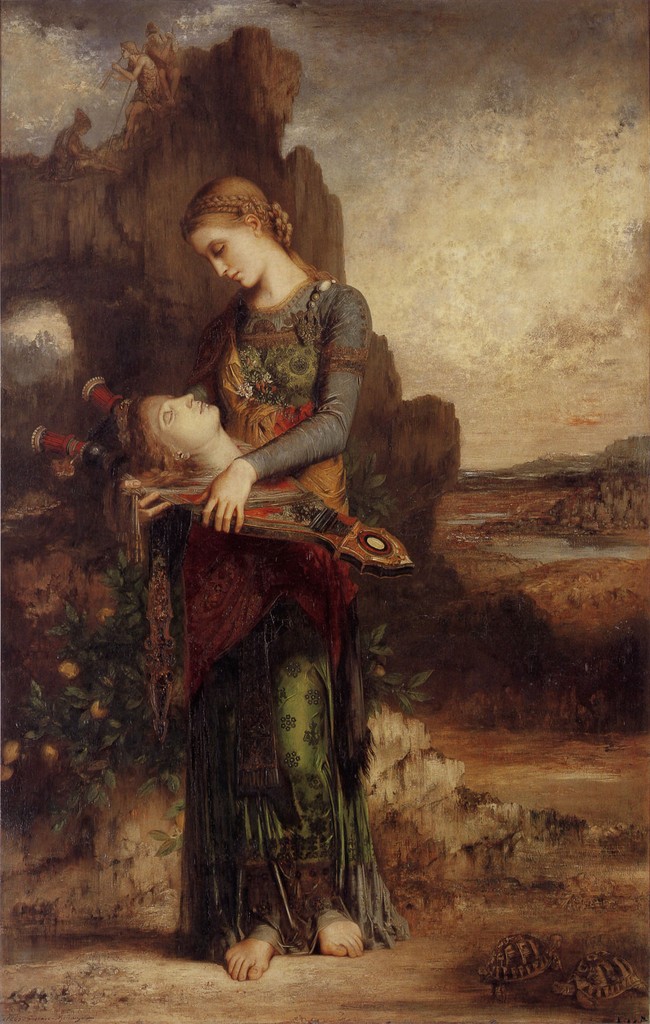
| Young Thracian Woman Holding Orpheus' Head | 1866 | Painting |
Frequently Asked Questions
The National Gallery dates the finished oil to 1889–90. Louis Mante commissioned it in 1889 and Moreau completed it in 1890. The underlying design is much older, however: it relates to a circa-1869 watercolour and may appear in a studio plan made around 1870.[1]
Saint George confronts a dragon that demands human victims, rescuing a princess selected for sacrifice. Moreau shows the saint striking the monster while the princess prays from a high rock. The combat is underway, but the picture suspends the story before its aftermath.[1]
The National Gallery identifies Raphael’s mounted Saint George, Carpaccio’s Venetian cycle, Byzantine icon painting, Carlo Crivelli’s Late Gothic detail, and Moreau’s knowledge of Indian and Persian miniatures. It also compares the craggy landscape with Leonardo. Each source contributes particular possibilities; none provides a complete template.[1]
It first depicts the Christian rescue legend. The National Gallery further suggests that Moreau’s youthful saint embodies spiritual purity and may be vanquishing crude animal appetite in the dragon. The halo, calm rider and dark earthbound creature support that reading, but it remains an attributed interpretation rather than a fixed code.[1]
It belongs to the National Gallery in London, inventory NG6436. The current object record says it is not on display. Check the Gallery’s page before a visit because display and loan status may change.[1]
Discussion
Use this evidence-led guide as a starting point for close looking rather than a final verdict.
Share an observation about Saint George and the Dragon or a source that adds useful context.
Reader Insights
Which detail most changes your reading of Saint George and the Dragon?
How do scale, support, medium or present museum evidence shape the encounter?
What remains uncertain when visual inference is separated from documented fact?
Join the Conversation
Add your reading below, keeping observations specific and evidence clear.
References
- National Gallery, London, “Saint George and the Dragon.”, accessed 30 August 2026.
- National Gallery, London, “Gustave Moreau (1826–1898).”, accessed 30 August 2026.
- Musée Gustave Moreau, “The Art of Gustave Moreau.”, accessed 30 August 2026.
- Musée Gustave Moreau, “Gustave Moreau in Italy.”, accessed 30 August 2026.