 by Tom Gurney
Tom Gurney BSc (Hons) is an art history expert with over 20 years experience
Page Created: 30 August 2026 / Page Updated: November 6, 2026
Email: tomgurney1@gmail.com / Phone: +44 7429 011000
The Apparition: Introduction
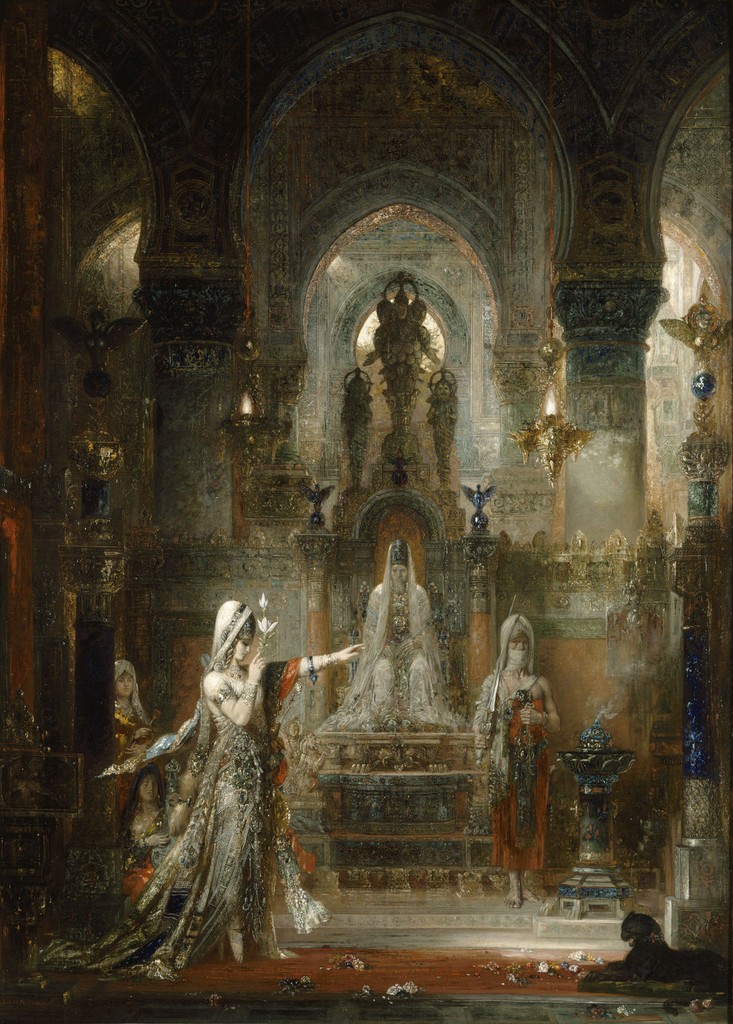
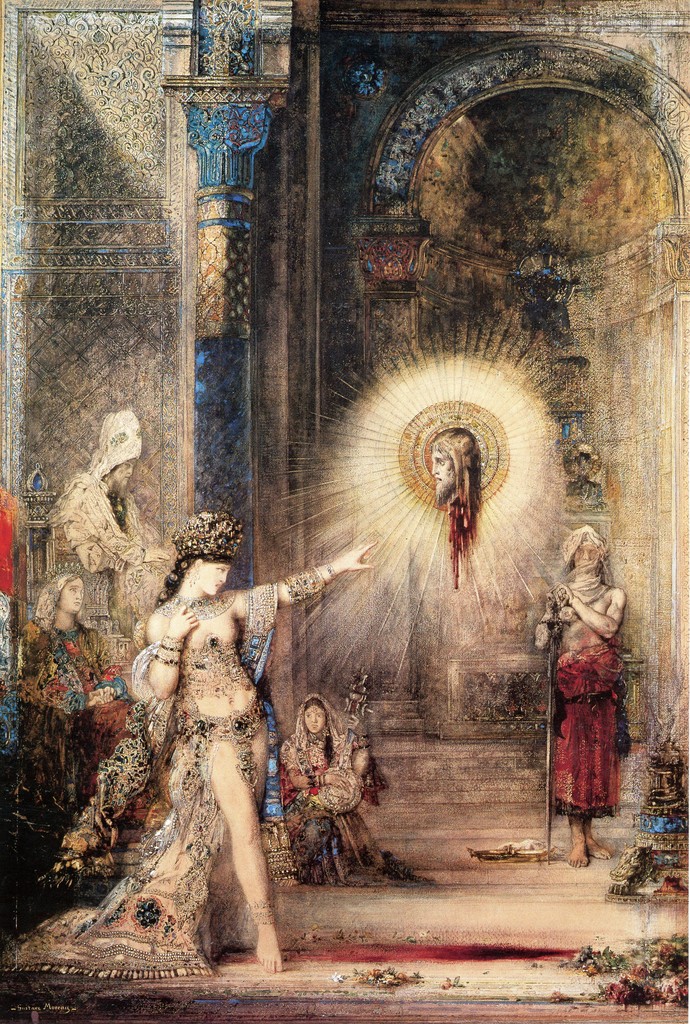
Gustave Moreau’s The Apparition confronts Salomé with the severed head of John the Baptist, floating at her eye level inside a dark, elaborately patterned hall. Blood falls from the neck, yet the head is ringed with light. Salomé points towards it while the court recedes around their encounter. The 1876 watercolour does not merely illustrate the biblical reward delivered on a platter: it invents a vision whose time, reality and ownership remain uncertain. Is Salomé seeing an external marvel, anticipating the killing, or remembering what has already happened?
At a Glance
- ArtistGustave Moreau
- TitleL’Apparition (The Apparition), RF 2130, Recto
- Date1876; exhibited at the Paris Salon that year
- MediumWatercolour
- Dimensions106 × 72.2 cm
- Collection and custodyMusée d’Orsay is responsible for the work; it is kept in the Louvre’s Department of Graphic Arts
Gustave Moreau in context
Orpheus
1865The Apparition
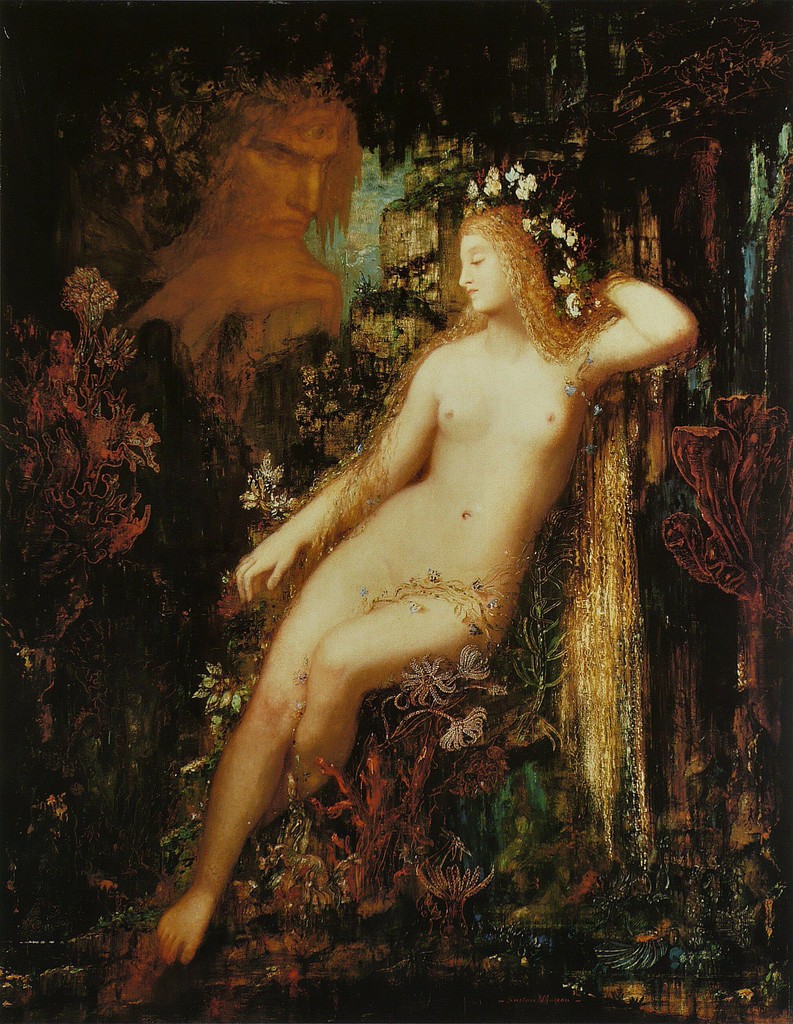
1876Galatea
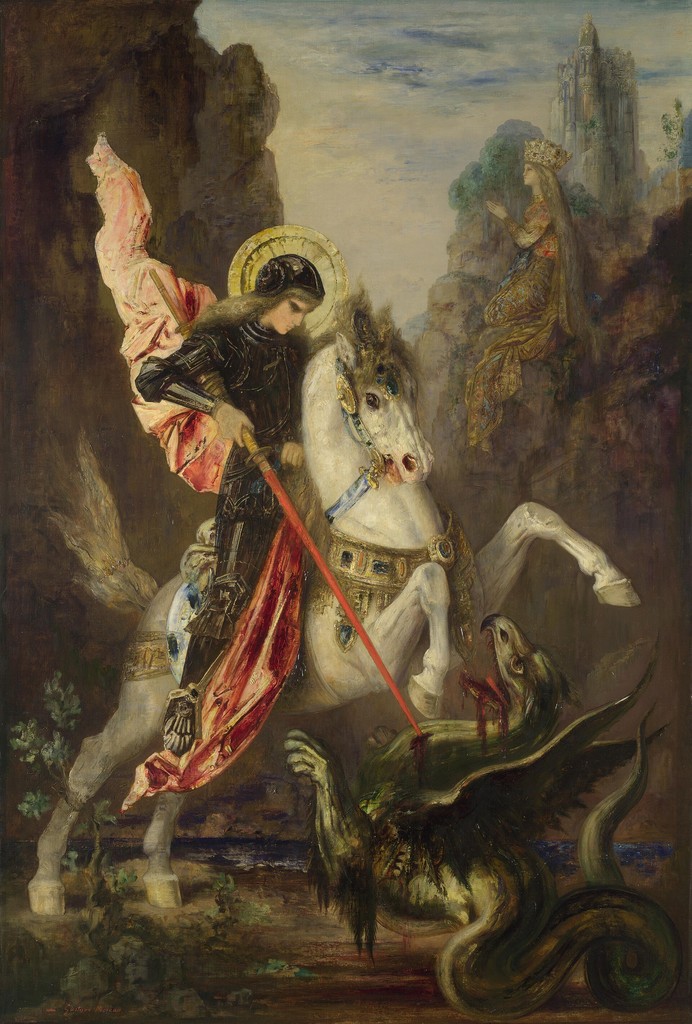
c. 1880Saint George and the Dragon
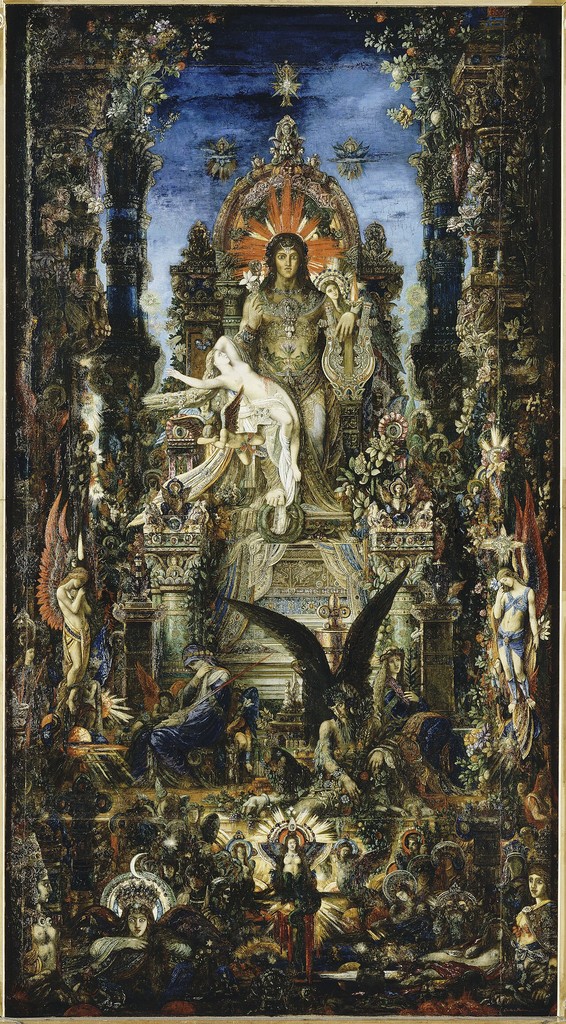
1889–90Jupiter and Semele
1894–95Contents
- Introduction
- Identifying RF 2130
- A Pointing Hand and a Suspended Head
- Matthew’s Banquet and Moreau’s New Event
- Agency Is Distributed, Not Solved
- Watercolour Made Monumental
- The Salon, a Sale and Charles Hayem
- Huysmans and the Image’s Literary Afterlife
- A Version Map: Five Objects, Not One
- Why Orsay and the Louvre Both Name the Work
Identifying RF 2130
The object discussed on this page is the tall watercolour registered as RF 2130, Recto. The Musée d’Orsay gives its date as 1876 and its dimensions as 106 by 72.2 centimetres. Moreau signed it in gold at the lower left. The museum’s present record names the Musée d’Orsay as the responsible institution and the Louvre’s Department of Graphic Arts as the place where it is kept.[1]
The Louvre catalogue independently records the same title, inventory number, year, medium and measurements. It also identifies Marie Gay as the model for Salomé.[2] These identifiers matter because Moreau developed several images around Salomé and John the Baptist. RF 2130 is neither an oil painting nor a generic composite assembled from those alternatives. Its facts must remain attached to this particular watercolour.
An exact public-domain reproduction corresponds to the Orsay object and inventory history.[3] It permits detailed visual study, although a screen cannot convey the physical presence of a sheet more than a metre high. The following account labels what is visibly present before proposing what those forms might mean.
A Pointing Hand and a Suspended Head
On visual inspection of RF 2130, Salomé occupies the lower-left foreground. Her body rises in profile, loaded with jewellery, linear ornaments and light fabric. One arm bends back towards her torso. The other reaches firmly across the composition, ending in a pointing hand. That horizontal gesture establishes the first route through the image: from the living dancer on the left towards the disembodied face above and to the right.
John’s head hangs without a visible support. A broad disc and radiating lines surround it, turning the severed face into the brightest concentration in the hall. Thin red trails descend from the neck. The conjunction is deliberately disturbing: bodily evidence of execution appears within a form associated with sacred radiance. The head is dead, but its open, frontal presence seems more commanding than the bodies around it. “Levitating” describes its appearance, not a claim that the image documents a physical event.
Salomé and the head face one another across a small interval, as though gesture and gaze complete a circuit. Her pointing finger may register shock, accusation, command or recognition. None of those emotions can be read as a documented mental state. What can be observed is the precision with which Moreau aligns an active hand with an unbodied face. The encounter becomes the composition’s axis even though it is displaced from the geometrical centre.
The court remains visible behind this pair. Herod sits in the left background, and Herodias is placed near him. Their shadowed presence makes royal authority part of the scene without allowing either figure to dominate it. At the right, the executioner appears with his sword. He connects the spectral display to material violence: whatever status the apparition has, someone has carried out the killing.
The interior rises above all five figures. Supports, arches, wall patterns and small ornamental details layer the setting rather than define one archaeologically consistent palace. Moreau’s structure resembles a throne room, sanctuary and theatre at once. It would be misleading to collapse its varied decorative vocabulary into a vague geographical label. Here the essential visual fact is how the patterns continue behind Salomé and John, making their stark face-to-face exchange flare inside a densely worked enclosure.
Scale changes the encounter further. At 106 centimetres high, this is not a small private sketch. Its portrait format gives Salomé almost bodily height while leaving a large architectural zone above her. The head therefore seems to occupy real space in front of a viewer, even as its unsupported suspension denies ordinary space. Monumental size and impossible placement pull in opposite directions.
Matthew’s Banquet and Moreau’s New Event
The source story appears in Matthew 14. Herod has imprisoned John because the prophet condemned his marriage to Herodias. At the ruler’s birthday feast, Herodias’s daughter dances and pleases him. Herod swears to grant her request; prompted by her mother, she asks for John’s head on a platter. The distressed king nevertheless gives the order, the executioner beheads John in prison, and the head is brought to the girl, who carries it to her mother. The Musée Gustave Moreau connects The Apparition directly to this chapter.[4]
Matthew does not name the daughter, although later tradition identifies her as Salomé. More importantly, the Gospel does not describe a shining head hovering before her. It provides imprisonment, dance, oath, request, execution and delivery. Moreau’s decisive addition is to convert the consequence into a confrontation. The platter no longer determines the image’s central relationship. Instead, the head occupies the air and seems to address the dancer through its unwavering presence.
That invention also changes narrative sequence. Blood indicates that beheading belongs to the imagined event, but the work supplies no clock. If the head appears after the killing, Salomé may be confronted by its result. If it is an anticipatory vision, the image projects the outcome before the order has been completed. If it is memory, the hall may be less a literal room than a space in which a past deed returns. Moreau lets all three routes remain available.
The guide to Moreau’s symbolism, mythology and religion is useful here because a symbol need not function as a one-word code. Halo, blood, sword and pointing hand set sacred authority, physical death and human action into relation. Their arrangement produces meaning without proving one psychological explanation.
Agency Is Distributed, Not Solved
Later culture often made Salomé the sole engine of John’s death. Matthew’s account is more structurally divided. Herod imprisons John, makes the public oath and orders the execution. Herodias supplies the desired request. Her daughter dances, asks and receives. An executioner performs the act. Moreau retains several participants in the background while isolating Salomé before the head.
That emphasis can encourage a reading of the dancer as powerful: her extended arm answers the vision, and her ornamented figure is the nearest complete body. Yet the same design can make her look exposed. Herod remains enthroned, Herodias is present, the armed agent stands nearby, and John’s face commands the brightest field. Salomé is central to looking without necessarily controlling what she sees.
The distinction guards against a familiar shortcut. Calling Salomé a timeless destructive woman simply repeats a later stereotype and hides the court’s network of decisions. A more productive gender-aware reading asks how spectacle redirects blame. The dancer is displayed for Herod and for the picture’s viewer; after the dance, she becomes the most visible person associated with violence authorised elsewhere. Moreau does not remove her agency, but he makes agency, command and consequence visually separable.
Three broad interpretations can therefore coexist. In a supernatural reading, John manifests as a sacred apparition before those implicated in his death. In a psychological reading, the head externalises anticipation, memory or remorse. In a theatrical reading, the luminous disc and frontal face organise a climactic tableau rather than a literal occurrence. Each explains part of the design. None is certified as the sole account by the object records or by the painted surface.
Watercolour Made Monumental
The current Orsay and Louvre catalogues classify RF 2130 as watercolour.[1][2] That official wording should govern the medium line. In reproduction, brilliant whites, dense colour and small opaque-looking accents can seem gouache-like, while fine contours and translucent passages preserve the mobility associated with watercolour. “Gouache-like” is a description of visible effect, not permission to add gouache, graphite or another material to the museum’s classification.
This distinction matters because the work can easily be discussed as if it were one of Moreau’s oils. Its depth does not depend on canvas impasto. Dark washes, drawn edges, reserved or heightened lights and concentrated details create changes of substance across the sheet. The halo appears to radiate because pale marks press against the surrounding darkness. Jewellery flickers because small accents interrupt larger areas of colour. Blood reads instantly because its narrow red lines remain isolated.
The unusually large format gives those water-based effects public force. Moreau could use works on paper for study, transfer and experiment, but RF 2130 demonstrates that watercolour could also carry a finished Salon statement. The gold signature reinforces that status. Readers can place it within the wider range of the artist’s drawings and watercolours, where preparatory function and autonomous display are kept distinct.
The Salon, a Sale and Charles Hayem
Moreau showed the watercolour at the Paris Salon of 1876. His contribution that year also included Salomé Dancing, Hercules and the Lernaean Hydra and Saint Sebastian, according to the Musée Gustave Moreau’s chronology.[5] The grouping allowed visitors to encounter related biblical imagery across different objects and media; it did not make the dancing oil and the apparition watercolour interchangeable.
The ownership record begins moving almost immediately. Moreau retained RF 2130 until 1876, then sold it to the dealer Léon Gauchez on 31 May for 8,000 francs. Gauchez owned it until 1878. Charles Hayem held it from 1878 and offered it to the French state in 1879. The Orsay record notes formal acceptance of the gift that year and material entry into the Luxembourg museum on 14 May 1898.[1][2]
The sheet subsequently passed through the Musée du Luxembourg and the Musée national d’art moderne before its transfer to the Louvre in 1929. Those movements explain why both donor and state appear early in its history while present catalogue responsibility belongs to Orsay. They also show that the watercolour’s public importance was recognised within a few years of its Salon appearance.
Huysmans and the Image’s Literary Afterlife
Joris-Karl Huysmans gave Moreau’s Salomé images an influential literary reception in his 1884 novel À rebours. The Musée Gustave Moreau notes the novel’s extensive attention to the dancer and The Apparition.[6] Huysmans’s highly charged description helped later readers approach the image through luxury, danger and heightened sensation.
The date sets a useful boundary. His novel appeared eight years after the Salon, so it records reception rather than Moreau’s instructions for decoding the watercolour. It can illuminate how compelling the image became for late nineteenth-century literature, but it cannot settle whether the head is a miracle, a recollection or a projection. The work’s uncertainty existed before the novelist elaborated it.
A Version Map: Five Objects, Not One
Moreau’s return to this narrative rewards comparison only when the objects stay separate.
RF 2130, the active work here, is the 1876 watercolour measuring 106 by 72.2 centimetres. Orsay carries institutional responsibility, and the Louvre’s graphic-arts department keeps it. These are the only identity and custody details that belong in its main record.[1][2]
Musée Gustave Moreau Cat. 222 is an undated oil on canvas measuring 142 by 103 centimetres. The house-museum explicitly says that its painting takes up the iconography of the celebrated watercolour, then describes the haloed, bleeding head, Salomé, the royal pair and executioner.[4] Shared imagery does not make it RF 2130.
The Fogg Museum work is another oil version of The Apparition. It is a distinct, smaller object in the Harvard Art Museums, not an alternative location or medium entry for the Orsay watercolour. Its role in this map is to mark another treatment of the hovering-head composition; its object data should never migrate to RF 2130.
The dancing Salomés choose an earlier narrative phase. The Hammer Museum’s Salomé Dancing Before Herod is the tall 1876 oil in which the dancer performs before the enthroned ruler and John’s head is absent. The Hammer’s focused exhibition also assembled numerous related studies and variants, including the separate canvas usually called the Tattooed Salomé.[7] Those works belong to the dance, not to the active watercolour’s inventory record.
The Metropolitan Museum oil is Salome with the Head of John the Baptist, dated about 1876. It is oil on wood and only 21.6 by 12.1 centimetres. In that small composition Salomé turns away from the luminous, bloodied head, revising the direction of attention that governs RF 2130.[8] Its support, size, pose and New York collection are all comparator facts, not missing data for The Apparition.
This map clarifies Moreau’s method. Repetition did not mean copying a single finished solution. He moved between the dance, request, apparition and aftermath; changed watercolour to oil and large scale to small; and redirected Salomé’s gesture or gaze. The broader guide to Moreau’s paintings traces similar revision across other subjects.
Why Orsay and the Louvre Both Name the Work
The two museum names describe complementary roles. Musée d’Orsay lists RF 2130 within its collection and carries responsibility for it. The physical work is kept by the Louvre’s Department of Graphic Arts, whose catalogue locates it in the framed-works reserve and says it may be viewed by appointment in the department’s consultation room.[1][2] That arrangement is not evidence for two watercolours.
Orsay’s current online notice says the work is not exhibited. Because works on paper are sensitive to light and museum arrangements change, a visitor should consult the live records and contact the graphic-arts study room before travelling. Ownership, curatorial responsibility, storage and public display are related facts, but they are not synonyms.
Researched works directory
This searchable evidence census was assembled from public museum records and a reproducible Wikidata snapshot. It is not a catalogue raisonné, a claim to complete oeuvre coverage, or a substitute for Pierre-Louis Mathieu's printed catalogue, which was not consulted for this directory.
| Name | Date | Medium |
|---|---|---|
| Abstract Study | 1850 | Painting |
| Abstract Study | 1875 | Painting |
| Abstract Study | 1890 | Painting |
| Academic Study of a Man | 1847 | Painting |
| Achilles the Centaur Chiron | 1859 | Painting |
| Andromeda | 1867 | Painting |
| Andromeda | Date unknown | Painting |
| Angels Following the Magi | 1860 | Painting |
| Angels following the Three Magi | 1898 | Painting |
| Angels Throwing Flowers on the Vatican | 1850 | Painting |
| Aphrodite, 1871 | Date unknown | Painting |
| Apollo and Daphne | 1852 | Painting |
| Apollo and The Nine Muses | 1856 | Painting |
| Apollo and the Satyrs | 1850 | Painting |
| Apollo Victorious over Python | 1885 | Painting |
| Apollon and Marsyas | 1858 | Painting |
| Ariadne and Theseus | 1875 | Painting |
| Arion | 1891 | Painting |
| Athenians being Delivered to the Minotaur in the Cretan Labyrinth | 1855 | Painting |
| Autumn | 1885 | Painting |
| Bacchanal | 1850 | Painting |
| Bacchus on the Panther -cart. | Date unknown | Painting |
| Bathsheba | 1875 | Painting |
| Beheading of John the Baptist | 1872 | Painting |
| Bertrand and Raton | 1879 | Painting |
| Binding of Isaac | 1850 | Painting |
| Birth of Venus | 1870 | Painting |
| Briseis Departure | 1859 | Painting |
| centaur | Date unknown | Painting |
| Centaurs | 1850 | Painting |
| Chimera | 1850 | Painting |
| Chimeras | 1875 | Painting |
| Christ and the Two Thieves | 1870 | Painting |
| Christ at Gethsemane | 1850 | Painting |
| Christ at Gethsemane | 1875 | Painting |
| Christ at Lake Tiberias | 1850 | Painting |
| Christ at the Column | 1850 | Painting |
| Christ Blessing Hist Mother | 1850 | Painting |
| Christ Reliever | 1850 | Painting |
| Circe | 1850 | Painting |
| Cleopatra | 1850 | Painting |
| Cleopatra | 1887 | Painting |
| Danaé | 1858 | Painting |
| Darius, Fleeing after the battle of Arbela, Stops, Exhausted, to Drink from a Pond | 1853 | Painting |
| Darius Flight | 1850 | Painting |
| Dead Orpheus | 1850 | Painting |
| Dead Orpheus | 1890 | Painting |
| Dead Poet Carried by a Centaur | 1890 | Painting |
| Death Giving Laurels to the Winner of the Tournament | 1859 | Painting |
| Death of a Young Crusader | 1870 | Painting |
| Death of Moses | 1850 | Painting |
| Death of Sapho | 1850 | Painting |
| Death of Sapho | 1872 | Painting |
| Debauchery | 1850 | Painting |
| Dejanira (Autumn) | 1872 | Painting |
| Delilah | 1850 | Painting |
| Delilah | 1890 | Painting |
| Delilah | 1896 | Painting |
| Descent from the Cross | 1850 | Painting |
| Diana bathing | 1900 | Painting |
| Diomede devoured by his horses | 1865 | Painting |
| Diomedes Devoured by His Horses | 1865 | Painting |
| Diomedes Devoured by His Own Horses | 1870 | Painting |
| Œdipus the Wayfarer | 1888 | Painting |
| Draft for Sapho | 1850 | Painting |
| Eleonora Gonzaga, Duchess of Urbino | 1858 | Painting |
| Endymion | 1850 | Painting |
| Erigone | 1865 | Painting |
| Eve | 1850 | Painting |
| Eve | 1875 | Painting |
| Fairy in a Cave | 1850 | Painting |
| Fairy with Griffins | 1870 | Painting |
| Fairy with Griffins | 1876 | Painting |
| Fée aux griffons | 1876 | Drawing |
| Femme et licorne | 1890 | Painting |
| Francesco Maria della Rovere, Duke of Urbino | 1858 | Painting |
| Françoise de Rimini | 1850 | Painting |
| Galatea | c. 1880 | Painting |
| Galathea | 1896 | Painting |
| Galathea | Date unknown | Painting |
| Ganymede | 1886 | Painting |
| Gardian Angel of the City | 1850 | Painting |
| Genius of Evil | 1850 | Painting |
| Genius of Evil | 1875 | Painting |
| Golgotha | 1870 | Painting |
| Hamlet | 1850 | Painting |
| Hamlet Giving Poison to the King | 1850 | Painting |
| Helen | 1850 | Painting |
| Helen | 1880 | Painting |
| Helen at the Scaean Gate | 1888 | Painting |
| Helen Glorified | 1893 | Painting |
| Helen on the Walls of Troy | 1850 | Painting |
| Helen on the Walls of Troy | 1875 | Painting |
| Helene | Date unknown | Painting |
| Hercule et les oiseaux du lac de Stymphale | Date unknown | Painting |
| Hercules and Omphale | 1856 | Painting |
| Hercules and the Ceryneian Hind | 1871 | Painting |
| Hercules and the Daughters of Thespius | 1850 | Painting |
| Hercules and the Lernaean Hydra | 1875–1876 | Painting |
| Hercules and the Nemean Lion | 1850 | Painting |
| Hercules and the Stymphalian Birds | 1872 | Painting |
| Hercules and Thespius Daughters | 1850 | Painting |
| Hercules at Lake Stymphalia | 1875 | Painting |
| Hercules between Vice and Virtue | 1850 | Painting |
| Hesiod and the Muse | 1870 | Painting |
| Hesiod and the Muse | 1875 | Painting |
| Hesiod and the Muse | 1891 | Painting |
| Hesiod and the Muses | 1860 | Painting |
| Hesiod and the Muses | 1882 | Painting |
| Hésiode enfant | 1860 | Painting |
| Horse Rider | 1854 | Painting |
| Horse Rider | 1870 | Painting |
| Horse Rider and Amazon | 1869 | Painting |
| Horse Riders and Horses | 1854 | Painting |
| Indian Women Poets | 1890 | Painting |
| Interior, Draft | 1850 | Painting |
| Jacob and the Angel | 1876 | Painting |
| Jacob and the Angel | 1878 | Painting |
| Jacob et l'Ange | 1878 | Painting |
| Jason | 1865 | Painting |
| Jason et Éros | 1891 | Painting |
| Judith | 1850 | Painting |
| Jupiter and Semele | 1889–1895 | Painting |
| King Canute and His Courtesans | 1850 | Painting |
| King David | 1878 | Painting |
| L'enlèvement d'Europe | 1872 | Painting |
| La Fée | Date unknown | Painting |
| La mort de Sapho | 1872 | Painting |
| La mort de Sapho | 1876 | Painting |
| La Villa Borghèse | Date unknown | Painting |
| Landscape | 1850 | Painting |
| Landscape, Draft | 1850 | Painting |
| Landscape (Neighborhood of Étampes) | 1850 | Painting |
| Le Bon Samaritain | 1865 | Painting |
| Le Cantique des cantiques | 1853 | Painting |
| Le Christ et Madeleine (Noli me Tangere) | 1889 | Painting |
| Le Grand Pan contemple les Sphères Célestes | 1897 | Drawing |
| Le Poète et la Sirène | 1893 | Painting |
| Le Soir | 1887 | Painting |
| Le Sphinx | 1886 | Painting |
| Leda | 1846 | Painting |
| Leda | 1850 | Painting |
| Leda | 1870 | Painting |
| Les Chimères | 1884 | Painting |
| Les Plaintes du poète | 1882 | Painting |
| Life of Humanity | 1875 | Painting |
| Life of Humanity | 1886 | Painting |
| Life of Humanity: Salvator Mundi | 1886 | Painting |
| Life of Humanity: The Golden Age, Adam - Evening - Sleep | 1879 | Painting |
| Life of Humanity: The Golden Age, Adam - Morning - Prayer | 1879 | Painting |
| Life of Humanity: The Golden Age, Adam - Noon - Extasy | 1879 | Painting |
| Life of Humanity: The Iron Age, Cain - Evening - Death | 1879 | Painting |
| Life of Humanity: The Iron Age, Cain - Morning - Work | 1879 | Painting |
| Life of Humanity: The Iron Age, Cain - Noon - Rest | 1879 | Painting |
| Life of Humanity: The Silver Age, Hesiod and Orpheus, Hesiod - Evening - Tears | 1879 | Painting |
| Life of Humanity: The Silver Age, Hesiod and Orpheus, Hesiod - Morning - Inspiration | 1879 | Painting |
| Life of Humanity: The Silver Age, Hesiod and Orpheus, Orpheus - Noon - Song | 1879 | Painting |
| Love Victorious over Death | 1850 | Painting |
| Lucretia and Tarquin | 1850 | Painting |
| Magdalene on Golgotha | 1850 | Painting |
| Magdalene on Golgotha | 1875 | Painting |
| Magdalene on Golgotha | 1880 | Painting |
| Magnolia | 1864 | Painting |
| Martyrdrom | 1850 | Painting |
| Messalina | 1850 | Painting |
| Messalina | 1874 | Painting |
| Messaline | 1874 | Painting |
| Mort de Sapho | 1900 | Painting |
| Moses Exposed | 1875 | Painting |
| Moses Exposed on the Nile | 1875 | Painting |
| Moses, in Sight of the Promised Land, Takes His Sandals Off | 1854 | Painting |
| Moses Rescued from the Nile | 1893 | Painting |
| Mystic Flower | 1890 | Painting |
| Narcissus | 1850 | Painting |
| Narcissus | 1885 | Painting |
| Narcissus | 1890 | Painting |
| Noces d’Alexandre et de Roxane | Date unknown | Drawing |
| Nude Study | 1850 | Painting |
| Nyx, Night Goddess | 1880 | Painting |
| Oedipus and the Sphinx | 1864 | Painting |
| Orestes | 1850 | Painting |
| Orestes | 1875 | Painting |
| Orestes and the Erinyes | 1875 | Painting |
| Orphés | 1865 | Painting |
| Orpheus | 1865 | Painting |
| Orpheus Head | 1850 | Painting |
| Orpheus on Eurydice's Tomb | 1890 | Painting |
| Pasiphaë | 1850 | Painting |
| Pasiphaë | 1880 | Painting |
| Pasiphaë, Grisaille | 1850 | Painting |
| Pauline Moreau as the Virgin | 1848 | Painting |
| Perseus and Andromeda | 1870 | Painting |
| Persian Poet | 1875 | Painting |
| Petrarch After the Triumph | 1850 | Painting |
| Phaéton | 1878 | Painting |
| Phoebus and Boreas | 1879 | Painting |
| Pietà | 1867 | Painting |
| Pietà | 1875 | Painting |
| Pietà | 1876 | Painting |
| Pietà | Date unknown | Painting |
| Pittacus the Tyrant in War Costume | 1883 | Drawing |
| Polyphemus | 1880 | Painting |
| Poney | 1870 | Painting |
| Portrait of Gustave Moreau by Himself | 1850 | Painting |
| Portrait of Gustave Moreau by Himself | 1890 | Painting |
| Postman and Horses | 1854 | Painting |
| Prometheus | 1868 | Painting |
| Prometheus | 1869 | Painting |
| Prometheus Thunderstruck | 1870 | Painting |
| Prometheus, Variant | 1870 | Painting |
| Rape of Deianira | 1850 | Painting |
| Rape of Deianira | 1872 | Painting |
| Return of the Argonauts | 1890 | Painting |
| Ruines de Rome : le Colisée vu des jardins de l'Angélicum des dominicains | 1858 | Painting |
| Saint Cecilia and the Angels of Music | 1850 | Painting |
| Saint Francis Kissing a Leper | 1850 | Painting |
| Saint George and the Dragon | 1889–1890 | Painting |
| Saint Jerome | 1850 | Painting |
| Saint Sebastian | 1850 | Painting |
| Saint Sebastian | 1870 | Painting |
| Saint Sebastian and the Angel | 1876 | Painting |
| Saint Sebastian and the Angels | 1850 | Painting |
| Saint Sebastian Succoured | 1885 | Painting |
| Saint Sebastian with Archers | 1875 | Painting |
| Saint-Sébastien et l'ange | 1876 | Painting |
| Saint Sébastien soigné par les saintes femmes | 1869 | Painting |
| Sainte Cecilia | 1850 | Painting |
| Salome | 1850 | Painting |
| Salome | 1872 | Painting |
| Salome | 1874 | Painting |
| Salome at the Prison | 1873 | Painting |
| Salomé au Jardin | 1878 | Painting |
| Salome Dancing | 1872 | Painting |
| Salomé Dancing Before Herod | 1876 | Painting |
| Salome Dancing in front of Herod | 1876 | Painting |
| Salome with the Head of John the Baptist | 1876 | Painting |
| Santa Cecilia (Moreau) | Date unknown | Painting |
| Sappho falling into the Abyss | 1867 | Painting |
| Semele | 1889 | Painting |
| Semele, Draft | 1889 | Painting |
| Singing Centaurs | 1850 | Painting |
| Slaves Thrown to the Morays | 1850 | Painting |
| Song of Songs (Cantique des Cantiques) | 1893 | Painting |
| Spanish Conversation | 1850 | Painting |
| Spring | 1850 | Painting |
| St. Sebastian | Date unknown | Painting |
| Study | 1850 | Painting |
| Study | 1874 | Painting |
| Study | 1875 | Painting |
| Study for Jupiter and Semele | 1889 | Painting |
| Study for Moses Taking Off His Sandals | 1854 | Painting |
| Study for Saint Cecilia | 1850 | Painting |
| Study for Salome | 1874 | Painting |
| Study for The Triumph of Alexander the Great | 1885 | Painting |
| Study from Nature | 1850 | Painting |
| Study of a red ibis | 1900 | Painting |
| Sultan | 1850 | Painting |
| Suzanne et les vieillards | 1895 | Painting |
| swinging girl | Date unknown | Painting |
| Tea Rose | 1850 | Painting |
| Temptation | 1890 | Painting |
| Tempting Demon | 1875 | Painting |
| The Angels of Sodome | 1872 | Painting |
| The Apparition | 1876 | Drawing |
| The Argonauts | 1885 | Painting |
| The Bad Rich | 1850 | Painting |
| The calvary | 1867 | Painting |
| The childhood of Sixtus V. | 1853 | Painting |
| The Chimera | 1867 | Painting |
| The chimera | Date unknown | Painting |
| The Chimeras | 1850 | Painting |
| The Crowning with Thorns | 1846 | Painting |
| The Daughters of Thespius | 1853 | Painting |
| The Dead Lyres | 1897 | Painting |
| The Decameron | 1850 | Painting |
| The Disciples in Emmaus | 1850 | Painting |
| The Dream Haunting the Mogul | 1881 | Painting |
| The Entombment | 1867 | Painting |
| The Good Samaritan | 1850 | Painting |
| The Infant Moses | 1877 | Painting |
| The Magi | 1860 | Painting |
| The Martyred Saint Sebastian | 1869 | Painting |
| The Mermaid and the Poet | 1895 | Painting |
| The Muses Leaving Their Father Apollo to Go and Light the World | 1868 | Painting |
| The Parca and the Angel of Death | 1890 | Painting |
| The Parcae | 1850 | Painting |
| The Pieridae | 1875 | Painting |
| The Pieridae | 1880 | Painting |
| The Pietà | 1867 | Painting |
| The Plague in Florence | 1870 | Painting |
| The Poet and the Siren | 1894 | Painting |
| The Prodigal Son | 1850 | Painting |
| The Prodigal Son | 1890 | Painting |
| The Rape of Europe | 1868 | Painting |
| The Rape of Europe | 1869 | Painting |
| The Shulamite | 1853 | Painting |
| The Sirens | 1850 | Painting |
| The Sirens | 1875 | Painting |
| The Sirens | 1882 | Painting |
| The Springs | 1856 | Painting |
| The Suitors | 1862 | Painting |
| The Toilette | 1887 | Painting |
| The Travelling Angels | 1875 | Painting |
| The Travelling Poet | 1890 | Painting |
| The Unicorn | 1885 | Painting |
| The Unicorns | 1888 | Painting |
| The Voices | 1867 | Painting |
| The Wandering Jew | 1870 | Painting |
| The Young Man and Death | 1856–1865 | Painting |
| Tomyris and Cyrus | 1850 | Painting |
| Triumph of Alexander the Great | 1873 | Painting |
| Triumphing Church | 1870 | Painting |
| Tyrtaeus | 1850 | Painting |
| Tyrtaeus Singing While Fighting | 1860 | Painting |
| Un Saint au désert | 1879 | Painting |
| Untitled | 1866 | Painting |
| Venice | 1850 | Painting |
| Venice | 1885 | Painting |
| Venus Rising from the Sea | 1866 | Painting |
| Victim | 1850 | Painting |
| Vue de Florence | 1858 | Painting |
| Walk in a Park | 1865 | Painting |
| Water Fairy | 1850 | Painting |
| Womand and Chimera | 1875 | Painting |
| Young Thracian Woman Holding Orpheus' Head | 1866 | Painting |
Frequently Asked Questions
The severed head of John the Baptist floats unsupported at Salomé’s eye level, surrounded by a radiant disc and marked by descending blood. Scripture describes the head being delivered on a platter; the hovering, haloed confrontation is Moreau’s invention.[3][4]
The Musée d’Orsay and Louvre classify it as watercolour.[1][2] Some dense, bright details may look gouache-like in reproduction, but visual appearance should not be turned into an unsupported addition to the official medium record.
Moreau made and exhibited the watercolour in 1876. It formed part of his return to the Paris Salon alongside two major oils, Salomé Dancing and Hercules and the Lernaean Hydra, as well as Saint Sebastian.[5]
The Hammer painting is a 1876 oil on canvas showing the dance before Herod, with no severed head visible. RF 2130 is a separate watercolour in which the bloodied head appears before Salomé. Their media, actions, dimensions, inventory numbers and custodial histories must not be combined.[1][7]
Discussion
Use this evidence-led guide as a starting point for close looking rather than a final verdict.
Share an observation about The Apparition or a source that adds useful context.
Reader Insights
Which detail most changes your reading of The Apparition?
How do scale, support, medium or present museum evidence shape the encounter?
What remains uncertain when visual inference is separated from documented fact?
Join the Conversation
Add your reading below, keeping observations specific and evidence clear.
References
- Musée d’Orsay, “L’Apparition.”, accessed 30 August 2026.
- Louvre Collections, “L’Apparition.”, accessed 30 August 2026.
- Musée d’Orsay via Wikimedia Commons, “The Apparition, Gustave Moreau 1876.”, accessed 30 August 2026.
- Musée Gustave Moreau, “The Apparition.”, accessed 30 August 2026.
- Musée Gustave Moreau, “Biography of Gustave Moreau.”, accessed 30 August 2026.
- Musée Gustave Moreau, “Artworks on the Move.”, accessed 30 August 2026.
- Hammer Museum, “A Strange Magic: Gustave Moreau’s Salome.”, accessed 30 August 2026.
- Metropolitan Museum of Art, “Salome with the Head of John the Baptist.”, accessed 30 August 2026.