 by Tom Gurney
Tom Gurney BSc (Hons) is an art history expert with over 20 years experience
Page Created: 30 August 2026 / Page Updated: November 6, 2026
Email: tomgurney1@gmail.com / Phone: +44 7429 011000
Gustave Moreau Paintings: Introduction
Gustave Moreau’s paintings often look as if they appeared fully formed from a jewelled dream. Their crowded architecture, poised figures and glints of colour can conceal a slower reality: drawing, copying, collecting, transferring, revising and sometimes enlarging a composition over many years. To understand how Moreau painted, it helps to look past ornament and follow the decisions that hold each imagined world together.
At a Glance
- Artistic identityMoreau regarded himself as a history painter, even when his biblical and mythological subjects later helped to shape Symbolism.
- DrawingDrawing remained fundamental, from a first compositional idea to tracing, squaring-up and the full-size cartoon used for transfer.
- Visual sourcesCopies made in Italy, prints, photographs, books and museum study supplied a working store of poses, buildings, plants and decorative forms.
- Working processHis practice was not uniform: some canvases were repeatedly altered or enlarged, while others remained rapid, visibly unfinished sketches.
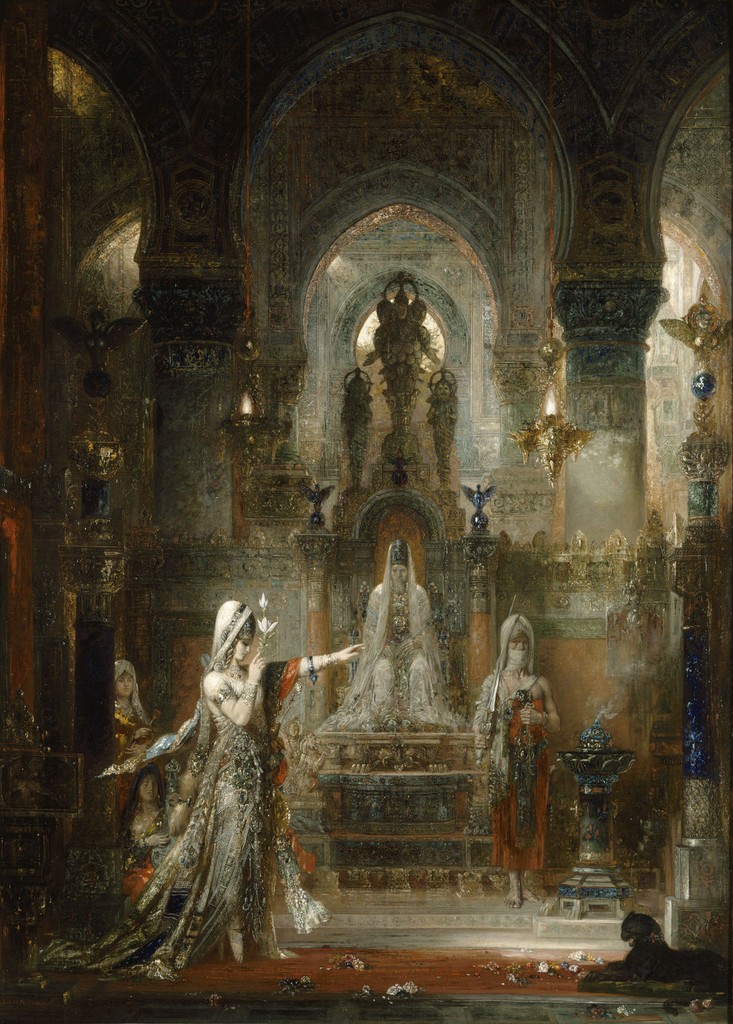
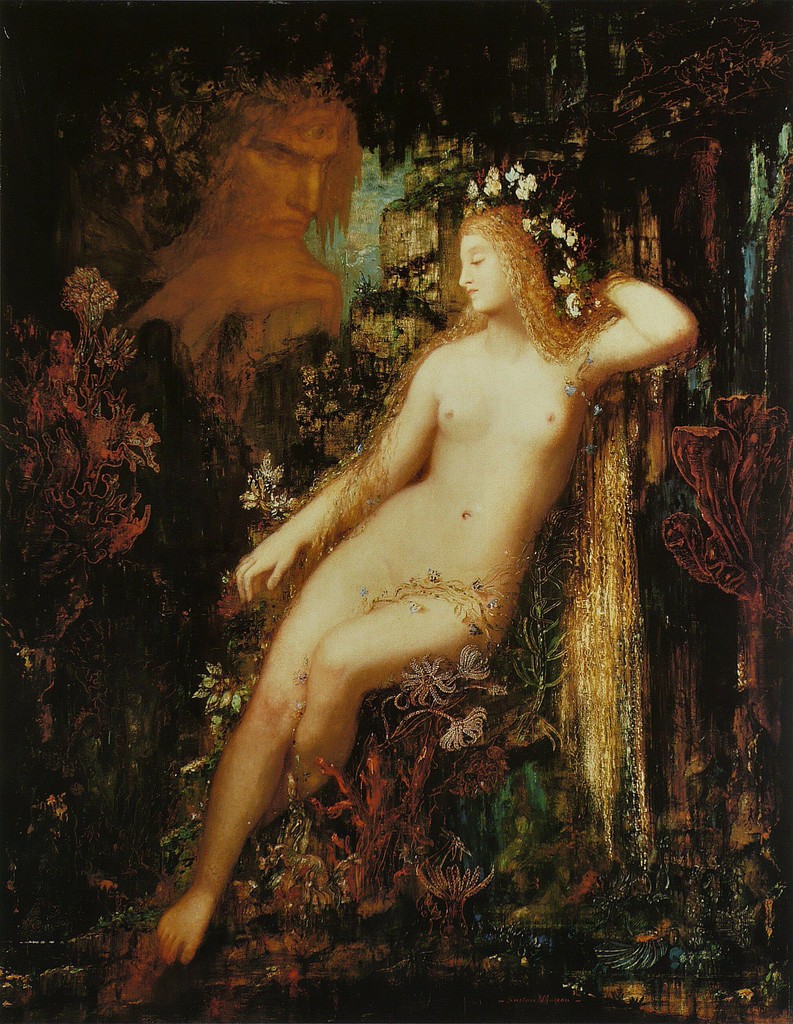
- Surface methodsSpecific works show different surface methods, including impasto and bright specks in Salomé and rubbed or scratched oil paint in Galatea.
- Materials and scaleMoreau painted in oil on both canvas and wooden panels, moving between intimate formats and pictures more than two metres high.
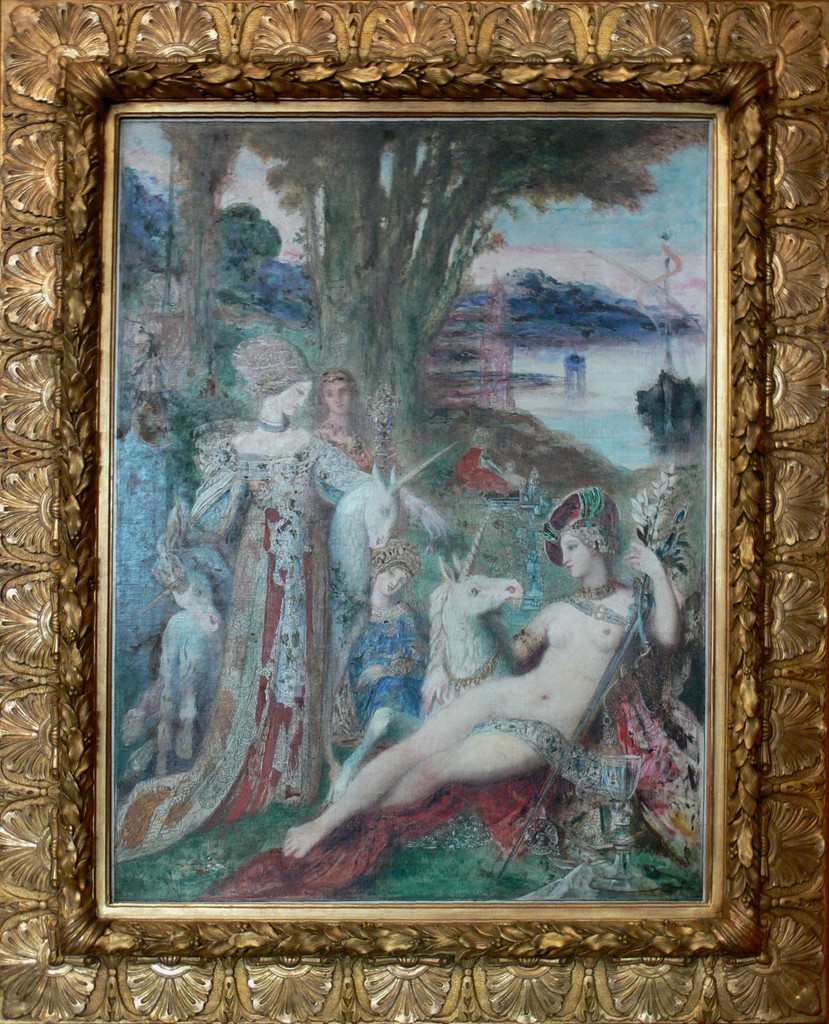
Selected Gustave Moreau paintings
Contents
- Introduction
- History Painting After the Mid-Century Salon
- Drawing Under the Painted Surface
- Copying as a Method of Invention
- Revision, Enlargement and the Productive Unfinished State
- Line, Colour and Object-Specific Surfaces
- Figures, Buildings and Ornament Work Together
- Canvas, Panel and the Question of Scale
- Eight Paintings, Eight Ways In
- Looking Carefully at Condition and Finish
History Painting After the Mid-Century Salon
Moreau trained for the established French system of history painting, the prestigious category devoted to scripture, mythology, literature and consequential events. His subjects remained inside that broad field, but his treatment increasingly displaced clear dramatic action with confrontation, contemplation and enigma. The Musée Gustave Moreau describes his purpose as addressing the spirit rather than reproducing observed nature. It also stresses that his borrowed models ultimately combined into individual creations.[1]
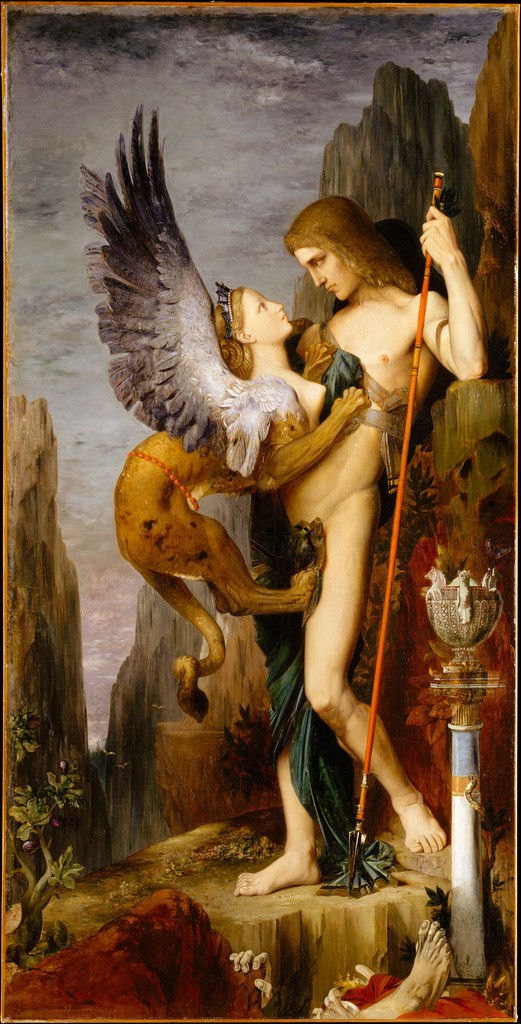
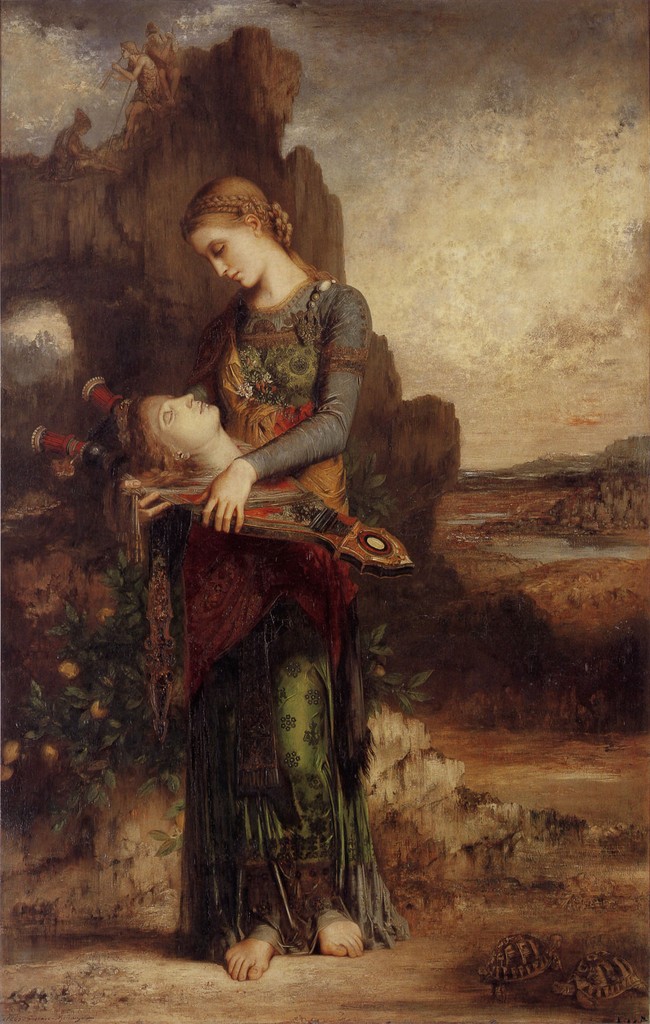
The Paris Salon gave those creations a public test. Oedipus and the Sphinx announced his return there in 1864: a canvas just over two metres high in which the two opponents meet at close range. The Metropolitan Museum records that the picture made his mark at the Salon despite the growing visibility of everyday-life subjects.[2] Orpheus, shown in 1866, turns dismemberment into a still encounter between a Thracian girl and the poet’s head. The Musée d’Orsay sees the golden chiaroscuro, complex construction and ambiguous calm of that oil on panel as anticipating his mature manner.[3]
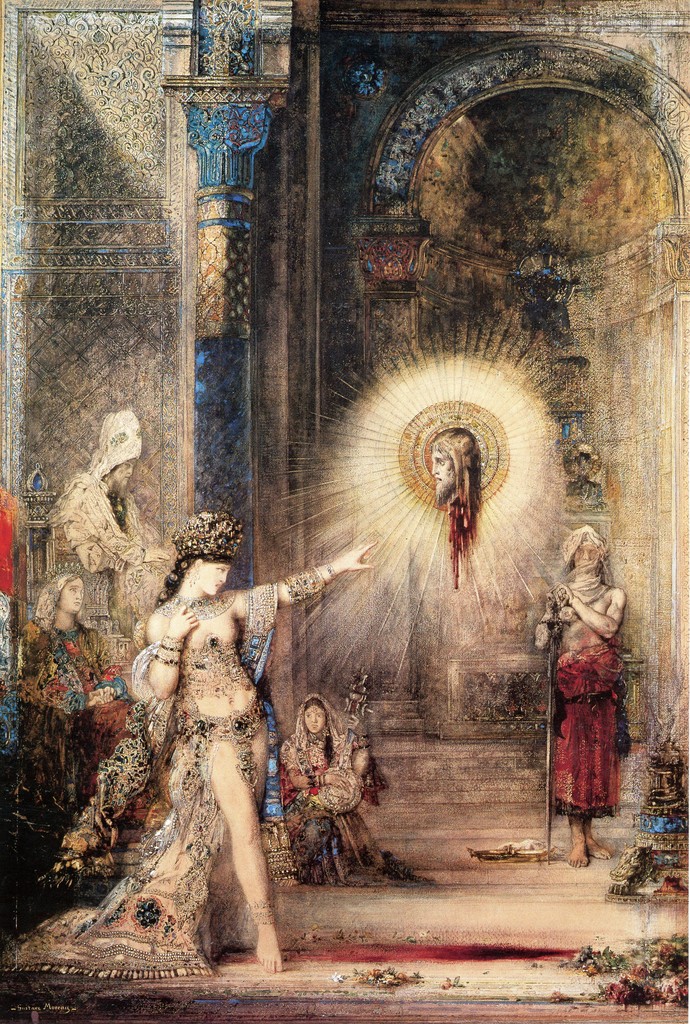
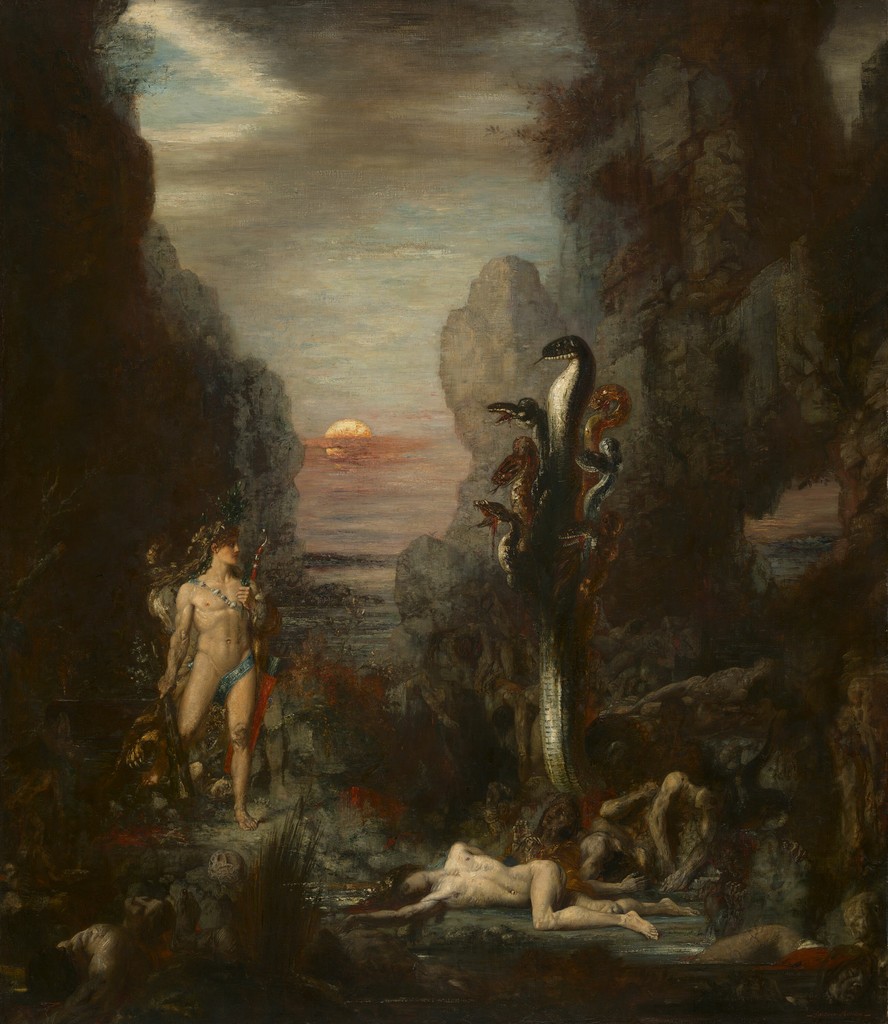
The sequence was never one of straightforward progress from simplicity to decoration. Prometheus, an oil canvas dated 1868 and about 2.05 metres high, met criticism at its Salon showing, although Théophile Gautier interpreted Moreau’s restrained, human-scale Titan through an analogy with Christ.[4] After several years away from the Salon, Moreau returned in 1876 with oils including Hercules and the Lernaean Hydra and Salomé Dancing Before Herod, alongside the watercolour The Apparition. His last Salon appearance came in 1880 with Helen and Galatea. Public exhibition mattered, but it represents only one part of a studio practice now unusually visible because the artist preserved its unfinished paths as well as its polished outcomes.[5]
Drawing Under the Painted Surface
Moreau did not use drawing simply to record a finished idea before adding colour. The house-museum’s large graphic collection shows a chain that could run from an exploratory sketch through figure and detail studies to tracing paper, squared enlargement and a full-size cartoon. The institution calls drawing a key component in the creation of a painting, including its final transfer stages.[1] That sequence explains how improbable bodies, weapons, rocks and buildings can occupy tightly controlled positions even when the painted surface around them flickers or dissolves.
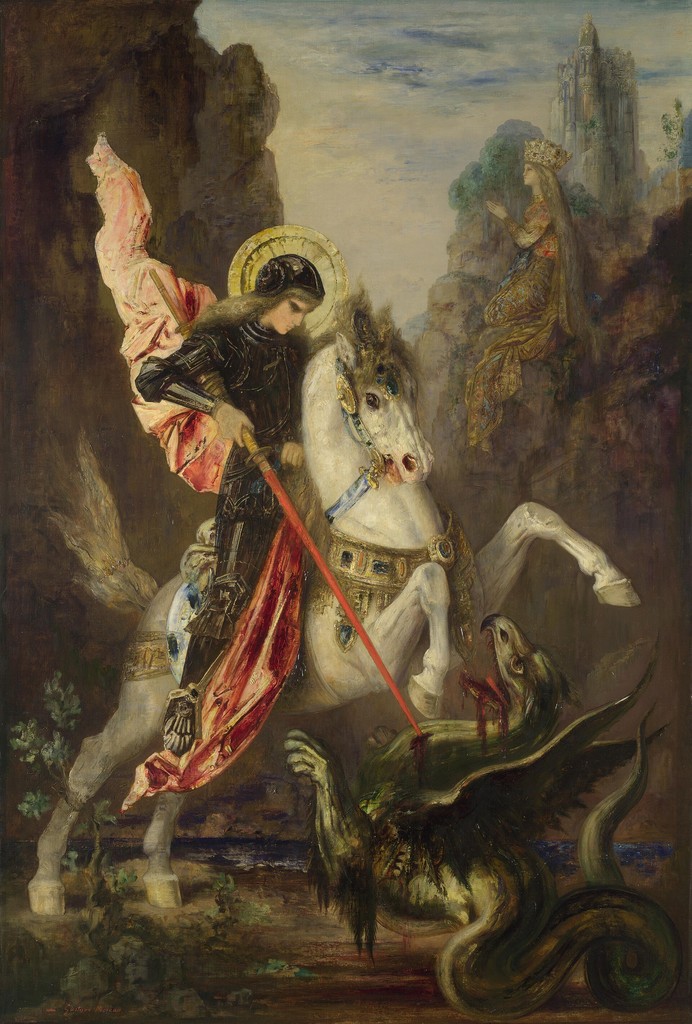
The point is especially clear when preparation survives beside a completed work. Five preparatory drawings are known for Saint George and the Dragon, while X-ray evidence relates the painting’s early state to a watercolour from about 1869. Moreau may have begun the design roughly two decades before completing the commission in 1889–90.[6] The preparatory record therefore does more than prove that he could draw. It shows composition as something portable: an arrangement could migrate between paper and canvas, small and large scale, or an early conception and a late sale.
This is also why line remains active in many finished oils. Contours do not always disappear into modelling. They can bind a figure, repeat in a spear, arch or halo, and make a composition read almost heraldically. In Saint George, the National Gallery identifies strong design and an emphasis on outline rather than deep perspective as part of the painting’s relationship to icon painting.[6] Elsewhere the contour becomes an arabesque, carrying the eye through bodies and ornaments. The drawings and watercolours guide follows these paper-based stages in greater depth; for the paintings, the important point is that linear planning and coloured execution remain in productive tension.
Copying as a Method of Invention
Moreau’s studio did not begin with a blank mind confronting a blank canvas. He accumulated visual information. During his Italian journey of 1857–59 he copied Raphael, Leonardo, Venetian painters, ancient sculpture and works associated with Pompeii and Herculaneum. His Paris research extended through illustrated books, engravings, photographs and visits to the Bibliothèque Nationale, where the Musée Gustave Moreau says he consulted Indian and Persian miniatures and Renaissance prints. He also collected Japanese prints.[1]
The reception room in his home makes this research concrete. Moreau arranged admired Italian copies there, including studies after Raphael, Leonardo and Carpaccio, alongside architectural treatises, illustrated folios, casts, ceramics and reproductions used in his compositions.[7] These objects were not a dictionary from which one source produced one motif. They supplied forms that could be compared, remembered and recombined.
In Saint George and the Dragon, for example, the National Gallery relates the horse and armed saint to Raphael; the subject’s development also draws on Carpaccio, icon painting, Late Gothic detail, and Indian and Persian miniatures.[6] Moreau did not merge such traditions into one vague, supposedly exotic category. He placed recognisable types of image-making into a new structure. That distinction matters when looking at his dense settings: architecture and ornament are the results of sustained selection, not evidence that historical sources have become interchangeable.
Revision, Enlargement and the Productive Unfinished State
The studios preserved in Moreau’s house overturn the idea that every painting moved efficiently towards exhibition finish. The second-floor space was built in 1895 to hold large canvases. Tyrtaeus Singing During the Combat and The Suitors, begun much earlier, had already been enlarged in late 1882. The Return of the Argonauts was painted around 1891, scaled up after the new studios were constructed, and revised again in 1897.[8] A composition could therefore remain available for a new physical form decades after its beginning.
Long duration did not always mean a uniformly polished skin. The same studio contains paintings the museum describes as endlessly reworked beside pictures made rapidly and left close to the sketch stage. The Chimeras may have been completed in about four months but remained largely an ébauche on canvas.[8] Hesiod and the Muses offers another instructive case. Preparatory drawings dated 1860 suggest an early start; Moreau later called the monochrome, square canvas a “large sketch” when distinguishing it from an enlarged variant. He apparently did not resume it, yet gave it an elaborate frame.[9] In his practice, incompletion could coexist with preservation and display.
This distinction prevents two common mistakes. A rough field of colour is not automatically a failed finished picture, and an ornate painting is not necessarily the product of uninterrupted minute work. The museum’s holdings include public statements, private experiments, studies, abandoned routes and late revisions. Their survival lets us see that finish was a decision made for a particular object, not a permanent setting in Moreau’s technique.
Line, Colour and Object-Specific Surfaces
Moreau wrote little that would allow a complete reconstruction of his materials. The museum describes him as a technically experimental “labourer” whose methods developed away from a more classical beginning from the 1870s onwards. It notes his interest in the relation between line and coloured areas and his use of new nineteenth-century binders, varnishes and pigments, while also recording his concern for physical preservation.[5] That evidence supports an experimental practice, but not a universal pigment list or a single sequence of layers.
Individual object records are safer guides. The Hammer Museum says Moreau made more than eighty preliminary sketches for Salomé Dancing Before Herod. In the finished 1876 oil he added specks of intense colour, bright touches of white and impasto to animate the scene.[10] Those raised or concentrated accents do not cover the canvas evenly. They punctuate the dancer, costume and sanctuary, so a controlled figure can seem to emit and catch light amid a dark interior.
The Musée d’Orsay describes a different handling in Galatea, painted in oil on wood around 1880. Rubbed and scratched paint gives the surface an enamel-like preciousness, while carefully researched marine vegetation forms a lace-like enclosure around the pale nymph.[11] The effect depends on abrasion as well as addition. In Oedipus and the Sphinx, by contrast, bodies and rock carry the visual argument through a severe, close confrontation; ornament is concentrated rather than spread across an all-enclosing interior.[2]
These comparisons make “jewel-like” useful only as a beginning. It can describe brightness, density or an enamel analogy, but it does not identify how a given passage was made. Look for where the support remains quiet, where an outline hardens, where thick paint catches light, and where scraping breaks a layer. Moreau’s surfaces vary because each picture negotiates differently between drawn order and coloured sensation.
Figures, Buildings and Ornament Work Together
Moreau’s settings are not lavish backdrops placed behind autonomous actors. Figure, building and ornament form one system. In Salomé, tall supports and arches establish a solemn, dark sanctuary, while scattered colour sharpens the dancer’s presence.[10] In Galatea, the cave controls the mismatch of scale between the inaccessible nymph and Polyphemus, and the marine growth thickens their separation.[11] In Saint George, the flattened, upright design makes the horse, spear, halo, dragon, distant princess and craggy landscape read as a hierarchy rather than an ordinary view into depth.[6]
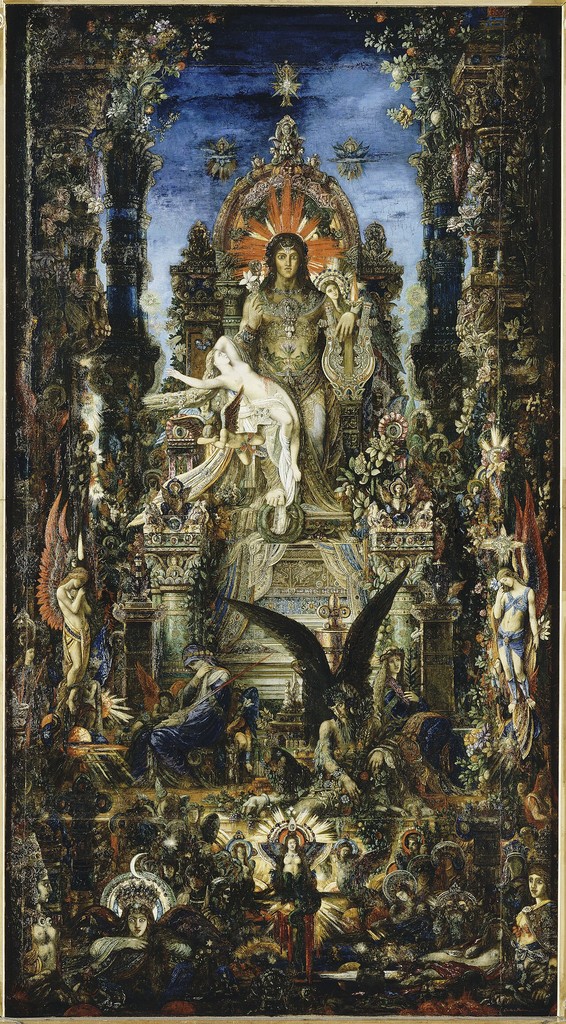
The figures often slow a familiar plot at its decisive threshold. Oedipus stares back at the Sphinx; Hercules stands before the Hydra; Salomé’s dance suspends the coming demand; Jupiter’s revelation overwhelms Semele. This stillness gives surrounding details time to operate. A column, crown, plant, throne or musical instrument can connect a character to sources beyond the immediate story. The density is therefore structural and interpretive, not merely luxurious. The separate guide to Moreau’s symbolism, mythology and religion examines what those combinations may mean without treating every object as a fixed code.
Canvas, Panel and the Question of Scale
“Moreau painting” does not name one physical type. Orpheus is an oil on wood measuring 154 by 99.5 centimetres.[3] Galatea is also on wood but considerably smaller, 85.5 by 66 centimetres.[11] The active Salon oils on canvas include Oedipus at 206.4 centimetres high, the Hammer Salomé at 143.5 centimetres, and the Art Institute of Chicago’s Hercules and the Lernaean Hydra, dated 1875–76.[12]
At the late end of the range, Jupiter and Semele is a 2.12-metre-high oil on canvas, commissioned in 1889 and completed in 1895.[13] Scale changes the viewing task. A panel can concentrate attention into a compact luminous field; a tall canvas recruits the viewer’s body and lets architecture rise above eye level. Support alone does not dictate finish—both wood and canvas can carry intricate or open passages—but dimensions shape how line, surface and story are encountered.
Eight Paintings, Eight Ways In
A selected group shows the range more clearly than a list of recurring traits. Begin with Oedipus and the Sphinx for the disciplined severity of Moreau’s 1864 Salon return: two profiles locked together, vertical canvas and little relief from the encounter.[2] Move to Orpheus for a quieter invention, where a diagonal arrangement, twilight landscape and paired, closed-eyed faces turn violence into meditation.[3]
Compare the 1876 Salon partners. In Hercules and the Lernaean Hydra, the hero and monster hold a tense, almost static opposition on a large canvas.[12] In Salomé Dancing Before Herod, architecture and sparkling surface extend the drama through an opulent interior; the many studies behind the work reveal that apparent profusion was designed.[10] The watercolour Apparition should not be silently treated as the same object as the oil version retained by the Musée Gustave Moreau. The house-museum explicitly distinguishes its Cat. 222 oil from the celebrated watercolour shown at the 1876 Salon.[14]
Then compare three later solutions. Galatea turns botanical study, rubbed paint and a panel support into an enclosed contest between radiance and shadow.[11] Saint George and the Dragon reworks an older design into a commissioned oil whose outlines and source-rich detail remain legible across a tall canvas.[6] Jupiter and Semele expands vertical architecture, divine hierarchy and clustered beings into what the Musée Gustave Moreau calls a synthesis of the artist’s art.[13] Together, the eight works show continuity of mythic ambition without reducing four decades of painting to a single ornamental style.
Seen in sequence, the group also resists a neat division between an austere early Moreau and an ornate late one. The stillness and golden complexity associated with his mature work are already present in Orpheus, while the late Saint George preserves a design conceived much earlier. Conversely, the elaborate Jupiter and Semele retains strong vertical ordering beneath its multitude of figures. A productive comparison therefore begins with the same questions for every object: where is the main encounter, how does line stabilise it, where does colour intensify it, and which details open the image beyond its first readable episode?
Looking Carefully at Condition and Finish
Surface photographs can clarify a scratched line or raised accent, but they can also exaggerate contrast and flatten scale. Gallery lighting, varnish, conservation history and the quality of a reproduction all affect what the viewer sees. Moreau himself worried about the material survival of paintings, according to the museum’s technical account.[5] It is therefore prudent to separate documented technique from an inference made through a screen.
When viewing an original, step back first to register the composition, then move closer where museum conditions allow. Ask which details organise the whole, which passages are revised, and which remain open. Check the institution’s current display notice before travelling: collection ownership does not guarantee that a work is on view. This slower method respects both the physical object and the different levels of finish that Moreau chose to preserve.
The surviving studio also warns against judging every visible interruption as damage or every smooth passage as completion. A change in handling may belong to the work’s history in Moreau’s hands. Conservation research and current object records should take priority over confident conclusions drawn from colour shifts in digital files.
Researched works directory
This searchable evidence census was assembled from public museum records and a reproducible Wikidata snapshot. It is not a catalogue raisonné, a claim to complete oeuvre coverage, or a substitute for Pierre-Louis Mathieu's printed catalogue, which was not consulted for this directory.
| Name | Date | Medium |
|---|---|---|
| Abstract Study | 1850 | Painting |
| Abstract Study | 1875 | Painting |
| Abstract Study | 1890 | Painting |
| Academic Study of a Man | 1847 | Painting |
| Achilles the Centaur Chiron | 1859 | Painting |
| Andromeda | 1867 | Painting |
| Andromeda | Date unknown | Painting |
| Angels Following the Magi | 1860 | Painting |
| Angels following the Three Magi | 1898 | Painting |
| Angels Throwing Flowers on the Vatican | 1850 | Painting |
| Aphrodite, 1871 | Date unknown | Painting |
| Apollo and Daphne | 1852 | Painting |
| Apollo and The Nine Muses | 1856 | Painting |
| Apollo and the Satyrs | 1850 | Painting |
| Apollo Victorious over Python | 1885 | Painting |
| Apollon and Marsyas | 1858 | Painting |
| Ariadne and Theseus | 1875 | Painting |
| Arion | 1891 | Painting |
| Athenians being Delivered to the Minotaur in the Cretan Labyrinth | 1855 | Painting |
| Autumn | 1885 | Painting |
| Bacchanal | 1850 | Painting |
| Bacchus on the Panther -cart. | Date unknown | Painting |
| Bathsheba | 1875 | Painting |
| Beheading of John the Baptist | 1872 | Painting |
| Bertrand and Raton | 1879 | Painting |
| Binding of Isaac | 1850 | Painting |
| Birth of Venus | 1870 | Painting |
| Briseis Departure | 1859 | Painting |
| centaur | Date unknown | Painting |
| Centaurs | 1850 | Painting |
| Chimera | 1850 | Painting |
| Chimeras | 1875 | Painting |
| Christ and the Two Thieves | 1870 | Painting |
| Christ at Gethsemane | 1850 | Painting |
| Christ at Gethsemane | 1875 | Painting |
| Christ at Lake Tiberias | 1850 | Painting |
| Christ at the Column | 1850 | Painting |
| Christ Blessing Hist Mother | 1850 | Painting |
| Christ Reliever | 1850 | Painting |
| Circe | 1850 | Painting |
| Cleopatra | 1850 | Painting |
| Cleopatra | 1887 | Painting |
| Danaé | 1858 | Painting |
| Darius, Fleeing after the battle of Arbela, Stops, Exhausted, to Drink from a Pond | 1853 | Painting |
| Darius Flight | 1850 | Painting |
| Dead Orpheus | 1850 | Painting |
| Dead Orpheus | 1890 | Painting |
| Dead Poet Carried by a Centaur | 1890 | Painting |
| Death Giving Laurels to the Winner of the Tournament | 1859 | Painting |
| Death of a Young Crusader | 1870 | Painting |
| Death of Moses | 1850 | Painting |
| Death of Sapho | 1850 | Painting |
| Death of Sapho | 1872 | Painting |
| Debauchery | 1850 | Painting |
| Dejanira (Autumn) | 1872 | Painting |
| Delilah | 1850 | Painting |
| Delilah | 1890 | Painting |
| Delilah | 1896 | Painting |
| Descent from the Cross | 1850 | Painting |
| Diana bathing | 1900 | Painting |
| Diomede devoured by his horses | 1865 | Painting |
| Diomedes Devoured by His Horses | 1865 | Painting |
| Diomedes Devoured by His Own Horses | 1870 | Painting |
| Œdipus the Wayfarer | 1888 | Painting |
| Draft for Sapho | 1850 | Painting |
| Eleonora Gonzaga, Duchess of Urbino | 1858 | Painting |
| Endymion | 1850 | Painting |
| Erigone | 1865 | Painting |
| Eve | 1850 | Painting |
| Eve | 1875 | Painting |
| Fairy in a Cave | 1850 | Painting |
| Fairy with Griffins | 1870 | Painting |
| Fairy with Griffins | 1876 | Painting |
| Fée aux griffons | 1876 | Drawing |
| Femme et licorne | 1890 | Painting |
| Francesco Maria della Rovere, Duke of Urbino | 1858 | Painting |
| Françoise de Rimini | 1850 | Painting |
| Galatea | c. 1880 | Painting |
| Galathea | 1896 | Painting |
| Galathea | Date unknown | Painting |
| Ganymede | 1886 | Painting |
| Gardian Angel of the City | 1850 | Painting |
| Genius of Evil | 1850 | Painting |
| Genius of Evil | 1875 | Painting |
| Golgotha | 1870 | Painting |
| Hamlet | 1850 | Painting |
| Hamlet Giving Poison to the King | 1850 | Painting |
| Helen | 1850 | Painting |
| Helen | 1880 | Painting |
| Helen at the Scaean Gate | 1888 | Painting |
| Helen Glorified | 1893 | Painting |
| Helen on the Walls of Troy | 1850 | Painting |
| Helen on the Walls of Troy | 1875 | Painting |
| Helene | Date unknown | Painting |
| Hercule et les oiseaux du lac de Stymphale | Date unknown | Painting |
| Hercules and Omphale | 1856 | Painting |
| Hercules and the Ceryneian Hind | 1871 | Painting |
| Hercules and the Daughters of Thespius | 1850 | Painting |
| Hercules and the Lernaean Hydra | 1875–1876 | Painting |
| Hercules and the Nemean Lion | 1850 | Painting |
| Hercules and the Stymphalian Birds | 1872 | Painting |
| Hercules and Thespius Daughters | 1850 | Painting |
| Hercules at Lake Stymphalia | 1875 | Painting |
| Hercules between Vice and Virtue | 1850 | Painting |
| Hesiod and the Muse | 1870 | Painting |
| Hesiod and the Muse | 1875 | Painting |
| Hesiod and the Muse | 1891 | Painting |
| Hesiod and the Muses | 1860 | Painting |
| Hesiod and the Muses | 1882 | Painting |
| Hésiode enfant | 1860 | Painting |
| Horse Rider | 1854 | Painting |
| Horse Rider | 1870 | Painting |
| Horse Rider and Amazon | 1869 | Painting |
| Horse Riders and Horses | 1854 | Painting |
| Indian Women Poets | 1890 | Painting |
| Interior, Draft | 1850 | Painting |
| Jacob and the Angel | 1876 | Painting |
| Jacob and the Angel | 1878 | Painting |
| Jacob et l'Ange | 1878 | Painting |
| Jason | 1865 | Painting |
| Jason et Éros | 1891 | Painting |
| Judith | 1850 | Painting |
| Jupiter and Semele | 1889–1895 | Painting |
| King Canute and His Courtesans | 1850 | Painting |
| King David | 1878 | Painting |
| L'enlèvement d'Europe | 1872 | Painting |
| La Fée | Date unknown | Painting |
| La mort de Sapho | 1872 | Painting |
| La mort de Sapho | 1876 | Painting |
| La Villa Borghèse | Date unknown | Painting |
| Landscape | 1850 | Painting |
| Landscape, Draft | 1850 | Painting |
| Landscape (Neighborhood of Étampes) | 1850 | Painting |
| Le Bon Samaritain | 1865 | Painting |
| Le Cantique des cantiques | 1853 | Painting |
| Le Christ et Madeleine (Noli me Tangere) | 1889 | Painting |
| Le Grand Pan contemple les Sphères Célestes | 1897 | Drawing |
| Le Poète et la Sirène | 1893 | Painting |
| Le Soir | 1887 | Painting |
| Le Sphinx | 1886 | Painting |
| Leda | 1846 | Painting |
| Leda | 1850 | Painting |
| Leda | 1870 | Painting |
| Les Chimères | 1884 | Painting |
| Les Plaintes du poète | 1882 | Painting |
| Life of Humanity | 1875 | Painting |
| Life of Humanity | 1886 | Painting |
| Life of Humanity: Salvator Mundi | 1886 | Painting |
| Life of Humanity: The Golden Age, Adam - Evening - Sleep | 1879 | Painting |
| Life of Humanity: The Golden Age, Adam - Morning - Prayer | 1879 | Painting |
| Life of Humanity: The Golden Age, Adam - Noon - Extasy | 1879 | Painting |
| Life of Humanity: The Iron Age, Cain - Evening - Death | 1879 | Painting |
| Life of Humanity: The Iron Age, Cain - Morning - Work | 1879 | Painting |
| Life of Humanity: The Iron Age, Cain - Noon - Rest | 1879 | Painting |
| Life of Humanity: The Silver Age, Hesiod and Orpheus, Hesiod - Evening - Tears | 1879 | Painting |
| Life of Humanity: The Silver Age, Hesiod and Orpheus, Hesiod - Morning - Inspiration | 1879 | Painting |
| Life of Humanity: The Silver Age, Hesiod and Orpheus, Orpheus - Noon - Song | 1879 | Painting |
| Love Victorious over Death | 1850 | Painting |
| Lucretia and Tarquin | 1850 | Painting |
| Magdalene on Golgotha | 1850 | Painting |
| Magdalene on Golgotha | 1875 | Painting |
| Magdalene on Golgotha | 1880 | Painting |
| Magnolia | 1864 | Painting |
| Martyrdrom | 1850 | Painting |
| Messalina | 1850 | Painting |
| Messalina | 1874 | Painting |
| Messaline | 1874 | Painting |
| Mort de Sapho | 1900 | Painting |
| Moses Exposed | 1875 | Painting |
| Moses Exposed on the Nile | 1875 | Painting |
| Moses, in Sight of the Promised Land, Takes His Sandals Off | 1854 | Painting |
| Moses Rescued from the Nile | 1893 | Painting |
| Mystic Flower | 1890 | Painting |
| Narcissus | 1850 | Painting |
| Narcissus | 1885 | Painting |
| Narcissus | 1890 | Painting |
| Noces d’Alexandre et de Roxane | Date unknown | Drawing |
| Nude Study | 1850 | Painting |
| Nyx, Night Goddess | 1880 | Painting |
| Oedipus and the Sphinx | 1864 | Painting |
| Orestes | 1850 | Painting |
| Orestes | 1875 | Painting |
| Orestes and the Erinyes | 1875 | Painting |
| Orphés | 1865 | Painting |
| Orpheus | 1865 | Painting |
| Orpheus Head | 1850 | Painting |
| Orpheus on Eurydice's Tomb | 1890 | Painting |
| Pasiphaë | 1850 | Painting |
| Pasiphaë | 1880 | Painting |
| Pasiphaë, Grisaille | 1850 | Painting |
| Pauline Moreau as the Virgin | 1848 | Painting |
| Perseus and Andromeda | 1870 | Painting |
| Persian Poet | 1875 | Painting |
| Petrarch After the Triumph | 1850 | Painting |
| Phaéton | 1878 | Painting |
| Phoebus and Boreas | 1879 | Painting |
| Pietà | 1867 | Painting |
| Pietà | 1875 | Painting |
| Pietà | 1876 | Painting |
| Pietà | Date unknown | Painting |
| Pittacus the Tyrant in War Costume | 1883 | Drawing |
| Polyphemus | 1880 | Painting |
| Poney | 1870 | Painting |
| Portrait of Gustave Moreau by Himself | 1850 | Painting |
| Portrait of Gustave Moreau by Himself | 1890 | Painting |
| Postman and Horses | 1854 | Painting |
| Prometheus | 1868 | Painting |
| Prometheus | 1869 | Painting |
| Prometheus Thunderstruck | 1870 | Painting |
| Prometheus, Variant | 1870 | Painting |
| Rape of Deianira | 1850 | Painting |
| Rape of Deianira | 1872 | Painting |
| Return of the Argonauts | 1890 | Painting |
| Ruines de Rome : le Colisée vu des jardins de l'Angélicum des dominicains | 1858 | Painting |
| Saint Cecilia and the Angels of Music | 1850 | Painting |
| Saint Francis Kissing a Leper | 1850 | Painting |
| Saint George and the Dragon | 1889–1890 | Painting |
| Saint Jerome | 1850 | Painting |
| Saint Sebastian | 1850 | Painting |
| Saint Sebastian | 1870 | Painting |
| Saint Sebastian and the Angel | 1876 | Painting |
| Saint Sebastian and the Angels | 1850 | Painting |
| Saint Sebastian Succoured | 1885 | Painting |
| Saint Sebastian with Archers | 1875 | Painting |
| Saint-Sébastien et l'ange | 1876 | Painting |
| Saint Sébastien soigné par les saintes femmes | 1869 | Painting |
| Sainte Cecilia | 1850 | Painting |
| Salome | 1850 | Painting |
| Salome | 1872 | Painting |
| Salome | 1874 | Painting |
| Salome at the Prison | 1873 | Painting |
| Salomé au Jardin | 1878 | Painting |
| Salome Dancing | 1872 | Painting |
| Salomé Dancing Before Herod | 1876 | Painting |
| Salome Dancing in front of Herod | 1876 | Painting |
| Salome with the Head of John the Baptist | 1876 | Painting |
| Santa Cecilia (Moreau) | Date unknown | Painting |
| Sappho falling into the Abyss | 1867 | Painting |
| Semele | 1889 | Painting |
| Semele, Draft | 1889 | Painting |
| Singing Centaurs | 1850 | Painting |
| Slaves Thrown to the Morays | 1850 | Painting |
| Song of Songs (Cantique des Cantiques) | 1893 | Painting |
| Spanish Conversation | 1850 | Painting |
| Spring | 1850 | Painting |
| St. Sebastian | Date unknown | Painting |
| Study | 1850 | Painting |
| Study | 1874 | Painting |
| Study | 1875 | Painting |
| Study for Jupiter and Semele | 1889 | Painting |
| Study for Moses Taking Off His Sandals | 1854 | Painting |
| Study for Saint Cecilia | 1850 | Painting |
| Study for Salome | 1874 | Painting |
| Study for The Triumph of Alexander the Great | 1885 | Painting |
| Study from Nature | 1850 | Painting |
| Study of a red ibis | 1900 | Painting |
| Sultan | 1850 | Painting |
| Suzanne et les vieillards | 1895 | Painting |
| swinging girl | Date unknown | Painting |
| Tea Rose | 1850 | Painting |
| Temptation | 1890 | Painting |
| Tempting Demon | 1875 | Painting |
| The Angels of Sodome | 1872 | Painting |
| The Apparition | 1876 | Drawing |
| The Argonauts | 1885 | Painting |
| The Bad Rich | 1850 | Painting |
| The calvary | 1867 | Painting |
| The childhood of Sixtus V. | 1853 | Painting |
| The Chimera | 1867 | Painting |
| The chimera | Date unknown | Painting |
| The Chimeras | 1850 | Painting |
| The Crowning with Thorns | 1846 | Painting |
| The Daughters of Thespius | 1853 | Painting |
| The Dead Lyres | 1897 | Painting |
| The Decameron | 1850 | Painting |
| The Disciples in Emmaus | 1850 | Painting |
| The Dream Haunting the Mogul | 1881 | Painting |
| The Entombment | 1867 | Painting |
| The Good Samaritan | 1850 | Painting |
| The Infant Moses | 1877 | Painting |
| The Magi | 1860 | Painting |
| The Martyred Saint Sebastian | 1869 | Painting |
| The Mermaid and the Poet | 1895 | Painting |
| The Muses Leaving Their Father Apollo to Go and Light the World | 1868 | Painting |
| The Parca and the Angel of Death | 1890 | Painting |
| The Parcae | 1850 | Painting |
| The Pieridae | 1875 | Painting |
| The Pieridae | 1880 | Painting |
| The Pietà | 1867 | Painting |
| The Plague in Florence | 1870 | Painting |
| The Poet and the Siren | 1894 | Painting |
| The Prodigal Son | 1850 | Painting |
| The Prodigal Son | 1890 | Painting |
| The Rape of Europe | 1868 | Painting |
| The Rape of Europe | 1869 | Painting |
| The Shulamite | 1853 | Painting |
| The Sirens | 1850 | Painting |
| The Sirens | 1875 | Painting |
| The Sirens | 1882 | Painting |
| The Springs | 1856 | Painting |
| The Suitors | 1862 | Painting |
| The Toilette | 1887 | Painting |
| The Travelling Angels | 1875 | Painting |
| The Travelling Poet | 1890 | Painting |
| The Unicorn | 1885 | Painting |
| The Unicorns | 1888 | Painting |
| The Voices | 1867 | Painting |
| The Wandering Jew | 1870 | Painting |
| The Young Man and Death | 1856–1865 | Painting |
| Tomyris and Cyrus | 1850 | Painting |
| Triumph of Alexander the Great | 1873 | Painting |
| Triumphing Church | 1870 | Painting |
| Tyrtaeus | 1850 | Painting |
| Tyrtaeus Singing While Fighting | 1860 | Painting |
| Un Saint au désert | 1879 | Painting |
| Untitled | 1866 | Painting |
| Venice | 1850 | Painting |
| Venice | 1885 | Painting |
| Venus Rising from the Sea | 1866 | Painting |
| Victim | 1850 | Painting |
| Vue de Florence | 1858 | Painting |
| Walk in a Park | 1865 | Painting |
| Water Fairy | 1850 | Painting |
| Womand and Chimera | 1875 | Painting |
| Young Thracian Woman Holding Orpheus' Head | 1866 | Painting |
Frequently Asked Questions
Moreau painted biblical, mythological, literary and imagined subjects within an expanded practice of history painting. His protagonists include Oedipus, Orpheus, Hercules, Salomé, Galatea, Saint George, Jupiter and Semele, as well as poets, saints and legendary rulers. He also made portraits, landscapes, copies and many experimental studies, so the famous mythic oils are important but not the whole of his work.[1]
There was no single fixed procedure. Drawing could progress from an initial sketch through detail studies, tracing, squaring-up and a full-size transfer cartoon.[1] Moreau also consulted copies, prints, photographs, books and museum collections, then recombined selected forms. Some pictures were completed for public display; others were revised, enlarged or left at a sketch-like stage.[8]
Detail helps Moreau coordinate narrative, mood and visual sources. Architecture locates the figures within an imagined order, while plants, textiles, jewels and attributes can redirect attention or connect a subject to a wider tradition. The details are rarely a neutral inventory. In the strongest works, their lines and colour accents control how the eye moves and how slowly the scene discloses itself.[6]
Yes, although the media overlap. Oil allowed him to work on panel or canvas, revise surfaces, build accents and enlarge some compositions over time. He described watercolour as a place for looser and more private experimentation, sometimes achieving effects that eluded him in more complicated paintings.[1] A watercolour and an oil of the same subject should still be treated as distinct objects, not interchangeable versions.[14]
The Musée Gustave Moreau in Paris preserves the artist’s house, studios and an exceptional concentration of his work, including Jupiter and Semele. Major paintings also belong to the Metropolitan Museum of Art, Musée d’Orsay, Art Institute of Chicago, Hammer Museum and National Gallery in London. Always consult the current object page before visiting, because display status and loans can change.
Discussion
Use this evidence-led guide as a starting point for close looking rather than a final verdict.
Share an observation about Gustave Moreau Paintings or a source that adds useful context.
Reader Insights
Which material decision best defines Moreau's practice in this group of works?
Where do you see observation and invention working together rather than as opposites?
Which work would you add to the selected group, and what would it change?
Join the Conversation
Add your reading below, keeping observations specific and evidence clear.
References
- Musée Gustave Moreau, “The Art of Gustave Moreau.”, accessed 30 August 2026.
- Metropolitan Museum of Art, “Oedipus and the Sphinx.”, accessed 30 August 2026.
- Musée d’Orsay, “Orphée.”, accessed 30 August 2026.
- Musée Gustave Moreau, “Prométhée.”, accessed 30 August 2026.
- Musée Gustave Moreau, “English Press Kit 2023.”, accessed 30 August 2026.
- National Gallery, London, “Saint George and the Dragon.”, accessed 30 August 2026.
- Musée Gustave Moreau, “The Cabinet de Réception.”, accessed 30 August 2026.
- Musée Gustave Moreau, “The Studios.”, accessed 30 August 2026.
- Musée Gustave Moreau, “Hésiode et les muses.”, accessed 30 August 2026.
- Hammer Museum, “Salomé Dancing Before Herod.”, accessed 30 August 2026.
- Musée d’Orsay, “Galatée.”, accessed 30 August 2026.
- Art Institute of Chicago, “Hercules and the Lernaean Hydra.”, accessed 30 August 2026.
- Musée Gustave Moreau, “Jupiter and Semele.”, accessed 30 August 2026.
- Musée Gustave Moreau, “Artworks on the Move.”, accessed 30 August 2026.