 by Tom Gurney
Tom Gurney BSc (Hons) is an art history expert with over 20 years experience
Page Created: 30 August 2026 / Page Updated: November 6, 2026
Email: tomgurney1@gmail.com / Phone: +44 7429 011000
Orpheus: Introduction
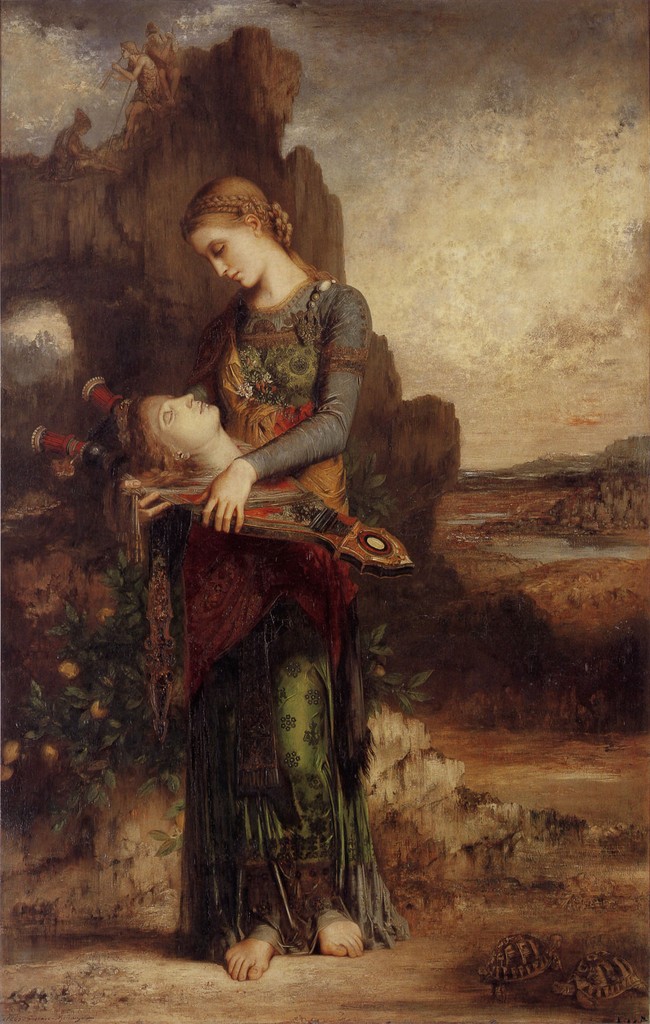
In Gustave Moreau’s Orpheus, violence has already happened, yet horror does not control the scene. A richly dressed young woman carries the poet’s severed head on his lyre through a dusky landscape. Her lowered face resembles his, and both have closed eyes. Moreau’s 1865 oil on wood turns a brutal mythical aftermath into a measured act of attention.[1]
At a Glance
- CollectionOrphée—usually titled Orpheus in English—is Musée d’Orsay painting RF 104.
- Date and mediumMoreau painted it in 1865 in oil on a wooden panel measuring 154 × 99.5 centimetres.[1]
- Central figureThe central figure is a young Thracian woman carrying Orpheus’s head, which rests upon his lyre.
- Other motifsDistant musicians and two tortoises extend the instrument’s story beyond the central pair.
- AcquisitionThe French state bought the painting directly from Moreau in 1866, the year it appeared at the Salon.[1]
- Display statusThe Orsay record currently says that the work is not on display, so visitors should check before travelling.
Gustave Moreau in context
Orpheus
1865The Apparition
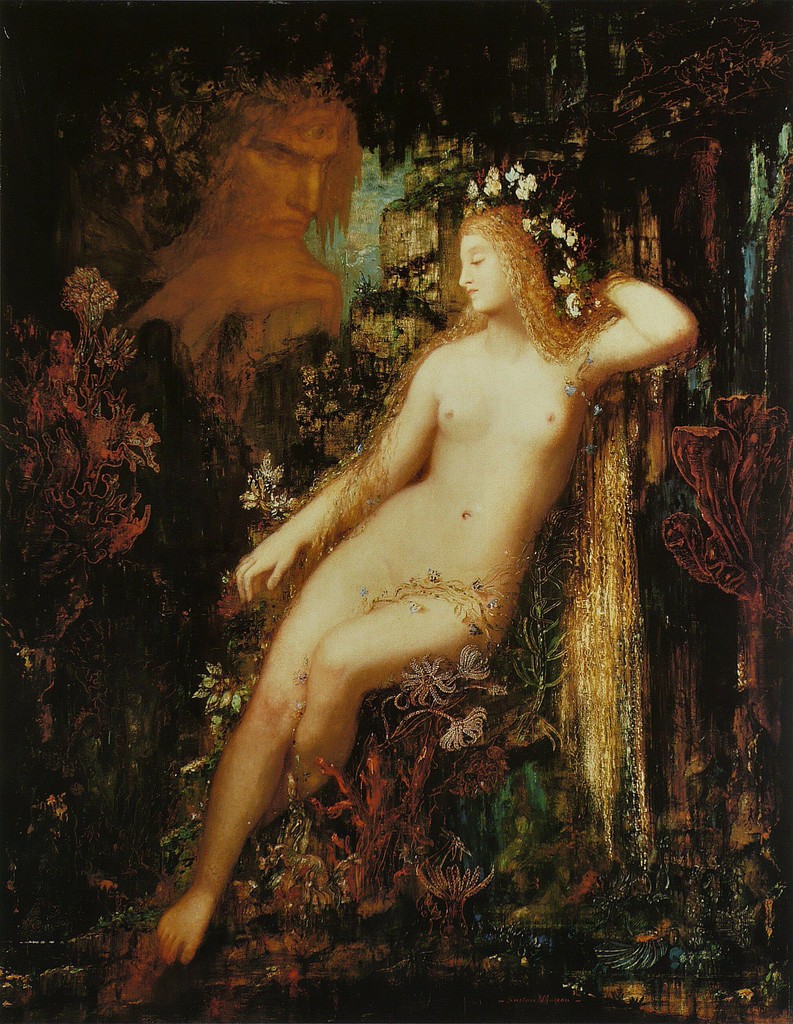
1876Galatea
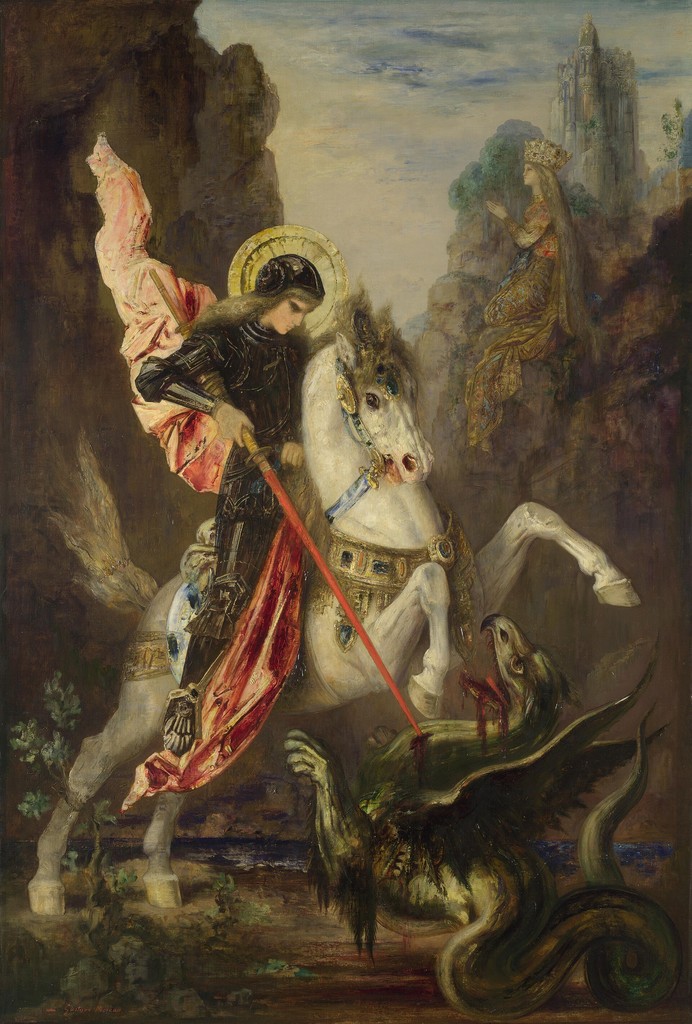
c. 1880Saint George and the Dragon
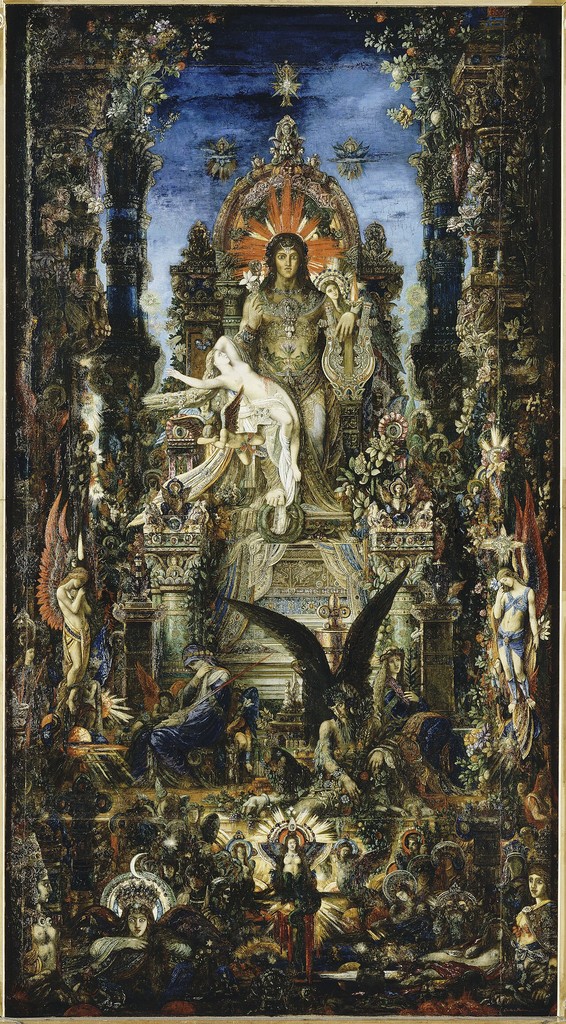
1889–90Jupiter and Semele
1894–95Contents
- Introduction
- A Face Lowered towards Another Face
- The Landscape Moves at a Different Pace
- The Myth Moreau Continues
- Stillness after Dismemberment
- A Poet Who Returns in Moreau’s Work
- Gold, Brown and a Painted Panel
- Salon, State Purchase and the Musée d’Orsay
- Why Orpheus Matters
A Face Lowered towards Another Face
The painting first asks the viewer to look down. The young woman inclines her head towards Orpheus, whose face is supported just below hers. The poet’s head does not lie on bare ground or appear as an isolated trophy. It rests on the broad face of his lyre, so person and instrument arrive together. The woman’s hands steady this joined burden while her own body remains upright.
A close visual reading shows how Moreau slows the encounter. The carrier does not stride, look outward or make a theatrical gesture of grief. Her heavy patterned garment descends in long folds, and one bare foot meets the rock. The profile, lowered gaze and vertical stance give the moment the formality of a presentation, but no audience appears before her. She seems absorbed in what she holds.
The Musée d’Orsay emphasises the resemblance between the two faces. Their eyes are closed, and the museum interprets them as drawn into a shared, apparently limitless contemplation.[1] Similarity does not prove that the woman is Orpheus’s double, a spirit or any named person. It creates a visual relation whose precise meaning remains open. Her living face answers the silent face of the dead poet without turning his death into spectacle.
Look next at the lyre. Its curved frame encloses and elevates the head, making music’s material tool function almost like a reliquary. This is an observation about the painting’s arrangement, not a claim that Moreau illustrated a historical ritual. The effect is to preserve Orpheus’s identity as a poet after his body has been destroyed. Voice has stopped, but the instrument and the act of carrying keep his art present.
The Landscape Moves at a Different Pace
The central figure occupies most of the tall panel, yet the setting continues far behind her. Dark rock rises at the right and frames her shoulder. To the left, the ground drops into a distant valley beneath a subdued sky. The space is deep, but it feels still; no crowd rushes in to explain what has happened.
Near the upper left, tiny musicians occupy a remote ledge. At the lower right, two tortoises provide a second, quieter counterweight. The Musée d’Orsay compares the diagonal balance between these upper and lower details to the reversed arrangement of figures on a playing card.[1] The comparison helps locate them: the eye travels from distant music down through the woman and lyre to the creatures associated with the instrument’s origin.
Scale separates these elements without disconnecting them. The musicians are so small that they belong to the landscape before they read as individuals. The tortoises are close but easy to miss beside the patterned hem and uneven ground. Moreau therefore surrounds the large act of carrying with minor echoes of music. Neither group interrupts the silence; each makes the absent sound of Orpheus more imaginable.
The rocky distance also prevents the picture from becoming only a portrait. The Musée d’Orsay calls the background fantastic and compares its atmosphere to Leonardo da Vinci.[1] That institutional comparison concerns the invented, receding terrain and twilight mood. It need not imply a direct quotation from one Leonardo painting. Moreau had studied Italian art closely, but here the remembered landscape has been transformed into an environment for suspended feeling.
The Myth Moreau Continues
Orpheus was the supreme singer and musician of Greek myth. His song could move people, animals and even the powers of the underworld. After his wife Eurydice died, he descended to recover her and was allowed to lead her back on condition that he did not turn to look before they reached the world above. He looked too soon and lost her again.
The Musée d’Orsay’s account then follows the tradition in which Maenads tear Orpheus apart after he rejects them. Moreau does not paint the attack. Nor does he show the better-known moment when the poet looks back at Eurydice. He invents what the museum calls a continuation: a young woman in elaborate dress rescues the head.[1]
That choice changes the emotional centre of the story. The Maenads’ frenzy is known but absent; the scattered body is reduced to a single, recognisable head; and an unnamed carrier replaces the attacking group. Violence survives as a fact that the viewer must supply, while the visible action becomes care, retrieval or contemplation. The scene is not free of death, but it is remarkably free of gore.
The woman’s identity should remain provisional. The Orsay commentary asks whether she might be a wise virgin who effaces the memory of the Bacchantes, presenting the idea as a question rather than a settled identification.[1] “Young Thracian Woman Carrying the Head of Orpheus” is a useful expanded title because it describes her role. It does not license a biography or a fixed symbolic name that the painting itself never provides.
Stillness after Dismemberment
Moreau organises the picture around an extreme contrast: a severed head and an atmosphere of calm. The Orsay record notes that the scene follows a horrific ordeal but avoids morbidity.[1] That judgement is borne out by the work’s restraint. There is no visible wound, active aggressor or panicked witness. Orpheus’s face appears intact, his expression quiet, and the lyre gives it a stable place.
The shared closure of the two pairs of eyes is central. Closed eyes can suggest death in the poet and inward attention in the carrier, but the resemblance also draws those states together. The viewer cannot meet either gaze. Instead, looking becomes one-sided: we inspect two figures who seem withdrawn into a relation unavailable to us.
This withdrawal makes the painting more than an illustration of narrative sequence. Time feels arrested between discovery and destination. We do not know where the woman found the head, where she is taking it or whether the distant musicians can see her. Moreau supplies enough myth to establish loss, then holds back the information that would convert the scene into a completed episode.
The result is neither a simple lament nor a victory over death. The head remains dead, yet poetry is not treated as extinguished. The carrier’s attention, the intact lyre and the musical signs within the landscape give artistic memory a physical form. For a broader account of how Moreau reworked inherited stories, see Symbolism, Mythology and Religion.
A Poet Who Returns in Moreau’s Work
Orpheus offered Moreau more than one tragic incident. The poet could stand for the power, vulnerability and survival of art, and Moreau returned to him in different subjects. The 1865 panel must nevertheless be kept separate from those later works.
The distinction is especially important with Orpheus at the Tomb of Eurydice. The Musée Gustave Moreau dates that painting to the period after the death of Moreau’s close friend Alexandrine Dureux in 1890 and identifies it as a memorial work.[2] It is not another title for Musée d’Orsay RF 104. Nor should the Orsay picture be replaced by a small private version from about 1875. Each object has its own date, support, scale and narrative arrangement.
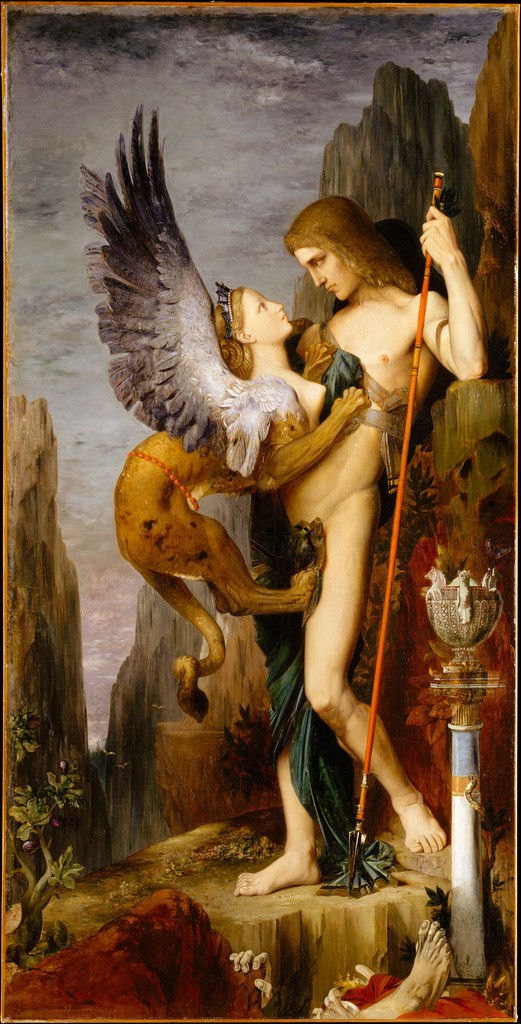
Within the active cluster, comparison can clarify the difference. Oedipus and the Sphinx stops a hero inside a threatening face-to-face test. Orpheus begins after conflict and sets one lowered face above another. Both paintings compress mythology into a charged interval, but the first depends on resistance while the second depends on bearing and preservation.
The recurring poet also gives Moreau a way to think about art through art. A painter represents a musician who can no longer perform, yet whose instrument and image continue to communicate. That reflexive structure helps explain why the head is composed so carefully with the lyre rather than treated as a gruesome fragment.
Gold, Brown and a Painted Panel
The Musée d’Orsay describes the work’s golden chiaroscuro and sees in it qualities that became characteristic of Moreau’s mature painting around 1870.[1] As a visual observation, warm brown and gold join the woman’s skin, garment, lyre and stone, while cooler green-blue passages open the remote landscape. Light gathers around the paired faces instead of flooding the whole scene evenly.
The ornamental detail remains controlled. Jewellery, woven patterns and the decorated instrument reward proximity, but the large rock and broad shadowed folds prevent the surface from becoming uniformly busy. The woman reads first as a single grave silhouette. Detail then slows the eye within that silhouette, particularly around her shoulders, hands and burden.
Moreau painted the work in oil on wood rather than canvas.[1] At 154 centimetres high, the panel gives the standing carrier substantial presence while preserving a relatively narrow, concentrated field. The firm support cannot by itself explain the precision of the image, and there is no basis for inventing a pigment recipe. It is more useful to observe how contour, tonal contrast and measured accents sustain both clarity and mystery. The Moreau paintings guide compares this solution with his larger canvases and later surfaces.
The work also reflects Moreau’s wider habit of transforming studied sources. The Musée Gustave Moreau describes an artist who drew on academic, Romantic and Italian art, then combined remembered forms into highly individual compositions. It links his figures and backgrounds at times to Michelangelo and Leonardo while stressing that those references become inseparable within the new image.[3] Orpheus is strongest when read as such a synthesis, not as a hunt for one borrowed model.
Salon, State Purchase and the Musée d’Orsay
Moreau signed and dated the painting in 1865. It appeared at the Salon in 1866 as number 1404, and the French state bought it directly from him on 3 July for 8,000 francs.[1] This was not a private picture discovered only after his death. It entered public ownership almost immediately and followed a documented institutional path.
The work went to the Musée du Luxembourg in 1867. In 1874 it was assigned to the national museums and registered as RF 104; it transferred to the Louvre in 1926 and was allocated to the Musée d’Orsay in 1986.[1] These dates explain why older publications or labels may connect it with different Paris collections without describing different paintings.
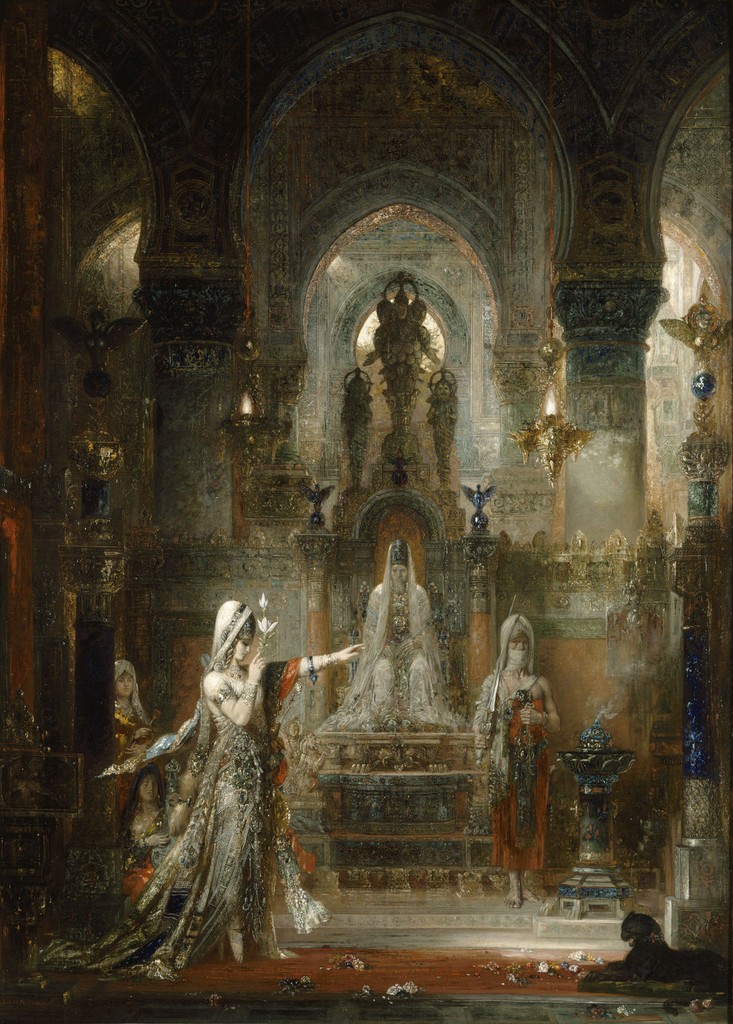
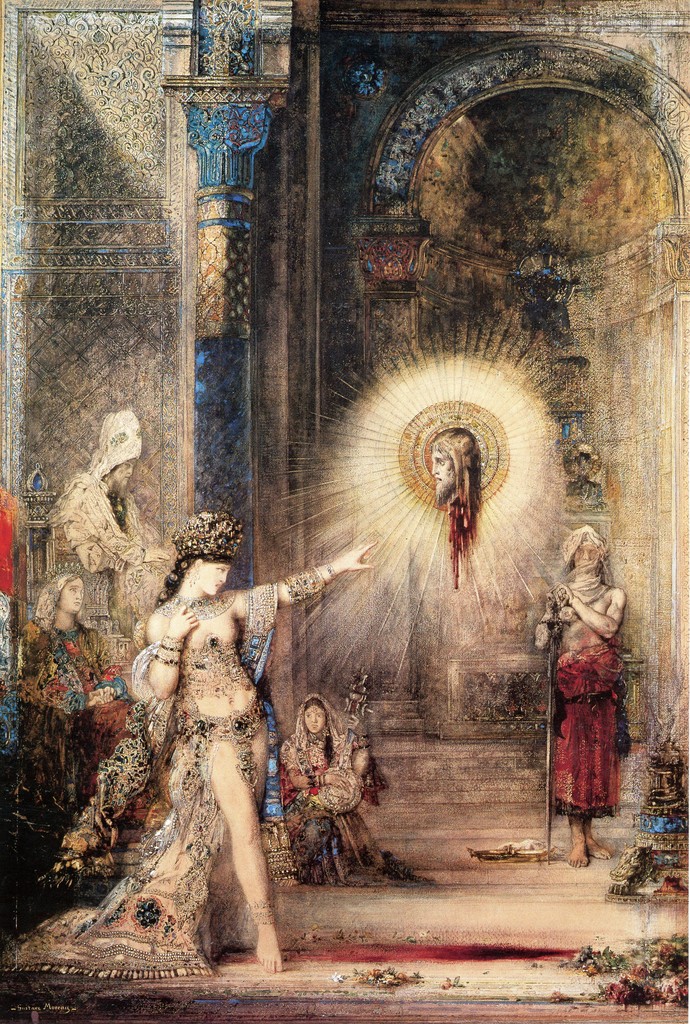
The acquisition followed closely after Moreau’s successful return to the Salon with Oedipus and the Sphinx in 1864. It belongs to the period before later Salomé compositions made his intricate interiors especially famous. The biography of Gustave Moreau sets that public sequence within his longer career.
The Orsay page currently reports that Orpheus is not exhibited in the museum.[1] That status may change, so the collection record should be checked before a visit. Ownership and visibility are separate questions: RF 104 remains in the Orsay collection even when it is not hanging in a public gallery.
Why Orpheus Matters
The Orsay interpretation locates in this early work a golden twilight, complex construction, and combination of sensual and spiritual atmosphere that would become central to Moreau’s mature art.[1] Its importance is therefore developmental as well as emotional. It shows him moving beyond a conventional mythological climax towards an invented, inward aftermath.
Later accounts identify Moreau as a decisive precursor of pictorial Symbolism, but Orpheus predates the movement’s formal emergence. The painting matters not because it obeys a later programme, but because it makes an old story carry a suggestive idea without translating that idea into one answer. Music persists without sound; death appears without spectacle; an unnamed woman performs an action that can be described more securely than it can be decoded.
Researched works directory
This searchable evidence census was assembled from public museum records and a reproducible Wikidata snapshot. It is not a catalogue raisonné, a claim to complete oeuvre coverage, or a substitute for Pierre-Louis Mathieu's printed catalogue, which was not consulted for this directory.
| Name | Date | Medium |
|---|---|---|
| Abstract Study | 1850 | Painting |
| Abstract Study | 1875 | Painting |
| Abstract Study | 1890 | Painting |
| Academic Study of a Man | 1847 | Painting |
| Achilles the Centaur Chiron | 1859 | Painting |
| Andromeda | 1867 | Painting |
| Andromeda | Date unknown | Painting |
| Angels Following the Magi | 1860 | Painting |
| Angels following the Three Magi | 1898 | Painting |
| Angels Throwing Flowers on the Vatican | 1850 | Painting |
| Aphrodite, 1871 | Date unknown | Painting |
| Apollo and Daphne | 1852 | Painting |
| Apollo and The Nine Muses | 1856 | Painting |
| Apollo and the Satyrs | 1850 | Painting |
| Apollo Victorious over Python | 1885 | Painting |
| Apollon and Marsyas | 1858 | Painting |
| Ariadne and Theseus | 1875 | Painting |
| Arion | 1891 | Painting |
| Athenians being Delivered to the Minotaur in the Cretan Labyrinth | 1855 | Painting |
| Autumn | 1885 | Painting |
| Bacchanal | 1850 | Painting |
| Bacchus on the Panther -cart. | Date unknown | Painting |
| Bathsheba | 1875 | Painting |
| Beheading of John the Baptist | 1872 | Painting |
| Bertrand and Raton | 1879 | Painting |
| Binding of Isaac | 1850 | Painting |
| Birth of Venus | 1870 | Painting |
| Briseis Departure | 1859 | Painting |
| centaur | Date unknown | Painting |
| Centaurs | 1850 | Painting |
| Chimera | 1850 | Painting |
| Chimeras | 1875 | Painting |
| Christ and the Two Thieves | 1870 | Painting |
| Christ at Gethsemane | 1850 | Painting |
| Christ at Gethsemane | 1875 | Painting |
| Christ at Lake Tiberias | 1850 | Painting |
| Christ at the Column | 1850 | Painting |
| Christ Blessing Hist Mother | 1850 | Painting |
| Christ Reliever | 1850 | Painting |
| Circe | 1850 | Painting |
| Cleopatra | 1850 | Painting |
| Cleopatra | 1887 | Painting |
| Danaé | 1858 | Painting |
| Darius, Fleeing after the battle of Arbela, Stops, Exhausted, to Drink from a Pond | 1853 | Painting |
| Darius Flight | 1850 | Painting |
| Dead Orpheus | 1850 | Painting |
| Dead Orpheus | 1890 | Painting |
| Dead Poet Carried by a Centaur | 1890 | Painting |
| Death Giving Laurels to the Winner of the Tournament | 1859 | Painting |
| Death of a Young Crusader | 1870 | Painting |
| Death of Moses | 1850 | Painting |
| Death of Sapho | 1850 | Painting |
| Death of Sapho | 1872 | Painting |
| Debauchery | 1850 | Painting |
| Dejanira (Autumn) | 1872 | Painting |
| Delilah | 1850 | Painting |
| Delilah | 1890 | Painting |
| Delilah | 1896 | Painting |
| Descent from the Cross | 1850 | Painting |
| Diana bathing | 1900 | Painting |
| Diomede devoured by his horses | 1865 | Painting |
| Diomedes Devoured by His Horses | 1865 | Painting |
| Diomedes Devoured by His Own Horses | 1870 | Painting |
| Œdipus the Wayfarer | 1888 | Painting |
| Draft for Sapho | 1850 | Painting |
| Eleonora Gonzaga, Duchess of Urbino | 1858 | Painting |
| Endymion | 1850 | Painting |
| Erigone | 1865 | Painting |
| Eve | 1850 | Painting |
| Eve | 1875 | Painting |
| Fairy in a Cave | 1850 | Painting |
| Fairy with Griffins | 1870 | Painting |
| Fairy with Griffins | 1876 | Painting |
| Fée aux griffons | 1876 | Drawing |
| Femme et licorne | 1890 | Painting |
| Francesco Maria della Rovere, Duke of Urbino | 1858 | Painting |
| Françoise de Rimini | 1850 | Painting |
| Galatea | c. 1880 | Painting |
| Galathea | 1896 | Painting |
| Galathea | Date unknown | Painting |
| Ganymede | 1886 | Painting |
| Gardian Angel of the City | 1850 | Painting |
| Genius of Evil | 1850 | Painting |
| Genius of Evil | 1875 | Painting |
| Golgotha | 1870 | Painting |
| Hamlet | 1850 | Painting |
| Hamlet Giving Poison to the King | 1850 | Painting |
| Helen | 1850 | Painting |
| Helen | 1880 | Painting |
| Helen at the Scaean Gate | 1888 | Painting |
| Helen Glorified | 1893 | Painting |
| Helen on the Walls of Troy | 1850 | Painting |
| Helen on the Walls of Troy | 1875 | Painting |
| Helene | Date unknown | Painting |
| Hercule et les oiseaux du lac de Stymphale | Date unknown | Painting |
| Hercules and Omphale | 1856 | Painting |
| Hercules and the Ceryneian Hind | 1871 | Painting |
| Hercules and the Daughters of Thespius | 1850 | Painting |
| Hercules and the Lernaean Hydra | 1875–1876 | Painting |
| Hercules and the Nemean Lion | 1850 | Painting |
| Hercules and the Stymphalian Birds | 1872 | Painting |
| Hercules and Thespius Daughters | 1850 | Painting |
| Hercules at Lake Stymphalia | 1875 | Painting |
| Hercules between Vice and Virtue | 1850 | Painting |
| Hesiod and the Muse | 1870 | Painting |
| Hesiod and the Muse | 1875 | Painting |
| Hesiod and the Muse | 1891 | Painting |
| Hesiod and the Muses | 1860 | Painting |
| Hesiod and the Muses | 1882 | Painting |
| Hésiode enfant | 1860 | Painting |
| Horse Rider | 1854 | Painting |
| Horse Rider | 1870 | Painting |
| Horse Rider and Amazon | 1869 | Painting |
| Horse Riders and Horses | 1854 | Painting |
| Indian Women Poets | 1890 | Painting |
| Interior, Draft | 1850 | Painting |
| Jacob and the Angel | 1876 | Painting |
| Jacob and the Angel | 1878 | Painting |
| Jacob et l'Ange | 1878 | Painting |
| Jason | 1865 | Painting |
| Jason et Éros | 1891 | Painting |
| Judith | 1850 | Painting |
| Jupiter and Semele | 1889–1895 | Painting |
| King Canute and His Courtesans | 1850 | Painting |
| King David | 1878 | Painting |
| L'enlèvement d'Europe | 1872 | Painting |
| La Fée | Date unknown | Painting |
| La mort de Sapho | 1872 | Painting |
| La mort de Sapho | 1876 | Painting |
| La Villa Borghèse | Date unknown | Painting |
| Landscape | 1850 | Painting |
| Landscape, Draft | 1850 | Painting |
| Landscape (Neighborhood of Étampes) | 1850 | Painting |
| Le Bon Samaritain | 1865 | Painting |
| Le Cantique des cantiques | 1853 | Painting |
| Le Christ et Madeleine (Noli me Tangere) | 1889 | Painting |
| Le Grand Pan contemple les Sphères Célestes | 1897 | Drawing |
| Le Poète et la Sirène | 1893 | Painting |
| Le Soir | 1887 | Painting |
| Le Sphinx | 1886 | Painting |
| Leda | 1846 | Painting |
| Leda | 1850 | Painting |
| Leda | 1870 | Painting |
| Les Chimères | 1884 | Painting |
| Les Plaintes du poète | 1882 | Painting |
| Life of Humanity | 1875 | Painting |
| Life of Humanity | 1886 | Painting |
| Life of Humanity: Salvator Mundi | 1886 | Painting |
| Life of Humanity: The Golden Age, Adam - Evening - Sleep | 1879 | Painting |
| Life of Humanity: The Golden Age, Adam - Morning - Prayer | 1879 | Painting |
| Life of Humanity: The Golden Age, Adam - Noon - Extasy | 1879 | Painting |
| Life of Humanity: The Iron Age, Cain - Evening - Death | 1879 | Painting |
| Life of Humanity: The Iron Age, Cain - Morning - Work | 1879 | Painting |
| Life of Humanity: The Iron Age, Cain - Noon - Rest | 1879 | Painting |
| Life of Humanity: The Silver Age, Hesiod and Orpheus, Hesiod - Evening - Tears | 1879 | Painting |
| Life of Humanity: The Silver Age, Hesiod and Orpheus, Hesiod - Morning - Inspiration | 1879 | Painting |
| Life of Humanity: The Silver Age, Hesiod and Orpheus, Orpheus - Noon - Song | 1879 | Painting |
| Love Victorious over Death | 1850 | Painting |
| Lucretia and Tarquin | 1850 | Painting |
| Magdalene on Golgotha | 1850 | Painting |
| Magdalene on Golgotha | 1875 | Painting |
| Magdalene on Golgotha | 1880 | Painting |
| Magnolia | 1864 | Painting |
| Martyrdrom | 1850 | Painting |
| Messalina | 1850 | Painting |
| Messalina | 1874 | Painting |
| Messaline | 1874 | Painting |
| Mort de Sapho | 1900 | Painting |
| Moses Exposed | 1875 | Painting |
| Moses Exposed on the Nile | 1875 | Painting |
| Moses, in Sight of the Promised Land, Takes His Sandals Off | 1854 | Painting |
| Moses Rescued from the Nile | 1893 | Painting |
| Mystic Flower | 1890 | Painting |
| Narcissus | 1850 | Painting |
| Narcissus | 1885 | Painting |
| Narcissus | 1890 | Painting |
| Noces d’Alexandre et de Roxane | Date unknown | Drawing |
| Nude Study | 1850 | Painting |
| Nyx, Night Goddess | 1880 | Painting |
| Oedipus and the Sphinx | 1864 | Painting |
| Orestes | 1850 | Painting |
| Orestes | 1875 | Painting |
| Orestes and the Erinyes | 1875 | Painting |
| Orphés | 1865 | Painting |
| Orpheus | 1865 | Painting |
| Orpheus Head | 1850 | Painting |
| Orpheus on Eurydice's Tomb | 1890 | Painting |
| Pasiphaë | 1850 | Painting |
| Pasiphaë | 1880 | Painting |
| Pasiphaë, Grisaille | 1850 | Painting |
| Pauline Moreau as the Virgin | 1848 | Painting |
| Perseus and Andromeda | 1870 | Painting |
| Persian Poet | 1875 | Painting |
| Petrarch After the Triumph | 1850 | Painting |
| Phaéton | 1878 | Painting |
| Phoebus and Boreas | 1879 | Painting |
| Pietà | 1867 | Painting |
| Pietà | 1875 | Painting |
| Pietà | 1876 | Painting |
| Pietà | Date unknown | Painting |
| Pittacus the Tyrant in War Costume | 1883 | Drawing |
| Polyphemus | 1880 | Painting |
| Poney | 1870 | Painting |
| Portrait of Gustave Moreau by Himself | 1850 | Painting |
| Portrait of Gustave Moreau by Himself | 1890 | Painting |
| Postman and Horses | 1854 | Painting |
| Prometheus | 1868 | Painting |
| Prometheus | 1869 | Painting |
| Prometheus Thunderstruck | 1870 | Painting |
| Prometheus, Variant | 1870 | Painting |
| Rape of Deianira | 1850 | Painting |
| Rape of Deianira | 1872 | Painting |
| Return of the Argonauts | 1890 | Painting |
| Ruines de Rome : le Colisée vu des jardins de l'Angélicum des dominicains | 1858 | Painting |
| Saint Cecilia and the Angels of Music | 1850 | Painting |
| Saint Francis Kissing a Leper | 1850 | Painting |
| Saint George and the Dragon | 1889–1890 | Painting |
| Saint Jerome | 1850 | Painting |
| Saint Sebastian | 1850 | Painting |
| Saint Sebastian | 1870 | Painting |
| Saint Sebastian and the Angel | 1876 | Painting |
| Saint Sebastian and the Angels | 1850 | Painting |
| Saint Sebastian Succoured | 1885 | Painting |
| Saint Sebastian with Archers | 1875 | Painting |
| Saint-Sébastien et l'ange | 1876 | Painting |
| Saint Sébastien soigné par les saintes femmes | 1869 | Painting |
| Sainte Cecilia | 1850 | Painting |
| Salome | 1850 | Painting |
| Salome | 1872 | Painting |
| Salome | 1874 | Painting |
| Salome at the Prison | 1873 | Painting |
| Salomé au Jardin | 1878 | Painting |
| Salome Dancing | 1872 | Painting |
| Salomé Dancing Before Herod | 1876 | Painting |
| Salome Dancing in front of Herod | 1876 | Painting |
| Salome with the Head of John the Baptist | 1876 | Painting |
| Santa Cecilia (Moreau) | Date unknown | Painting |
| Sappho falling into the Abyss | 1867 | Painting |
| Semele | 1889 | Painting |
| Semele, Draft | 1889 | Painting |
| Singing Centaurs | 1850 | Painting |
| Slaves Thrown to the Morays | 1850 | Painting |
| Song of Songs (Cantique des Cantiques) | 1893 | Painting |
| Spanish Conversation | 1850 | Painting |
| Spring | 1850 | Painting |
| St. Sebastian | Date unknown | Painting |
| Study | 1850 | Painting |
| Study | 1874 | Painting |
| Study | 1875 | Painting |
| Study for Jupiter and Semele | 1889 | Painting |
| Study for Moses Taking Off His Sandals | 1854 | Painting |
| Study for Saint Cecilia | 1850 | Painting |
| Study for Salome | 1874 | Painting |
| Study for The Triumph of Alexander the Great | 1885 | Painting |
| Study from Nature | 1850 | Painting |
| Study of a red ibis | 1900 | Painting |
| Sultan | 1850 | Painting |
| Suzanne et les vieillards | 1895 | Painting |
| swinging girl | Date unknown | Painting |
| Tea Rose | 1850 | Painting |
| Temptation | 1890 | Painting |
| Tempting Demon | 1875 | Painting |
| The Angels of Sodome | 1872 | Painting |
| The Apparition | 1876 | Drawing |
| The Argonauts | 1885 | Painting |
| The Bad Rich | 1850 | Painting |
| The calvary | 1867 | Painting |
| The childhood of Sixtus V. | 1853 | Painting |
| The Chimera | 1867 | Painting |
| The chimera | Date unknown | Painting |
| The Chimeras | 1850 | Painting |
| The Crowning with Thorns | 1846 | Painting |
| The Daughters of Thespius | 1853 | Painting |
| The Dead Lyres | 1897 | Painting |
| The Decameron | 1850 | Painting |
| The Disciples in Emmaus | 1850 | Painting |
| The Dream Haunting the Mogul | 1881 | Painting |
| The Entombment | 1867 | Painting |
| The Good Samaritan | 1850 | Painting |
| The Infant Moses | 1877 | Painting |
| The Magi | 1860 | Painting |
| The Martyred Saint Sebastian | 1869 | Painting |
| The Mermaid and the Poet | 1895 | Painting |
| The Muses Leaving Their Father Apollo to Go and Light the World | 1868 | Painting |
| The Parca and the Angel of Death | 1890 | Painting |
| The Parcae | 1850 | Painting |
| The Pieridae | 1875 | Painting |
| The Pieridae | 1880 | Painting |
| The Pietà | 1867 | Painting |
| The Plague in Florence | 1870 | Painting |
| The Poet and the Siren | 1894 | Painting |
| The Prodigal Son | 1850 | Painting |
| The Prodigal Son | 1890 | Painting |
| The Rape of Europe | 1868 | Painting |
| The Rape of Europe | 1869 | Painting |
| The Shulamite | 1853 | Painting |
| The Sirens | 1850 | Painting |
| The Sirens | 1875 | Painting |
| The Sirens | 1882 | Painting |
| The Springs | 1856 | Painting |
| The Suitors | 1862 | Painting |
| The Toilette | 1887 | Painting |
| The Travelling Angels | 1875 | Painting |
| The Travelling Poet | 1890 | Painting |
| The Unicorn | 1885 | Painting |
| The Unicorns | 1888 | Painting |
| The Voices | 1867 | Painting |
| The Wandering Jew | 1870 | Painting |
| The Young Man and Death | 1856–1865 | Painting |
| Tomyris and Cyrus | 1850 | Painting |
| Triumph of Alexander the Great | 1873 | Painting |
| Triumphing Church | 1870 | Painting |
| Tyrtaeus | 1850 | Painting |
| Tyrtaeus Singing While Fighting | 1860 | Painting |
| Un Saint au désert | 1879 | Painting |
| Untitled | 1866 | Painting |
| Venice | 1850 | Painting |
| Venice | 1885 | Painting |
| Venus Rising from the Sea | 1866 | Painting |
| Victim | 1850 | Painting |
| Vue de Florence | 1858 | Painting |
| Walk in a Park | 1865 | Painting |
| Water Fairy | 1850 | Painting |
| Womand and Chimera | 1875 | Painting |
| Young Thracian Woman Holding Orpheus' Head | 1866 | Painting |
Frequently Asked Questions
It shows an aftermath invented by Moreau. After the Maenads have killed and dismembered Orpheus, a young woman carries his head resting on his lyre. The attack itself and Eurydice are not shown.[1]
Her personal identity is not established. The Musée d’Orsay describes a young girl and asks whether she might be a wise virgin opposed to the frenzy of the Bacchantes, but it leaves that as an interpretive question.[1] “Young Thracian woman” is a descriptive label, not a confirmed name.
Moreau painted it in 1865 in oil on a wooden panel. It measures 154 × 99.5 centimetres and carries the Musée d’Orsay accession number RF 104.[1]
The tortoises refer to the traditional account that a tortoise shell was used to make the first lyre. The Orsay commentary also notes how they balance the tiny musicians high on the opposite side of the diagonal composition.[1]
Discussion
Use this evidence-led guide as a starting point for close looking rather than a final verdict.
Share an observation about Orpheus or a source that adds useful context.
Reader Insights
Which detail most changes your reading of Orpheus?
How do scale, support, medium or present museum evidence shape the encounter?
What remains uncertain when visual inference is separated from documented fact?
Join the Conversation
Add your reading below, keeping observations specific and evidence clear.
References
- Musée d’Orsay, “Orphée.”, accessed 30 August 2026.
- Musée Gustave Moreau, “Biography of Gustave Moreau.”, accessed 30 August 2026.
- Musée Gustave Moreau, “The Art of Gustave Moreau.”, accessed 30 August 2026.