 by Tom Gurney
Tom Gurney BSc (Hons) is an art history expert with over 20 years experience
Page Created: 30 August 2026 / Page Updated: November 6, 2026
Email: tomgurney1@gmail.com / Phone: +44 7429 011000
Gustave Moreau Biography: Introduction
Gustave Moreau built a public career from subjects that can look private and dreamlike: Oedipus facing the Sphinx, Orpheus mourned after death, Salomé dancing before Herod and Jupiter revealing himself to Semele. Yet his life was not a simple retreat from modern France. He trained for official success, exhibited at the Paris Salon, accepted commissions, won honours, entered the Académie des Beaux-Arts and taught at the École des Beaux-Arts. In his final years he also turned his family house and studio into a permanent record of his practice. The result is a career best understood in four stages—formation, Italian study and Salon return, mature experimentation, and teaching and museum-making—rather than as the legend of an isolated visionary.
At a Glance
- LivedGustave Moreau was born in Paris on 6 April 1826 and died there on 18 April 1898.
- TrainingHe trained in François-Édouard Picot’s studio and at the École des Beaux-Arts, but failed twice to win the Prix de Rome.
- Italian studiesA sustained Italian study journey from 1857 to 1859 reshaped his knowledge of Renaissance painting, antiquity, colour and composition.
- Salon breakthroughHe returned prominently to the Salon with Oedipus and the Sphinx in 1864, then developed an increasingly elaborate art of biblical and mythological subjects.
- TeachingMoreau was elected to the Académie des Beaux-Arts in 1888 and taught at the École des Beaux-Arts from 1892 until his death.
- Museum legacyHis bequest preserved the house, studios and contents at 14 rue de La Rochefoucauld; the Musée Gustave Moreau opened in 1903.
Gustave Moreau in context
Neoclassical contexts
c. 1780–1850Romanticism
c. 1800–1850Symbolism
c. 1880–1910J.-A.-D. Ingres
1780–1867Eugène Delacroix
1798–1863Théodore Chassériau
1819–1856Gustave Moreau
1826–1898Edgar Degas
1834–1917Henri Matisse
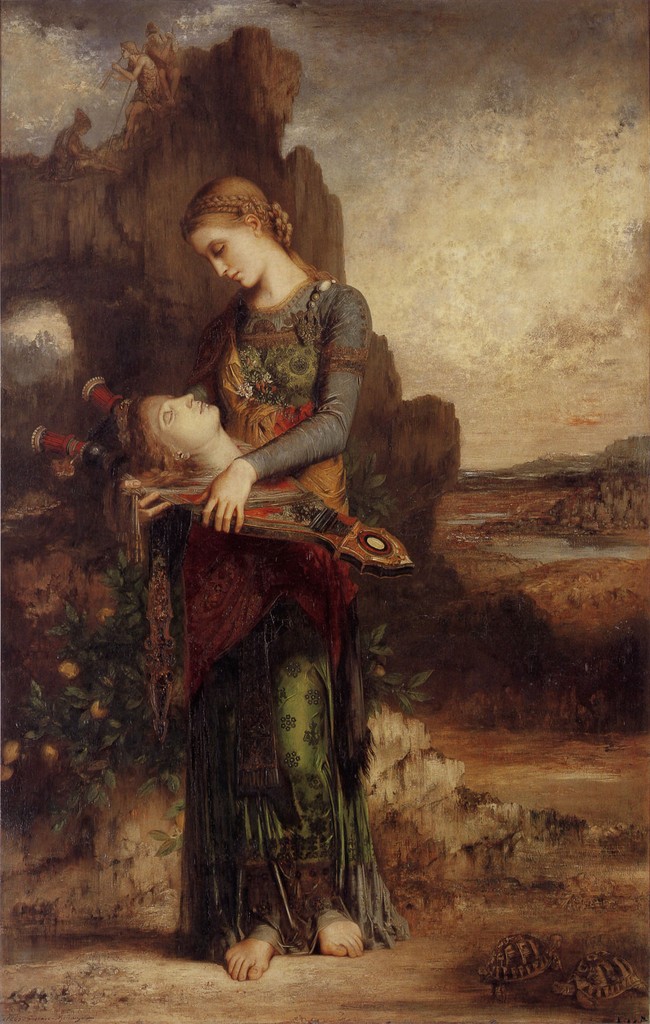
1869–1954Orpheus
1865The Apparition
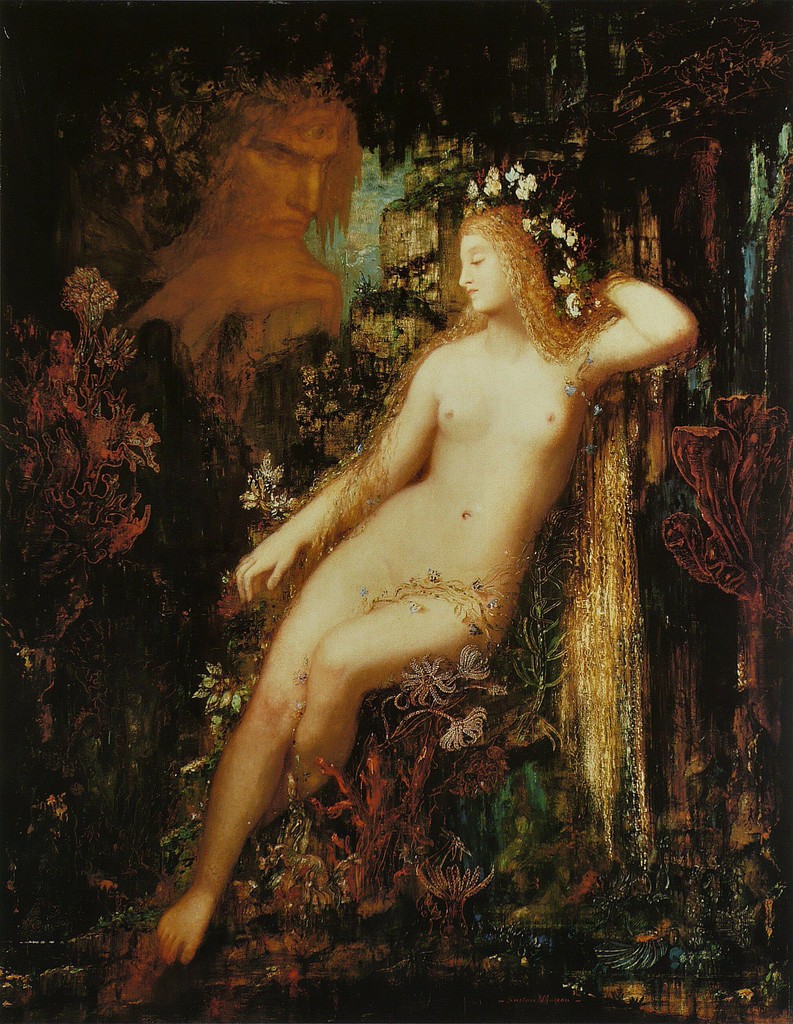
1876Galatea
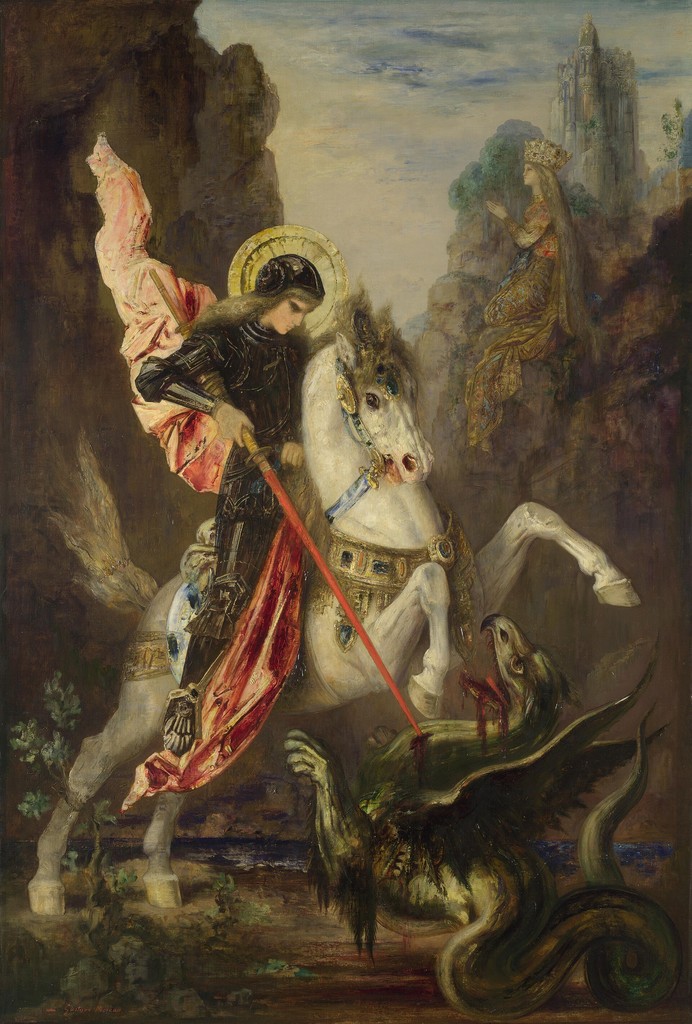
c. 1880Saint George and the Dragon
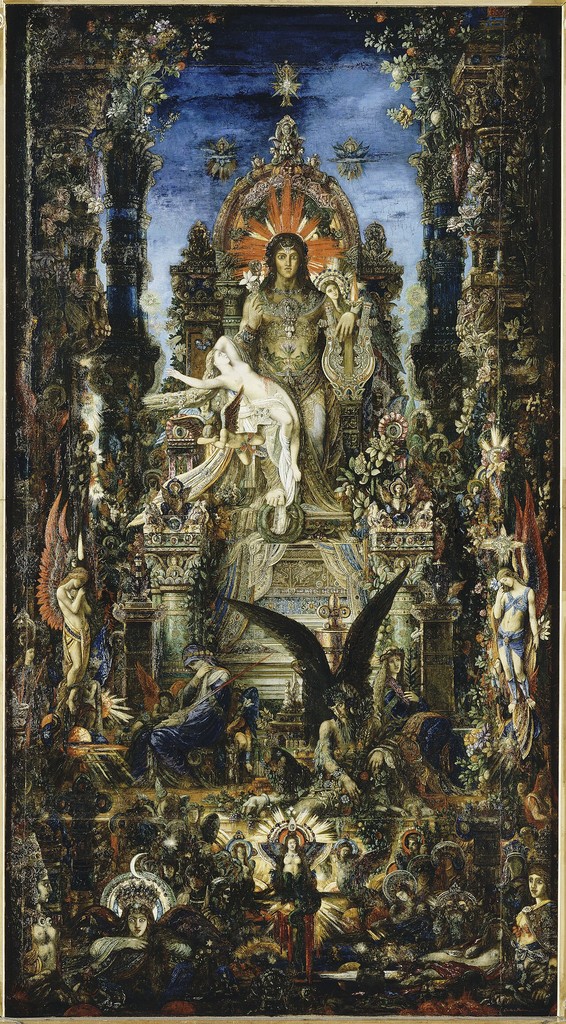
1889–90Jupiter and Semele
1894–95Contents
- Introduction
- Stage One: Family, Training and First Salons, 1826–1856
- Stage Two: Italy and the Return to the Salon, 1857–1869
- Stage Three: Mature Work, Selective Public Life and Honours, 1870–1889
- Stage Four: Academy Teacher and Maker of a Museum, 1890–1898
- Reputation After Moreau’s Death
Stage One: Family, Training and First Salons, 1826–1856
Gustave Moreau was born in Paris on 6 April 1826. His father, Louis Moreau, was an architect, and the Musée Gustave Moreau credits him with giving his son a strong classical culture. His mother, Pauline, closely supervised a childhood affected by poor health. Moreau attended the Collège Rollin from 1836 to 1840. After his thirteen-year-old sister Camille died, he left the school and continued his education with his father while drawing persistently. A first journey to northern Italy in 1841 produced an album of drawings, although the much longer Italian campaign of the late 1850s would be the decisive period of study.[1]
Between 1844 and 1846 Moreau entered the private studio of François-Édouard Picot, a Neoclassical painter responsible for public and church decoration. The studio prepared him for admission to the École Royale des Beaux-Arts in 1846. This was a conventional route towards the most prestigious forms of French history painting. Moreau competed for the Prix de Rome, the prize that could send a young artist to the French Academy in Rome, but failed in 1848 and again in 1849. He then left the École. Failure did not end his academic ambitions or his study of the past: in 1849–50 he copied works in the Louvre and received some commissions from the state’s fine-arts administration.[1]
The friendship that redirected his early development began in 1851. Moreau became close to Théodore Chassériau, who had trained with Ingres but combined linear discipline with colour and Romantic drama. Moreau rented a studio near Chassériau’s on the avenue Frochot. The artist’s museum calls Chassériau’s influence crucial, while the National Gallery presents Moreau’s early work as indebted to both Chassériau and Eugène Delacroix.[1][2] That influence should not be reduced to imitation. Chassériau offered an example of how the inherited language of history painting might be made sensuous, psychologically charged and contemporary without abandoning ambitious subjects.
Moreau first exhibited at the official Salon in 1852. The same year, his parents bought a house in his name at 14 rue de La Rochefoucauld, in the Paris district known as New Athens. The family moved there in 1853, and Louis Moreau arranged for a studio on the upper floor. This address later became inseparable from the artist’s legacy, but it initially functioned as an active family home and workplace rather than a sealed private sanctuary. Moreau went to the theatre and opera, worked for public recognition and operated within the institutions of the Paris art world.[1][3]
Chassériau died in 1856. It is tempting to make that loss explain everything that followed, but the documentary record supports a more precise account: Moreau soon embarked on an exacting programme of self-education in Italy. The journey responded both to his failed Prix de Rome attempts and to his sense that contemporary history painting needed renewal. It was a practical decision about artistic means as much as an emotional turning point.
Stage Two: Italy and the Return to the Salon, 1857–1869
Moreau left for Italy on 18 October 1857 and returned to Paris in September 1859. He followed much of the Grand Tour route, but the surviving account describes a planned research programme rather than tourism. In Rome he studied ancient sculpture and Renaissance fresco, copied Sodoma at the Villa Farnesina, worked from Michelangelo in the Sistine Chapel and made a prized tempera copy of Raphael’s Putto at the Academy of Saint Luke. He attended evening life-drawing sessions at the Villa Medici, where he met or renewed contact with artists including Élie Delaunay, Léon Bonnat and Edgar Degas.[4]
The itinerary expanded with the questions Moreau wanted to answer. Around Rome he made landscape studies in sepia and watercolour. In Florence he copied paintings then attributed to Titian, studied portraits in the Uffizi and worked from the angel in Verrocchio and Leonardo’s Baptism of Christ. Milan offered Leonardo drawings and further study after Titian. In Venice he paid close attention to Vittore Carpaccio, producing numerous copies after the cycles of Saint Ursula and Saint George. Returning to Rome in 1859, he completed further studies before travelling with his parents to Naples, where antiquities and works from Pompeii occupied him. The range is important: line, colour, monumental figure design, narrative cycles, landscape and ancient art all entered a personal working archive.[4]
This immersion did not make Moreau a belated Renaissance painter. It supplied methods and motifs that he could recombine. The museum’s account of his practice stresses drawing at every stage, from first conception to tracing, squaring and full-size transfer. It also identifies a wide visual library: old-master copies, photographs, prints, natural studies, Japanese prints, Renaissance engravings, and Indian and Persian miniatures consulted in the Bibliothèque Nationale. Those sources should be named separately, not collapsed into a vague idea of exotic influence. Moreau’s mature originality lay partly in the disciplined synthesis of disparate materials.[4]
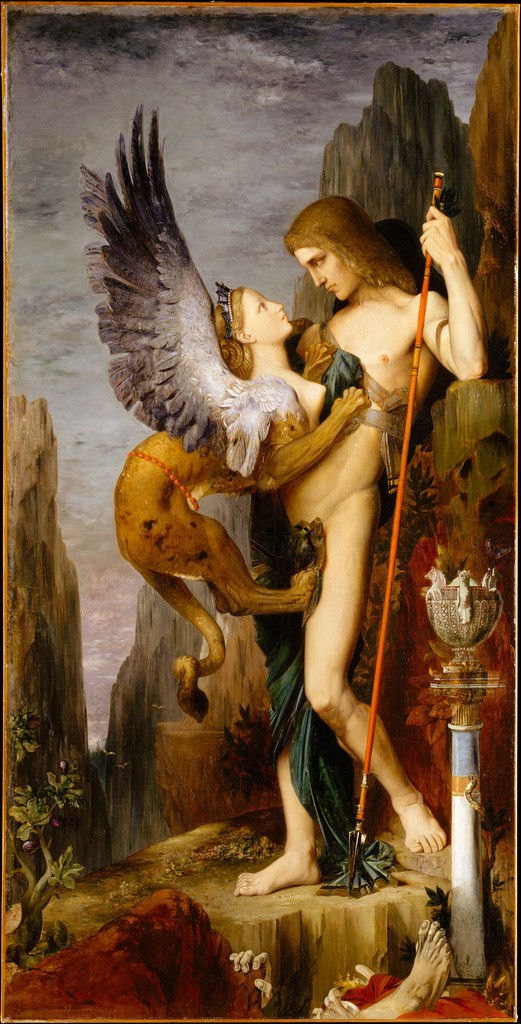
Back in Paris, he worked for several years before making a conspicuous Salon return. His father died in February 1862. In 1864 Moreau exhibited Oedipus and the Sphinx, a tall, severe confrontation between the legendary prince and the creature whose riddle threatens travellers. The Metropolitan Museum of Art, which holds the painting, describes it as the work with which Moreau made his mark at that year’s Salon.[5] Its success contradicts the notion that he had simply abandoned official exhibition. He used the Salon’s public stage to propose a renewed history painting in which a familiar myth became a psychologically concentrated trial.
The following year brought an invitation to Compiègne from Napoleon III. In 1866 the state bought Orpheus, the 1865 panel now in the Musée d’Orsay. Rather than showing the musician’s death, Moreau imagined a young woman holding his severed head on his lyre. Orsay sees in its golden chiaroscuro, complex arrangement and mingling of sensual and mystical feeling essential features of his mature art already taking shape.[6] Public purchase and imperial contact demonstrate that Moreau’s unusual imagery could coexist with institutional recognition.
That recognition remained unstable. At the Salon of 1869 he showed Prometheus and The Abduction of Europa. He received a medal but also harsh criticism, and did not exhibit again at the Salon until 1876.[1] This seven-year interval was a withdrawal from that particular exhibition, not proof that he stopped working, selling or engaging with patrons. The distinction matters. Moreau’s subsequent practice included private commissions, works on paper and elaborately revised paintings, while his later returns to public display were selective rather than nonexistent.
Stage Three: Mature Work, Selective Public Life and Honours, 1870–1889
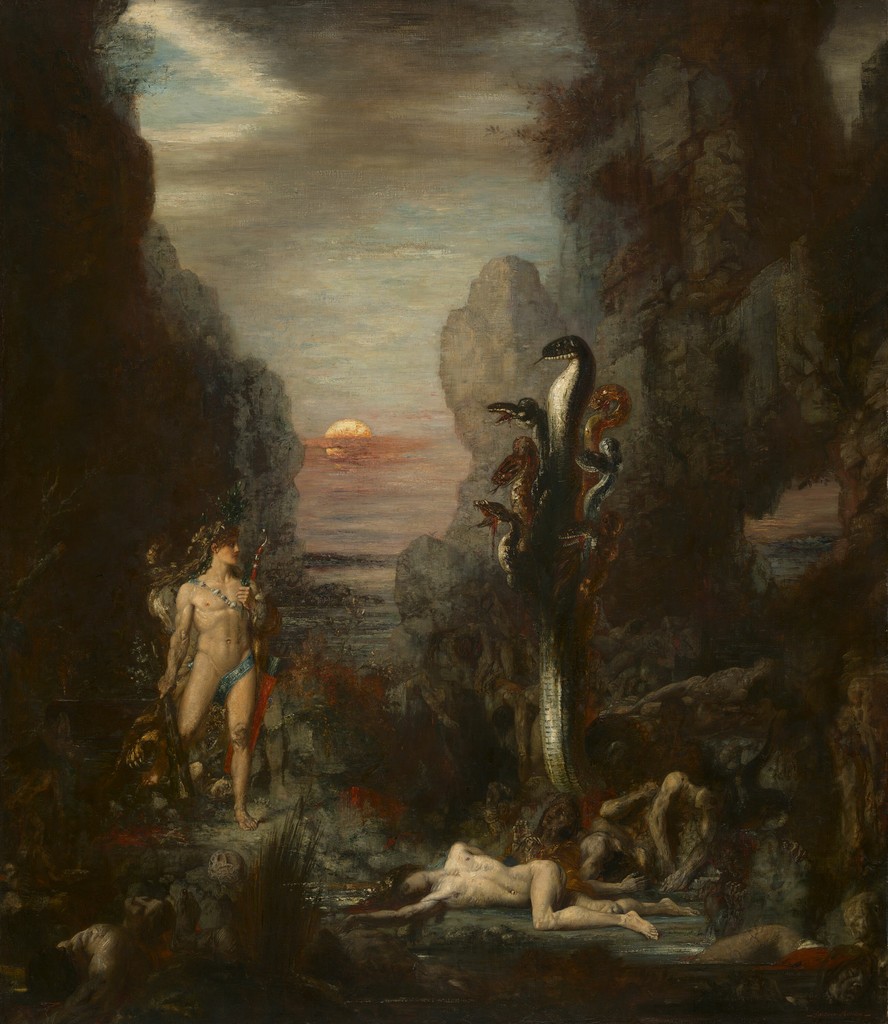
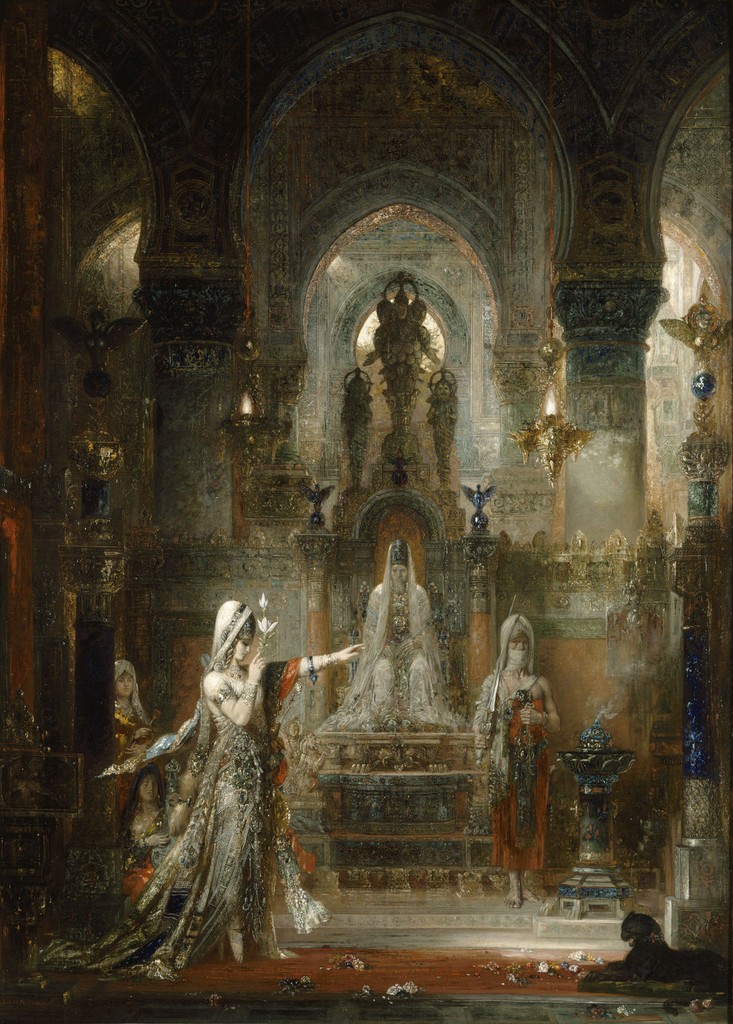
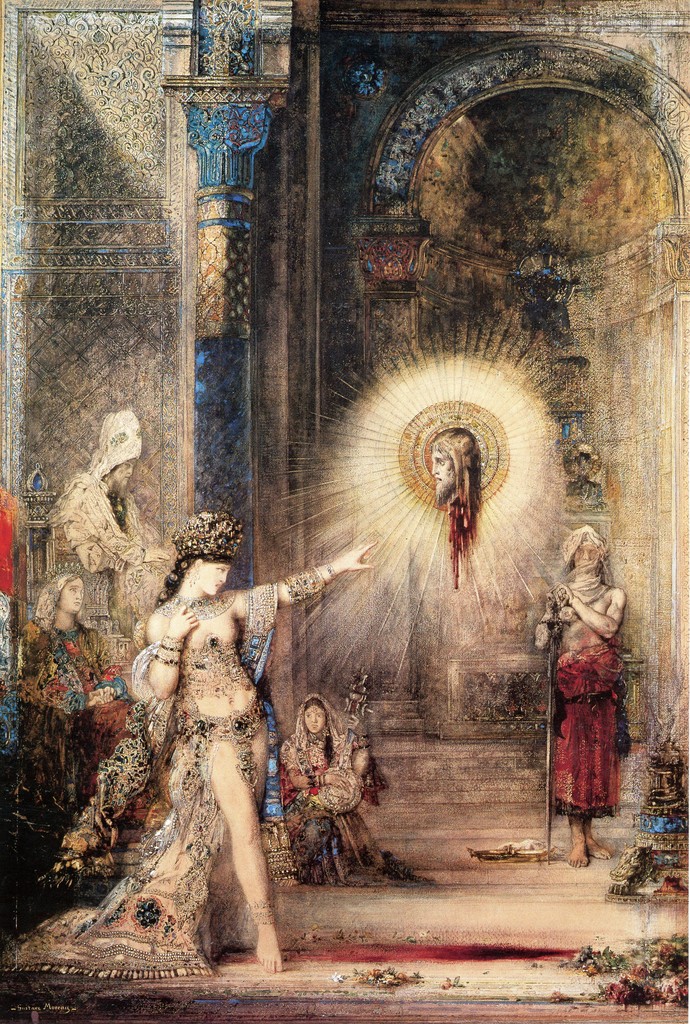
Moreau’s reappearance at the Salon in 1876 was substantial. He exhibited Salomé Dancing, Hercules and the Lernaean Hydra, Saint Sebastian and the watercolour The Apparition.[1] These works were not repetitions of one formula. Salomé Dancing Before Herod was developed through an unusually extensive process: the Hammer Museum reports more than eighty studies and describes how Moreau transferred his design before building the surface through layered paint, incised lines and added ornament.[7] The Apparition, by contrast, demonstrates what watercolour could do for the same narrative world. The active 1876 watercolour is now assigned to the Louvre’s Department of Prints and Drawings and recorded by the Musée d’Orsay; it should not be confused with Moreau’s separate oil versions.[8]
The 1876 Salon therefore marked both a public return and a declaration of technical range. Moreau had been made a Chevalier of the Légion d’honneur in 1875. At the Paris Exposition Universelle of 1878 he showed six paintings, further evidence that his relations with official culture did not end after hostile reviews. In 1879 he began sixty-four watercolours illustrating La Fontaine’s Fables, a private commission that occupied a different scale and medium from his Salon canvases. The finished series remains in private ownership, while preparatory studies are preserved at the Musée Gustave Moreau.[1]
Watercolour was not a secondary sideline. The museum’s technical account describes it as a field in which Moreau allowed himself looser, more experimental decisions than in many complex oils. His drawings and watercolours reveal how he tested poses, transferred designs, studied animals and landscapes, and explored colour without the same burden of monumental finish. This helps explain how the La Fontaine project belongs to the central history of his art rather than a decorative appendix.[4]
Moreau’s final Salon appearance came in 1880 with Helen and Galatea. The Musée d’Orsay dates its panel of Galatea to about 1880 and records that the state bought it directly from Moreau in 1891, another reminder that public acquisition continued after his last Salon.[9] His later career mixed work retained in the studio, commissions, gallery display and official status. In 1886 he completed the polyptych The Life of Humanity and held his only solo exhibition during his lifetime at the Goupil gallery.[1]
Family and friendship belonged to this period, but the record does not justify turning them into a psychological key for every painting. Moreau’s mother died in 1884. The museum chronology records his profound distress, yet grief should not be used to diagnose the artist or mechanically explain a change of style. Alexandrine Dureux, whom he appears to have met shortly after returning from Italy, remained a close friend until her death in 1890. Moreau taught her drawing and gave her works. The later arrangement of his house preserved her furniture and gifts in a room devoted to her memory.[1][10] These facts show intimacy and commemoration; they do not settle questions about the private nature of their relationship.
Institutional ambition also remained active. Moreau stood for election to the Académie des Beaux-Arts in 1882 but was unsuccessful. He became an Officer of the Légion d’honneur in 1883 and was finally elected to the Académie in 1888.[1] His election matters because it complicates the familiar opposition between official academic artist and Symbolist outsider. He could value old-master discipline and official distinction while producing a highly personal art of myth, religion and imagination.
Stage Four: Academy Teacher and Maker of a Museum, 1890–1898
The last stage of Moreau’s life joined two forms of transmission: teaching living artists and arranging his own work for future viewers. After Élie Delaunay died in 1891, Moreau succeeded him as professor at the École des Beaux-Arts in January 1892. He taught there until 1898. The Musée Gustave Moreau counts 125 pupils, including Henri Matisse, Georges Rouault, Albert Marquet, Henri Manguin, Henri Evenepoel and Charles Camoin. Moreau also received pupils and younger artists at his house on Sundays.[4]
His classroom reputation is especially striking because his pupils did not simply reproduce his imagery. Museum accounts emphasise the freedom he gave them and his insistence that each develop an individual personality. He encouraged study from nature and from the old masters, and directed students to the Louvre. This was rigorous rather than permissive teaching: tradition supplied resources, not a style to copy. The later prominence of Matisse, Rouault and Marquet helps explain why Moreau is often connected to Fauvism, but he did not design that movement in advance. His contribution was pedagogical—protecting difference inside an academic institution—rather than prescribing the look of paintings made after his death.[4]
At home, Moreau was preparing another kind of legacy. He had long considered the fate of works kept together in his studio. In April 1895 he commissioned the architect Albert Lafon to transform the family house. Work carried out from May 1895 to September 1896 created large, north-lit studios on the second and third floors, linked by a metal spiral staircase. The first-floor living quarters were rearranged by Moreau as a memorial ensemble for family and friends. It was not the untouched home of his parents: rooms were demolished or reassigned, furniture was moved, and memories were deliberately staged.[3][10]
The new studios could hold large canvases, including works begun much earlier and repeatedly enlarged or revised. Moreau continued to work within this future museum. The studio record notes that The Return of the Argonauts, first painted around 1891, was enlarged after the rebuilding and reworked in 1897. Other canvases remained visibly unfinished, while some late works were executed quickly. The building therefore preserved process as well as polished outcomes.[11]
In the same period Moreau completed Jupiter and Semele, commissioned in 1889 and finished in 1895. Its packed field of figures, emblems and jewel-like colour made it an apt culmination of his painting practice, but it was not a final isolated masterpiece in an inactive studio. He was teaching, revising older canvases, organising drawings and planning what visitors would encounter after his death.[12]
Moreau’s will, dated 10 September 1897, bequeathed the house and its contents to the French state on the condition that the collection retain its integral character. He appointed his friend Henri Rupp as sole legatee and provided resources to complete the project. Moreau died in Paris on 18 April 1898, aged seventy-two. After an inventory, Rupp arranged the dense hanging and installed panels and pivoting frames in accordance with the artist’s intentions. The state accepted the bequest in 1902, and the Musée national Gustave Moreau was inaugurated in January 1903. Georges Rouault, the former pupil, became its first curator.[3]
Reputation After Moreau’s Death
The house-museum preserved something rare: paintings, watercolours, thousands of drawings, working studies, personal rooms and monumental studios remained legible as parts of one sustained practice. It also shaped reception. Early visitors could find the abundance of sketches and unfinished work bewildering, and the museum attracted limited public interest for decades. A wider reassessment gathered momentum with a monographic Louvre exhibition in 1961.[3] Later exhibitions placed Moreau in broader accounts of nineteenth-century art, including the Metropolitan Museum of Art’s 1999 retrospective, which brought together nearly 175 paintings, watercolours, drawings and preparatory studies and presented the span from his early academic formation to his late visionary work.[13]
Moreau is now closely associated with Symbolism, mythology and religion, but the label requires chronology. The literary Symbolist manifesto appeared only in 1886, after many of his defining works. Moreau helped create conditions for pictorial Symbolism through an art that treated inherited narratives as vehicles for suggestion, inward experience and ambiguity. He was not the movement’s sole founder, and calling him a Surrealist would be anachronistic. Surrealists such as André Breton and Salvador Dalí later admired the museum; that is evidence of reception, not a change in Moreau’s historical identity.[3][4]
The biography that survives in his house is therefore double. It records a nineteenth-century artist who sought success through Salons, commissions, honours and teaching, and it records an artist who carefully preserved the private labour behind public works. Moreau’s career makes most sense when those halves remain together. His imagined worlds were built through institutions, study, relationships, technical experiment and deliberate planning for posterity.
Follow Gustave Moreau's career through four stages
Paris, Picot and the example of Chassériau
Moreau grew up in Paris, entered François-Édouard Picot's studio and studied at the École des Beaux-Arts. Early Salon ambitions developed alongside sustained attention to Théodore Chassériau and to older art.
Copying, travel and a decisive Salon re-entry
An extended Italian journey made copying into a working method. Back in Paris, Oedipus and the Sphinx and Orpheus announced a deliberately individual renewal of history painting.
Myth, scripture and a selective public career
Moreau developed richly worked oils and watercolours around heroes, poets, saints and fatal encounters. Salon successes coexisted with a guarded studio practice and long processes of revision.
The École des Beaux-Arts and an artist-designed legacy
As a professor, Moreau encouraged students to find individual means of expression. He also transformed his family house and studios into the museum that would preserve works, studies and working relationships together.
Researched works directory
This searchable evidence census was assembled from public museum records and a reproducible Wikidata snapshot. It is not a catalogue raisonné, a claim to complete oeuvre coverage, or a substitute for Pierre-Louis Mathieu's printed catalogue, which was not consulted for this directory.
| Name | Date | Medium |
|---|---|---|
| Abstract Study | 1850 | Painting |
| Abstract Study | 1875 | Painting |
| Abstract Study | 1890 | Painting |
| Academic Study of a Man | 1847 | Painting |
| Achilles the Centaur Chiron | 1859 | Painting |
| Andromeda | 1867 | Painting |
| Andromeda | Date unknown | Painting |
| Angels Following the Magi | 1860 | Painting |
| Angels following the Three Magi | 1898 | Painting |
| Angels Throwing Flowers on the Vatican | 1850 | Painting |
| Aphrodite, 1871 | Date unknown | Painting |
| Apollo and Daphne | 1852 | Painting |
| Apollo and The Nine Muses | 1856 | Painting |
| Apollo and the Satyrs | 1850 | Painting |
| Apollo Victorious over Python | 1885 | Painting |
| Apollon and Marsyas | 1858 | Painting |
| Ariadne and Theseus | 1875 | Painting |
| Arion | 1891 | Painting |
| Athenians being Delivered to the Minotaur in the Cretan Labyrinth | 1855 | Painting |
| Autumn | 1885 | Painting |
| Bacchanal | 1850 | Painting |
| Bacchus on the Panther -cart. | Date unknown | Painting |
| Bathsheba | 1875 | Painting |
| Beheading of John the Baptist | 1872 | Painting |
| Bertrand and Raton | 1879 | Painting |
| Binding of Isaac | 1850 | Painting |
| Birth of Venus | 1870 | Painting |
| Briseis Departure | 1859 | Painting |
| centaur | Date unknown | Painting |
| Centaurs | 1850 | Painting |
| Chimera | 1850 | Painting |
| Chimeras | 1875 | Painting |
| Christ and the Two Thieves | 1870 | Painting |
| Christ at Gethsemane | 1850 | Painting |
| Christ at Gethsemane | 1875 | Painting |
| Christ at Lake Tiberias | 1850 | Painting |
| Christ at the Column | 1850 | Painting |
| Christ Blessing Hist Mother | 1850 | Painting |
| Christ Reliever | 1850 | Painting |
| Circe | 1850 | Painting |
| Cleopatra | 1850 | Painting |
| Cleopatra | 1887 | Painting |
| Danaé | 1858 | Painting |
| Darius, Fleeing after the battle of Arbela, Stops, Exhausted, to Drink from a Pond | 1853 | Painting |
| Darius Flight | 1850 | Painting |
| Dead Orpheus | 1850 | Painting |
| Dead Orpheus | 1890 | Painting |
| Dead Poet Carried by a Centaur | 1890 | Painting |
| Death Giving Laurels to the Winner of the Tournament | 1859 | Painting |
| Death of a Young Crusader | 1870 | Painting |
| Death of Moses | 1850 | Painting |
| Death of Sapho | 1850 | Painting |
| Death of Sapho | 1872 | Painting |
| Debauchery | 1850 | Painting |
| Dejanira (Autumn) | 1872 | Painting |
| Delilah | 1850 | Painting |
| Delilah | 1890 | Painting |
| Delilah | 1896 | Painting |
| Descent from the Cross | 1850 | Painting |
| Diana bathing | 1900 | Painting |
| Diomede devoured by his horses | 1865 | Painting |
| Diomedes Devoured by His Horses | 1865 | Painting |
| Diomedes Devoured by His Own Horses | 1870 | Painting |
| Œdipus the Wayfarer | 1888 | Painting |
| Draft for Sapho | 1850 | Painting |
| Eleonora Gonzaga, Duchess of Urbino | 1858 | Painting |
| Endymion | 1850 | Painting |
| Erigone | 1865 | Painting |
| Eve | 1850 | Painting |
| Eve | 1875 | Painting |
| Fairy in a Cave | 1850 | Painting |
| Fairy with Griffins | 1870 | Painting |
| Fairy with Griffins | 1876 | Painting |
| Fée aux griffons | 1876 | Drawing |
| Femme et licorne | 1890 | Painting |
| Francesco Maria della Rovere, Duke of Urbino | 1858 | Painting |
| Françoise de Rimini | 1850 | Painting |
| Galatea | c. 1880 | Painting |
| Galathea | 1896 | Painting |
| Galathea | Date unknown | Painting |
| Ganymede | 1886 | Painting |
| Gardian Angel of the City | 1850 | Painting |
| Genius of Evil | 1850 | Painting |
| Genius of Evil | 1875 | Painting |
| Golgotha | 1870 | Painting |
| Hamlet | 1850 | Painting |
| Hamlet Giving Poison to the King | 1850 | Painting |
| Helen | 1850 | Painting |
| Helen | 1880 | Painting |
| Helen at the Scaean Gate | 1888 | Painting |
| Helen Glorified | 1893 | Painting |
| Helen on the Walls of Troy | 1850 | Painting |
| Helen on the Walls of Troy | 1875 | Painting |
| Helene | Date unknown | Painting |
| Hercule et les oiseaux du lac de Stymphale | Date unknown | Painting |
| Hercules and Omphale | 1856 | Painting |
| Hercules and the Ceryneian Hind | 1871 | Painting |
| Hercules and the Daughters of Thespius | 1850 | Painting |
| Hercules and the Lernaean Hydra | 1875–1876 | Painting |
| Hercules and the Nemean Lion | 1850 | Painting |
| Hercules and the Stymphalian Birds | 1872 | Painting |
| Hercules and Thespius Daughters | 1850 | Painting |
| Hercules at Lake Stymphalia | 1875 | Painting |
| Hercules between Vice and Virtue | 1850 | Painting |
| Hesiod and the Muse | 1870 | Painting |
| Hesiod and the Muse | 1875 | Painting |
| Hesiod and the Muse | 1891 | Painting |
| Hesiod and the Muses | 1860 | Painting |
| Hesiod and the Muses | 1882 | Painting |
| Hésiode enfant | 1860 | Painting |
| Horse Rider | 1854 | Painting |
| Horse Rider | 1870 | Painting |
| Horse Rider and Amazon | 1869 | Painting |
| Horse Riders and Horses | 1854 | Painting |
| Indian Women Poets | 1890 | Painting |
| Interior, Draft | 1850 | Painting |
| Jacob and the Angel | 1876 | Painting |
| Jacob and the Angel | 1878 | Painting |
| Jacob et l'Ange | 1878 | Painting |
| Jason | 1865 | Painting |
| Jason et Éros | 1891 | Painting |
| Judith | 1850 | Painting |
| Jupiter and Semele | 1889–1895 | Painting |
| King Canute and His Courtesans | 1850 | Painting |
| King David | 1878 | Painting |
| L'enlèvement d'Europe | 1872 | Painting |
| La Fée | Date unknown | Painting |
| La mort de Sapho | 1872 | Painting |
| La mort de Sapho | 1876 | Painting |
| La Villa Borghèse | Date unknown | Painting |
| Landscape | 1850 | Painting |
| Landscape, Draft | 1850 | Painting |
| Landscape (Neighborhood of Étampes) | 1850 | Painting |
| Le Bon Samaritain | 1865 | Painting |
| Le Cantique des cantiques | 1853 | Painting |
| Le Christ et Madeleine (Noli me Tangere) | 1889 | Painting |
| Le Grand Pan contemple les Sphères Célestes | 1897 | Drawing |
| Le Poète et la Sirène | 1893 | Painting |
| Le Soir | 1887 | Painting |
| Le Sphinx | 1886 | Painting |
| Leda | 1846 | Painting |
| Leda | 1850 | Painting |
| Leda | 1870 | Painting |
| Les Chimères | 1884 | Painting |
| Les Plaintes du poète | 1882 | Painting |
| Life of Humanity | 1875 | Painting |
| Life of Humanity | 1886 | Painting |
| Life of Humanity: Salvator Mundi | 1886 | Painting |
| Life of Humanity: The Golden Age, Adam - Evening - Sleep | 1879 | Painting |
| Life of Humanity: The Golden Age, Adam - Morning - Prayer | 1879 | Painting |
| Life of Humanity: The Golden Age, Adam - Noon - Extasy | 1879 | Painting |
| Life of Humanity: The Iron Age, Cain - Evening - Death | 1879 | Painting |
| Life of Humanity: The Iron Age, Cain - Morning - Work | 1879 | Painting |
| Life of Humanity: The Iron Age, Cain - Noon - Rest | 1879 | Painting |
| Life of Humanity: The Silver Age, Hesiod and Orpheus, Hesiod - Evening - Tears | 1879 | Painting |
| Life of Humanity: The Silver Age, Hesiod and Orpheus, Hesiod - Morning - Inspiration | 1879 | Painting |
| Life of Humanity: The Silver Age, Hesiod and Orpheus, Orpheus - Noon - Song | 1879 | Painting |
| Love Victorious over Death | 1850 | Painting |
| Lucretia and Tarquin | 1850 | Painting |
| Magdalene on Golgotha | 1850 | Painting |
| Magdalene on Golgotha | 1875 | Painting |
| Magdalene on Golgotha | 1880 | Painting |
| Magnolia | 1864 | Painting |
| Martyrdrom | 1850 | Painting |
| Messalina | 1850 | Painting |
| Messalina | 1874 | Painting |
| Messaline | 1874 | Painting |
| Mort de Sapho | 1900 | Painting |
| Moses Exposed | 1875 | Painting |
| Moses Exposed on the Nile | 1875 | Painting |
| Moses, in Sight of the Promised Land, Takes His Sandals Off | 1854 | Painting |
| Moses Rescued from the Nile | 1893 | Painting |
| Mystic Flower | 1890 | Painting |
| Narcissus | 1850 | Painting |
| Narcissus | 1885 | Painting |
| Narcissus | 1890 | Painting |
| Noces d’Alexandre et de Roxane | Date unknown | Drawing |
| Nude Study | 1850 | Painting |
| Nyx, Night Goddess | 1880 | Painting |
| Oedipus and the Sphinx | 1864 | Painting |
| Orestes | 1850 | Painting |
| Orestes | 1875 | Painting |
| Orestes and the Erinyes | 1875 | Painting |
| Orphés | 1865 | Painting |
| Orpheus | 1865 | Painting |
| Orpheus Head | 1850 | Painting |
| Orpheus on Eurydice's Tomb | 1890 | Painting |
| Pasiphaë | 1850 | Painting |
| Pasiphaë | 1880 | Painting |
| Pasiphaë, Grisaille | 1850 | Painting |
| Pauline Moreau as the Virgin | 1848 | Painting |
| Perseus and Andromeda | 1870 | Painting |
| Persian Poet | 1875 | Painting |
| Petrarch After the Triumph | 1850 | Painting |
| Phaéton | 1878 | Painting |
| Phoebus and Boreas | 1879 | Painting |
| Pietà | 1867 | Painting |
| Pietà | 1875 | Painting |
| Pietà | 1876 | Painting |
| Pietà | Date unknown | Painting |
| Pittacus the Tyrant in War Costume | 1883 | Drawing |
| Polyphemus | 1880 | Painting |
| Poney | 1870 | Painting |
| Portrait of Gustave Moreau by Himself | 1850 | Painting |
| Portrait of Gustave Moreau by Himself | 1890 | Painting |
| Postman and Horses | 1854 | Painting |
| Prometheus | 1868 | Painting |
| Prometheus | 1869 | Painting |
| Prometheus Thunderstruck | 1870 | Painting |
| Prometheus, Variant | 1870 | Painting |
| Rape of Deianira | 1850 | Painting |
| Rape of Deianira | 1872 | Painting |
| Return of the Argonauts | 1890 | Painting |
| Ruines de Rome : le Colisée vu des jardins de l'Angélicum des dominicains | 1858 | Painting |
| Saint Cecilia and the Angels of Music | 1850 | Painting |
| Saint Francis Kissing a Leper | 1850 | Painting |
| Saint George and the Dragon | 1889–1890 | Painting |
| Saint Jerome | 1850 | Painting |
| Saint Sebastian | 1850 | Painting |
| Saint Sebastian | 1870 | Painting |
| Saint Sebastian and the Angel | 1876 | Painting |
| Saint Sebastian and the Angels | 1850 | Painting |
| Saint Sebastian Succoured | 1885 | Painting |
| Saint Sebastian with Archers | 1875 | Painting |
| Saint-Sébastien et l'ange | 1876 | Painting |
| Saint Sébastien soigné par les saintes femmes | 1869 | Painting |
| Sainte Cecilia | 1850 | Painting |
| Salome | 1850 | Painting |
| Salome | 1872 | Painting |
| Salome | 1874 | Painting |
| Salome at the Prison | 1873 | Painting |
| Salomé au Jardin | 1878 | Painting |
| Salome Dancing | 1872 | Painting |
| Salomé Dancing Before Herod | 1876 | Painting |
| Salome Dancing in front of Herod | 1876 | Painting |
| Salome with the Head of John the Baptist | 1876 | Painting |
| Santa Cecilia (Moreau) | Date unknown | Painting |
| Sappho falling into the Abyss | 1867 | Painting |
| Semele | 1889 | Painting |
| Semele, Draft | 1889 | Painting |
| Singing Centaurs | 1850 | Painting |
| Slaves Thrown to the Morays | 1850 | Painting |
| Song of Songs (Cantique des Cantiques) | 1893 | Painting |
| Spanish Conversation | 1850 | Painting |
| Spring | 1850 | Painting |
| St. Sebastian | Date unknown | Painting |
| Study | 1850 | Painting |
| Study | 1874 | Painting |
| Study | 1875 | Painting |
| Study for Jupiter and Semele | 1889 | Painting |
| Study for Moses Taking Off His Sandals | 1854 | Painting |
| Study for Saint Cecilia | 1850 | Painting |
| Study for Salome | 1874 | Painting |
| Study for The Triumph of Alexander the Great | 1885 | Painting |
| Study from Nature | 1850 | Painting |
| Study of a red ibis | 1900 | Painting |
| Sultan | 1850 | Painting |
| Suzanne et les vieillards | 1895 | Painting |
| swinging girl | Date unknown | Painting |
| Tea Rose | 1850 | Painting |
| Temptation | 1890 | Painting |
| Tempting Demon | 1875 | Painting |
| The Angels of Sodome | 1872 | Painting |
| The Apparition | 1876 | Drawing |
| The Argonauts | 1885 | Painting |
| The Bad Rich | 1850 | Painting |
| The calvary | 1867 | Painting |
| The childhood of Sixtus V. | 1853 | Painting |
| The Chimera | 1867 | Painting |
| The chimera | Date unknown | Painting |
| The Chimeras | 1850 | Painting |
| The Crowning with Thorns | 1846 | Painting |
| The Daughters of Thespius | 1853 | Painting |
| The Dead Lyres | 1897 | Painting |
| The Decameron | 1850 | Painting |
| The Disciples in Emmaus | 1850 | Painting |
| The Dream Haunting the Mogul | 1881 | Painting |
| The Entombment | 1867 | Painting |
| The Good Samaritan | 1850 | Painting |
| The Infant Moses | 1877 | Painting |
| The Magi | 1860 | Painting |
| The Martyred Saint Sebastian | 1869 | Painting |
| The Mermaid and the Poet | 1895 | Painting |
| The Muses Leaving Their Father Apollo to Go and Light the World | 1868 | Painting |
| The Parca and the Angel of Death | 1890 | Painting |
| The Parcae | 1850 | Painting |
| The Pieridae | 1875 | Painting |
| The Pieridae | 1880 | Painting |
| The Pietà | 1867 | Painting |
| The Plague in Florence | 1870 | Painting |
| The Poet and the Siren | 1894 | Painting |
| The Prodigal Son | 1850 | Painting |
| The Prodigal Son | 1890 | Painting |
| The Rape of Europe | 1868 | Painting |
| The Rape of Europe | 1869 | Painting |
| The Shulamite | 1853 | Painting |
| The Sirens | 1850 | Painting |
| The Sirens | 1875 | Painting |
| The Sirens | 1882 | Painting |
| The Springs | 1856 | Painting |
| The Suitors | 1862 | Painting |
| The Toilette | 1887 | Painting |
| The Travelling Angels | 1875 | Painting |
| The Travelling Poet | 1890 | Painting |
| The Unicorn | 1885 | Painting |
| The Unicorns | 1888 | Painting |
| The Voices | 1867 | Painting |
| The Wandering Jew | 1870 | Painting |
| The Young Man and Death | 1856–1865 | Painting |
| Tomyris and Cyrus | 1850 | Painting |
| Triumph of Alexander the Great | 1873 | Painting |
| Triumphing Church | 1870 | Painting |
| Tyrtaeus | 1850 | Painting |
| Tyrtaeus Singing While Fighting | 1860 | Painting |
| Un Saint au désert | 1879 | Painting |
| Untitled | 1866 | Painting |
| Venice | 1850 | Painting |
| Venice | 1885 | Painting |
| Venus Rising from the Sea | 1866 | Painting |
| Victim | 1850 | Painting |
| Vue de Florence | 1858 | Painting |
| Walk in a Park | 1865 | Painting |
| Water Fairy | 1850 | Painting |
| Womand and Chimera | 1875 | Painting |
| Young Thracian Woman Holding Orpheus' Head | 1866 | Painting |
Frequently Asked Questions
Gustave Moreau was born in Paris on 6 April 1826. He died in Paris on 18 April 1898 and was buried in Montmartre Cemetery after a funeral at the Church of the Trinity. He lived and worked for much of his career at 14 rue de La Rochefoucauld, the family property that he transformed into the Musée Gustave Moreau.[1][3]
Moreau trained in the private studio of François-Édouard Picot from 1844 to 1846 and entered the École Royale des Beaux-Arts in 1846. He left after failing twice to win the Prix de Rome, in 1848 and 1849. He continued his education through copying at the Louvre, friendship with Théodore Chassériau and a systematic two-year study journey in Italy.[1][4]
The 1857–59 journey was a structured research programme intended to deepen Moreau’s command of history painting. He copied and studied ancient, Renaissance and later art in Rome, Florence, Milan, Venice and Naples, worked from the figure, and made landscapes in watercolour and sepia. The studies formed a visual archive that he used throughout his career; they also strengthened his approach to drawing, colour and narrative composition.[4]
Institutional records document close ties to his parents, the early death of his sister Camille, his friendships with artists and pupils, and his long friendship with Alexandrine Dureux. Moreau taught Dureux drawing, gave her works and later preserved her furniture and mementos in his house. The evidence supports calling the relationship close and lasting, but not confident claims about its private character. Nor should the deaths of his mother or Dureux be used as medical diagnoses or automatic explanations for his art.[1][10]
Moreau taught at the École des Beaux-Arts from 1892 to 1898. His 125 pupils included Henri Matisse, Georges Rouault, Albert Marquet, Henri Manguin and Henri Evenepoel, and his teaching encouraged individual development through study of nature and the old masters. In parallel, he converted his house into large studios and memorial rooms, then left the property and its contents to the state. The bequest was accepted in 1902, the museum opened in January 1903, and Rouault served as its first curator.[3][4]
Discussion
Use this evidence-led guide as a starting point for close looking rather than a final verdict.
Share an observation about Gustave Moreau Biography or a source that adds useful context.
Reader Insights
Which work most clearly complicates the familiar image of Moreau as a painter of finished, jewel-like visions?
Where do Paris, Italian study, literary networks or older art most productively alter your reading?
Which source or surviving object would you investigate next?
Join the Conversation
Add your reading below, keeping observations specific and evidence clear.
References
- Musée Gustave Moreau, “Biography of Gustave Moreau”:, accessed 30 August 2026.
- National Gallery, London, “Gustave Moreau (1826–1898)”:, accessed 30 August 2026.
- Musée Gustave Moreau, English Press Kit 2023:, accessed 30 August 2026.
- Musée Gustave Moreau, “The Art of Gustave Moreau”:, accessed 30 August 2026.
- Metropolitan Museum of Art, “Oedipus and the Sphinx”:, accessed 30 August 2026.
- Musée d’Orsay, “Orphée”:, accessed 30 August 2026.
- Hammer Museum, “Salomé Dancing Before Herod”:, accessed 30 August 2026.
- Musée d’Orsay, “L’Apparition”:, accessed 30 August 2026.
- Musée d’Orsay, “Galatée”:, accessed 30 August 2026.
- Musée Gustave Moreau, “Gustave Moreau’s Apartment”:, accessed 30 August 2026.
- Musée Gustave Moreau, “The Studios”:, accessed 30 August 2026.
- Musée Gustave Moreau, “Jupiter and Semele”:, accessed 30 August 2026.
- Metropolitan Museum of Art, “Gustave Moreau: Between Epic and Dream”:, accessed 30 August 2026.