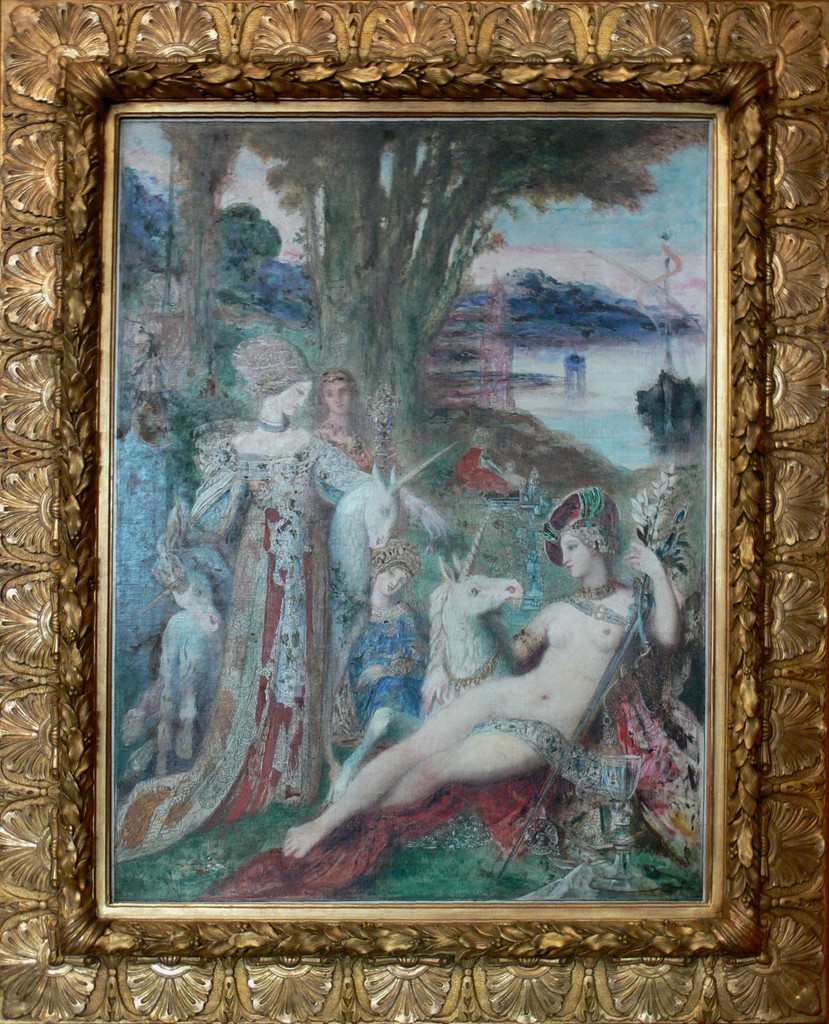
 by Tom Gurney
Tom Gurney BSc (Hons) is an art history expert with over 20 years experience
Page Created: 30 August 2026 / Page Updated: November 6, 2026
Email: tomgurney1@gmail.com / Phone: +44 7429 011000
Gustave Moreau: Symbolism, Mythology and Religion: Introduction
Gustave Moreau did not illustrate ancient myths and biblical episodes as if their meanings were already settled. He selected a charged encounter—the riddle, the vision, the ordeal, the fatal revelation—and rebuilt it through line, colour and an unusually broad visual memory. That method helped later critics place him near Symbolism. It does not turn every crown, flower or jewel into a word in a fixed code. Moreau’s pictures reward interpretation because story, form and remembered art interact; they also resist any single key that claims to unlock them all.
At a Glance
- SymbolismSymbolism became an organised literary movement in the 1880s, after several of Moreau’s defining Salon paintings.
- Subject sourcesGreek myth, scripture, saints’ legends and stories of poets supplied situations that he could transform rather than merely retell.
- Visual traditionsMoreau studied specific traditions, including ancient, Byzantine, medieval and Renaissance art, Indian and Persian miniatures, and Japanese prints.
- Recurring figuresRecurring figures such as the poet, hero, sphinx and Salomé change meaning from one composition to another.
- InterpretationTitles, artist’s notes and museum research can guide a reading, but there is no dependable universal Moreau symbol dictionary.
- LegacyWriters, pupils and twentieth-century viewers extended his reputation in directions he could not wholly control.
Contents
- Introduction
- Symbolism Came After Moreau’s Early Masterworks
- Myth, Scripture, Saints and Poets
- A Library of Images, Not a Single Style
- Poet, Hero, Sphinx and Salomé
- How Visible Form Carries an Idea
- Notes Help, but They Do Not Form a Universal Dictionary
- Huysmans and the Expansion of Salomé
- Teaching an Art of Individual Meaning
Symbolism Came After Moreau’s Early Masterworks
Calling Moreau a Symbolist is useful when it describes his historical importance; it becomes misleading when it suggests that he joined a settled movement before it existed. The Metropolitan Museum of Art dates Symbolism’s initial development as a French literary movement to the 1880s and identifies Jean Moréas’s 1886 manifesto as a public turning point. Its account places Moreau among an older generation that prepared the ground for pictorial Symbolism by favouring imagination, subjective experience and suggestive biblical or mythological imagery over objective description.[1]
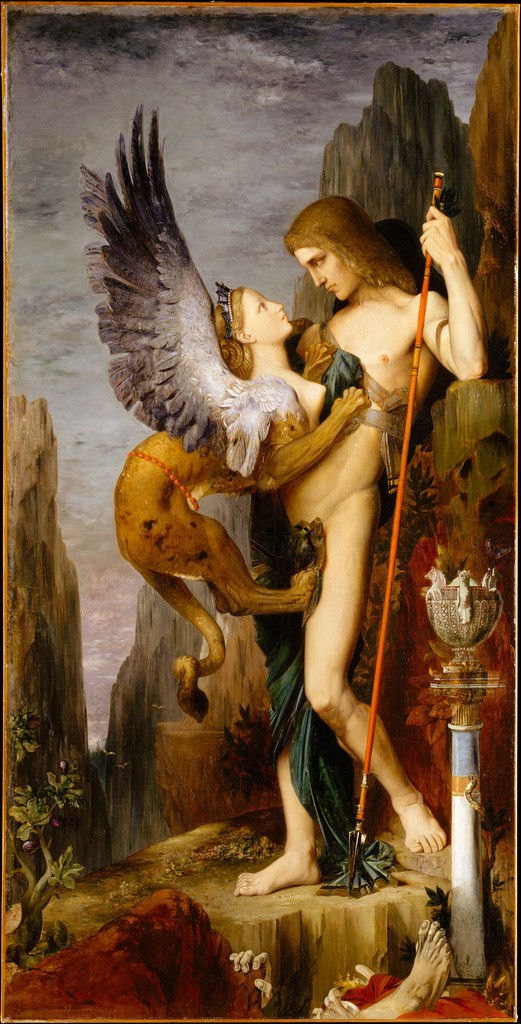
The chronology matters. Oedipus and the Sphinx appeared at the Salon in 1864; Orpheus followed in the middle of that decade; the celebrated group containing Hercules, Salomé and The Apparition was shown in 1876. Those works can be understood as precedents for later Symbolist art without making Moreau a member of a party in advance. His own institutional identity remained that of a history painter trained for the Salon and eventually elected to the Académie des Beaux-Arts.[2]
This distinction also prevents a false opposition between tradition and invention. Moreau retained ambitious narrative subjects, careful drawing and study of earlier art. What changed was the function of those resources. A familiar story became less a lesson with one public conclusion than a structure for fear, desire, inspiration, sacrifice or spiritual aspiration. That shift is central to his importance for Symbolism, even though his art does not share one style with every artist now placed under the label.
Myth, Scripture, Saints and Poets
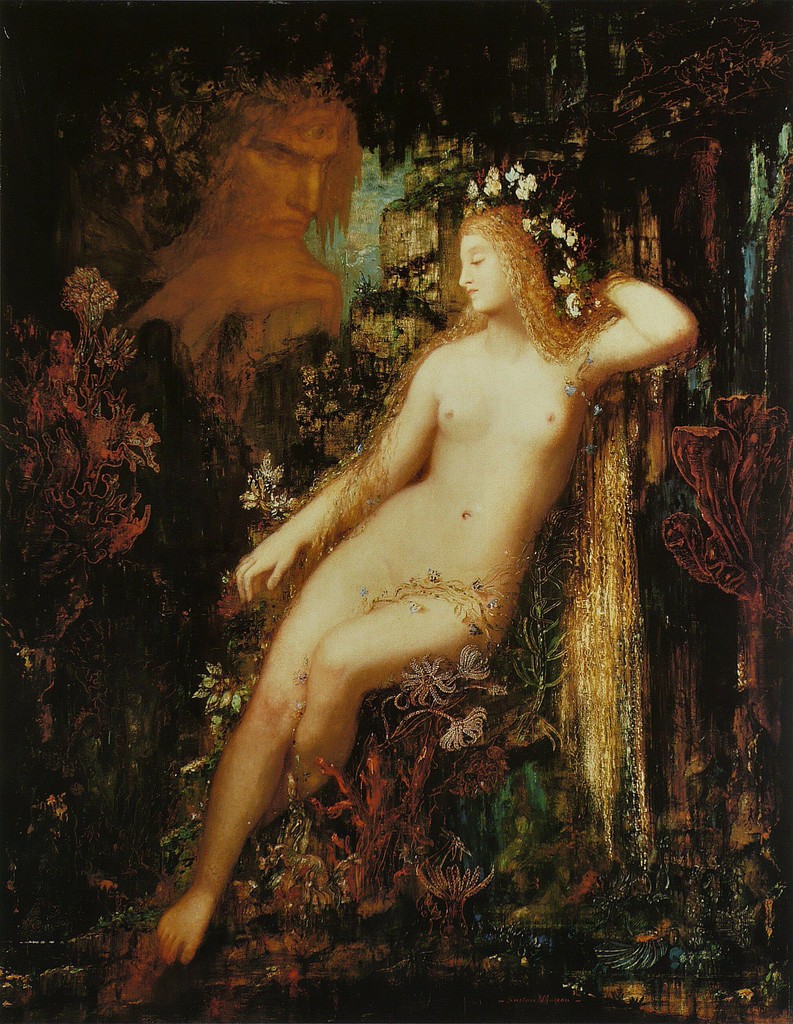
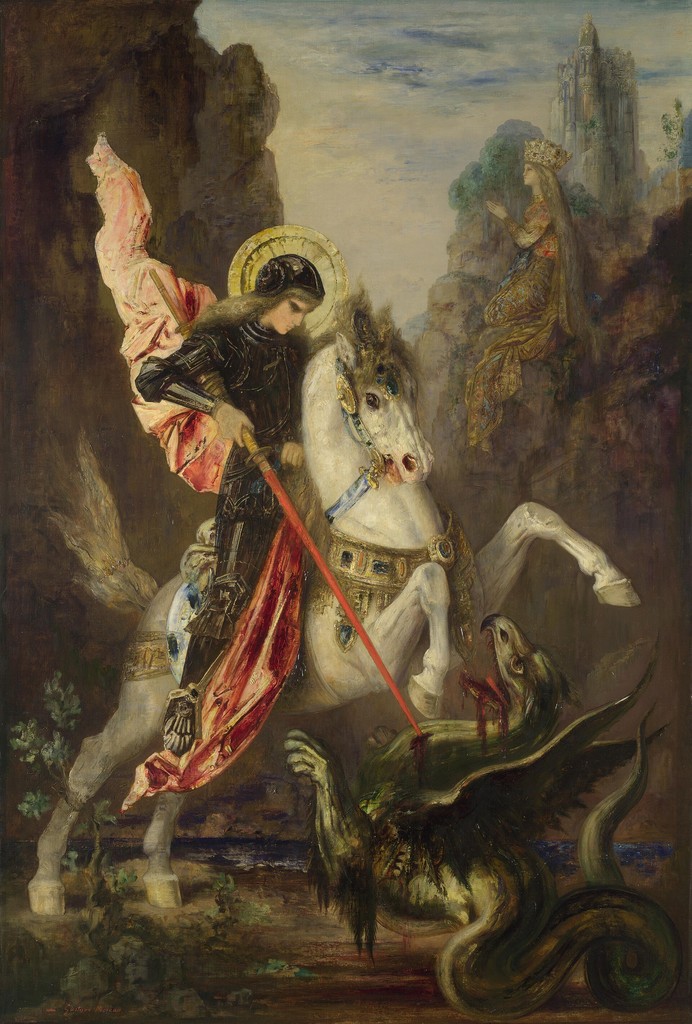
Moreau ranged across bodies of story rather than confining himself to one mythology. Greek subjects include Oedipus, Hercules, Prometheus, Orpheus, Galatea, Hesiod, Jupiter and Semele. Biblical imagery includes Salomé, Herod, John the Baptist and Moses. Saint George offered a Christian legend in which warrior, victim, monster and rescue could be held in one vertical design. Literary sources and later retellings supplemented scripture and ancient texts.
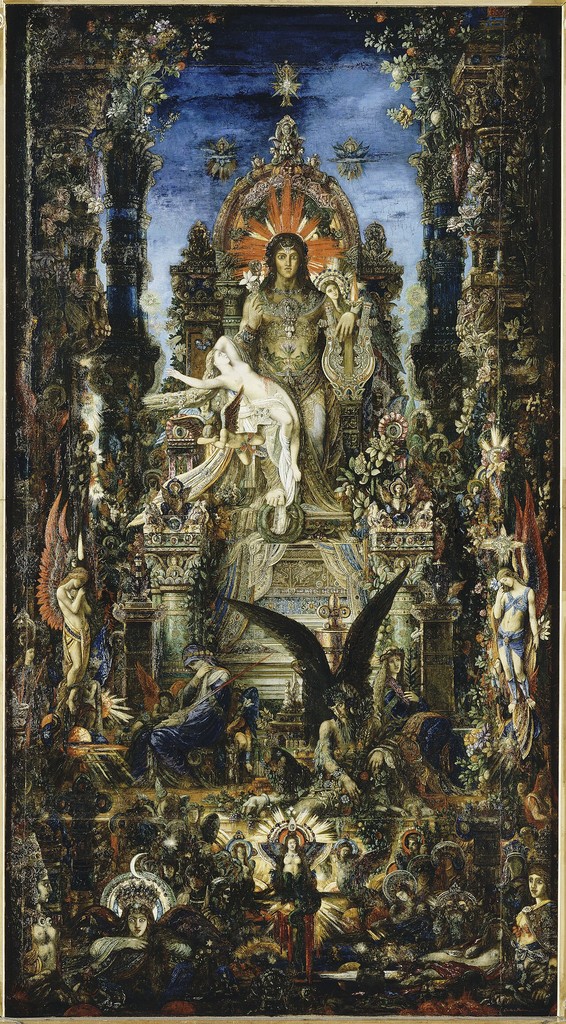
These subjects gave Moreau situations already dense with consequences. Oedipus solves the Sphinx’s riddle but remains caught in a tragedy he does not yet understand. Prometheus helps humanity and suffers divine punishment. Semele’s demand to see Jupiter revealed destroys her mortal body. Such narratives join knowledge to danger. Moreau could stop them at the instant when a figure faces something that cannot be safely mastered. In Jupiter and Semele, for example, the museum identifies a vertical movement from shadowed, hybrid beings towards increasingly spiritual regions, while the central revelation brings death as well as transcendence.[3]
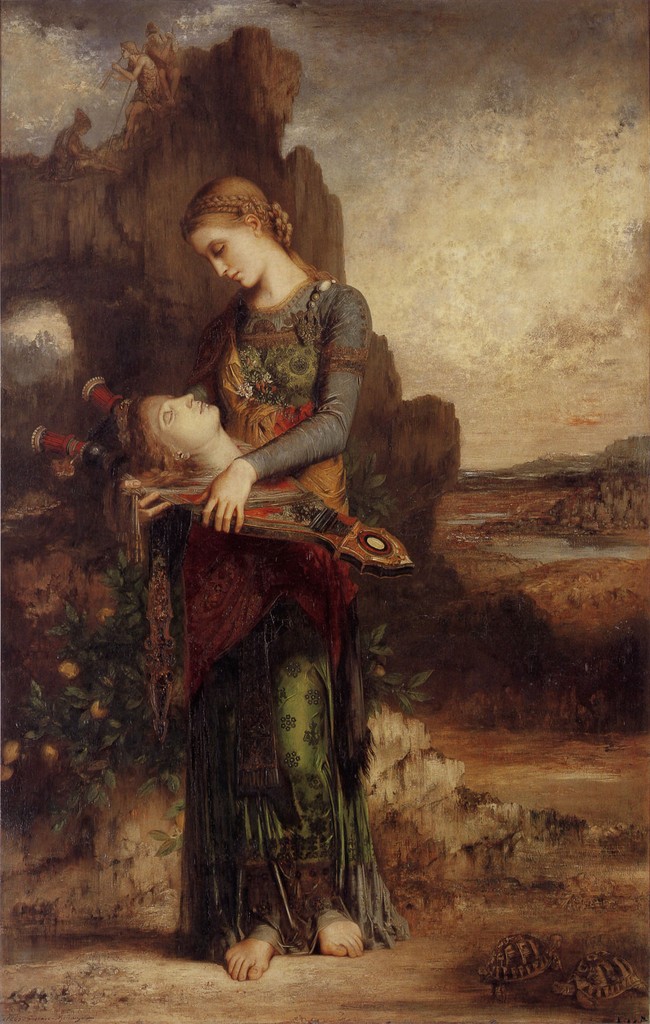
Poets provide a different model. The Musée d’Orsay interprets Orpheus as Moreau’s invention: a young woman receives the dead musician’s head and lyre, and physical horror gives way to a suspended, contemplative meeting.[4] In Hesiod and the Muses, Moreau chose the poet’s vocation, when the shepherd receives divine inspiration. The Musée Gustave Moreau connects that subject to Hesiod’s Theogony, John Flaxman’s engravings known from Moreau’s family library and memories of Italian art.[5] Poet and hero are therefore not interchangeable emblems. One listens or transmits; another confronts; both can stage the uncertain passage between ordinary life and knowledge from beyond it.
Religious subjects should be read with equal care. They can carry sacrifice, purity, corruption, vision and salvation without proving a simple account of Moreau’s private belief. The artist’s museum describes a spiritual ambition in his theory of painting, but biography is not required to recognise how a halo, shrine-like architecture or biblical episode structures a given image.[2] The responsible question is what the work does with religious form, not whether every passage is a confession.
A Library of Images, Not a Single Style
Moreau’s imagined worlds were assembled through sustained looking. His 1857–59 journey in Italy involved copying and comparison in Rome, Florence, Milan, Venice and Naples. He studied ancient art, Renaissance fresco and painting, Venetian narrative cycles and material associated with Pompeii. The journey created a working store of figures, gestures, landscapes and arrangements that he could revisit long afterwards.[6]
Research continued in Paris. The Musée Gustave Moreau records his use of classical models, engravings, photographs and illustrated publications. At the Bibliothèque Nationale he consulted Indian and Persian miniatures as well as Renaissance prints; he also collected Japanese prints.[2] Naming these sources matters. “Non-Western” or “Oriental” is too broad to explain how a specific pattern, line or compositional device entered one picture, and it can conceal the different histories of the works Moreau viewed.
Saint George and the Dragon offers a well-documented case. The National Gallery connects its horse and armed saint to Raphael, its narrative ancestry to Carpaccio, its outlines and halo to Byzantine icon painting, and parts of its ornament to Late Gothic art and Moreau’s awareness of Indian and Persian miniatures. The Gallery presents these relationships as an eclectic field of sources, not as one geographical style.[7] The result is neither an archaeological reconstruction nor a disguised copy of one prototype.
Quotation became invention through selection and rearrangement. A remembered horse may enter a new landscape; the flat authority of an icon can organise an oil painting made for a nineteenth-century collector; a miniature’s precision can affect the treatment of pattern without transferring its original subject. The paintings guide traces how this assembly worked alongside revision and surface, while the drawings and watercolours guide follows the paper processes that made recombination possible. Source recognition is valuable when it clarifies a choice. It is not a contest to identify one parent image for every detail.
Poet, Hero, Sphinx and Salomé
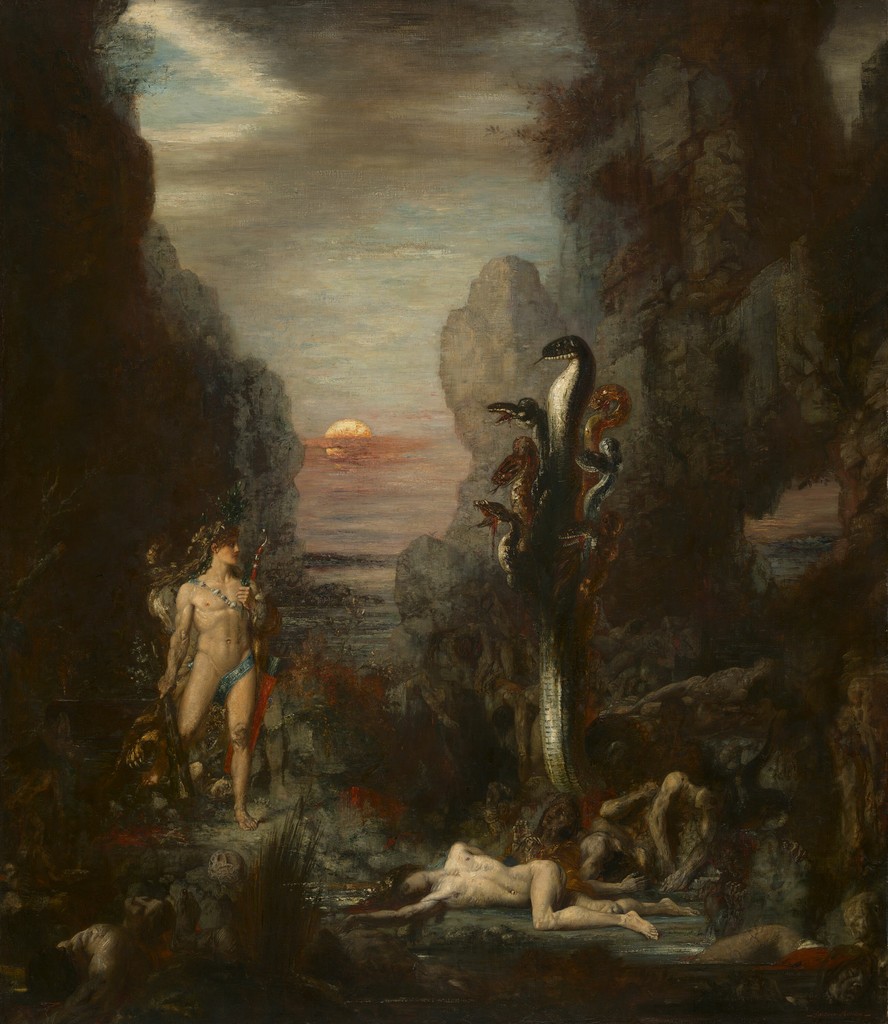
Moreau’s recurring figures form families of questions, not stable definitions. The poet can appear as a severed head whose song survives bodily death, as in Orpheus, or as a shepherd receiving the Muses’ gift, as in the Hesiod compositions. A hero may possess physical power yet remain almost motionless before an adversary. The Art Institute of Chicago describes Hercules and the Lernaean Hydra as a confrontation in which the muscular hero and many-headed creature are held in taut opposition rather than shown at the peak of combat.[8] Moreau repeatedly asks what an encounter reveals before action resolves it.
The Sphinx makes that delay particularly intense. The Metropolitan Museum’s study of mythical female hybrids notes that Moreau’s Oedipus obscures the expected outcome: monster and hero lock eyes while her claws fasten to his body. It also records Moreau’s own oppositional account of the image, in which the Sphinx represents an attractive material threat challenged by a steadfast soul.[9] That evidence supports a reading of conflict between bodily temptation and intellectual or spiritual resistance. It does not require every later viewer to accept the gender hierarchy embedded in that account.
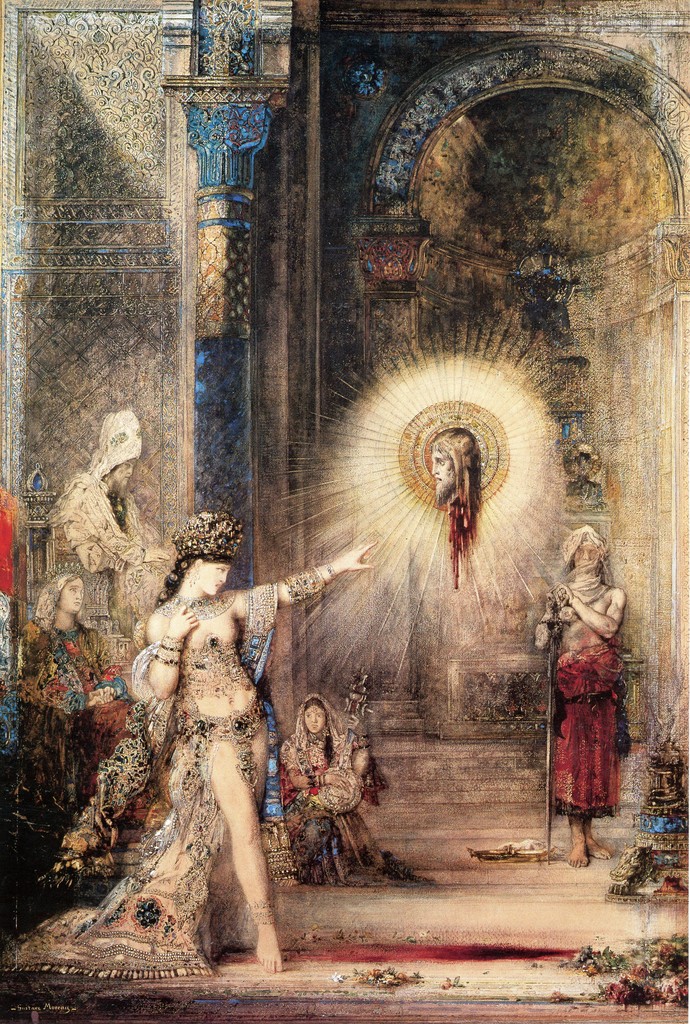
Indeed, the history of the “femme fatale” category deserves scrutiny. Later Symbolist culture repeatedly made beautiful women bear ideas of danger, sexuality and death; the Met identifies the Sphinx and Salomé as motifs that Moreau helped popularise within that pattern.[1] The label explains part of the period’s reception, but it can flatten very different characters and make male fear seem like a timeless truth about women. In Oedipus, the Sphinx is predator, riddle and physical attachment. In Moreau’s Salomé subjects, a biblical daughter becomes dancer, agent, witness or terrified beholder depending on the moment chosen.
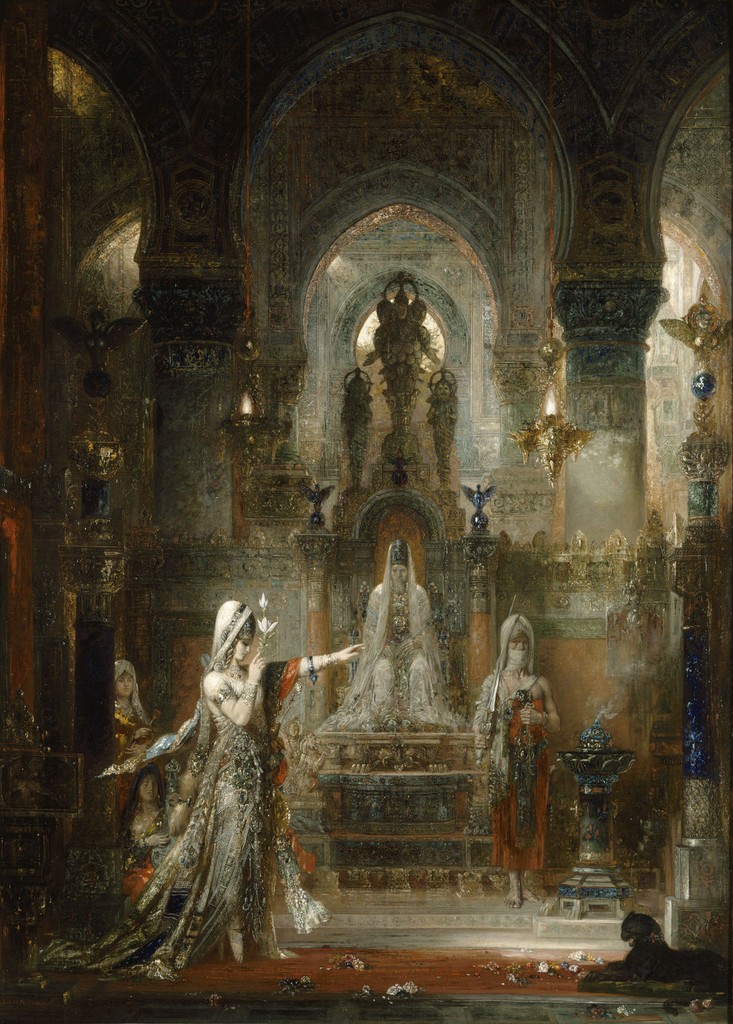
The 1876 Salomé Dancing Before Herod in the Hammer Museum suspends the dance within a dark, ceremonial interior. Moreau built that painting through more than eighty studies, according to the museum, so its profusion rests on prolonged design.[10] The famous watercolour The Apparition shows another instant: the severed head of John the Baptist manifests before Salomé. The Musée d’Orsay identifies that watercolour as the 1876 Salon work now assigned to the Louvre’s graphic-arts collection.[11] A separate oil in the Musée Gustave Moreau revisits its iconography.[12] Treating all these objects as one “Salomé” would erase the decisions that make each version interpretable.
How Visible Form Carries an Idea
For Moreau, meaning was not a message added after the design. The artist’s museum describes painting as a mental art in which line, arabesque and material means evoke thought.[2] That position helps explain why his narratives are often static. When action slows, spacing, silhouette, colour and gaze become argumentative. Oedipus’s upright body answers the Sphinx’s clinging diagonal; the paired faces in Orpheus turn a gruesome relic into a quiet exchange; the towering organisation of Jupiter and Semele makes spiritual ascent and mortal collapse simultaneous.
Ornament participates in this work. Dense jewellery may intensify a figure’s ceremonial distance, while a dark unfilled area may isolate an encounter. A throne or temple can establish hierarchy without representing a historically exact building. Moreau’s imagery is therefore “literary” only in a limited sense. A title and source story begin the reading, but the painting changes the story through its own visible relationships.
This is why subject and technique should not be separated. Moreau’s drawings organise bodies and attributes; tracing and enlargement stabilise a complex arrangement; watercolour can make a vision seem to flare or dissolve; layered oil can give a sanctuary material weight. Form does not merely decorate the idea. It is the means by which an inherited narrative becomes newly uncertain and available to feeling.
Notes Help, but They Do Not Form a Universal Dictionary
Some works have unusually direct interpretive evidence. The museum’s account of Jupiter and Semele identifies figures such as Death and Sorrow and explains the Sphinxes at the base as guardians associated with past and future.[3] Moreau’s recorded explanation of Oedipus supplies another strong guide.[9] Such notes matter because they connect a particular artist, title and object to a particular interpretation.
The method cannot simply be exported. A lily does not automatically mean precisely the same thing in every Moreau composition; neither does a lyre, halo, crown or monster. Attributes inherit histories from myth, scripture and earlier art, but their force changes with placement and company. The lyre belongs naturally to Orpheus, yet the museum notes that Moreau gives one to Jupiter, converting the ruler of the gods into a poet-god.[3] Context alters the attribute.
A reliable reading begins with the current object record, confirms which version is under discussion, identifies the source narrative, and then tests an interpretation against what is visible. Where an artist’s note or institutional essay supports a meaning, it should be cited. Where evidence ends, language such as “may suggest” is more accurate than certainty. Ambiguity is not a research failure when the picture was constructed to sustain it.
Huysmans and the Expansion of Salomé
Moreau’s reputation grew through writing as well as exhibition. Joris-Karl Huysmans devoted an extended passage in his 1884 novel À rebours to Moreau’s Salomé imagery. The Musée Gustave Moreau explains that the fictional collector Des Esseintes contemplates Salomé and The Apparition, and that Huysmans’s description helped link the paintings to a literary world of heightened sensation and artifice.[13] This was reception, not an artist’s instruction manual.
The distinction is useful because Huysmans’s prose amplified features that later readers associate with Decadence and the femme fatale. It demonstrates how compelling Moreau’s images became for a novelist, while also showing how interpretation can acquire a life outside the studio. Oscar Wilde and later artists would further develop the Salomé story. Their versions illuminate the cultural afterlife of Moreau’s subjects without settling what every element originally meant.
Twentieth-century interest widened the frame again. A major 1998–99 retrospective, shown in Paris, Chicago and New York, brought together nearly 175 works at the Metropolitan venue, including Salon paintings, watercolours, drawings and preparatory studies. The Met presented a fifty-year career whose later experiments influenced very different subsequent artists.[14] Later admiration should be described as influence or reception; it should not be used to rename Moreau as a member of a movement formed after his time.
Teaching an Art of Individual Meaning
Moreau’s influence was also direct. From 1892 until his death he taught at the École des Beaux-Arts, where his pupils included Henri Matisse, Georges Rouault, Albert Marquet, Henri Evenepoel and Charles Camoin. The Musée Gustave Moreau emphasises that he encouraged each student to develop an individual personality while studying nature and the old masters.[2][15]
That approach is consistent with his own use of tradition. Moreau did not ask pupils to reproduce his mythic figures or ornate surfaces. He modelled a way of treating historical art as material for invention. The eventual stylistic distance between Matisse, Rouault and their teacher is therefore evidence of the teaching’s purpose, not its failure. His strongest legacy lies less in a transferable set of symbols than in permission to make form answer an inward idea.
Researched works directory
This searchable evidence census was assembled from public museum records and a reproducible Wikidata snapshot. It is not a catalogue raisonné, a claim to complete oeuvre coverage, or a substitute for Pierre-Louis Mathieu's printed catalogue, which was not consulted for this directory.
| Name | Date | Medium |
|---|---|---|
| Abstract Study | 1850 | Painting |
| Abstract Study | 1875 | Painting |
| Abstract Study | 1890 | Painting |
| Academic Study of a Man | 1847 | Painting |
| Achilles the Centaur Chiron | 1859 | Painting |
| Andromeda | 1867 | Painting |
| Andromeda | Date unknown | Painting |
| Angels Following the Magi | 1860 | Painting |
| Angels following the Three Magi | 1898 | Painting |
| Angels Throwing Flowers on the Vatican | 1850 | Painting |
| Aphrodite, 1871 | Date unknown | Painting |
| Apollo and Daphne | 1852 | Painting |
| Apollo and The Nine Muses | 1856 | Painting |
| Apollo and the Satyrs | 1850 | Painting |
| Apollo Victorious over Python | 1885 | Painting |
| Apollon and Marsyas | 1858 | Painting |
| Ariadne and Theseus | 1875 | Painting |
| Arion | 1891 | Painting |
| Athenians being Delivered to the Minotaur in the Cretan Labyrinth | 1855 | Painting |
| Autumn | 1885 | Painting |
| Bacchanal | 1850 | Painting |
| Bacchus on the Panther -cart. | Date unknown | Painting |
| Bathsheba | 1875 | Painting |
| Beheading of John the Baptist | 1872 | Painting |
| Bertrand and Raton | 1879 | Painting |
| Binding of Isaac | 1850 | Painting |
| Birth of Venus | 1870 | Painting |
| Briseis Departure | 1859 | Painting |
| centaur | Date unknown | Painting |
| Centaurs | 1850 | Painting |
| Chimera | 1850 | Painting |
| Chimeras | 1875 | Painting |
| Christ and the Two Thieves | 1870 | Painting |
| Christ at Gethsemane | 1850 | Painting |
| Christ at Gethsemane | 1875 | Painting |
| Christ at Lake Tiberias | 1850 | Painting |
| Christ at the Column | 1850 | Painting |
| Christ Blessing Hist Mother | 1850 | Painting |
| Christ Reliever | 1850 | Painting |
| Circe | 1850 | Painting |
| Cleopatra | 1850 | Painting |
| Cleopatra | 1887 | Painting |
| Danaé | 1858 | Painting |
| Darius, Fleeing after the battle of Arbela, Stops, Exhausted, to Drink from a Pond | 1853 | Painting |
| Darius Flight | 1850 | Painting |
| Dead Orpheus | 1850 | Painting |
| Dead Orpheus | 1890 | Painting |
| Dead Poet Carried by a Centaur | 1890 | Painting |
| Death Giving Laurels to the Winner of the Tournament | 1859 | Painting |
| Death of a Young Crusader | 1870 | Painting |
| Death of Moses | 1850 | Painting |
| Death of Sapho | 1850 | Painting |
| Death of Sapho | 1872 | Painting |
| Debauchery | 1850 | Painting |
| Dejanira (Autumn) | 1872 | Painting |
| Delilah | 1850 | Painting |
| Delilah | 1890 | Painting |
| Delilah | 1896 | Painting |
| Descent from the Cross | 1850 | Painting |
| Diana bathing | 1900 | Painting |
| Diomede devoured by his horses | 1865 | Painting |
| Diomedes Devoured by His Horses | 1865 | Painting |
| Diomedes Devoured by His Own Horses | 1870 | Painting |
| Œdipus the Wayfarer | 1888 | Painting |
| Draft for Sapho | 1850 | Painting |
| Eleonora Gonzaga, Duchess of Urbino | 1858 | Painting |
| Endymion | 1850 | Painting |
| Erigone | 1865 | Painting |
| Eve | 1850 | Painting |
| Eve | 1875 | Painting |
| Fairy in a Cave | 1850 | Painting |
| Fairy with Griffins | 1870 | Painting |
| Fairy with Griffins | 1876 | Painting |
| Fée aux griffons | 1876 | Drawing |
| Femme et licorne | 1890 | Painting |
| Francesco Maria della Rovere, Duke of Urbino | 1858 | Painting |
| Françoise de Rimini | 1850 | Painting |
| Galatea | c. 1880 | Painting |
| Galathea | 1896 | Painting |
| Galathea | Date unknown | Painting |
| Ganymede | 1886 | Painting |
| Gardian Angel of the City | 1850 | Painting |
| Genius of Evil | 1850 | Painting |
| Genius of Evil | 1875 | Painting |
| Golgotha | 1870 | Painting |
| Hamlet | 1850 | Painting |
| Hamlet Giving Poison to the King | 1850 | Painting |
| Helen | 1850 | Painting |
| Helen | 1880 | Painting |
| Helen at the Scaean Gate | 1888 | Painting |
| Helen Glorified | 1893 | Painting |
| Helen on the Walls of Troy | 1850 | Painting |
| Helen on the Walls of Troy | 1875 | Painting |
| Helene | Date unknown | Painting |
| Hercule et les oiseaux du lac de Stymphale | Date unknown | Painting |
| Hercules and Omphale | 1856 | Painting |
| Hercules and the Ceryneian Hind | 1871 | Painting |
| Hercules and the Daughters of Thespius | 1850 | Painting |
| Hercules and the Lernaean Hydra | 1875–1876 | Painting |
| Hercules and the Nemean Lion | 1850 | Painting |
| Hercules and the Stymphalian Birds | 1872 | Painting |
| Hercules and Thespius Daughters | 1850 | Painting |
| Hercules at Lake Stymphalia | 1875 | Painting |
| Hercules between Vice and Virtue | 1850 | Painting |
| Hesiod and the Muse | 1870 | Painting |
| Hesiod and the Muse | 1875 | Painting |
| Hesiod and the Muse | 1891 | Painting |
| Hesiod and the Muses | 1860 | Painting |
| Hesiod and the Muses | 1882 | Painting |
| Hésiode enfant | 1860 | Painting |
| Horse Rider | 1854 | Painting |
| Horse Rider | 1870 | Painting |
| Horse Rider and Amazon | 1869 | Painting |
| Horse Riders and Horses | 1854 | Painting |
| Indian Women Poets | 1890 | Painting |
| Interior, Draft | 1850 | Painting |
| Jacob and the Angel | 1876 | Painting |
| Jacob and the Angel | 1878 | Painting |
| Jacob et l'Ange | 1878 | Painting |
| Jason | 1865 | Painting |
| Jason et Éros | 1891 | Painting |
| Judith | 1850 | Painting |
| Jupiter and Semele | 1889–1895 | Painting |
| King Canute and His Courtesans | 1850 | Painting |
| King David | 1878 | Painting |
| L'enlèvement d'Europe | 1872 | Painting |
| La Fée | Date unknown | Painting |
| La mort de Sapho | 1872 | Painting |
| La mort de Sapho | 1876 | Painting |
| La Villa Borghèse | Date unknown | Painting |
| Landscape | 1850 | Painting |
| Landscape, Draft | 1850 | Painting |
| Landscape (Neighborhood of Étampes) | 1850 | Painting |
| Le Bon Samaritain | 1865 | Painting |
| Le Cantique des cantiques | 1853 | Painting |
| Le Christ et Madeleine (Noli me Tangere) | 1889 | Painting |
| Le Grand Pan contemple les Sphères Célestes | 1897 | Drawing |
| Le Poète et la Sirène | 1893 | Painting |
| Le Soir | 1887 | Painting |
| Le Sphinx | 1886 | Painting |
| Leda | 1846 | Painting |
| Leda | 1850 | Painting |
| Leda | 1870 | Painting |
| Les Chimères | 1884 | Painting |
| Les Plaintes du poète | 1882 | Painting |
| Life of Humanity | 1875 | Painting |
| Life of Humanity | 1886 | Painting |
| Life of Humanity: Salvator Mundi | 1886 | Painting |
| Life of Humanity: The Golden Age, Adam - Evening - Sleep | 1879 | Painting |
| Life of Humanity: The Golden Age, Adam - Morning - Prayer | 1879 | Painting |
| Life of Humanity: The Golden Age, Adam - Noon - Extasy | 1879 | Painting |
| Life of Humanity: The Iron Age, Cain - Evening - Death | 1879 | Painting |
| Life of Humanity: The Iron Age, Cain - Morning - Work | 1879 | Painting |
| Life of Humanity: The Iron Age, Cain - Noon - Rest | 1879 | Painting |
| Life of Humanity: The Silver Age, Hesiod and Orpheus, Hesiod - Evening - Tears | 1879 | Painting |
| Life of Humanity: The Silver Age, Hesiod and Orpheus, Hesiod - Morning - Inspiration | 1879 | Painting |
| Life of Humanity: The Silver Age, Hesiod and Orpheus, Orpheus - Noon - Song | 1879 | Painting |
| Love Victorious over Death | 1850 | Painting |
| Lucretia and Tarquin | 1850 | Painting |
| Magdalene on Golgotha | 1850 | Painting |
| Magdalene on Golgotha | 1875 | Painting |
| Magdalene on Golgotha | 1880 | Painting |
| Magnolia | 1864 | Painting |
| Martyrdrom | 1850 | Painting |
| Messalina | 1850 | Painting |
| Messalina | 1874 | Painting |
| Messaline | 1874 | Painting |
| Mort de Sapho | 1900 | Painting |
| Moses Exposed | 1875 | Painting |
| Moses Exposed on the Nile | 1875 | Painting |
| Moses, in Sight of the Promised Land, Takes His Sandals Off | 1854 | Painting |
| Moses Rescued from the Nile | 1893 | Painting |
| Mystic Flower | 1890 | Painting |
| Narcissus | 1850 | Painting |
| Narcissus | 1885 | Painting |
| Narcissus | 1890 | Painting |
| Noces d’Alexandre et de Roxane | Date unknown | Drawing |
| Nude Study | 1850 | Painting |
| Nyx, Night Goddess | 1880 | Painting |
| Oedipus and the Sphinx | 1864 | Painting |
| Orestes | 1850 | Painting |
| Orestes | 1875 | Painting |
| Orestes and the Erinyes | 1875 | Painting |
| Orphés | 1865 | Painting |
| Orpheus | 1865 | Painting |
| Orpheus Head | 1850 | Painting |
| Orpheus on Eurydice's Tomb | 1890 | Painting |
| Pasiphaë | 1850 | Painting |
| Pasiphaë | 1880 | Painting |
| Pasiphaë, Grisaille | 1850 | Painting |
| Pauline Moreau as the Virgin | 1848 | Painting |
| Perseus and Andromeda | 1870 | Painting |
| Persian Poet | 1875 | Painting |
| Petrarch After the Triumph | 1850 | Painting |
| Phaéton | 1878 | Painting |
| Phoebus and Boreas | 1879 | Painting |
| Pietà | 1867 | Painting |
| Pietà | 1875 | Painting |
| Pietà | 1876 | Painting |
| Pietà | Date unknown | Painting |
| Pittacus the Tyrant in War Costume | 1883 | Drawing |
| Polyphemus | 1880 | Painting |
| Poney | 1870 | Painting |
| Portrait of Gustave Moreau by Himself | 1850 | Painting |
| Portrait of Gustave Moreau by Himself | 1890 | Painting |
| Postman and Horses | 1854 | Painting |
| Prometheus | 1868 | Painting |
| Prometheus | 1869 | Painting |
| Prometheus Thunderstruck | 1870 | Painting |
| Prometheus, Variant | 1870 | Painting |
| Rape of Deianira | 1850 | Painting |
| Rape of Deianira | 1872 | Painting |
| Return of the Argonauts | 1890 | Painting |
| Ruines de Rome : le Colisée vu des jardins de l'Angélicum des dominicains | 1858 | Painting |
| Saint Cecilia and the Angels of Music | 1850 | Painting |
| Saint Francis Kissing a Leper | 1850 | Painting |
| Saint George and the Dragon | 1889–1890 | Painting |
| Saint Jerome | 1850 | Painting |
| Saint Sebastian | 1850 | Painting |
| Saint Sebastian | 1870 | Painting |
| Saint Sebastian and the Angel | 1876 | Painting |
| Saint Sebastian and the Angels | 1850 | Painting |
| Saint Sebastian Succoured | 1885 | Painting |
| Saint Sebastian with Archers | 1875 | Painting |
| Saint-Sébastien et l'ange | 1876 | Painting |
| Saint Sébastien soigné par les saintes femmes | 1869 | Painting |
| Sainte Cecilia | 1850 | Painting |
| Salome | 1850 | Painting |
| Salome | 1872 | Painting |
| Salome | 1874 | Painting |
| Salome at the Prison | 1873 | Painting |
| Salomé au Jardin | 1878 | Painting |
| Salome Dancing | 1872 | Painting |
| Salomé Dancing Before Herod | 1876 | Painting |
| Salome Dancing in front of Herod | 1876 | Painting |
| Salome with the Head of John the Baptist | 1876 | Painting |
| Santa Cecilia (Moreau) | Date unknown | Painting |
| Sappho falling into the Abyss | 1867 | Painting |
| Semele | 1889 | Painting |
| Semele, Draft | 1889 | Painting |
| Singing Centaurs | 1850 | Painting |
| Slaves Thrown to the Morays | 1850 | Painting |
| Song of Songs (Cantique des Cantiques) | 1893 | Painting |
| Spanish Conversation | 1850 | Painting |
| Spring | 1850 | Painting |
| St. Sebastian | Date unknown | Painting |
| Study | 1850 | Painting |
| Study | 1874 | Painting |
| Study | 1875 | Painting |
| Study for Jupiter and Semele | 1889 | Painting |
| Study for Moses Taking Off His Sandals | 1854 | Painting |
| Study for Saint Cecilia | 1850 | Painting |
| Study for Salome | 1874 | Painting |
| Study for The Triumph of Alexander the Great | 1885 | Painting |
| Study from Nature | 1850 | Painting |
| Study of a red ibis | 1900 | Painting |
| Sultan | 1850 | Painting |
| Suzanne et les vieillards | 1895 | Painting |
| swinging girl | Date unknown | Painting |
| Tea Rose | 1850 | Painting |
| Temptation | 1890 | Painting |
| Tempting Demon | 1875 | Painting |
| The Angels of Sodome | 1872 | Painting |
| The Apparition | 1876 | Drawing |
| The Argonauts | 1885 | Painting |
| The Bad Rich | 1850 | Painting |
| The calvary | 1867 | Painting |
| The childhood of Sixtus V. | 1853 | Painting |
| The Chimera | 1867 | Painting |
| The chimera | Date unknown | Painting |
| The Chimeras | 1850 | Painting |
| The Crowning with Thorns | 1846 | Painting |
| The Daughters of Thespius | 1853 | Painting |
| The Dead Lyres | 1897 | Painting |
| The Decameron | 1850 | Painting |
| The Disciples in Emmaus | 1850 | Painting |
| The Dream Haunting the Mogul | 1881 | Painting |
| The Entombment | 1867 | Painting |
| The Good Samaritan | 1850 | Painting |
| The Infant Moses | 1877 | Painting |
| The Magi | 1860 | Painting |
| The Martyred Saint Sebastian | 1869 | Painting |
| The Mermaid and the Poet | 1895 | Painting |
| The Muses Leaving Their Father Apollo to Go and Light the World | 1868 | Painting |
| The Parca and the Angel of Death | 1890 | Painting |
| The Parcae | 1850 | Painting |
| The Pieridae | 1875 | Painting |
| The Pieridae | 1880 | Painting |
| The Pietà | 1867 | Painting |
| The Plague in Florence | 1870 | Painting |
| The Poet and the Siren | 1894 | Painting |
| The Prodigal Son | 1850 | Painting |
| The Prodigal Son | 1890 | Painting |
| The Rape of Europe | 1868 | Painting |
| The Rape of Europe | 1869 | Painting |
| The Shulamite | 1853 | Painting |
| The Sirens | 1850 | Painting |
| The Sirens | 1875 | Painting |
| The Sirens | 1882 | Painting |
| The Springs | 1856 | Painting |
| The Suitors | 1862 | Painting |
| The Toilette | 1887 | Painting |
| The Travelling Angels | 1875 | Painting |
| The Travelling Poet | 1890 | Painting |
| The Unicorn | 1885 | Painting |
| The Unicorns | 1888 | Painting |
| The Voices | 1867 | Painting |
| The Wandering Jew | 1870 | Painting |
| The Young Man and Death | 1856–1865 | Painting |
| Tomyris and Cyrus | 1850 | Painting |
| Triumph of Alexander the Great | 1873 | Painting |
| Triumphing Church | 1870 | Painting |
| Tyrtaeus | 1850 | Painting |
| Tyrtaeus Singing While Fighting | 1860 | Painting |
| Un Saint au désert | 1879 | Painting |
| Untitled | 1866 | Painting |
| Venice | 1850 | Painting |
| Venice | 1885 | Painting |
| Venus Rising from the Sea | 1866 | Painting |
| Victim | 1850 | Painting |
| Vue de Florence | 1858 | Painting |
| Walk in a Park | 1865 | Painting |
| Water Fairy | 1850 | Painting |
| Womand and Chimera | 1875 | Painting |
| Young Thracian Woman Holding Orpheus' Head | 1866 | Painting |
Frequently Asked Questions
Moreau is rightly described as a major precursor and leading figure in pictorial Symbolism. However, several key works predate the literary movement’s emergence in the 1880s and Moréas’s manifesto of 1886. Moreau trained and exhibited as a history painter; later Symbolists recognised in his suggestive myths, biblical scenes and imaginative form an important foundation for their aims.[1][2]
Myths offered inherited situations dense with conflict: knowledge against danger, mortal limits against divine power, the hero against the monster, and the poet’s passage from suffering to inspiration. Because viewers could recognise the underlying story, Moreau could concentrate on changing its emotional and visual terms rather than narrating every event.[3][4]
No universal key is reliable. Artist’s notes, titles, source texts and museum research can support specific readings, but meaning depends on the object. A lyre, Sphinx or lily changes force according to its place, companions and narrative. Start with the exact version and visible arrangement, then distinguish documented interpretation from a plausible inference.[3][9]
Treat “Oriental” as a broad historical label, not an explanation. Institutional research identifies distinct materials: Indian and Persian miniatures consulted in Paris, Japanese prints, and in particular works, patterns associated with Middle Eastern textiles. These sources have different origins and functions. They should be named specifically and studied alongside Moreau’s ancient, Byzantine, medieval and Renaissance references.[2][7]
His teaching directly shaped pupils including Matisse, Rouault and Marquet by encouraging individual development rather than imitation. More broadly, Symbolist painters and writers responded to his imaginative treatment of myth, while later twentieth-century artists valued his watercolours, sketches and freedom of invention. Those responses vary, so influence should not be mistaken for a single Moreau-derived style.[1][14][15]
Discussion
Use this evidence-led guide as a starting point for close looking rather than a final verdict.
Share an observation about Gustave Moreau: Symbolism, Mythology and Religion or a source that adds useful context.
Reader Insights
Which work most clearly complicates the familiar image of Moreau as a painter of finished, jewel-like visions?
Where do Paris, Italian study, literary networks or older art most productively alter your reading?
Which source or surviving object would you investigate next?
Join the Conversation
Add your reading below, keeping observations specific and evidence clear.
References
- Metropolitan Museum of Art, “Symbolism.”, accessed 30 August 2026.
- Musée Gustave Moreau, “The Art of Gustave Moreau.”, accessed 30 August 2026.
- Musée Gustave Moreau, “Jupiter and Semele.”, accessed 30 August 2026.
- Musée d’Orsay, “Orphée.”, accessed 30 August 2026.
- Musée Gustave Moreau, “Hésiode et les muses.”, accessed 30 August 2026.
- Musée Gustave Moreau, “Gustave Moreau in Italy.”, accessed 30 August 2026.
- National Gallery, London, “Saint George and the Dragon.”, accessed 30 August 2026.
- Art Institute of Chicago, “Hercules and the Lernaean Hydra.”, accessed 30 August 2026.
- Metropolitan Museum of Art, Dangerous Beauty: Medusa in Classical Art, accessed 30 August 2026.
- Hammer Museum, “Salomé Dancing Before Herod.”, accessed 30 August 2026.
- Musée d’Orsay, “L’Apparition.”, accessed 30 August 2026.
- Musée Gustave Moreau, “The Apparition.”, accessed 30 August 2026.
- Musée Gustave Moreau, “Artworks on the Move.”, accessed 30 August 2026.
- Metropolitan Museum of Art, “Gustave Moreau: Between Epic and Dream.”, accessed 30 August 2026.
- Musée Gustave Moreau, “Gustave Moreau and Fauvism.”, accessed 30 August 2026.