 by Tom Gurney
Tom Gurney BSc (Hons) is an art history expert with over 20 years experience
Page Created: 30 August 2026 / Page Updated: November 6, 2026
Email: tomgurney1@gmail.com / Phone: +44 7429 011000
Hercules and the Lernaean Hydra: Introduction
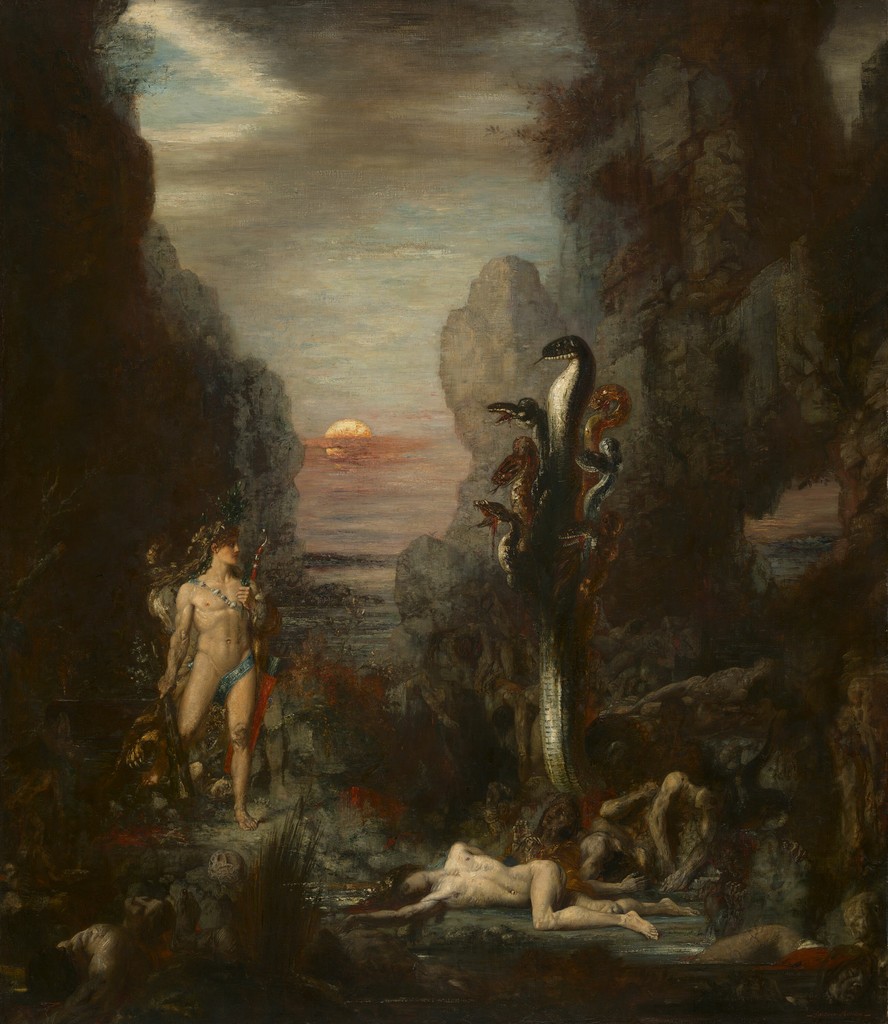
Hercules does not swing his club. He stands at the left edge of a ravine, almost motionless, while the Hydra rises from the darkness opposite him. Between hero and monster lie bodies that make the danger unmistakable; beyond them, a narrow opening reveals pale sky, distant water and a low sun. Gustave Moreau chose the breath before violence, when looking itself becomes the action. The result is a mythological combat picture built from suspense rather than impact.
At a Glance
- ArtistGustave Moreau
- Date1875–76
- MediumOil on canvas
- Dimensions179.3 × 154 cm; 226.7 × 201.9 cm framed
- CollectionArt Institute of Chicago, accession 1964.231, Gift of Mrs. Eugene A. Davidson
- SubjectHercules confronting the many-headed Hydra during his second labour
Gustave Moreau in context
Orpheus
1865The Apparition
1876Galatea
c. 1880Saint George and the Dragon
1889–90Jupiter and Semele
1894–95Contents
- Introduction
- The Exact Painting in Chicago
- A Slow Route Through the Image
- The Second Labour Without the Climax
- Drawing, Sources and Revision
- Darkness, Surface and Scale
- Moral and Political Meanings
- The Salon of 1876: Hercules Beside Salomé
- Provenance and the Art Institute of Chicago
- Why the Painting Still Matters
The Exact Painting in Chicago
The active work is the Art Institute of Chicago’s Hercules and the Lernaean Hydra, object 20579 and accession 1964.231. Its current record dates it to 1875–76, identifies the support as canvas and gives an unframed size of 179.3 by 154 centimetres.[1][2] Those facts matter because Moreau returned to the subject more than once.
The Musée Gustave Moreau owns Cat. 26, an oil measuring 1.55 by 1.32 metres. Its hero stands differently, although he is likewise youthful and carries a club amid rock formations and dead victims. The museum describes Cat. 26 as an earlier, smaller version of the picture shown in 1876.[3] It can illuminate the development of the design, but its date, measurements and ownership must not migrate to the Chicago canvas. Private variants and studies require the same separation.
Moreau’s Chicago picture is large enough to address a standing viewer bodily. Its present frame takes the total dimensions beyond two metres in both height and width.[2] Yet the composition does not use scale for a crowded battle. It makes the interval between two adversaries feel monumental.
A Slow Route Through the Image
Seen in the exact reproduction, the eye first meets a dark field of rock. Hercules occupies a relatively narrow ledge on the left. He is youthful, almost nude except for a small blue-green covering and ornaments; his upright club brings a red vertical accent near his face. His free arm bends behind him. This posture does not look relaxed, but neither does it announce an immediate blow. He watches.[1]
Across the gap, the Hydra forms a dense, rising column. Its long central neck catches an unearthly light, while other heads turn in several directions. Some mouths open, but the creature does not lunge. The clustered necks make it difficult to isolate one stable body. Moreau places the monster where animal form begins to merge with the rock and shadow around it.
The foreground changes the encounter from a formal face-off into a mortal test. One pale corpse lies on its back near the centre; another body folds against the right-hand rocks. Fragments and bones emerge from the lower gloom. These are the Hydra’s previous victims, evidence of repeated failure before Hercules arrived. The Art Institute also notes the swamp-like setting and decomposing remains as key parts of the scene.[1]
At the centre-left, the ravine opens towards a distant horizon. The small disc of the sun and muted expanse of water provide the painting’s broadest light. Hercules stands closer to this opening; the Hydra is backed by a darker wall. That contrast is observable, but its moral meaning is an interpretation rather than a neutral fact. The rocks meanwhile act like wings of a stage, containing both figures and preventing an easy escape for the gaze.
Move from the pale distance back to the club, then across the dead bodies to the Hydra’s lit neck. The composition repeatedly directs vision along the space that separates the living opponents. Moreau has made a void carry dramatic weight.
The Second Labour Without the Climax
In the myth, Hercules must perform twelve labours. The killing of the Lernaean Hydra is the second. The museum’s account describes the creature as an aquatic, many-headed serpent associated with the marsh near Lerna; one head is immortal.[1][3] Moreau provides enough attributes to identify the episode—hero, club, monster and victims—without illustrating every stage of the traditional narrative.
That decision keeps myth from overtaking the picture. A viewer does not need to rehearse the entire labour before noticing how unusually still the encounter is. There is no severed neck, no rushing body and no victorious pose. The outcome familiar from the story has not yet entered the visible moment.
Hercules’ calm is therefore not proof that the danger is slight. The remains around him insist on its severity. Nor does the Hydra’s immobility make it passive: seven possible directions of attack are compressed into one vertical mass. By withholding collision, Moreau allows anticipation to last. Knowledge that Hercules will win sits uneasily beside the painting’s refusal to show how.
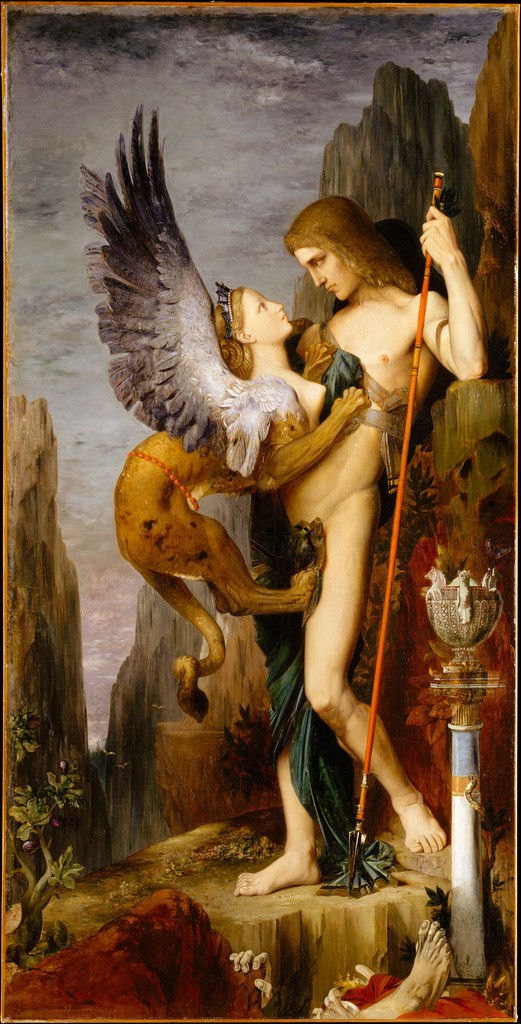
This emphasis connects the work with Oedipus and the Sphinx, Moreau’s Salon breakthrough of 1864. Both subjects oppose a solitary young man to a composite monster, and both pause at a decisive test. The differences are equally revealing. Oedipus and the Sphinx touch and stare at close range; Hercules and the Hydra remain apart, divided by landscape and death.
Drawing, Sources and Revision
Moreau developed the composition through repeated studies rather than a single preliminary outline. A finished preparatory sheet in the Art Institute is especially informative. On a cream sheet toned light brown, he combined graphite with two colours of ink, brushed brown shading and touches of lead white that have since discoloured. The study already establishes the dark, enclosed setting and the opposing zones of illumination.[4]
The same source records important changes. The drawn Hercules is craggier and less idealised than the body chosen for the canvas. Moreau consulted ancient Greek sculpture when reshaping the hero, while studies of venomous snakes in scientific publications informed the Hydra’s individual heads. The invented creature thus combines observed reptile forms with a mythic body; Hercules similarly joins a model derived from sculpture to a modern painted presence.[4]
The painting’s method can be followed further through Moreau’s drawings and watercolours. A study is not simply an inferior copy of the oil. Here it preserves a bodily conception that Moreau rejected and a tonal structure he retained. Revision operated through substitution as well as addition.
The current Art Institute description also notes that Moreau made numerous studies down to specific details and drew live snakes at the Paris zoo.[1] Such preparation helps explain the painting’s paradox: the Hydra is fantastical, yet its heads possess enough anatomical particularity to feel alert. Exact looking provided components for an impossible organism.
Darkness, Surface and Scale
Brown, black, deep green and muted red dominate much of the canvas. These colours do not form one flat night. Thin, suggestive passages let rock, marsh and debris blend into one another, while sharper touches pick out scales, jewellery, the club and exposed flesh. The Art Institute describes a combination of loose painterly areas and exact detail.[1] In reproduction, the contrast is strongest around the Hydra, whose body seems both carefully articulated and partially absorbed into shadow.
The pale centre prevents the darkness from closing completely. Its horizontal water and sky cross the otherwise vertical design, giving a distant measure to the ravine. Hercules’ lit torso and the nearest corpse repeat that pallor lower down. The Hydra’s central neck answers it with a colder, narrow illumination. Light therefore touches hero, victim and monster rather than belonging to only one of them.
At nearly 1.8 metres high, the canvas amplifies these changes of handling. From a distance the viewer registers the vertical opposition and bright opening. Closer inspection brings out the many heads, ornament and scattered remains. This oscillation between large structure and disturbing detail is central to Moreau’s painting practice: drawn order holds the scene together, but the surface refuses to become uniformly finished or legible.
Moral and Political Meanings
The simplest moral reading treats Hercules as a force of courage and the Hydra as evil. The AIC preparatory-study essay interprets the division of light and dark as intensifying that opposition.[4] The association fits the traditional labour and Moreau’s staging, but it should not become a claim that every colour has one permanent symbolic value across his work.
A more historically specific interpretation links the confrontation to France’s defeat by Prussia in 1870–71. The Art Institute says Moreau may have intended the myth to carry contemporary political concern, with Hercules possibly personifying France and the Hydra possibly standing for Prussia. The scholarly catalogue likewise presents this as a suggestion, not as a documented one-to-one key supplied by the artist.[1][4]
That uncertainty is productive. The painting can register a recent national trauma without functioning as a political cartoon. Hercules’ assured but isolated body, the field of prior casualties and the proliferating monster could have made the ancient episode newly urgent to a French Salon audience. Yet the scene also exceeds that moment. It remains a meditation on courage before an adversary whose threats multiply.
The broader guide to Moreau’s Symbolism, mythology and religion places this ambiguity in context. Moreau’s image can invite moral, spiritual and political thought at once. Interpretation is strongest when it stays anchored to the visible composition and to the conditional language of the museums.
The Salon of 1876: Hercules Beside Salomé
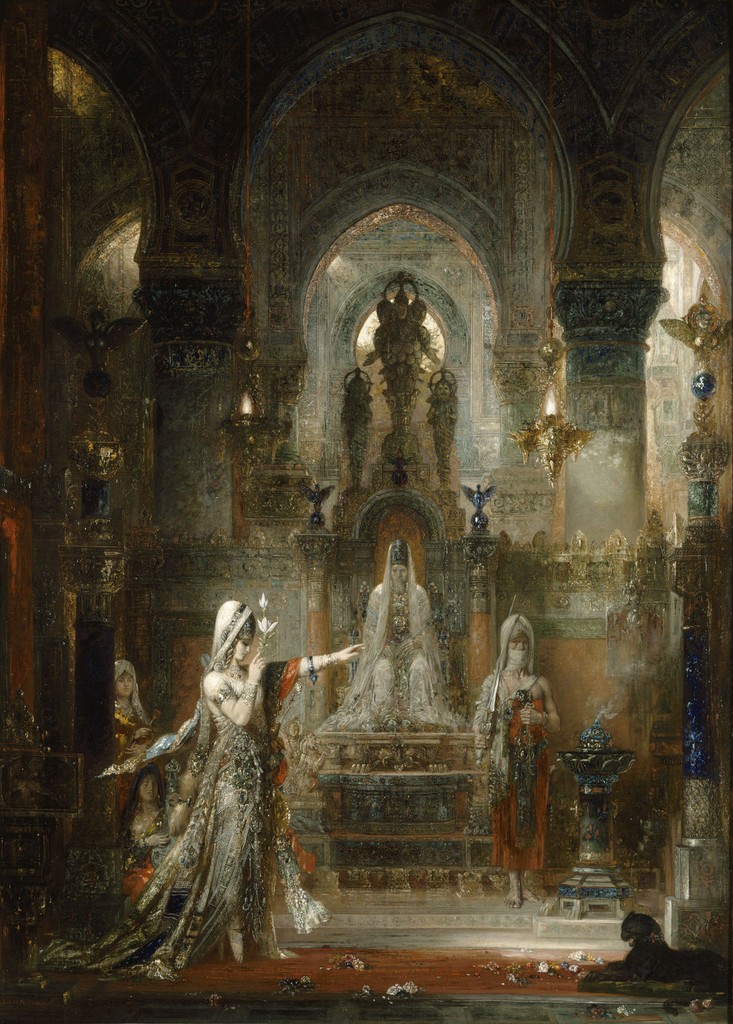
Moreau exhibited the Chicago Hercules and the Lernaean Hydra at the Paris Salon of 1876, catalogue number 1505. It marked a major return after his absence from the Salon since 1869. The work appeared in the same exhibition as the oil now called Salomé Dancing Before Herod, held by the Hammer Museum.[2][3][5]
The pairing showed two different forms of suspended danger. Hercules stands before the fight; Salomé performs before the deadly request is fulfilled. One setting is a dark ravine filled with remains, the other an elaborate ceremonial interior. Both canvases depended on intensive preparation, but their surfaces and protagonists ask different questions. Seeing them only as matching products of a bizarre imagination misses the deliberation behind each work.
Contemporary response was divided. The Musée Gustave Moreau notes that Émile Zola found the two pictures baffling and attacked their remoteness from Realism.[3] The Hammer, by contrast, describes Salomé as critically acclaimed.[5] Such disagreement is part of the significance of Moreau’s return: the paintings compelled viewers to debate whether mythic history painting still had a place in modern art.
Provenance and the Art Institute of Chicago
Moreau sold the painting in 1887 to Louis Mante of Marseille. It passed by descent, appeared in the 1956 Mante sale in Paris, and was with Richard L. Feigen and then Jacques Seligmann before entering the collection of Mrs. Eugene A. Davidson. She gave it to the Art Institute in 1964.[2]
The museum currently lists the canvas as on view in Gallery 223.[2] Gallery status can change, so visitors should check the object record shortly before travelling. The institution also marks the work as public domain and supplies an open digital image. The current home and accession number—not a similarly titled Moreau version—govern all identification.
Its Chicago setting gives the painting a different public life from the smaller Cat. 26 in Moreau’s Paris house-museum. Together, the surviving versions and drawings reveal an artist who revisited a central confrontation while continuing to alter pose, scale and emphasis. The Chicago canvas matters not merely because it is the largest treatment: it is the work that carried this version of the problem into the Salon of 1876.
Why the Painting Still Matters
Hercules and the Lernaean Hydra turns a story renowned for strenuous action into an image of concentrated waiting. Its monumental dimensions, murky surface and pale distance create physical drama, yet the two living figures remain held in thought. Moreau makes the viewer inhabit the uncertainty that the myth’s known ending would normally remove.
The work is also a strong introduction to his method. Zoological observation and scientific illustration meet a body adapted from antique sculpture. Preparatory drawing controls the encounter, but revision changes the hero. Moral meaning is legible without being exhaustive, and a possible political reference remains open rather than compulsory. Few paintings show so clearly how Moreau could be traditional in subject while making the experience of that subject newly unstable.
Researched works directory
This searchable evidence census was assembled from public museum records and a reproducible Wikidata snapshot. It is not a catalogue raisonné, a claim to complete oeuvre coverage, or a substitute for Pierre-Louis Mathieu's printed catalogue, which was not consulted for this directory.
| Name | Date | Medium |
|---|---|---|
| Abstract Study | 1850 | Painting |
| Abstract Study | 1875 | Painting |
| Abstract Study | 1890 | Painting |
| Academic Study of a Man | 1847 | Painting |
| Achilles the Centaur Chiron | 1859 | Painting |
| Andromeda | 1867 | Painting |
| Andromeda | Date unknown | Painting |
| Angels Following the Magi | 1860 | Painting |
| Angels following the Three Magi | 1898 | Painting |
| Angels Throwing Flowers on the Vatican | 1850 | Painting |
| Aphrodite, 1871 | Date unknown | Painting |
| Apollo and Daphne | 1852 | Painting |
| Apollo and The Nine Muses | 1856 | Painting |
| Apollo and the Satyrs | 1850 | Painting |
| Apollo Victorious over Python | 1885 | Painting |
| Apollon and Marsyas | 1858 | Painting |
| Ariadne and Theseus | 1875 | Painting |
| Arion | 1891 | Painting |
| Athenians being Delivered to the Minotaur in the Cretan Labyrinth | 1855 | Painting |
| Autumn | 1885 | Painting |
| Bacchanal | 1850 | Painting |
| Bacchus on the Panther -cart. | Date unknown | Painting |
| Bathsheba | 1875 | Painting |
| Beheading of John the Baptist | 1872 | Painting |
| Bertrand and Raton | 1879 | Painting |
| Binding of Isaac | 1850 | Painting |
| Birth of Venus | 1870 | Painting |
| Briseis Departure | 1859 | Painting |
| centaur | Date unknown | Painting |
| Centaurs | 1850 | Painting |
| Chimera | 1850 | Painting |
| Chimeras | 1875 | Painting |
| Christ and the Two Thieves | 1870 | Painting |
| Christ at Gethsemane | 1850 | Painting |
| Christ at Gethsemane | 1875 | Painting |
| Christ at Lake Tiberias | 1850 | Painting |
| Christ at the Column | 1850 | Painting |
| Christ Blessing Hist Mother | 1850 | Painting |
| Christ Reliever | 1850 | Painting |
| Circe | 1850 | Painting |
| Cleopatra | 1850 | Painting |
| Cleopatra | 1887 | Painting |
| Danaé | 1858 | Painting |
| Darius, Fleeing after the battle of Arbela, Stops, Exhausted, to Drink from a Pond | 1853 | Painting |
| Darius Flight | 1850 | Painting |
| Dead Orpheus | 1850 | Painting |
| Dead Orpheus | 1890 | Painting |
| Dead Poet Carried by a Centaur | 1890 | Painting |
| Death Giving Laurels to the Winner of the Tournament | 1859 | Painting |
| Death of a Young Crusader | 1870 | Painting |
| Death of Moses | 1850 | Painting |
| Death of Sapho | 1850 | Painting |
| Death of Sapho | 1872 | Painting |
| Debauchery | 1850 | Painting |
| Dejanira (Autumn) | 1872 | Painting |
| Delilah | 1850 | Painting |
| Delilah | 1890 | Painting |
| Delilah | 1896 | Painting |
| Descent from the Cross | 1850 | Painting |
| Diana bathing | 1900 | Painting |
| Diomede devoured by his horses | 1865 | Painting |
| Diomedes Devoured by His Horses | 1865 | Painting |
| Diomedes Devoured by His Own Horses | 1870 | Painting |
| Œdipus the Wayfarer | 1888 | Painting |
| Draft for Sapho | 1850 | Painting |
| Eleonora Gonzaga, Duchess of Urbino | 1858 | Painting |
| Endymion | 1850 | Painting |
| Erigone | 1865 | Painting |
| Eve | 1850 | Painting |
| Eve | 1875 | Painting |
| Fairy in a Cave | 1850 | Painting |
| Fairy with Griffins | 1870 | Painting |
| Fairy with Griffins | 1876 | Painting |
| Fée aux griffons | 1876 | Drawing |
| Femme et licorne | 1890 | Painting |
| Francesco Maria della Rovere, Duke of Urbino | 1858 | Painting |
| Françoise de Rimini | 1850 | Painting |
| Galatea | c. 1880 | Painting |
| Galathea | 1896 | Painting |
| Galathea | Date unknown | Painting |
| Ganymede | 1886 | Painting |
| Gardian Angel of the City | 1850 | Painting |
| Genius of Evil | 1850 | Painting |
| Genius of Evil | 1875 | Painting |
| Golgotha | 1870 | Painting |
| Hamlet | 1850 | Painting |
| Hamlet Giving Poison to the King | 1850 | Painting |
| Helen | 1850 | Painting |
| Helen | 1880 | Painting |
| Helen at the Scaean Gate | 1888 | Painting |
| Helen Glorified | 1893 | Painting |
| Helen on the Walls of Troy | 1850 | Painting |
| Helen on the Walls of Troy | 1875 | Painting |
| Helene | Date unknown | Painting |
| Hercule et les oiseaux du lac de Stymphale | Date unknown | Painting |
| Hercules and Omphale | 1856 | Painting |
| Hercules and the Ceryneian Hind | 1871 | Painting |
| Hercules and the Daughters of Thespius | 1850 | Painting |
| Hercules and the Lernaean Hydra | 1875–1876 | Painting |
| Hercules and the Nemean Lion | 1850 | Painting |
| Hercules and the Stymphalian Birds | 1872 | Painting |
| Hercules and Thespius Daughters | 1850 | Painting |
| Hercules at Lake Stymphalia | 1875 | Painting |
| Hercules between Vice and Virtue | 1850 | Painting |
| Hesiod and the Muse | 1870 | Painting |
| Hesiod and the Muse | 1875 | Painting |
| Hesiod and the Muse | 1891 | Painting |
| Hesiod and the Muses | 1860 | Painting |
| Hesiod and the Muses | 1882 | Painting |
| Hésiode enfant | 1860 | Painting |
| Horse Rider | 1854 | Painting |
| Horse Rider | 1870 | Painting |
| Horse Rider and Amazon | 1869 | Painting |
| Horse Riders and Horses | 1854 | Painting |
| Indian Women Poets | 1890 | Painting |
| Interior, Draft | 1850 | Painting |
| Jacob and the Angel | 1876 | Painting |
| Jacob and the Angel | 1878 | Painting |
| Jacob et l'Ange | 1878 | Painting |
| Jason | 1865 | Painting |
| Jason et Éros | 1891 | Painting |
| Judith | 1850 | Painting |
| Jupiter and Semele | 1889–1895 | Painting |
| King Canute and His Courtesans | 1850 | Painting |
| King David | 1878 | Painting |
| L'enlèvement d'Europe | 1872 | Painting |
| La Fée | Date unknown | Painting |
| La mort de Sapho | 1872 | Painting |
| La mort de Sapho | 1876 | Painting |
| La Villa Borghèse | Date unknown | Painting |
| Landscape | 1850 | Painting |
| Landscape, Draft | 1850 | Painting |
| Landscape (Neighborhood of Étampes) | 1850 | Painting |
| Le Bon Samaritain | 1865 | Painting |
| Le Cantique des cantiques | 1853 | Painting |
| Le Christ et Madeleine (Noli me Tangere) | 1889 | Painting |
| Le Grand Pan contemple les Sphères Célestes | 1897 | Drawing |
| Le Poète et la Sirène | 1893 | Painting |
| Le Soir | 1887 | Painting |
| Le Sphinx | 1886 | Painting |
| Leda | 1846 | Painting |
| Leda | 1850 | Painting |
| Leda | 1870 | Painting |
| Les Chimères | 1884 | Painting |
| Les Plaintes du poète | 1882 | Painting |
| Life of Humanity | 1875 | Painting |
| Life of Humanity | 1886 | Painting |
| Life of Humanity: Salvator Mundi | 1886 | Painting |
| Life of Humanity: The Golden Age, Adam - Evening - Sleep | 1879 | Painting |
| Life of Humanity: The Golden Age, Adam - Morning - Prayer | 1879 | Painting |
| Life of Humanity: The Golden Age, Adam - Noon - Extasy | 1879 | Painting |
| Life of Humanity: The Iron Age, Cain - Evening - Death | 1879 | Painting |
| Life of Humanity: The Iron Age, Cain - Morning - Work | 1879 | Painting |
| Life of Humanity: The Iron Age, Cain - Noon - Rest | 1879 | Painting |
| Life of Humanity: The Silver Age, Hesiod and Orpheus, Hesiod - Evening - Tears | 1879 | Painting |
| Life of Humanity: The Silver Age, Hesiod and Orpheus, Hesiod - Morning - Inspiration | 1879 | Painting |
| Life of Humanity: The Silver Age, Hesiod and Orpheus, Orpheus - Noon - Song | 1879 | Painting |
| Love Victorious over Death | 1850 | Painting |
| Lucretia and Tarquin | 1850 | Painting |
| Magdalene on Golgotha | 1850 | Painting |
| Magdalene on Golgotha | 1875 | Painting |
| Magdalene on Golgotha | 1880 | Painting |
| Magnolia | 1864 | Painting |
| Martyrdrom | 1850 | Painting |
| Messalina | 1850 | Painting |
| Messalina | 1874 | Painting |
| Messaline | 1874 | Painting |
| Mort de Sapho | 1900 | Painting |
| Moses Exposed | 1875 | Painting |
| Moses Exposed on the Nile | 1875 | Painting |
| Moses, in Sight of the Promised Land, Takes His Sandals Off | 1854 | Painting |
| Moses Rescued from the Nile | 1893 | Painting |
| Mystic Flower | 1890 | Painting |
| Narcissus | 1850 | Painting |
| Narcissus | 1885 | Painting |
| Narcissus | 1890 | Painting |
| Noces d’Alexandre et de Roxane | Date unknown | Drawing |
| Nude Study | 1850 | Painting |
| Nyx, Night Goddess | 1880 | Painting |
| Oedipus and the Sphinx | 1864 | Painting |
| Orestes | 1850 | Painting |
| Orestes | 1875 | Painting |
| Orestes and the Erinyes | 1875 | Painting |
| Orphés | 1865 | Painting |
| Orpheus | 1865 | Painting |
| Orpheus Head | 1850 | Painting |
| Orpheus on Eurydice's Tomb | 1890 | Painting |
| Pasiphaë | 1850 | Painting |
| Pasiphaë | 1880 | Painting |
| Pasiphaë, Grisaille | 1850 | Painting |
| Pauline Moreau as the Virgin | 1848 | Painting |
| Perseus and Andromeda | 1870 | Painting |
| Persian Poet | 1875 | Painting |
| Petrarch After the Triumph | 1850 | Painting |
| Phaéton | 1878 | Painting |
| Phoebus and Boreas | 1879 | Painting |
| Pietà | 1867 | Painting |
| Pietà | 1875 | Painting |
| Pietà | 1876 | Painting |
| Pietà | Date unknown | Painting |
| Pittacus the Tyrant in War Costume | 1883 | Drawing |
| Polyphemus | 1880 | Painting |
| Poney | 1870 | Painting |
| Portrait of Gustave Moreau by Himself | 1850 | Painting |
| Portrait of Gustave Moreau by Himself | 1890 | Painting |
| Postman and Horses | 1854 | Painting |
| Prometheus | 1868 | Painting |
| Prometheus | 1869 | Painting |
| Prometheus Thunderstruck | 1870 | Painting |
| Prometheus, Variant | 1870 | Painting |
| Rape of Deianira | 1850 | Painting |
| Rape of Deianira | 1872 | Painting |
| Return of the Argonauts | 1890 | Painting |
| Ruines de Rome : le Colisée vu des jardins de l'Angélicum des dominicains | 1858 | Painting |
| Saint Cecilia and the Angels of Music | 1850 | Painting |
| Saint Francis Kissing a Leper | 1850 | Painting |
| Saint George and the Dragon | 1889–1890 | Painting |
| Saint Jerome | 1850 | Painting |
| Saint Sebastian | 1850 | Painting |
| Saint Sebastian | 1870 | Painting |
| Saint Sebastian and the Angel | 1876 | Painting |
| Saint Sebastian and the Angels | 1850 | Painting |
| Saint Sebastian Succoured | 1885 | Painting |
| Saint Sebastian with Archers | 1875 | Painting |
| Saint-Sébastien et l'ange | 1876 | Painting |
| Saint Sébastien soigné par les saintes femmes | 1869 | Painting |
| Sainte Cecilia | 1850 | Painting |
| Salome | 1850 | Painting |
| Salome | 1872 | Painting |
| Salome | 1874 | Painting |
| Salome at the Prison | 1873 | Painting |
| Salomé au Jardin | 1878 | Painting |
| Salome Dancing | 1872 | Painting |
| Salomé Dancing Before Herod | 1876 | Painting |
| Salome Dancing in front of Herod | 1876 | Painting |
| Salome with the Head of John the Baptist | 1876 | Painting |
| Santa Cecilia (Moreau) | Date unknown | Painting |
| Sappho falling into the Abyss | 1867 | Painting |
| Semele | 1889 | Painting |
| Semele, Draft | 1889 | Painting |
| Singing Centaurs | 1850 | Painting |
| Slaves Thrown to the Morays | 1850 | Painting |
| Song of Songs (Cantique des Cantiques) | 1893 | Painting |
| Spanish Conversation | 1850 | Painting |
| Spring | 1850 | Painting |
| St. Sebastian | Date unknown | Painting |
| Study | 1850 | Painting |
| Study | 1874 | Painting |
| Study | 1875 | Painting |
| Study for Jupiter and Semele | 1889 | Painting |
| Study for Moses Taking Off His Sandals | 1854 | Painting |
| Study for Saint Cecilia | 1850 | Painting |
| Study for Salome | 1874 | Painting |
| Study for The Triumph of Alexander the Great | 1885 | Painting |
| Study from Nature | 1850 | Painting |
| Study of a red ibis | 1900 | Painting |
| Sultan | 1850 | Painting |
| Suzanne et les vieillards | 1895 | Painting |
| swinging girl | Date unknown | Painting |
| Tea Rose | 1850 | Painting |
| Temptation | 1890 | Painting |
| Tempting Demon | 1875 | Painting |
| The Angels of Sodome | 1872 | Painting |
| The Apparition | 1876 | Drawing |
| The Argonauts | 1885 | Painting |
| The Bad Rich | 1850 | Painting |
| The calvary | 1867 | Painting |
| The childhood of Sixtus V. | 1853 | Painting |
| The Chimera | 1867 | Painting |
| The chimera | Date unknown | Painting |
| The Chimeras | 1850 | Painting |
| The Crowning with Thorns | 1846 | Painting |
| The Daughters of Thespius | 1853 | Painting |
| The Dead Lyres | 1897 | Painting |
| The Decameron | 1850 | Painting |
| The Disciples in Emmaus | 1850 | Painting |
| The Dream Haunting the Mogul | 1881 | Painting |
| The Entombment | 1867 | Painting |
| The Good Samaritan | 1850 | Painting |
| The Infant Moses | 1877 | Painting |
| The Magi | 1860 | Painting |
| The Martyred Saint Sebastian | 1869 | Painting |
| The Mermaid and the Poet | 1895 | Painting |
| The Muses Leaving Their Father Apollo to Go and Light the World | 1868 | Painting |
| The Parca and the Angel of Death | 1890 | Painting |
| The Parcae | 1850 | Painting |
| The Pieridae | 1875 | Painting |
| The Pieridae | 1880 | Painting |
| The Pietà | 1867 | Painting |
| The Plague in Florence | 1870 | Painting |
| The Poet and the Siren | 1894 | Painting |
| The Prodigal Son | 1850 | Painting |
| The Prodigal Son | 1890 | Painting |
| The Rape of Europe | 1868 | Painting |
| The Rape of Europe | 1869 | Painting |
| The Shulamite | 1853 | Painting |
| The Sirens | 1850 | Painting |
| The Sirens | 1875 | Painting |
| The Sirens | 1882 | Painting |
| The Springs | 1856 | Painting |
| The Suitors | 1862 | Painting |
| The Toilette | 1887 | Painting |
| The Travelling Angels | 1875 | Painting |
| The Travelling Poet | 1890 | Painting |
| The Unicorn | 1885 | Painting |
| The Unicorns | 1888 | Painting |
| The Voices | 1867 | Painting |
| The Wandering Jew | 1870 | Painting |
| The Young Man and Death | 1856–1865 | Painting |
| Tomyris and Cyrus | 1850 | Painting |
| Triumph of Alexander the Great | 1873 | Painting |
| Triumphing Church | 1870 | Painting |
| Tyrtaeus | 1850 | Painting |
| Tyrtaeus Singing While Fighting | 1860 | Painting |
| Un Saint au désert | 1879 | Painting |
| Untitled | 1866 | Painting |
| Venice | 1850 | Painting |
| Venice | 1885 | Painting |
| Venus Rising from the Sea | 1866 | Painting |
| Victim | 1850 | Painting |
| Vue de Florence | 1858 | Painting |
| Walk in a Park | 1865 | Painting |
| Water Fairy | 1850 | Painting |
| Womand and Chimera | 1875 | Painting |
| Young Thracian Woman Holding Orpheus' Head | 1866 | Painting |
Frequently Asked Questions
It depicts Hercules’ second labour: the destruction of the many-headed water monster associated with Lerna. Moreau selects the moment before combat, showing the hero with his club, the Hydra and the bodies of earlier victims rather than the labour’s eventual victory.[1][3]
The Art Institute dates it to 1875–76. It is an oil on canvas measuring 179.3 by 154 centimetres; with its frame, it measures 226.7 by 201.9 centimetres. Its accession number is 1964.231.[2]
The painting concentrates on suspense. Hercules and the Hydra look across a charged interval while the dead demonstrate what is at stake. By stopping before impact, Moreau gives the hero’s self-command and the monster’s multiple threats time to register.[1]
It supports a moral reading of courage confronting evil. Art Institute sources also present a possible political analogy in which Hercules evokes France and the Hydra Prussia after the war of 1870–71. Because the museum frames that link as a possibility, it should not be treated as the painting’s only or proven meaning.[1][4]
Discussion
Use this evidence-led guide as a starting point for close looking rather than a final verdict.
Share an observation about Hercules and the Lernaean Hydra or a source that adds useful context.
Reader Insights
Which detail most changes your reading of Hercules and the Lernaean Hydra?
How do scale, support, medium or present museum evidence shape the encounter?
What remains uncertain when visual inference is separated from documented fact?
Join the Conversation
Add your reading below, keeping observations specific and evidence clear.
References
- Art Institute of Chicago, “Hercules and the Lernaean Hydra”:, accessed 30 August 2026.
- Art Institute of Chicago API, “Hercules and the Lernaean Hydra” (artwork 20579):, accessed 30 August 2026.
- Musée Gustave Moreau, “Artworks on the move”:, accessed 30 August 2026.
- Art Institute of Chicago, Maineri to Miró: The Regenstein Collection since 1975:, accessed 30 August 2026.
- Hammer Museum, “Salomé Dancing Before Herod”:, accessed 30 August 2026.