 by Tom Gurney
Tom Gurney BSc (Hons) is an art history expert with over 20 years experience
Page Created: 30 August 2026 / Page Updated: November 6, 2026
Email: tomgurney1@gmail.com / Phone: +44 7429 011000
Galatea: Introduction
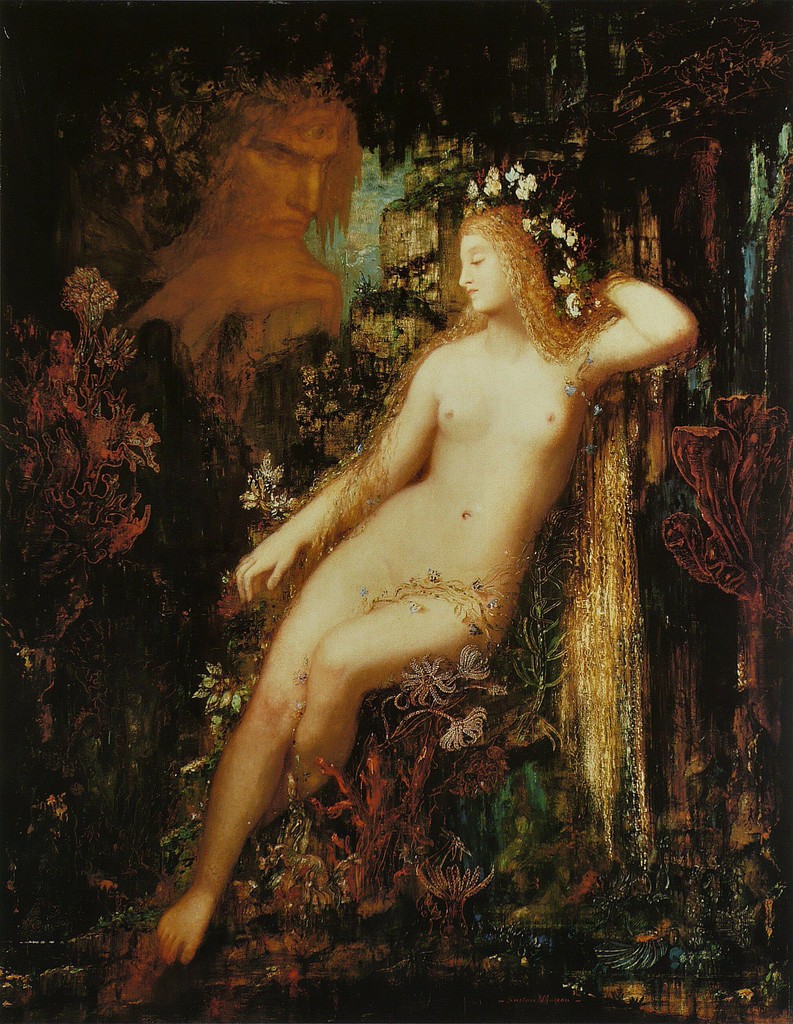
Galatea reclines in a sea cave as if light has taken human form. Her pale body and long golden hair occupy the centre of Gustave Moreau’s panel, while the colossal face of Polyphemus emerges from brown shadow behind her. He looks; she does not return his gaze. Coral, strange marine growth and nearly hidden nereids fill the remaining space. The ancient story has been reduced to an unequal act of desire, and every contrast—large and small, light and dark, flesh and stone—intensifies it.
At a Glance
- ArtistGustave Moreau
- TitleGalatée (Galatea)
- DateAbout 1880
- Medium and sizeOil on wood, 85.5 × 66 cm
- CollectionMusée d’Orsay, Paris, RF 1997 16
- SubjectThe sea nymph Galatea observed by the Cyclops Polyphemus, adapted from Ovid’s Metamorphoses
Gustave Moreau in context
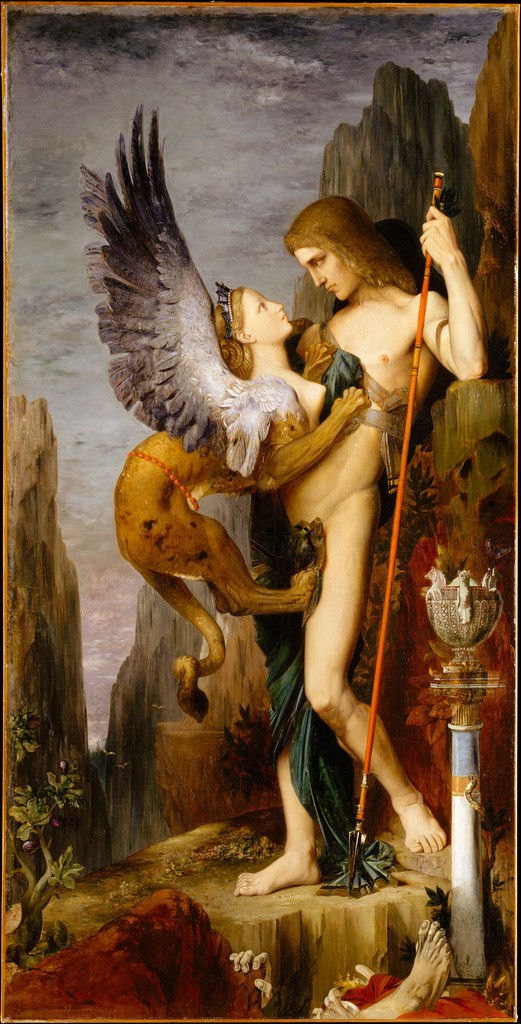
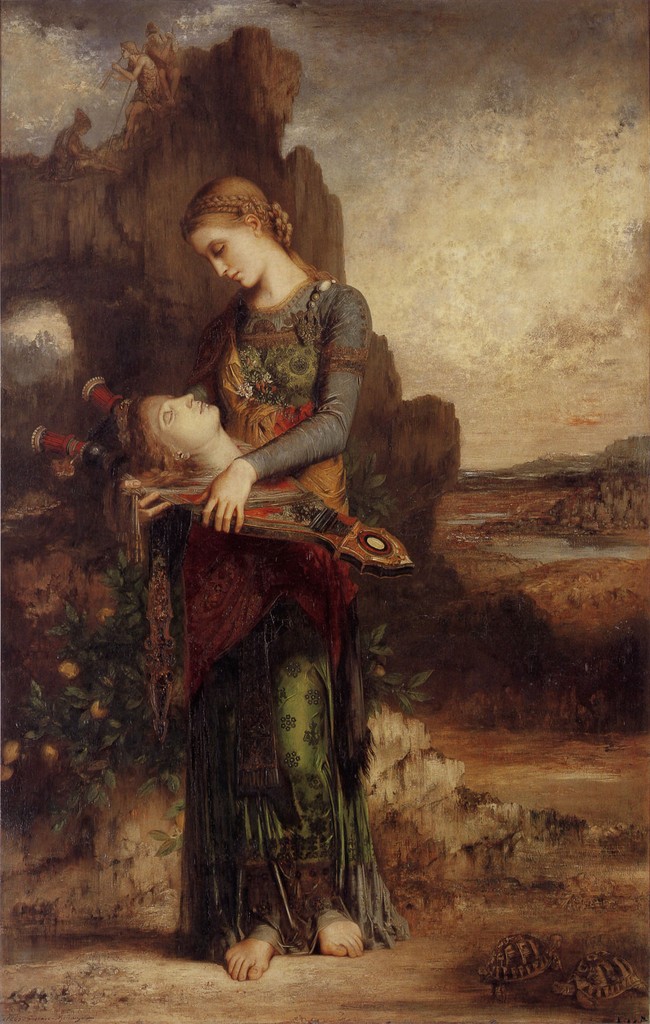
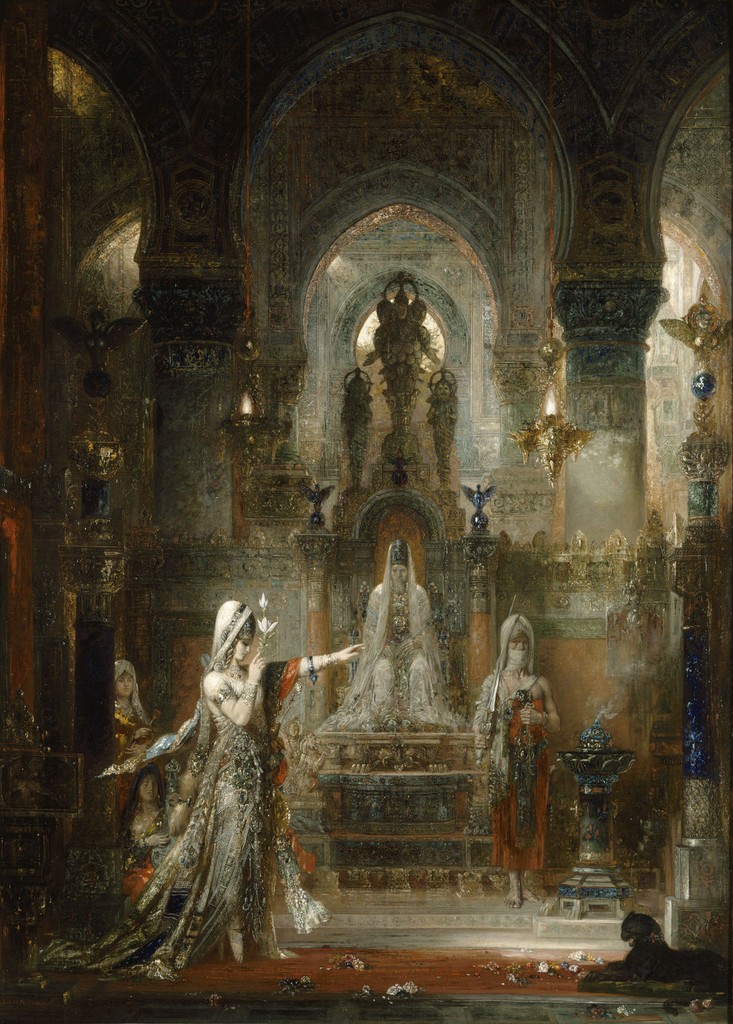
Orpheus
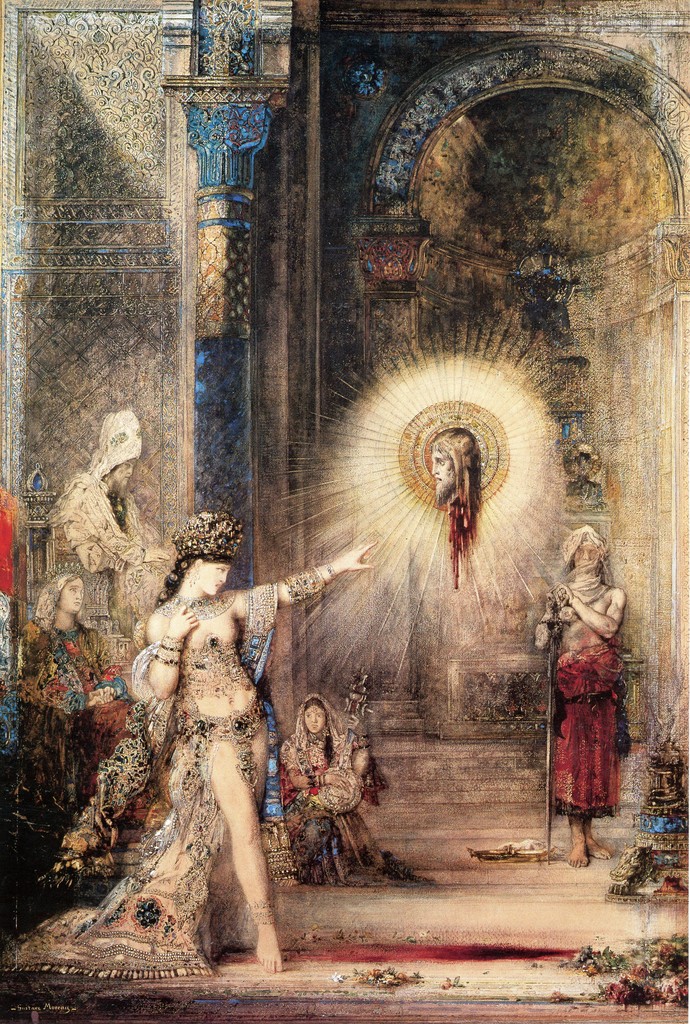
1865The Apparition
1876Galatea
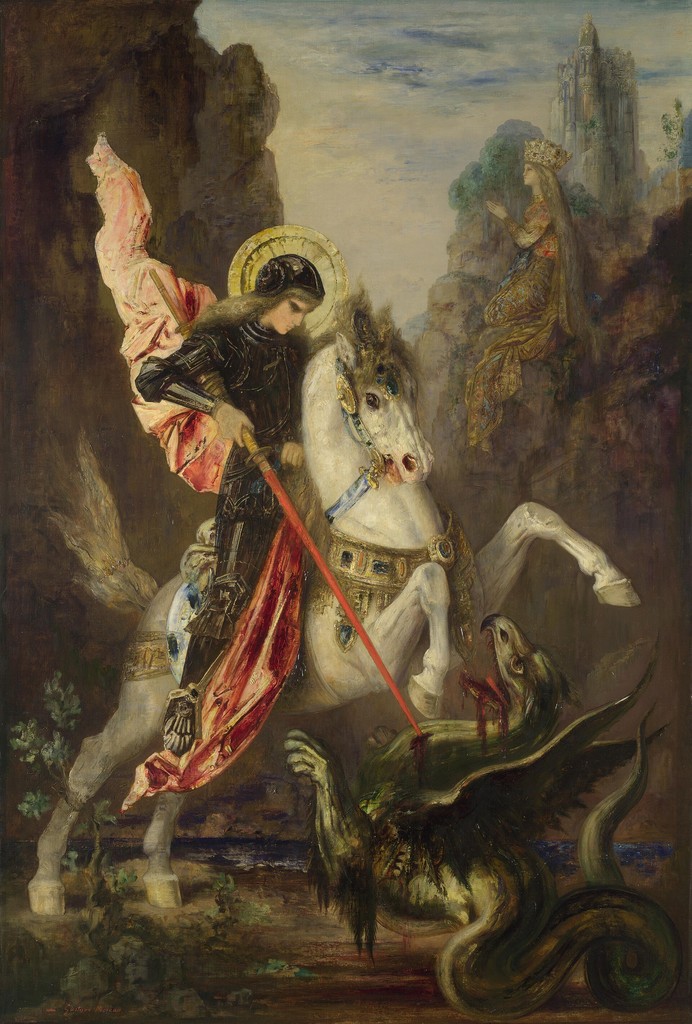
c. 1880Saint George and the Dragon
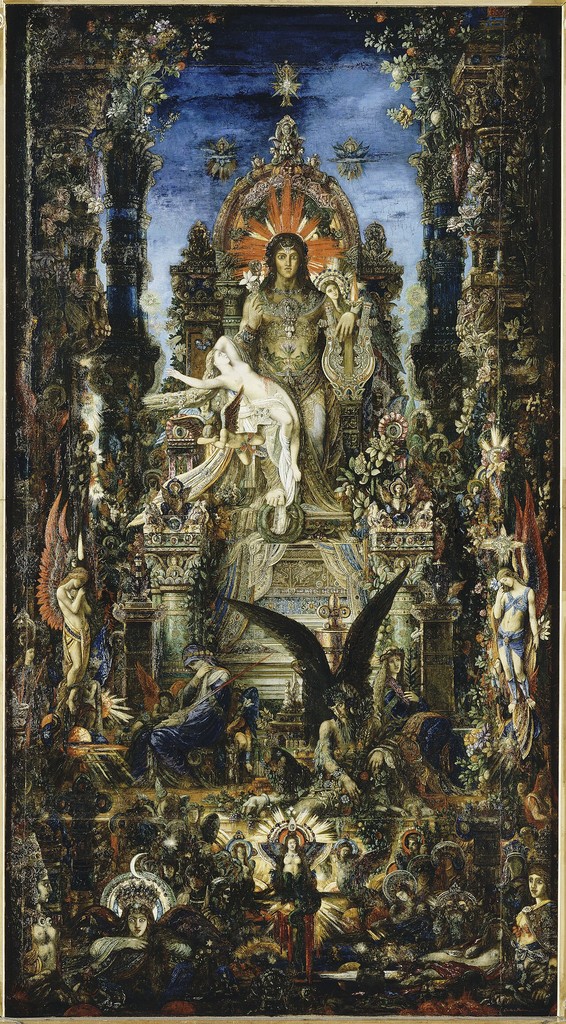
1889–90Jupiter and Semele
1894–95Contents
- Introduction
- Identifying the Orsay Panel
- Looking from Galatea to Polyphemus
- Ovid’s Story and What Moreau Leaves Out
- Scale, Light and the Elements
- Marine Botany and the Enamel-Like Surface
- The Final Salon Appearance of 1880
- Meanings Without a Single Code
- A Disrupted Provenance
- Why Galatea Matters
Identifying the Orsay Panel
The work discussed here is Musée d’Orsay RF 1997 16. The museum dates it to about 1880, records oil on a wooden support and gives dimensions of 85.5 by 66 centimetres. Moreau signed the lower-right area. The present frame measures 115 by 105 centimetres and brings the object’s recorded weight to 112 kilograms.[1]
Those details distinguish this compact panel from other works in which Moreau returned to Galatea. They also prevent a tempting but false connection with Odilon Redon’s The Cyclops, painted by a different artist at a later date. Both artists imagined Polyphemus and Galatea, but their objects, compositions and histories are separate.
At present, Orsay’s collection page marks Galatée as not exhibited.[1] Ownership does not guarantee continuous display, so anyone planning a visit should consult the live record. For online looking, the exact public-domain file matches the Orsay title, dimensions, support and accession number.[2]
Looking from Galatea to Polyphemus
In the exact reproduction, Galatea appears first because she is the brightest and most fully modelled element. She reclines diagonally from her lifted right elbow to the foot that reaches the lower edge. Her eyes are closed or lowered. One hand rests behind her head, while the other falls loosely beside her thigh. The pose offers her body to view but withholds any answering look.
Polyphemus occupies the upper left. His single eye, heavy face and broad shoulder emerge from a dark orange-brown mass. His scale is uncertain because much of him merges with the cave, yet his head alone is close to the size of Galatea’s torso. The Musée d’Orsay interprets him not as a raging ogre but as a melancholy watcher contemplating someone he cannot reach.[1]
The cave controls this separation. Its opening is large enough to hold Galatea’s reclining figure but too tight for the giant, according to the museum. Dark verticals at the right and a shadowed wall at the left close around her. A blue-green opening between the two principal figures adds depth, but no ordinary route joins them. Polyphemus can see across the space without entering it.
Plant and animal forms make the setting denser. Red branching coral spreads at the left; tubular growth rises at the right; minute blossoms and curling stems collect around Galatea’s body. Tiny nereids are almost lost in this intricacy. Moreau repeats the change of scale: the Cyclops dwarfs the nymph, and she in turn dwarfs the sea beings embedded below.[1] Finding them slows the eye after the main opposition has already registered.
Ovid’s Story and What Moreau Leaves Out
Orsay traces the subject to Book XIII of Ovid’s Metamorphoses. Galatea loves the shepherd Acis, while the Cyclops Polyphemus desires her and becomes jealous. In Ovid’s narrative, the giant’s frustrated courtship leads to fatal violence against Acis. Moreau does not show the shepherd, the pursuit or the crushing rock. He stops before the story becomes an event.[1]
This omission changes the viewer’s task. Without Acis, there is no visible triangle of lovers. Without action, Polyphemus’ threat must be inferred from his size, concealment and knowledge of the myth. Galatea’s closed gaze may suggest indifference or inward withdrawal, but the painting does not supply her thoughts. A responsible reading separates that inference from what can actually be seen.
Moreau did keep the central asymmetry: the giant wants a figure who remains inaccessible. The cave gives that emotional distance a physical structure. Polyphemus is close enough to dominate the background yet cannot share Galatea’s luminous enclosure. Desire becomes prolonged observation rather than possession.
For Moreau, an ancient narrative could therefore serve as a framework rather than a script. The page on Symbolism, mythology and religion follows this method across other subjects. In Galatea, the missing climax is not a gap to be repaired; it is the condition that lets beauty, isolation and menace coexist.
Scale, Light and the Elements
The museum describes the composition through linked oppositions: beauty and ugliness, shadow and illumination, mineral and liquid, love and disdain.[1] These pairings are interpretations, not fixed labels that must be assigned to every detail. They are persuasive because the visual structure repeatedly puts unlike states beside each other.
Galatea’s skin is pale and softly graded; Polyphemus is darker, rougher and partly geological. Her hair descends like a bright stream, while the cave surrounds her with upright and branching forms. Some plants appear brittle or mineralised, yet their marine setting associates them with water. Moreau does not choose between a solid grotto and an underwater garden. The surface allows stone, coral, vegetation and flowing colour to overlap.
The panel’s vertical format reinforces the contrast in bodies. Galatea extends downwards through most of its height, while Polyphemus is compressed behind her in the upper zone. He is anatomically vast but spatially constrained. She is smaller in the story’s scale yet commands the painted field through light.
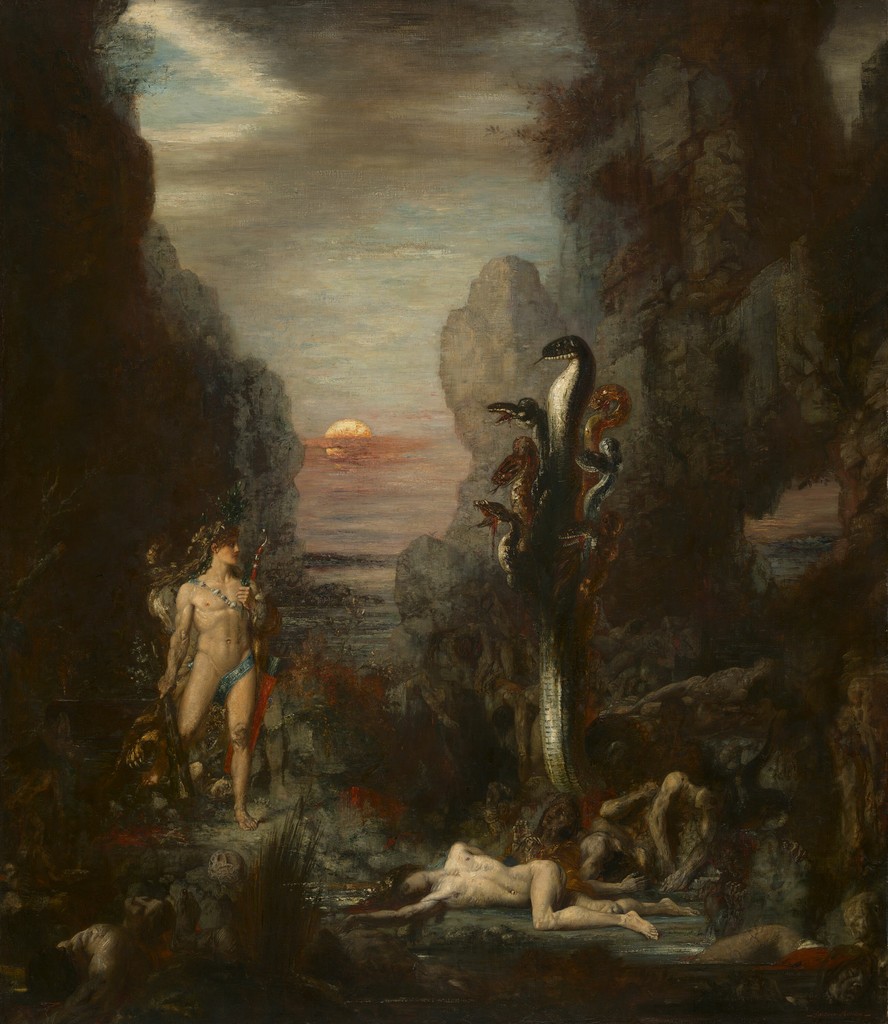
These effects differ from the suspended face-off in Hercules and the Lernaean Hydra. There the adversaries occupy separate sides of a ravine and look across an interval. Here the nymph does not acknowledge the watcher, and intricate marine life threads through the distance between them. Moreau uses stillness in both works, but not for the same emotional purpose.
Marine Botany and the Enamel-Like Surface
The vegetation may look invented, but Orsay connects it to sustained research. Moreau registered as an unofficial student at the Paris natural-history museum in 1879 and carefully copied illustrations from a marine-botany book. Those studies supplied material for the coral and aquatic plants that enclose Galatea.[1] Observation did not produce a scientific plate; it provided precise forms that could be reorganised within fantasy.
This procedure belongs to Moreau’s wider reliance on drawing. The Musée Gustave Moreau describes graphic work as essential from an initial conception through tracing and enlargement. It also notes his practice of gathering models from nature, engravings, photographs and books.[3] The guide to Moreau’s drawings and watercolours shows how such source material moved between study and finished object.
On the panel, the oil surface was rubbed and scratched. Orsay argues that this handling creates a precious effect comparable to enamel.[1] The analogy is useful because the colours often appear embedded or incised rather than laid down as uniformly soft modelling. Fine lines catch light around hair, plants and jewellery; darker passages are abraded into irregular depth.
Moreau’s own museum says that he valued painting as a materially rich art and associated its colouristic ambition with enamel.[3] That does not make Galatea an enamel or prove one procedure for every passage. It explains why scratching, rubbing and concentrated colour matter together. Surface is part of the meaning: Galatea seems luminous not only because she is pale, but because the surrounding matter has been worked into a dark, intricate setting for her.
The Final Salon Appearance of 1880
Moreau exhibited Galatée at the Salon of 1880 as number 2711, alongside Hélène. It was his last participation in the official Salon.[1][4] The Musée d’Orsay characterises the response to Galatée as a triumph and presents the exhibition as a high point in his career.[1]
That reception is significant because the painting does not provide the clear narrative climax expected from conventional history painting. Its ancient subject was legible, yet its organisation favoured suggestion, texture and psychological distance. Moreau could make a Salon success from a myth transformed into an atmosphere of looking.
The date also requires care when calling the work Symbolist. Jean Moréas’ literary manifesto appeared in 1886. The Metropolitan Museum identifies Moreau’s subjective, dreamlike treatments of myth and scripture in the 1870s as important precedents for pictorial Symbolism.[5] Galatea can be understood as foundational to that development without pretending it was produced under a fully established movement label.
Meanings Without a Single Code
Orsay’s contrast between beauty and ugliness captures one aspect of the panel, but “beauty and the beast” is not a complete explanation. Polyphemus is not shown attacking, and his melancholy attention complicates a purely monstrous role. Galatea is inaccessible, but her stillness is not an explicit declaration of triumph. Moreau makes each figure difficult to reduce to a moral token.[1]
The painting can instead be approached through relations. Sight flows in one direction from Polyphemus to Galatea. Light distinguishes her without opening an escape. Scale makes him powerful but unable to enter. Botanical abundance protects and displays her at once. The nymph is both sheltered by the grotto and exposed to the viewer.
That tension is central to Moreau’s painting practice. Drawing gives the panel a controlled arrangement; oil handling makes its boundaries unstable. Classical narrative supplies names and stakes; omission keeps the moment unresolved. Meaning accumulates through these choices rather than through a dictionary in which every flower, colour or gesture has one answer.
A Disrupted Provenance
The panel remained in the family of the collector Edmond Taigny for decades: first with Taigny until 1906, then with his widow, his son Olivier, and in 1941 his niece Françoise Marie Elisabeth Lejeune. The Orsay record next places it in the collection of Joachim von Ribbentrop in Berlin, adding that it was probably acquired at a public sale in Paris.[1] The museum does not specify more than that, so the transfer should not be described with greater certainty.
After the Second World War, France’s Office des biens et intérêts privés recovered the painting in Germany. It was handed to the Domaines administration on 19 December 1950 and sold at the Crédit municipal in Paris on 7 June 1951. Robert Lebel acquired it at that sale and owned it until 1991. By 1995 it was in Eric Turquin’s collection.[1]
The Musées nationaux purchased Galatée in 1997 with support from Philippe Meyer, Japanese sponsorship coordinated by the newspaper Nikkei and France’s Fonds du Patrimoine. It was assigned to the Musée d’Orsay that year.[1] This sequence matters: the painting’s present public status followed a complicated private and wartime history, not an uninterrupted path from the 1880 Salon to the museum wall.
Why Galatea Matters
Galatea concentrates Moreau’s art into a modest wooden panel. A familiar Ovidian plot is pared back until a look replaces an action. Exact research into marine forms enters a setting that feels impossible. Scratched and rubbed oil gives botanical detail an enamel-like intensity, while dramatic inequalities of light and scale remain easy to grasp from a distance.
It also records a public turning point. The picture succeeded at Moreau’s final Salon even as its suggestive method pointed beyond conventional narrative history painting. Its later recovery and 1997 acquisition gave Orsay a work that links scholarly preparation, material experiment and the emerging Symbolist imagination. The painting is memorable not because it solves the myth, but because it makes looking, being looked at and remaining unreachable occupy the same space.
Researched works directory
This searchable evidence census was assembled from public museum records and a reproducible Wikidata snapshot. It is not a catalogue raisonné, a claim to complete oeuvre coverage, or a substitute for Pierre-Louis Mathieu's printed catalogue, which was not consulted for this directory.
| Name | Date | Medium |
|---|---|---|
| Abstract Study | 1850 | Painting |
| Abstract Study | 1875 | Painting |
| Abstract Study | 1890 | Painting |
| Academic Study of a Man | 1847 | Painting |
| Achilles the Centaur Chiron | 1859 | Painting |
| Andromeda | 1867 | Painting |
| Andromeda | Date unknown | Painting |
| Angels Following the Magi | 1860 | Painting |
| Angels following the Three Magi | 1898 | Painting |
| Angels Throwing Flowers on the Vatican | 1850 | Painting |
| Aphrodite, 1871 | Date unknown | Painting |
| Apollo and Daphne | 1852 | Painting |
| Apollo and The Nine Muses | 1856 | Painting |
| Apollo and the Satyrs | 1850 | Painting |
| Apollo Victorious over Python | 1885 | Painting |
| Apollon and Marsyas | 1858 | Painting |
| Ariadne and Theseus | 1875 | Painting |
| Arion | 1891 | Painting |
| Athenians being Delivered to the Minotaur in the Cretan Labyrinth | 1855 | Painting |
| Autumn | 1885 | Painting |
| Bacchanal | 1850 | Painting |
| Bacchus on the Panther -cart. | Date unknown | Painting |
| Bathsheba | 1875 | Painting |
| Beheading of John the Baptist | 1872 | Painting |
| Bertrand and Raton | 1879 | Painting |
| Binding of Isaac | 1850 | Painting |
| Birth of Venus | 1870 | Painting |
| Briseis Departure | 1859 | Painting |
| centaur | Date unknown | Painting |
| Centaurs | 1850 | Painting |
| Chimera | 1850 | Painting |
| Chimeras | 1875 | Painting |
| Christ and the Two Thieves | 1870 | Painting |
| Christ at Gethsemane | 1850 | Painting |
| Christ at Gethsemane | 1875 | Painting |
| Christ at Lake Tiberias | 1850 | Painting |
| Christ at the Column | 1850 | Painting |
| Christ Blessing Hist Mother | 1850 | Painting |
| Christ Reliever | 1850 | Painting |
| Circe | 1850 | Painting |
| Cleopatra | 1850 | Painting |
| Cleopatra | 1887 | Painting |
| Danaé | 1858 | Painting |
| Darius, Fleeing after the battle of Arbela, Stops, Exhausted, to Drink from a Pond | 1853 | Painting |
| Darius Flight | 1850 | Painting |
| Dead Orpheus | 1850 | Painting |
| Dead Orpheus | 1890 | Painting |
| Dead Poet Carried by a Centaur | 1890 | Painting |
| Death Giving Laurels to the Winner of the Tournament | 1859 | Painting |
| Death of a Young Crusader | 1870 | Painting |
| Death of Moses | 1850 | Painting |
| Death of Sapho | 1850 | Painting |
| Death of Sapho | 1872 | Painting |
| Debauchery | 1850 | Painting |
| Dejanira (Autumn) | 1872 | Painting |
| Delilah | 1850 | Painting |
| Delilah | 1890 | Painting |
| Delilah | 1896 | Painting |
| Descent from the Cross | 1850 | Painting |
| Diana bathing | 1900 | Painting |
| Diomede devoured by his horses | 1865 | Painting |
| Diomedes Devoured by His Horses | 1865 | Painting |
| Diomedes Devoured by His Own Horses | 1870 | Painting |
| Œdipus the Wayfarer | 1888 | Painting |
| Draft for Sapho | 1850 | Painting |
| Eleonora Gonzaga, Duchess of Urbino | 1858 | Painting |
| Endymion | 1850 | Painting |
| Erigone | 1865 | Painting |
| Eve | 1850 | Painting |
| Eve | 1875 | Painting |
| Fairy in a Cave | 1850 | Painting |
| Fairy with Griffins | 1870 | Painting |
| Fairy with Griffins | 1876 | Painting |
| Fée aux griffons | 1876 | Drawing |
| Femme et licorne | 1890 | Painting |
| Francesco Maria della Rovere, Duke of Urbino | 1858 | Painting |
| Françoise de Rimini | 1850 | Painting |
| Galatea | c. 1880 | Painting |
| Galathea | 1896 | Painting |
| Galathea | Date unknown | Painting |
| Ganymede | 1886 | Painting |
| Gardian Angel of the City | 1850 | Painting |
| Genius of Evil | 1850 | Painting |
| Genius of Evil | 1875 | Painting |
| Golgotha | 1870 | Painting |
| Hamlet | 1850 | Painting |
| Hamlet Giving Poison to the King | 1850 | Painting |
| Helen | 1850 | Painting |
| Helen | 1880 | Painting |
| Helen at the Scaean Gate | 1888 | Painting |
| Helen Glorified | 1893 | Painting |
| Helen on the Walls of Troy | 1850 | Painting |
| Helen on the Walls of Troy | 1875 | Painting |
| Helene | Date unknown | Painting |
| Hercule et les oiseaux du lac de Stymphale | Date unknown | Painting |
| Hercules and Omphale | 1856 | Painting |
| Hercules and the Ceryneian Hind | 1871 | Painting |
| Hercules and the Daughters of Thespius | 1850 | Painting |
| Hercules and the Lernaean Hydra | 1875–1876 | Painting |
| Hercules and the Nemean Lion | 1850 | Painting |
| Hercules and the Stymphalian Birds | 1872 | Painting |
| Hercules and Thespius Daughters | 1850 | Painting |
| Hercules at Lake Stymphalia | 1875 | Painting |
| Hercules between Vice and Virtue | 1850 | Painting |
| Hesiod and the Muse | 1870 | Painting |
| Hesiod and the Muse | 1875 | Painting |
| Hesiod and the Muse | 1891 | Painting |
| Hesiod and the Muses | 1860 | Painting |
| Hesiod and the Muses | 1882 | Painting |
| Hésiode enfant | 1860 | Painting |
| Horse Rider | 1854 | Painting |
| Horse Rider | 1870 | Painting |
| Horse Rider and Amazon | 1869 | Painting |
| Horse Riders and Horses | 1854 | Painting |
| Indian Women Poets | 1890 | Painting |
| Interior, Draft | 1850 | Painting |
| Jacob and the Angel | 1876 | Painting |
| Jacob and the Angel | 1878 | Painting |
| Jacob et l'Ange | 1878 | Painting |
| Jason | 1865 | Painting |
| Jason et Éros | 1891 | Painting |
| Judith | 1850 | Painting |
| Jupiter and Semele | 1889–1895 | Painting |
| King Canute and His Courtesans | 1850 | Painting |
| King David | 1878 | Painting |
| L'enlèvement d'Europe | 1872 | Painting |
| La Fée | Date unknown | Painting |
| La mort de Sapho | 1872 | Painting |
| La mort de Sapho | 1876 | Painting |
| La Villa Borghèse | Date unknown | Painting |
| Landscape | 1850 | Painting |
| Landscape, Draft | 1850 | Painting |
| Landscape (Neighborhood of Étampes) | 1850 | Painting |
| Le Bon Samaritain | 1865 | Painting |
| Le Cantique des cantiques | 1853 | Painting |
| Le Christ et Madeleine (Noli me Tangere) | 1889 | Painting |
| Le Grand Pan contemple les Sphères Célestes | 1897 | Drawing |
| Le Poète et la Sirène | 1893 | Painting |
| Le Soir | 1887 | Painting |
| Le Sphinx | 1886 | Painting |
| Leda | 1846 | Painting |
| Leda | 1850 | Painting |
| Leda | 1870 | Painting |
| Les Chimères | 1884 | Painting |
| Les Plaintes du poète | 1882 | Painting |
| Life of Humanity | 1875 | Painting |
| Life of Humanity | 1886 | Painting |
| Life of Humanity: Salvator Mundi | 1886 | Painting |
| Life of Humanity: The Golden Age, Adam - Evening - Sleep | 1879 | Painting |
| Life of Humanity: The Golden Age, Adam - Morning - Prayer | 1879 | Painting |
| Life of Humanity: The Golden Age, Adam - Noon - Extasy | 1879 | Painting |
| Life of Humanity: The Iron Age, Cain - Evening - Death | 1879 | Painting |
| Life of Humanity: The Iron Age, Cain - Morning - Work | 1879 | Painting |
| Life of Humanity: The Iron Age, Cain - Noon - Rest | 1879 | Painting |
| Life of Humanity: The Silver Age, Hesiod and Orpheus, Hesiod - Evening - Tears | 1879 | Painting |
| Life of Humanity: The Silver Age, Hesiod and Orpheus, Hesiod - Morning - Inspiration | 1879 | Painting |
| Life of Humanity: The Silver Age, Hesiod and Orpheus, Orpheus - Noon - Song | 1879 | Painting |
| Love Victorious over Death | 1850 | Painting |
| Lucretia and Tarquin | 1850 | Painting |
| Magdalene on Golgotha | 1850 | Painting |
| Magdalene on Golgotha | 1875 | Painting |
| Magdalene on Golgotha | 1880 | Painting |
| Magnolia | 1864 | Painting |
| Martyrdrom | 1850 | Painting |
| Messalina | 1850 | Painting |
| Messalina | 1874 | Painting |
| Messaline | 1874 | Painting |
| Mort de Sapho | 1900 | Painting |
| Moses Exposed | 1875 | Painting |
| Moses Exposed on the Nile | 1875 | Painting |
| Moses, in Sight of the Promised Land, Takes His Sandals Off | 1854 | Painting |
| Moses Rescued from the Nile | 1893 | Painting |
| Mystic Flower | 1890 | Painting |
| Narcissus | 1850 | Painting |
| Narcissus | 1885 | Painting |
| Narcissus | 1890 | Painting |
| Noces d’Alexandre et de Roxane | Date unknown | Drawing |
| Nude Study | 1850 | Painting |
| Nyx, Night Goddess | 1880 | Painting |
| Oedipus and the Sphinx | 1864 | Painting |
| Orestes | 1850 | Painting |
| Orestes | 1875 | Painting |
| Orestes and the Erinyes | 1875 | Painting |
| Orphés | 1865 | Painting |
| Orpheus | 1865 | Painting |
| Orpheus Head | 1850 | Painting |
| Orpheus on Eurydice's Tomb | 1890 | Painting |
| Pasiphaë | 1850 | Painting |
| Pasiphaë | 1880 | Painting |
| Pasiphaë, Grisaille | 1850 | Painting |
| Pauline Moreau as the Virgin | 1848 | Painting |
| Perseus and Andromeda | 1870 | Painting |
| Persian Poet | 1875 | Painting |
| Petrarch After the Triumph | 1850 | Painting |
| Phaéton | 1878 | Painting |
| Phoebus and Boreas | 1879 | Painting |
| Pietà | 1867 | Painting |
| Pietà | 1875 | Painting |
| Pietà | 1876 | Painting |
| Pietà | Date unknown | Painting |
| Pittacus the Tyrant in War Costume | 1883 | Drawing |
| Polyphemus | 1880 | Painting |
| Poney | 1870 | Painting |
| Portrait of Gustave Moreau by Himself | 1850 | Painting |
| Portrait of Gustave Moreau by Himself | 1890 | Painting |
| Postman and Horses | 1854 | Painting |
| Prometheus | 1868 | Painting |
| Prometheus | 1869 | Painting |
| Prometheus Thunderstruck | 1870 | Painting |
| Prometheus, Variant | 1870 | Painting |
| Rape of Deianira | 1850 | Painting |
| Rape of Deianira | 1872 | Painting |
| Return of the Argonauts | 1890 | Painting |
| Ruines de Rome : le Colisée vu des jardins de l'Angélicum des dominicains | 1858 | Painting |
| Saint Cecilia and the Angels of Music | 1850 | Painting |
| Saint Francis Kissing a Leper | 1850 | Painting |
| Saint George and the Dragon | 1889–1890 | Painting |
| Saint Jerome | 1850 | Painting |
| Saint Sebastian | 1850 | Painting |
| Saint Sebastian | 1870 | Painting |
| Saint Sebastian and the Angel | 1876 | Painting |
| Saint Sebastian and the Angels | 1850 | Painting |
| Saint Sebastian Succoured | 1885 | Painting |
| Saint Sebastian with Archers | 1875 | Painting |
| Saint-Sébastien et l'ange | 1876 | Painting |
| Saint Sébastien soigné par les saintes femmes | 1869 | Painting |
| Sainte Cecilia | 1850 | Painting |
| Salome | 1850 | Painting |
| Salome | 1872 | Painting |
| Salome | 1874 | Painting |
| Salome at the Prison | 1873 | Painting |
| Salomé au Jardin | 1878 | Painting |
| Salome Dancing | 1872 | Painting |
| Salomé Dancing Before Herod | 1876 | Painting |
| Salome Dancing in front of Herod | 1876 | Painting |
| Salome with the Head of John the Baptist | 1876 | Painting |
| Santa Cecilia (Moreau) | Date unknown | Painting |
| Sappho falling into the Abyss | 1867 | Painting |
| Semele | 1889 | Painting |
| Semele, Draft | 1889 | Painting |
| Singing Centaurs | 1850 | Painting |
| Slaves Thrown to the Morays | 1850 | Painting |
| Song of Songs (Cantique des Cantiques) | 1893 | Painting |
| Spanish Conversation | 1850 | Painting |
| Spring | 1850 | Painting |
| St. Sebastian | Date unknown | Painting |
| Study | 1850 | Painting |
| Study | 1874 | Painting |
| Study | 1875 | Painting |
| Study for Jupiter and Semele | 1889 | Painting |
| Study for Moses Taking Off His Sandals | 1854 | Painting |
| Study for Saint Cecilia | 1850 | Painting |
| Study for Salome | 1874 | Painting |
| Study for The Triumph of Alexander the Great | 1885 | Painting |
| Study from Nature | 1850 | Painting |
| Study of a red ibis | 1900 | Painting |
| Sultan | 1850 | Painting |
| Suzanne et les vieillards | 1895 | Painting |
| swinging girl | Date unknown | Painting |
| Tea Rose | 1850 | Painting |
| Temptation | 1890 | Painting |
| Tempting Demon | 1875 | Painting |
| The Angels of Sodome | 1872 | Painting |
| The Apparition | 1876 | Drawing |
| The Argonauts | 1885 | Painting |
| The Bad Rich | 1850 | Painting |
| The calvary | 1867 | Painting |
| The childhood of Sixtus V. | 1853 | Painting |
| The Chimera | 1867 | Painting |
| The chimera | Date unknown | Painting |
| The Chimeras | 1850 | Painting |
| The Crowning with Thorns | 1846 | Painting |
| The Daughters of Thespius | 1853 | Painting |
| The Dead Lyres | 1897 | Painting |
| The Decameron | 1850 | Painting |
| The Disciples in Emmaus | 1850 | Painting |
| The Dream Haunting the Mogul | 1881 | Painting |
| The Entombment | 1867 | Painting |
| The Good Samaritan | 1850 | Painting |
| The Infant Moses | 1877 | Painting |
| The Magi | 1860 | Painting |
| The Martyred Saint Sebastian | 1869 | Painting |
| The Mermaid and the Poet | 1895 | Painting |
| The Muses Leaving Their Father Apollo to Go and Light the World | 1868 | Painting |
| The Parca and the Angel of Death | 1890 | Painting |
| The Parcae | 1850 | Painting |
| The Pieridae | 1875 | Painting |
| The Pieridae | 1880 | Painting |
| The Pietà | 1867 | Painting |
| The Plague in Florence | 1870 | Painting |
| The Poet and the Siren | 1894 | Painting |
| The Prodigal Son | 1850 | Painting |
| The Prodigal Son | 1890 | Painting |
| The Rape of Europe | 1868 | Painting |
| The Rape of Europe | 1869 | Painting |
| The Shulamite | 1853 | Painting |
| The Sirens | 1850 | Painting |
| The Sirens | 1875 | Painting |
| The Sirens | 1882 | Painting |
| The Springs | 1856 | Painting |
| The Suitors | 1862 | Painting |
| The Toilette | 1887 | Painting |
| The Travelling Angels | 1875 | Painting |
| The Travelling Poet | 1890 | Painting |
| The Unicorn | 1885 | Painting |
| The Unicorns | 1888 | Painting |
| The Voices | 1867 | Painting |
| The Wandering Jew | 1870 | Painting |
| The Young Man and Death | 1856–1865 | Painting |
| Tomyris and Cyrus | 1850 | Painting |
| Triumph of Alexander the Great | 1873 | Painting |
| Triumphing Church | 1870 | Painting |
| Tyrtaeus | 1850 | Painting |
| Tyrtaeus Singing While Fighting | 1860 | Painting |
| Un Saint au désert | 1879 | Painting |
| Untitled | 1866 | Painting |
| Venice | 1850 | Painting |
| Venice | 1885 | Painting |
| Venus Rising from the Sea | 1866 | Painting |
| Victim | 1850 | Painting |
| Vue de Florence | 1858 | Painting |
| Walk in a Park | 1865 | Painting |
| Water Fairy | 1850 | Painting |
| Womand and Chimera | 1875 | Painting |
| Young Thracian Woman Holding Orpheus' Head | 1866 | Painting |
Frequently Asked Questions
It draws on Ovid’s account of the Cyclops Polyphemus desiring the sea nymph Galatea, who loves the shepherd Acis. Moreau omits Acis and the later violence. His panel concentrates on Polyphemus watching the inaccessible nymph inside a sea cave.[1]
The Musée d’Orsay dates it to about 1880. It is oil on a wooden panel measuring 85.5 by 66 centimetres. Its accession number is RF 1997 16.[1]
Moreau copied material from a marine-botany book at the Paris natural-history museum, where he had registered as an unofficial student in 1879. He adapted those studied forms into the coral and aquatic growth surrounding the figures rather than presenting them as a scientific inventory.[1]
The painting sets desire against inaccessibility through one-way vision, unequal scale and strong contrasts of light and darkness. Orsay also reads oppositions between beauty and ugliness, mineral and liquid, love and disdain. These ideas are interpretive routes, not proof that every visual element carries one fixed code.[1]
It belongs to the Musée d’Orsay in Paris, which acquired and assigned it to the collection in 1997. The museum currently lists the panel as not exhibited, so check its collection record before planning a visit.[1]
Discussion
Use this evidence-led guide as a starting point for close looking rather than a final verdict.
Share an observation about Galatea or a source that adds useful context.
Reader Insights
Which detail most changes your reading of Galatea?
How do scale, support, medium or present museum evidence shape the encounter?
What remains uncertain when visual inference is separated from documented fact?
Join the Conversation
Add your reading below, keeping observations specific and evidence clear.
References
- Musée d’Orsay, “Galatée”:, accessed 30 August 2026.
- Musée d’Orsay via Wikimedia Commons, “Gustave Moreau – Galatée”:, accessed 30 August 2026.
- Musée Gustave Moreau, “The Art of Gustave Moreau”:, accessed 30 August 2026.
- Musée Gustave Moreau, “Biography of Gustave Moreau”:, accessed 30 August 2026.
- Metropolitan Museum of Art, “Symbolism”:, accessed 30 August 2026.