 Buy Art Prints Now
from Amazon
* As an Amazon Associate I earn from qualifying purchases.
Image reference [image]
 by Tom Gurney
Tom Gurney BSc (Hons) is an art history expert with over 20 years experience
Published on August 14, 2026 / Updated on August 14, 2026
Email: tomgurney1@gmail.com / Phone: +44 7429 011000
Gather Ye Rosebuds While Ye May (1908): Introduction
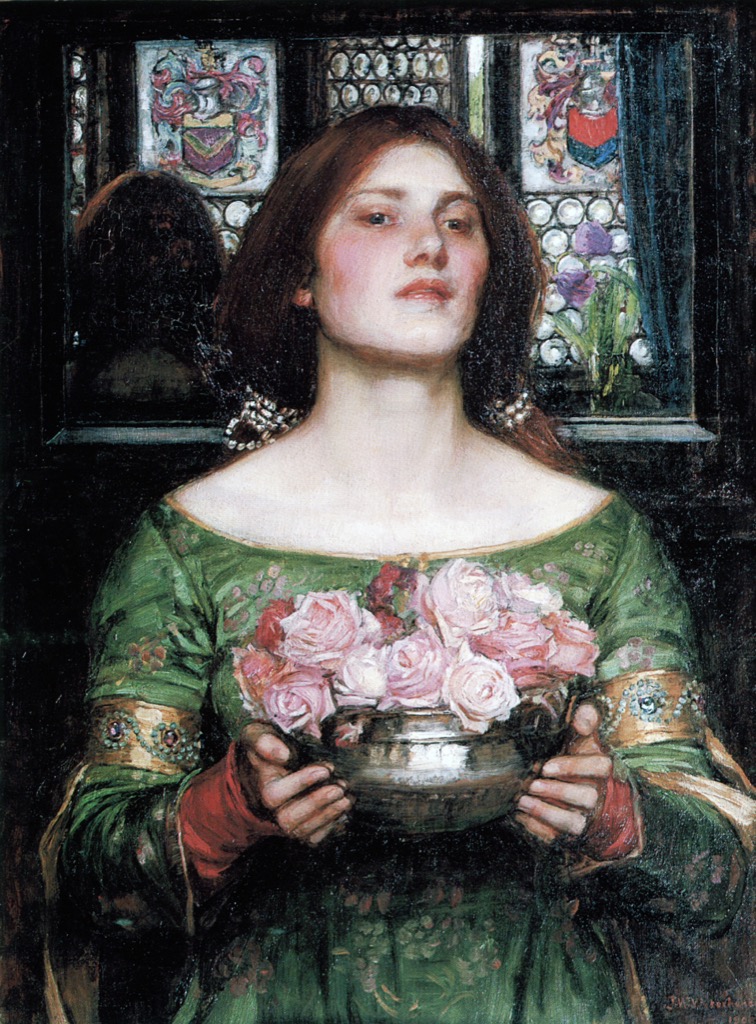
A young woman stands in a dark historic interior and presents a metal bowl filled with flowers. Light catches her skin, jewellery, pearls, roses and the bottle glass behind her. John William Waterhouse's 1908 Gather Ye Rosebuds While Ye May turns Robert Herrick's famous instruction to seize youth into an image that is sumptuous, self-possessed and shadowed by time. [1] [2]
This is the smaller, single-figure painting exhibited at the Royal Academy in 1908. It must be kept distinct from Waterhouse's larger 1909 composition of two women gathering flowers outdoors. The shared title joins them, but their scale, setting, ownership and narrative possibilities are different. [1]
At a Glance
- ArtistJohn William Waterhouse (1849–1917)
- TitleGather Ye Rosebuds While Ye May [1]
- DateSigned and dated 1908 [1]
- MediumOil on canvas [1]
- Dimensions62 × 46.4 cm [1]
- CollectionPrivate collection [1]
- First exhibitedRoyal Academy, London, Summer Exhibition, 1908, no. 669 [1]
- Original purchaserFrederick M. Fry, who bought it from the artist in 1908 [1]
- Literary sourceRobert Herrick, “To the Virgins, to Make Much of Time,” published in Hesperides in 1648 [2] [3]
- FormatHalf-length single figure in a dark, medieval- or Renaissance-inspired interior
- Essential distinctionThis is not the curved-top, multi-figure outdoor painting signed in 1909
Contents
- Introduction
- A Bowl of Roses Against Passing Time
- Herrick's Carpe Diem Poem
- What Waterhouse Chooses to Show
- Model, Gaze and Self-Possession
- Metal, Glass, Pearls and Reflected Light
- Rossetti, Historicism and the Flower-Women
- Exhibition, Ownership and Changing Reputation
- The 1908 and 1909 Versions Compared
A Bowl of Roses Against Passing Time
The woman does not gather flowers in front of us. The work has already happened. She holds a shallow metal vessel in which cut blossoms have been arranged and brings it into the viewer's space.
That difference gives the 1908 picture an unusually ceremonial quality. The roses are not scattered across a landscape or carried casually in a fold of cloth. They have been selected, contained and presented.
Her raised chin and direct, level presence prevent the pose from becoming one of meek offering. Christie's calls attention to the pride of the red-haired figure and to the way her illuminated face emerges from the darker room. [1] She appears aware of being seen, yet she does not ask permission to occupy the image.
The title changes the bowl's meaning. Without Herrick, the painting might be read as a portrait-like fantasy of luxury. With the poem, every flower is also a unit of passing time.
Cut roses are at their most displayable and already separated from the plant that sustained them. Their beauty is real rather than false, but it cannot last. Waterhouse makes impermanence visible without showing decay.
The figure is similarly poised at a moment of fullness. Herrick addresses young women and links youth with opportunity, warmth and marriage. [2] Waterhouse does not illustrate a wedding or a suitor. He concentrates the poem's pressure in the contrast between radiant life and the darkness surrounding it.
The interior seems older than the woman. Stained or armorial bottle glass, metalwork, pearls and historic dress place her in an invented past. She will pass; beautiful objects and images may outlive her, though their meanings also change.
The painting therefore contains two experiences of time. Herrick urges speed because life moves quickly. Waterhouse slows the viewer down through surface, light and detail. Looking becomes a temporary answer to loss.
Herrick's Carpe Diem Poem
The title comes from the opening of Robert Herrick's “To the Virgins, to Make Much of Time.” The four-stanza poem appeared in his 1648 collection Hesperides. [2] [3]
Herrick begins with rosebuds and immediately turns them into a clock. A flower smiling today will die tomorrow. The sun rises towards its height only to come nearer to setting. [2]
Youth occupies the same pattern. The speaker calls the first age the best because blood is warmer, then imagines progressively worse stages after that warmth is spent. The final instruction is not simply to enjoy sensation but to marry while opportunity remains. [2]
This is a carpe diem argument: take the present because time cannot be recovered. Its bright flowers and quick rhythm make the advice memorable, but the poem also places social pressure upon the women it addresses.
“Be not coy” assumes that hesitation is the obstacle and that marriage is the proper use of youth. [2] A modern reading can recognise the lyric's vitality without treating its gendered command as neutral wisdom.
Waterhouse changes that speaking relationship. No male adviser appears. The woman does not listen to anyone within the scene. She holds the flowers and faces outward.
The title still carries the poem's imperative, but the image does not tell us whether she obeys, resists or has already transformed it. Presenting gathered roses may demonstrate that she has acted. Her composure may equally withhold the intimate decision Herrick demands.
Nor are the flowers necessarily rosebuds in the strict botanical sense. The bowl contains a varied display. The literary title need not function as an inventory of every painted bloom.
Waterhouse preserves the poem's central paradox: awareness of death intensifies beauty. Yet he replaces argument with atmosphere. Herrick's sun runs; Waterhouse's light seems held upon skin, glass and metal for one extended instant.
The shift from verse to image also changes who controls duration. Herrick's speaker sets the pace and warns that delay will close the future. Waterhouse's woman is silent, but silence is not necessarily submission. A painted figure cannot answer the poem in words, so posture becomes her reply. The raised chin, contained flowers and unhurried stillness interrupt the pressure of the imperative.
This does not make the painting a documented feminist rejection of Herrick. It shows why illustration is never a neutral transfer. Once the addressed woman becomes the visible centre and the advising voice disappears, the power relation changes whether or not Waterhouse stated a programme.
What Waterhouse Chooses to Show
Waterhouse could have painted women bending through a rose garden. He would take something closer to that route in the 1909 version. Here he creates an interior image closer to an aesthetic portrait.
There is no explicit episode. The sitter is not securely identified as a literary heroine, goddess or historical person. Christie's places the work at the beginning of a six-year group of largely non-narrative “flower-women.” [1]
This absence of fixed identity broadens the title. The woman can embody youth, the act of choosing beauty, or the person to whom carpe diem advice is directed without becoming an illustration of a named character.
The bowl matters because it separates ownership from environment. She does not belong to a garden that surrounds and absorbs her. She holds a portable arrangement whose care and display may be her own.
The mirror and windows complicate the room. Reflective surfaces imply spaces beyond the one directly visible, yet they do not release the figure into an outdoor world. She remains contained by a narrow vertical format.
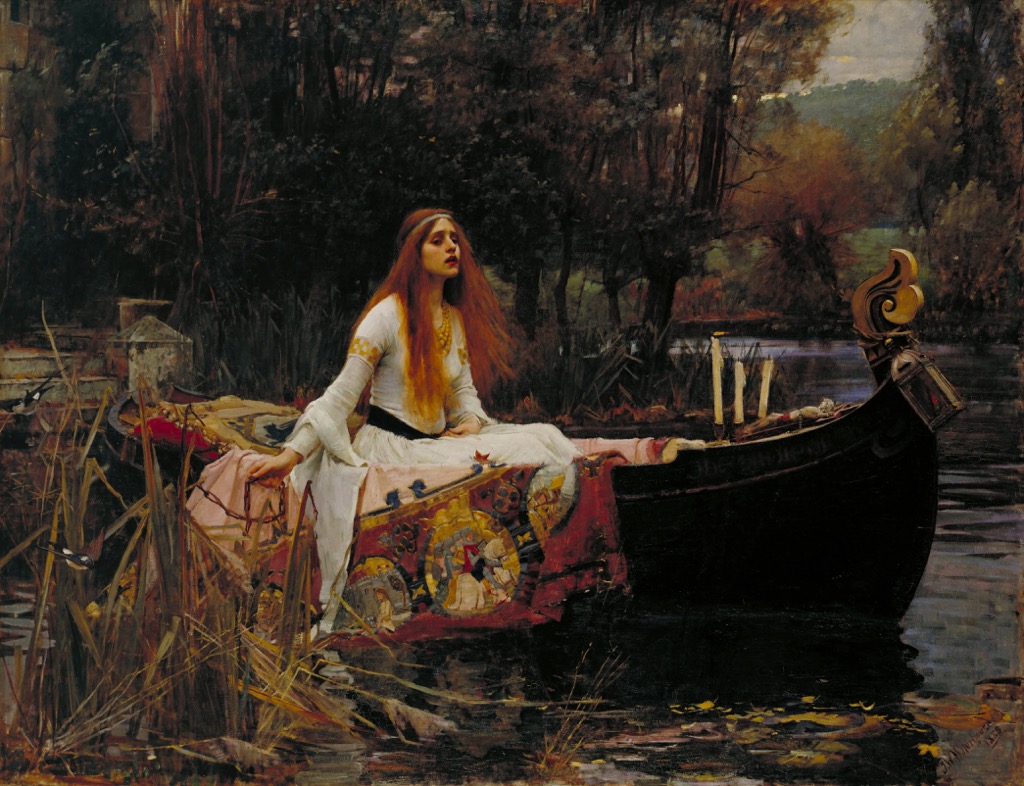
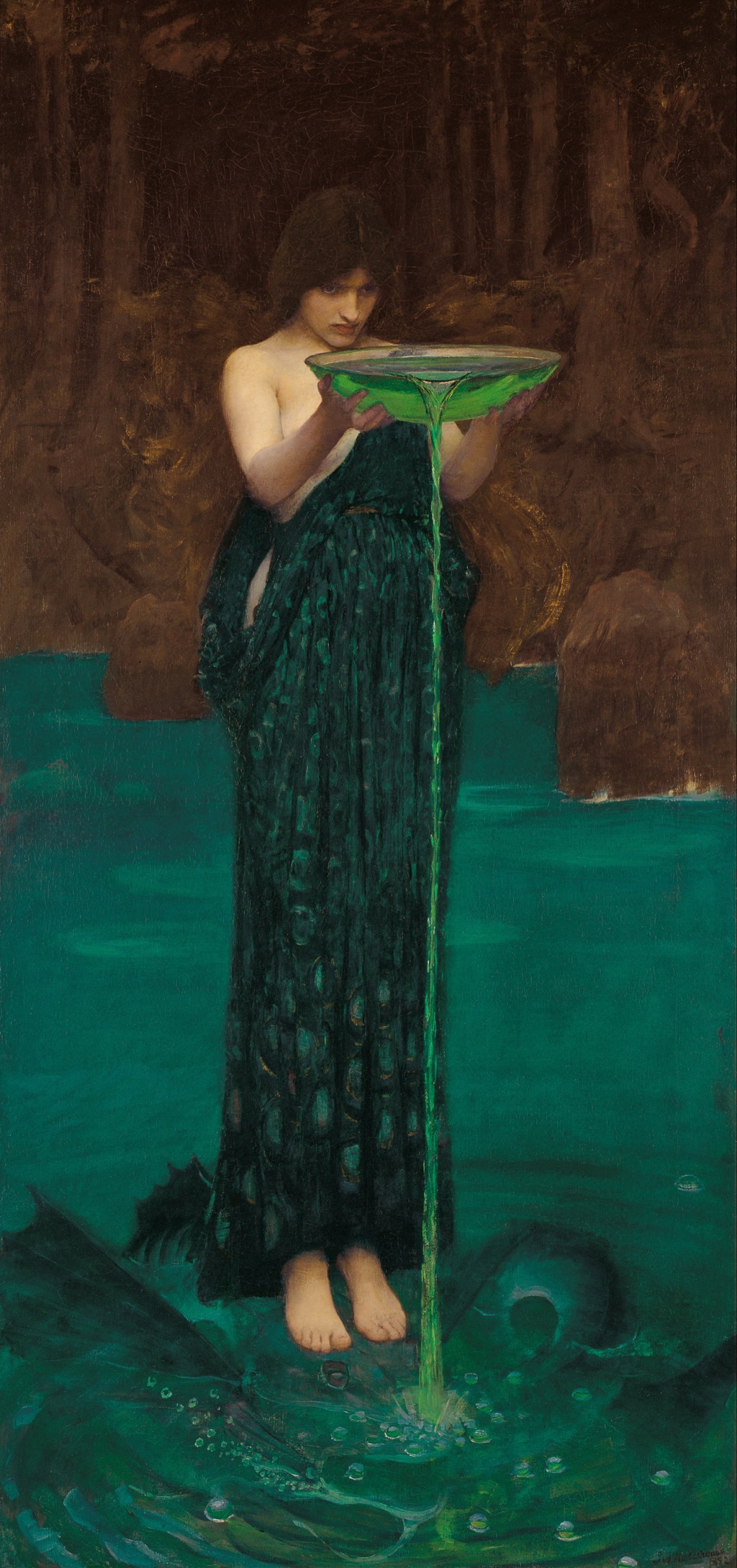
Waterhouse frequently used mirrors to divide knowledge. In The Lady of Shalott, reflected reality mediates a forbidden world; in Circe Offering the Cup to Ulysses, a mirror reduces the approaching hero behind the commanding sorceress. Here reflection is less narrative and more sensuous. [1]
It lets light and ornament circulate. The viewer looks not through a transparent opening but across overlapping surfaces—skin, polished vessel, gems, pearls, glass and paint.
The pose resembles presentation, but the painting does not specify a recipient. The bowl may be offered to us, shown to us or simply held at the boundary of her body.
That uncertainty protects the figure from becoming a literal embodiment of Herrick's compliant virgin. She is subject to time, as everyone is, but her decision remains private.
Model, Gaze and Self-Possession
Christie's describes the model as unnamed. [1] Her red hair, strong jaw, flushed cheeks and full lips connect her with a recognisable type in Waterhouse's late work, but resemblance cannot recover a documented identity.
The distinction between model and character is essential. “Waterhouse woman” is a visual category created through repeated faces, costumes and poses. It is not evidence that one known person carried the same symbolic meaning from painting to painting.
Her chin rises slightly. This creates physical distance from the bowl below and directs attention towards face and throat. The flowers do not conceal her.
She neither smiles invitingly nor withdraws. Her expression can appear proud, reflective or reserved depending on the viewer's expectations. None of those responses should be converted into biographical knowledge about the sitter.
The composition's closeness intensifies scrutiny. We see her at roughly half length, with little surrounding narrative to distract us. Yet the portrait-like format does not make the work a commissioned portrait.
Waterhouse gives her elaborate costume and jewellery but no social name. Historic dress turns an individual body into an image outside ordinary contemporary time.
That detachment suits the poem's universalising language. Herrick addresses “virgins” as a group; Waterhouse gives the pressure of that address one face.
At the same time, painting can resist language. The woman has already gathered the flowers, holds them securely and meets our inspection without visible haste. The command to act encounters someone who appears to possess her own rhythm.
The ambiguity is more compelling than a single moral. If she looks confident, the roses become a sign of chosen pleasure. If she looks solemn, they become a reminder that knowledge of time can burden the present it is supposed to liberate.
Metal, Glass, Pearls and Reflected Light
The painting's argument is carried through materials. Christie's highlights the reflections in the metal bowl, jewelled armlets, pearl-bound braids and bottle-glass windows. [1]
These surfaces do not reflect in the same way. Metal compresses light into bright, curved accents. Pearls produce small repeated points. Glass admits and redirects illumination while preserving the dark armorial pattern around it.
Skin offers the softest surface. Waterhouse lights face, neck and shoulders through the windows before which the woman stands. [1] The body appears warmer because the room is subdued.
Green and red organise the lower half of the image as complementary colours. [1] Flowers, gown and flesh are therefore bound into a designed harmony rather than treated as isolated objects.
The metal bowl is particularly important. It is both container and display. Its hard, durable surface contrasts with petals that bruise and fade.
Jewellery introduces another scale of time. Gems and metal can pass between owners; pearls were once organic growths and become permanent ornaments. All are arranged upon a mortal body.
Bottle glass also carries historic associations without reconstructing one precise building. Christie's notes armorial designs whose downward-pointing chevrons are unusual. [1] The detail is visible, but no secure family identification follows from it.
Waterhouse's historicism is selective. Costume, window and vessel create an atmosphere of the Middle Ages or Renaissance, not a documented room tied to Herrick's seventeenth-century life.
This temporal mixture is deliberate in effect even if its exact intention is undocumented. A seventeenth-century poem, Renaissance-derived portrait format, medievalising interior and Edwardian model coexist.
The image is therefore about historical memory as well as youth. The past is not recovered accurately; it is assembled into a beautiful present that knows it too will become past.
Rossetti, Historicism and the Flower-Women
Christie's proposes Dante Gabriel Rossetti's Bocca Baciata as an important comparison and suggests Waterhouse may have seen it at the Royal Academy's 1906 winter exhibition. [1] The relationship is persuasive but should remain an informed comparison rather than a documented confession of influence.
Both works bring a richly coloured, red-haired woman close to the picture plane and use beauty, flowers and luxury without requiring a fully narrated episode. Waterhouse's figure is less tightly cropped and more ceremonially occupied with the bowl.
By 1908, original Pre-Raphaelite art had become part of British art history. Waterhouse was not a member of the Brotherhood founded in 1848; he was a later Royal Academician who adapted its literary and visual inheritance. [1]
The late date matters. Calling the canvas simply “Pre-Raphaelite” can erase its position in Edwardian exhibition culture and the conscious revival of older styles.
Christie's places it among flower-women painted from 1908 to 1914: women carrying, arranging, wearing or smelling flowers. [1] The group shares motifs but not one narrative.
Flowers can indicate beauty, growth and mortality without becoming a fixed dictionary. Their repetition allows Waterhouse to vary relations between woman, object, landscape and time.
In The Soul of the Rose, scent and enclosed garden turn the flower inward towards memory or desire. In the 1909 Gather Ye Rosebuds, figures bend across a sunny landscape. In the 1908 interior, the gathered display is already complete.
Waterhouse's late work is sometimes described as less narrative. This picture shows that reduced plot need not mean reduced meaning. Title, pose and material contrast can sustain an argument without an identifiable climax.
Exhibition, Ownership and Changing Reputation
Waterhouse signed and dated the canvas in 1908 and exhibited it at the Royal Academy that summer as no. 669. [1] Frederick M. Fry purchased it from the artist in the same year.
Fry was a barrister and significant Waterhouse collector. Christie's records that he came to own six works by the artist and several drawings and attended Waterhouse's funeral in 1917. [1]
The painting appeared at the Royal Glasgow Institute in 1910, lent by Fry. [1] Its early history therefore combines the major London exhibition with a documented second public showing.
It remained with the Fry family until his estate sale at Christie's in 1943. By then, its title had been lost or suppressed in the catalogue, and it was offered generically as a lady in green holding roses. [1]
That renaming demonstrates how meaning can disappear when documentation and taste change. Without Herrick's title, the painting becomes decorative figure work; its meditation on time is weakened.
The price of eighteen guineas at the 1943 sale also records the collapse of Waterhouse's market reputation during the mid-twentieth century. [1] Auction value is not artistic value, but it is evidence of changing fashion.
The picture later returned to prominence. It appeared in the major 2008–10 Waterhouse retrospective in Groningen, London and Montreal and on the exhibition catalogue's cover. [1]
The movement from Royal Academy purchase to generic wartime sale and retrospective emblem is especially suited to a painting about time. Reputation, like youth, does not remain fixed.
Its original frame survives according to the 2022 catalogue. [1] That material continuity is valuable because frame and picture were conceived as one displayed object, not merely as an image reproduced online.
The retrospective history supplies a warning against reading present popularity backwards. Waterhouse was successful in 1908, neglected by much of the market in 1943 and celebrated again by 2009. None of those moments alone defines the painting. The object remained materially similar while institutions, prices and critical categories around it changed.
Its return to the Royal Academy in the 2008–10 tour also created a deliberate historical echo. The gallery that first introduced the work to buyers became the place where later audiences encountered it as part of a recovered career rather than as a new exhibit competing for attention.
The 1908 and 1909 Versions Compared
Waterhouse used the same Herrick title for two very different paintings. The 1908 version is a 62-centimetre-high, single-figure interior; the 1909 painting measures about a metre high and shows two flower gatherers outdoors. [1]
The earlier work was publicly exhibited at the Royal Academy and bought by Frederick Fry. The later curved-top canvas went directly to Brodie Henderson and was not exhibited during Waterhouse's lifetime. [1]
In 1908, gathering is implied by the completed bowl. In 1909, bending figures enact the gathering itself.
The first picture uses mirrors, bottle glass, jewellery and metal to create compressed luxury. The second uses sunlight, open ground, distant landscape and drapery to create expansion.
Herrick's warning applies to both, but differently. The interior woman holds beauty at its peak after selection. The outdoor women occupy the instant before mythic or seasonal change can interrupt them.
Modern scholarship connects the 1909 scene with Persephone because she was abducted while gathering flowers. That association is far less necessary for the 1908 interior, whose stronger lineage is the aesthetic portrait and Rossettian beauty type. [1]
The two works should therefore have separate pages, images and object facts. Calling one a study for the other would misrepresent their independence.
Together they show how a title can generate alternatives rather than repetitions. Waterhouse tests whether carpe diem is best expressed as possession, action, interior awareness or the last freedom of a figure in a landscape.
Related Pages
- The Lady Clare: Compare another Waterhouse painting whose title depends on a literary source.
- Literary and Mythological Sources: Follow the Ovidian and classical source framework behind Waterhouse's myth paintings.
- Paintings: Return to the protected Waterhouse paintings hub.
Frequently Asked Questions
Robert Herrick's “To the Virgins, to Make Much of Time,” first published in Hesperides in 1648. [2] [3]
Waterhouse signed and dated it 1908. [1]
At the Royal Academy Summer Exhibition of 1908, no. 669. [1]
It measures 62 × 46.4 centimetres. [1]
The model's name is not documented in the cited catalogue. She should not be assigned a biographical identity from resemblance alone. [1]
Herrick addresses an unnamed group of young women. Waterhouse creates a visual embodiment of the theme, not a portrait of a named literary character.
No. That is Waterhouse's larger 1909 work with the same title.
Frederick M. Fry bought it from Waterhouse in 1908. [1]
Herrick uses rosebuds as figures for youth and opportunities that disappear with time. [2]
It remains in a private collection. [1]
Discussion
1. Does the woman offer the flowers, display them or keep them? 2. How does her composed gaze alter Herrick's command to act quickly? 3. Why might Waterhouse place a poem about speed in a painting that rewards slow looking? 4. What do metal, glass, pearls and petals each suggest about permanence? 5. Does the invented historic interior deepen the theme of time or merely decorate it? 6. How does the 1908 interior differ emotionally from the 1909 outdoor version? 7. What was lost when the painting was sold under a generic title in 1943? 8. Can an image celebrate youth without endorsing all the social pressure in Herrick's poem?
Reader Insights
Which visible detail most changes the way you read this page?
Which source or comparison helps the work feel less familiar and more specific?
What question would you bring back to the painting after reading?
Join the Conversation
Share your reading of this page below.
References
- Image reference
- Christie's, “John William Waterhouse, R.A., R.I., Gather Ye Rosebuds While Ye May,” catalogue record and essay documenting signature, dimensions, provenance, exhibitions, visual analysis, Rossetti comparison and the later flower-women, View source.
- Robert Herrick, “To the Virgins, to Make Much of Time,” Poetry Foundation, text of the poem, View source.
- Poetry Foundation, “Robert Herrick,” biographical and publication context for Hesperides, View source.