 Buy Art Prints Now
from Amazon
* As an Amazon Associate I earn from qualifying purchases.
Image reference [image]
 by Tom Gurney
Tom Gurney BSc (Hons) is an art history expert with over 20 years experience
Published on August 14, 2026 / Updated on August 14, 2026
Email: tomgurney1@gmail.com / Phone: +44 7429 011000
Phyllis and Demophoon: Introduction
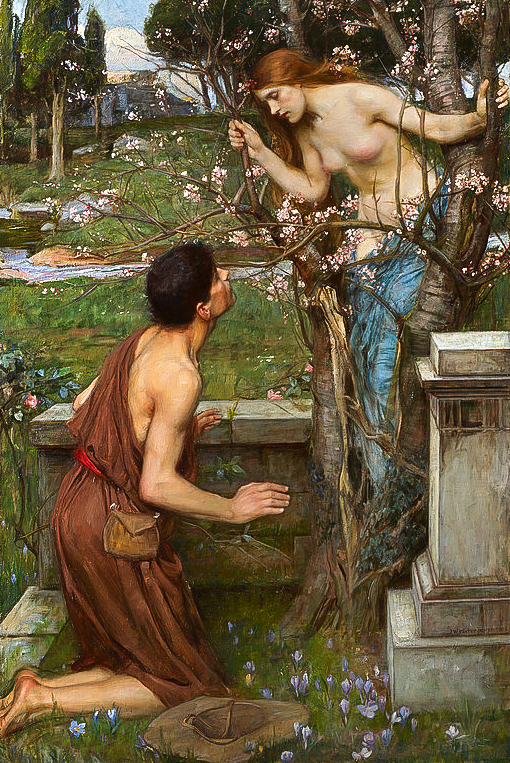
A flowering almond tree opens around a woman who can no longer return wholly to human life. Below her, the man who broke his promise kneels in remorse. John William Waterhouse's Phyllis and Demophoon, signed in 1905 and first exhibited at the Royal Academy in 1907, turns betrayal, death and metamorphosis into an encounter of extraordinary tenderness. [1] [4] [5]
The tenderness must not be mistaken for a simple happy ending. Ovid gives Phyllis a voice before her death: she counts the months of Demophoon's absence, recalls his vows and imagines the epitaph that will blame him. [2] Later tradition supplies the almond tree that flowers when he returns and embraces it. [3] Waterhouse joins those stages, but restoration remains incomplete.
At a Glance
- ArtistJohn William Waterhouse (1849–1917)
- TitlePhyllis and Demophoon or Phyllis and Demophoön [1] [4] [5]
- DateSigned 1905; first exhibited in 1907 [1] [4] [5]
- MediumOil on canvas [5]
- Dimensions136.5 × 91.5 cm [5]
- CollectionPrivate collection; current whereabouts are not publicly documented [1] [4] [5]
- First exhibitedRoyal Academy, London, Summer Exhibition, 1907, no. 232 [4]
- Early ownerH. W. Henderson [4]
- Literary starting pointOvid, Heroides, Epistle 2, “Phyllis to Demophoon” [2]
- Later narrative traditionPhyllis becomes an almond tree that responds when the returning Demophoon embraces its trunk [3]
- Essential distinctionOvid's letter records abandonment and anticipated death; the flowering reunion belongs to later versions of the myth
Contents
- Introduction
- A Reunion After It Is Too Late
- Phyllis Speaks in Ovid's Heroides
- Death, the Almond Tree and Later Tradition
- What Waterhouse Chooses to Show
- Gaze, Body and Flowering Tree
- Remorse, Forgiveness and the Limits of Return
- The 1905 Painting and 1907 Exhibition
- Studies, Reversal and Waterhouse's Working Method
A Reunion After It Is Too Late
Waterhouse does not paint the departure that begins the tragedy. He does not show Phyllis waiting by the Thracian shore, nor the suicide that follows her abandonment. He begins with the act that comes last: Demophoon has returned and the dead woman answers from a tree.
The vertical canvas is organised around the difference between their conditions. Demophoon remains a traveller with a separate human body. Phyllis appears continuous with trunk, branches and blossom. His delay has not merely caused time to pass; it has altered what reunion can mean.
He kneels below her. The posture reverses the earlier imbalance in which Phyllis depended upon his promised return. He is now the supplicant, while she occupies the higher position and controls the painting's emotional centre.
Yet height does not equal freedom. Her body emerges from living wood but cannot simply step down. Christie’s describes the encounter as one in which Phyllis appears to forgive Demophoon while remaining unable to recover human form. [1] [4] The tree saves, commemorates and confines her at once.
Blossom announces that the apparently barren trunk is alive. It is a response to contact, but not proof that damage has been undone. The painting's beauty depends on that distinction.
Waterhouse makes recognition happen through the figures' exchanged look. Phyllis bends her attention toward Demophoon; he looks up. Their eyes cross the gap between transformed and untransformed bodies. [1]
No crowd witnesses the moment. Unlike a public scene of judgement, the encounter is quiet and secluded. This privacy intensifies responsibility because Demophoon cannot disappear among secondary figures or heroic distractions.
Nor can the viewer retreat into the comfort of a conventional marriage picture. There is no wedding, shared home or future represented beyond the flowering tree. What remains is an impossible meeting created by remorse.
Phyllis Speaks in Ovid's Heroides
Ovid's Heroides imagines letters written by mythological women to absent men. Epistle 2 belongs to Phyllis, daughter of a Thracian king, addressing Demophoon after the date fixed for his return has passed. [2]
The letter opens with counting. Four moons have waned and grown full since the agreed day, yet no Athenian ship appears. This measured time makes abandonment concrete. Phyllis does not complain vaguely that he has been gone too long; she has tracked the promise against repeated cycles of the sky. [2]
Hope persists after evidence has turned against it. She imagines winds bringing white sails and invents explanations for delay. She fears wreck, curses Theseus for perhaps detaining his son and prays for the safety of the very man whose failure is destroying her. [2]
That generosity becomes an instrument of anguish. Each possible excuse postpones the conclusion that Demophoon chose not to return. Ovid lets readers hear trust defending itself before it finally gives way.
Phyllis recalls the hospitality she gave the traveller and the vows he made. He invoked sea, gods, Venus, marriage and his own pledged hand. Her grievance is not simply that affection cooled. A structure of promises allowed him to receive refuge, love and expectation before he departed. [2]
The letter also contests the heroic perspective. Demophoon is a son of Theseus returning from the Trojan world, but Phyllis measures heroism by fidelity rather than ancestry or travel. A celebrated name cannot protect him from the moral meaning of a broken word.
She imagines future stories in which Thracian women will cite her as a warning. She also anticipates her death and proposes an epitaph that will name Demophoon as its cause. [2] Writing becomes a final attempt to control the record when she cannot control his movement.
Waterhouse's painting contains none of the letter's sentences. Nevertheless, its force depends upon the history they provide. Without Phyllis's voice, the returning man might look merely sorrowful and the blossoming woman merely magical. Ovid establishes what his remorse answers.
The poem should not be confused with a neutral chronology. It is a dramatic monologue shaped through Phyllis's knowledge, fear and rhetoric. That partial viewpoint is precisely its value: the abandoned woman, not the returning hero, receives sustained narrative authority.
Death, the Almond Tree and Later Tradition
The Heroides ends within Phyllis's crisis. It does not narrate Waterhouse's visible reunion in the complete form the painting requires. That part of the story comes through later mythographic and commentary traditions.
A note in the classical tradition recorded by the scholar James George Frazer describes Phyllis hanging herself in despair and becoming a leafless almond tree. When Demophoon eventually returns and embraces the trunk, it bursts into leaf. [3]
Frazer distinguishes this from a less romantic version attributed to Hyginus, in which trees grow upon Phyllis's grave and mourn her by losing their leaves at the season of her death. [3] There is therefore no single ancient account that must govern every detail.
The almond-tree version gives Demophoon's return a visible effect. His embrace does not resurrect Phyllis as an ordinary mortal, but the tree answers with growth. Recognition occurs biologically rather than verbally.
Later retellings often call the flowering a sign of forgiveness. That interpretation suits Waterhouse's gentle exchange of gazes and is used in modern catalogue descriptions. [1] [4] It remains an interpretation, not a command issued by the picture.
Flowering may also signify memory, response, residual love or the release of life held in suspension. A tree can acknowledge the person who touches it without cancelling the act that caused the transformation.
This distinction guards against an easy moral transaction: he regrets, she forgives, and the tragedy disappears. Waterhouse gives Demophoon remorse but does not give him the power to make Phyllis human again.
The myth's etymological explanation—linking Phyllis's name with Greek words for leaf—belongs to the same tradition of making language grow from transformation. [3] Body, plant and name preserve one another when human continuity has failed.
The painting therefore brings together related but non-identical sources. Ovid supplies the abandoned woman's interior voice; later tradition supplies tree, return and miraculous response. Treating all of this simply as “Ovid's story” conceals how Waterhouse and his culture inherited mythology through layers.
What Waterhouse Chooses to Show
Waterhouse selects aftermath rather than spectacle. There is no ship leaving, no body hanging and no god visibly performing metamorphosis. The violent sequence survives through consequences.
This restraint is not the same as removing death. Phyllis's fusion with the tree makes it unavoidable. Her changed state occupies most of the composition even while flowers soften its appearance.
The choice also refuses the instant of greatest helplessness. Waterhouse does not turn her suicide into a beautiful display for the viewer. He represents her after she has acquired a strange, limited form of presence.
Demophoon's remorse is equally compressed. He does not need a theatrical gesture before a crowd. Kneeling, touch and upward attention establish that the returning hero now recognises the person he failed.
Christie's notes that Waterhouse's Phyllis does not threaten as she had in treatments of the subject by Edward Burne-Jones. [1] The difference gives this picture its distinctive pathos, but it should not be converted into certainty about absolution.
Her calm can be read as forgiveness, distance, sadness or the altered consciousness of a person now partly arboreal. The painting gives emotional cues without a caption that fixes speech.
Waterhouse also chooses the moment of blossom rather than full leaf. Flowers are both culmination and beginning: the tree answers spectacularly, yet each bloom is fragile and temporary.
The comparison with Isabella and the Pot of Basil, which Waterhouse showed at the same Royal Academy exhibition, is revealing. [1] [4] Both pictures connect a woman's grief with a plant. In one, Isabella tends the basil that contains her murdered lover's head; in the other, the woman herself becomes flowering growth.
Across these works, vegetation does more than decorate female beauty. It bears memory when ordinary human relationships have been broken by betrayal, murder or delay.
Gaze, Body and Flowering Tree
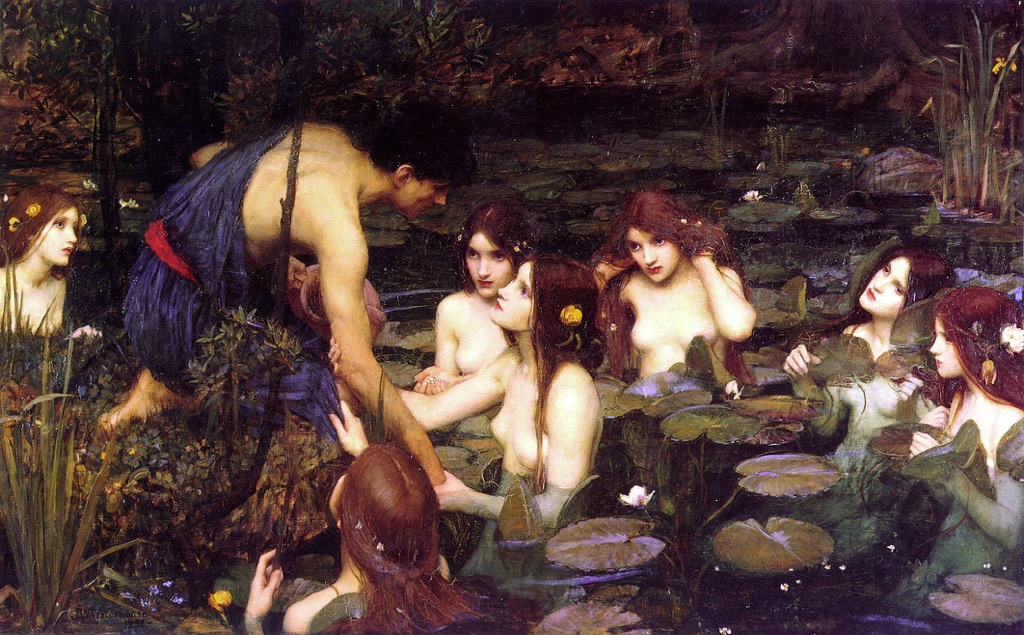
The emotional axis is the gaze between Phyllis and Demophoon. Christie’s identifies it as a device Waterhouse had refined in earlier works, including Hylas and the Nymphs. [1] [4] Here, however, looking does not entice someone towards danger. It recognises a danger already realised.
Their faces belong to different zones. Demophoon is grounded in the lower human world. Phyllis appears amid trunk and branches, where flesh and plant meet. The diagonal between their eyes briefly connects those conditions.
Her red hair, pale skin and blossom create visual continuities rather than a hard border between woman and tree. Waterhouse's preparatory head study isolates the familiar red-haired model while affirming that her name is unknown. [4]
The lack of a documented name matters. Calling her merely “Waterhouse's favourite model” may describe repeated use, but it cannot recover biography. The painting's heroine is Phyllis; the sitter behind her remains unidentified.
Blossom surrounds the meeting with colour and texture. In a surviving large oil study, Christie’s describes thick impasto and touches of varied hues that coalesce at viewing distance. [1] Such handling makes growth seem active rather than emblematic.
Branches zigzag around the figure. They can read as an extension of gesture, a structure holding her body or a visible record of transformation. The tree is at once setting, anatomy and narrative evidence.
Demophoon's draped figure provides denser, earthbound mass. His human mobility is paradoxically expressed through kneeling stillness, while the immobile Phyllis seems animated by branching lines and opening flowers.
That reversal complicates power. He can travel but has arrived too late; she cannot leave but commands the image. Physical freedom and emotional authority do not coincide.
Waterhouse's idealisation should be acknowledged. Phyllis appears young and beautiful after death, and tragedy unfolds in a radiant landscape. Beauty makes the story memorable, but it can also make loss easier to consume. Responsible looking keeps cause beside effect.
Remorse, Forgiveness and the Limits of Return
Demophoon's kneeling body makes remorse visible before any explanation is offered. He is not presented in the triumphant posture of a homecoming hero.
Yet remorse is not restitution. His return activates the tree in later tradition, but it cannot restore the waiting months, prevent Phyllis's death or return her fully to human life. [1] [3] [4]
This limit is the painting's deepest source of pathos. The lovers can see one another only after the ordinary conditions of relationship have become impossible.
Modern catalogue writing describes Phyllis as forgiving him. [1] [4] Her unthreatening gaze supports that reading, as does the miraculous bloom. Still, forgiveness should be distinguished from reconciliation.
Forgiveness may belong to Phyllis as an act of agency, if that is what her expression signifies. Reconciliation requires a shared future, and the painting withholds one. She remains a tree; he remains separate.
The difference also prevents Demophoon's sorrow from taking over her story. His remorse is real within the image, but Ovid's letter ensures that readers remember the greater duration of Phyllis's waiting and the broken vows that preceded the final instant. [2]
The flowering response can even be read as judgement in gentle form. It proves that the tree is Phyllis and that she received his return, so he cannot pretend his promise was forgotten or inconsequential.
Waterhouse does not decide whether late recognition redeems the man. He stages what recognition costs when it arrives after irreversible change.
This is why the picture exceeds a sentimental illustration of undying love. It asks whether love can persist without repairing harm, whether transformation is rescue or memorial, and whether beauty can hold grief without resolving it.
The 1905 Painting and 1907 Exhibition
The finished canvas is signed 1905, although Waterhouse did not exhibit it at the Royal Academy until 1907. [1] [4] [5] The exhibition date has caused some sources to call it a 1907 painting; the signature provides the firmer date of execution.
One circulating image record has also carried an 1897 date. That date conflicts with the signed 1905 chronology, the 1907 Academy record and contemporary study evidence. [1] [4] [5] It should not be repeated as established fact.
At the 1907 Summer Exhibition, Phyllis and Demophoon appeared as no. 232. [4] It was shown alongside Waterhouse's Isabella and the Pot of Basil, reinforcing his concentration on literary women, bereavement and plants in the middle of the decade.
The painting was then owned by H. W. Henderson, one of Waterhouse's important patrons. [4] It remains associated with a private collection, and its current location is not publicly documented in the accessible records. [1] [4] [5]
Its dimensions, 136.5 by 91.5 centimetres, make it a substantial vertical exhibition picture. [5] The scale allows Phyllis's tree-body to rise above the kneeling man while keeping the exchange intimate.
The work belongs to Waterhouse's mature return to Ovidian women. Christie’s places it beside his treatments of Ariadne, Medea and Penelope, all figures whose experience is shaped by men's action or inaction and whose voices appear in the Heroides. [1] [4]
That context is more useful than applying “Pre-Raphaelite” as an all-purpose description. Waterhouse inherited the movement's bright colour, literary seriousness and precise natural symbolism, but he was a Royal Academician working decades after the original Brotherhood formed.
The two-year interval between signature and exhibition does not by itself prove two years of continuous revision. What can be said is that the subject received unusually extensive preparation and that major compositional decisions changed before the Academy version. [1] [4]
Studies, Reversal and Waterhouse's Working Method
More preparatory material survives for Phyllis and Demophoon than for many Waterhouse paintings. It includes pencil sketches, a separate painted head and multiple large oil studies. [1] [4]
A full-scale oil study now in a private Spanish collection measures 74.9 by 104.1 centimetres in its cut-down state. [1] It preserves the figures and the flowering encounter, although an owner removed the lower half after Waterhouse's studio sale.
The study is horizontal, while the completed work is a tall vertical canvas. This difference alone shows that preparation was not merely a smaller copy of a predetermined design.
Waterhouse also reversed the composition late in development. In the rediscovered oil study the tree stands to the left and Phyllis looks down towards the viewer's right; the Academy painting reverses that arrangement. [1]
Several pencil sketches in the Victoria and Albert Museum support the same history of reversal. [1] [4] The reason is undocumented, so claims about symbolism should remain hypotheses.
The change may have improved the direction in which viewers encounter the gaze, balanced branch and figure masses or solved the transition from horizontal study to vertical final format. None of those possibilities should be presented as Waterhouse's stated intention.
The separate head study measures 40.6 by 34.3 centimetres. [4] Its connection to Phyllis is unusually secure because Alfred Lys Baldry reproduced and identified it as such in The Studio in 1911, during Waterhouse's lifetime. [4]
That contemporary identification corrected a later attribution of the head to Hylas and the Nymphs. It is a useful lesson in evidence: visual resemblance across Waterhouse's repeated models is weaker than a near-contemporary published caption linked to the artist. [4]
Christie's suggests that the same beardless youth who posed for Hylas also modelled Demophoon, perhaps through older studio drawings. [1] [4] The connection is plausible catalogue scholarship rather than a documented statement by Waterhouse.
Three full-scale oil studies for the subject were offered when Waterhouse's studio contents were dispersed at Christie's in 1926. [1] Their existence indicates sustained labour behind the final image's apparent ease.
The rediscovered study also reveals material decisions difficult to see in ordinary reproductions: varied colours within single passages, bright lake pigments, thick blossom and brushwork that resolves as the viewer steps back. [1]
Waterhouse's method therefore parallels the story in an unexpected way. The final image of miraculous emergence grew through reversals, discarded formats and layered studies. Its flowering surface is the end of a long process, not an effortless first conception.
Related Pages
- Apollo and Daphne: Compare another Ovidian pursuit-and-transformation subject in Waterhouse's mythological work.
- Literary and Mythological Sources: Follow the Ovidian and classical source framework behind Waterhouse's myth paintings.
- Paintings: Return to the protected Waterhouse paintings hub.
Frequently Asked Questions
Phyllis is a Thracian princess who welcomes and loves Demophoon, a son of Theseus returning from the Trojan War. He promises to return and marry her but fails to arrive at the appointed time. [1] [2]
Ovid's letter anticipates her death. Later tradition says she hangs herself and becomes an almond tree, which responds when Demophoon eventually returns. [2] [3]
In the later almond-tree version, Demophoon's remorseful embrace causes the barren tree to burst into growth. The flowering acknowledges Phyllis's continued presence. [1] [3]
Modern catalogue interpretations read her gentle gaze and the blossom as forgiveness. [1] [4] The painting leaves room for that reading but does not prove absolution, and she cannot recover human form.
No. Ovid's Heroides supplies Phyllis's letter of abandonment. The transformed almond tree and its response to Demophoon's embrace belong to later transmitted versions. [2] [3]
It is privately owned, and its present whereabouts are not publicly documented in the cited sources. [1] [4] [5]
The finished oil on canvas measures 136.5 × 91.5 centimetres. [5]
Yes. They include pencil sketches, several large oil studies and a separate painted head of Phyllis identified in print during Waterhouse's lifetime. [1] [4]
Discussion
1. Does the flowering tree signify forgiveness, memory, judgement or several things at once? 2. How does Ovid's first-person letter change the way we view Demophoon's remorse? 3. Why might Waterhouse choose the reunion instead of Phyllis's waiting or death? 4. Is transformation a rescue if Phyllis cannot return to human form? 5. How does the exchange of gazes connect two different states of being? 6. What is gained by distinguishing Ovid's poem from later versions of the almond-tree story? 7. Does the painting give Phyllis agency, or does its beauty soften the harm done to her? 8. What do the reversal and surviving studies reveal about Waterhouse's working method?
Reader Insights
Which visible detail most changes the way you read this page?
Which source or comparison helps the work feel less familiar and more specific?
What question would you bring back to the painting after reading?
Join the Conversation
Share your reading of this page below.
References
- Image reference
- Christie's, “John William Waterhouse, R.A., Study for ‘Phyllis and Demophoön’, 1905,” catalogue essay documenting the finished work's chronology, narrative, preparatory sequence, compositional reversal and studio sale, View source.
- Ovid, Heroides, Epistle 2, “Phyllis to Demophoon,” translated by Grant Showerman, Theoi Classical Texts Library, View source.
- Apollodorus, The Library, Epitome commentary, note 169, translated and edited by James George Frazer, Theoi Classical Texts Library; discussion of the Phyllis traditions attributed to Servius and Hyginus, View source.
- Christie's, “John William Waterhouse, R.A., Phyllis,” catalogue essay for the painted head study, documenting its lifetime publication, 1907 Royal Academy number, Henderson ownership, narrative and reversal, View source.
- Wikimedia Commons, “John William Waterhouse — Phyllis and Demophoon,” object metadata for the finished painting's date, medium, dimensions and private ownership, View source.