 Buy Art Prints Now
from Amazon
* As an Amazon Associate I earn from qualifying purchases.
Image reference [image]
 by Tom Gurney
Tom Gurney BSc (Hons) is an art history expert with over 20 years experience
Published on August 14, 2026 / Updated on August 14, 2026
Email: tomgurney1@gmail.com / Phone: +44 7429 011000
Windflowers: Introduction
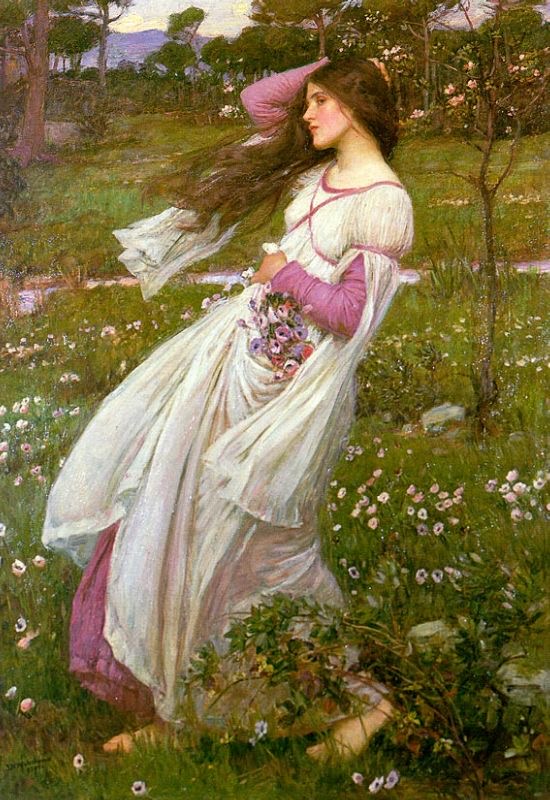
A young woman crosses a spring landscape while a gust drives her hair and drapery sideways. She gathers the flowers against her body as if trying to keep what the wind may scatter. John William Waterhouse's Windflowers, painted in 1902 and exhibited at the Royal Academy in 1903, creates drama without a named story: weather is enough. [1] [2]
The painting is sometimes forced into myths of Persephone or the Lady of Shalott. No secure title, attribute or contemporary record establishes either identity. Its achievement lies in keeping the figure anonymous while turning air, cloth and fragile flowers into a complete subject.
At a Glance
- ArtistJohn William Waterhouse (1849–1917)
- TitleWindflowers [1]
- Date1902 [2]
- MediumOil on canvas [2]
- DimensionsApproximately 116.5 × 79.1 cm [2]
- CollectionPrivate collection [2]
- First documented exhibitionRoyal Academy, London, Summer Exhibition, 1903, no. 204 [1]
- SubjectAn unnamed young woman carrying gathered flowers through a windblown spring landscape
- Botanical note“Windflower” is a common name for anemone [3]
- Related Waterhouse workBoreas, exhibited at the Royal Academy in 1904 [1]
- Essential distinctionThe title describes flowers and weather; it does not securely identify a literary heroine or wind god
Contents
- Introduction
- Air Becomes the Event
- The Woman and Her Gathered Flowers
- Drapery, Hair and the Direction of Movement
- Anemones, Windflowers and Naming
- A Narrative Without a Named Heroine
- Landscape, Colour and Selective Finish
- Royal Academy Exhibition and Related Works
- Modern Interpretation and Evidential Limits
Air Becomes the Event
Wind cannot be painted directly. Waterhouse makes it visible through effects: displaced hair, pulled cloth, bent growth, the figure's forward movement and her effort to protect what she carries.
The result is an action painting in the literal sense. No person attacks, calls or pursues the woman. Pressure comes from the atmosphere itself.
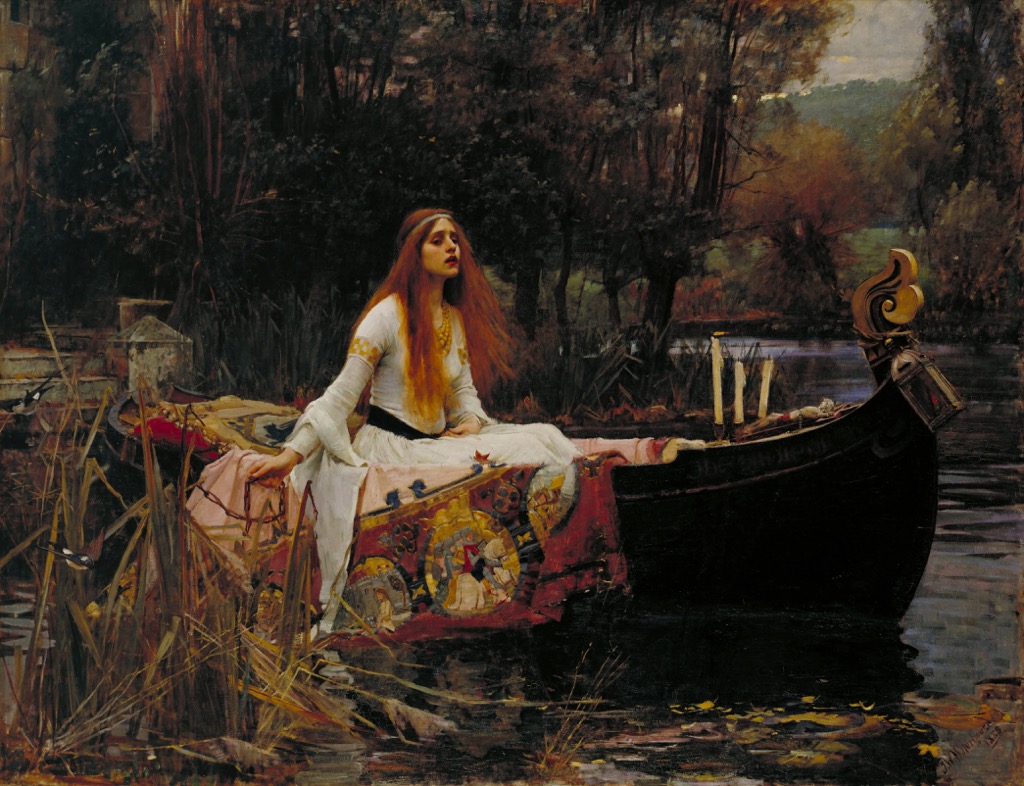
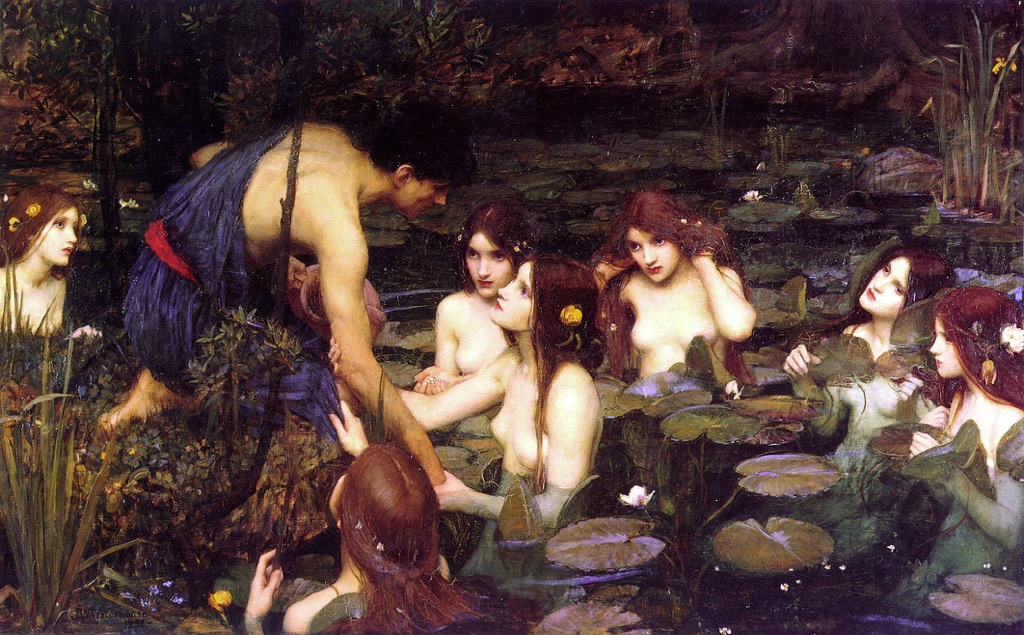
That choice distinguishes Windflowers from many of Waterhouse's famous literary canvases. Hylas and the Nymphs depends upon a fatal invitation; The Lady of Shalott upon Tennyson's curse; Apollo and Daphne upon pursuit. Here the title provides no plot beyond an encounter between body and weather.
This makes sequence emerge from cause and response rather than from a known text. The wind acts, the woman's outline changes, and her arms close around the flowers. A complete visual sentence forms before any symbolism is proposed.
The gust is temporary, yet the painting holds it. Cloth remains suspended in a shape that ordinary fabric could maintain for only a moment.
This creates a paradox. The subject is movement, while the medium fixes movement into an enduring surface. Waterhouse's figure appears forever at the instant of imbalance.
The woman does not collapse. Her body inclines and adjusts. She is vulnerable to the force around her but actively negotiating it.
The gathered flowers sharpen the problem. Hair and clothing can recover after a gust; cut blooms may be lost or damaged. Her arms turn weather into care.
The painting's tension is small in scale but emotionally legible. Anyone who has crossed open ground in strong wind understands the instinct to hold clothing and carried objects close.
This familiarity lets Waterhouse avoid explanation. The event belongs to physical experience rather than mythic literacy.
Yet the idealised dress and spring setting keep it outside ordinary street life. The image is observational in weather and poetic in world.
Air also equalises different materials. It touches hair, woven cloth, stems, leaves and the unseen surface of the woman's skin. Nothing in the landscape is completely self-contained.
That physical continuity distinguishes the picture from a theatrical effect in which a machine blows only upon a model. The gust is understood as environmental because multiple parts of the scene answer it.
The woman nevertheless experiences its force differently from rooted plants. Vegetation can bend where it grows; she must move, balance and keep possession of cut blooms. Waterhouse makes a shared atmosphere reveal unequal kinds of vulnerability.
The Woman and Her Gathered Flowers
The woman occupies almost the full height of the vertical canvas. Landscape surrounds her, but she is not a small figure absorbed by distance.
Her face turns away from direct confrontation with the viewer. Attention seems divided between the direction of travel, the wind and the flowers she holds.
This withheld gaze differs from Waterhouse's half-length flower-women of 1908 and after. In the 1908 Gather Ye Rosebuds, a woman presents a bowl and occupies a compressed interior. Windflowers gives the whole body to motion.
The flowers have already been picked. As in the later rosebud pictures, gathering joins beauty to separation from the living plant.
Here possession is unstable. The bouquet may scatter. The title can refer to a botanical name, to flowers moved by air or to both.
The woman's act of holding them close can be read practically before it is read symbolically. Waterhouse does not require a code to make the gesture meaningful.
At the same time, protection invites broader thought. What can be preserved when time and nature move independently of desire? The painting makes that question without illustrating a moral text.
Her anonymity supports the theme. A named heroine would carry a known past and future. This figure remains within the present physical problem.
No documented identity for the model is established by the cited records. Similarity to other Waterhouse faces should not become a confident name.
Nor does youth alone make her Ophelia, Persephone or the Lady of Shalott. Waterhouse repeatedly painted young women in landscapes; iconography and documentary evidence are needed to move beyond resemblance.
Drapery, Hair and the Direction of Movement
Drapery does more than clothe the figure. It records the competing directions of body and air.
The woman appears to move through the landscape while fabric is caught and redirected. Folds that would normally fall under gravity stretch, lift or wrap.
Hair supplies finer lines than cloth. Its loosened strands make the same force visible at a smaller scale.
Together they create continuity between figure and surroundings. The body has a stable core, while its edges dissolve into movement.
A recent scholarly discussion of Pre-Raphaelite nature imagery reads the flowing garments and hair in Windflowers as a formal merging of woman and environment rather than as a specific mythological episode. [4] That interpretation helps explain why the image feels integrated without making nature benign.
Wind both connects and threatens. It passes through landscape and around the woman, placing all visible forms within one atmosphere. It also endangers the flowers and challenges balance.
The direction of folds guides the eye across the canvas. We do not merely look at a central body; we follow lines leaving it.
This outward energy prevents the vertical format from becoming static. The figure's height provides stability, while diagonal and lateral accents produce motion.
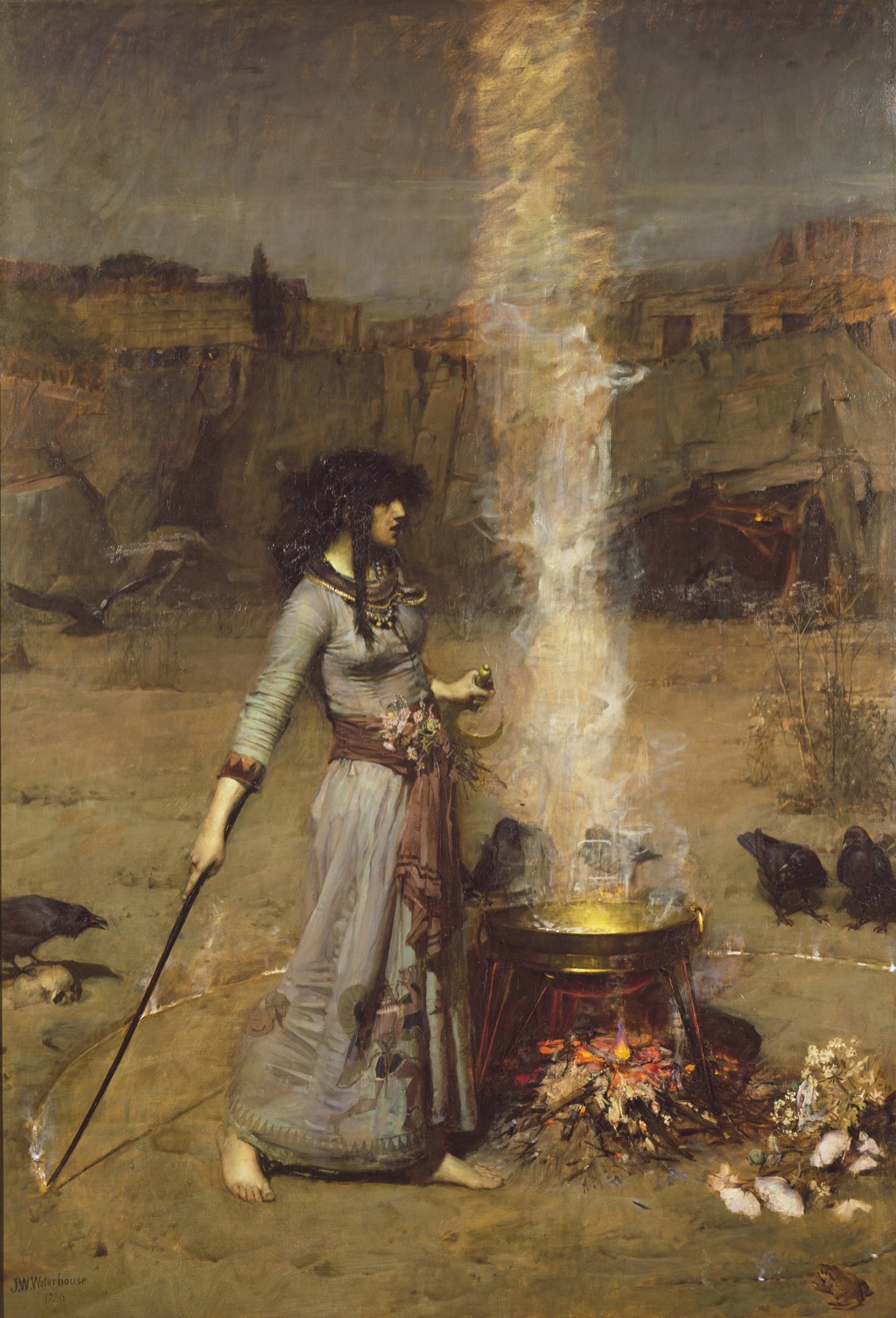
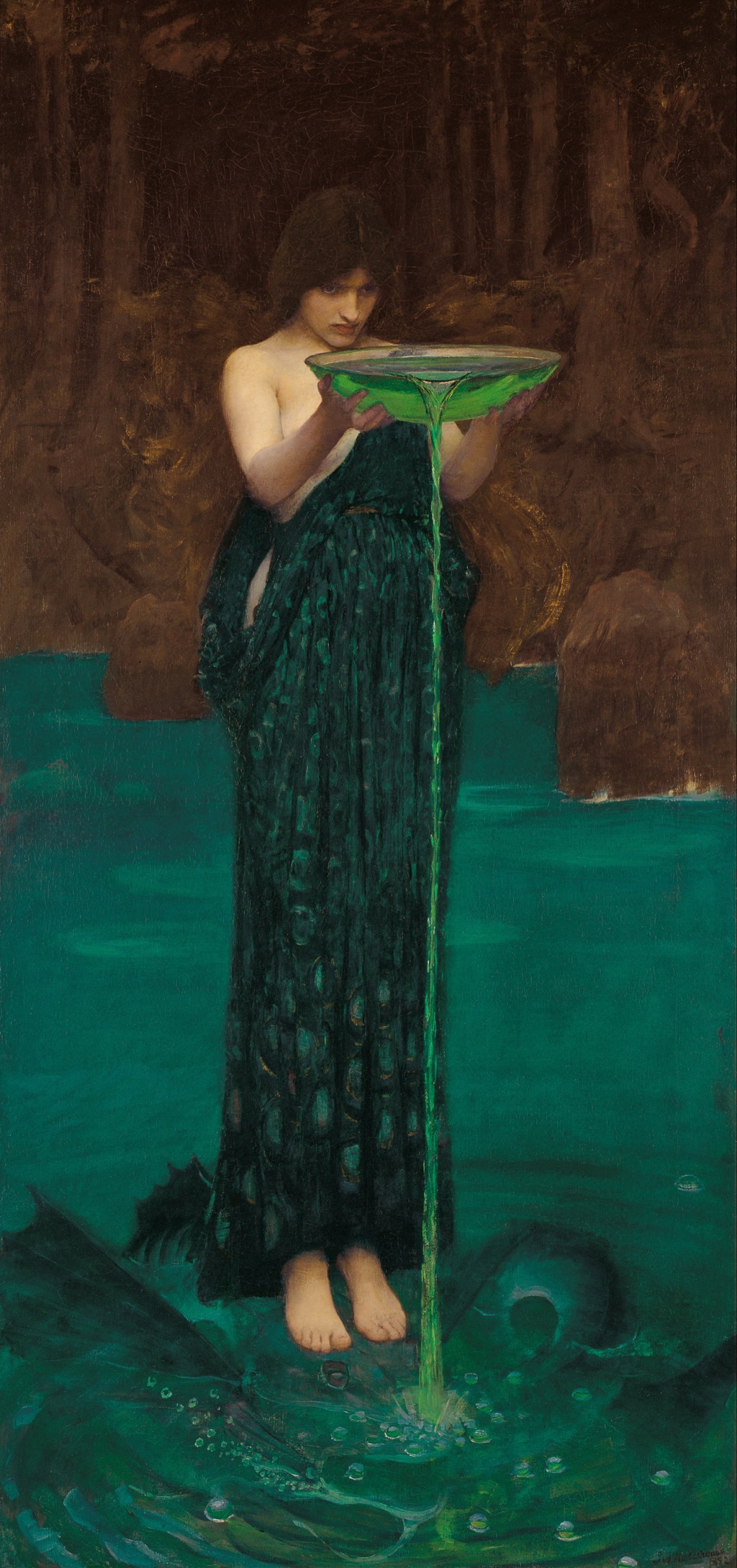
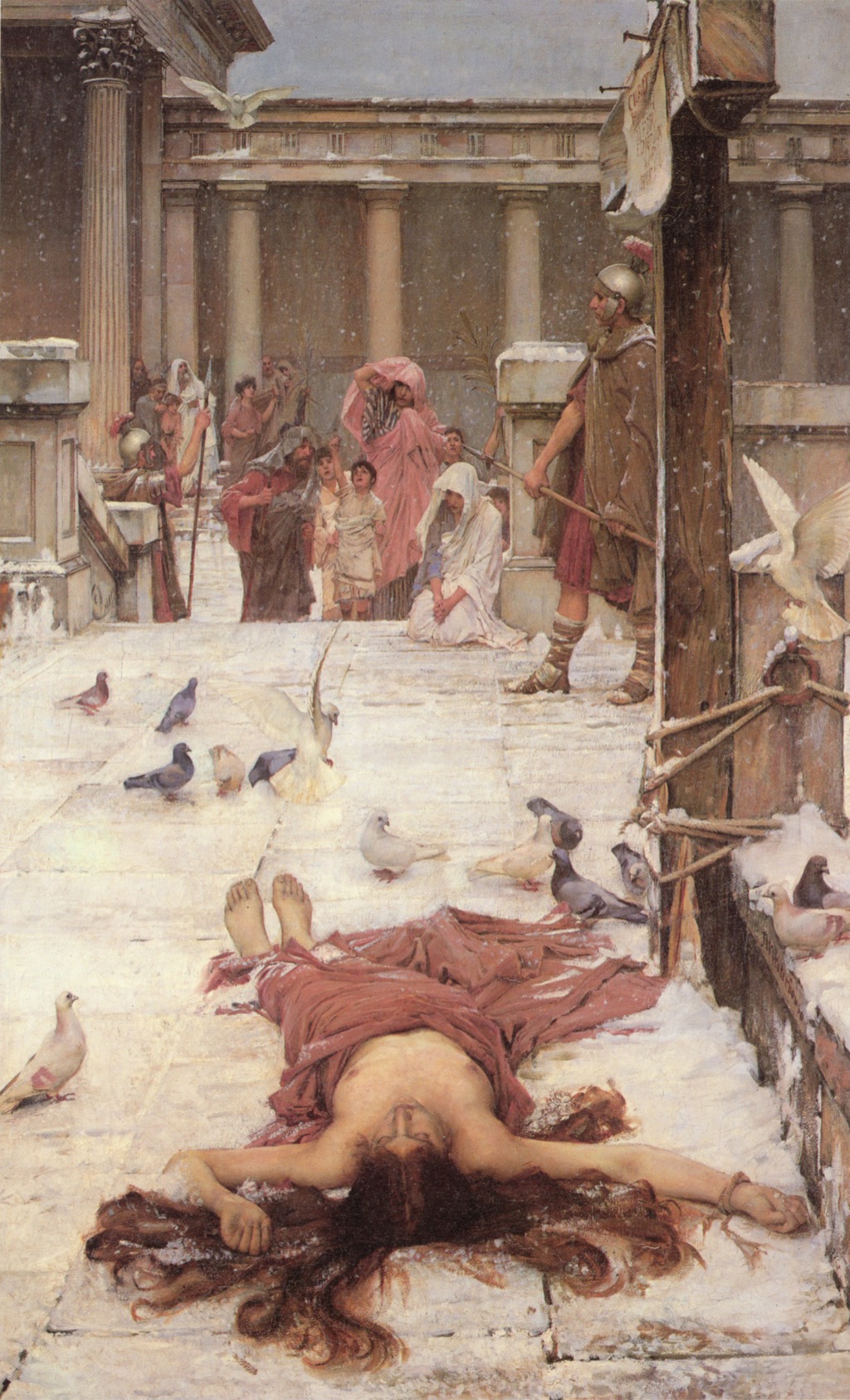
Waterhouse had long used drapery to organise narrative—wet folds around Saint Eulalia, patterned cloth at Circe's throne, loosening fabric in scenes of enchantment. In Windflowers, the weather itself designs the cloth.
The painting therefore converts costume from historical atmosphere into an instrument. Its form lets air be seen.
Anemones, Windflowers and Naming
The Royal Horticultural Society records “windflower” as a common name for plants in the genus Anemone. [3] That botanical usage gives the title a literal base.
Anemones include varied species and colours. The RHS describes them as herbaceous perennials with divided leaves and generally saucer-shaped flowers. [3]
Published reproductions do not provide a secure basis for identifying every bloom in Waterhouse's bouquet to species. The title is stronger evidence for the general association than pixels are for a complete botanical inventory.
“Windflowers” can also be understood descriptively. The flowers are exposed to wind and appear at risk of being blown from the woman's grasp.
The plural joins objects to motion. Unlike Boreas, which names the north wind through a classical personification, Windflowers names what is affected.
Classical traditions connect anemones with Adonis and transformed blood, and Waterhouse knew such stories. But no source proves that this canvas illustrates the death of Adonis.
The distinction is important because Waterhouse had painted The Awakening of Adonis only a few years earlier. Repeated flowers can create dialogue across works without making every picture an episode from the same myth.
Likewise, Persephone gathers flowers before Hades abducts her. Waterhouse's late flower pictures sometimes invite that comparison, but Windflowers contains no abductor, pomegranate or explicit underworld sign.
The title permits botanical, atmospheric and poetic meanings at once. It does not need one secret solution.
That openness suits the painting's reduced narrative. We know what wind is doing even when we do not know who the woman is.
A Narrative Without a Named Heroine
Waterhouse's reputation encourages viewers to search for literary sources. Many of his most celebrated works do depend upon Tennyson, Homer, Ovid, Shakespeare or Keats.
Windflowers demonstrates another mode. A figure, setting and physical pressure can generate narrative without an external text.
The likely sequence is minimal: flowers were gathered; wind rose or the woman entered an exposed place; she protects the bouquet and continues.
Everything beyond that remains open. We do not know where she came from, where she is going or whether the gust signals worse weather.
This incompleteness is not a failure of documentation that must be repaired by attaching a heroine. It is part of the image's design.
An anonymous woman can represent a condition without becoming an allegorical diagram. She is a particular painted body and a general figure of holding something fragile against change.
The absence of plot also shifts attention towards sensory memory. Viewers may imagine pressure against cloth, sound in vegetation and the difficulty of walking.
Painting addresses touch indirectly. We cannot feel the wind, but we recognise its shapes upon another body.
The sensory route creates a different kind of identification from portraiture. We do not need to know the woman's face or biography to understand the involuntary reflex of closing arms around something fragile.
Her action is neither heroic in a public sense nor passive. It belongs to daily bodily intelligence: adjusting weight, narrowing exposed surface and securing what can be lost.
This modest agency is important in Waterhouse's art, where women are often discussed only as victims, temptresses or decorative ideals. Windflowers gives its figure no supernatural power, but neither does it make her merely an object upon which weather acts.
The wind cannot be defeated. Her achievement is adaptation within it. That may be why the image supports ideas of resilience without needing a triumphant outcome.
This physical empathy differs from the suspense of literary recognition. It requires less cultural knowledge and may explain the picture's wide appeal in reproduction.
That popularity can encourage generic captions about “Romanticism” or “the Pre-Raphaelite style.” The useful question is more precise: how does Waterhouse make an invisible natural force structure every visible part?
Landscape, Colour and Selective Finish
The landscape supplies more than a backdrop. Open ground gives wind room to travel and lets the figure's exposed condition make sense.
Spring growth establishes renewal, while cut flowers introduce fragility within that abundance. The season is active rather than safely decorative.
Waterhouse balances the woman against surrounding vegetation. Her drapery carries colours that distinguish her from the field but also echo natural tones.
Edges vary. Stronger contours around hands, face or major folds establish bodily presence; softer passages allow hair, cloth and foliage to participate in air.
This variation avoids two extremes. The figure is not dissolved into an Impressionist atmosphere, and the landscape is not reduced to a hard theatrical set.
The recent ecological reading of the painting emphasises formal and chromatic interconnection between figure and environment. [4] The observation is persuasive as visual analysis, though claims about Waterhouse's personal environmental philosophy would require further evidence.
The work's scale—about 116.5 by 79.1 centimetres in published records—makes the figure substantial rather than cabinet-sized. [2] A viewer would confront her movement at nearly bodily scale.
Its verticality concentrates exposure. A wider panorama might disperse attention across weather; here the landscape's force is measured directly against one body.
The flowers provide small, high-value accents. Their visual delicacy explains the woman's protective gesture before any symbolic interpretation is applied.
Colour reproduction varies considerably for privately held paintings. Exact statements about hue should therefore remain cautious unless based on direct examination or a calibrated image.
Royal Academy Exhibition and Related Works
The Royal Academy's complete dictionary of exhibitors lists Windflowers as no. 204 in 1903. [1] Published object records date the painting to 1902. [2]
The two dates are compatible: execution in 1902 and public exhibition the following year. Sources that call it simply a 1903 painting may be using the Academy date.
The same dictionary lists Echo and Narcissus and Psyche Opening the Golden Box in 1903, followed by Boreas in 1904. [1] Windflowers therefore appeared at a transition between named myth and an independent weather subject.
Boreas is the closest famous companion. Both show a woman outdoors with hair and drapery disturbed by wind.
Yet their titles work differently. Boreas is the Greek north wind, even though Waterhouse does not show him as a male god. Windflowers keeps attention on the woman and what she carries.
The Academy sequence also clarifies dating. Graves places Windflowers in 1903 and Boreas in 1904. [1] These are exhibition years; the first canvas is widely dated 1902, and Boreas is signed 1903. In each case Waterhouse presented a completed work in the following Academy season.
Boreas wraps its figure heavily and makes cold weather legible through darker, weightier cloth. Windflowers uses a more open spring setting and lets the threatened bouquet carry much of the fragility. The two pictures are variations on exposure, not duplicates.
Because Boreas has a mythological name, it can tempt viewers to retrospectively personify the wind in Windflowers. Nothing requires an invisible god to be pursuing the woman. Natural force is already sufficient.
The paintings should not be treated as two frames from one story. Their dates, compositions and titles are separate.
Christopher Newall identifies Windflowers as an early prototype for Waterhouse's later series of women gathering flowers in spring landscapes. [5] The connection is useful because it locates the painting before the 1908–14 flower-women commonly discussed as a late group.
Later works shift the activity. Some women bend to pick, some present vessels, some arrange flowers, and Narcissus directs gathering towards a named myth.
Windflowers adds the risk of loss. It asks what happens after flowers have been gathered but before they reach safety.
Accessible authoritative records do not fully set out the private ownership history, and they do not support naming patrons, sale dates or a current location beyond “private collection.”
Modern Interpretation and Evidential Limits
Several online descriptions identify the figure as the Lady of Shalott. That claim lacks the objects central to Waterhouse's three documented Shalott paintings: loom and mirror, fatal view of Lancelot, or boat towards Camelot.
Other descriptions invoke Persephone because she gathered flowers. The comparison is possible within Waterhouse's interests but not enough to rename the subject.
The work's actual title is already meaningful. Replacing it with a more famous heroine reduces its unusual commitment to an unpersonified natural force.
Botanical precision also needs limits. “Windflower” supports anemone as a title association. [3] It does not establish the exact cultivar, ancient symbolic code or intended moral of every painted bloom.
Model identification is similarly uncertain. Repeated facial features across Waterhouse's work show studio continuity, not necessarily one documented sitter.
Dates require a simple distinction: 1902 is the work date found in object records; 1903 is the Royal Academy exhibition year confirmed by the contemporary exhibitor dictionary. [1] [2]
Modern scholarship can deepen close reading. The ecological account of figure and landscape offers one valuable framework. [4] It should be attributed rather than written as Waterhouse's stated aim.
The strongest interpretation begins from what the image makes undeniably visible: wind changes the woman's outline; she holds flowers against that pressure; landscape and body share one moving air.
From there, mortality, preservation, vulnerability and resilience become reasoned possibilities. They do not require a secret poem.
This evidence hierarchy does not impoverish the work. On the contrary, it makes its departure from Waterhouse's named heroines easier to appreciate. The picture can hold many experiences because the woman has not been locked into one inherited fate.
An open interpretation still needs discipline. It should grow from wind, gesture, flowers, landscape and the Academy title—not from any story that happens to feature a young woman outdoors.
Related Pages
- Boreas: Compare another Waterhouse image of a wind-driven figure.
- Gather Ye Rosebuds While Ye May (1909): Compare a later flower subject with a distinct version identity.
- Paintings: Return to the protected Waterhouse paintings hub.
Frequently Asked Questions
An unnamed woman carrying gathered flowers while wind drives her hair and drapery.
“Windflower” is a common name for anemone. [3]
No secure evidence identifies her as Persephone. Flower gathering makes comparison possible, but not certain.
No documented source or specific Shalott attribute supports that identification.
Yes, as no. 204 in 1903. [1]
Published records give approximately 116.5 × 79.1 centimetres. [2]
It is privately owned. [2]
The works share a windblown female figure and were exhibited in consecutive years, but they are independent compositions. [1]
Her identity is not securely documented in the cited sources.
Discussion
1. How does Waterhouse make invisible air visible? 2. Does the figure seem endangered, resilient or both? 3. What changes when an anonymous woman is not assigned a famous literary identity? 4. Why are the gathered flowers more vulnerable than flowers rooted in the field? 5. How do hair and drapery connect body with landscape? 6. Compare the weather in Windflowers and Boreas. 7. Does the painting need mythology to sustain a narrative? 8. Where should interpretation stop when object history is limited?
Reader Insights
Which visible detail most changes the way you read this page?
Which source or comparison helps the work feel less familiar and more specific?
What question would you bring back to the painting after reading?
Join the Conversation
Share your reading of this page below.
References
- Image reference
- Algernon Graves, The Royal Academy of Arts: A Complete Dictionary of Contributors and Their Work from Its Foundation in 1769 to 1904, vol. 8, Waterhouse entries, listing Windflowers as no. 204 in 1903 and adjacent exhibits, View source.
- WikiArt, “John William Waterhouse, Windflowers,” object metadata for date, medium, dimensions and private ownership, View source.
- Royal Horticultural Society, “Anemone,” plant profile listing “windflower” as a common name, View source.
- New Materialism: Die ökologische Avantgarde und die Kunst der Präraffaeliten, Karlsruhe Institute of Technology repository, discussion of nature, drapery and non-mythological openness in Windflowers, View source.
- Christopher Newall, “Maidens Picking Flowers by a Stream,” Victorian Web, discussion of Waterhouse's flower-gathering series and Windflowers as prototype, View source.