 by Tom Gurney
Tom Gurney BSc (Hons) is an art history expert with over 20 years experience
Page Created on September 22, 2026 / Page Updated on September 22, 2026
Email: tomgurney1@gmail.com / Phone: +44 7429 011000
Leonardo's Self-Propelled Cart
Leonardo da Vinci's self-propelled cart is often introduced as the world's first automobile. The comparison is memorable, but it obscures more than it explains. Leonardo did not call the device a car. His drawing does not show an engine for sustained road travel, accommodation for passengers or a vehicle connected to the later history of motoring. It shows a compact wheeled mechanism that could release stored energy, regulate its motion and follow a direction set in advance. Its most convincing setting is the culture of court entertainment and automata, where a machine needed to move a short distance at a chosen moment and create surprise. [1] [2]
Even that description requires care. The evidence is a single, densely drawn sheet rather than a surviving Renaissance machine. Modern makers have had to decide which lines belong together, what lies beneath the visible gears, how large the device should be and which materials and connections Leonardo left unstated. Their models have changed substantially over the past century. The cart is therefore both a study in Leonardo's mechanics and a study in reconstruction: an incomplete drawing has generated several plausible machines, not one recovered object.
At a Glance
- SubjectLeonardo's Self-Propelled Cart
- Artist and contextLeonardo da Vinci (1452–1519) and his Renaissance world
- Periodlate 1470s–1480s
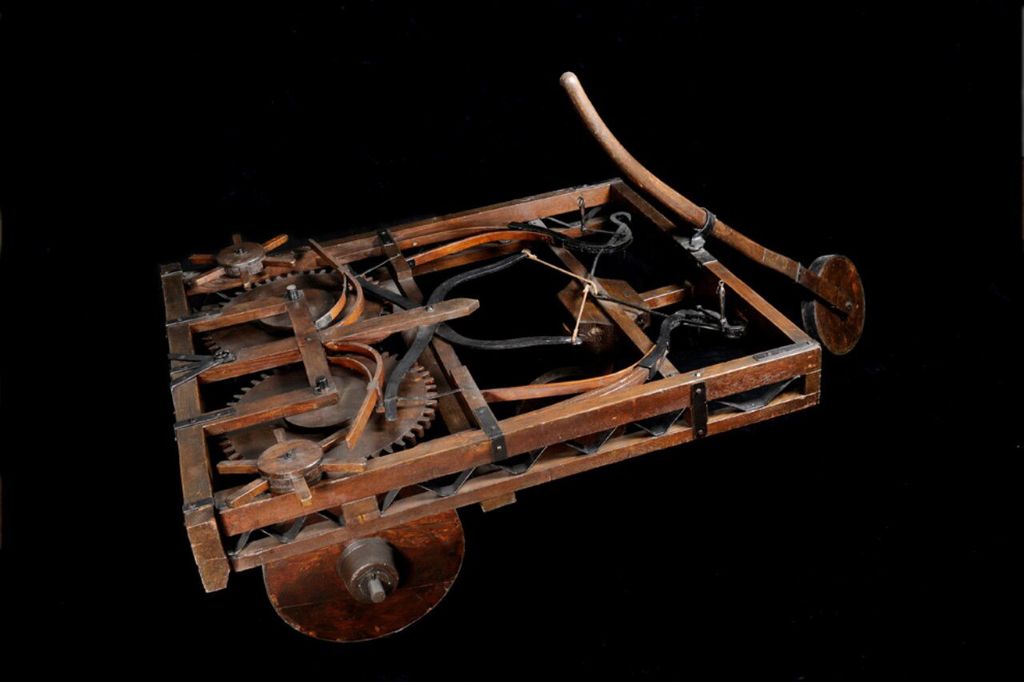
- ImageMuseum reconstruction of Leonardo's self-propelled cart.
Where this study sits in Leonardo’s career
Florentine training
c. 1469–82The Last Supper
c. 1495–98Leonardo's Self-Propelled Cart
late 1470s–1480sMona Lisa
from c. 1503Contents
- What survives on folio 812r
- A machine from the age of automata
- Where did the power come from?
- Transmitting and regulating motion
- What “programmable” means
- What was it probably for?
- How the cart was reconstructed
- Why it is not the first modern car
What survives on folio 812r
The primary witness is folio 812r of the Codex Atlanticus in the Biblioteca Ambrosiana, formerly numbered 296v-a and also associated with the ancient number 152. Museo Galileo's current Motus presentation dates the sheet to Leonardo's Milanese years, between 1478 and 1485. Such a range locates the work without pretending that the day or even year of conception is known. [1] [2]
The sheet carries two related arrangements. In the detailed analysis prepared for Museo Galileo's 2004 exhibition, the first is interpreted as an axonometric preliminary project, while the second is a more developed view from above. Together they show a low chassis, large toothed or pegged wheels, spring-like elements, gear trains and a smaller wheel positioned to influence direction. They also contain local studies: a rack, an alternative rack arrangement, a brake operated by a line, a pivoting curved arm, a petal-shaped cam and an auxiliary tensioning device. [3]
These details are abundant, but abundance is not completeness. Leonardo did not provide an assembly sequence, scale, material list or continuous explanation of the machine's operation. Some parts appear isolated from the main views. Others overlap or are difficult to read spatially. The two configurations record development rather than two clean projections of one final design. A modern reconstruction has to convert this exploratory page into a single three-dimensional arrangement, and every such conversion contains judgement.
The Italian descriptions carro automotore and carro semovente are often translated as self-moving or self-propelled carriage. “Automobile” entered the interpretation much later. It is useful only in its broad literal sense of something that moves by itself. In ordinary modern usage it suggests a road vehicle, driver, useful range and independent transport function that the sheet does not establish.
A machine from the age of automata
Self-movement was not a concept invented in the fifteenth century. Ancient descriptions of automaton theatres explained how concealed weights, ropes and rotating elements could make scenery and figures move. Mechanical clocks, striking figures and festival devices gave medieval and Renaissance audiences further experience of motion produced without a visible animal or human pushing the object. Museo Galileo's historical chronology places Hero of Alexandria's moving automaton theatre and later self-moving designs before Leonardo's sheet. [2]
This matters because the natural comparison is not only with later transport. Courts valued machines that compressed technical knowledge into performance. A platform might carry a figure, scenery or another visual effect. It could begin on cue, travel across a defined space and stop before the illusion was exhausted. Leonardo worked within court cultures in which engineering, stagecraft and ceremony overlapped. A small reserve of power and a preset path could be more valuable there than speed, endurance or a comfortable rider.
No document securely places the cart in a named Milanese festival. Nor can it simply be assigned to Leonardo's mechanical lion or armoured automaton. Those associations are tempting because they belong to the same broad world of spectacular machinery, but they are not proven connections to this folio. “Automaton platform” is best treated as a functional interpretation: it explains why controlled short movement and remote starting would matter, without inventing the object placed on top.
Where did the power come from?
The most conspicuous features in the drawings are two bowed leaf springs. Early twentieth-century interpreters naturally treated them as motors. In the influential reconstruction made in 1952 by Giovanni Canestrini with IBM Italia and Roberto Guatelli, the springs drive the large pegged wheels. Museo Leonardiano's own record warns that the connecting lines needed to make this work were added to the model and do not appear in Leonardo's drawing. [4]
That model helped establish the image of Leonardo's “car”. A related full-scale interpretive object in Milan's national science museum has a three-wheeled body, an additional wheel on a long control bar, leaf springs and rack handles. Its wood, iron, rope, dimensions and considerable weight make an ambiguous sketch physically legible, but they are properties of a museum model produced in the 1950s, not measurements taken from a lost original. [5]
The leaf-spring reading has not vanished. Museo Galileo's current Motus presentation describes the springs as providing power through the gearing and reads the rear wheel and control lever as implying a driver. It estimates that the device could travel only a few metres, enough for a court party or theatrical event. [2] That account is an authoritative contemporary museum interpretation, but it differs from another major reconstruction produced by the same institutional tradition.
For the 2004 Florence exhibition, researchers built a digital model and then a wooden working version informed by studies by Carlo Pedretti and Mark Rosheim. They placed two large coiled or spiral springs beneath the paired horizontal gears. Wound in opposite directions, these concealed springs supplied the stored energy. The prominent leaf springs received a different job: instead of driving the wheels, they formed part of a regulating mechanism. [6] [7]
This reassignment solves some visual and mechanical problems, but it remains an inference. The hidden motors are not presented on the folio as a complete pair of installed springs with every attachment specified. The reconstruction asks what arrangement can make the drawn components work together. Its success shows that the answer is mechanically coherent, not that an invisible layer of the drawing has been recovered beyond dispute.
Transmitting and regulating motion
In the 2004 solution, each coiled spring turns one of two large horizontal gears. Because the gears mesh, they rotate in opposite directions. Their motion passes through pairs of angular gears to smaller lantern gears whose bars engage pegs around the inner rims of the large road wheels. This converts stored spring energy into rotation at the wheels. [7]
The paired layout is sometimes described as a differential. That term is misleading here. A modern vehicle differential allows driven wheels to rotate at different speeds when turning while continuing to receive torque. The 2004 reconstruction instead uses coupled horizontal gears to keep the two sides related and the drive wheels synchronised. The road wheels can sit independently on their axles, but the central system does not perform modern differential action. [7]
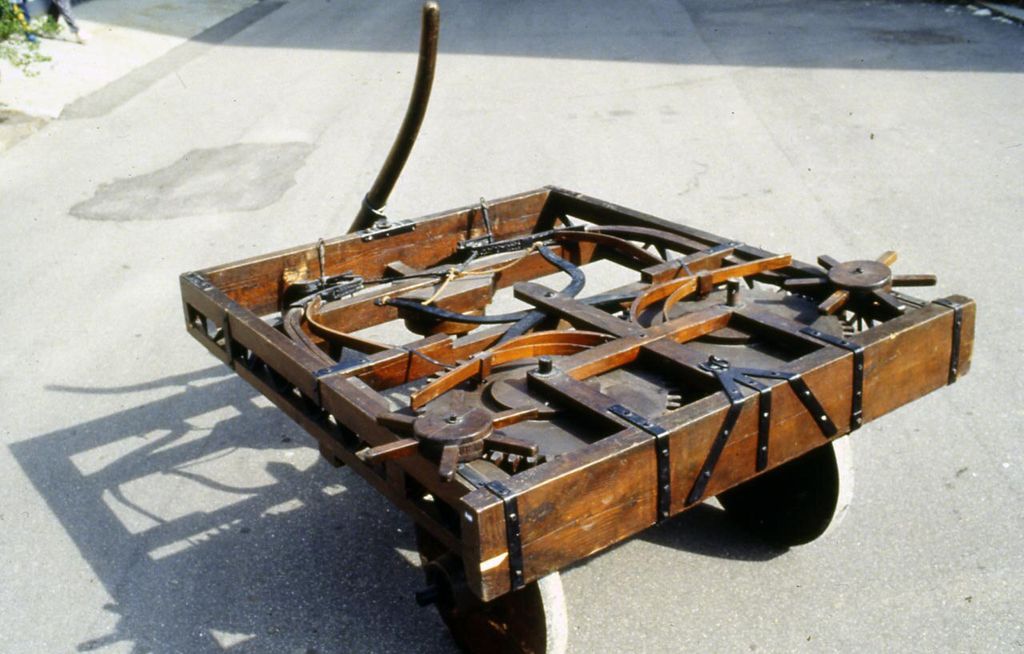
Unregulated springs would release energy unevenly. The cart might leap forward, slow rapidly or strain its teeth and shafts. The reconstruction therefore interprets an angular rotating element striking the bowed springs as a clock-like escapement. An escapement does not create power; it parcels out energy. Each interaction lets the gear train advance in controlled increments, reducing the abruptness of release and making the cart's progress more regular. [8]
The analogy with a clock is functional rather than a claim that every component matches a standard clock movement. It directs attention to a central achievement of the drawing: Leonardo was considering the behaviour of a system, not merely sketching wheels. Stored energy, transmission, timing, braking and direction have to cooperate. A cart that contains a strong spring but cannot govern it is less useful than one whose smaller reserve can be released predictably.
The 1950s and 2004 models divide these functions differently. In one, the visible leaf springs are the motors and extra links convey their force. In the other, concealed coiled springs are the motors and the leaf springs regulate their release. The disagreement is historically productive. It shows why a drawing can preserve an intelligible mechanical intention while leaving the exact architecture of the machine unsettled.
What “programmable” means
The 2004 reconstruction also gives the cart a preset steering system. Petal-shaped cams can be fixed around one horizontal gear. As the gear turns, each cam presses a curved pivoting arm. That movement acts on the offset steering wheel and changes the cart's direction. With no cam, the model travels straight. Adding cams at chosen positions produces successive steering movements; changing their number and placement alters the resulting curve. [9]
This is the basis for calling the machine programmable. The word should be kept within strict limits. Before release, an operator selects a physical sequence by placing mechanical stops or cams. During the run, the rotating gear encounters them in order. The cart does not calculate a route, sense obstacles, correct its position or receive new instructions. Its “program” is closer to the shaped barrel of a musical mechanism than to software.
Preset control would still have been remarkable. It separates the visible motion from a person steering continuously. It also makes a performance repeatable: the machine can be prepared behind the scenes and sent along a chosen straight or curved path. Yet even this reconstruction depends on decisions about cam form, leverage and connection. The folio supplies suggestive elements; the model supplies a complete working relationship among them.
A separate feature provides a cue for the start. In the 2004 model, a sliding bar locks the two meshing horizontal gears after the springs have been charged. A cord pulls the bar free, releasing the mechanism from a distance. [10] Remote release has an obvious theatrical value. The object can begin moving without a visible hand at the chassis, strengthening the impression of autonomous motion. It supports a spectacle interpretation, although it does not identify a particular performance.
What was it probably for?
The cart's likely purpose follows from the combination of its capacities and limits. Spring power is finite. The Motus display's estimate of only a few metres belongs to that reconstruction's scale, loading and spring choices, so it cannot be quoted as the measured range of Leonardo's machine. It nevertheless captures the order of use implied by such a device: a brief controlled traverse rather than a journey between towns. [2]
A driver is possible in the current Motus interpretation, which reads a rear steering wheel and lever as a control position. Other reconstructions leave no practical place or need for one. Neither reading turns the machine into personal transport. A human rider would consume scarce energy and complicate balance; a light figure, prop or empty platform could use the same motion more effectively in a hall or courtyard.
Court spectacle therefore offers the strongest context. The brake can be released on cue, the mechanism can follow a preset curve, and concealed power can make an object appear animated. These qualities also explain why Leonardo might care about regularity more than distance. A jerky start could expose the mechanism or topple its load, while a smooth, surprising entrance would transform technical control into theatre.
Other uses cannot be ruled out merely because they are less persuasive. The sheet might explore a general mechanical problem or serve as a platform for experiments. It need not record a commissioned object at all. The responsible conclusion is probabilistic: a theatrical automaton or mobile stage platform fits the reconstructed functions better than a road carriage, but no surviving account closes the question.
How the cart was reconstructed
The familiar object emerged through successive readings. Girolamo Calvi drew attention to the folio in 1905. Guido Semenza's 1928 interpretation then strongly promoted the automobile analogy, and Calvi memorably called it “Leonardo's Fiat” in 1936. These labels did more than translate a mechanism for modern readers: they framed it through Italy's highly visible motor industry and a search for technological ancestors. [11] [13]
That search had a political setting. Giovanni Canestrini's construction drawings led to a model displayed in Milan's 1939 Mostra di Leonardo da Vinci e delle invenzioni italiane. Museo Galileo's history of the reconstruction identifies the exhibition's nationalist aim of reclaiming scientific primacy for Italy under Fascism. The universal inventor supplied a powerful cultural emblem, and the cart could be presented as both automobile and pioneering differential. This context does not by itself disprove Canestrini's mechanics. It explains why priority claims and a modern transport identity were especially attractive, and why the model's interpretive additions could acquire the authority of Leonardo's design. [13]
Engineering reconstructions in the following decades continued to develop the leaf-spring motor, culminating in museum models associated with Canestrini and Guatelli. These gave the drawing volume and public visibility, while necessarily adding structure. [4] [5] [11]
From the 1970s, Pedretti reconsidered the sheet in relation to Leonardo's automata and spectacle. Rosheim later developed an integrated programmable-platform interpretation and connected the cart with a broader history of Leonardo's robotic mechanisms. His work is technically influential, although stronger publisher claims that the device was the first self-propelled vehicle or direct platform for particular lost robots exceed what this folio alone can prove. [12]
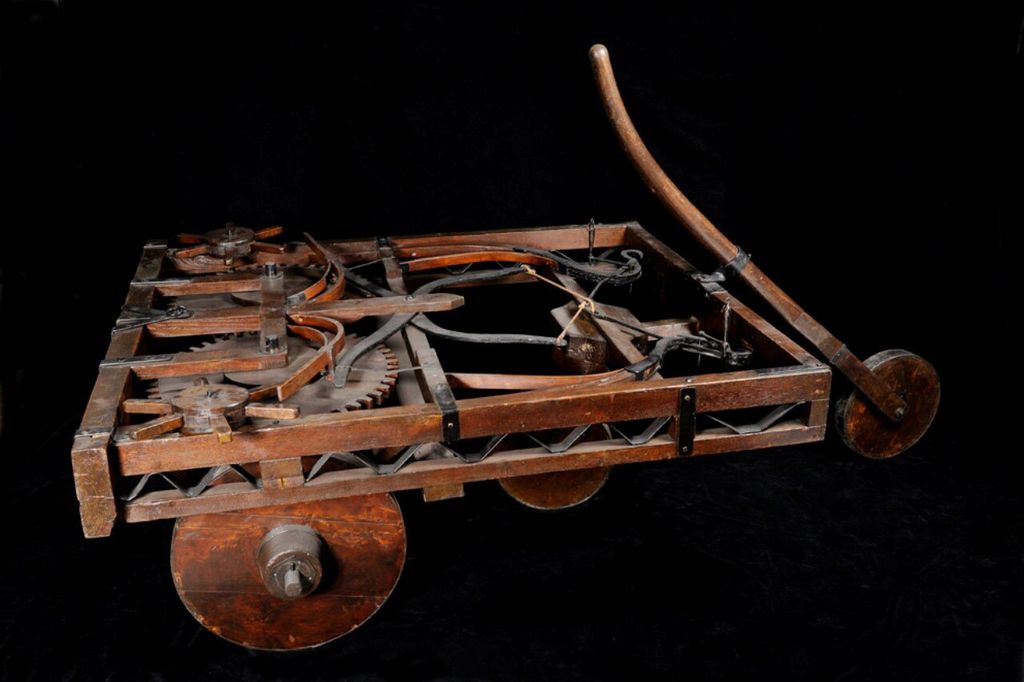
The 2004 Museo Galileo project used three-dimensional modelling to test gear pitch, wheel diameter, lines of action, transmission, regulation and steering before constructing a wooden prototype. According to the exhibition account, the physical mechanism operated on its first trial. [6] That is significant evidence about the reconstruction. The supplied dimensions and connections did not merely create a persuasive animation; they formed a machine capable of movement.
Functionality narrows the field of interpretation, but it does not abolish it. Many incomplete historical designs can be made to work in more than one way when skilled builders choose dimensions, tolerances and materials. A successful replica proves that a proposed arrangement obeys mechanics. It cannot prove that Leonardo chose the same hidden springs, built a full-scale version or watched it perform.
The continuing difference between the current Motus display and the 2004 project makes that limitation unusually clear. One institutional presentation retains powered leaf springs and possible onboard control; the other places coiled motors below the gears and emphasises preset cams and remote release. Rather than selecting one as Leonardo's recovered final answer, the manuscript evidence supports a layered conclusion. The sheet contains a sophisticated family of ideas, while models expose the additional choices needed to turn them into an object.
Why it is not the first modern car
Calling the cart the first automobile compresses unrelated meanings of self-propulsion. Moving automata existed long before Leonardo. His cart lacks sustained power, useful road range, passenger provision, a documented transport purpose and a chain of development into later motor vehicles. No evidence shows that it entered manufacture or influenced the technologies from which the modern car emerged. [2]
The claim also directs attention towards priority instead of design. What is remarkable on f. 812r is not that a Renaissance sketch can be made to resemble a primitive car. It is the attempt to coordinate energy storage, controlled release, transmission, steering and starting within a mobile mechanism. Those problems belong to automata, clocks, machines and vehicles alike.
Seen in that wider mechanical culture, the cart loses none of its interest. It becomes more precise. Leonardo explored how a machine might carry its own temporary source of motion, regulate that source and execute a path prepared in advance. Modern reconstructions show credible ways in which those aims can be joined, and their disagreements reveal where the drawing stops. The enduring achievement is a compact investigation of controlled motion, not a motor car displaced four centuries into the past.
Continue exploring Leonardo
Explore Leonardo’s works and designs
| Name | Date | Medium |
|---|---|---|
| A Map of Imola | 1502 | Drawing |
| Adoration of the Magi | About 1482 | Painting |
| Annunciation | About 1472 | Painting |
| Bacchus | Around 1517–1520 | Painting |
| Benois Madonna | Around 1478–1480 | Painting |
| Crossbow | 1485-1490 | Drawing |
| Diving Suit | — | Drawing |
| Flying Machine | — | Drawing |
| Ginevra de’ Benci | c. 1474/1478 | Painting |
| Head of a Woman (Turin) | Source-led range: 1478-1485, c. 1483-1485 or 1480s | Drawing |
| Helicopter | — | Drawing |
| Horse and Rider | — | Sculpture |
| La Bella Principessa | — | Painting |
| La Belle Ferronnière | c.1490–1497 | Painting |
| La Scapigliata | 1492–1501 ca | Painting |
| Lady with an Ermine | c. 1490 | Painting |
| Landscape Drawing for Santa Maria della Neve | Fifteenth century; inscription dated 5 August 1473 | Drawing |
| Leda and the Swan | — | Painting |
| Leonardo's Catapult Designs | late fifteenth century | Drawing |
| Leonardo's Designs for Milan Cathedral | 1487–90 | Architecture |
| Leonardo's River-Lock Drawing | late fifteenth century | Drawing |
| Leonardo's Romorantin Palace Project | 1517–18 | Architecture |
| Leonardo's Self-Propelled Cart | late 1470s–1480s | Drawing |
| Machine Gun | — | Drawing |
| Madonna Litta | Mid-1490s | Painting |
| Madonna of the Carnation | Around 1475 | Painting |
| Madonna of the Yarnwinder | — | Painting |
| Mary Magdalene | — | Painting |
| Mona Lisa | 1503 / 1519 | Painting |
| Ornithopter | — | Drawing |
| Parachute | — | Drawing |
| Portrait of a Lady: The Historic Leonardo Attribution | late fifteenth century | Painting |
| Portrait of a Man in Red Chalk (Self Portrait) | 1517/1518 or c. 1517-1518 | Drawing |
| Portrait of a Musician | About 1485 / first Milan period | Painting |
| Portrait of Isabella d’Este | Around 1499/1500 | Drawing |
| Profile of an Ancient Captain | c. 1475–1480 | Drawing |
| Rearing Horse and Mounted Warrior | First half of the 16th century | Sculpture |
| Saint Jerome in the Wilderness | About 1480–1482 / 1481–1482 | Painting |
| Saint John the Baptist | Around 1508–1519 | Painting |
| Salvator Mundi | — | Painting |
| Study of Hands | c.1480 | Drawing |
| The Baptism of Christ | About 1470–75 | Painting |
| The Battle of Anghiari | — | Painting |
| The Burlington House Cartoon | About 1506–8 | Painting |
| The Fetus in the Womb | c. 1511 | Drawing |
| The Last Supper | 1495–1498 in the Museo del Cenacolo Vinciano object table | Painting |
| The Sforza Horse Monument | 1480s–1499 | Sculpture |
| The Trivulzio Monument | c. 1506–13 | Sculpture |
| The Virgin and Child with Saint Anne | Around 1503–1519 | Painting |
| Triple Barrel Cannon | — | Drawing |
| Virgin of the Rocks | — | Painting |
| Vitruvian Man | Generally associated with Leonardo’s Milanese years, around 1490; exact dating remains cautious | Drawing |
| Wreath of Laurel, Palm, and Juniper with a Scroll | c. 1474/1478 | Drawing |
Frequently Asked Questions
Discussion
Which part of the evidence changes the way you read Leonardo's Self-Propelled Cart? The article sets surviving material beside later interpretation; share the distinction that matters most to you.
Reader Insights
What detail in the images or drawings is easiest to miss on a first viewing?
How does what survives on folio 812r alter your understanding of this subject?
Where does the article leave a question open rather than presenting a settled answer?
Join the Conversation
Share your reading of Leonardo's Self-Propelled Cart below.
References
- Museo Galileo, Leonardo//thek@, Codex Atlanticus f. 812r object record. View Source
- Museo Galileo, Motus, “Leonardo da Vinci's Self-Propelled Cart”. View Source
- Museo Galileo/IMSS, “Anatomy of the drawing,” 2004 interactive reconstruction. View Source
- Museo Leonardiano di Vinci, “The self-moving carriage (1952)”. View Source
- Museo Nazionale Scienza e Tecnologia Leonardo da Vinci, Carro automotore model record. View Source
- Museo Galileo, “L'‘automobile’ di Leonardo,” 2004 exhibition record and reconstruction project. View Source
- Museo Galileo/IMSS, 2004 digital reconstruction, paired horizontal gears and transmission. View Source
- Museo Galileo/IMSS, 2004 digital reconstruction, escapement section. View Source
- Museo Galileo/IMSS, 2004 digital reconstruction, programmable steering section. View Source
- Museo Galileo/IMSS, 2004 digital reconstruction, remote-brake section. View Source
- Museo Galileo/IMSS, “Interpretations,” historical sequence. View Source
- Mark E. Rosheim, Leonardo's Lost Robots (Springer, 2006). View Source
- Museo Galileo/IMSS, “L'‘automobile’ di Leonardo: la tradizione storiografica”. View Source