 by Tom Gurney
Tom Gurney BSc (Hons) is an art history expert with over 20 years experience
Page Created on September 22, 2026 / Page Updated on September 22, 2026
Email: tomgurney1@gmail.com / Phone: +44 7429 011000
The Trivulzio Monument
Leonardo da Vinci's designs for the Trivulzio Monument can look like a second attempt at the great Sforza Horse: another commander, another bronze rider and another project that was never realised. The resemblance is real, but it can obscure the work Leonardo was asked to do. Gian Giacomo Trivulzio did not simply want a statue in a public square. He was planning his own burial at the Basilica of San Nazaro in Milan. Leonardo therefore had to join two kinds of commemoration that pull in different directions—the triumphant commander mounted above and the dead Christian patron laid below.
The project survives through several kinds of evidence rather than one final design. A sheet at Windsor, Royal Collection Trust RCIN 912355, tests horses, riders and architectural bases. Other Windsor drawings explore related solutions and casting. In the Codex Atlanticus, sheet 492 recto contains a detailed estimate headed for the tomb of “Messer Giovanni Iacomo da Treulso”. Trivulzio's testaments establish a changing funerary programme at San Nazaro. The mausoleum now standing there was designed and built under Bramantino after Leonardo's proposal had been set aside. [1] [3] [5]
These sources do not fit together as a single finished elevation. Their differences are the history of the project. Leonardo moved between a rearing horse and a walking one, between several bases, and between an independent tomb and the patron's developing plan for a family chapel. Reconstructing the monument means keeping those alternatives visible.
At a Glance
- SubjectThe Trivulzio Monument
- Artist and contextLeonardo da Vinci (1452–1519) and his Renaissance world
- Periodc. 1506–13
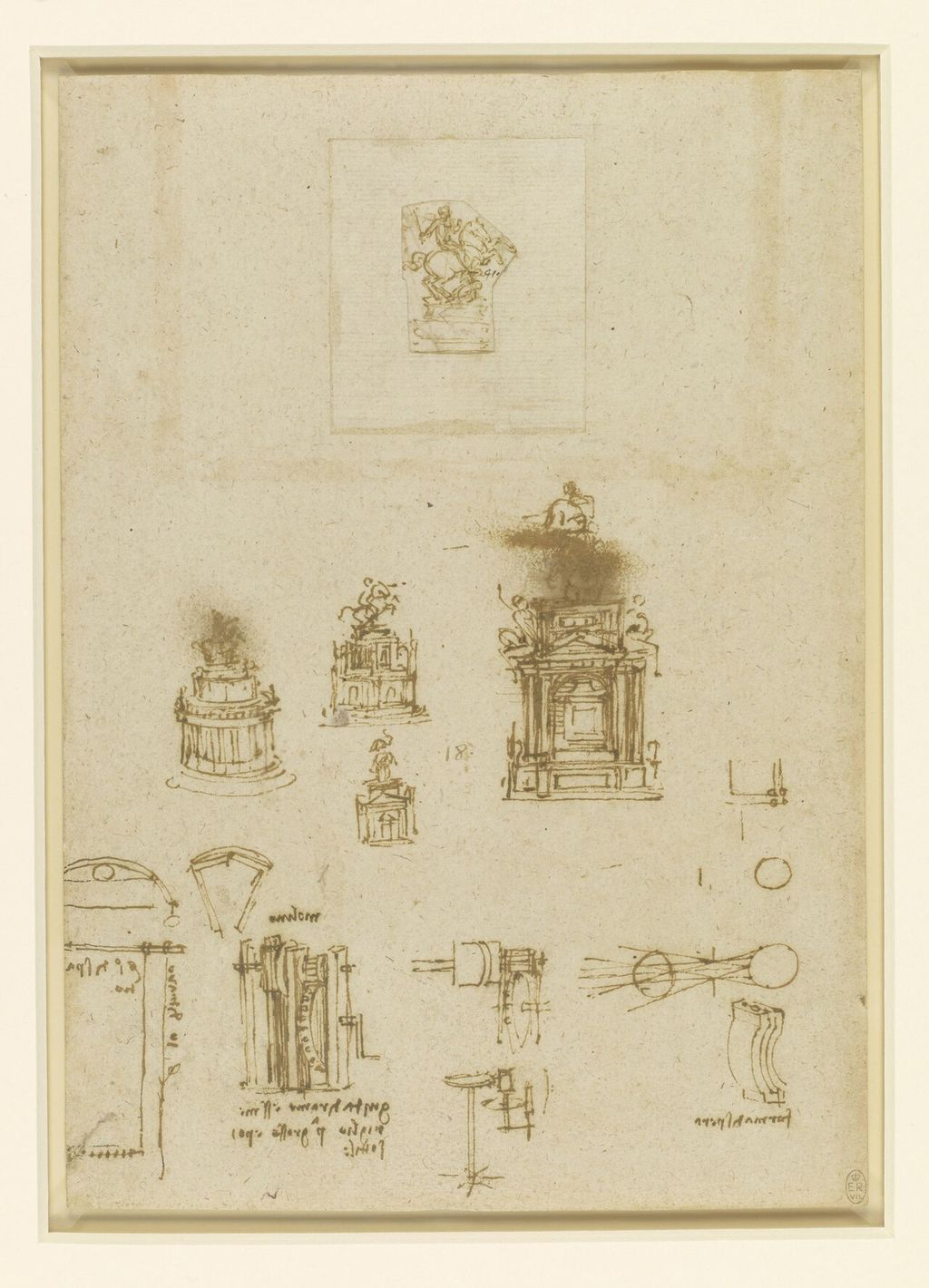
- ImageSketches for the Trivulzio monument.
Where this study sits in Leonardo’s career
Florentine training
c. 1469–82The Last Supper
c. 1495–98The Trivulzio Monument
c. 1506–13Mona Lisa
from c. 1503Contents
- A commander on the opposite side of Milan's history
- Two testaments and a changing ambition
- Victory above, death below
- The estimate turns invention into labour
- Rearing, walking and the problem of a final pose
- What Leonardo carried forward from the Sforza Horse
- Why Leonardo's monument was not built
- The surviving building is evidence of change
- Drawings preserved after the commission vanished
- A monument divided between action and rest
A commander on the opposite side of Milan's history
Gian Giacomo Trivulzio, called il Magno, was born in 1442 into a major Milanese family. He first served the Sforza and fought in the military world they governed, but he broke with Ludovico il Moro and entered the service of the French monarchy. In 1499 he commanded the army that took Milan for Louis XII. The king made him Marshal of France, governor of the duchy and Marquis of Vigevano. [7]
That career makes the commission politically charged. Leonardo's earlier equestrian project had honoured Francesco Sforza, founder of the dynasty displaced by the French invasion. Trivulzio helped bring that displacement about. When Leonardo later planned a mounted image for him, equestrian form passed from the defeated ruling house to one of the agents of French power.
The transfer was not simple opportunism. Trivulzio was Milanese, had once served the Sforza and possessed his own family ambitions. His monument was to stand in a venerable Milanese basilica, not merely advertise a foreign king. Yet its imagery—commander, horse, captives and fallen enemy—would have turned a contested military career into hereditary memory.
Trivulzio's fortunes remained tied to the Italian Wars. He fought at Marignano in 1515 and later lost the confidence of Francis I. He died at Chartres on 5 December 1518, and his body was returned to Milan. [5] [7] A funerary monument planned during his power therefore acquired an unintended final context: the conqueror came home after dying in political disgrace.
Two testaments and a changing ambitionThe documentary story begins before Leonardo's secure involvement. In a testament dated 2 August 1504, Trivulzio asked to be buried at San Nazaro in a worked marble ark raised roughly eight braccia above the floor. The provision reportedly allowed 4,000 ducats, a sum commensurate with an extraordinary tomb. [3] [4] [6]
On 22 February 1507 he replaced that arrangement with a more extensive one. The later testament speaks of a chapel to be constructed and founded in or near San Nazaro, endowed and ornamented, with a tomb built inside it. The shift is consequential. A tall freestanding sepulchre in a church and a dynastic chapel containing several burials pose different architectural problems. [3] [6]
Leonardo returned to Milan after receiving permission to leave Florence at the end of May 1506. One scholarly reading therefore places his estimate in the second half of that year, between the 1504 tomb provision and the chapel language of February 1507. Other catalogues date it around 1508, and the Royal Collection dates RCIN 912355 to about 1508–10. [1] [3]
The dates should not be forced into false certainty. The paper evidence may preserve work done at different stages, and the change in testament does not tell us the exact day on which every design became obsolete. What can be said securely is that Leonardo's named cost estimate and related drawings belong to Trivulzio's developing funerary programme during Leonardo's second Milanese period.
No complete signed contract survives. The Royal Collection consequently says Trivulzio “seems” to have commissioned the design. That caution does not make the connection weak: a calculation explicitly headed for Trivulzio's tomb is stronger evidence than a resemblance between horses. It means that the precise terms, approval sequence and last agreed form remain unknown. [1] [3]
RCIN 912355: alternatives on one sheet
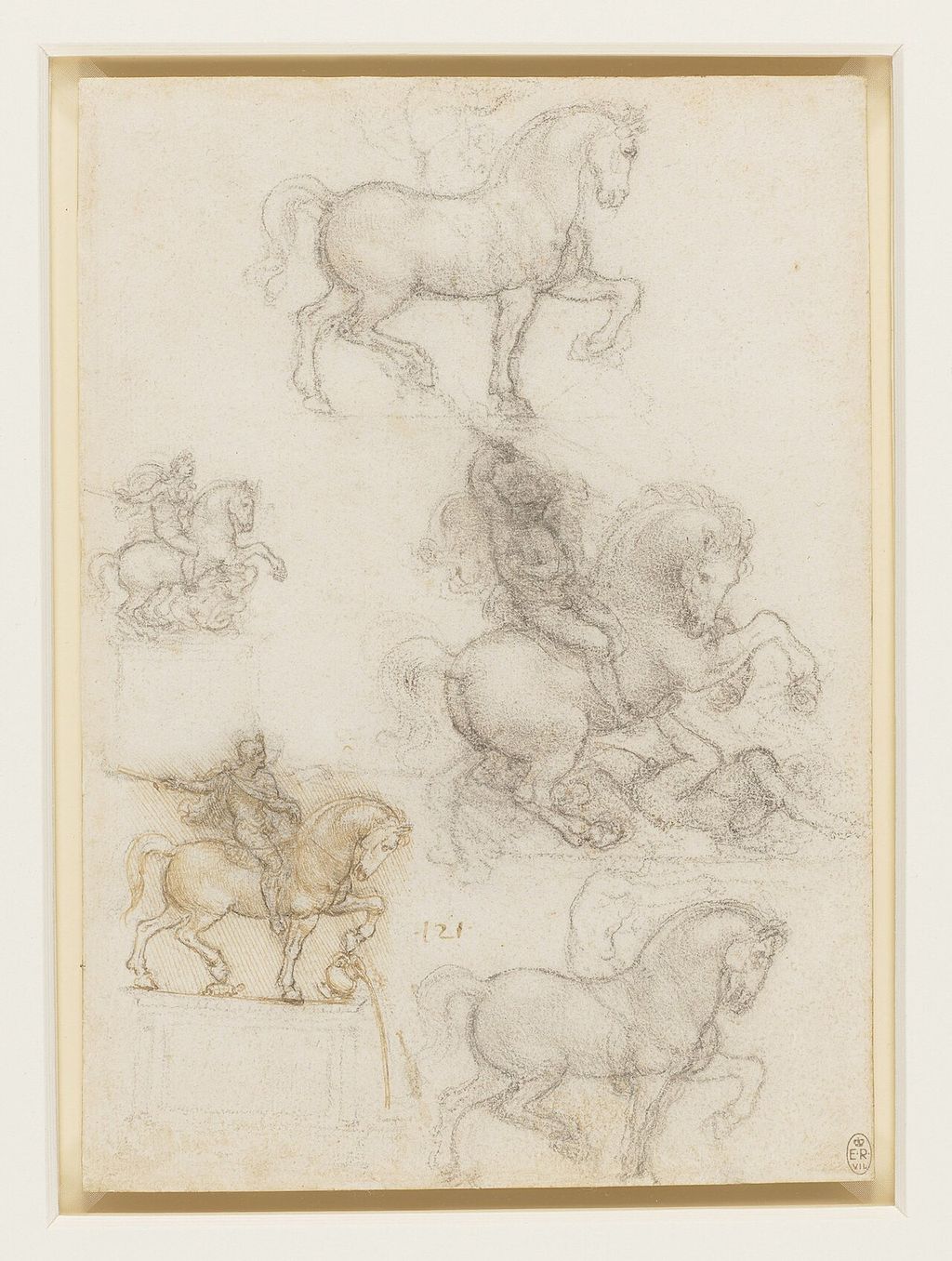
RCIN 912355 is a sheet of pen-and-ink studies on paper measuring approximately 28 by 19.8 centimetres. The rapid drawings do not present one monument from several mechanically consistent views. Leonardo changes the pose and the base as he works. Small scale lets him test the relation of large masses before committing to detail. [1] [9]
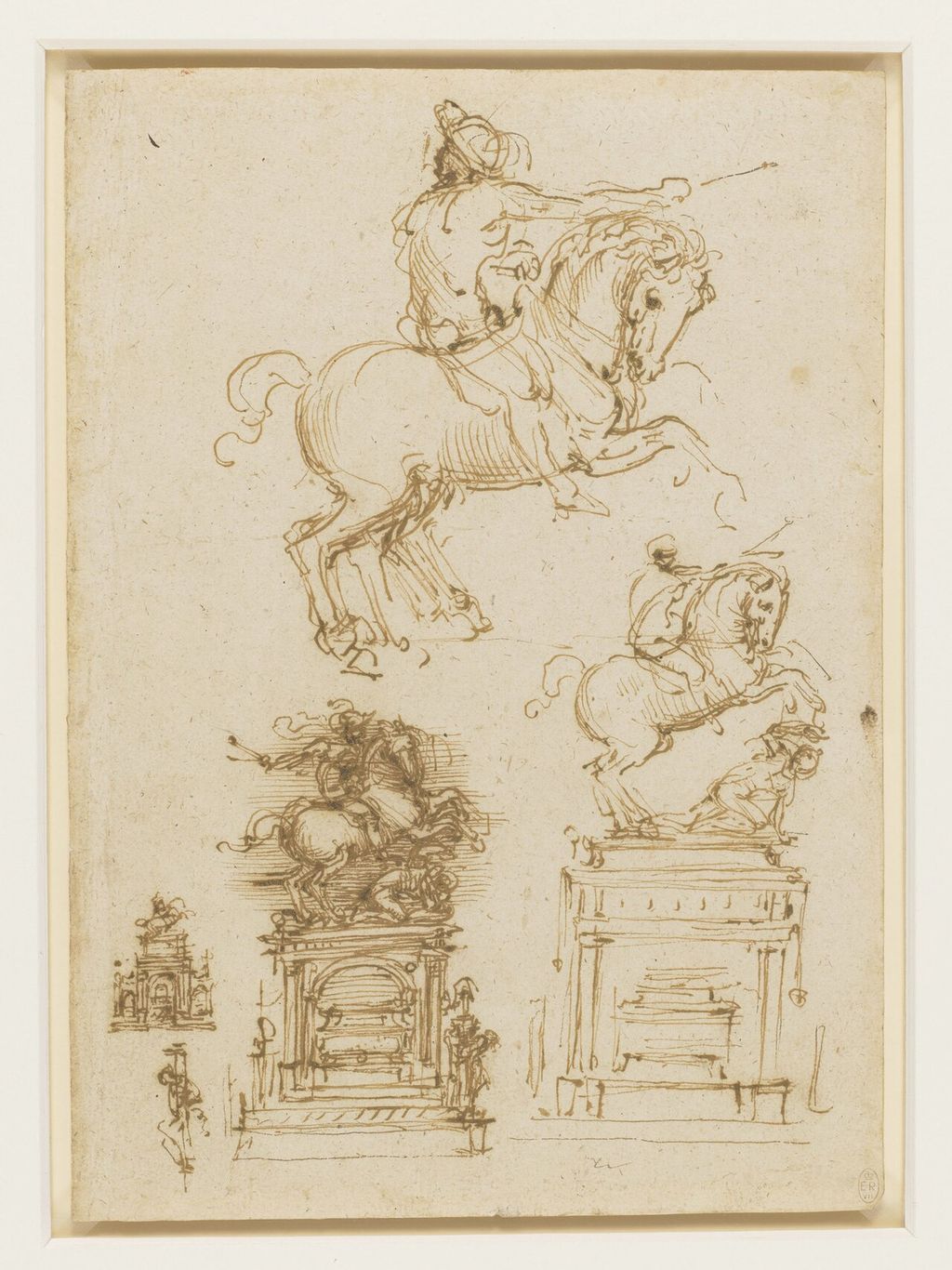
The most dramatic proposals raise a rearing horse and armed rider above the architecture. In some versions a defeated figure lies or struggles beneath the horse. The animal's lifted forequarters, the rider's forward drive and the body below compress victory into a single vertical action. Balance is both visual and structural: the group must appear violently unstable while being capable of standing in bronze.
Below it, the bases change. Leonardo tries circular and square organisations, projecting supports and columned structures. Captive figures appear at corners, bound to the architecture like living trophies. They are usually called prigioni, prisoners. Their role is not merely decorative. They translate the commander's victories into subordinated bodies and make the support itself an image of domination. [4]
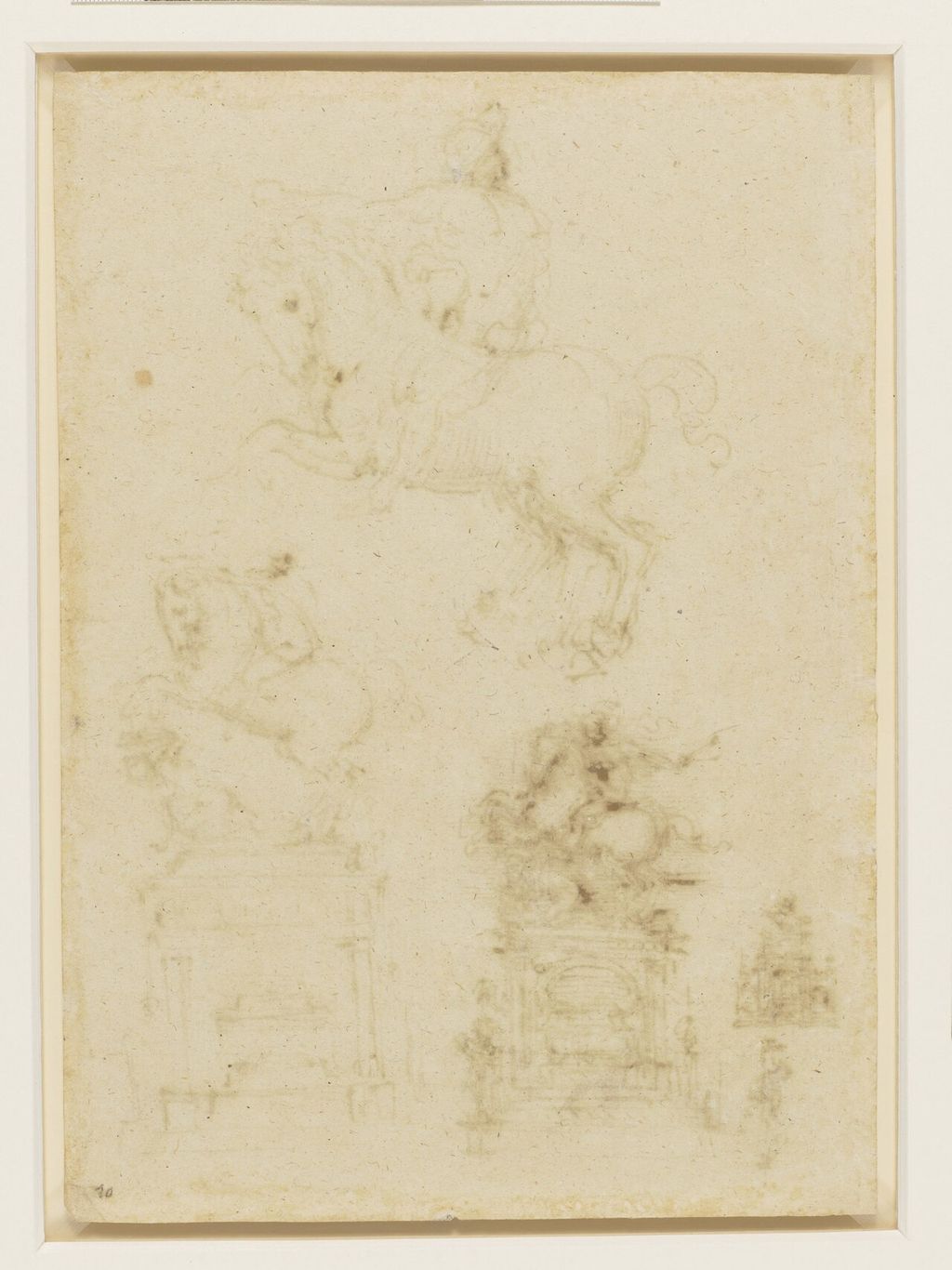
The sketchiness can tempt a modern reconstruction to choose the most spectacular horse, the clearest prisoners and the most complete base, then combine them. That produces a plausible monument, but it may never have existed even as Leonardo's preferred idea. A design sheet records thought in motion. Variants that occupy the same paper can be alternatives rather than missing pieces of one whole.
Victory above, death belowThe costed architecture clarifies the funerary programme more than the tiny sketches alone. Leonardo envisaged a stone and marble structure with eight columns, bronze capitals, pilasters, friezes and a place for the sarcophagus. Accounts and later reconstructions also connect it with a recumbent effigy and sculptural supports. [3]
Such an ensemble would make the visitor read vertically. At the lower level, Trivulzio's body or effigy belongs to the tomb and the expectation of burial. Columns create a permanent architectural frame. Above, the bronze commander remains active, armoured and mounted. The same person appears under two temporal conditions: mortal remains below and public reputation above.
This duality was common to elite tomb culture, but an equestrian crown intensifies it. A recumbent figure submits to death; a rider commands space. Christian burial and classical-military apotheosis coexist without resolving each other. The captives make the tension sharper because victory over human enemies supports the memorial of a man facing judgement and decay.
The design also joins media and trades. Marble must be quarried, transported, cut and polished; bronze capitals must fit the columns; carved figures must relate to the sarcophagus; the equestrian group requires modelling, moulding, metal and finishing. Leonardo was not drawing a statue to be placed on a generic plinth. He was coordinating sculpture, architecture and fabrication as a single commemorative machine.
The estimate turns invention into labour
Codex Atlanticus 492 recto is unusually valuable because it gives costs rather than only forms. Now held by the Biblioteca Ambrosiana, the sheet measures about 27.2 by 19.2 centimetres and is written in black ink. Its older foliation has caused it to be cited as 179 verso-a; the current Marinoni foliation is 492 recto. [3] [11]
The account divides the work into three broad parts: making the bronze equestrian group, buying the marble and working the marble. Leonardo calculates dimensions and quantities for architectural pieces rather than offering a round prestige price. The traditional total is 3,046 ducats, more than three quarters of the 4,000 associated with Trivulzio's earlier testament. [3]
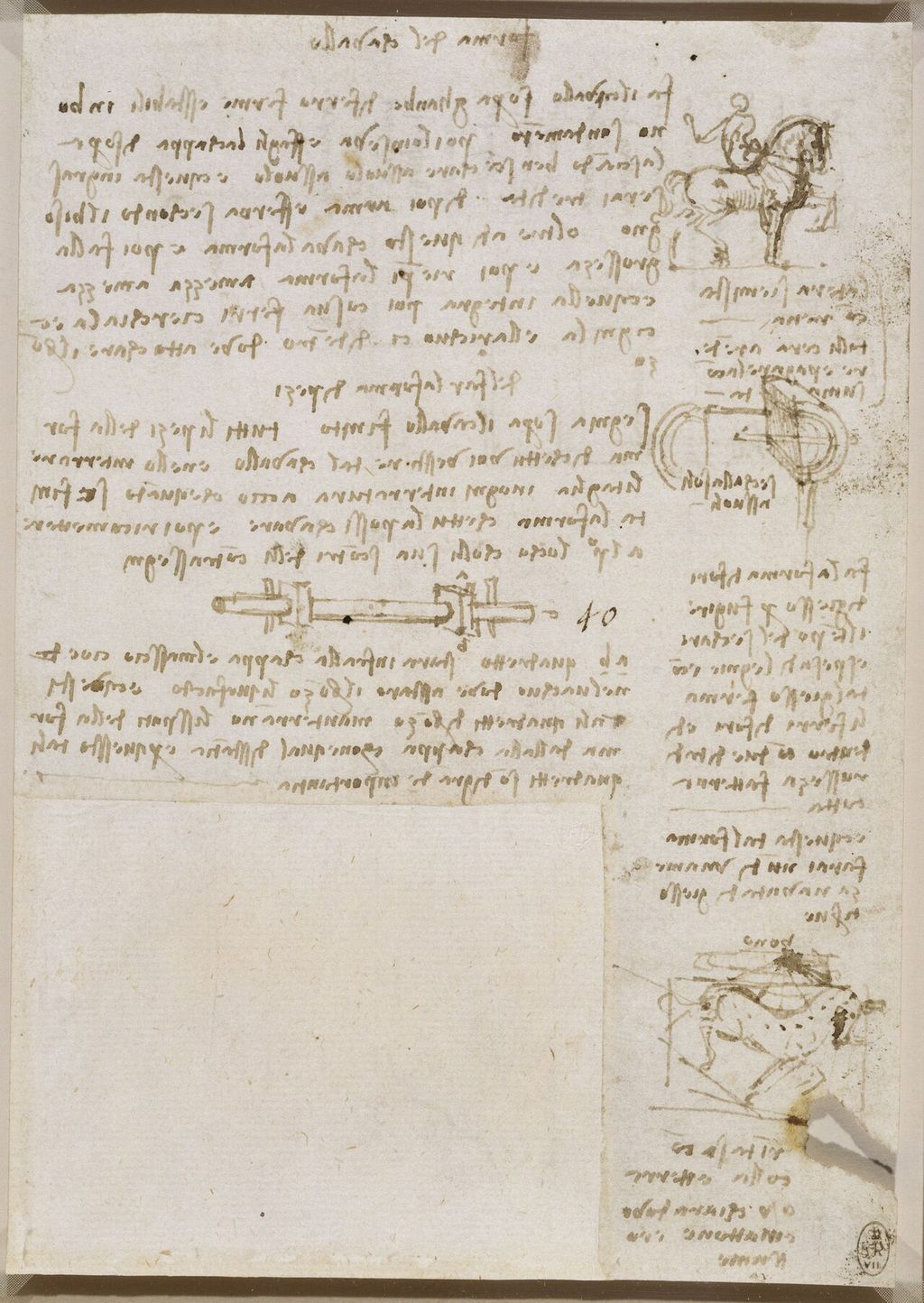
The equestrian group alone totals 1,582 ducats. Leonardo assigns 500 to metal. Another 200 covers ironwork in the model, charcoal, timber, the casting pit, closing the mould and the furnace. Clay and wax models receive 432; workers cleaning the casting receive 450. The figures reveal where risk and labour accumulated. Metal was costly, but preparation and finishing together cost more than the raw bronze. [3]
The phrase describing the statue calls for a large horse at natural size with a man above it. This matters in two ways. First, Trivulzio's horse was life-size, not the colossal animal—about three times life-size—planned in the mature phase of the Sforza project. Second, the costed wording names horse and rider but no fallen enemy. The most dramatic three-figure sketches may therefore precede or stand apart from the version priced in the estimate. [3] [4]
An estimate is neither casual fantasy nor proof of construction. It shows that Leonardo could convert appearance into material operations and payments. It does not show that Trivulzio released funds, that a clay model reached full size, that marble arrived or that a mould was fired. The Royal Collection states that there is no evidence Leonardo began physical work. [1]
What the numbers can and cannot tell usThe total of 3,046 ducats sounds exact, but it should not be translated into a modern currency figure as if prices and wages formed a stable exchange rate. A ducat could measure metal, skilled labour, prestige and financial commitment in very different ways. The useful comparison is internal. The projected cost consumed most of the 4,000 ducats associated with the 1504 provision, and the bronze group alone accounted for slightly more than half of Leonardo's total. [3]
The divisions also expose the monument's dependency chain. Marble material without carving produces no tomb; a finished base without the bronze group loses its culminating image; a cast horse without cleaning and repair remains a rough industrial object. Leonardo budgets not only substances but transformations. Clay becomes a model, the model generates wax and mould, metal enters the prepared void, and specialist labour turns the result into a surface intended for close and distant viewing.
Some calculations on the sheet resist easy reconciliation. The critical catalogue notes that Leonardo supplies three dimensions for many stone elements and uses weight or quantity units whose relation to the recorded volumes is not always constant. One measurement is hidden by an ink stain, while some entries give only two dimensions. [3] This is a working estimate, not a modern bill of quantities certified after construction.
Its incompleteness is historically useful. It shows an artist calculating within available workshop conventions, revising components and bringing unlike trades under one account. The apparent precision belongs to planning under uncertainty. Rather than prove a fixed final design, the arithmetic marks the point at which alternatives had become concrete enough to price.
Rearing, walking and the problem of a final pose
Leonardo had confronted the structural difficulty of a rearing bronze horse during the Sforza commission. A heavy body held above two hind legs demands a convincing support and a viable path for forces through the casting. A fallen warrior can become part of that support, but then an enemy who looks incidental in iconography is essential in engineering.
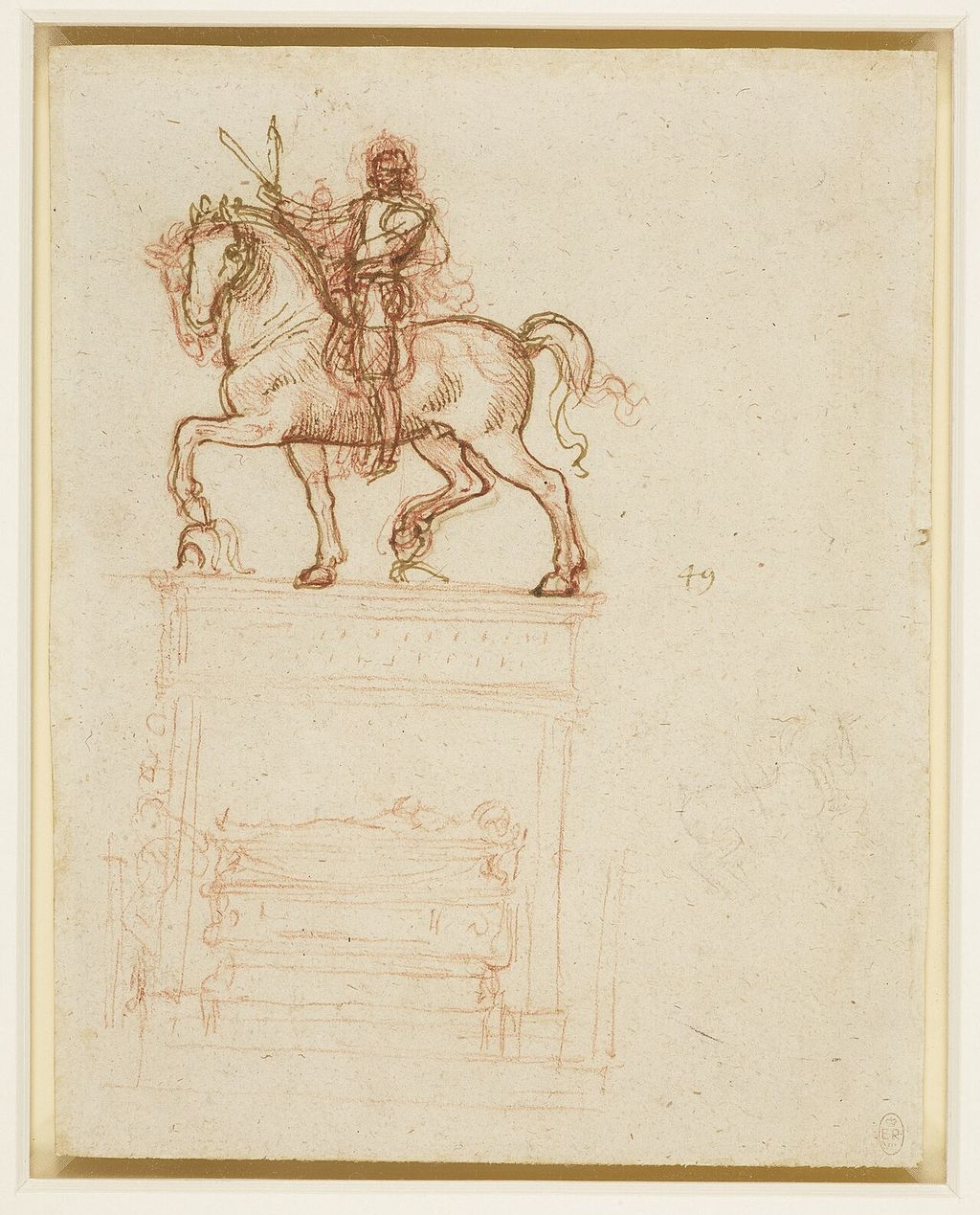
The Trivulzio sheets return to this knot. The rearing horse supplies force, danger and mastery. A walking or trotting horse offers a calmer imperial rhythm and a more manageable distribution of weight. Treccani and the Museo Galileo critical record describe a movement from complex rearing schemes towards a walking solution that may sit closer to the estimate's two-figure group. [3] [4]
That sequence is persuasive, not a surviving approval minute. Dating individual horse studies is difficult, and similar poses recur across decades. RCIN 912356, for example, contains work assigned to more than one period. The responsible reconstruction uses project-specific architecture, inscriptions, paper, technique and catalogue history rather than treating every late Leonardo horse as Trivulzio. [8] [9]
Nor does a quieter gait make the final idea weak. In Renaissance equestrian imagery, restraint could signify command. The rider who does not need to fight for control may appear more sovereign than one caught in a violent instant. A walking horse also lets the architectural tomb, rather than a defeated soldier, carry the full burden beneath it.
What Leonardo carried forward from the Sforza Horse
The earlier monument gave Leonardo hard-won knowledge of scale and bronze casting. He had investigated clay cores, wax layers, iron armatures, mould sections, furnaces, channels and the enormous coordination required to pour a horse. The Trivulzio estimate refers to distinct models in clay and wax and to closing the mould, language compatible with the indirect process developed through the Sforza work. [3] [8]
Reuse of technique does not make the two commissions one project. Francesco Sforza was the founder of a dynasty; Trivulzio was a French-aligned marshal planning his own tomb. The mature Sforza horse was colossal and appears to have shifted towards a walking pose without a rider surviving at full scale. The Trivulzio group was priced at life size and integrated with sarcophagus architecture.
Leonardo may also have reused visual problems. The rearing horse over a fallen enemy had appeared in earlier studies and in the wider Renaissance tradition. Reconsidering an unsolved pose for a new patron was normal workshop practice. The patron, function, scale and base determine the new work's identity more securely than the recurrence of a horse.
This boundary also protects the Sforza project from retroactive completion. A Trivulzio rider cannot simply be placed on the lost 1493 clay horse, and a Sforza casting diagram cannot prove which Trivulzio variant was chosen. Related technical knowledge belongs in comparison; interchangeable components do not.
Casting was part of the designA separate Windsor sheet, RCIN 912347, contains notes and diagrams associated with casting the Trivulzio group. It belongs to the practical side of the commission: how a model becomes a mould, how the assembly is supported and how molten bronze reaches the required spaces. [8]
At life size, the task was feasible within contemporary bronze practice, but feasibility is not simplicity. Horse and rider create thin extremities, deep undercuts and unequal masses. A successful pour depends on thickness, vents, channels, alloy temperature and a mould strong enough to withstand pressure. After cooling, workers must free the casting, remove channels, repair faults, join elements where necessary and finish the surface—the labour category Leonardo priced heavily.
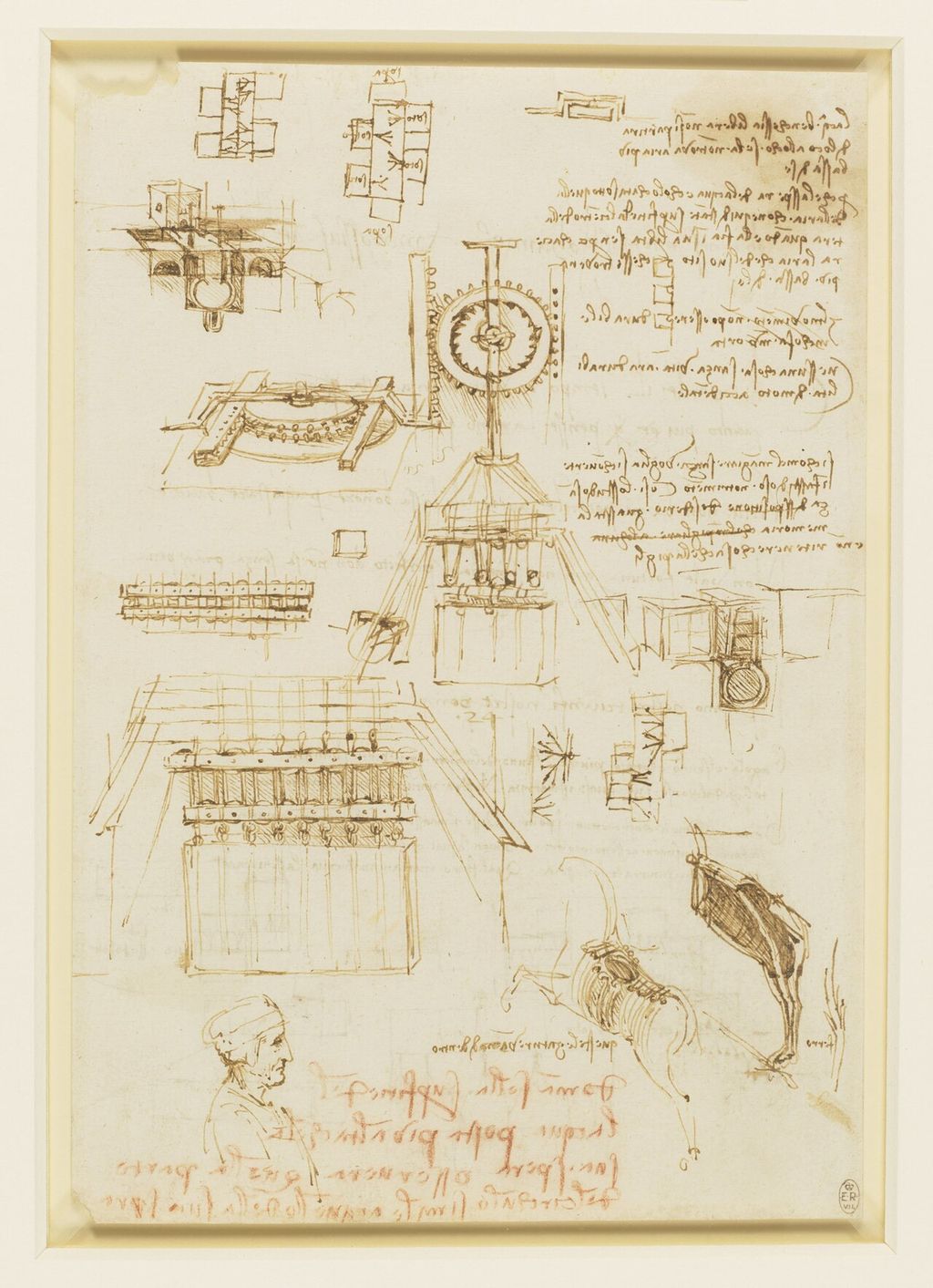
The drawings therefore should not be divided into “artistic” horses and “technical” apparatus as if invention happened first and engineering followed. Pose changes casting. A raised leg alters support; a cloak changes mass; an enemy under the belly can become a structural route. Leonardo's monument develops where iconography, mechanics and workshop sequence meet.
Why Leonardo's monument was not built
No surviving document supplies a single reason. The patron changed the form of his funerary provision, the chapel programme developed, and another architect eventually controlled the building. Cost, design, politics, time and working relationships may all have mattered, but assigning the failure to Leonardo's slowness or to a quarrel with Trivulzio would exceed the evidence.
By 1511 or early 1512, work on the family mausoleum at San Nazaro was associated with Bartolomeo Suardi, called Bramantino. Political upheaval intervened almost immediately. The restoration of Massimiliano Sforza in 1512 forced the Trivulzio family into exile and interrupted construction. Following the French victory at Marignano in 1515, work resumed. In 1517 Trivulzio engaged Francesco Briosco to make recumbent statues for himself and family members. [5]
The change from Leonardo's freestanding, vertically crowned tomb to Bramantino's chapel was not the construction of a simplified Leonardo design. The surviving mausoleum is a massive square brick building attached to the façade of San Nazaro, with an octagonal interior and tiers of niches. It now forms the vestibule through which visitors enter the basilica. Its attribution rests with Bramantino, with later work by Cristoforo Lombardo. [5]
Trivulzio personally dedicated the mausoleum in 1518 and died four months later. His remains reached Milan in January 1519. His recumbent monument stands above the entrance to the church with an epitaph often translated as: he who never rested, rests here; be silent. The body arrived, but the bronze rider did not. [5]
The surviving building is evidence of changeIt is tempting to visit San Nazaro and imagine Leonardo's horse once intended for the top of the structure. The documents do not support that composite. The 1507 chapel, the later Bramantino building and Leonardo's free-standing schemes are connected phases of Trivulzio's patronage, but their spatial logic differs.
The built mausoleum turns a square exterior into an octagonal interior. Sarcophagi occupy upper niches around the space; altars belonged below. Its architectural mass creates a dynastic chamber and a threshold to the ancient basilica. Leonardo's costed tomb, by contrast, centres one equestrian image above a columned structure and sarcophagus. It asks to be viewed as an object in space. [3] [5]
The distinction explains why the built work can illuminate without completing the lost one. It shows the scale of Trivulzio's ambition, his commitment to family memory and the vulnerability of construction to political reversal. It cannot tell us which horse Leonardo would have approved or how the marble base would have looked in every dimension.
Later horse studies do not supply the missing ending
Leonardo continued to study equestrian monuments. A coherent group drawn on French paper around 1517–18 tests rearing and pacing horses, sometimes with riders in antique dress. Royal Collection cataloguing treats this as evidence for a putative third monument from Leonardo's years in France and explicitly distinguishes it from the Trivulzio group represented by RCIN 912353, 912355 and 912356. [10]
That distinction rests partly on conservation evidence rather than subject matter. Technical work completed on the Windsor drawings in 1992 revealed French watermarks on equestrian sheets previously assigned to the Trivulzio project. Martin Clayton used those marks in 1996 to support the earlier stylistic judgement that the sheets belonged to Leonardo's French years. Watermarks do not identify a patron, but they can relocate the paper on which an idea was developed. Here they break an apparently continuous sequence of horses into materially different campaigns. [12]
That separation matters because late studies can appear more resolved and therefore attractively fill gaps. But a familiar pose is not a project identity. Paper, date, costume and group coherence point towards a new context. Absorbing them into Trivulzio would turn Leonardo's continued thinking into an artificial final design.
The same caution applies to small three-dimensional horses attributed to Leonardo or his circle. The Budapest Horse and Rider was once presented as Leonardo's model for Trivulzio, but no document links the bronze to the commission and no securely autograph Leonardo sculpture survives for comparison. Examination in Washington in 2009 established that its lost-wax casting and alloy are compatible with the Renaissance, while stopping short of identifying Leonardo as maker. A Renaissance date, an attribution and a project identity are three separate questions. [12]
The statuette may preserve a Leonardesque invention or illuminate how his equestrian forms travelled through workshops, including that of Giovanni Francesco Rustici. It cannot select a final Trivulzio pose. Technical analysis is decisive against some modern-forgery claims, yet it cannot manufacture the absent provenance or contract. [12]
Drawings preserved after the commission vanishedLeonardo kept the project sheets even though the monument was abandoned. After his death, his drawings passed to Francesco Melzi. Pompeo Leoni later assembled many of them; a large album reached Thomas Howard, Earl of Arundel, and entered the Royal Collection by the late seventeenth century. The Windsor sheets were removed from their album and mounted individually in the nineteenth century. [2]
The Codex Atlanticus followed a different physical history and is now at the Biblioteca Ambrosiana. Modern digital projects can reunite the estimate conceptually with Windsor drawings, but their present separation encourages a useful discipline: the text and pictures must be compared rather than assumed to be one approved set. [3] [11]
That comparison changes the historical picture. RCIN 912355 displays ambition and variation. The estimate reveals costs, materials and sequence. The testaments show a patron revising his burial plans. The surviving mausoleum records the solution eventually built by other hands. None is sufficient alone.
A monument divided between action and rest
Leonardo's Trivulzio project is compelling because its failure left the design open. A completed bronze and marble ensemble would have fixed pose, scale, viewpoint and iconography. The surviving papers preserve incompatible possibilities: a horse rears or walks; a vanquished soldier supports victory or disappears; the base is circular, square or more elaborately projected.
Behind those choices lies a consistent problem. Trivulzio wanted the memory of motion to govern a place of rest. Leonardo answered by stacking identities: commander above, corpse below; bronze action over marble permanence; personal fame within sacred space. His estimate proves that this was more than a pictorial reverie, yet the absence of physical work keeps it short of fabrication.
The monument should therefore be remembered neither as the Sforza Horse attempted again nor as the hidden design of the mausoleum now at San Nazaro. It was a distinct funerary commission for the man who helped overthrow the Sforza, developed through architectural, sculptural and technical alternatives. Its surviving evidence shows Leonardo doing something more difficult than inventing a spectacular horse: trying to make triumph, burial, engineering and dynastic memory occupy the same structure.
Continue exploring Leonardo
Explore Leonardo’s works and designs
| Name | Date | Medium |
|---|---|---|
| A Map of Imola | 1502 | Drawing |
| Adoration of the Magi | About 1482 | Painting |
| Annunciation | About 1472 | Painting |
| Bacchus | Around 1517–1520 | Painting |
| Benois Madonna | Around 1478–1480 | Painting |
| Crossbow | 1485-1490 | Drawing |
| Diving Suit | — | Drawing |
| Flying Machine | — | Drawing |
| Ginevra de’ Benci | c. 1474/1478 | Painting |
| Head of a Woman (Turin) | Source-led range: 1478-1485, c. 1483-1485 or 1480s | Drawing |
| Helicopter | — | Drawing |
| Horse and Rider | — | Sculpture |
| La Bella Principessa | — | Painting |
| La Belle Ferronnière | c.1490–1497 | Painting |
| La Scapigliata | 1492–1501 ca | Painting |
| Lady with an Ermine | c. 1490 | Painting |
| Landscape Drawing for Santa Maria della Neve | Fifteenth century; inscription dated 5 August 1473 | Drawing |
| Leda and the Swan | — | Painting |
| Leonardo's Catapult Designs | late fifteenth century | Drawing |
| Leonardo's Designs for Milan Cathedral | 1487–90 | Architecture |
| Leonardo's River-Lock Drawing | late fifteenth century | Drawing |
| Leonardo's Romorantin Palace Project | 1517–18 | Architecture |
| Leonardo's Self-Propelled Cart | late 1470s–1480s | Drawing |
| Machine Gun | — | Drawing |
| Madonna Litta | Mid-1490s | Painting |
| Madonna of the Carnation | Around 1475 | Painting |
| Madonna of the Yarnwinder | — | Painting |
| Mary Magdalene | — | Painting |
| Mona Lisa | 1503 / 1519 | Painting |
| Ornithopter | — | Drawing |
| Parachute | — | Drawing |
| Portrait of a Lady: The Historic Leonardo Attribution | late fifteenth century | Painting |
| Portrait of a Man in Red Chalk (Self Portrait) | 1517/1518 or c. 1517-1518 | Drawing |
| Portrait of a Musician | About 1485 / first Milan period | Painting |
| Portrait of Isabella d’Este | Around 1499/1500 | Drawing |
| Profile of an Ancient Captain | c. 1475–1480 | Drawing |
| Rearing Horse and Mounted Warrior | First half of the 16th century | Sculpture |
| Saint Jerome in the Wilderness | About 1480–1482 / 1481–1482 | Painting |
| Saint John the Baptist | Around 1508–1519 | Painting |
| Salvator Mundi | — | Painting |
| Study of Hands | c.1480 | Drawing |
| The Baptism of Christ | About 1470–75 | Painting |
| The Battle of Anghiari | — | Painting |
| The Burlington House Cartoon | About 1506–8 | Painting |
| The Fetus in the Womb | c. 1511 | Drawing |
| The Last Supper | 1495–1498 in the Museo del Cenacolo Vinciano object table | Painting |
| The Sforza Horse Monument | 1480s–1499 | Sculpture |
| The Trivulzio Monument | c. 1506–13 | Sculpture |
| The Virgin and Child with Saint Anne | Around 1503–1519 | Painting |
| Triple Barrel Cannon | — | Drawing |
| Virgin of the Rocks | — | Painting |
| Vitruvian Man | Generally associated with Leonardo’s Milanese years, around 1490; exact dating remains cautious | Drawing |
| Wreath of Laurel, Palm, and Juniper with a Scroll | c. 1474/1478 | Drawing |
Frequently Asked Questions
Discussion
Which part of the evidence changes the way you read The Trivulzio Monument? The article sets surviving material beside later interpretation; share the distinction that matters most to you.
Reader Insights
What detail in the images or drawings is easiest to miss on a first viewing?
How does a commander on the opposite side of milan's history alter your understanding of this subject?
Where does the article leave a question open rather than presenting a settled answer?
Join the Conversation
Share your reading of The Trivulzio Monument below.
References
- Royal Collection Trust, “Studies for the Trivulzio monument,” RCIN 912355. View Source
- Royal Collection Trust, “Leonardo in the Royal Collection”. View Source
- Museo Galileo and Biblioteca Ambrosiana, “Codex Atlanticus Sheet 492 r,” Leonardo//thek@. View Source
- Treccani, “Il monumento equestre,” Storia della civiltà europea. View Source
- Lombardia Beni Culturali, “Mausoleo di Gian Giacomo Trivulzio”. View Source
- Marino Viganò, “Gian Giacomo Trivulzio,” Università Ca' Foscari Venezia repository. View Source
- Annamaria Valenti and Marino Viganò, “Gian Giacomo Trivulzio,” Dizionario storico della Svizzera. View Source
- Città Metropolitana di Milano, Leonardo nel Ducato di Milano. View Source
- University of Tokyo Komaba Museum, Exhibition B, Group III catalogue. View Source
- Royal Collection Trust, “Designs for an equestrian monument,” RCIN 912360, via Google Arts & Culture. View Source
- Veneranda Biblioteca Ambrosiana, “Codice Atlantico”. View Source
- Zoltán Kárpáti, “A Brief History of an Attribution,” Museum of Fine Arts, Budapest, Leonardo Project. View Source