 by Tom Gurney
Tom Gurney BSc (Hons) is an art history expert with over 20 years experience
Page Created on September 22, 2026 / Page Updated on September 22, 2026
Email: tomgurney1@gmail.com / Phone: +44 7429 011000
Leonardo's Caricatures and Grotesque Heads
Leonardo da Vinci filled small sheets with faces that seem to push humanity beyond its normal limits. Noses swell or hook; chins retreat or jut forward; mouths collapse into toothless folds; foreheads rise like domes. Old men confront old women in strict profile. A proud headdress sits above a face assembled from mismatched curves. Some heads are comic, others disturbing, and many appear to hover between close observation and invention.
They are commonly called Leonardo's caricatures. The name is useful, but it arrived after him and can suggest a modern genre he did not practise: a recognisable public figure distorted for political or personal satire. Leonardo wrote of visi mostruosi, “monstrous faces”, and later collectors used terms such as grotesque or bizarre heads. His drawings range from rapid experiments in facial structure to paired jokes, narrative scenes and types that survive only in copies. [5]
This variety explains why attribution matters. Leonardo's heads were copied by pupils, collectors and printmakers for centuries. Some copies reproduce lost originals; others imitate his left-handed hatching so closely that they were long accepted as autograph. A familiar face on the internet may therefore preserve Leonardo's invention without being the sheet he drew.
At a Glance
- SubjectLeonardo's Caricatures and Grotesque Heads
- Artist and contextLeonardo da Vinci (1452–1519) and his Renaissance world
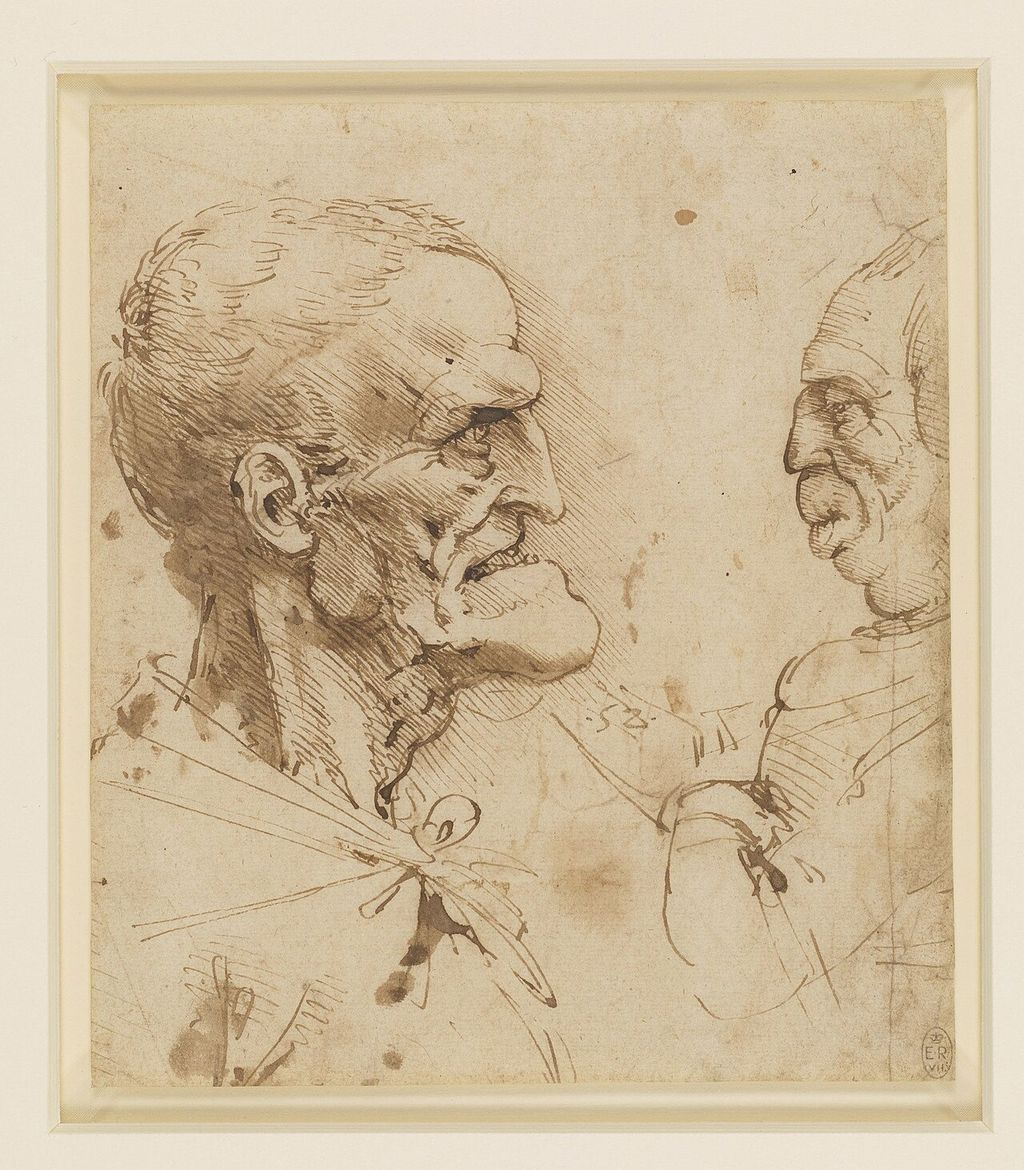
- ImageTwo grotesque profiles.
Contents
- The face as a system of variables
- “Caricature” is a later name
- Physiognomy without diagnosis
- Human expression beside animal expression
- A more elaborate narrative at the Sforza court
- Ideal beauty and “perfect ugliness”
- Resolving two old-woman profiles
- The old woman in Washington and the value of comparison
- Prints made the grotesques famous
- How to look at a grotesque head
The face as a system of variables
Leonardo's instructions for remembering a profile divide it into four principal zones: forehead, nose, mouth and chin. Each has a limited set of broad shapes—straight, concave or convex, projecting or receding—and those shapes can be recombined. The method turns a face into a sequence that an artist can retain after a brief encounter. [15]
Profile is ideal for this work because it converts the head's silhouette into a legible line. A frontal face hides how far the mouth projects or the chin falls back. In profile, one change alters the rhythm of the whole. Make the nose longer and the space above the lip contracts; push the jaw forward and the forehead may seem to retreat.
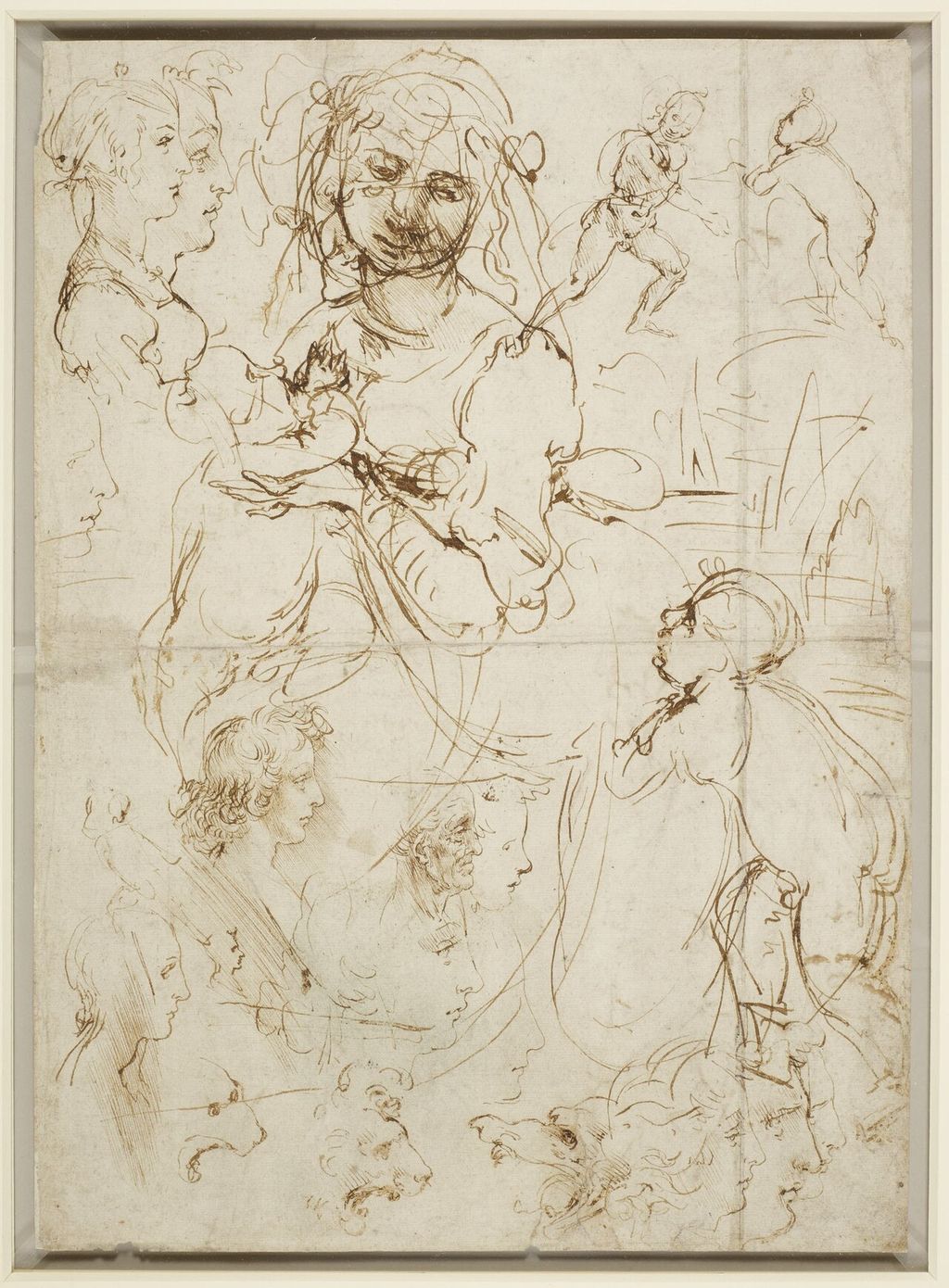
Leonardo used this combinatorial habit early. A large sheet of about 1478, RCIN 912276, surrounds a Virgin and Child study with women, old and young men, animals and invented profiles. The Royal Collection notes that several contemporary women may have been sketched from life, but that the types already recur habitually. Observation supplies material; drawing rearranges it. [3]
The grotesque heads take permutation towards extremes. Leonardo does not merely enlarge one feature. He coordinates protrusion and recession across the skull, nose, lips and chin so that an improbable head still feels structurally related. That coherence separates the strongest drawings from a collection of random deformities.
“Caricature” is a later nameThe Italian idea of a ritratto carico—a “loaded” portrait that exaggerates a likeness—is associated with artists after Leonardo, especially the Carracci. Museum interpretation places the word about fifty years after his death. Calling Leonardo the inventor of modern caricature therefore compresses different practices into a convenient origin story. [5] [13]
His sheets certainly helped make exaggeration an independent artistic subject. Yet their targets and purposes are often unknown. Many cannot be tied to a named sitter. They do not carry captions attacking rulers, clergy or policies. Some may record memorable people, some develop workshop types, and some clearly create comedy by pairing incompatible faces.
The Metropolitan Museum's catalogue keeps these options open: physiognomic study, record of an actual person, humorous invention and the beginnings of caricature can overlap without becoming identical. [5] “Grotesque head” is often the safer umbrella because it describes visual extremity without claiming a specific satirical function.
The term grotesque also needs care. In Renaissance decoration, grottesche referred to fanciful mixtures of human, animal and plant forms inspired by ancient wall paintings rediscovered underground. Leonardo's heads rarely belong to that ornamental system. Modern catalogues use “grotesque” more broadly for distorted or fantastic physiognomy.
Memory, observation and Vasari's story
Leonardo wrote that monstrous faces required little explanation because they were easily remembered. His practical advice asks painters to note the distinguishing forms of nose, mouth, chin and forehead, then use those stored types when reconstructing a face. [15]
Giorgio Vasari later turned this ability into a vivid anecdote. He says Leonardo would follow a person with a bizarre head for a day and draw the face from memory at home. The story agrees with Leonardo's interest in visual memory, but Vasari wrote decades after Leonardo's death and shaped biographies into moral and entertaining narratives. It should not be used as an eyewitness report for every drawing.
Nor does “from life” mean neutral transcription. An encountered face could prompt Leonardo to lengthen a nose, compress a mouth or join the head to a body and costume of his own invention. The resulting figure may preserve the shock of recognition while no longer representing one individual.
This process was useful to a painter of narrative scenes. Crowds require age, temperament and social difference. An artist who can vary profiles avoids repeating the same head. The strange face is memorable raw material even when it never appears unchanged in a painting.
Physiognomy without diagnosisRenaissance physiognomy claimed that the body's visible form could reveal temperament or moral character. Ancient and medieval texts classified foreheads, noses, eyes and animal resemblances. Leonardo knew this intellectual field, but scholarship has also shown how his permutations strain its fixed categories rather than simply illustrate them. [12]
Michael Kwakkelstein's later reassessment gives satire a larger place. He distinguishes heads prompted by uncommon features observed from life from increasingly invented Milanese types, and proposes that some imaginary busts became a moralising outlet for Leonardo's frustration with court society. [18] The argument helps recover humour and social criticism from readings that make every sheet a detached scientific exercise. It remains an interpretation of a corpus with few named targets: without captions or securely identified sitters, a particular profile cannot automatically be assigned to a court faction or vice.
The drawings can look like demonstrations that ugliness means vice. Some pair age, vanity, aggression or lust with distorted features. But the corpus is not a consistent code in which one nose always signifies one character. Leonardo repeatedly alters a type, reverses it, changes its partner or places it in another narrative.
Modern viewers should not convert exaggeration into medical diagnosis. A swollen forehead or collapsed profile may be invented. Even where a real condition contributed, a drawing designed for comedy cannot serve as a clinical case record. Historical physiognomy itself is not valid science; it joined observation to cultural prejudice and moral judgement.
Disability scholarship adds a further qualification. Emily Cock's study of diagnostic readings around Leonardo's Mona Lisa and Massys's Old Woman argues that diagnosis can impose a medical verdict that closes interpretation, but that disabled viewers may also use speculative identification to find historical presence and creative affinity. [19] The ethical choice is therefore not to declare a condition from an image, nor to insist that bodily difference is irrelevant. It is to state uncertainty, attend to what the artwork and its reception do with facial difference, and leave room for readings formed by lived disability rather than only by medical authority.
Age is especially charged. Leonardo often gives ideal youth smooth transitions and gives old age broken contours, missing teeth, sagging flesh and enlarged features. This can explore physical change, but it can also expose Renaissance anxieties about sexuality, vanity and bodies that no longer conform to elite ideals.
Human expression beside animal expression
Leonardo's comparisons sometimes cross the boundary between human and animal heads. On RCIN 912326, made about 1503–4 while preparing the Battle of Anghiari, he set studies of horses beside the heads of a lion and a man. The Royal Collection identifies fury as the common problem: the lion is present for comparison, while the man and horses belong to the search for an extreme expression appropriate to battle. [17]
This sheet helps distinguish two operations that can otherwise be confused. Leonardo could compare the visible mechanics of emotion across species: bared teeth, compressed nostrils, tightened brow, raised head and straining neck. Such correspondences gave an artist ways to intensify movement. They did not require every human face to stand for a particular animal or to carry an animal's supposedly fixed moral nature.
The grotesque profiles often invite animal comparison because a hooked nose can resemble a beak, a projecting jaw a muzzle, or a heavy neck a bull's. Renaissance physiognomy encouraged viewers to turn those resemblances into claims about character. Yet Leonardo's practice remains more mobile than a chart of correspondences. On the battle sheet, comparison serves the construction of an action: bodies under pressure must appear seized by the same violence. In the independent heads, a similar formal echo might instead support comedy, memory or variation.
Animal analogy should therefore be read as one instrument among several. It can sharpen an expressive contour and connect a face to a wider study of living form. It is not a licence to treat a represented person as less human. That distinction matters because physiognomic traditions were later used to naturalise judgements about class, ethnicity and mental capacity. Leonardo's visual experiment belongs to that history, but no modern biological truth follows from it.
Two old lovers: RCIN 912490One of the clearest comic constructions is Two grotesque profiles, RCIN 912490, dated about 1485–90. The pen-and-ink drawing with wash measures 16.3 by 14.3 centimetres. An elderly man with a vast projecting chin faces a smaller old woman with a long upper lip and double chin. Her bodice is pulled tight and her hand reaches towards his chin. [1]
The pair parodies a familiar portrait format. Fifteenth-century husbands and wives could be represented in opposed profiles, dignified by stillness, fine dress and balanced placement. Leonardo keeps the confrontation but replaces composure with appetite and incompatibility. The woman's gesture turns two head studies into aged lovers.
The humour depends on more than ugliness. Scale, gaze and touch create a relationship. His chin advances like a weapon while her hand tests or caresses it. Costume signals vanity; bodies press towards the edge of decorum. We are invited to recognise the conventions of respectable marriage portraiture beneath the joke. [1]
This is also the secure identity behind a reproduction sometimes given the generic modern label “Caricature III”. It is one autograph sheet with two figures, not the third item in a numbered series created by Leonardo. Replacing the serial title with its collection identity restores date, medium and meaning.
A more elaborate narrative at the Sforza court
RCIN 912495, conventionally catalogued as A man tricked by Gypsies, goes beyond an isolated head. Around 1493 Leonardo placed a wreath-wearing old man at the centre of four surrounding figures. One woman takes his raised hand as if reading his palm, while a grinning figure at the other side reaches towards his purse. The sheet has been cut, removing part of the palm-reading action. [2]
The Royal Collection proposes that the work entertained the Sforza court. Faces crowd the central man and turn physiognomic contrast into social action. Trust, distraction, touch and theft unfold simultaneously. His antique-looking wreath makes his solemnity vulnerable to the animated figures around him.
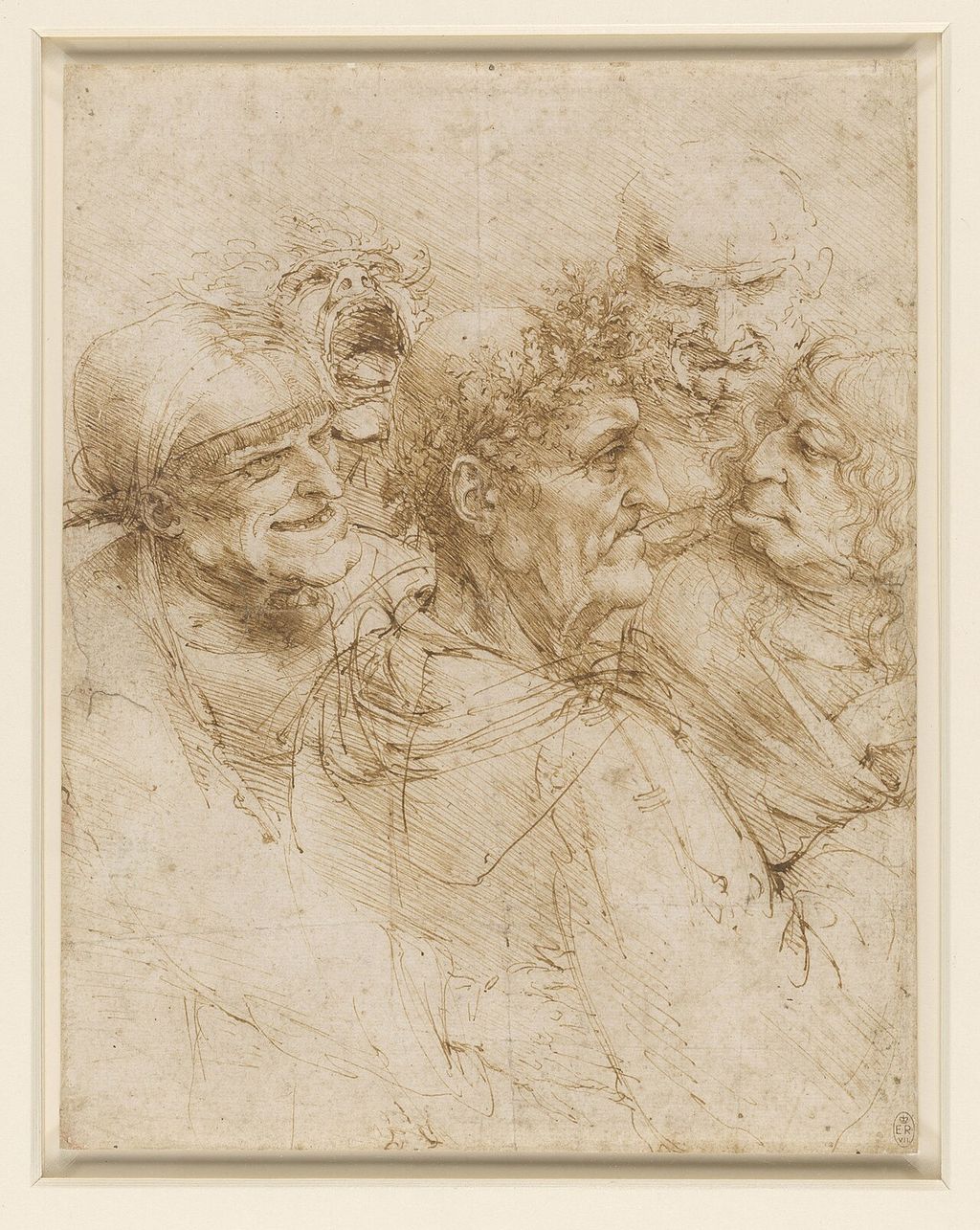
The inherited English title uses a term now widely recognised as a slur for Romani people. It also carries an early modern stereotype that casts Romani figures as deceitful fortune-tellers and thieves. Naming the catalogue title can identify the object; repeating its prejudice as description would mistake satire for social fact.
That ethical boundary changes how the humour is read. The drawing may mock the vain victim, but it also depends on marginalised people as a ready-made image of fraud. Court entertainment and discriminatory stereotype coexist. Leonardo's ingenuity does not neutralise the social work performed by the scene.
Ideal beauty and “perfect ugliness”
Royal Collection writing often presents grotesque heads as a counterpoint to Leonardo's search for ideal beauty. The contrast is useful: smooth young profiles and ruined old ones occupy opposite visual poles. Yet they are connected by the same practice of selecting, combining and refining features. [1] [4]
The beautiful head is no more a raw transcript than the grotesque one. Leonardo can lengthen a neck, regularise a nose and coordinate curls into an ideal pattern. At the other pole he exaggerates discontinuity. Both teste divine and monstrous faces ask how far a type can move from ordinary appearance while remaining compelling.
That is why grotesques cannot be dismissed as doodles made during more serious work. Small scale gave Leonardo freedom to test rhythms quickly. A line from forehead to nose to mouth could become tender, proud, vacant, belligerent or absurd. These experiments sharpened his understanding of character even when they did not prepare a known painting.
Humour also has intellectual value here. A grotesque profile makes proportion visible by breaking it. The viewer notices the normal relationship between nose and chin precisely when it is violated. Laughter becomes a form of visual analysis, although one entangled with judgement about age, gender and bodily difference.
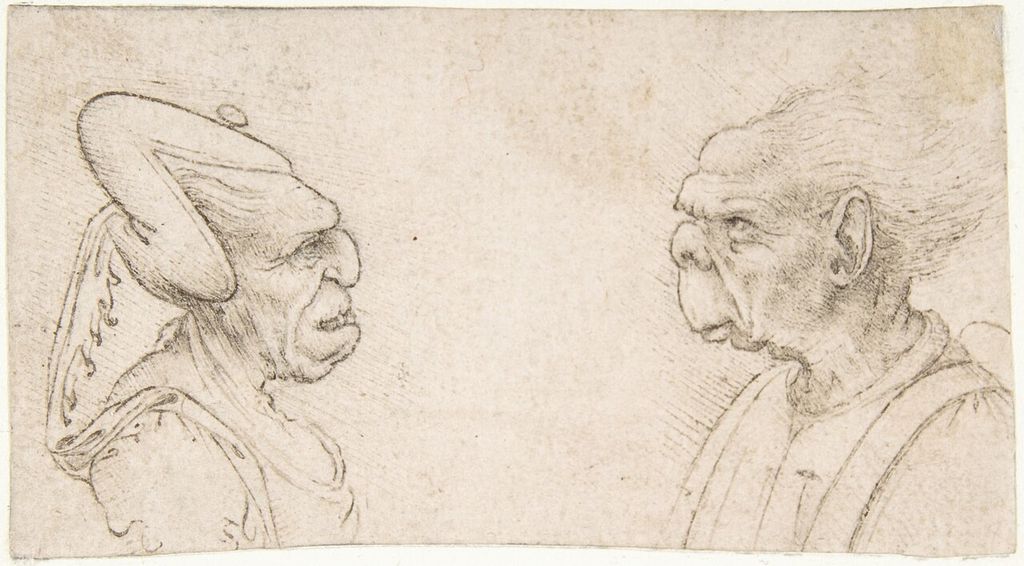
One invention, many handsFrancesco Melzi inherited Leonardo's drawings and manuscripts. He also made close copies of grotesque heads, including sheets once in the collection of the Earls of Pembroke. The Metropolitan Museum attributes one paired drawing to Melzi after Leonardo: an old woman with an elaborate headdress faces a large-eared man lacking a chin. [6]
Melzi did more than trace an outline. He imitated Leonardo's diagonal left-handed hatching, apparently rotating or shifting the paper to achieve the correct angle. Later right-handed copyists did the same. The Getty and British Museum therefore warn that hatching direction is evidence to analyse, not an autograph signature by itself. [11] [16]
The British Museum's sheet 1886,0609.40 shows seven heads after Leonardo. Its lines slope in Leonardo's manner, but the handling is too hard and mechanical for the master. Several heads recur in other drawings and prints. This repetition lets scholars reconstruct networks of prototypes, yet it also means that an image can circulate far from its first sheet. [16]
Copies are not merely failures of attribution. When an original is lost, a Melzi or later workshop version may be the best witness to Leonardo's invention. The correct label—“after Leonardo”, “attributed to Melzi”, “school of”, or autograph—tells the reader what kind of evidence survives.
Resolving two old-woman profiles
Two widely reproduced old women illustrate this problem. One wears a veil or hood and faces right. The Louvre holds a round pen, brown-ink and wash copy, RF 28737, possibly by Constantijn Huygens Jr., made after a related design. Its catalogue points to a British Museum sheet known as Pp-37, whose status has itself been discussed as either Leonardo's original or another copy. [8]
A second woman faces right beneath a tall hennin. The Louvre's RF 28749 is again explicitly a copy, also tentatively connected with Huygens. In this case the museum identifies Leonardo's surviving prototype as Chatsworth inv. 823B. [9]
These types have been reproduced under the arbitrary labels “Caricature I” and “Caricature II”. Those names obscure different collections, hands and histories. The veiled woman belongs to a contested original-and-copy problem; the high-hennin woman has an autograph Chatsworth prototype and later copies. A digital reproduction cannot be assigned to one physical sheet solely because the composition matches.
The distinction matters to interpretation. A copy may regularise a contour, simplify wash or reproduce a left-handed stroke mechanically. What looks like Leonardo's deliberately hesitant line may instead be a later artist's effort to preserve it.
The old woman in Washington and the value of comparisonThe National Gallery of Art's Grotesque Head of an Old Woman, dated 1489–90, provides a secure autograph point of comparison. In right profile, the woman has a hooked nose, thin downturned lips, receding chin, sagging neck and hunched back. A flower sits at her low neckline. [7]
Related copies survive, including a nearly exact version associated with Melzi. When original and copy can be examined together, line rhythm becomes visible evidence. Leonardo's strokes move with form and change pressure; the copy may preserve every component while losing some unity.
The Washington sheet also resists a simple “ugly face” reading. Costume, flower and exposed neckline suggest self-presentation. The woman is not just old; she participates in a visual language of courtship and vanity. Exaggerated anatomy and social satire reinforce each other.
From Leonardo to Massys
Quinten Massys's An Old Woman, known as The Ugly Duchess, transformed a related grotesque female type into a large oil painting around 1513. The National Gallery's research traces affinities with drawings connected to Leonardo while emphasising a complicated transmission history. Italian and Netherlandish artists exchanged designs, and the direction of dependence among particular drawings, copies and the painting has been debated. [10]
Massys adds colour, texture, hands, jewellery, a parapet and a flower. The outmoded horned headdress and exposed ageing body parody elite portraiture. What was intimate and mobile on paper becomes a public-looking painted presence.
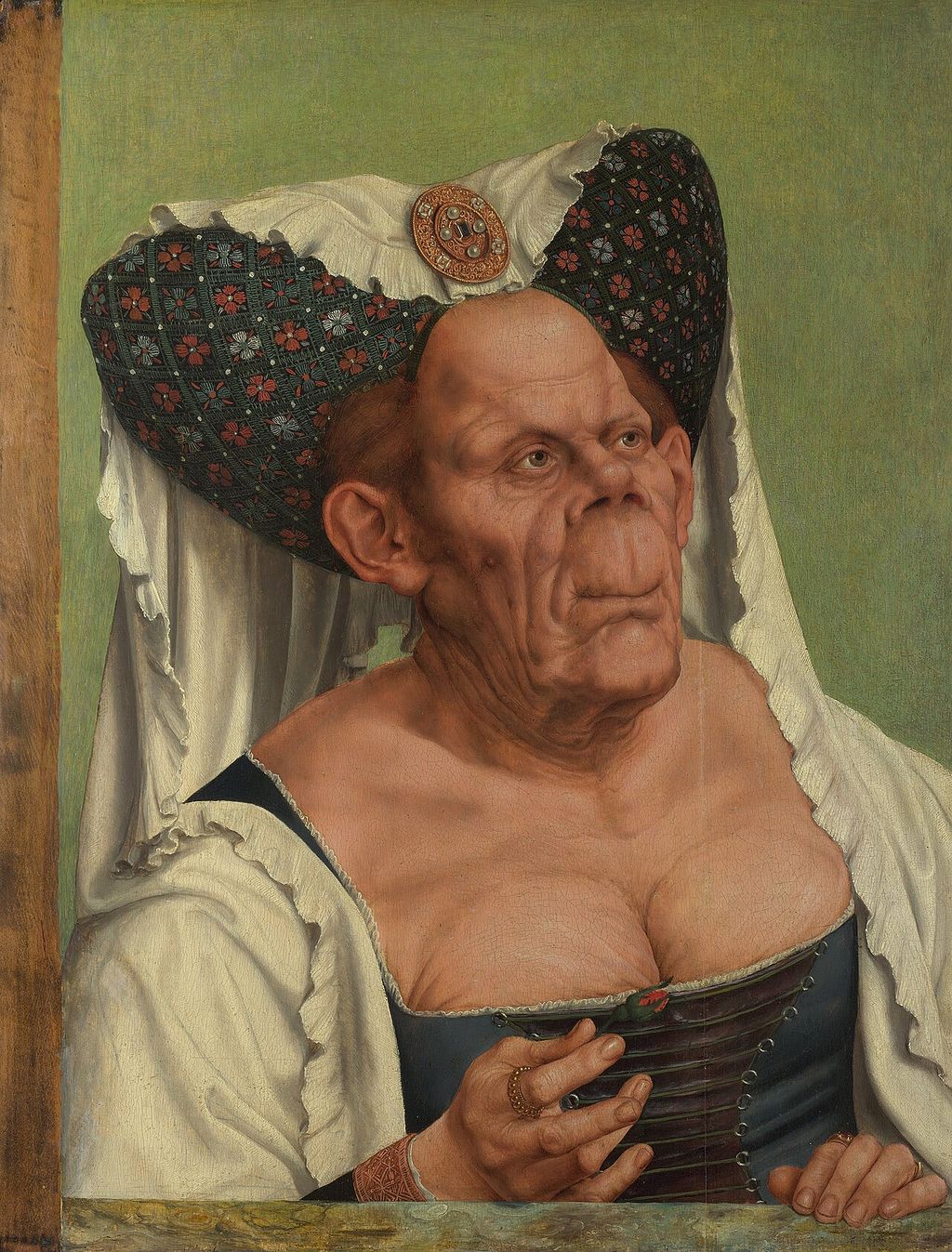
His Ill-Matched Lovers likewise adapts Leonardesque physiognomic types within a moralising northern scene of age, desire, money and deception. These paintings show that Leonardo's heads were not sealed exercises. Their forms could migrate into other media and acquire new stories.
The exchange also complicates the heroic claim that Leonardo single-handedly founded caricature. His designs were extraordinarily influential, but later artists selected, paired and reinterpreted them within existing comic and moral traditions.
Prints made the grotesques famousLeonardo's original drawings passed through Melzi and the sculptor Pompeo Leoni before a large album reached Thomas Howard, Earl of Arundel. In the 1640s Wenceslaus Hollar made etchings after heads in the Arundel collection. The album later entered the Royal Collection, probably through Charles II. [14]
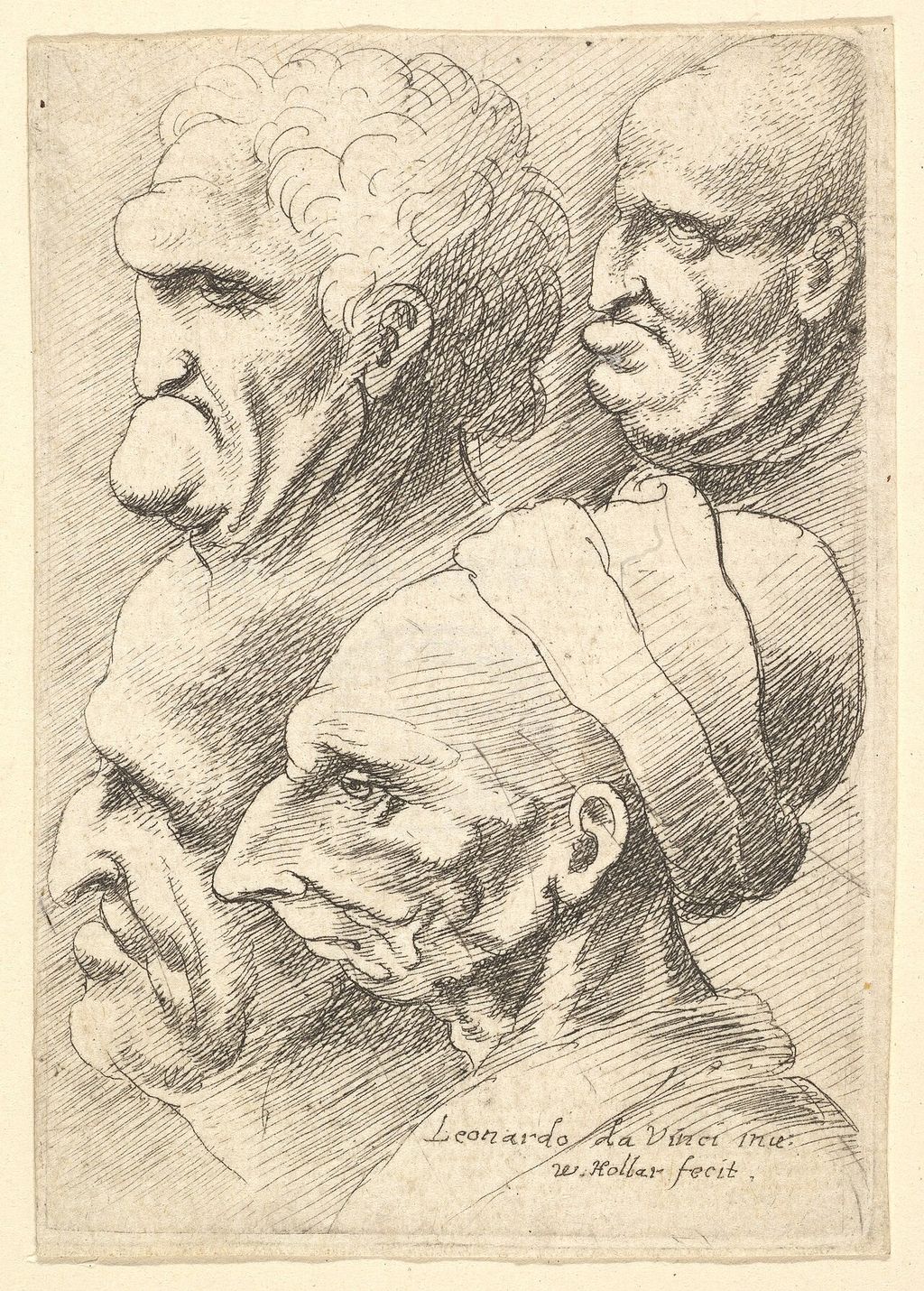
Print removed the drawings from the intimacy of a single sheet. Hollar could reverse, group and standardise heads, and collectors could encounter them without seeing Leonardo's paper. Later albums associated with Mariette and Caylus in Paris, and the Spencer collection in New York, preserve further copies and printed afterlives. [5] [6] [8]
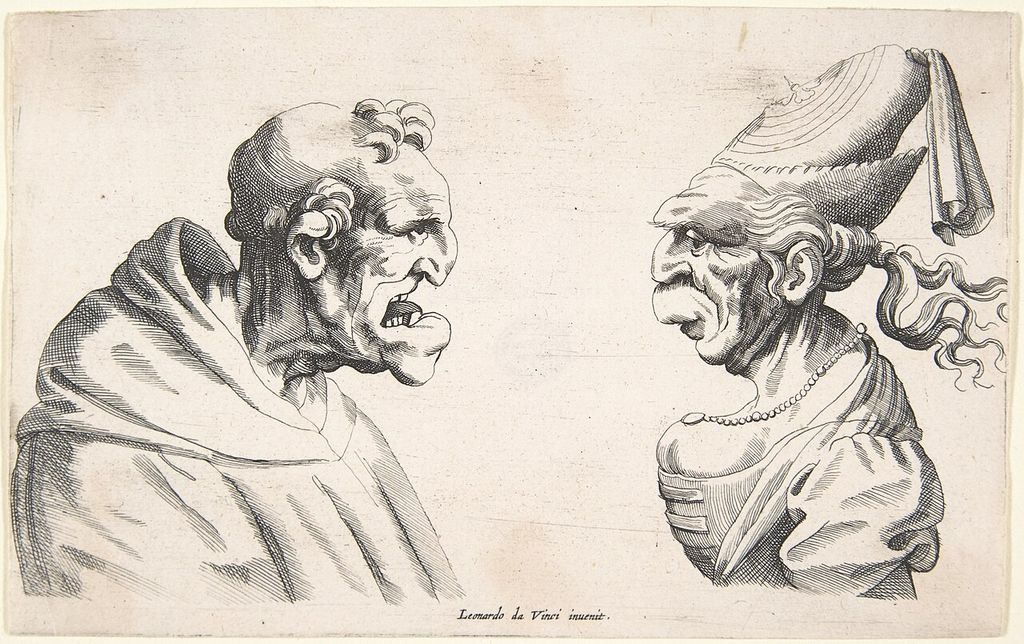
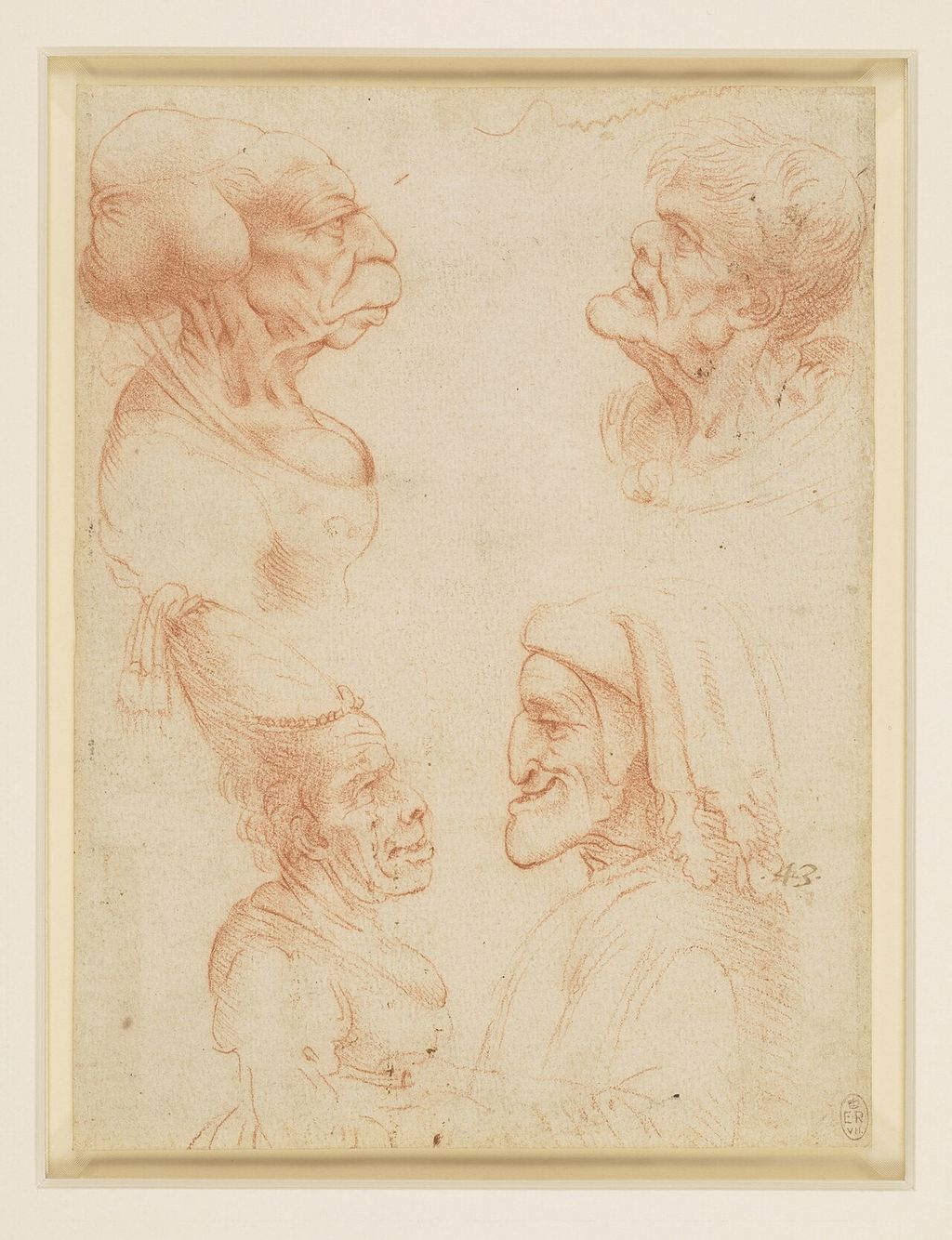
By the eighteenth century Leonardo had become strongly associated with caricature. His heads supplied a genealogy for a genre that now included social types, personal satire and political lampoon. That reputation was real even if it simplified the original drawings' mixed purposes. [5] [13]
How to look at a grotesque head
Begin with structure rather than a verdict about beauty. Follow the contour from forehead to nose, mouth and chin. Ask which features project and which collapse. Then look at internal lines: eyelid, cheek, jaw and neck. A convincing grotesque makes the distortions answer one another.
Next examine costume and pairing. A headdress can turn anatomy into vanity; a bodice can make age part of courtship; another face can transform a study into confrontation. Gesture and scale may carry more comedy than the nose.
Finally ask what survives. Is the sheet autograph, a Melzi copy, a later studio version or a print? Does the catalogue identify a prototype? Has a generic internet title stripped away the inventory number? These questions do not drain the humour from the work. They reveal how Leonardo's inventions remained memorable enough to be copied, rearranged and renamed for five centuries.
His grotesque heads matter because they sit where seeing becomes imagining. They investigate the face as anatomy, social signal, remembered pattern and comic image. Their legacy is not one straight line to the political cartoon. It is a dense family of profiles in which beauty and distortion, sympathy and ridicule, observation and fantasy remain difficult to separate.
Continue exploring Leonardo
Explore Leonardo’s works and designs
| Name | Date | Medium |
|---|---|---|
| A Map of Imola | 1502 | Drawing |
| Adoration of the Magi | About 1482 | Painting |
| Annunciation | About 1472 | Painting |
| Bacchus | Around 1517–1520 | Painting |
| Benois Madonna | Around 1478–1480 | Painting |
| Crossbow | 1485-1490 | Drawing |
| Diving Suit | — | Drawing |
| Flying Machine | — | Drawing |
| Ginevra de’ Benci | c. 1474/1478 | Painting |
| Head of a Woman (Turin) | Source-led range: 1478-1485, c. 1483-1485 or 1480s | Drawing |
| Helicopter | — | Drawing |
| Horse and Rider | — | Sculpture |
| La Bella Principessa | — | Painting |
| La Belle Ferronnière | c.1490–1497 | Painting |
| La Scapigliata | 1492–1501 ca | Painting |
| Lady with an Ermine | c. 1490 | Painting |
| Landscape Drawing for Santa Maria della Neve | Fifteenth century; inscription dated 5 August 1473 | Drawing |
| Leda and the Swan | — | Painting |
| Leonardo's Catapult Designs | late fifteenth century | Drawing |
| Leonardo's Designs for Milan Cathedral | 1487–90 | Architecture |
| Leonardo's River-Lock Drawing | late fifteenth century | Drawing |
| Leonardo's Romorantin Palace Project | 1517–18 | Architecture |
| Leonardo's Self-Propelled Cart | late 1470s–1480s | Drawing |
| Machine Gun | — | Drawing |
| Madonna Litta | Mid-1490s | Painting |
| Madonna of the Carnation | Around 1475 | Painting |
| Madonna of the Yarnwinder | — | Painting |
| Mary Magdalene | — | Painting |
| Mona Lisa | 1503 / 1519 | Painting |
| Ornithopter | — | Drawing |
| Parachute | — | Drawing |
| Portrait of a Lady: The Historic Leonardo Attribution | late fifteenth century | Painting |
| Portrait of a Man in Red Chalk (Self Portrait) | 1517/1518 or c. 1517-1518 | Drawing |
| Portrait of a Musician | About 1485 / first Milan period | Painting |
| Portrait of Isabella d’Este | Around 1499/1500 | Drawing |
| Profile of an Ancient Captain | c. 1475–1480 | Drawing |
| Rearing Horse and Mounted Warrior | First half of the 16th century | Sculpture |
| Saint Jerome in the Wilderness | About 1480–1482 / 1481–1482 | Painting |
| Saint John the Baptist | Around 1508–1519 | Painting |
| Salvator Mundi | — | Painting |
| Study of Hands | c.1480 | Drawing |
| The Baptism of Christ | About 1470–75 | Painting |
| The Battle of Anghiari | — | Painting |
| The Burlington House Cartoon | About 1506–8 | Painting |
| The Fetus in the Womb | c. 1511 | Drawing |
| The Last Supper | 1495–1498 in the Museo del Cenacolo Vinciano object table | Painting |
| The Sforza Horse Monument | 1480s–1499 | Sculpture |
| The Trivulzio Monument | c. 1506–13 | Sculpture |
| The Virgin and Child with Saint Anne | Around 1503–1519 | Painting |
| Triple Barrel Cannon | — | Drawing |
| Virgin of the Rocks | — | Painting |
| Vitruvian Man | Generally associated with Leonardo’s Milanese years, around 1490; exact dating remains cautious | Drawing |
| Wreath of Laurel, Palm, and Juniper with a Scroll | c. 1474/1478 | Drawing |
Frequently Asked Questions
Discussion
Which part of the evidence changes the way you read Leonardo's Caricatures and Grotesque Heads? The article sets surviving material beside later interpretation; share the distinction that matters most to you.
Reader Insights
What detail in the images or drawings is easiest to miss on a first viewing?
How does the face as a system of variables alter your understanding of this subject?
Where does the article leave a question open rather than presenting a settled answer?
Join the Conversation
Share your reading of Leonardo's Caricatures and Grotesque Heads below.
References
- Royal Collection Trust, “Two grotesque profiles,” RCIN 912490. View Source
- Royal Collection Trust, “Top 10 Leonardo Drawings in the Royal Collection,” entry for RCIN 912495. View Source
- Royal Collection Trust, “The Madonna and Child with the infant Baptist, and heads in profile,” RCIN 912276. View Source
- Martin Clayton, Leonardo da Vinci: The Divine and the Grotesque, Royal Collection Trust. View Source
- Constance C. McPhee and Nadine Orenstein, Infinite Jest: Caricature from Leonardo to Levine, Metropolitan Museum of Art. View Source
- Metropolitan Museum of Art, “A Grotesque Couple: Old Woman with an Elaborate Headdress and Old Man with Large Ears and Lacking a Chin,” attributed to Francesco Melzi after Leonardo. View Source
- National Gallery of Art, “Grotesque Head of an Old Woman,” 2022.84.1. View Source
- Musée du Louvre, “Vieille femme en buste de profil à droite, coiffée d'un voile,” RF 28737. View Source
- Musée du Louvre, “Vieille femme en buste de profil à droite, coiffée d'un hennin,” RF 28749. View Source
- National Gallery, London, catalogue entry for Quinten Massys, An Old Woman ('The Ugly Duchess'). View Source
- J. Paul Getty Museum, “Leonardo da Vinci, Renaissance Lefty”. View Source
- Michael W. Kwakkelstein, “Leonardo da Vinci's Grotesque Heads and the Breaking of the Physiognomic Mould,” Journal of the Warburg and Courtauld Institutes 54 (1991). View Source
- Marsilio Arte, De' visi mostruosi and caricatures. View Source
- Royal Collection Trust, “Collecting Italian Renaissance Drawings”. View Source
- Leonardo da Vinci, Trattato della pittura, sections 283–85, 1890 edition at Italian Wikisource. View Source
- British Museum, “Grotesque caricature heads of five men and two women, after Leonardo,” 1886,0609.40. View Source
- Royal Collection Trust, “A rearing horse, and heads of horses, a lion and a man,” RCIN 912326. View Source
- Michael Kwakkelstein, “Leonardo's Drawings of Busts of Old Men and Women with Monstrous Faces: Satire as Moral Criticism,” in Lucia Tantardini and Rebecca Norris, eds., Grotesque and Caricature: Leonardo to Bernini (Brill, 2023), 13–37. View Source
- Emily Cock, “Portraiture and Disability: Cripping Retrospective Diagnosis,” Journal of Literary & Cultural Disability Studies 20, no. 1 (2026), 37–54. View Source