 by Tom Gurney
Tom Gurney BSc (Hons) is an art history expert with over 20 years experience
Page Created on September 22, 2026 / Page Updated on September 22, 2026
Email: tomgurney1@gmail.com / Phone: +44 7429 011000
Leonardo's Water-Lifting Devices
Leonardo da Vinci did not leave one finished invention called the “water-lifting device”. He left a dispersed investigation. Across large sheets and pocket notebooks, screws carry water up slopes, pistons work in pairs, valves regulate flow, counterweights ease a stroke and wheels transmit power. Some arrangements answer practical needs. Others ask whether water raised by a machine could fall back through a wheel and keep the same machine moving forever.
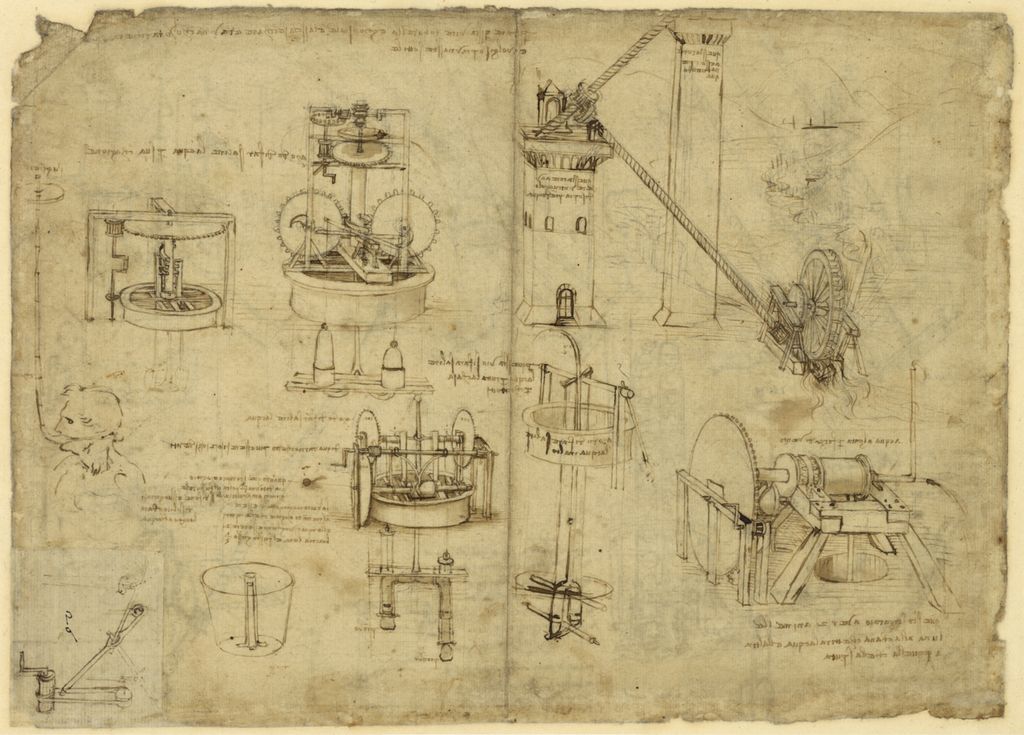
A familiar reproduction usually associated with this subject is Codex Atlanticus folio 26r. It is crowded because it is not a presentation drawing of one contraption. It is a working field of alternatives. Reading it well means separating the small systems, identifying what supplies their power, and resisting the modern wish to turn every sketch into a successful prototype.
Water lifting was never a marginal curiosity. A town, palace, garden, workshop, fortress or construction site needed to move water against gravity. The task joined mechanics to labour, architecture and landscape. It also exposed a basic limit: water can drive a machine while descending, but raising it again demands at least as much energy as the descent can return.
At a Glance
- SubjectLeonardo's Water-Lifting Devices
- Artist and contextLeonardo da Vinci (1452–1519) and his Renaissance world
- ImageCodex Atlanticus folio with water-raising and pumping devices.
Contents
- The legacy image: Codex Atlanticus 26r
- What does it mean to lift water?
- Screws that carry water upwards
- Buckets, boxes, chains and wells
- Siphons and communicating vessels are not pumps
- Why raise water?
- The Forster notebook laboratory
- Codex Atlanticus 1062v and the value of a failed machine
- Leonardo within a longer engineering history
- How to read the devices now
The legacy image: Codex Atlanticus 26r
The large sheet now numbered Codex Atlanticus 26r is in the Biblioteca Ambrosiana in Milan. Older publications call it 7r-a, a previous foliation that can make one object look like two. The current catalogue measures it at 291 by 400 millimetres and records black ink, text, drawings and calculations. Carlo Pedretti dated it about 1480–82; Matthew Landrus proposed the slightly broader range 1480–85. [1]
The general theme continues from the verso: raising water with gears, toothed wheels, pumps and bellows. Three human figures at the left concern going beneath water or walking on its surface. These aquatic devices share the sheet without belonging to the pumps as operators or scale figures. Leonardo used available paper associatively, not as a modern patent plate divided into a title, definitive elevations and a specification. [1]
At the centre, a broad helical form descends towards a geared drive. Elsewhere wheels stand above containers; pipes bend between vessels; levers, valves and weighted components appear in isolated details. The eye wants to connect every line into one enormous apparatus, but the page offers several propositions. Some are repeated from another angle or at another scale; some investigate only a transmission or closure.
This object identity corrects the old description in two ways. “Devices” is properly plural, and detail does not equal completeness. The sheet lacks one locked configuration, dimensions for a full machine, a fabrication sequence and evidence that the group was built. Its value lies in the range of mechanisms Leonardo puts into conversation.
What does it mean to lift water?Water lifting increases the water's height. In mechanical terms, an operator or another source supplies work that becomes gravitational potential energy. The machine may trade force against distance: a small force applied over a long crank path can raise a heavier quantity through a shorter vertical distance. No gearing removes the total cost, and real mechanisms add losses.
This distinguishes a pump from its prime mover. A hand, animal, falling counterweight, flowing stream or wind can turn the shaft. Gears, cranks, cams and levers transmit or transform that motion. A screw, bucket chain or piston then acts on the water. Leonardo often draws these stages together, but they answer different questions: where does the energy enter, how does motion change direction, and how does the water rise?
A water wheel is especially easy to misread. Flowing or falling water can rotate it and drive another mechanism. If the driven mechanism raises water from the same lower level and returns that water to the wheel, the circle cannot sustain itself. Friction at bearings, leakage past seals, turbulence, impacts and incomplete filling remove useful energy on every circuit. A workable water-powered lift requires an external head or current whose energy is not created by the lift.
Output also matters. A screw can move a relatively continuous stream through a modest rise. Buckets raise separate loads. A reciprocating pump delivers pulses unless several cylinders alternate. The best arrangement depends on height, volume, construction skill, available power and tolerance for leakage. Leonardo's sheets are strongest when they expose those design choices rather than announce a universal solution.
Modern pump analysis makes the trade-off explicit. The useful hydraulic power is proportional to the water's density, gravitational acceleration, discharge and total head: in compact form, P = ρgQH. The required input is greater because efficiency is below one. Total head includes the vertical lift but can also include pressure, outlet velocity and friction losses in pipes, valves and fittings. [18] A machine that raises a trickle through a high pipe and one that moves a large irrigation flow through a low rise may therefore demand similar power while serving different purposes.
Leonardo's drawings rarely supply all the quantities needed for a performance calculation. Cylinder bore and stroke may be unclear; rotational speed, valve timing, pipe roughness, leakage and seal behaviour are usually unknown. A modern model that makes water emerge proves that one selected geometry has workable kinematics. Without measured discharge, head and input power, it does not establish efficiency, historic capacity or suitability for continuous service. This is why reconstruction should report operating conditions rather than stop at “it works”. [18]
Screws that carry water upwards
The water screw was ancient long before Leonardo. The name “Archimedes' screw” associates it with the Greek mathematician and engineer, and science museums still demonstrate its basic action: turn an inclined helix or a helical tube with its lower end immersed, and portions of water remain trapped as the compartments travel upward. [16] Leonardo inherited a recognised family of machines rather than inventing the principle.
His contribution is investigative variation. On folio 26r and related sheets he changes the helix, casing and drive. A screw can be represented as a broad continuous surface within a cylinder or as pipe wound around a core. Multiple coils can share an axis. Their inclination, diameter and number of turns affect the path, capacity and torque required.
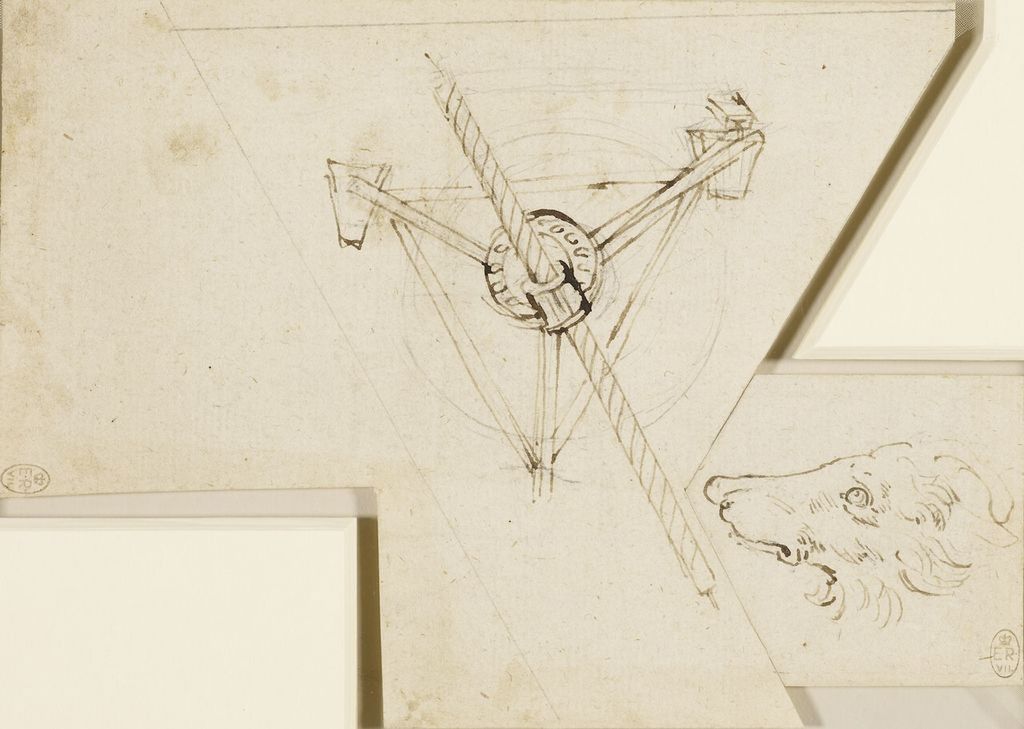
The device does not force an intact column vertically through a sealed tube. Rotating pockets repeatedly collect, carry and release water. If the axis is too steep or the geometry leaves an open path downhill, water spills back. If the clearances are generous, leakage increases; if construction is tight and heavy, friction and manufacturing difficulty rise. Leonardo's attention to screws therefore joins geometry to material practice.
Codex Atlanticus 1069r, dated about 1480–82, expands the same vocabulary. Its catalogue identifies Archimedean screws and plunging pumps among several lifting systems. In the upper landscape, long screws connect a river with two towers. Elsewhere a crank reaches paired pumps through alternative transmissions. Siphon, hydraulic valve and diving studies sit on the same sheet. [5]
The National Museum of Science and Technology's interpretation stresses the division between power and lifting: a current turns a mill wheel, the rotation reaches a screw, and the screw raises water to a tower. [14] Whether every drawn linkage would survive full-scale loads is a separate question. The drawing nevertheless shows Leonardo treating the machine as a chain of energy conversions rather than as an isolated spiral.
Pistons, valves and alternating strokes
A reciprocating pump uses a piston or plunger moving inside a cylinder. On one stroke, a pressure difference admits water through an inlet valve; on the return, that valve closes and an outlet opens. The valves make the flow directional. Without reliable seals and closures, the piston merely stirs water or moves air.
Leonardo repeatedly studies paired pumps. When one piston rises as the other descends, the power stroke can alternate and the delivery becomes less intermittent. The coupling also spreads a demanding load through the cycle. Cranks, cams, eccentrics and rocking beams offer different ways to turn rotation into back-and-forth motion.
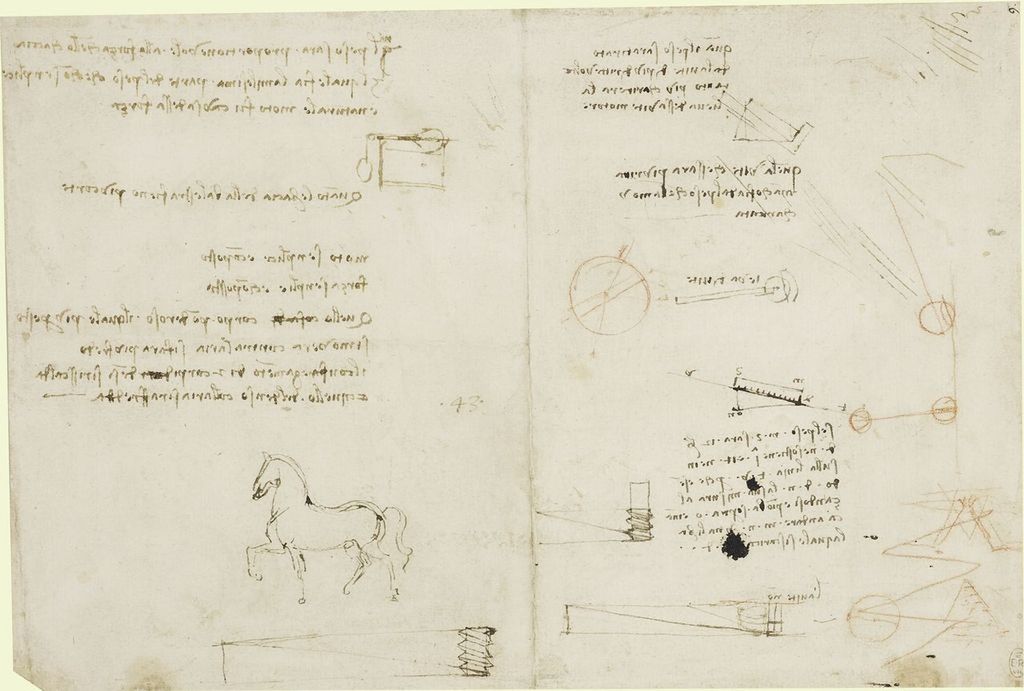
Codex Atlanticus 20r, dated about 1487, presents a large double pump with a central counterweight and long levers for human input. The current catalogue places it among hydraulic machines for domestic supply, draining canals and ditches, military use and spectacular fountains. [6] Those categories describe Leonardo's wider corpus; they do not prove that this particular sheet received a commission in each field.
A counterweight does not provide endless power. It can balance the mass of pump rods, smooth the operator's effort or store energy during part of a cycle, but after descending it must be raised. The distinction between reducing peak effort and reducing total work is central to Leonardo's mechanical thinking.
Codex Atlanticus 5r explores a different early system. A large bellows acts through air on a valve and water passage; small studies analyse the valve and related components. The sheet is generally dated around 1480–82, although other drawings on it have prompted later dating discussions. [7] It demonstrates close attention to pressure and closure without proving a complete, tested pneumatic installation.
Buckets, boxes, chains and wellsThe oldest way to raise water is also the most legible: lift a container. A rope and pulley change the direction of effort; a windlass winds the rope; a counterweight assists the return. Arrange many containers on a moving loop and the separate trips become a repeating process. Chains of pots or cups and bucket wheels belonged to a long practical tradition.
Leonardo's drawings often dissolve the boundary between a single bucket and a continuous transporter. Boxes attached to a wheel fill, rise and empty. Hinged doors or tipping geometry control discharge. A chain or articulated sequence can pass around upper and lower wheels. Such machines tolerate water that would challenge a close-fitting pump, but the weight of the moving chain, empty containers and supporting frame must also be driven.
Museum models help viewers understand this movement. The Museo Leonardiano collection has included a chain-of-cups pump since 1963 and later added other hydraulic models. [15] Yet a twentieth-century wooden reconstruction is an interpretation of marks on paper. It selects dimensions, bearings, materials and connections that the drawing may leave uncertain. The model demonstrates one coherent reading; it is not a surviving Leonardo prototype.
A well produces a related architectural problem. Pulley radius, axle size and counterweight determine the force at the handle, while the building must keep the suspended load clear of walls and users. Leonardo's water devices often expand into edifici d'acqua, “water buildings”, where the machine and its housing form one design.
Codex Atlanticus 375r, about 1485–87, places a lever, wheel and counterpoise within an arcade-like structure to raise water from an underground channel. A second drawing removes much of the architecture, making the mechanism and communicating vessels easier to see. [12] The pairing reveals two stages of thought: installation in a prestigious setting and analytical exposure of the working parts.
Siphons and communicating vessels are not pumps
Leonardo also sketches siphons and connected vessels. These can move water in surprising directions, but their limits differ from a powered lift. In communicating vessels open to the same pressure, free surfaces tend towards the same level. A siphon can carry liquid over an intermediate crest when it remains filled and its outlet lies lower than the source surface. It does not deliver water continuously to a final level higher than its supply without external work.
Confusion arises because part of a siphon rises. The liquid crosses a high point, so the device appears to defeat gravity. Across the complete path, however, the lower outlet and pressure conditions make the flow possible. If the destination is higher than the source, the siphon stops short of the claimed task.
Leonardo's use of connected vessels could clarify pressure and level relationships or support a larger pump. It should not be treated as evidence that he found an exception to energy balance. The drawings record a period when practical craft, inherited propositions and direct tests were being brought into a more searching mechanical language.
Why raise water?
Domestic supply is the most immediate purpose. A mechanism can bring well or channel water to a cistern on an upper floor, from which gravity distributes it. Gardens and fountains add spectacle: stored water descends through jets, automata or cascades, converting height back into movement.
Drainage reverses the reader's viewpoint. The object is not necessarily to place water in a high tank, but to remove it from a ditch, canal, foundation, mine or defensive moat. A small rise repeated continuously can expose ground for work. Codex Atlanticus catalogue entries explicitly connect parts of Leonardo's hydraulic corpus with emptying canals and ditches and with military systems. [6]
Irrigation values volume, reliability and access to an external power source. Al-Jazari's Book of Knowledge of Ingenious Mechanical Devices demonstrates how deep and geographically broad this history is. A folio copied in 1315, now at the Metropolitan Museum of Art, shows a donkey walking around a pole to rotate a water-raising device. A large ladle repeatedly lifts water from a pool or well and discharges it into an irrigation channel. [9]
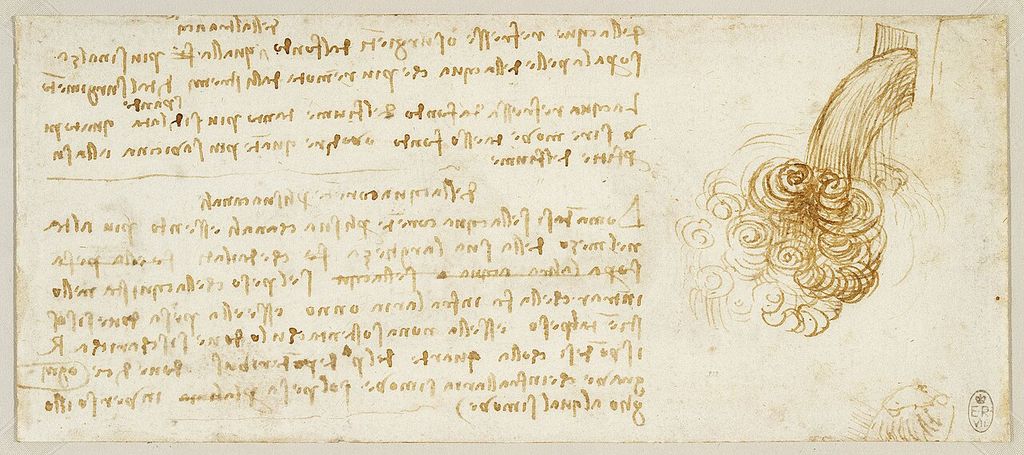
Courtly use could make the mechanism itself part of the performance. The V&A notes that Leonardo designed water clocks and fountains for elite settings, including an automated device for the French governor of Milan with a mechanical bell-ringer. [2] A pump supplying a garden might therefore be judged by regularity, concealment and theatrical effect as much as raw efficiency.
These applications should remain possibilities unless a sheet names its site or patron. Leonardo could transfer the same valve or gear from a domestic thought to a military one. Functional categories organise the corpus; they do not turn every sketch into a documented installation.
The Forster notebook laboratoryThe V&A's Codex Forster I contains two originally separate notebooks. Folios 1–40 form a book on solid transformations begun at Florence in 1505. From folio 41 onward is an earlier Milanese notebook, now called Forster I.2, compiled about 1487–90. Its dominant subjects are hydraulic engineering and the moving and raising of water. [2]
This binding history matters. A present codex is not necessarily a book Leonardo planned from first page to last. He worked on loose or folded paper units later assembled under other owners. The water studies belong to a concentrated early booklet, but their position after the 1505 geometry material is a consequence of binding rather than intellectual chronology.
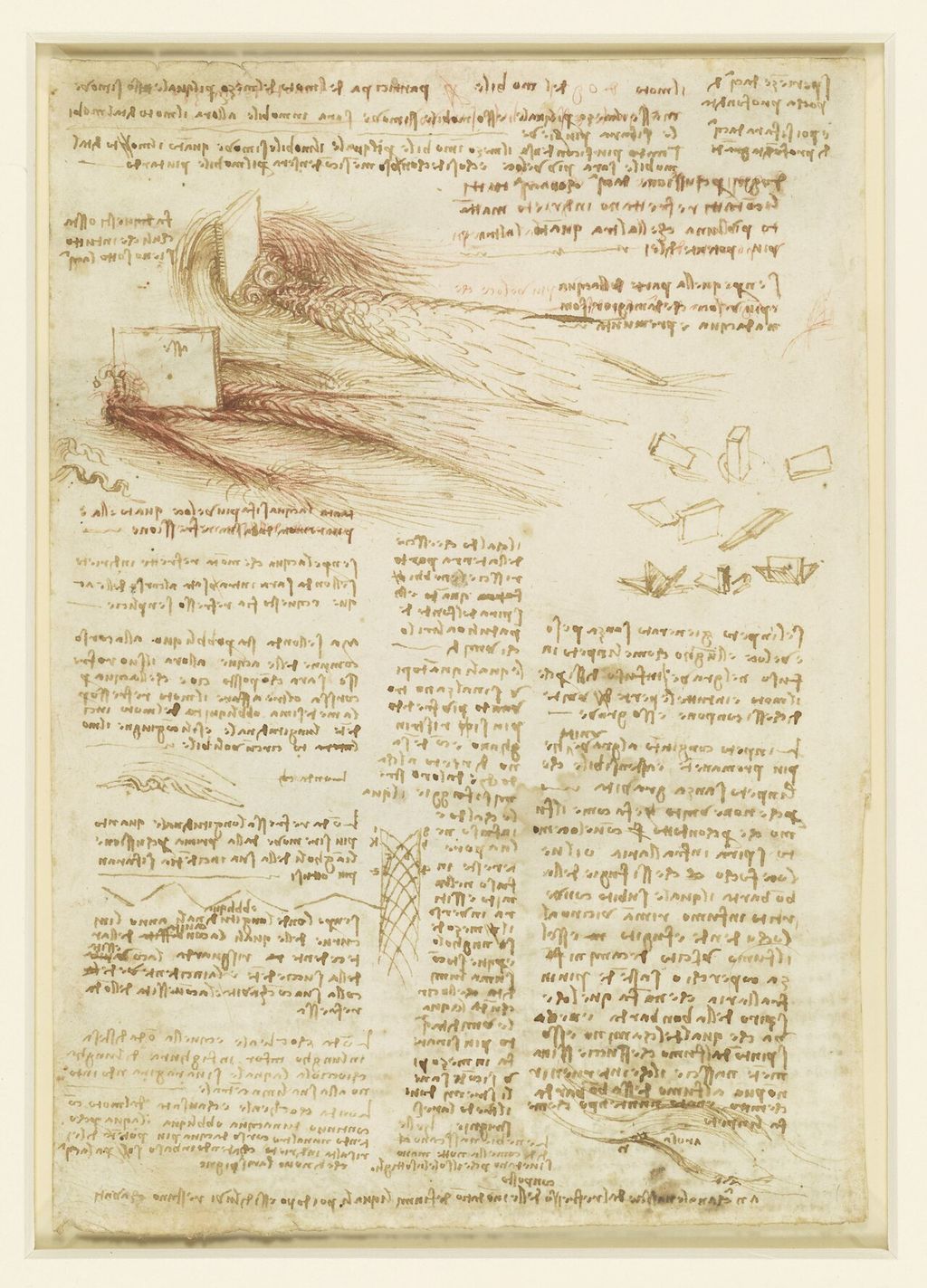
Across folios 41v, 43v, 45v, 46r, 52r and 54r, Leonardo modifies the Archimedean screw. Pipes or larger outer coils receive water raised by a central helix. He hopes the outward movement of that water will create an imbalance large enough to rotate the whole assembly. Folio 54r presents a repeatable “hydraulic lever” module, multiplied by adding coils on the same axis. [3]
These pages are technically fertile because they force Leonardo to think about moment arms, mass distribution and linked circuits. They are physically unsuccessful because the water's apparent advantage on the larger radius cannot repay all the work required to lift and redirect it. The outer water may exert greater torque at one stage, but the complete cycle includes the forces that placed it there.
The temptation of the self-feeding pump
Codex Atlanticus 26v, the other side of the legacy sheet, includes an unusually developed perpetual-motion pump. Cams on a wheel drive paired pistons that fill three boxes attached to the wheel. Leonardo records weights for pistons, compression chamber and water column, and studies a spring-and-weight door that empties each box at the intended point. [4]
The detail is instructive but cannot rescue the energy loop. The boxes are meant to turn the wheel whose cams operate the pumps that fill the boxes. Each stage loses energy. Once the initially raised or falling masses have completed their motion, the wheel slows and stops unless a person, stream or other external source continues to drive it.
Leonardo was not alone in pursuing this promise. Museo Galileo traces overbalanced-wheel ideas through seventh- and twelfth-century Indian mathematics, a thirteenth-century Arabic hydraulic manuscript, medieval Europe, and Renaissance workshops. [10] Taccola drew overbalanced wheels; Francesco di Giorgio coupled water motors to piston pumps or Archimedean screws in recirculation mills. [8]
This history changes the question from “Why did a genius make a mistake?” to “How did engineers test a persistent mechanical problem?” Perpetual motion offered princes power without fuel and mills without a reliable stream. It also posed a demanding theoretical question about balance: could changing the position of weights produce a permanent excess of turning force?
Leonardo's answer developed. He continued to invent arrangements, but he also mocked claimants who promised impossible mills. Codex Forster II, compiled in part around 1495–97, includes a remark rejecting perpetual motion. [2] The critical turn does not make every earlier drawing a disguised refutation. It shows an investigation moving through proposals, calculations, failures and increasingly explicit scepticism.
Codex Atlanticus 1062v and the value of a failed machine
A later hydromechanical wheel on Codex Atlanticus 1062v places opposed pistons in liquid-filled, S-shaped circuits. Two units lie at right angles on the drawn wheel; Leonardo considers increasing the number on one axle. A foliot escapement regulates speed, and a material note proposes wine so the leather bellows will not deteriorate in water. [11]
The level of detail reveals serious mechanical attention: phasing, working fluid, flexible material and regulation all matter. Yet the Museo Leonardiano record also points to a related version in Madrid Codex I folio 74r, where Leonardo calls the device moto soffistico—an ingenious but deceptive or specious motion, impossible in practice. [11]
Modern reconstruction makes the contradiction tangible. A museum model can reproduce the proposed piston shifts and show why an impulse seems plausible. It can also show that the internal transfers do not supply net energy over a cycle. “It moves when pushed” is not the same as “it powers itself”.
Failure therefore has evidential value. The design records Leonardo learning to analyse a machine as a closed system. Attention moves from attractive local effects—a weight falling here, water pressing there—to the balance of the entire return path. That intellectual shift is more important than claiming a modern pump as his invention.
Leonardo within a longer engineering historyThe hydraulic sheets belong to a culture of machines. Museo Galileo's research on Renaissance Siena emphasises Taccola and Francesco di Giorgio as participants in an original fifteenth-century technical tradition before Leonardo. [17] Leonardo later owned and annotated a copy of Francesco's treatise, whose machine drawings include hydraulic apparatus and lifting systems.
The longer history crosses languages and institutions. Al-Jazari's Arabic treatise joined practical lifting devices, water clocks and automata centuries before Leonardo. [9] Indian and Arabic sources contributed to the history of overbalanced wheels transmitted westward. [10] Ancient screws, medieval craft knowledge, Brunelleschian building practice and Sienese manuscript drawings all supplied problems and forms that a Renaissance engineer could inherit.
Leonardo's distinction lies less in solitary invention than in the density of his visual analysis. He opens casings, repeats components, changes viewpoints and makes transmission itself a subject. One page can pass from a landscape installation to a valve detail. His draughtsmanship gives speculative machinery a persuasive material presence, which is also why later viewers can overestimate how completely it was engineered.
Digital archives now reunite sources dispersed among Milan, London, Madrid, Paris and Windsor. The Biblioteca Leonardiana's e-Leo project uses historic facsimiles while identifying the institutions that hold the originals. [13] That access is invaluable, but foliation, reconstruction and catalogue history still matter. A searchable image does not erase changes of binding or prove which lines form one system.
How to read the devices now
Start by locating the water. Where does it enter, and at what level does it leave? Then locate the power. A handle, animal or external stream can do work; a counterweight provides only a finite store until reset. Follow the transmission from input through gears, crank, cam or lever to the component that touches the water.
Next identify the operating cycle. Which valve opens on the intake stroke? Where does a bucket tip? How does an emptied container return? Does a screw remain sufficiently immersed? A drawing that explains one phase may leave the return phase unresolved.
Finally test the boundary between a proposal and an object. An original folio proves that Leonardo drew and considered a mechanism. A note, calculation or repeated variant can show depth of engagement. A later working model proves that a modern maker found one construction consistent with selected marks. None of these facts alone proves a full-size Renaissance machine was commissioned, built or used.
Codex Atlanticus 26r is compelling precisely because it does not offer a single triumph. It preserves a young engineer moving between inherited machines, observed needs and imagined combinations. Across the later notebooks, practical pumps and impossible loops remain close neighbours. Together they show technical thought at its most useful: not a parade of inventions, but a sustained effort to discover where motion comes from, how it can be transmitted, and why some elegant circles cannot close.
Continue exploring Leonardo
Explore Leonardo’s works and designs
| Name | Date | Medium |
|---|---|---|
| A Map of Imola | 1502 | Drawing |
| Adoration of the Magi | About 1482 | Painting |
| Annunciation | About 1472 | Painting |
| Bacchus | Around 1517–1520 | Painting |
| Benois Madonna | Around 1478–1480 | Painting |
| Crossbow | 1485-1490 | Drawing |
| Diving Suit | — | Drawing |
| Flying Machine | — | Drawing |
| Ginevra de’ Benci | c. 1474/1478 | Painting |
| Head of a Woman (Turin) | Source-led range: 1478-1485, c. 1483-1485 or 1480s | Drawing |
| Helicopter | — | Drawing |
| Horse and Rider | — | Sculpture |
| La Bella Principessa | — | Painting |
| La Belle Ferronnière | c.1490–1497 | Painting |
| La Scapigliata | 1492–1501 ca | Painting |
| Lady with an Ermine | c. 1490 | Painting |
| Landscape Drawing for Santa Maria della Neve | Fifteenth century; inscription dated 5 August 1473 | Drawing |
| Leda and the Swan | — | Painting |
| Leonardo's Catapult Designs | late fifteenth century | Drawing |
| Leonardo's Designs for Milan Cathedral | 1487–90 | Architecture |
| Leonardo's River-Lock Drawing | late fifteenth century | Drawing |
| Leonardo's Romorantin Palace Project | 1517–18 | Architecture |
| Leonardo's Self-Propelled Cart | late 1470s–1480s | Drawing |
| Machine Gun | — | Drawing |
| Madonna Litta | Mid-1490s | Painting |
| Madonna of the Carnation | Around 1475 | Painting |
| Madonna of the Yarnwinder | — | Painting |
| Mary Magdalene | — | Painting |
| Mona Lisa | 1503 / 1519 | Painting |
| Ornithopter | — | Drawing |
| Parachute | — | Drawing |
| Portrait of a Lady: The Historic Leonardo Attribution | late fifteenth century | Painting |
| Portrait of a Man in Red Chalk (Self Portrait) | 1517/1518 or c. 1517-1518 | Drawing |
| Portrait of a Musician | About 1485 / first Milan period | Painting |
| Portrait of Isabella d’Este | Around 1499/1500 | Drawing |
| Profile of an Ancient Captain | c. 1475–1480 | Drawing |
| Rearing Horse and Mounted Warrior | First half of the 16th century | Sculpture |
| Saint Jerome in the Wilderness | About 1480–1482 / 1481–1482 | Painting |
| Saint John the Baptist | Around 1508–1519 | Painting |
| Salvator Mundi | — | Painting |
| Study of Hands | c.1480 | Drawing |
| The Baptism of Christ | About 1470–75 | Painting |
| The Battle of Anghiari | — | Painting |
| The Burlington House Cartoon | About 1506–8 | Painting |
| The Fetus in the Womb | c. 1511 | Drawing |
| The Last Supper | 1495–1498 in the Museo del Cenacolo Vinciano object table | Painting |
| The Sforza Horse Monument | 1480s–1499 | Sculpture |
| The Trivulzio Monument | c. 1506–13 | Sculpture |
| The Virgin and Child with Saint Anne | Around 1503–1519 | Painting |
| Triple Barrel Cannon | — | Drawing |
| Virgin of the Rocks | — | Painting |
| Vitruvian Man | Generally associated with Leonardo’s Milanese years, around 1490; exact dating remains cautious | Drawing |
| Wreath of Laurel, Palm, and Juniper with a Scroll | c. 1474/1478 | Drawing |
Frequently Asked Questions
Discussion
Which part of the evidence changes the way you read Leonardo's Water-Lifting Devices? The article sets surviving material beside later interpretation; share the distinction that matters most to you.
Reader Insights
What detail in the images or drawings is easiest to miss on a first viewing?
How does the legacy image: codex atlanticus 26r alter your understanding of this subject?
Where does the article leave a question open rather than presenting a settled answer?
Join the Conversation
Share your reading of Leonardo's Water-Lifting Devices below.
References
- Museo Galileo, Leonardo//thek@, “Codice Atlantico Foglio 26 r”. View Source
- Victoria and Albert Museum, “Leonardo da Vinci's notebooks”. View Source
- Museo Galileo, “Studies of perpetual engines based on the Archimedean screw”. View Source
- Museo Galileo, “Perpetual motion pump,” Codex Atlanticus f. 26v. View Source
- Museo Galileo, Leonardo//thek@, “Codice Atlantico Foglio 1069 r”. View Source
- Museo Galileo, Leonardo//thek@, “Codice Atlantico Foglio 20 r”. View Source
- Museo Galileo, Leonardo//thek@, “Codex Atlanticus Sheet 5 r”. View Source
- Museo Galileo, “The Sienese engineers”. View Source
- Metropolitan Museum of Art, “Design on Each Side for Waterwheel Worked by Donkey Power,” folio from al-Jazari's Book of the Knowledge of Ingenious Mechanical Devices. View Source
- Museo Galileo, “Indian and Arab origins”. View Source
- Museo Leonardiano di Vinci, “Hydromechanical perpetual wheel,” after Codex Atlanticus f. 1062v. View Source
- Museo Galileo, Leonardo//thek@, “Codice Atlantico Foglio 375 r”. View Source
- Biblioteca Leonardiana, e-Leo, “Project Description”. View Source
- Biblioteca Ambrosiana and Museo Nazionale della Scienza e della Tecnologia Leonardo da Vinci, “Codice Atlantico — Macchine Civili”. View Source
- Museo Leonardiano, “Museo Leonardiano” collection history, Tuscany heritage network. View Source
- Visvesvaraya Industrial and Technological Museum, “Archimedes Screw,” Science Park. View Source
- Museo Galileo, “Before Leonardo: Culture of Machines in Renaissance Siena”. View Source
- Food and Agriculture Organization of the United Nations, “Principes généraux d'élévation de l'eau,” in Techniques d'élévation de l'eau pour l'irrigation. View Source