 by Tom Gurney
Tom Gurney BSc (Hons) is an art history expert with over 20 years experience
Page Created on September 22, 2026 / Page Updated on September 22, 2026
Email: tomgurney1@gmail.com / Phone: +44 7429 011000
Leonardo and Mathematics
Leonardo da Vinci did not encounter mathematics as a single finished discipline. It entered his work through several doors: the arithmetic of a commercial city, the measured procedures of a painter's workshop, the geometry of perspective, the ratios of mechanisms and buildings, and eventually the learned texts he pursued with increasing determination. Across his notebooks, mathematics is therefore less a collection of settled answers than a way of making relations visible. A line measures a distance, but it can also trace a force. A square may establish an area, organise a plan or become one stage in a transformation. A diagram can test whether parts fit together before wood, stone or metal is cut.
That development matters because two familiar descriptions distort it in opposite directions. Leonardo was neither an untaught genius who created mathematics from intuition nor a modern mathematician born centuries early. He began with practical, vernacular knowledge and enlarged it through books, conversation, drawing and repeated trials. His collaboration with the mathematician Luca Pacioli gave this effort new range. Yet Leonardo's strongest mathematical thinking remained visual and operational. He often understood a spatial relation by drawing it more powerfully than he could prove it in the formal language of his learned contemporaries. [1] [2]
At a Glance
- SubjectLeonardo and Mathematics
- Artist and contextLeonardo da Vinci (1452–1519) and his Renaissance world
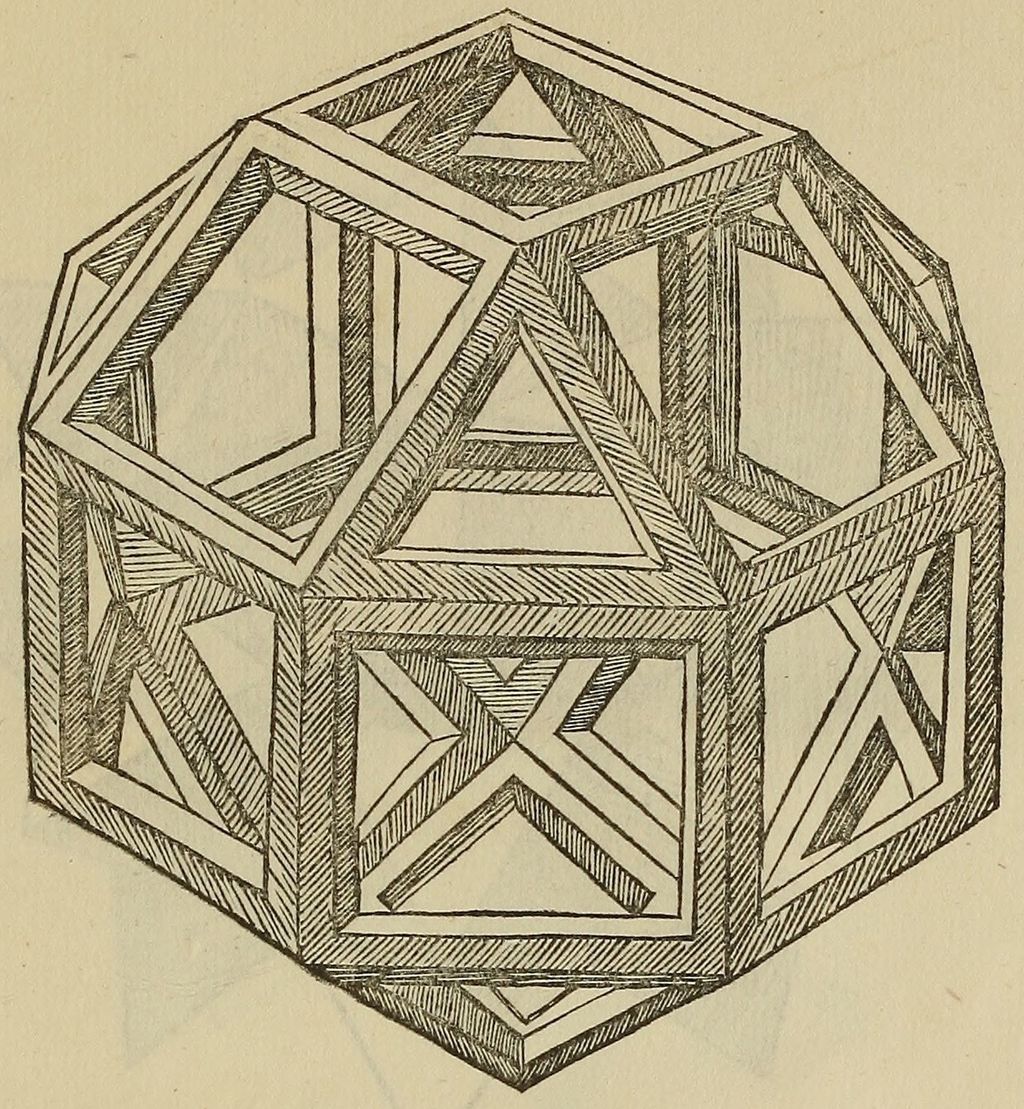
- ImageLeonardo's skeletal rhombicuboctahedron for De divina proportione.
Contents
- Learning numbers in a commercial city
- Geometry before Pacioli
- Luca Pacioli in Milan
- Drawing solids so that they can be understood
- What the “divine proportion” meant
- Number, measure and the working diagram
- A late “mania” for transformation
- Proof, error and visual intelligence
Learning numbers in a commercial city
Leonardo was born in 1452 outside the legitimate line of a notarial family. This excluded him from the conventional university route that depended on sustained Latin schooling, but it did not place him outside education. Florence had a dense culture of vernacular instruction. Its abacus schools taught the arithmetic needed by merchants and artisans: operations with whole numbers and fractions, currencies and exchange, weights and measures, partnership, interest, and practical problems in geometry. Museo Galileo connects the young Leonardo with this environment and with the kind of abacus education appropriate to a merchant's grandson. [1]
The distinction between this training and university learning is essential. Abacus mathematics was not elementary in the modern sense of being trivial. Florentine trade required calculations across incompatible coins and measures; building, land division and manufacture required reliable mensuration. Problems were commonly stated through concrete situations and solved by worked examples. Such habits suited Leonardo. His later pages repeatedly move from a particular case to variants, testing a procedure by changing dimensions, loads or forms.
His apprenticeship in Andrea del Verrocchio's workshop added another mathematical culture. A painter had to enlarge a design, establish convincing recession, transfer outlines, calculate materials and organise figures within a surface. A sculptor or metalworker dealt with scale, volume, moulds, weight and balance. These procedures were rarely separated from making. Geometry existed in the straightedge, compass, plumb line, grid and proportional transfer, as well as in books.
Leonardo later called himself an omo sanza lettere, a “man without letters”. The phrase is often mistranslated into an image of near illiteracy. In Renaissance usage, the “letters” he lacked were above all the classical languages and the education that gave scholars direct access to Latin authorities. Museo Galileo's study of his library shows a far more interesting situation. Leonardo assembled books, extracted passages, sought help with technical vocabulary and tested written claims against observation. By the period of the Codex Leicester, he had access to a considerable range of ancient, medieval and contemporary thought. What he never acquired completely was the ease in Latin and the formal institutional training of a university natural philosopher. [2]
This position created both difficulty and freedom. Leonardo could not simply enter every scholarly argument on its established terms. He had to translate, paraphrase and reconstruct. At the same time, he was accustomed to asking what a proposition would look like, how it might be built and whether it agreed with experience. His mathematical education was cumulative rather than miraculous: practical arithmetic first, then increasingly ambitious encounters with geometry, proportion and proof.
Geometry before Pacioli
By the time Leonardo moved to Milan in the early 1480s, geometry already served several parts of his work. Linear perspective treated the painted surface as the intersection of a visual pyramid. Proportional enlargement related a small drawing to a wall, panel or sculptural model. Engineering demanded the comparison of wheels, levers, cords and loads. Surveying converted distances and directions into plans. Architecture required the coordination of plan, elevation and section.
The notebooks show Leonardo using different kinds of projection according to the question. A plan can establish disposition without the obstruction of walls; a section can expose what a surface conceals; an axonometric view can keep parallel relations legible while suggesting three-dimensional form. Cutaways and transparent views let the observer follow motion through a machine. The Museo Nazionale Scienza e Tecnologia emphasises that drawing was both a means of study and a means of communication for Leonardo. Mathematical representation did not merely record an idea reached elsewhere. It helped generate the idea by forcing parts into a coherent spatial relation. [3]
Milan intensified this work. The court of Ludovico Sforza brought artists, engineers, physicians and learned advisers into contact. Leonardo worked on architecture, festivities, hydraulic schemes and the enormous equestrian monument to Francesco Sforza. Each project raised questions of scale and transformation. A small model had to become a colossal object; a force applied at one point had effects elsewhere; a centralised building had to maintain order through repeated geometrical units.
Yet Leonardo's early geometrical practice did not make him fully at home in formal mathematics. A construction that appeared convincing in a diagram might still lack a proof. Similarity, ratio and area could be grasped operationally while their Euclidean foundations remained incomplete. His later hunger for mathematical books reflects an awareness of this gap. In 1495 he recorded buying Pacioli's large printed Summa de arithmetica, geometria, proportioni et proportionalità for 119 soldi. Published in Venice the previous year, the Summa gathered arithmetic, algebra, commercial practice and geometry within the Italian abacus tradition. The purchase gives a firm date for Leonardo's deliberate engagement with a major mathematical compendium before his documented collaboration with its author. [4]
The Summa also helps prevent a false division between “practical” and “theoretical” Leonardo. Its long account of arithmetic and commercial calculation stood beside geometry and proportion. In the culture from which both Pacioli and Leonardo emerged, a rule could travel between a merchant's calculation, a survey and a geometrical proposition. Leonardo's notebooks similarly mix columns of figures, word problems, sketches and constructions. He did not leave practical mathematics behind when he sought Euclid. He tried to find firmer grounds for operations he already used and to extend them into problems that could not be settled by workshop experience alone.
Proportion was especially suited to that movement. It did not mean a single pleasing shape or privileged number. It described a relation between quantities: one length compared with another, a small model with a large object, the teeth of one wheel with those of the next. In art, proportion could order bodies and buildings; in mechanics, it could express the gain in distance or force obtained through an arrangement. Learning a more formal language of ratios allowed Leonardo to recognise shared structures across otherwise separate crafts.
Luca Pacioli in Milan
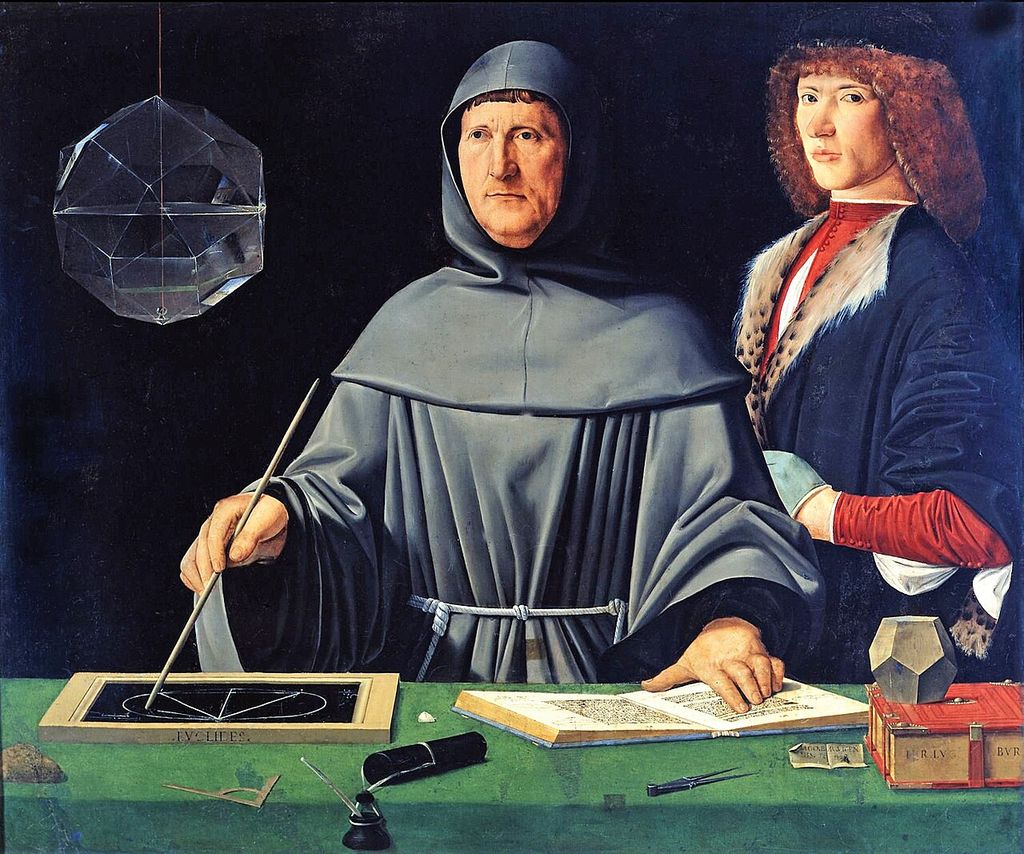
Luca Pacioli arrived in Milan in 1496 and lectured at the Scuole Palatine under Sforza patronage. A Franciscan friar trained in the abacus tradition, he could move between commercial calculation, Euclidean geometry and courtly discussion. Leonardo brought different resources: exceptional spatial imagination, command of perspective and an ability to make complex structures intelligible through images. Their association was an exchange between two mature practitioners, not a simple lesson in which a scholar handed mathematical truth to an ignorant artist. [5]
Evidence of Leonardo's study survives in his notebooks. He copied definitions and proportional schemes and reminded himself to learn mathematical operations from “maestro Luca”. Pacioli, in turn, credited Leonardo with the figures for his treatise De divina proportione. The collaboration coincided with a marked expansion of Leonardo's mathematical vocabulary and ambition. He became more concerned with the status of demonstrations, the classification of bodies and the possibility that geometry could give certainty to investigations of nature and art. [4] [6]
Pacioli completed De divina proportione in Milan in 1498. The work survives in two manuscript copies made during his lifetime. The presentation manuscript now at the Bibliothèque de Genève, Ms. l.e. 210, was prepared for Ludovico Sforza. Its text is followed by sixty depictions of polyhedra, shown in solid and open forms and associated with Leonardo's designs. The volume's parchment leaves, formal script and dedicatory purpose locate the geometrical collaboration within the political culture of the Milanese court as well as the history of mathematics. [7]
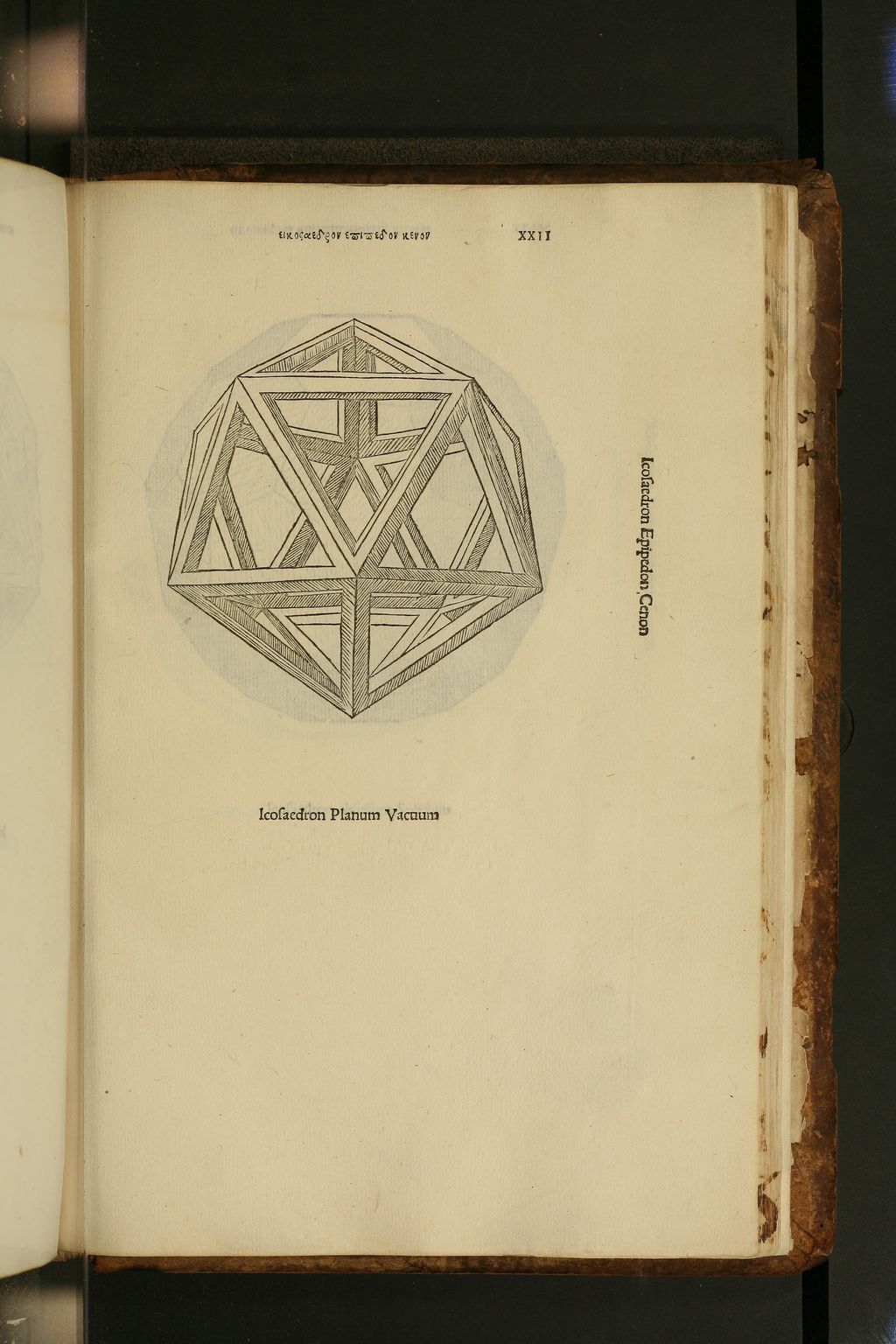
The partnership did not end neatly with a completed book. When French forces displaced Ludovico in 1499, Pacioli and Leonardo left Milan. They travelled in overlapping circles, and their intellectual connection continued. Divina proportione appeared in print at Venice in 1509, issued by Paganinus de Paganinis. The Metropolitan Museum of Art catalogues the printed illustrations as “after Leonardo da Vinci”. That wording protects an important distinction: Leonardo supplied designs for the geometrical figures, but the surviving printed woodcuts are products of translation into another medium, not sheets drawn and cut by his own hand. [8]
The same Venetian publisher issued Pacioli's revised Latin edition of Euclid's Elements in 1509. Its preface acknowledges Leonardo's contribution to interpreting the text, evidence that their mathematical exchange continued beyond the Milanese preparation of the polyhedra and into their later Florentine contact. [13] Pacioli helped Leonardo approach Euclid through vernacular explanation; Leonardo's questions and spatial demonstrations could in turn test what the propositions meant. Collaboration here was more sustained than a single commission for illustrations.
The date of print publication can otherwise create a false chronology. Leonardo's designs belong to the manuscript project completed in 1498, while the woodcuts and Euclid edition appeared eleven years later. Between those moments the collaborators moved through political displacement and different cities. The books preserve the outcome of an exchange whose working sessions, drawings and explanations are only partly recoverable.
Drawing solids so that they can be understood
The polyhedra are the clearest result of the collaboration because their intellectual content depends upon their mode of depiction. A conventional view of a solid shows the faces presented to the observer while hiding those at the rear. That may be enough to recognise a cube, but it becomes obstructive when a body has many faces and intersecting relations. Leonardo's open, or vacuo, versions turn the edges into a framework. Through the gaps, rear edges remain visible. The viewer can inspect the whole organisation rather than infer an invisible half.
The paired solid and open forms answer different questions. A filled body clarifies the continuous planes and overall mass. Its skeletal counterpart reveals connections, symmetries and the paths by which one face meets another. Some figures are “elevated”: pyramidal additions project from their faces, multiplying the spatial problem. Perspective makes these bodies appear extended in depth, but the image must also preserve enough regularity for the geometrical object to remain legible. [3] [7]
Leonardo did not invent the regular or semi-regular solids. Their study belonged to a long tradition running through Euclid and other ancient authors, and Pacioli drew heavily on earlier mathematics, including the work of Piero della Francesca. Leonardo's achievement lay in representation. He transformed verbal and geometrical descriptions into images through which a reader could apprehend structure. The open polyhedra function almost like visual arguments: they disclose information that an opaque object would conceal.
Piero's role deserves precision. The printed Divina proportione is not one continuous book about a single ratio. It joins Pacioli's account of divine proportion to an architectural treatise and an Italian version of Piero's Libellus de quinque corporibus regularibus, a study of the five regular bodies and forms derived from them. [14] Vasari later accused Pacioli of appropriating Piero's work, and the extent and ethics of that reuse remain a scholarly dispute. For Leonardo's mathematics, the safer conclusion is structural: the celebrated images stand within a layered textual inheritance, not a self-contained dialogue between only two men. Piero's stereometric work, Euclid's definitions, Pacioli's compilation and Leonardo's visualisation meet in the surviving volume.
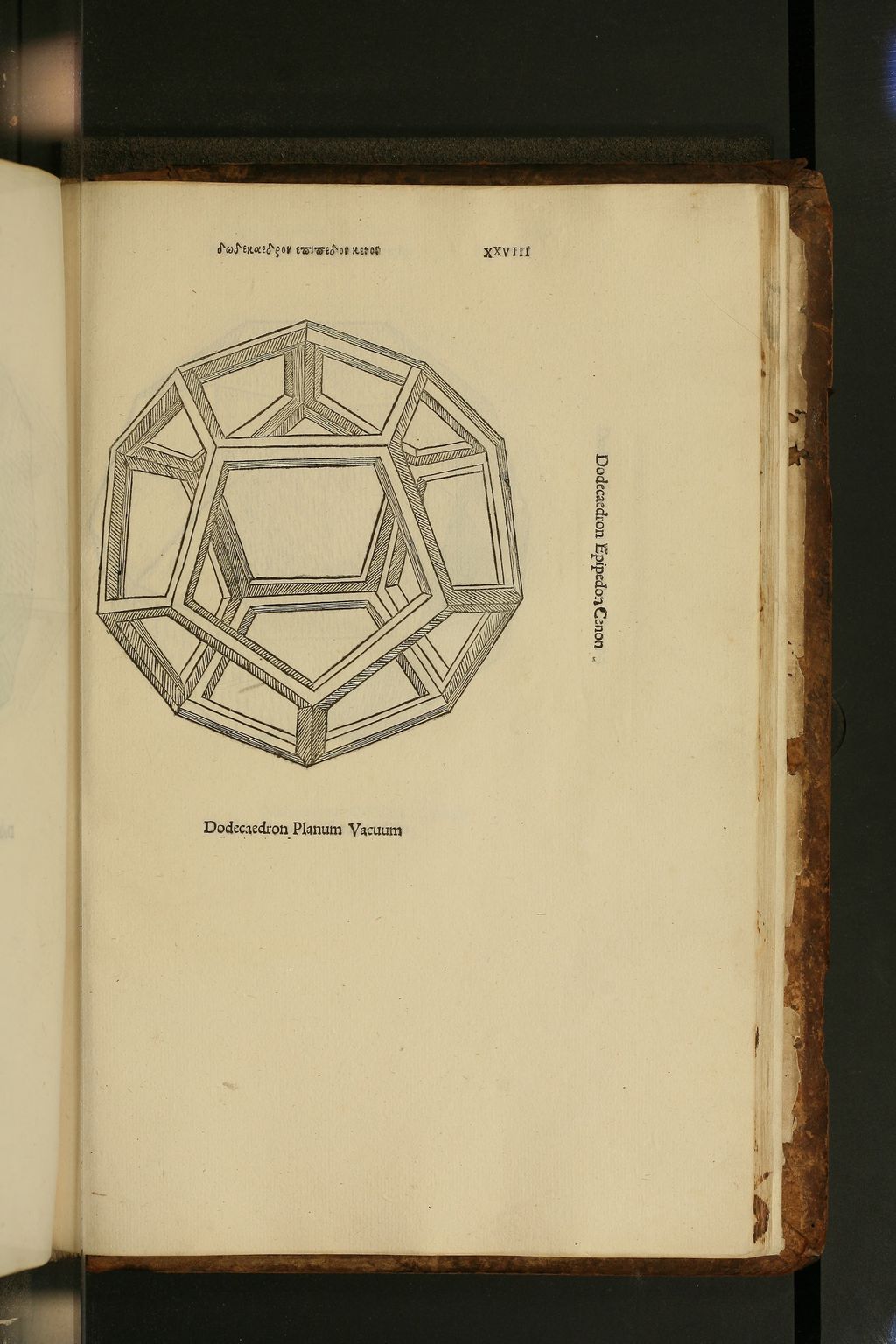
This is one reason the illustrations belong at the centre of Leonardo's mathematics rather than at the margin as decoration. Their beauty comes from exactness, selection and intelligibility. A successful image must decide which lines are visible, how edges cross, how depth is signalled and how the object occupies the page. The mathematical body and its graphic explanation become inseparable.
The drawings also demonstrate a broader principle in Leonardo's work. He regularly removes an outer surface to expose causes: skin opens to reveal anatomy, earth is cut in section to reveal watercourses, walls disappear to reveal rooms, and machine housings become transparent so that gears can be followed. The polyhedral frameworks are a particularly rigorous instance of this investigative vision. To know a form is to see how its parts are related, including the parts normally hidden.
Their production also required translation between kinds of knowledge. A geometrical definition specifies relations that must hold regardless of viewpoint; a perspective image shows one appearance from one position. Leonardo had to preserve the first while constructing the second. Too much optical realism could obscure regularity, while a flat diagram could fail to convey the body. The resulting images negotiate between proof, model and picture. They do not replace Pacioli's text, but they let the reader perform a kind of mental rotation and comparison that prose alone makes laborious.
The Geneva manuscript reinforces this pairing through its sequence. Sixty filled or empty bodies follow the written treatise, creating an image collection that can be consulted across individual propositions. The drawings form a visual vocabulary of solid geometry. Their influence rests partly on this serial character: they show not an isolated virtuoso object but a repeatable method applied to bodies of increasing complexity. [7]
What the “divine proportion” meant
The title Divina proportione has encouraged centuries of loose association. Pacioli's “divine proportion” was the division of a line in mean and extreme ratio, later widely called the golden ratio: the whole is to the larger part as the larger part is to the smaller. Expressed in modern notation, the ratio is approximately 1.618 to 1. Pacioli treated it as mathematically remarkable and invested it with theological analogies. The treatise also ranged across regular bodies, proportional relations and applications to art and architecture. [5] [7]
This documented interest does not establish that Leonardo organised every important picture around the same number. There is a large difference between illustrating a treatise that discusses a ratio and using that ratio as a concealed universal template. A convincing claim about a painting would require evidence that the relevant points were chosen in advance, that the measurements are stable and that another simpler proportional system does not fit equally well. Arbitrary rectangles can often be selected within a reproduction after the event, especially when cropping and image dimensions vary.
Modern mathematical historians have shown how frequently golden-ratio stories rest on retrospective measurement rather than documents or demonstrable constructions. Leonardo and Pacioli certainly knew the mean-and-extreme ratio. That fact makes specific, evidenced uses possible; it does not make every attractive proportion “golden”. Nor did Pacioli invent the relation. It had a much older geometrical history. The phrase “divine proportion” belongs to his philosophical and religious presentation of it. [9]
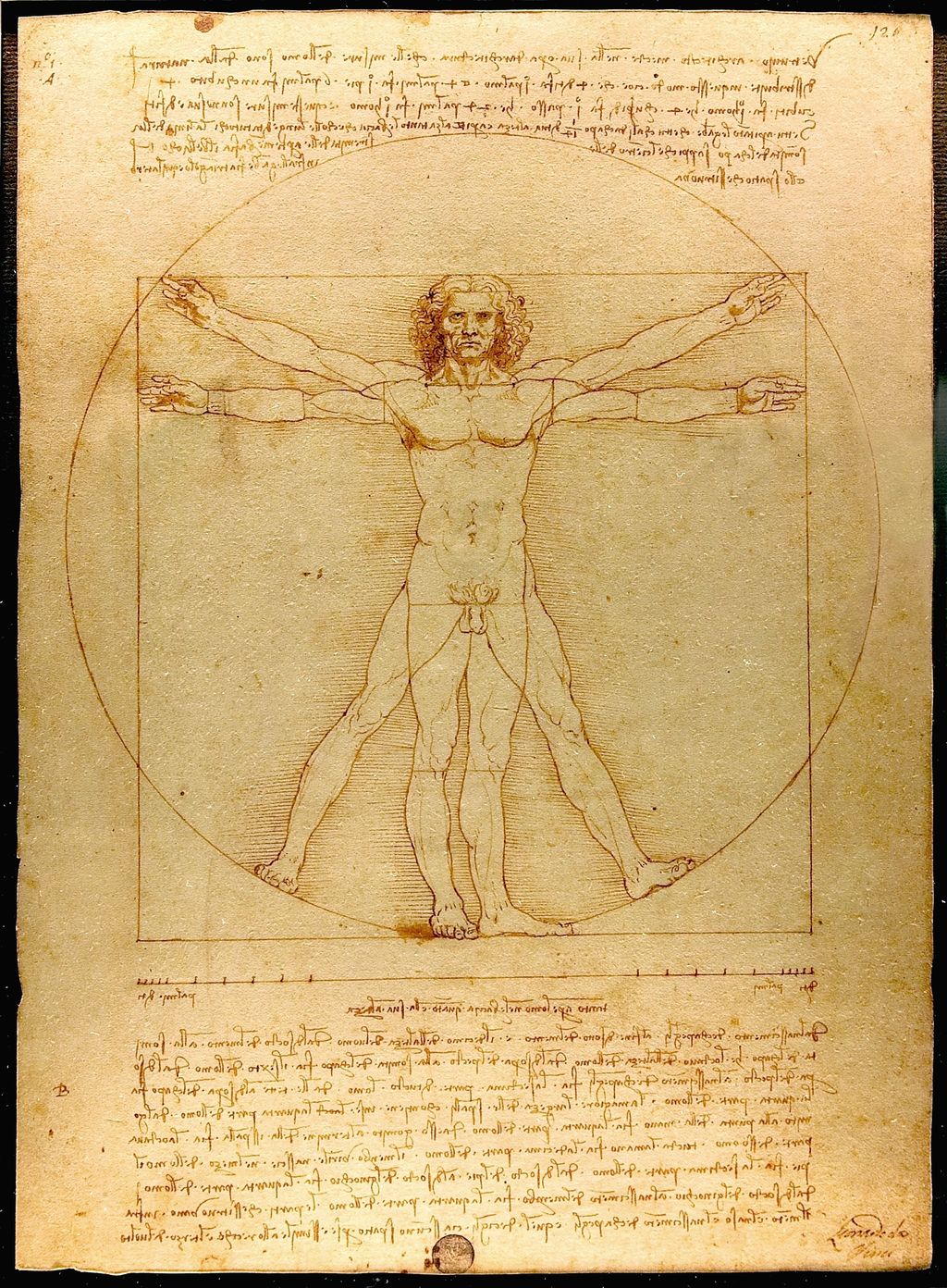
The same caution applies to claims about Leonardo's body studies. The Vitruvian Man is a study of commensuration: a human figure occupies superimposed positions within a circle and a square, while notes compare bodily parts to the whole. The Gallerie dell'Accademia stresses that its proportions are not merely a mechanical transcription of Vitruvius and that Leonardo's inquiry also belongs with Renaissance work such as Leon Battista Alberti's De statua. The drawing joins textual interpretation, observation and geometrical construction. [10]
But it is not a labelled golden-ratio diagram. Published measurements that seek phi among selected distances do not outweigh the ratios Leonardo actually wrote or the Vitruvian and Albertian problem he was addressing. Its intellectual force lies elsewhere: it tests whether ideal geometrical figures and the variable, articulated human body can be brought into a coherent system. The two centres of the circle and square do not simply coincide, and the changing position of the limbs is essential. Leonardo makes proportion dynamic.
Number, measure and the working diagram
Leonardo's mature notebooks do not isolate mathematics from practice. They use geometrical relations to analyse machines, buildings, landscapes and bodies. The same habits recur: divide a complex action into stages, represent unseen relations, compare variants and measure the consequences of change.
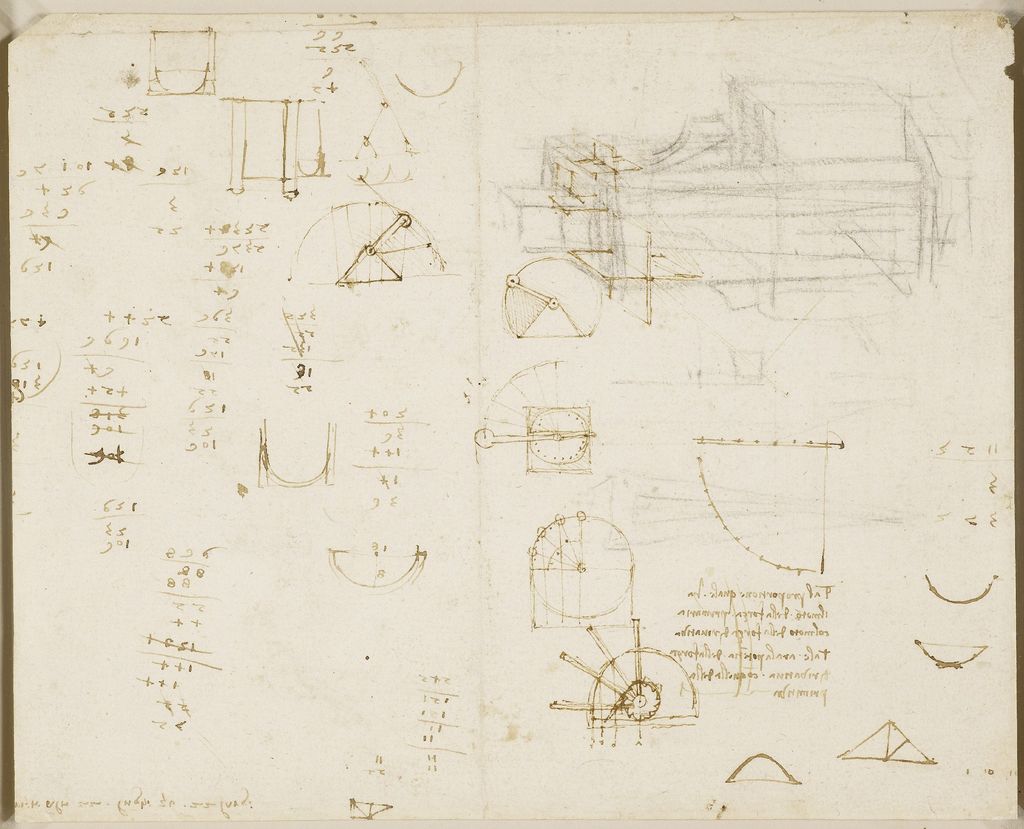
In mechanics, a wheel, axle, pulley or lever converts one motion or force into another. Geometry fixes the distances between pivots, the diameter of wheels and the direction of pull. Ratio relates the movement of a driver to that of a driven part. Leonardo sometimes struggled to distinguish ideal mechanical relations from losses caused by friction, deformation and imperfect materials, but his diagrams seek to make a causal chain inspectable. Arrows, repeated positions and transparent assemblies turn motion into a sequence that can be reasoned about. [3]
Questions of balance led naturally to centres of gravity. If a load shifts, or if the point of support moves, the stability of an object changes. Such concerns connected theoretical geometry with cranes, weapons, bridges, human movement and the proposed casting of a monumental horse. Leonardo's pages often place several cases together, making difference visible. The page is a testing ground on which a variable can be altered without constructing a full-scale machine.
Architecture required related operations. Plans organise spaces through axes, rotations and repeated modules. Elevations control vertical proportion; sections expose thickness, support and circulation. In studies for centralised churches, Leonardo combined squares, circles, octagons and subsidiary chapels into increasingly complex configurations. These designs will receive fuller treatment in their own context, but mathematically they show geometry serving invention. A base figure is not merely copied. It is subdivided, rotated, expanded and combined, producing a family of possible plans.
Surveying and cartography turned traversed ground into measured information. Direction, distance and scale had to be translated onto a surface. Leonardo's celebrated map of Imola will be considered separately, yet its achievement depends on this mathematical discipline: the town is organised through a coherent overhead view rather than a traveller's sequence of landmarks. Hydraulic projects similarly demanded gradients, levels, sections and estimates of flow. The mathematical drawing made distant parts of a system simultaneously available to thought.
Perspective supplied another bridge between art and measurement. Leonardo inherited a powerful fifteenth-century theory, rather than inventing it. He extended its practical use through intense attention to visual effects: apparent size, diminution, the loss of clarity and colour with distance, reflection and the geometry of light. Not all these phenomena can be reduced to linear perspective. His achievement was to see that pictorial truth required several interacting kinds of relation. Geometry provided an ordered basis; observation tested where a simple scheme was insufficient.
This approach explains why numbers in the notebooks can be both indispensable and unstable. Leonardo calculated, tabulated and annotated, but he also revised. Units may change; a copied result may contain an error; a geometrical intuition may outrun its demonstration. The notebooks record work in motion rather than a polished textbook. Their value lies partly in this exposure of thought: calculation, drawing and verbal explanation correct and provoke one another.
A late “mania” for transformation
In the last years of his life, Leonardo devoted extraordinary energy to a narrow family of geometrical problems: transforming one plane figure into another of equal area. Rectilinear forms were converted into curvilinear ones and back again. Circles, semicircles, rectangles, triangles and crescent-shaped lunules were divided and recombined in long series. The campaign drew on ancient problems of quadrature, including the lunules associated with Hippocrates of Chios, but Leonardo pursued it through his own prolific visual permutations. [11]
Quadrature was one member of a wider family of classical construction problems. Around 1505 Leonardo also tried to duplicate the cube—construct a cube with twice the volume of a given cube—and experimented with geometrical constructions for square roots. A Louvre research presentation identifies Codex Atlanticus 428r as a sheet on which he attempted to carry the Pythagorean theorem from areas into volumes. [15] The move is revealing even where it fails: a valid relation between squares cannot simply be raised into a three-dimensional analogue without establishing a new proof. Leonardo repeatedly tested whether an operation that worked visibly in one domain could survive transformation into another.
Codex Atlanticus f. 455r, dated about 1514–15, is the most spectacular surviving sheet. Its present foliation needs care: the Leonardo//thek@ catalogue URL contains the identifier ATL.0909.1, which has sometimes been mistaken for folio 909. The record itself identifies the sheet as 455r, formerly Hoepli 167r-a/b and bearing older numbers 149–150. Across the page Leonardo arranged about 177 constructions—specialist counts differ by one according to how the groups are divided—most built from circles and semicircles. [11] [12]
Hatching identifies portions to be removed, retained or relocated. A curve becomes a component of a new figure; repeated subdivisions establish equal areas; small changes generate another case. The crowded page is systematic without being a conventional proof. Its visual rhythm has prompted the description mania geometrica: a geometrical obsession in which analytical labour and aesthetic order become difficult to separate. [12]
The aim was not simply to produce decorative patterns. Leonardo wanted general procedures for converting curved and straight-edged areas while preserving quantity. He imagined a work called De ludo geometrico, a “geometrical game” or recreation, and associated Codex Atlanticus f. 272v with innumerable varieties of quadratures of curved surfaces. The title acknowledges pleasure and play, but the repeated diagrams also seek mastery: if enough transformations could be classified, perhaps a difficult continuous form could be reduced to known rectilinear areas. [11]
This brought Leonardo close to the ancient problem of squaring the circle—constructing, by stipulated geometrical means, a square exactly equal in area to a given circle. He did not solve it. The impossibility of the classical compass-and-straightedge construction was proved only in the nineteenth century, after the transcendence of pi was established. Leonardo could not know that proof, but his individual constructions still had to meet the standards available in his time. Visual equivalence or an approximate procedure was not an exact demonstration.
His persistence nevertheless reveals a mature mathematical identity. The late sheets are not incidental calculations for a painting or machine. They are sustained investigations of geometrical quantity pursued for their own sake and for the intellectual promise of transformation. Leonardo treats geometry as motion: figures unfold, migrate and reassemble while area remains constant. This way of thinking is continuous with his engineering and anatomical diagrams, even when the immediate subject is abstract.
Proof, error and visual intelligence
Leonardo repeatedly associated certainty with mathematics. For an investigator dissatisfied with inherited authority, geometrical demonstration offered an ideal: a conclusion compelled by relations that could be shown. Yet his own route to that ideal was uneven. He lacked early access to much Latin scholarship, learned advanced subjects relatively late and did not consistently distinguish a persuasive diagram from a complete proof. His manuscripts contain false starts and errors beside striking insights. [2] [6]
Calling these limits does not diminish the work. It locates Leonardo within the mathematical worlds he actually inhabited. He was a workshop-trained artist and engineer who entered learned geometry through vernacular books, collaboration and self-directed study. Pacioli gave him access to a more formal language of proportion and Euclidean bodies. Leonardo gave geometrical ideas an exceptional visible form. Each contributed something the other could not supply in the same way.
Nor should “visual” be taken to mean vague or merely intuitive. Leonardo's best diagrams select viewpoints, remove obstructions and coordinate multiple states with great precision. The open polyhedra disclose hidden edges. Mechanical drawings show transmission through an assembly. Plans and sections hold spatial relations steady for comparison. Transformation sheets preserve area while form changes. Drawing becomes an instrument for isolating a problem and sharing it with another mind.
His mathematics is therefore best understood as a practice of relational seeing. Proportion connects part and whole; perspective connects object, distance and observer; mechanics connects force, motion and time; cartography connects terrain and scale; quadrature connects unlike shapes through equal area. The subjects vary, but the intellectual action is similar. Leonardo searches for an invariant relation beneath visible change.
That search never produced a unified mathematical treatise. Projects remained unfinished, terminology fluctuated and demonstrations often stopped short of contemporary scholarly standards. The notebooks resist the retrospective fantasy of a modern discipline fully formed in one exceptional mind. They offer something historically richer: the record of an artist-engineer learning to make mathematics central to inquiry, borrowing from established traditions while altering how geometrical knowledge could be seen.
The collaboration with Pacioli stands at the centre of that story, but not at its beginning or end. Practical number and workshop geometry prepared Leonardo to recognise the value of formal mathematics. The polyhedra showed what his graphic intelligence could contribute to it. The late transformations reveal how completely geometrical problems could occupy him once immediate commissions had fallen away. Between those points, mathematics became one of the principal means by which he tried to connect art, machines, buildings, bodies and nature.
Continue exploring Leonardo
Explore Leonardo’s works and designs
| Name | Date | Medium |
|---|---|---|
| A Map of Imola | 1502 | Drawing |
| Adoration of the Magi | About 1482 | Painting |
| Annunciation | About 1472 | Painting |
| Bacchus | Around 1517–1520 | Painting |
| Benois Madonna | Around 1478–1480 | Painting |
| Crossbow | 1485-1490 | Drawing |
| Diving Suit | — | Drawing |
| Flying Machine | — | Drawing |
| Ginevra de’ Benci | c. 1474/1478 | Painting |
| Head of a Woman (Turin) | Source-led range: 1478-1485, c. 1483-1485 or 1480s | Drawing |
| Helicopter | — | Drawing |
| Horse and Rider | — | Sculpture |
| La Bella Principessa | — | Painting |
| La Belle Ferronnière | c.1490–1497 | Painting |
| La Scapigliata | 1492–1501 ca | Painting |
| Lady with an Ermine | c. 1490 | Painting |
| Landscape Drawing for Santa Maria della Neve | Fifteenth century; inscription dated 5 August 1473 | Drawing |
| Leda and the Swan | — | Painting |
| Leonardo's Catapult Designs | late fifteenth century | Drawing |
| Leonardo's Designs for Milan Cathedral | 1487–90 | Architecture |
| Leonardo's River-Lock Drawing | late fifteenth century | Drawing |
| Leonardo's Romorantin Palace Project | 1517–18 | Architecture |
| Leonardo's Self-Propelled Cart | late 1470s–1480s | Drawing |
| Machine Gun | — | Drawing |
| Madonna Litta | Mid-1490s | Painting |
| Madonna of the Carnation | Around 1475 | Painting |
| Madonna of the Yarnwinder | — | Painting |
| Mary Magdalene | — | Painting |
| Mona Lisa | 1503 / 1519 | Painting |
| Ornithopter | — | Drawing |
| Parachute | — | Drawing |
| Portrait of a Lady: The Historic Leonardo Attribution | late fifteenth century | Painting |
| Portrait of a Man in Red Chalk (Self Portrait) | 1517/1518 or c. 1517-1518 | Drawing |
| Portrait of a Musician | About 1485 / first Milan period | Painting |
| Portrait of Isabella d’Este | Around 1499/1500 | Drawing |
| Profile of an Ancient Captain | c. 1475–1480 | Drawing |
| Rearing Horse and Mounted Warrior | First half of the 16th century | Sculpture |
| Saint Jerome in the Wilderness | About 1480–1482 / 1481–1482 | Painting |
| Saint John the Baptist | Around 1508–1519 | Painting |
| Salvator Mundi | — | Painting |
| Study of Hands | c.1480 | Drawing |
| The Baptism of Christ | About 1470–75 | Painting |
| The Battle of Anghiari | — | Painting |
| The Burlington House Cartoon | About 1506–8 | Painting |
| The Fetus in the Womb | c. 1511 | Drawing |
| The Last Supper | 1495–1498 in the Museo del Cenacolo Vinciano object table | Painting |
| The Sforza Horse Monument | 1480s–1499 | Sculpture |
| The Trivulzio Monument | c. 1506–13 | Sculpture |
| The Virgin and Child with Saint Anne | Around 1503–1519 | Painting |
| Triple Barrel Cannon | — | Drawing |
| Virgin of the Rocks | — | Painting |
| Vitruvian Man | Generally associated with Leonardo’s Milanese years, around 1490; exact dating remains cautious | Drawing |
| Wreath of Laurel, Palm, and Juniper with a Scroll | c. 1474/1478 | Drawing |
Frequently Asked Questions
Discussion
Which part of the evidence changes the way you read Leonardo and Mathematics? The article sets surviving material beside later interpretation; share the distinction that matters most to you.
Reader Insights
What detail in the images or drawings is easiest to miss on a first viewing?
How does learning numbers in a commercial city alter your understanding of this subject?
Where does the article leave a question open rather than presenting a settled answer?
Join the Conversation
Share your reading of Leonardo and Mathematics below.
References
- Museo Galileo, “A scuola d'abaco,” La Biblioteca di Leonardo. View Source
- Museo Galileo, “Omo sanza lettere?”, Leonardo e i suoi libri: la biblioteca del genio universale. View Source
- Museo Nazionale Scienza e Tecnologia Leonardo da Vinci, Gallerie Leonardo guide. View Source
- Max Planck Institute for the History of Science, Leonardo's Intellectual Cosmos, entry on Luca Pacioli's Summa de arithmetica. View Source
- Treccani, “Luca Pacioli,” Il Contributo italiano alla storia del Pensiero – Scienze. View Source
- Stephen R. Wassell, “Leonardo da Vinci and Luca Pacioli: a collaboration of art and mathematics,” British Society for the History of Mathematics Bulletin. View Source
- Bibliothèque de Genève, Ms. l.e. 210, Luca Pacioli, De divina proportione. View Source
- Metropolitan Museum of Art, Luca Pacioli, Divina proportione, 1509, accession 19.50. View Source
- Farhad B. Naini, “The golden ratio—dispelling the myth,” Maxillofacial Plastic and Reconstructive Surgery 46 (2024): 2. View Source
- Gallerie dell'Accademia di Venezia, “Studio di proporzioni del corpo, noto come Uomo vitruviano,” cat. 228. View Source
- Museo Galileo, Leonardo//thek@, Codex Atlanticus f. 455r, catalogue identifier ATL.0909.1. View Source
- Francesca Borgo, “Mania geometrica: Leonardo's visual experiments with form and transformation,” University of St Andrews Research Repository. View Source
- Museo Galileo, “The Partnership with Luca Pacioli,” Leonardo's Library. View Source
- Paola Magnaghi-Delfino and Tullia Norando, “Luca Pacioli: letters from Venice,” Politecnico di Milano Research Archive. View Source
- Musée du Louvre, Léonard de Vinci 1452–1519, entries for Codex Atlanticus fols 389r and 428r. View Source