 by Tom Gurney
Tom Gurney BSc (Hons) is an art history expert with over 20 years experience
Page Created on September 22, 2026 / Page Updated on September 22, 2026
Email: tomgurney1@gmail.com / Phone: +44 7429 011000
Leonardo and Science
Leonardo da Vinci did not call himself a scientist. The word in its modern professional sense belongs to a later age, as do the institutions, journals, shared standards and sharply divided disciplines that now organise scientific work. He moved through a different world: Florentine workshops, princely courts, building sites, hospitals, libraries, foundries, canals and military camps. In those settings he was a painter, engineer, designer, anatomist, consultant and increasingly ambitious author. Calling him a scientist can still be useful, provided it opens a question about how he investigated nature rather than placing a modern occupation backwards onto the Renaissance.
His surviving papers reveal no single “scientific method” announced and followed from youth to old age. They reveal something richer and less tidy: habits that changed with the problem. Leonardo watched, drew, compared, measured, read, calculated, built models, planned tests and sometimes performed them. He used analogies to carry an idea from one domain to another, then returned to appearances to see whether the transfer held. At his best, he refused to let an inherited authority settle a question that experience could reopen. At other times, an attractive analogy or traditional premise pulled him into error. His science lies in that continuing traffic between hand, eye, text, image and material—not in an imaginary collection of modern discoveries waiting five centuries ahead of their time. [1]
At a Glance
- SubjectLeonardo and Science
- Artist and contextLeonardo da Vinci (1452–1519) and his Renaissance world
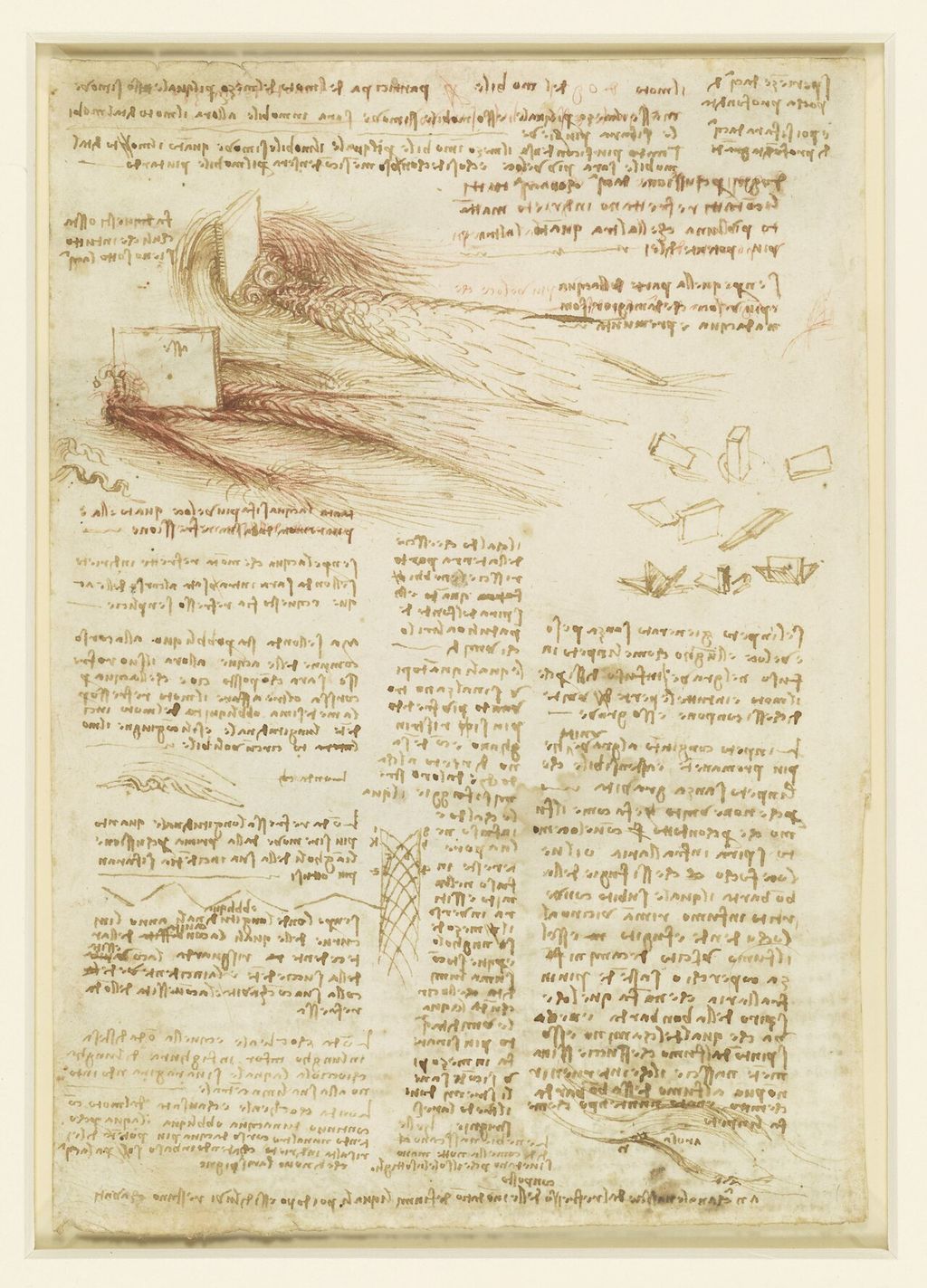
- ImageStudies of water.
Contents
- Before science became a profession
- The notebooks are a workshop, not a finished encyclopaedia
- Drawing as an instrument of thought
- Measuring a world that would not stay still
- Water as object, model and connecting medium
- Light, sight and the Moon
- Making motion visible
- Mathematics: the desired language and a persistent difficulty
- Why so little became a finished science
- What kind of investigator was Leonardo?
Before science became a profession
The divisions familiar today would have made little sense within Leonardo's working life. Painting demanded knowledge of geometry, light, shadow, human movement, materials, atmosphere and the behaviour of water. A court engineer might design a festival device one month, inspect a canal the next, and then consider a weapon, stable or palace. Anatomy could serve painting, medicine, mechanics and a more general inquiry into life. Optics belonged to learned traditions of perspective and natural philosophy but also to the daily decisions of an artist arranging light on a face.
Leonardo was therefore not escaping art whenever he studied nature. Painting helped define his questions. How does a distant mountain acquire a blue cast? What makes a shadow soften? How does a face change when its muscles pull? How should water turn around an obstacle? The painting workshop trained attention to surfaces, proportions, mixtures, effects and procedures. It also trained the hand to preserve an observation in a form that another mind—or the same mind years later—could inspect. The Max Planck Institute's historical reconstruction places this work in a culture of artist-engineers and practical mechanics, rather than treating it as modern laboratory science appearing in isolation. [1]
That context matters because the familiar heroic story can diminish the achievement it intends to praise. Leonardo did not stand outside his century receiving ideas from the future. He made unusual combinations from resources available within it, extended them with extraordinary visual skill and pushed some enquiries far beyond their customary limits. His originality depended on connection: workshop practice, books, conversations, commissions, instruments, sites and bodies.
A workshop education and a widening libraryLeonardo lacked the university training and fluent classical Latin expected of a humanist scholar. His challenging phrase omo sanza lettere—a man without letters—referred to that social and educational distinction. It did not mean that he could not read, that he despised books or that every thought arose directly from untouched nature. He wrote thousands of pages in the vernacular, compiled word lists, tried to improve his Latin and gathered books with increasing determination.
By the years of the Codex Leicester, lists in his manuscripts show a substantial personal library. Museo Galileo's reconstruction identifies ancient and medieval authorities including Aristotle, Plato, Strabo, Archimedes, Frontinus, Albert the Great and Albert of Saxony, alongside vernacular authors such as Dante, Ristoro d'Arezzo and Cecco d'Ascoli. Access could be indirect: translations, summaries, conversations and borrowed manuscripts all belonged to the movement of knowledge. Leonardo's response was neither obedience nor blanket rejection. He absorbed propositions, tested some against experience and disputed others. [7]
His technical inheritance was equally important. Verrocchio's workshop joined painting, sculpture, metalwork, casting and mechanical problem-solving. Brunelleschi's building machinery formed part of Florentine craft memory. In Milan, Leonardo read or consulted the work of engineers such as Taccola, Francesco di Giorgio Martini and Roberto Valturio. Their machines, conventions and problems gave him a platform from which to vary, criticise and visualise. The later friendship with Luca Pacioli brought sustained contact with mathematics. His efforts to become an author of learned works grew from this mixed education rather than from a rejection of it. [19]
“Experience” in Leonardo's writing consequently has a precise adversary: an empty appeal to authority by someone who has not examined the thing. It does not mean proceeding without concepts or sources. On a celebrated sheet of about 1489–90, he defends experience as the true teacher while struggling with optical and anatomical ideas received from earlier traditions. The page is valuable because its words and diagrams do not show effortless victory. They expose a working mind trying to reconcile sight, theory and the structure of the eye. [3]
The notebooks are a workshop, not a finished encyclopaediaNo reader in Leonardo's lifetime could open a shelf of codices in their present form. He wrote on sheets, booklets and small notebooks of different sizes, returned to them across years, copied passages and planned to reorder material. Owners, heirs, binders and collectors later changed their physical arrangements. Pompeo Leoni, working in the late sixteenth century, dismembered and regrouped many sheets to create large thematic albums, including the Codex Atlanticus and the Windsor collection. Museo Galileo's Leonardo//thek@ project brings together some 1,200 Atlanticus leaves and about 600 Windsor leaves—an enormous body that still represents only part of what once existed. [4]
The surviving groups preserve different stages of thought. Madrid Codex I is unusually sustained and polished, approaching a treatise on mechanics. Madrid Codex II is a zibaldone, a working miscellany that mixes technical investigation with other notes. The contrast warns against speaking of “the notebook” as one uniform object or assuming that every rough diagram states a final position. [5]
The Forster codices at the Victoria and Albert Museum offer the same variety on a smaller scale. One portion examines solid geometry; another contains hydraulics. Others range through weights, traction, stress, balances, proportions, machines and the impossibility of perpetual motion. These volumes are later bindings, and their present sequence is not a hidden master plan. Mirror writing is also less mysterious than popular legend suggests. It was a habitual and perhaps comfortable direction for a left-handed writer, not proof that he encrypted forbidden science; when legal or public convention required it, he could write in the usual direction. [2]
Leonardo himself described the problem. At the beginning of material now in the British Library's Codex Arundel, he called it a collection without order, copied from many papers, and asked the reader to forgive repetitions caused by the volume of material and long intervals between bouts of writing. The admission reveals both ambition and obstruction. He imagined arranging observations under their subjects, yet new enquiries kept overtaking the work of synthesis. [6]
The papers should therefore be read as an active research environment. A list may announce a future book; a neat proposition may preserve a mature result; a sketch may test a possibility; a note may challenge itself on the next page. Their incompletion is not a secret code to be solved away. It is evidence of how Leonardo thought and why so few of his investigations became finished works.
Questions that became research programmes
Leonardo often began with an imperative addressed to himself: describe this movement, ask someone about that material, obtain a particular book, observe a structure from another side, make a test. These reminders are easy to mistake for knowledge he already possessed. In fact, they mark the edge of it. A sentence beginning “find out” is a research instruction, not a discovery. The distinction prevents a planned inquiry from being reported as a completed result.
Lists of questions also reveal how rapidly one problem divided into many. To understand a bird's flight required the shape and movement of wings, the distribution of weight, the action of wind, the properties of feathers and the response of the body when a current changed. To understand water meant asking about drops, waves, impact, sediment, channels, pressure, evaporation, clouds and erosion. Anatomy expanded from bones and muscles to nerves, vessels, organs, development and the motions of life. Each answer produced conditions and exceptions that demanded another page.
This branching habit resembles his drawings. A main question divides into subsidiary questions just as a river or tree divides into smaller paths. The resulting programme could be systematic even when the surviving page looks disorderly. Repeated headings, projected book divisions and tables of contents show an urge to assemble local enquiries into a teachable order. The difficulty was that Leonardo's standard for completeness kept increasing. Before he could finish a book on a phenomenon, he wanted its causes, varieties, interactions and applications.
His reminders identify knowledge as social as well as observational. Names appear beside requests for books, information, calculations, instruments or access. Craftspeople knew materials and processes; physicians and hospital contacts made dissections possible; mathematicians could clarify demonstrations; officials controlled rivers, buildings and fortifications. The solitary figure in a landscape with a notebook captures only one part of the method. Much of his evidence depended on other people and on institutions that let him reach an object of study. [1]
Even a direct observation had to be made portable. A date, place, dimension or named animal could anchor it. A quick sketch preserved the configuration long enough for later comparison. Copying an older sheet into a new notebook let Leonardo regroup evidence around a developing subject, although it also produced repetition and separated notes from their original circumstances. The research programme existed across movement, memory, paper and revision rather than inside a single decisive experiment.
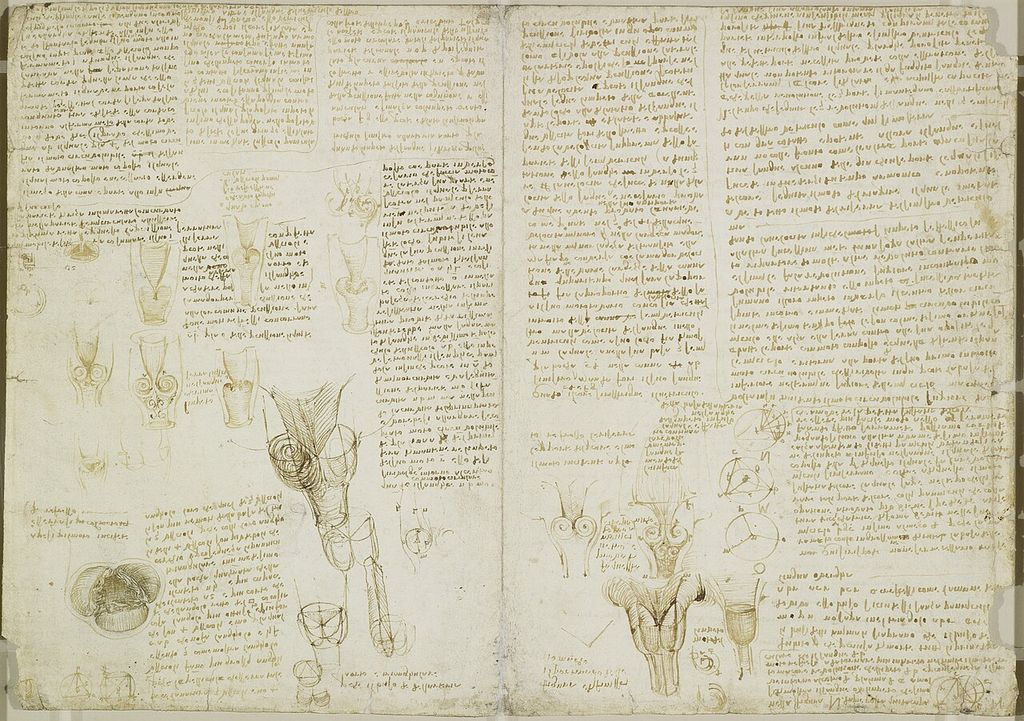
Drawing as an instrument of thoughtLeonardo's most distinctive research instrument was the drawn page. Drawing did more than record what the eye had already understood. It separated a complicated event into stages, held moving water still, allowed an object to be viewed from several sides and exposed a hidden mechanism. Lines could mark force, direction, reflection or flow rather than the visible edge of a thing. A cutaway could make an enclosure transparent. Repetition could compare several solutions without building each one at full scale.
The method linked otherwise remote subjects. In anatomy, successive views turn a body so that the reader can reconstruct volume. In mechanics, exploded parts clarify how motion passes through a device. In optics, geometrical rays connect object, aperture and image. In studies of water, curling strokes are both records of appearance and hypotheses about movement. Leonardo frequently made the image carry an argument that prose alone could not manage.
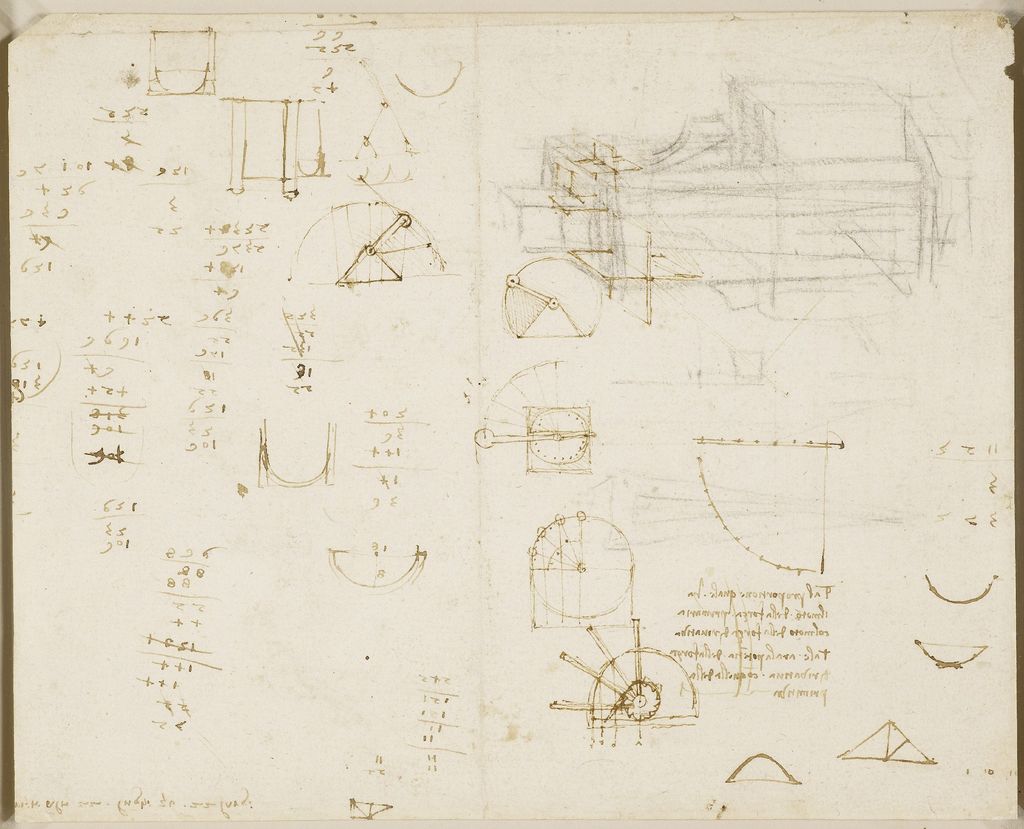
This visual power did not guarantee truth. A beautiful diagram can make a mistaken model persuasive, and a drawing assembled from several observations may look like a single witnessed scene. Nor does a perspective sketch prove that the represented machine was built. The page could be observational record, analytical diagram, memory aid, presentation image, fantasy, quotation from another engineer or proposal under revision. Interpretation begins by asking what a particular drawing was doing.
Anatomy shows the strength and limit together. Leonardo dissected human and animal bodies, corrected received claims and devised visual conventions that could explain structure with exceptional economy. His planned anatomical publication would have combined text with images from multiple viewpoints. Yet analogy between species sometimes filled gaps in access to human material, and physiological theories inherited from tradition persisted beside new observation. The Royal Collection's chronology presents not one uninterrupted project but phases of intense work, interruption and return. [16]
Observation, experiment and demonstration
Leonardo repeatedly told himself to test a claim. His papers include instructions for trials, descriptions of arrangements, measured comparisons and observations that only make sense as the residue of practical investigation. Yet “experiment” covers several activities. Some exercises isolate variables in a controlled arrangement. Some demonstrate a phenomenon already known. Others are thought experiments carried through in diagrams. Field observation, model-making and workshop experience provide different kinds of evidence.
The camera obscura is a clear case. In a darkened chamber, light from an illuminated scene passes through a small opening and forms a reduced, inverted image on the opposite surface. Leonardo used the arrangement as a large-scale analogue for the eye and described shapes and colours appearing on white paper. The optical effect had been known since antiquity, so the point is not that he invented it. His contribution lay in using an accessible physical arrangement to examine image formation and connect geometrical optics to vision and painting. [8]
That experiment did not resolve the physiology of sight. Leonardo could observe the projection correctly while retaining mistaken ideas about where visual information came together inside the eye. The mixed result is characteristic. A controlled phenomenon constrained his explanation, but it did not erase every assumption surrounding it.
He also rejected devices that promised perpetual motion. The rejection rested on attention to loss, balance and the behaviour of real mechanisms. It belongs beside his more famous inventions because it shows technical judgement: the capacity to recognise that a seductive drawing cannot supply its own energy. Scientific work here meant ruling something out, not adding another miraculous machine to a catalogue. [2]
Measuring a world that would not stay stillLeonardo's pages contain numbers, proportions and proposed instruments because looking closely was not always enough. He considered ways to measure time, distance, force, weight, humidity, wind and water. A quantity could make two cases comparable and expose a claim that a purely verbal account left vague. The impulse connects his commercial arithmetic, geometric study and engineering practice.
Measurement nevertheless had different levels of precision. A dimension taken from a horse or a body is not equivalent to a universal constant. A ratio learned under one frictional condition may fail when surfaces, loads or lubrication change. River speed varies across a channel and through time. Leonardo often knew that circumstances mattered, which is why he recorded multiple cases, but he did not possess modern standards of calibration, error analysis or controlled replication.
Proportion was especially attractive because it could join image and number. A machine part could be enlarged while relationships remained visible; the limbs of a body could be compared; a flow or force could be divided. Proportional reasoning also risked turning a local regularity into a universal harmony. Leonardo's search for measure was empirical and philosophical at once: he wanted useful dimensions, but he also expected nature to contain intelligible order.
The strongest examples combine a quantity with a material operation. A weight pulls a block; a balance shows equilibrium; falling water strikes a surface; an aperture limits a beam of light. Such arrangements make an invisible relation visible through movement. They are close to experiments in a modern sense, yet their record is often too brief to reproduce exactly. A diagram may omit the surface, material, duration or sequence because Leonardo wrote for himself. The absence does not disprove a trial, but it limits what can be reconstructed from it. [14]
A newly analysed Codex Arundel example makes both the strength and the limit unusually clear. Leonardo imagined or tested a vessel moving horizontally while releasing water or granular material. Once released, each particle retained the horizontal motion it already had while falling with increasing downward speed. If the vessel itself accelerated at the same rate as the fall, the successive particles aligned along the diagonal of an isosceles right triangle. Leonardo labelled this relation Equatione di Moti, an equalisation of the two motions. [21]
Gharib, Roh and Noca used modern analysis and simulation to reconstruct the proposal. They argue that Leonardo recognised gravitational fall as accelerated rather than uniform motion. His mathematical rule was nevertheless wrong: he treated distance as increasing like two raised to the time rather than as proportional to time squared. Over the four short intervals he drew, the two sequences happen to approximate one another closely, producing the much-publicised estimate within about three per cent of the modern value. The result is evidence of an ingenious graphic experiment and a real conceptual advance, but not a measurement of a universal gravitational constant or a finished Galilean law. [21]
This is one reason modern demonstrations must be labelled carefully. Repeating a plausible arrangement can show that the principle works, but it cannot recover unrecorded conditions with certainty. Historical experiment involves two investigations: what nature does and what the surviving page permits us to say Leonardo actually did.
Mechanics with weight, friction and resistant materialsMechanics offered Leonardo a route towards general rules, but his route began with actual machines. He examined levers, pulleys, screws, axles, gears, springs, impacts and the strength of materials. He wanted mathematics to organise these operations, yet he remained acutely conscious that friction, deformation, imperfect surfaces and material differences change what a mechanism can do.
His work on friction is among the best documented examples of long empirical development. Ian Hutchings's chronological study traces it from about 1493 through more than twenty years. Leonardo recognised that sliding resistance increases with load and, under his conditions, does not depend on the apparent area of contact. He applied empirical ratios to axles, screw threads, pulleys and other machine elements, considered lubrication and understood friction as a limit on efficiency. The work was probably grounded in measurements, although some diagrams later reconstructed as experimental apparatus do not actually show the tests modern model-makers claimed. [14]
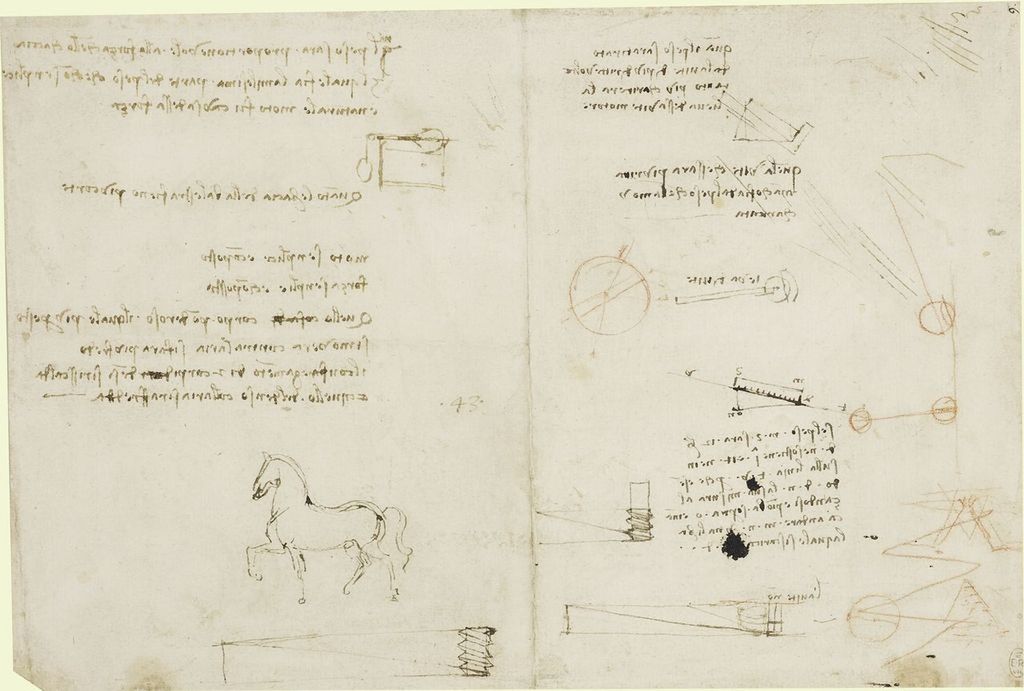
The same research also exposes limits. In analysing a body on an inclined plane, Leonardo combined weight and friction incorrectly and failed to improve the result when he returned to it years later. His practical rules could be effective without becoming a mathematically coherent dynamics. Nor did his friction studies influence Guillaume Amontons two centuries later; they remained unknown. Priority without transmission describes a date in a private manuscript, not a contribution operating within a historical chain. [14]
This tension helps distinguish Leonardo's practical mechanics from later classical mechanics. He wanted to retain the resistant, noisy, material world. Seventeenth-century breakthroughs often depended on idealisation: points instead of extended bodies, motion without friction, simplified forces and mathematically clean conditions. Leonardo's refusal or inability to make that leap kept him close to engineering reality but restricted the general theories he could derive. His “failure” and later science's success are not a simple ranking. They answer different needs and work at different levels of abstraction. [19]
Water as object, model and connecting medium
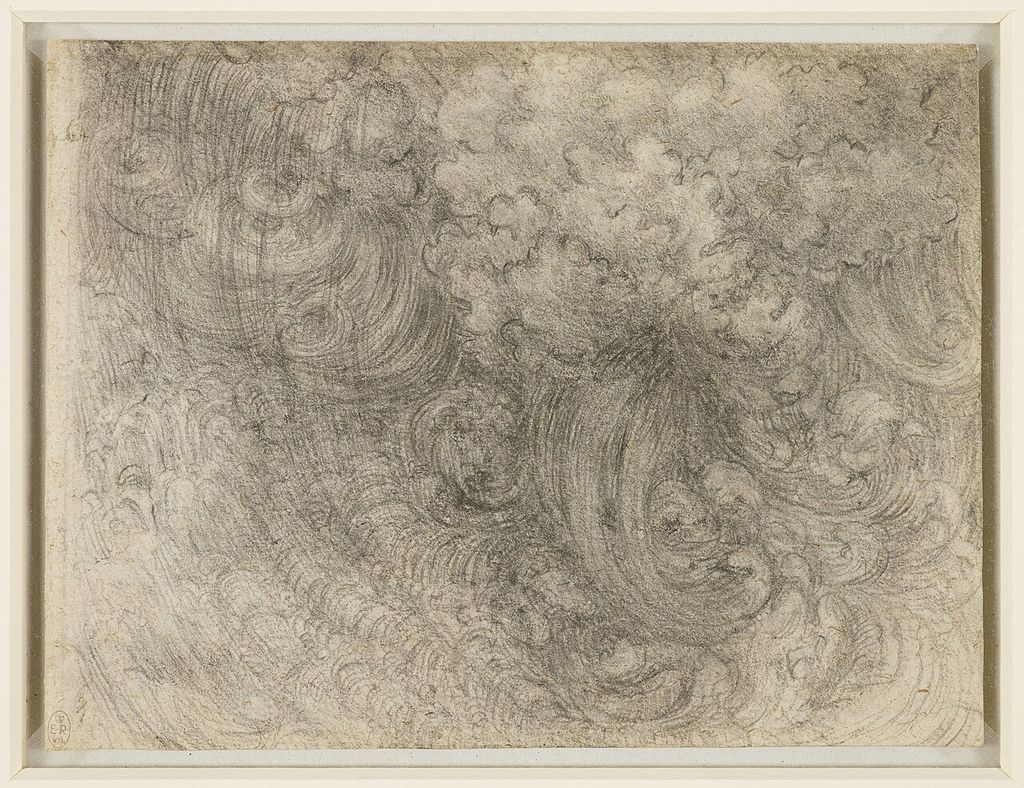
Water drew together Leonardo's powers more completely than almost any other subject. It moves too quickly and changes too readily to be captured by a single static glance. He therefore broke its actions into recurring forms: waves, rebounds, spirals, eddies, falls and branching currents. In a waterfall he distinguished downward descent, downstream motion and vortex action that erodes bed and bank. He noticed air carried beneath the surface and the boiling movement made as it tries to rise. Drawings convert these intertwined events into a sequence that can be compared. [20]
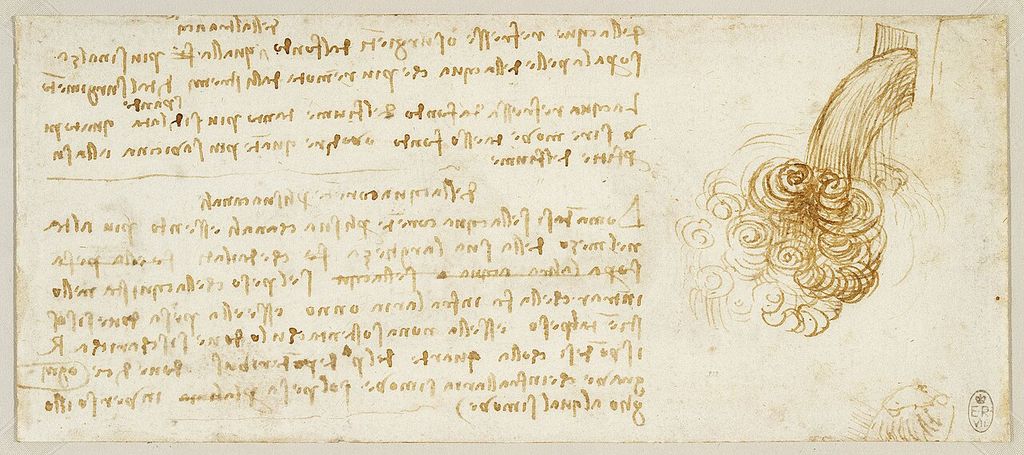
The Codex Leicester, formed from eighteen double sheets or seventy-two pages and compiled largely in Florence between 1504 and 1508, is the most concentrated survival of this inquiry. Its subjects spread from flow and erosion to fossils, atmosphere, light and the Moon. That range is not random. Leonardo thought water could disclose the operation of nature at many scales. [9]
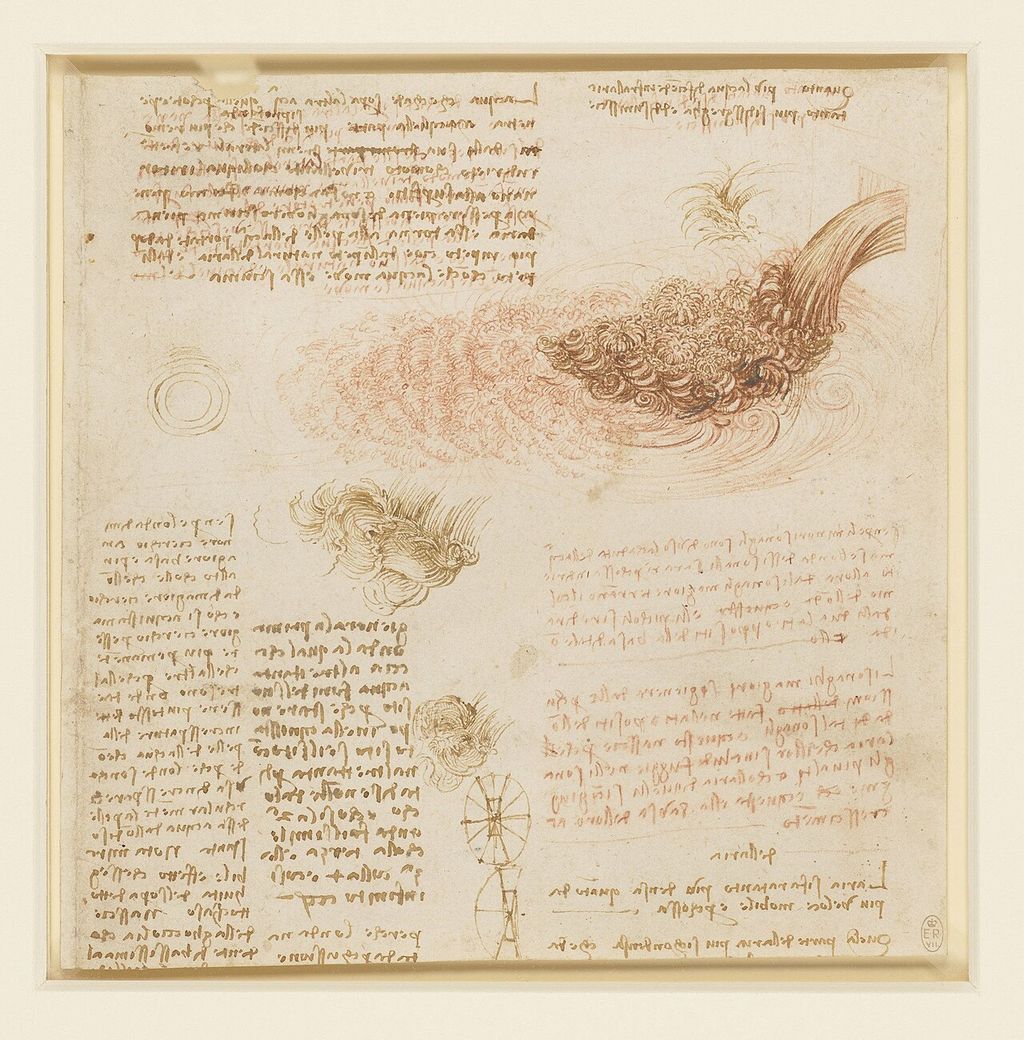
He planned a large treatise on water and drafted three different tables of contents without completing it. The projected work would have moved between the structure of water, catastrophic action, vortices, river defences and comparisons among water, air, swimming fish and flying birds. A river problem could become a question about resistance; a vortex could connect a stream, a storm and blood; an engineering intervention could test a natural explanation. [10]
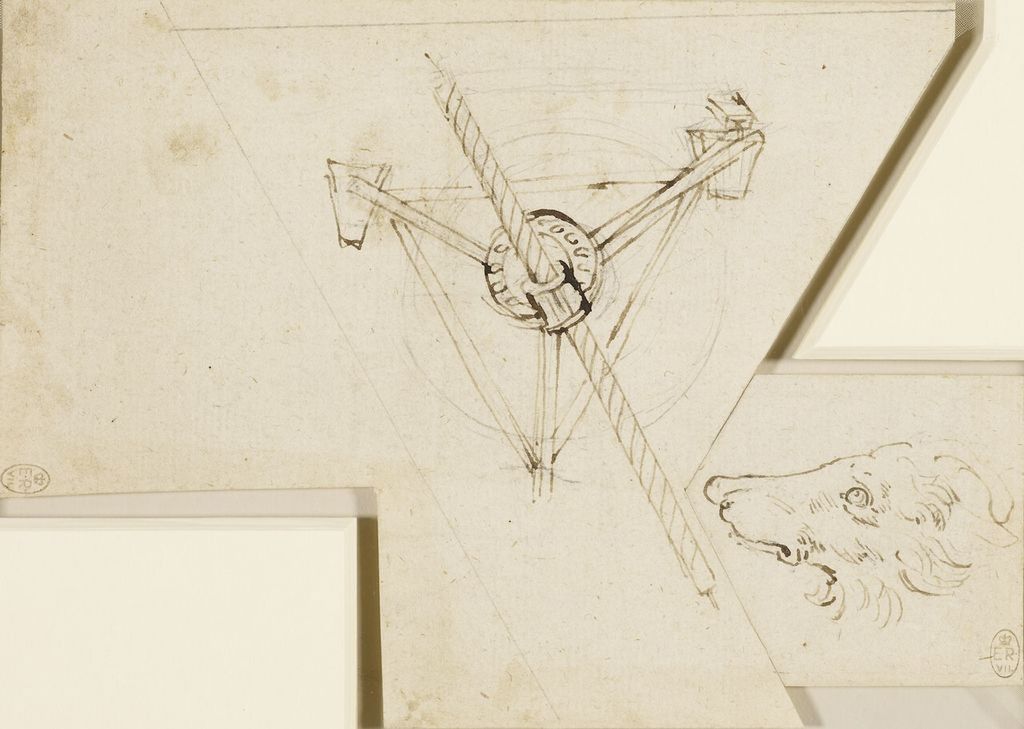
Analogy made this movement possible. It was neither a decorative flourish nor a reliable law. To say that rivers are like veins directs attention to networks, branching and circulation. To compare a swimmer in water with a bird in air highlights lift, drag and control. The comparison generates observations. It becomes dangerous when resemblance is allowed to prove identity. Leonardo's work is full of productive analogies and of cosmologies stretched too far by them.
A changing Earth read from shells, strata and erosionMarine shells embedded high in mountains posed a physical question. How had organisms associated with the sea arrived inside layered rock? Leonardo rejected the idea that a single biblical Flood had simply carried the shells uphill. He argued from their positions, preservation and the behaviour of living shellfish. Water moving for a brief period could not account for ordered deposits, intact colonies and sediments formed over time. Land now raised above the sea must once have been submerged, while erosion and deposition continually remade the surface. [11]
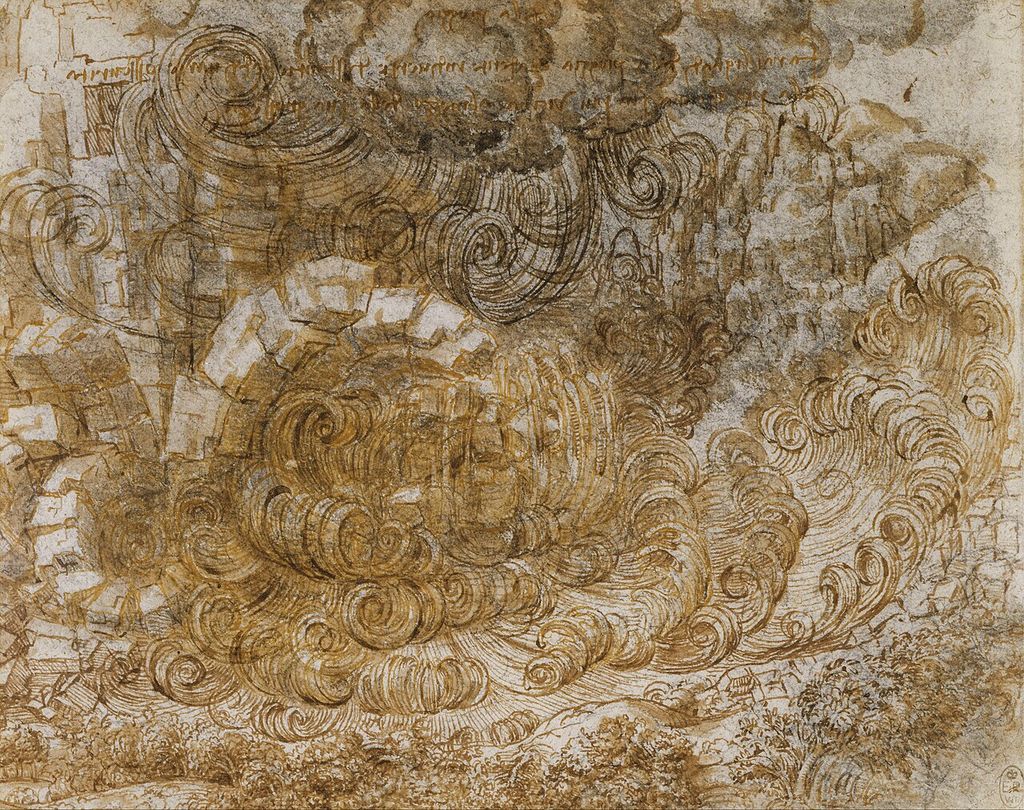
The reasoning is powerful because ordinary things become historical evidence. A shell is not an isolated curiosity; its place and relation to surrounding stone matter. A river is not merely water passing through a landscape; it removes material, transports it and lays it elsewhere. Present processes provide a way to read past environments.
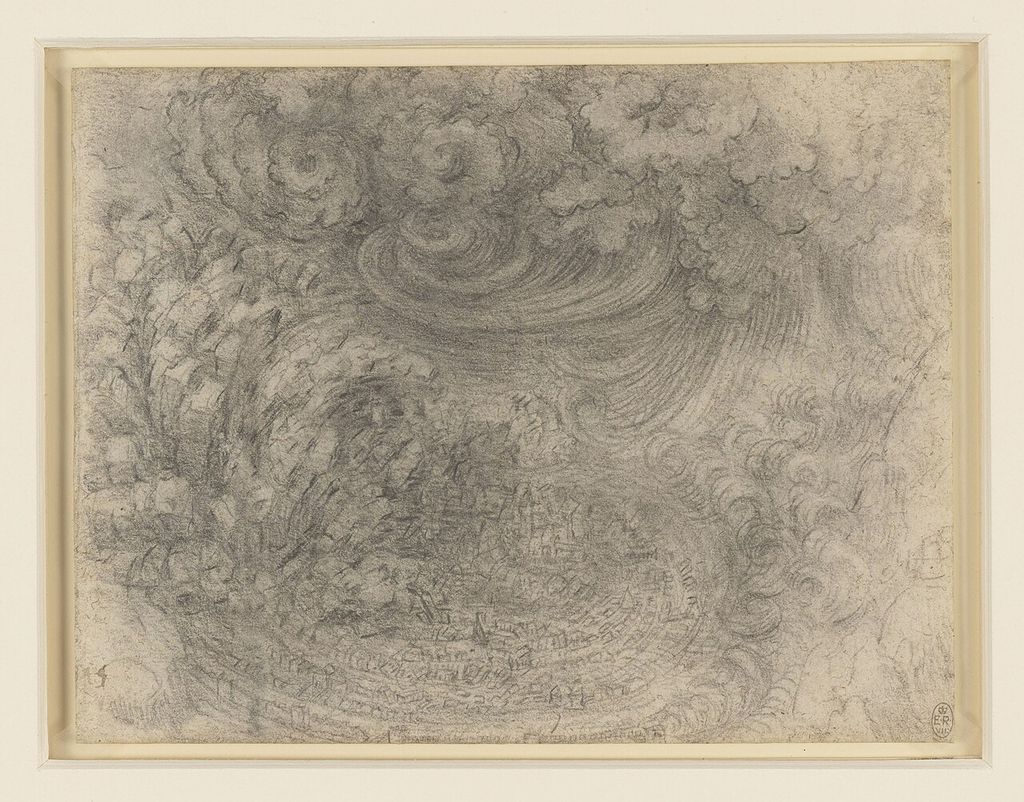
It is tempting to make Leonardo the founder of modern geology. That claim erases both context and difference. Fossils, mountains and the history of the Earth were already subjects of ancient, medieval and Renaissance debate. Leonardo's arguments were not published as a discipline-forming theory. He also pictured Earth through the body: soil as flesh, rocks as bones and water as blood. The analogy helped him conceive a planet under continuous transformation, but it also supported a living-Earth system of cyclic compensation that is not plate tectonics, stratigraphy or a modern water cycle. [12]
His achievement is more exact when described locally. He developed penetrating physical objections to particular explanations and connected erosion, sediment, former seas and fossil position. Those arguments show how observation could resist authority without freeing itself from every inherited cosmological frame.
Light, sight and the Moon
Optics stood where art, geometry, physiology and astronomy met. Perspective treated the visual field through lines and intersections. Shadow depended on the size and position of light sources. Atmospheric perspective asked why contrast, colour and clarity change with distance. Reflection and refraction mattered to water, mirrors and the eye. Leonardo moved between these topics because the same ray diagrams could organise several phenomena.
His lunar studies again combine insight and error. He rejected the conception of the Moon as a self-luminous perfect crystal sphere and understood that it receives light from the Sun. He considered faint illumination on its dark portion in terms of reflected light between Earth and Moon. Yet he explained the Moon's diffuse brightness through sunlight scattered by agitated lunar oceans and interpreted darker patches as land rising from the water. The Moon, in his account, was a second Earth composed of the same elements. [13]
The error is not an embarrassing footnote to a correct anticipation. It reveals his procedure. Analogy with Earth offered a material explanation for appearances, and reflection from water supplied a mechanism he knew. Without telescopic evidence, the model remained plausible enough to him. On another sheet he proposed making spectacles to see the Moon larger, a concise recognition that better observation required an optical aid, although no Leonardo telescope is documented. [13]
Painting benefited from the same enquiry. Knowledge of reflected light could explain a softly lit face; study of aerial effects could give distance to a landscape; geology could make rocks structurally convincing. Science did not sit behind the art as hidden trivia. The painted image and the natural investigation repeatedly supplied one another with problems, tests and forms of representation.
From birds to the mechanics of flightLeonardo's study of flight developed through repeated changes in emphasis. Early machines often asked how human muscular power might reproduce flapping wings. Observation of actual birds gradually made balance, air currents, wing deformation, gliding and control more central. The shift did not produce a modern aircraft, but it shows enquiry correcting design.
The Codex on the Flight of Birds in Turin began as a small sketchbook. In spring 1506 Leonardo reused it for close descriptions of how different species behave in air, alongside mechanical notes for human flight. Bird and glider overlap on its pages: a living body is analysed as a natural machine, while the proposed machine borrows flexible motions from the bird. The codex also contains material on hydraulics, architecture and the Arno, another reminder that present titles describe a dominant subject rather than a sealed research compartment. [15]
Comparison did much of the work. Swimming beneath water could illuminate flight in air because both involve a body moving through a resisting medium. A bird turning into a gust could suggest control surfaces or changes of centre of gravity. Yet air and water differ, and human muscles do not reproduce avian power-to-weight ratios. Leonardo's papers do not document a successful manned flight. Statements that he built and flew a machine convert observation and proposal into an event for which the evidence is absent.
The deepest result may be the form of attention. Leonardo did not study “the bird” as a single ideal. He recorded species, motions, winds and changing configurations. That sensitivity to variation coexisted with his desire for general mechanical rules. Flight became a negotiation between rule and circumstance rather than a single copied wing.
Making motion visibleMotion was a common problem beneath many of these subjects. A body falls, a bird banks, a wheel turns, a face changes expression and a current curls around an obstruction. A painting or sheet of paper is still. Leonardo had to invent graphic means of carrying time into space.
One solution was sequence: successive positions of a limb, wing or falling object imply stages of an action. Another was the path line, which traces where something has travelled rather than what it looks like. Repeated curves can show the formation and decay of a vortex. Arrows were not yet a fully standard scientific notation, so direction might be carried by the orientation of a line, the placement of labels or a series of small forms. These choices make the page both image and model.
He also looked for persistence beneath change. Water is never the same material at one place, yet a recurring eddy has a recognisable form. A bird constantly adjusts its body, yet balance can be analysed through centres and forces. Muscles alter shape while their attachments organise movement. Leonardo's studies repeatedly distinguish the moving substance from the pattern its motion makes.
This interest encouraged comparison among media. Water and air both form vortices; sound, light, impact and waves can spread from a source; branching can organise rivers, vessels and plants. Some comparisons captured structural similarities of real value. Others combined phenomena that later physics would separate. The page records an early search for common forms before the relevant quantities and laws could be defined.
His depictions of turbulence are especially important for understanding the ambition. Turbulence is not reduced to one neat trajectory. Interlocking curls preserve irregularity while proposing local order. Modern viewers sometimes call such pages photographic, but they are not instantaneous exposures. They are analytical composites made from sustained observation, memory and graphic convention. Leonardo made change legible by constructing an image no unaided glance could hold. [20]
Plants, branching and rules of growth
Plants offered another meeting between the painter's need and the investigator's curiosity. Leaves turn towards light, overlap, emerge in sequences and change colour with distance. Branches divide while preserving the visual and structural coherence of a tree. Roots, trunks and twigs carry water through a branching network. Leonardo's studies attend to these relations as patterns rather than collecting decorative plant shapes.
The rule most associated with him states, in effect, that the combined thickness of branches at a given level corresponds to the thickness of the trunk below. It is better understood as a model arising from observation and pictorial construction than as an exact universal law of plant hydraulics. Real trees vary with species, age, damage, load and environment; modern work continues to debate what branching quantities are conserved. The historical importance lies in seeking a measurable relation across a living form.
The University of Florence's natural-history study places these observations within the botany of Leonardo's time, before the later transformations of the discipline. His plant work was neither a modern taxonomy nor simply ornament. It examined growth, water, light and form through problems that belonged simultaneously to painting and natural history. [17]
Mathematics: the desired language and a persistent difficultyLeonardo repeatedly treated mathematical demonstration as the strongest form of certainty. Geometry gave him proportions, transformations, centres of gravity and a language for optical rays or mechanical relations. His collaboration with Pacioli and intense work on solid geometry show that this ambition was serious. Diagrams of polyhedra, areas and transformed bodies are not incidental exercises in an artist's margins.
Yet his mathematical capacity was uneven. He had received commercial abacus training rather than a university education in learned mathematics. Arithmetic, algebraic notation and complex proof could obstruct him. He sometimes repeated long calculations, made errors or pursued a construction that could not yield what he hoped. The gap between mathematical aspiration and mathematical command shaped his science.
That gap helps explain the page. Leonardo often reached a relation visually and mechanically before he could state it in a general symbolic form. He wanted “necessity” beneath appearances, but his most effective route remained diagram, proportion, model and concrete case. His work can be mathematically ambitious without being an unpublished version of Galileo or Newton.
Errors are part of the evidence
A balanced account does not divide Leonardo's pages into prophetic successes and disposable mistakes. The errors show what evidence he possessed, which assumptions he retained and how far a method could travel. Lunar oceans followed from a terrestrial analogy. The body's heat could be explained through mechanical effects that seemed persuasive but were physiologically wrong. Water was made to circulate through the Earth in ways modelled on blood. Some mechanical analyses used faulty components even when the underlying friction observations were strong.
He also changed his mind. Different dates may preserve incompatible explanations because a question remained open or because he had not gathered the notes into a final treatise. The contradiction is often the historical fact. Selecting only the statement that resembles present knowledge falsely supplies a conclusion he never made.
Leonardo's scepticism must be judged in the same way. He could challenge the Flood as a transport mechanism for fossils and reject perpetual motion, yet accept other inherited or analogical structures. Experience was a demanding corrective, not a universal solvent. This is precisely why the manuscripts matter for the history of knowledge: they preserve reasoning before a polished publication hides its abandoned paths.
Why so little became a finished scienceLeonardo repeatedly planned books—on painting, anatomy, water, mechanics, flight and other subjects. He drew up contents, wrote openings, instructed himself to obtain missing information and copied passages towards future order. No scientific treatise reached print under his direction. The sheer expansion of each topic worked against closure. An attempt to explain water led into geology, atmosphere, the Moon, engineering and the body; anatomy demanded more dissections and better images; mechanics exposed new questions about friction and materials.
Material circumstances also intervened. Courts fell, patrons changed, travel interrupted projects and access to bodies or sites was temporary. Some writing served a current commission; some sought long-term publication; some remained private reminders. After Leonardo's death in 1519, Francesco Melzi inherited the papers and compiled material on painting, but the broader scientific corpus fragmented. Later collectors rearranged it, and substantial portions disappeared.
This transmission history limits claims of influence. A result recorded privately cannot have guided later investigators unless a path of access can be shown. The Codex Leicester did circulate more widely than most groups in later centuries, but much of Leonardo's scientific reputation emerged only as manuscripts were recovered, transcribed and reproduced. His place in the history of science is therefore not the same as that of a published author whose propositions were read, tested and cited by contemporaries.
The modern machine made from an old drawingLeonardo's twentieth- and twenty-first-century image has been shaped by physical models. Museums and exhibitions turned small drawings into helicopters, tanks, bridges and machines that visitors could grasp at once. These objects can reveal mechanisms and provoke excellent questions, but they also introduce decisions absent from the source: scale, material, dimensions, fastenings, power, clearances and the relation among parts.
The Science Museum's own history of its 1952 Leonardo exhibition records curatorial doubt about whether some machines were original, practical, constructed or sufficiently specified to model. A working reconstruction proves that a modern team found one workable interpretation. A non-working reconstruction may expose a historical difficulty, a mistaken reading or a deliberately speculative sketch. Neither outcome can silently become evidence that Leonardo built the object. [18]
The same caution applies to the word invention. Leonardo drew known devices, variants on inherited designs, improvements, presentation fantasies and original mechanisms. His notebooks were also a visual library. Asking what changed between a source and his version is more informative than granting or denying ownership from resemblance alone.
What kind of investigator was Leonardo?
Leonardo's scientific achievement was not a complete system. Museo Galileo's account of his sources makes the point directly: he constantly challenged conclusions but never formed an organic interpretation of nature and all its operations. [7] The incompletion matters, yet it does not reduce the papers to curiosity. Across them, several durable habits recur.
He treated close description as intellectual work. He made images analyse rather than merely adorn. He crossed the boundary between learned theory and manual practice. He sought rules inside variable natural events, while remaining alert to friction, turbulence and material resistance. He used analogy to generate questions across scales. He returned to subjects over decades and allowed some observations to defeat an attractive machine or inherited account.
At the same time, he lacked the institutional exchange, publication and mathematical abstraction that made later science cumulative in different ways. His investigations could be exact without becoming a shared programme. His general models could be imaginative without being correct. His refusal to separate art, engineering and nature produced unusual insight, but it did not automatically produce modern disciplines.
The most faithful description is therefore neither “the first modern scientist” nor “only an artist with hobbies”. Leonardo was an exceptional Renaissance artist-engineer whose research practices sometimes resemble later experimental science and sometimes belong unmistakably to older natural philosophy, workshop knowledge and cosmology. He made observation active, gave drawing evidential force and demanded that explanations encounter the material world. The surviving pages let us see both the power of that demand and the difficulty of turning an inexhaustible investigation into finished knowledge.
Continue exploring Leonardo
Explore Leonardo’s works and designs
| Name | Date | Medium |
|---|---|---|
| A Map of Imola | 1502 | Drawing |
| Adoration of the Magi | About 1482 | Painting |
| Annunciation | About 1472 | Painting |
| Bacchus | Around 1517–1520 | Painting |
| Benois Madonna | Around 1478–1480 | Painting |
| Crossbow | 1485-1490 | Drawing |
| Diving Suit | — | Drawing |
| Flying Machine | — | Drawing |
| Ginevra de’ Benci | c. 1474/1478 | Painting |
| Head of a Woman (Turin) | Source-led range: 1478-1485, c. 1483-1485 or 1480s | Drawing |
| Helicopter | — | Drawing |
| Horse and Rider | — | Sculpture |
| La Bella Principessa | — | Painting |
| La Belle Ferronnière | c.1490–1497 | Painting |
| La Scapigliata | 1492–1501 ca | Painting |
| Lady with an Ermine | c. 1490 | Painting |
| Landscape Drawing for Santa Maria della Neve | Fifteenth century; inscription dated 5 August 1473 | Drawing |
| Leda and the Swan | — | Painting |
| Leonardo's Catapult Designs | late fifteenth century | Drawing |
| Leonardo's Designs for Milan Cathedral | 1487–90 | Architecture |
| Leonardo's River-Lock Drawing | late fifteenth century | Drawing |
| Leonardo's Romorantin Palace Project | 1517–18 | Architecture |
| Leonardo's Self-Propelled Cart | late 1470s–1480s | Drawing |
| Machine Gun | — | Drawing |
| Madonna Litta | Mid-1490s | Painting |
| Madonna of the Carnation | Around 1475 | Painting |
| Madonna of the Yarnwinder | — | Painting |
| Mary Magdalene | — | Painting |
| Mona Lisa | 1503 / 1519 | Painting |
| Ornithopter | — | Drawing |
| Parachute | — | Drawing |
| Portrait of a Lady: The Historic Leonardo Attribution | late fifteenth century | Painting |
| Portrait of a Man in Red Chalk (Self Portrait) | 1517/1518 or c. 1517-1518 | Drawing |
| Portrait of a Musician | About 1485 / first Milan period | Painting |
| Portrait of Isabella d’Este | Around 1499/1500 | Drawing |
| Profile of an Ancient Captain | c. 1475–1480 | Drawing |
| Rearing Horse and Mounted Warrior | First half of the 16th century | Sculpture |
| Saint Jerome in the Wilderness | About 1480–1482 / 1481–1482 | Painting |
| Saint John the Baptist | Around 1508–1519 | Painting |
| Salvator Mundi | — | Painting |
| Study of Hands | c.1480 | Drawing |
| The Baptism of Christ | About 1470–75 | Painting |
| The Battle of Anghiari | — | Painting |
| The Burlington House Cartoon | About 1506–8 | Painting |
| The Fetus in the Womb | c. 1511 | Drawing |
| The Last Supper | 1495–1498 in the Museo del Cenacolo Vinciano object table | Painting |
| The Sforza Horse Monument | 1480s–1499 | Sculpture |
| The Trivulzio Monument | c. 1506–13 | Sculpture |
| The Virgin and Child with Saint Anne | Around 1503–1519 | Painting |
| Triple Barrel Cannon | — | Drawing |
| Virgin of the Rocks | — | Painting |
| Vitruvian Man | Generally associated with Leonardo’s Milanese years, around 1490; exact dating remains cautious | Drawing |
| Wreath of Laurel, Palm, and Juniper with a Scroll | c. 1474/1478 | Drawing |
Frequently Asked Questions
Discussion
Which part of the evidence changes the way you read Leonardo and Science? The article sets surviving material beside later interpretation; share the distinction that matters most to you.
Reader Insights
What detail in the images or drawings is easiest to miss on a first viewing?
How does before science became a profession alter your understanding of this subject?
Where does the article leave a question open rather than presenting a settled answer?
Join the Conversation
Share your reading of Leonardo and Science below.
References
- Max Planck Institute for the History of Science and Staatsbibliothek zu Berlin, “About,” Leonardo's Intellectual Cosmos. View Source
- Victoria and Albert Museum, “Leonardo da Vinci's notebooks”. View Source
- Museo Galileo, Leonardo//thek@, Codex Atlanticus f. 327v, catalogue identifier ATL.0654.1. View Source
- Museo Galileo, “Introduction,” Leonardo//thek@. View Source
- Biblioteca Nacional de España, Códices Madrid I y II. View Source
- British Library, Arundel MS 263. View Source
- Museo Galileo, “A man without letters?”, Water as Microscope of Nature: Leonardo da Vinci's Codex Leicester. View Source
- Max Planck Institute for the History of Science, “Leonardo da Vinci: Camera obscura, ca. 1508–1509,” Leonardo's Intellectual Cosmos. View Source
- Museo Galileo, “Introduction,” Water as Microscope of Nature: Leonardo da Vinci's Codex Leicester. View Source
- Museo Galileo, “L'acqua ‘vetturale della natura’,” L'acqua microscopio della natura. View Source
- Museo Galileo, “Animali con le ossa di fora,” L'acqua microscopio della natura. View Source
- Museo Galileo, “The Earth as mirror of man,” Water as Microscope of Nature. View Source
- Museo Galileo, “The Moon: a second Earth,” Water as Microscope of Nature. View Source
- Ian M. Hutchings, “Leonardo da Vinci's studies of friction,” Wear 360–361 (2016), University of Cambridge Repository. View Source
- Musei Reali Torino, “The sections of the exhibition,” Leonardo da Vinci: Drawing the Future. View Source
- Martin Clayton, “Leonardo's Study of Anatomy,” Royal Collection Trust. View Source
- University of Florence Natural History Museum, Leonardo e la Storia Naturale. View Source
- Tim Boon, “The Science Museum and the Leonardo da Vinci Quincentenary Exhibition of 1952,” Science Museum Group Journal 5 (2016). View Source
- Max Planck Institute for the History of Science, “Challenges of Technology,” Leonardo's Intellectual Cosmos. View Source
- Museo Galileo, “Waterfalls,” Water as Microscope of Nature. View Source
- Morteza Gharib, Chris Roh and Flavio Noca, “Leonardo da Vinci's Visualization of Gravity as a Form of Acceleration,” Leonardo 56, no. 1 (2023), 21–27. View Source