 by Tom Gurney
Tom Gurney BSc (Hons) is an art history expert with over 20 years experience
Page Created on September 22, 2026 / Page Updated on September 22, 2026
Email: tomgurney1@gmail.com / Phone: +44 7429 011000
Leonardo's Catapult Designs
There is no single machine that can accurately be called “Leonardo's catapult”. The famous museum image usually labelled Codex Atlanticus folio 140r is itself a joined display of two separately catalogued sheets. The upper part, current folio 140a recto, contains two spoon catapults and operating details. The lower part, folio 140b recto, contains four sling catapults. Other Atlanticus sheets investigate wall-mounted throwers, a large bent-frame springald, a counterweight trebuchet and related release systems. They differ in the way they store energy, hold a projectile, load the mechanism and begin the throw. [1] [2] [3]
This variety is the subject. Leonardo did not invent mechanical artillery, and his drawings do not document one perfected weapon entering Sforza service. He inherited an old and still changing body of machines from practice, manuscripts and printed military books. What he added most visibly was a sustained graphic analysis of how their parts might work together. Across the sheets, he varies frames, screws, drums, flexible members, slings, ratchets and triggers as though testing a family of mechanical propositions.
At a Glance
- SubjectLeonardo's Catapult Designs
- Artist and contextLeonardo da Vinci (1452–1519) and his Renaissance world
- Periodlate fifteenth century
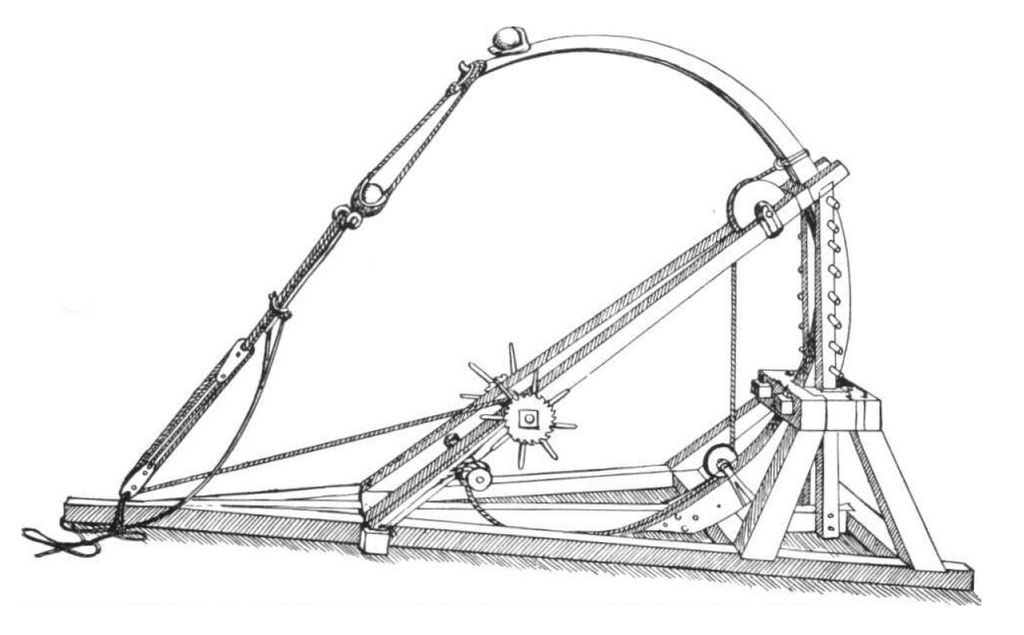
- ImageDouble sling-and-cup catapult attributed to Leonardo.
Where this study sits in Leonardo’s career
Florentine training
c. 1469–82The Last Supper
c. 1495–98Leonardo's Catapult Designs
late fifteenth centuryMona Lisa
from c. 1503Contents
- Correcting the identity of “folio 140r”
- Spoon and sling catapults
- “Ways of shooting far away”
- The large bent-frame springald
- An engineer's claim to a court
- Old engines in the age of cannon
- The books behind the drawings
- What reconstructions can establish
Correcting the identity of “folio 140r”
The Biblioteca Ambrosiana's public image is headed “Codex Atlanticus, folio 140 r” and aptly summarised as sling-style and spoon-style catapults. Its mounting, however, preserves two pieces that the current scholarly catalogue distinguishes. Folio 140a recto is Leonardo//thek@ record ATL.0279.1, formerly Hoepli 50 verso-a and ancient number 10. Folio 140b recto is ATL.0279.2, formerly 50 verso-b and ancient number 13. They were joined in the old codex, but their dimensions, old numbers and proposed dates remain separately recorded. [1] [2] [3]
The distinction resolves a common confusion. “140a” is not merely an obsolete mistake for “140r”; it identifies the upper component in current Marinoni foliation. The corresponding versos, 140a verso and 140b verso, are blank. They cannot be used as a hidden source for missing locks or connections. The familiar display brings related studies together, but it is not one sheet carrying six views of a single object. [2] [3]
This problem belongs to the physical history of the Codex Atlanticus. In the late sixteenth century Pompeo Leoni cut, rearranged and mounted material from Leonardo's notebooks and loose papers into large albums. Museo Galileo's Leonardo//thek@ 2.0 project now combines the Atlanticus and Windsor records and uses digital and non-invasive methods to test relationships among separated fragments. That work makes present folio numbers indispensable identifiers rather than guarantees of Leonardo's original sequence. It also imposes a limit here: the shared subject and historic mounting of 140a and 140b justify studying them together, but they do not by themselves establish that Leonardo drew the two pieces consecutively or intended them as one leaf. [12]
Dating also argues against a seamless blueprint. Carlo Pedretti placed 140a recto around 1485, while Matthew Landrus proposed about 1485–93. Folio 140b recto has been dated around 1487–90, and some of its inscriptions may have been added around 1497–1500. These ranges suggest that Leonardo could revisit the subject and annotate earlier ideas. They do not establish a linear sequence from rough sketch to approved final design. [2] [3]
Spoon and sling catapults
On 140a recto, the two large studies use a long throwing track or arm ending in a spoon-like holder. A central drum twists ropes acting on bent members. In the upper design, a hand crank turns a worm gear, toothed wheel and drum. A small study to the right examines release: a hammer depresses a crank held by a spring, letting the mechanism run. In the lower design, a lever charges the drum while a post engages a ratchet wheel and holds it in position. [2]
These are not simply attractive profiles. The details divide a violent action into stages: load the engine, store energy, restrain it, release it and guide the projectile. A worm drive provides large mechanical advantage and resists easy backward motion. A ratchet converts intermittent effort into a held state. A trigger allows the crew to stand clear when accumulated force is released. The drawing asks how a machine can be made ready without allowing it to discharge prematurely.
Folio 140b recto replaces the spoon with slings. Its four machines are related but not identical. The upper pair use central screws and poles to draw back the sling and trigger system. In the lower-left design, ropes wind around a bar and pull flexible arms together. The lower-right study substitutes a spoked wheel to rotate a pole on one side. Leonardo's notes distinguish machines represented as complete and ready to throw from others still lacking parts or posing difficult loading problems. [3]
The sling changes the throw. Instead of a stone resting in a rigid cup at the tip of an arm, it travels in a flexible pouch and must be released at the correct point in the arc. Timing affects height, distance and safety. The frame must tolerate the sudden reversal of bent members, while the pouch and cords must clear the structure. Leonardo's variations show attention to the entire path of force rather than to a single dramatic silhouette.
The later note about using a green, straight piece of wood and turning it after each shot is difficult to interpret precisely. The catalogue records disagreement even over whether one verb was copied correctly. Its practical concern is clearer than its exact application: repeated bending can leave timber warped, so the orientation of a green member may need to be reversed. The note belongs to the material behaviour of an engine, not to proof that the pictured machines completed a firing programme. [3]
“Ways of shooting far away”
Folio 144 recto widens the subject. Leonardo heads it “ways of shooting far away” and lays out an inventory of six spear- or dart-throwing arrangements, hand slings and a catapult. Some carry striking names: caccianemico, cacciafrusto, frommola, cimitrilla or ronzastra. Historical usage is not stable enough to replace every term with a neat modern weapon class. The page is valuable precisely because it preserves a contemporary vocabulary alongside the drawings. [4]
One device uses a cord wrapped around a spear to impart rotation as it is thrown. Elsewhere Leonardo reminds himself to speak with the martial-arts author Pietro Monte about methods of casting darts and asks at what point in a curved motion the moving cause releases the moving object. That question reaches beyond weapon collecting. It isolates release timing as a problem in mechanics: the same stored effort produces a different trajectory according to the instant at which projectile and machine part company. [4]
At the bottom of 144r, a larger cimitrilla or ronzastra is measured from pivot to sling and operated with a heavy mallet. Leonardo says it is to be positioned on a town wall or similar place. Folio 160a recto returns to the idea in a striking row of arms above a fortified wall. A figure swings a large hammer; one arm has just been struck and a stone is leaving it. The repeated raised arms may show a battery, or in part a single arm in successive positions. Either way, the drawing explores how human impact can trigger a larger throwing action. [4] [5]
The same 160a sheet places this wall system beside a counterweight trebuchet shown in motion. Its weight has descended and the long arm is releasing a stone. A written “4000” may refer to pounds proposed for the counterweight, but the catalogue cautions that Leonardo probably did not calculate its exact volume. Juliana Barone has suggested that the juxtaposition compares two devices through the science of weights: equilibrium is prepared and then deliberately disrupted to create motion. [5]
The large bent-frame springald
Folio 145 recto presents the most imposing catapult in the group. A broad base supports a large bent frame, paired torsion-spring assemblies and geared controls. The projectile rests centrally. Leonardo draws the machine with persuasive precision, yet the spatial construction is not fully consistent: the frame may be too shallow for the arms to rotate and throw the stone as shown. Fine finish therefore cannot be equated with a construction-ready perspective. [6]
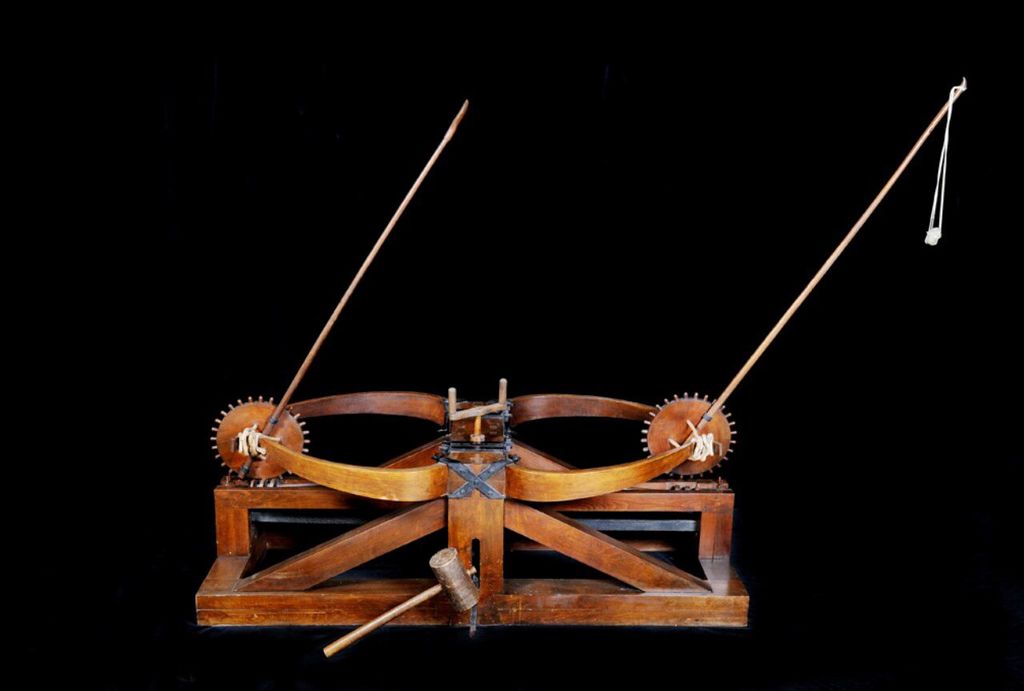
The design is related to a smaller springald study on folio 149a recto and, through it, to machines illustrated in Roberto Valturio's De re militari. Valturio's Latin book appeared in print at Verona in 1472 with eighty-two woodcuts; an Italian edition followed in 1483. The work belonged to Leonardo's documented reading, and its tenth book offered a visual repertory of artillery. On 149a r, he does not merely repeat a woodcut. He studies how a bent frame, torsion springs and operating machinery might actually be constructed and controlled. [7] [8]
On 145r, linked gears are interpreted as regulating the rate at which each torsion screw turns, so comparable force is applied to the two sides. A connecting bar coordinates the spring gears. This is a significant design concern: if the arms are charged unevenly, the projectile may leave off-centre or the frame may be loaded asymmetrically. Leonardo's solution seeks balance through transmission rather than relying on the crew to judge two independent adjustments. [6]
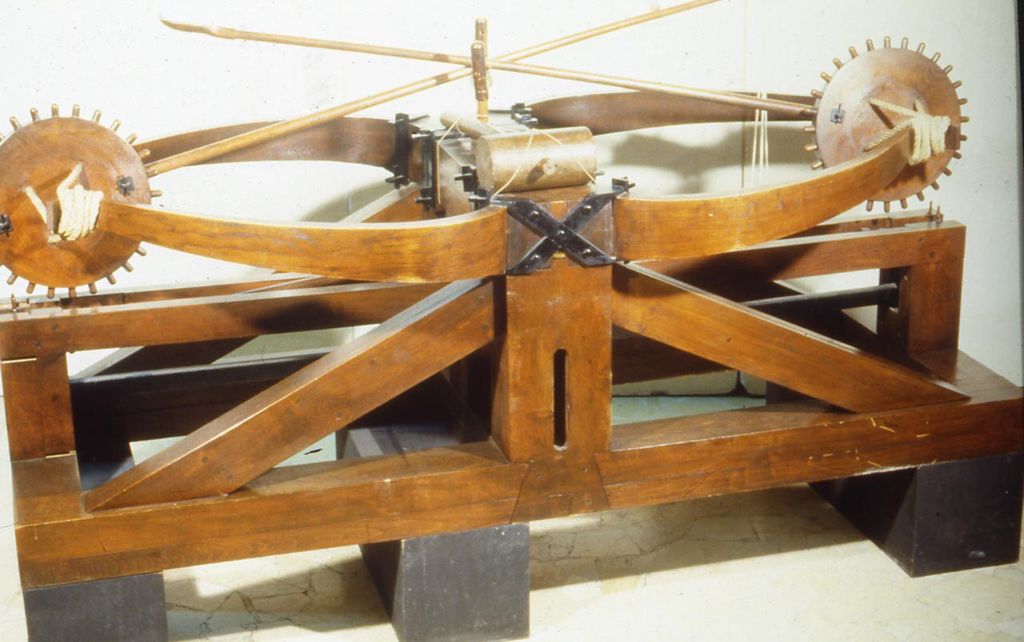
The physical feasibility remains open. The spoked handles look light for the force required, and the available arc may be insufficient. A note at the bottom says that bending the members that drive the stone would make the machine throw farther because the total motion becomes compounded. Pedretti dated the drawing around 1485 and the inscription to about 1497–1500 or later; Landrus gives the drawing a broader range of about 1485–92 and the note around 1500. The separation matters. The sentence may record Leonardo reconsidering an older design, not a contemporary report of a successful test. [6]
An engineer's claim to a court
The catapults belong to the professional identity Leonardo shaped after moving to Milan. On Codex Atlanticus 1082r survives a celebrated draft letter addressed to Ludovico Sforza. Its military inventory promises bridges, siege works, cannon, armoured vehicles, naval devices and, where cannon cannot be used, briccole, mangani and trabucchi—terms commonly translated as catapults, mangonels and trebuchets. The clause offers machines adapted to circumstances rather than one universal weapon. [9]
The document must not be read as a contract. Its hand is that of an amanuensis, not Leonardo, although its contents are accepted as representing his pitch. Scholars date it variously from about 1482 to 1485, and the surviving text is a draft with corrections. It is unknown whether a final version was delivered. Its organisation and language are promotional: Leonardo lists spectacular capacities, then offers to demonstrate anything thought impossible in the duke's park. [9]
The drawings give substance to that self-presentation without proving that every promise was fulfilled. They show the studies from which an aspiring court engineer could assemble a persuasive repertoire. Conversely, the letter explains why he might devote expensive attention to weapons already known in broad principle. Military machines were intellectual credentials, courtly commodities and potential instruments of power.
Old engines in the age of cannon
By Leonardo's Milanese years, gunpowder artillery had transformed siege warfare. His own letter gives cannon and mortars a prominent place. Mechanical engines were not an unsuspected alternative that he alone rediscovered, nor did cannon erase them everywhere at once. Comparative evidence from Poland and Bohemia shows throwing engines and firearms overlapping in late-medieval siege records, although their roles and survival varied by place. [10]
The clause “where cannon cannot be used” gives the best guide to Leonardo's reasoning. A gun required powder, metal, transport, specialist handling and ammunition suited to its bore. Mechanical artillery also demanded timber, rope, labour, space and long preparation, but might use locally available materials and stones. A counterweight engine, springald or wall thrower answered a different set of logistical and tactical conditions. Cost and availability could preserve an older technology even when a newer one had greater destructive promise.
That is context, not evidence of deployment. No secure document identifies one of the 140a, 140b or 145r machines as commissioned, constructed or used in battle. Leonardo's pages are unusually informative about concepts and mechanisms but silent about procurement, crews, firing trials and results. His written statement that a modification would throw farther remains a prediction unless supported by a documented experiment.
The books behind the drawings
Valturio belonged to a larger culture of military books and engineer manuscripts. Mariano Taccola and Francesco di Giorgio Martini had assembled images of machines, waterworks, fortifications and weapons before Leonardo's mature studies. Francesco's Trattato di architettura e macchine, made around 1478–81, is the one surviving book securely identified as Leonardo's own: twelve marginal notes show that he read it closely around 1504, and he also copied passages from a later version. [8]
This transmission does not reduce Leonardo to a copyist. Renaissance technical drawing was a way to receive, criticise and transform prior designs. A manuscript image might preserve an old engine, advertise ingenuity or stimulate a new solution without having been copied from a working machine. Leonardo's distinctive strength lay in changing viewpoint, isolating parts and drawing alternative states so that operation became visible.
The inheritance is clearest where a specific link can be made, as between Valturio's springald tradition and the 149a/145r studies. Broader claims require restraint. Taccola and Francesco establish the Sienese engineer culture in which machine images circulated; they do not supply a single source sheet for every Leonardo catapult. Influence here is a network of books, people, practices and problems.
What reconstructions can establish
Modern model makers must answer questions the folios leave open. They select timber species and thickness, rope construction, fasteners, bearings, joints, dimensions and projectile weight. They decide how a trigger locks, how force is adjusted and how many people load the engine. Some reconstructions combine the catapult drawings with locking or regulating devices found on other folios. Such choices may be mechanically intelligent, but they are additions unless the manuscript relationship is independently demonstrated. [11]
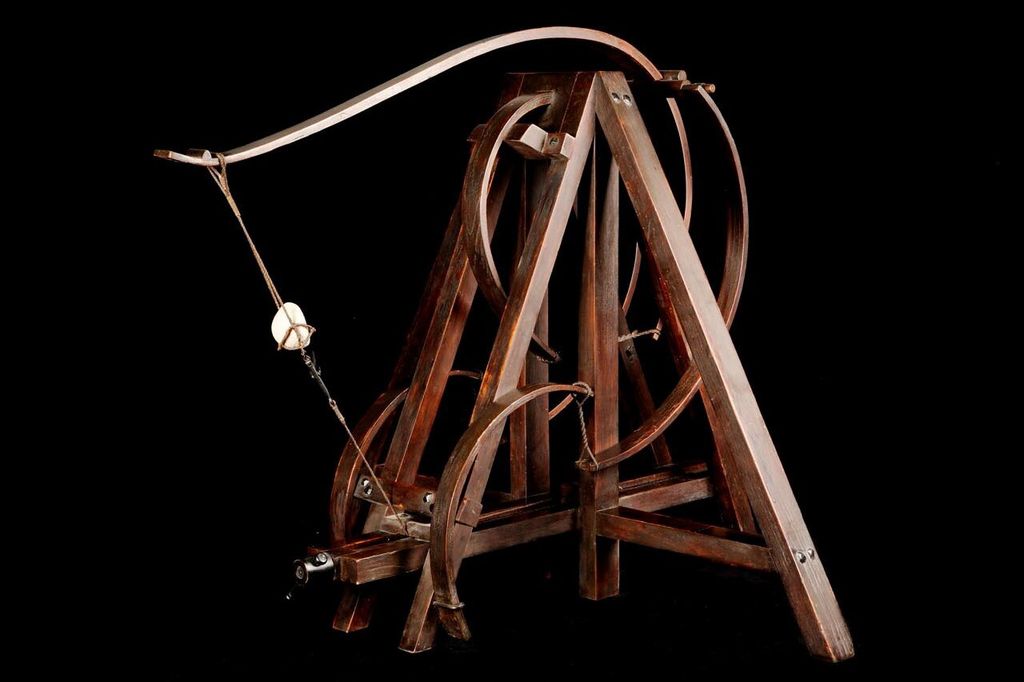
A working model can test whether one reading transmits force, releases cleanly and survives at its chosen scale. It can reveal interference that a two-dimensional drawing conceals. It cannot establish Leonardo's materials, full-size performance or battlefield use. Scaling is particularly treacherous: loads do not increase in simple proportion to length, and a small wooden replica can succeed where a monumental frame would split or deform.
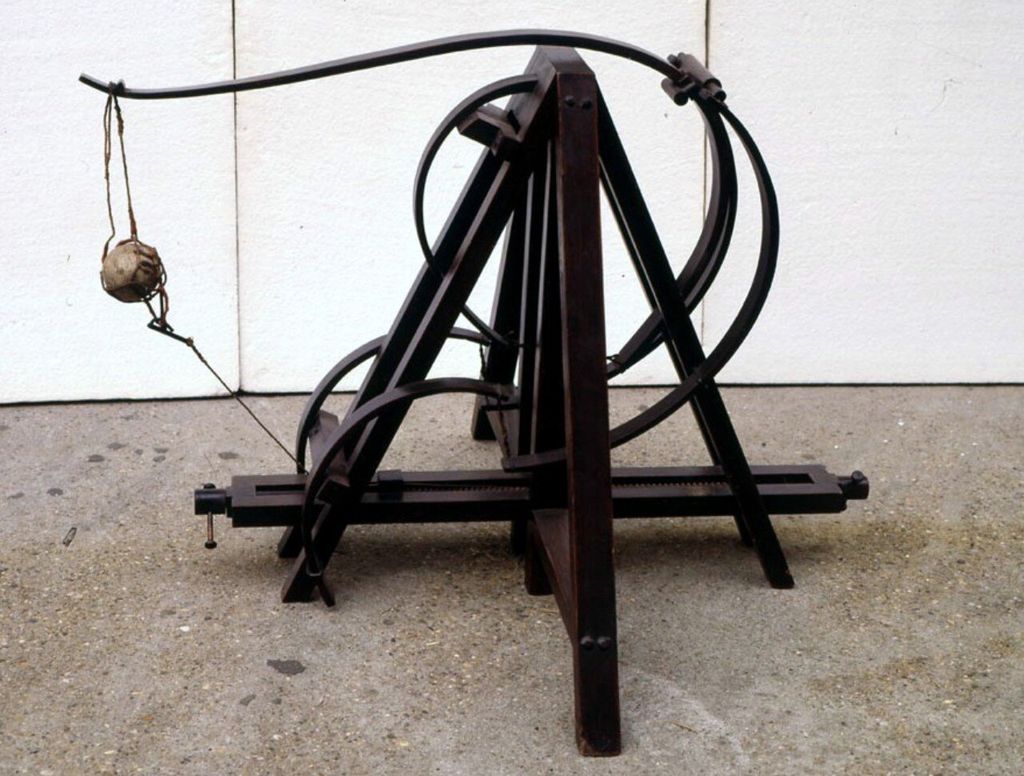
The catapult drawings remain important without a successful firing legend. They record Leonardo moving between inherited weapon types and the underlying problems of loading, restraint, release, balance and trajectory. Folio 140a separates two spoon mechanisms; 140b tests four sling arrangements; 144r turns a weapon inventory into a study of release; 145r coordinates paired forces; and 160a compares falling weight with hammer-triggered motion. Read together, they reveal an engineer investigating how energy becomes a controlled throw. That is more historically credible, and more interesting, than attributing one miraculous catapult to him.
Continue exploring Leonardo
Explore Leonardo’s works and designs
| Name | Date | Medium |
|---|---|---|
| A Map of Imola | 1502 | Drawing |
| Adoration of the Magi | About 1482 | Painting |
| Annunciation | About 1472 | Painting |
| Bacchus | Around 1517–1520 | Painting |
| Benois Madonna | Around 1478–1480 | Painting |
| Crossbow | 1485-1490 | Drawing |
| Diving Suit | — | Drawing |
| Flying Machine | — | Drawing |
| Ginevra de’ Benci | c. 1474/1478 | Painting |
| Head of a Woman (Turin) | Source-led range: 1478-1485, c. 1483-1485 or 1480s | Drawing |
| Helicopter | — | Drawing |
| Horse and Rider | — | Sculpture |
| La Bella Principessa | — | Painting |
| La Belle Ferronnière | c.1490–1497 | Painting |
| La Scapigliata | 1492–1501 ca | Painting |
| Lady with an Ermine | c. 1490 | Painting |
| Landscape Drawing for Santa Maria della Neve | Fifteenth century; inscription dated 5 August 1473 | Drawing |
| Leda and the Swan | — | Painting |
| Leonardo's Catapult Designs | late fifteenth century | Drawing |
| Leonardo's Designs for Milan Cathedral | 1487–90 | Architecture |
| Leonardo's River-Lock Drawing | late fifteenth century | Drawing |
| Leonardo's Romorantin Palace Project | 1517–18 | Architecture |
| Leonardo's Self-Propelled Cart | late 1470s–1480s | Drawing |
| Machine Gun | — | Drawing |
| Madonna Litta | Mid-1490s | Painting |
| Madonna of the Carnation | Around 1475 | Painting |
| Madonna of the Yarnwinder | — | Painting |
| Mary Magdalene | — | Painting |
| Mona Lisa | 1503 / 1519 | Painting |
| Ornithopter | — | Drawing |
| Parachute | — | Drawing |
| Portrait of a Lady: The Historic Leonardo Attribution | late fifteenth century | Painting |
| Portrait of a Man in Red Chalk (Self Portrait) | 1517/1518 or c. 1517-1518 | Drawing |
| Portrait of a Musician | About 1485 / first Milan period | Painting |
| Portrait of Isabella d’Este | Around 1499/1500 | Drawing |
| Profile of an Ancient Captain | c. 1475–1480 | Drawing |
| Rearing Horse and Mounted Warrior | First half of the 16th century | Sculpture |
| Saint Jerome in the Wilderness | About 1480–1482 / 1481–1482 | Painting |
| Saint John the Baptist | Around 1508–1519 | Painting |
| Salvator Mundi | — | Painting |
| Study of Hands | c.1480 | Drawing |
| The Baptism of Christ | About 1470–75 | Painting |
| The Battle of Anghiari | — | Painting |
| The Burlington House Cartoon | About 1506–8 | Painting |
| The Fetus in the Womb | c. 1511 | Drawing |
| The Last Supper | 1495–1498 in the Museo del Cenacolo Vinciano object table | Painting |
| The Sforza Horse Monument | 1480s–1499 | Sculpture |
| The Trivulzio Monument | c. 1506–13 | Sculpture |
| The Virgin and Child with Saint Anne | Around 1503–1519 | Painting |
| Triple Barrel Cannon | — | Drawing |
| Virgin of the Rocks | — | Painting |
| Vitruvian Man | Generally associated with Leonardo’s Milanese years, around 1490; exact dating remains cautious | Drawing |
| Wreath of Laurel, Palm, and Juniper with a Scroll | c. 1474/1478 | Drawing |
Frequently Asked Questions
Discussion
Which part of the evidence changes the way you read Leonardo's Catapult Designs? The article sets surviving material beside later interpretation; share the distinction that matters most to you.
Reader Insights
What detail in the images or drawings is easiest to miss on a first viewing?
How does correcting the identity of “folio 140r” alter your understanding of this subject?
Where does the article leave a question open rather than presenting a settled answer?
Join the Conversation
Share your reading of Leonardo's Catapult Designs below.
References
- Veneranda Biblioteca Ambrosiana, “Codex Atlanticus, folio 140 r,” Google Arts & Culture. View Source
- Museo Galileo, Leonardo//thek@, Codex Atlanticus f. 140a r (ATL.0279.1). View Source
- Museo Galileo, Leonardo//thek@, Codex Atlanticus f. 140b r (ATL.0279.2). View Source
- Museo Galileo, Leonardo//thek@, Codex Atlanticus f. 144r (ATL.0287.1). View Source
- Museo Galileo, Leonardo//thek@, Codex Atlanticus f. 160a r (ATL.0319.1). View Source
- Museo Galileo, Leonardo//thek@, Codex Atlanticus f. 145r (ATL.0289.1). View Source
- Museo Galileo, Leonardo//thek@, Codex Atlanticus f. 149a r (ATL.0297.1). View Source
- Max Planck Institute for the History of Science, “Francesco di Giorgio Martini, Trattato di architettura e macchine, 1478–1481”. View Source
- Museo Galileo, Leonardo//thek@, Codex Atlanticus f. 1082r, draft letter to Ludovico Sforza. View Source
- Piotr Strzyż, “Throwing Engines versus Gunpowder Artillery in Siege Activities in the Middle Ages: An Example of the Kingdoms of Poland and Bohemia,” Fasciculi Archaeologiae Historicae 33 (2020). View Source
- European Commission / Artisans of Florence, Leonardo da Vinci: The European Genius, reconstruction catalogue. View Source
- Museo Galileo, “Leonardo//thek@ 2.0,” integrated Codex Atlanticus and Windsor research environment. View Source