 by Tom Gurney
Tom Gurney BSc (Hons) is an art history expert with over 20 years experience
Published on June 19, 2020 / Updated on July 30, 2026
Email: tomgurney1@gmail.com / Phone: +44 7429 011000
Virgin and Child Enthroned: Introduction
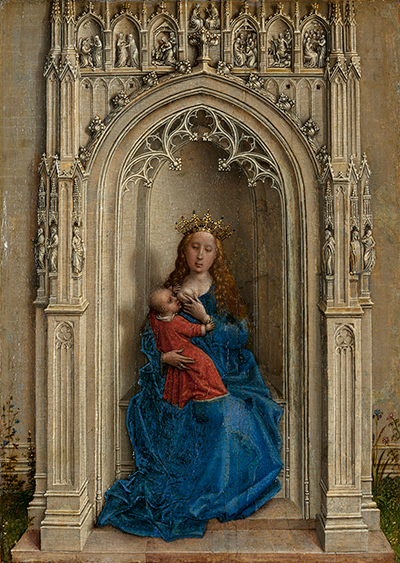
The Virgin and Child Enthroned, sometimes called the Thyssen Madonna, matters because it shows Rogier van der Weyden near the beginning of his surviving career. It is still close to the world of Robert Campin and Jan van Eyck, but already interested in the sculptural niche, symbolic architecture and compressed devotional presence that would later become central to his mature art. [1] [2]
The panel is in the Museo Thyssen-Bornemisza in Madrid. It is small, usually dated around 1430-1433, and is often discussed in relation to the National Gallery of Art's Saint George and the Dragon. [2] [3]
This page should be read as an early-work page, not as a substitute for the larger Duran Madonna. Both are Virgin and Child images, but they solve different problems. The Thyssen panel is tiny, architectural and experimental; the Duran Madonna is larger, more sculptural and more fully developed.
At a Glance
- ArtistUsually attributed to Rogier van der Weyden
- TitleVirgin and Child Enthroned / Thyssen Madonna
- DateUsually around 1430-1433
- MediumOil on panel
- DimensionsAbout 15.8 x 11.4 cm in common references
- Current locationMuseo Thyssen-Bornemisza, Madrid
- SubjectVirgin and Child in a small architectural niche
Contents
- Introduction
- At a Glance
- A Tiny Architectural World
- Mary, Throne And Sacred Status
- Early Style And Influence
- Possible Diptych With Saint George
- Relation To Duran Madonna And Saint George
- Why It Matters
- FAQs
- Discussion
- References
A Tiny Architectural World
The panel places the Virgin and Child inside a tiny Gothic architectural setting. The space is too small to be naturalistic, and that is part of its force. Rogier makes the architecture behave like a devotional shrine rather than a believable room.
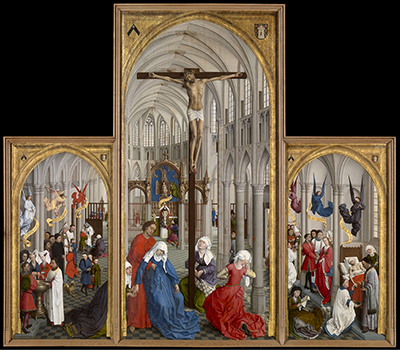
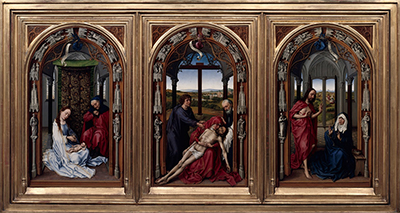
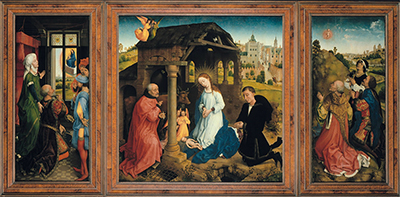
In the Duran Madonna, Miraflores Altarpiece, Saint John Altarpiece and Descent from the Cross, Rogier keeps testing how painting can imitate, activate or transform sculpture and architecture.
The value of the Thyssen panel is different. It shows Rogier working in miniature intensity, compressing architecture, prophecy, motherhood and devotional attention into a handheld or intimate scale.
The small scale changes how the viewer reads the image. Rather than standing before a large altarpiece, the viewer imagines close looking. Details of architecture, throne, figures and ornament become unusually important because the whole image is so compressed.
Smallness is not a weakness here. It is part of the devotional experience. A tiny panel can ask for a more private kind of attention than a large public altarpiece. The viewer must come close, and that closeness makes the architecture and figures feel intensely concentrated.
This is one reason the painting deserves its own page even though the cluster also includes the Duran Madonna and other Virgin and Child images. The Thyssen panel shows Rogier thinking through scale: how much sacred presence can be held inside a very small format?
Mary, Throne And Sacred Status
The title's word "enthroned" matters. This is not simply a mother holding a child. The Virgin is given a formal sacred status through her seat, architectural enclosure and the image's shrine-like framing.
That status is balanced against intimacy. The figures are small and close, but the architecture elevates them. Rogier's early achievement is to make the Virgin and Child feel both near and set apart.
This tension continues in later Rogier works. The Duran Madonna makes the figures more physically present, while the Saint Columba Altarpiece and Miraflores Altarpiece place Marian imagery inside larger narrative structures. The Thyssen panel is an early, compact version of the same concern: how can motherhood, sacred authority and devotional presence coexist in one image?
The enthroned format also guards against reading the painting as merely tender. Mary is intimate, but she is also queenly and sacred. The Child is close, but the setting gives him theological weight. Rogier's early art already understands that devotional images need to balance human nearness with sacred distance.
Early Style And Influence
The painting is often discussed in relation to Robert Campin and Jan van Eyck. Campin's influence can be felt in the figure type and intimate physicality, while Van Eyck's influence appears in the use of luminous detail and niche-like sacred presence. [1] [2]
Rogier learned from existing models, then pushed them toward a more emotionally concentrated and sculptural language.
The iconographic density also belongs to early Rogier. The small architectural setting can carry prophets, Marian symbols and scenes that point forward to Christ's life and Passion. If a viewer looks only at the central mother and child, the image may seem simple. Look at the frame and niche, and it becomes a compact theological structure.
Possible Diptych With Saint George
Any connection with related devotional panels remains cautious. The useful point is broader: small panels could work as paired or portable images, and their original settings are not always recoverable.
The panel has often been discussed in relation to the NGA Saint George and the Dragon. [3] One panel would present the Virgin and Child in an otherworldly architectural shrine; the other would show a saintly knight acting in a more worldly landscape. The contrast between sacred stillness and active witness is exactly the kind of relationship early Netherlandish diptychs could exploit.
This possibility should not be overstated, but it is valuable for interpretation. It shows how small devotional panels can lose part of their original meaning when separated from possible companions. The object now seen as a single painting may once have belonged to a more complex devotional arrangement.
That uncertainty is useful for readers. It shows that museum objects often survive without their original partners, frames or functions. The page can therefore teach caution while still explaining why scholars compare the Thyssen Madonna with Saint George and the Dragon.
Relation To Duran Madonna And Saint George
The Thyssen panel also helps explain why the cluster includes both Virgin and Child Enthroned and the Duran Madonna. The two works are not duplicates. The Thyssen panel is about early compact architecture and possible diptych context. The Duran Madonna is about a more developed sculptural niche, red drapery and the Child with a book.
Its connection with Saint George and the Dragon is also useful because it keeps the early Rogier section from becoming only Marian. The possible relationship between a Marian panel and a chivalric saint gives readers a way to think about paired images, patronage and devotional contrast.
Why It Matters
The painting helps explain Rogier's early Madonna imagery, the move from Campin and Van Eyck inheritance to Rogier's mature style, small-scale devotional panels, the possible diptych relationship with Saint George and the Dragon, and the sculptural-niche idea that grows in the Duran Madonna.
It is a small page in object scale, but not in interpretive value. It gives the cluster a compact early-work anchor and helps readers see that Rogier's later monumental clarity was built from experiments in tiny, highly charged devotional spaces.
The page also helps clarify the cluster's treatment of attribution and early style. Because early Rogier is tied to Campin, Van Eyck and workshop questions, the safest interpretation avoids pretending that every early object is simple or fully settled. The value of the Thyssen panel lies in what it reveals about early Netherlandish devotional language: small scale, architectural framing, symbolic density and sacred nearness.
Read beside Robert Campin, Jan van Eyck and Rogier's later Madonnas, the panel becomes a useful bridge between inheritance and invention. It shows Rogier learning from the visual world around him while moving toward his own compressed, sculptural kind of devotion.
It also strengthens the cluster's internal route through early Netherlandish artists. The page can point readers toward Campin and Van Eyck without reducing Rogier to either one. That is the useful balance: Rogier emerges from a shared visual culture, but his mature character can already be sensed in the pressure of the tiny niche, the concentrated figures and the intense devotional scale.
For that reason, the panel is best treated as a small but strategic page. It helps explain where Rogier came from, how his Marian imagery developed, and why even his earliest associated works are already concerned with presence, framing and sacred nearness.
FAQs
It is in the Museo Thyssen-Bornemisza in Madrid. [2]
It is one of the earliest surviving works associated with Rogier and shows his early interest in architectural niches and devotional compression.
It may have been paired with the NGA Saint George and the Dragon, but this remains a possibility rather than a certainty. [3]
The Thyssen panel is smaller and earlier, with a compact enthroned Virgin in an architectural niche. The Duran Madonna is larger and more fully developed as a sculptural Virgin and Child image.
Discussion
How does the Virgin and Child Enthroned balance devotional intimacy, throne imagery, fabric, architecture and sacred status?
Reader Insights
The throne changes the relationship between tenderness and authority, placing the Virgin and Child inside a more formal devotional image.
Textiles, edges and setting are not only decorative; they help frame sacred status through Netherlandish precision.
Read this with the Duran Madonna and Virgin and Child pages to follow Rogier's Marian imagery beyond the famous Passion works.
Join the Conversation
Have a thought or observation about Virgin and Child Enthroned? Share it below. Thoughtful responses may be added to this section as the Rogier van der Weyden cluster develops.
References
- Wikipedia, Virgin and Child Enthroned, accessed 2026-07-11. https://en.wikipedia.org/wiki/Virgin_and_Child_Enthroned
- Museo Thyssen-Bornemisza collection entry for The Virgin and Child Enthroned, accessed 2026-07-11. https://www.museothyssen.org/en/collection/artists/weyden-rogier-van-der/virgin-and-child-enthroned
- National Gallery of Art, Washington, Saint George and the Dragon, collection record for 1966.1.1, accessed 2026-07-11. https://www.nga.gov/artworks/50662-saint-george-and-dragon
- John Oliver Hand, Catherine Metzger and Ron Spronk, Prayers and Portraits: Unfolding the Netherlandish Diptych, 2006.