 by Tom Gurney
Tom Gurney BSc (Hons) is an art history expert with over 20 years experience
Published on November 5, 2026 / Page Updated on November 5, 2026
Email: tomgurney1@gmail.com / Phone: +44 7429 011000
Introduction
Thomas Gainsborough's fancy pictures and related rustic subjects occupy one of the most delicate areas of his art. They are not straightforward portraits, not simple landscapes, and not documentary scenes of rural life. They bring children, cottages, carts, country girls, animals, woods, water and twilight into images that feel emotionally immediate but are carefully made. The difficulty is that their charm can mislead. If they are treated only as sweetness, their invention disappears. If they are treated only as social evidence, their painterly freedom disappears.
The term fancy picture is best used cautiously. It can help describe Gainsborough's interest in invented figure subjects, especially children and rustic figures whose identity is less fixed than that of a commissioned sitter. It should not be used as a licence to invent meanings without evidence. In Gainsborough, this territory sits between portraiture, landscape, genre-like scene, family study and poetic rural image. A child may be a daughter, a model, an emblem of transience, or a figure in a landscape rhythm. A cart may suggest work, movement, market, return, pleasure or speculation. The point is to keep those possibilities distinct.
Gainsborough's House describes him as an artist for whom landscape remained an abiding concern, even while portraiture was more lucrative, and notes that he often fused landscape and portraiture in inventive ways.[1] The same account also says that in his later years he expanded into mythological and so-called fancy pictures with stronger narrative content.[1] That combination is the key. Fancy pictures do not sit outside the rest of the career. They grow from the same habits that animate his portraits and landscapes: touch, movement, mood, figure study, rural memory, old-master looking and the visual pleasure of paint.
At a Glance
- ArtistThomas Gainsborough
- Working termInvented or semi-invented figure subjects, used cautiously [1]
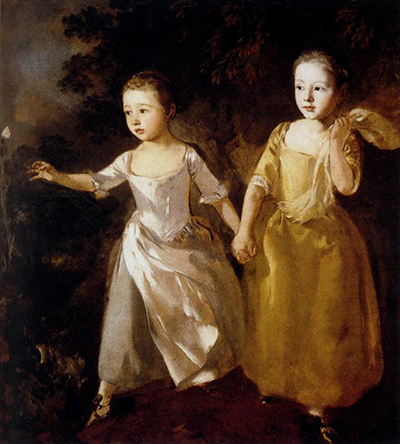
- Central child imageThe Painter's Daughters chasing a Butterfly [3]
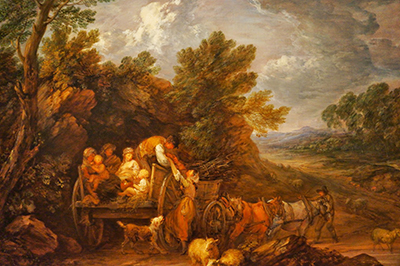
- Rustic landscapeThe Harvest Wagon, exhibited in 1767 [6]
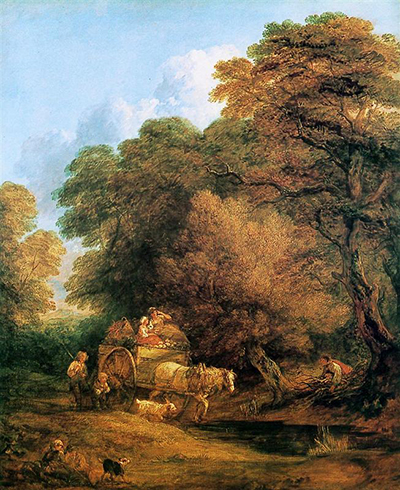
- Late cart sceneThe Market Cart, painted in 1786 [7]
- Contemplative subjectThe Watering Place, exhibited in 1777 [8]
- Shared territoryPortraiture, landscape, family study and genre-like rural scene
- Interpretive cautionDo not turn unnamed figures into unsupported biographies
- Career settingPrivate feeling, public exhibition, studio invention and market [9]
- ExplorePaintings; Peasant Girl with Dog and Jug
Contents
- Introduction
- Defining the Territory Carefully
- Children, Daughters and Experiment
- Rustic Figures Without Moral Flattening
- Carts, Roads and Rural Movement
- Water, Cattle and Contemplative Rural Scenes
- Portrait, Landscape and the In-Between
- Childhood and the Problem of Sentiment
- Rural Poverty, Pleasure and Distance
- Looking Without Overclaiming
Defining the Territory Carefully
Fancy pictures are easiest to misunderstand when the phrase is treated as a tidy category with fixed borders. Gainsborough's practice is more fluid. Some works are family portraits that behave like poetic images, such as The Painter's Daughters chasing a Butterfly. Some are landscapes with unusually prominent rustic figures, such as The Harvest Wagon. Some are late rural cart scenes, such as The Market Cart, where ordinary movement becomes a meditation on passage. Some landscape subjects, including The Watering Place, bring country figures, animals and old-master memory into a contemplative rural setting.
The category therefore works best as a field of relations rather than a box. It gathers works in which named portraiture loosens, rural figures grow in importance, landscape becomes emotionally active, and invented or semi-invented scenes invite feeling without offering one fixed story. This makes the pictures rich but also risky to describe. Their subjects often look accessible, but they are not simple illustrations.
The National Gallery of Art's retrospective record for Thomas Gainsborough, 1727-1788 is useful because it presents the artist's achievement across several practices, bringing together likenesses, landscape invention, drawn work and images of rural poverty.[2] This breadth helps prevent a narrow reading of Gainsborough as only a society portraitist. It also prevents the rustic works from being treated as marginal curiosities. They are part of the full sweep of his invention.
The words used for this territory should therefore remain tools for looking, not verdicts delivered in advance. A single work may belong to more than one conversation. The Painter's Daughters chasing a Butterfly can be discussed as family portraiture, an image of childhood, a wooded scene and an experiment in unfinished paint. The Harvest Wagon can be approached through landscape, rustic figure study, rural labour, friendship and the economics of an artist making works outside straightforward commission. The usefulness of a label depends on whether it helps preserve that doubleness.
At the same time, modern readers should avoid turning every child or rural figure into a moral prop. Gainsborough's art often suggests tenderness, vulnerability and transience, but suggestion is not the same as certainty. Good interpretation should begin with the object: who is shown, what is known, what is uncertain, how the figures move, what the landscape does, and how the paint has been handled.
Children, Daughters and Experiment
The Painter's Daughters chasing a Butterfly is the central child image because it is both intimate and experimental. The National Gallery identifies the girls as Mary and Margaret Gainsborough, the artist's daughters by Margaret Burr, and dates the painting probably about 1756.[3] It is unfinished, oil on canvas, 113.5 by 105 centimetres, and entered the National Gallery through the Henry Vaughan Bequest in 1900.[3] Those facts place it within family portraiture, but the picture behaves more freely than a conventional likeness.
The two girls run hand in hand through dark woodland, pursuing a cabbage white butterfly that has landed on a tall thistle.[3] Margaret reaches; Mary gathers her apron as if to catch the insect.[3] The National Gallery says the attempt may suggest the fleeting nature of childhood and the fragility of children's lives, and that cautious wording matters.[3] The butterfly is suggestive, not a closed allegorical label.
Judy Egerton's catalogue entry deepens the reading without shutting it down. It explains that the painting was probably made in Ipswich about 1756, when Mary appears about six and Margaret about four or five, and that it may have passed to the Revd Robert Hingeston, Master of Ipswich School, who lived close to Gainsborough's rented house.[4] The same entry emphasises the boldness of the nearly life-sized figures and the freedom Gainsborough found in painting his own children.[4]
That freedom is one of the roots of the fancy-picture problem. The girls are identifiable, yet the painting also works as a poetic image of childhood in motion. It is family portrait, landscape, technical experiment and symbolic scene at once. The unfinished surface contributes to that openness: the pinkish-brown ground shows through in places, the girls' faces are more finished than the surrounding passages, and loose handling makes the chase feel alive.[3][4]
The National Gallery's article on Gainsborough's daughters also stresses that family images allowed him to work outside the full pressure of patron demands.[5] He knew the sitters intimately, which gave him access to gestures and moods different from formal portraiture.[5] That does not make the pictures private diary entries. It means that affection, observation and experimentation could meet with unusual directness.
Rustic Figures Without Moral Flattening
Rustic figures in Gainsborough need the same care as children. They can be emotionally engaging without being simple symbols of innocence, poverty or virtue. In The Harvest Wagon, the Barber Institute of Fine Arts describes rustic figures travelling in a harvest wagon at the end of the working day.[6] The figures are unusually prominent for Gainsborough's landscapes and are the result of careful study.[6] Two of the women are based on the artist's daughters, while the landscape is inspired by countryside around Bath.[6]
This evidence gives the painting its complexity. The figures are rustic, but they are studied. The scene is rural, but not documentary. The daughters' connection adds intimacy, but the picture is not a family portrait in disguise. The Barber also records a non-commissioned context of pleasure and possible sale, and says Gainsborough presented the work to Walter Wiltshire when he moved to London in 1774, in thanks for the grey horse shown in the painting.[6]
That evidence shows that these landscapes could be made for enjoyment and possible sale rather than on portrait commission, while also becoming gifts within networks of friendship. The mixture is very Gainsborough. It keeps The Harvest Wagon from becoming only an image of harvest labour. The wagon is a moving stage. The figures gather into a procession. The horse carries both pictorial weight and the memory of a gift. The landscape evokes Bath without becoming a precise topographical record. The rustic subject is therefore constructed from several kinds of relation: rural movement, personal study, patron friendship and painterly ambition.
The temptation is to use rustic imagery as a shortcut to feeling. Gainsborough's rural figures often invite sympathy, but the sympathy is made through composition and handling. A bent body, a lifted arm, a child's position on a cart, a resting group by water, or a girl reaching toward an insect becomes meaningful because of how the whole image is arranged. The figures are not simply moral examples placed in a countryside frame.
Carts, Roads and Rural Movement
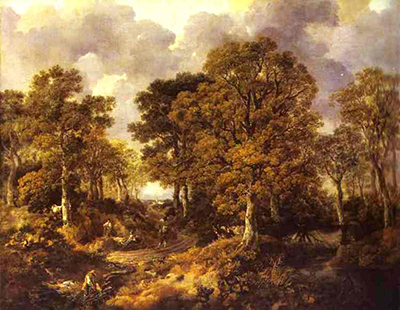
Carts were a repeated and flexible motif for Gainsborough. They offered wheels, weight, animals, children, produce, roads, sloping tracks and the feeling of a passing moment. The National Gallery's account of The Market Cart describes a horse-drawn cart travelling along a woodland path toward market, with children, produce, travellers and a dog.[7] It records the work as one of Gainsborough's last landscapes, painted in 1786, and notes that the original position of the horse's head can now be seen through the paint.[7]
The same National Gallery account explicitly warns against reducing The Market Cart to accurate rural documentation or ideal landscape; it suggests the work may be about transience.[7] That is a useful model for many of Gainsborough's rustic pictures. The cart is real enough to carry produce, people and a horse, but the painting's meaning lies in motion, perishability and the viewer's glimpse of a scene already passing.
The Harvest Wagon and The Market Cart should therefore be related but not confused. The Barber picture is anchored in Bath in 1767: a return after work, Wiltshire's gift-horse, and the later 1774 presentation to a patron-friend.[6] The National Gallery's 1786 cart scene turns instead toward market produce, late landscape ambition and a sharper feeling of passage.[7] Both depend on rural movement, yet their emotional structures differ.
The cart motif also helps explain why these works sit between landscape and fancy picture. A cart scene can be a landscape because trees, track, water and light organise the world around it. It can be genre-like because figures perform ordinary action. It can be poetic because the action becomes a meditation on passing time. Gainsborough's achievement is to hold those possibilities together without making the picture stiff.
Water, Cattle and Contemplative Rural Scenes
The Watering Place shows a related but calmer form of rustic invention. The National Gallery describes cattle and goats drinking from a stream or pool, with two country girls, a child and a man resting nearby in evening light.[8] The work was probably made after Gainsborough returned from Bath to London, was exhibited at the Royal Academy in 1777 as a large landscape, and drew praise that left viewers uncertain whether he excelled more in landscape or portraiture.[8]
This painting matters for fancy-picture thinking because the rural figures do not dominate in the way they do in The Harvest Wagon. Instead, they form part of a broader contemplative scene. The girls, child, animals, herdsman, water, trees and sunset create a rural mood rather than a tight anecdote. Their stillness contrasts with the chase in The Painter's Daughters and the movement of the carts.
The National Gallery also connects The Watering Place to Rubens, while making clear that Gainsborough did not simply copy Rubens's painting of the same later title.[8] Gainsborough's version is quieter, evening-toned and contemplative, with placid animals rather than Rubens's more energetic cattle.[8] This helps clarify his rural invention. He could absorb old-master example while transforming it into a different emotional weather.
The work also shows that rustic or country figures need not always imply narrative drama. Sometimes they establish scale, repose and atmosphere. A seated group beside water can be less about story than about the mood of waiting, drinking, resting and looking. Gainsborough's rural people are often most powerful when they resist being explained too quickly.
Portrait, Landscape and the In-Between
The strongest fancy pictures are not escapes from portraiture or landscape; they are crossings between them. The Painter's Daughters keeps portrait identity while moving into symbolic landscape. The Harvest Wagon keeps landscape structure while making rustic figures unusually prominent. The Market Cart uses a road, cart and produce to turn landscape into an image of movement. The Watering Place gives country figures and animals a place within a large old-master-inflected rural mood.
Gainsborough's House describes him as innovative in joining landscape and portraiture within single compositions.[1] In the fancy-picture field, this innovation becomes freer. The figures need not be socially identified sitters, and the landscape need not be a named estate or exact prospect. The image can depend on mood, gesture, movement, costume, setting and touch.
This in-between quality is why the works remain fresh. They are not bound to the public duties of grand portraiture, but neither are they casual sketches. They ask the viewer to look for tone: tenderness, unease, transience, pleasure, speculation, play, rest, return or contemplation. Those tones are made through paint and composition, not attached afterward as slogans.
Rosenthal's Paul Mellon Centre study is useful because it frames Gainsborough's career within a changing world of artistic production, commercial pressure and visual variety.[9] Fancy pictures sit squarely within that world. They gave Gainsborough ways to produce visual pleasure beyond commissioned likeness, but they also had to live in a market and exhibition culture where category, subject and charm mattered.
Childhood and the Problem of Sentiment
Gainsborough's images of children can be deeply moving, but they should not be reduced to sentimental childhood. In The Painter's Daughters, the children's affection is visible in their clasped hands, but the dark wood and fragile butterfly complicate the scene.[3] In later daughter portraits, according to the National Gallery and Egerton, the sisters appear with a cat, as gleaners, as students of drawing and in later companionship.[3][4][5] The sequence is affectionate, but not one-note.
Sentiment becomes a problem when it makes children passive. Gainsborough's children are often active: running, reaching, holding, protecting, playing, learning or moving through landscape. Their bodies matter as much as their faces. In the butterfly picture, Margaret's reach and Mary's apron shape the whole composition. Their childhood is not a decorative condition; it is an action.
The same caution applies to unnamed or less securely identified children in rustic pictures. They should not be used merely as convenient symbols of rural innocence. A child on a cart, a child beside water, or a girl in a wooded landscape may help produce sympathy, but the image also depends on scale, rhythm, colour, movement and the relation of body to setting. The moral feeling is inseparable from the pictorial structure.
This matters especially because Gainsborough's later work includes fancy and rustic subjects that circulate widely in reproduction. Public familiarity can make them seem simpler than they are. The responsible approach is to keep returning to current museum records and catalogue evidence for facts, while allowing visual interpretation to remain open where evidence does not decide the matter.
Rural Poverty, Pleasure and Distance
The National Gallery of Art retrospective record includes scenes of the rural poor within Gainsborough's broader output.[2] That phrase is useful, but it should be handled carefully. Gainsborough did paint rural figures who can be read in relation to poverty, labour or social vulnerability, but his pictures are rarely straightforward social documents. They often transform rural subjects through grace, mood and painterly pleasure.
This creates an ethical difficulty for modern viewers. A rustic child, cottage figure or country traveller may appear charming, yet the charm can soften the social realities implied by poverty or labour. At the same time, to treat the figures only as evidence of hardship can miss Gainsborough's art: the way he arranges bodies, trees, roads, light and touch into images of feeling. Both flattening moves should be resisted.
The better approach is to keep rural pleasure and social distance in view at the same time. The Harvest Wagon includes rustic figures, but the Barber's evidence also points to careful study, daughters used as models, pleasure or speculation, and a gift to Walter Wiltshire.[6] The Market Cart involves produce and market movement, but the National Gallery warns against reading it as literal record or simple idealisation.[7] These pictures are artful rural inventions with social implications, not transparent reports.
That does not make them evasive. It makes them complex. Gainsborough's rural scenes often draw their power from the tension between sympathy and distance. The viewer is invited close enough to care, but not given enough to convert the figures into full biographies. They remain pictorial presences: moving, resting, reaching, carrying, waiting.
This distance is part of the historical subject. Many viewers who admired such works were not themselves the rural poor, and Gainsborough's pictures often translate hardship-adjacent subjects into forms of grace, dusk, softness and compositional pleasure. That translation can be beautiful and uncomfortable at once. It does not require accusing the artist of insincerity, nor does it require accepting charm as innocence. It asks for a double attention: to the visual intelligence of the work and to the social gap that made such looking possible.
The same double attention helps with cottage and child subjects that are not tied to secure individual histories. Where a figure is unnamed, it is tempting to supply a story that the evidence cannot support. A more disciplined reading can still be vivid. It can describe posture, light, clothing, scale, glance, setting and touch; it can compare the figure's role with better-documented works; it can admit sympathy without pretending to know the whole life behind the image.
Looking Without Overclaiming
A careful way to look at Gainsborough's fancy pictures begins with identity. Are the figures named, as Mary and Margaret are? Are they based on known models, as two women in The Harvest Wagon are said to be? Are they anonymous country figures? The answer changes the reading. Named daughters require family context; rustic figures require caution against turning them into fictional biographies.
The next question is movement. Are the figures running, travelling, resting, pointing, reaching, riding or waiting? Movement often carries meaning in Gainsborough. The butterfly chase is urgent and unfinished. The harvest wagon returns after work. The market cart travels toward sale and perishability. The watering group sits within evening calm. These are different kinds of rural time.
Then look at the setting. Is the landscape dark and symbolic, Bath-inspired, wooded, watery, road-based, old-master-inflected or linked to a specific place? Gainsborough rarely uses landscape as neutral background. It gives emotional temperature. It can make childhood feel vulnerable, rustic travel feel graceful, or animal rest feel contemplative.
Finish and scale also matter. The unfinished condition of The Painter's Daughters chasing a Butterfly changes the way the scene is felt: the exposed ground, looser surrounding passages and more concentrated faces make the chase seem half-caught in the act of becoming.[3][4] In The Watering Place, the large format and evening breadth give rustic figures and animals a slower dignity.[8] In the cart pictures, the handling of horse, wheel, tree, path and cargo produces movement as much as description. Fancy and rustic subjects are not all made in the same key; their meanings depend on size, surface and tempo.
Finally, keep the category provisional. Fancy picture, rustic subject, child portrait, landscape, genre-like scene and family image are useful terms only if they sharpen looking. If they become labels pasted over the painting, they stop helping. Gainsborough's best works in this field survive because they are mixed, not because they fit cleanly.
Why Fancy Pictures Matter
Gainsborough's fancy pictures and related rustic subjects matter because they reveal how much invention could happen away from formal likeness. Portraiture made his reputation and income, but these works show another form of ambition: the desire to make children, rural figures, carts, animals, cottages, water and trees carry emotional pressure without relying on a named sitter's status.
They also matter because they connect different parts of the career. The daughter portraits belong to family life and portrait experiment. The cart pictures belong to landscape, rural movement and market imagery. The Watering Place belongs to old-master response, Royal Academy display and contemplative landscape. Together they show Gainsborough moving between private feeling, public exhibition, studio invention and the art market.
The best of these works are neither innocent nor cynical. They invite tenderness while resisting easy explanation. They can be charming without being trivial, socially suggestive without being documentary, and poetic without being vague. That balance is why they remain some of the most alive parts of Gainsborough's art.
They are also useful because they set limits on confidence. Where firm catalogue evidence exists, it should carry the weight: Mary and Margaret in the butterfly picture, Bath and Wiltshire in The Harvest Wagon, the 1786 date and market journey in The Market Cart, the Royal Academy showing of The Watering Place. Where that kind of evidence is absent, the stronger interpretation is often to discuss a wider type or visual habit rather than attach confident histories to individual works. Gainsborough rewards imagination, but he rewards disciplined imagination most.
Above all, they matter because they make looking active. A child reaches; a butterfly hovers; a wagon moves; a cart passes; cattle drink; figures rest in fading light. Nothing is entirely still, and nothing is entirely explained. Gainsborough's fancy pictures hold the viewer in that mobile space between recognition and uncertainty, where visual pleasure becomes thoughtful rather than merely decorative.
Frequently Asked Questions
Discussion
Which boundary is most useful when looking at Gainsborough’s fancy pictures?
Reader Insights
When does a named likeness begin to operate as an invented image?
How do woods, roads, water and carts give figures emotional force?
How can visual pleasure remain attentive to rural labour and social difference?
Join the Conversation
Share your reading below.
References
- Gainsborough's House, “About Thomas Gainsborough.” View source.
- National Gallery of Art, Washington, “Thomas Gainsborough, 1727-1788.” View source.
- National Gallery, London, “Thomas Gainsborough, The Painter's Daughters chasing a Butterfly.” View source.
- Judy Egerton, “The Painter's Daughters chasing a Butterfly,” in National Gallery Catalogues: The British Paintings (London: National Gallery Company and Yale University Press, 2000), National Gallery, London. View source.
- National Gallery, London, “Gainsborough's daughters.” View source.
- The Barber Institute of Fine Arts, “Thomas Gainsborough: The Harvest Wagon.” View source.
- National Gallery, London, “Thomas Gainsborough, The Market Cart.” View source.
- National Gallery, London, “Thomas Gainsborough, The Watering Place.” View source.
- Michael Rosenthal, The Art of Thomas Gainsborough: "A Little Business for the Eye" (New Haven and London: Yale University Press for the Paul Mellon Centre for Studies in British Art, 1999). Publication record.