 by Tom Gurney
Tom Gurney BSc (Hons) is an art history expert with over 20 years experience
Published on June 19, 2020 / Updated on October 16, 2026
Email: tomgurney1@gmail.com / Phone: +44 7429 011000
The Secret and Bouguereau's Theatre of Confidence
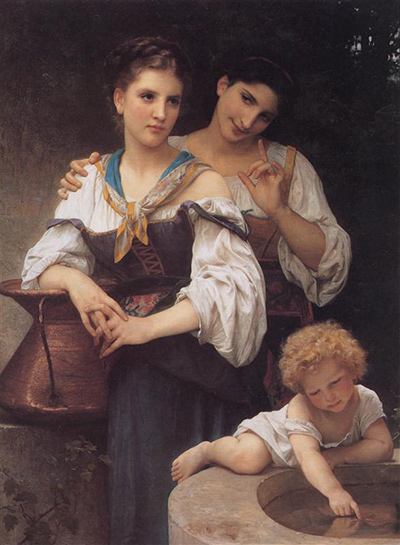
William-Adolphe Bouguereau's The Secret, also known by the French title Le Secret, is an 1876 oil painting built around the drama of withheld information. The picture presents two young women and a child near a fountain, but its real subject is the suspended moment between disclosure and silence. One figure leans close to the other, while the foreground woman turns outward with a guarded expression. The title gives the viewer a clue, yet it does not explain exactly what has been said.
That restraint is part of the painting's appeal. Bouguereau was often praised for finish, surface and idealized figure painting, but a work such as The Secret also shows his skill at narrative economy. He does not need a crowded scene or historical costume to create tension. A lowered voice, a touch at the shoulder and a carefully arranged group are enough to make the viewer feel that private information has entered the scene.
The page keeps The Secret as its public title because that is the protected local route and the title used by the strongest captured object trail. The French title Le Secret appears as a title variant. That approach lets the article stay clear for readers while still acknowledging the painting's catalogue and image-history routes.
At a Glance
- ArtistWilliam-Adolphe Bouguereau
- TitleThe Secret
- French TitleLe Secret
- Date1876
- MediumOil on canvas
- Source SpineNew-York Historical Society object route
- IdentifierS-176 / Bartoli-Ross 1876/02
- Display NoteDisplay status is not asserted
Contents
- Introduction
- Object Facts and Source Trail
- Reading the Figures
- Place within Bouguereau's Work
- What Can Be Said with Confidence
- Related Figure Pages
- Frequently Asked Questions
- References
Object Facts and Source Trail
The governing source route for this page is the New-York Historical Society eMuseum object record for The Secret. The accepted source review treats that route as the strongest object authority for the painting's identity, with the work identified as Bouguereau's 1876 The Secret / Le Secret, oil on canvas, in the New-York Historical collection. Wikimedia Commons and Wikidata support the same object family and connect it with accession S-176 and the Bartoli-Ross catalogue code 1876/02. [1] [2] [3]
That evidence gives the page a firmer base than the current legacy copy. The article can state the artist, title, date, medium and New-York Historical Society collection association from the accepted source spine. It can also note the Robert L. Stuart Collection context where supported by New-York Historical Society exhibition/checklist material. What it should not do is turn that source trail into a full provenance or a current-display claim. [4]
This is especially important because the older local page blends object facts with anecdotal and speculative description. It says the work was commissioned by American sugar baron Robert Stuart and includes a story about preliminary studies and a requested child figure. Those details may belong to the wider object tradition, but the safer article can explain Stuart-linked collection context without building a narrative from unsupported legacy prose.
Reading the Figures
The Secret works because its figures are arranged as a small social triangle. The standing women are close enough to suggest intimacy, but their expressions do not tell the viewer everything. The foreground figure's turned head and composed body create a polished barrier. The figure behind her seems to press the private exchange forward. The child at the fountain adds another register, making the scene feel domestic and public at once.
Bouguereau often gave idealized figures a clarity that can look simple at first and more calculated on second viewing. In The Secret, the smooth drawing and refined surface keep the scene controlled, while the subject depends on uncertainty. The viewer is invited to ask what has been said, who knows it, and why it matters. That invitation is stronger when the article avoids invented answers.
The legacy page pushes too far when it suggests family relationships or a specific scandal behind the exchange. A careful reading should stay with visible structure: a whispered communication, a listening or withholding figure, and a child absorbed in the fountain. The painting's title supplies mystery, not a documented story. That distinction matters because Bouguereau's academic polish can make imagined narratives feel authoritative when they are only interpretations.
The fountain setting also helps the composition stay poised rather than theatrical. Water, stone and garden space give the group a calm setting, while the figures carry the human tension. Bouguereau's polished surface can make that calm feel effortless, but the picture depends on careful contrast: private speech against open space, adult secrecy beside childhood absorption, and formal beauty around an unresolved exchange.
Place within Bouguereau's Work
The Secret belongs beside Bouguereau's many paintings of women and children, but it is more psychologically charged than a simple domestic scene. It shares the artist's interest in graceful figures, controlled light and idealized presence. At the same time, it depends on a small social drama rather than a mythological or devotional subject.
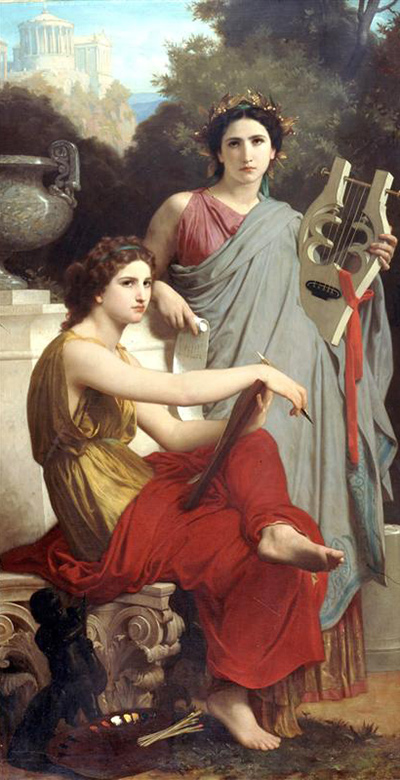
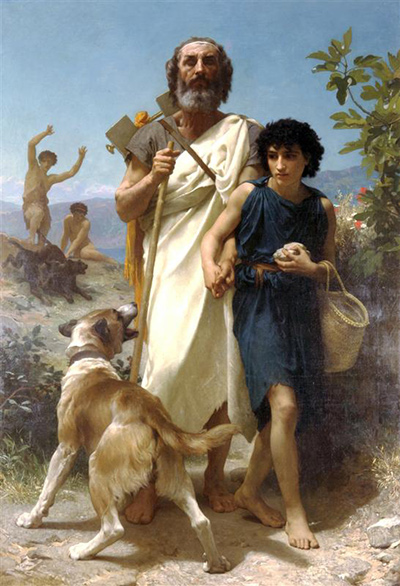
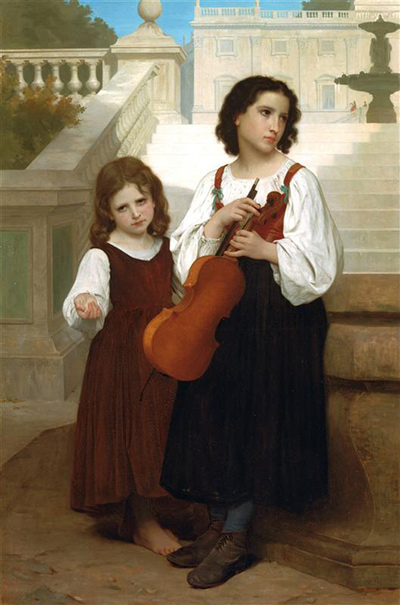
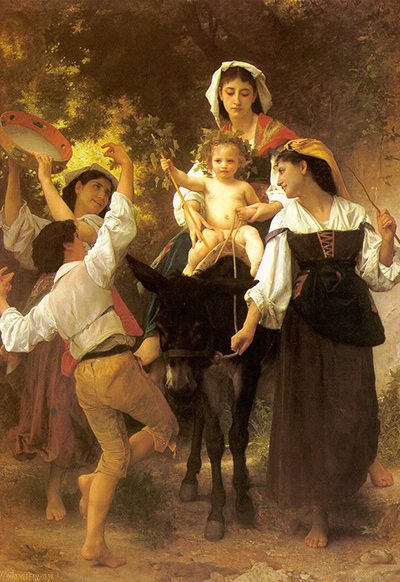
That makes it a useful companion to pages such as Art and Literature, where Bouguereau uses allegorical figures, and Homer and his Guide, where narrative and figure grouping carry a more public subject. It also sits near works such as Far from Home and Return from the Harvest, where children, women and everyday settings become carefully composed images rather than casual genre scenes.
The article should avoid treating The Secret as merely sentimental. Its power lies in how Bouguereau turns private communication into a formal image. The gestures are readable, but the story is withheld. The painting offers enough detail to make secrecy visible, while refusing to explain the secret itself.
What Can Be Said with Confidence
The secure public article should therefore begin with source-led facts: The Secret / Le Secret is an 1876 oil painting by William-Adolphe Bouguereau, governed for this route by the New-York Historical Society object trail and supported by Commons, Wikidata and selected secondary artwork records. It can discuss the scene as a polished academic image of secrecy, intimacy and withheld narrative.
The article should also be honest about what remains unresolved. It should not assert a live display status. It should not claim image clearance or an exact match between the existing local file and a source-approved reproduction. It should not identify the women, the child or the secret as documented facts. A stronger page comes from that restraint: Bouguereau's composition can be described closely without pretending that every interpretive possibility is a source-backed answer.
Related Figure Pages
Frequently Asked Questions
Discussion
The Secret rewards careful looking at Bouguereau's handling of gesture, silence and source-backed object evidence.
Use the prompts below to compare this intimate scene with Bouguereau's other figure paintings.
Reader Insights
How does Bouguereau make secrecy visible without explaining the secret?
What changes when object facts are led by a museum route but current display is not claimed?
How does this scene compare with Bouguereau's other paintings of women and children?
Join the Conversation
Share your reading of Bouguereau's withheld narrative and figure grouping below.
References
- New-York Historical Society eMuseum, The Secret, accessed 29 July 2026.
- Wikimedia Commons, Bouguereau, Le secret, 1876 file page, accessed 29 July 2026.
- Wikidata, The Secret, accessed 29 July 2026.
- Traditional Fine Arts Organization, New-York Historical Society checklist text, accessed 29 July 2026.
- Art Renewal Center, The Secret, accessed 29 July 2026.
- Wikidata catalogue mapping, William Bouguereau: His Life and Works, accessed 29 July 2026.