 by Tom Gurney
Tom Gurney BSc (Hons) is an art history expert with over 20 years experience
Published on June 19, 2020 / Updated on August 2, 2026
Email: tomgurney1@gmail.com / Phone: +44 7429 011000
Contents
- Introduction
- What The Painting Shows
- The Adirondack Setting
- Hunting Without Easy Triumph
- Why This Work Belongs In The Homer Cluster
Introduction
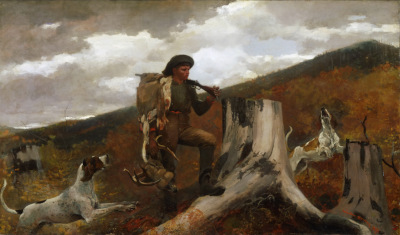
Winslow Homer's A Huntsman and Dogs is a late outdoor painting about hunting, labor and the difficulty of separating a person from the environment that sustains him. Painted in 1891 and set in the Adirondack region of New York State, it shows a huntsman with dogs after a successful deer hunt. The man carries the signs of the kill: deerskin, antlers, a rifle and, according to the Philadelphia Museum of Art's object record, likely a pack filled with meat. The dogs are active around him, but the human figure is still, serious and absorbed. [1]
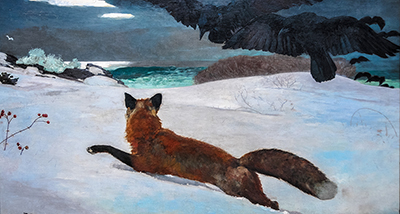
This article matters because A Huntsman and Dogs gives the Homer cluster a quieter Adirondack route into late nature. It belongs near The Fox Hunt, Hound and Hunter, Below Zero and Two Guides, but it has its own center of gravity. Fox Hunt removes the human hunter and turns the chase into an animal survival drama. A Huntsman and Dogs keeps the human figure visible, yet refuses to present hunting as simple triumph. The result is a painting about skill, weather, animal life, economic necessity and the changing Adirondack landscape. [2]
What The Painting Shows
The huntsman stands in a rough upland setting rather than a polished sporting scene. PMA identifies the man not as one of the late nineteenth-century visitors who came to the Adirondacks for recreation, but as a local trapper or guide. That distinction changes the whole picture. This is not only leisure or trophy display. The deer pelt, antlers and meat point toward work and survival as well as sport. [3]
The figure's posture is restrained. The dogs bring movement, noise and excitement, while the man remains heavy and inward. His stillness gives the painting its somber tone. He has succeeded in the hunt, but Homer does not turn success into celebration. The hunter's lowered attention and planted body make the scene feel practical rather than heroic. [4]
The landscape is equally important. PMA notes that earthen colors visually bind the man to the hillside behind him. This is one of Homer's sharpest choices. The huntsman does not stand apart from nature as a master looking over his prize. His clothes, burden and body merge with the autumnal ground. The viewer has to look carefully to separate person, hill, stump, dog and weather. [1]
That closeness helps explain the painting's seriousness. The Adirondacks are not decorative background. They are the condition of the scene. Cold mountain air, fading autumn color, cut wood and dark ground all press on the figure. Homer makes the hunt feel like something that belongs to a specific place and season, not a generalized adventure in the woods. [2]
The Adirondack Setting
Homer returned often to outdoor subjects, and the local Phase 1 biography packet records hunting and fishing trips to the Adirondacks or Quebec after he had settled into his later life. PMA's resource for A Huntsman and Dogs adds a useful page-specific frame: Homer knew the Adirondacks as a place of hunting, observation and changing wilderness. The painting was made in 1891, just before major public protection of the Adirondack Park began in 1892. [3]
The image also complicates the idea of nature as untouched. The hunter has killed a deer. A stump sits in the scene. Dogs, rifle, pelt and antlers all mark human use of the landscape. Yet the painting does not feel like a scene of easy human control. The man looks physically absorbed by the same earth colors and weather that surround him. Nature is not outside human life here. It is the field in which hunger, work, skill and mortality operate. [4]
This is why the painting connects naturally to Watercolours even though it is an oil. Homer's Adirondack works across media often focus on outdoor knowledge: guides, camps, canoes, rivers, fishing, hunting and weather. Watercolor gave him one way to follow those conditions quickly. Oil, in A Huntsman and Dogs, gives him weight, stillness and a darker late-season mood. [1]
Hunting Without Easy Triumph
Hunting pictures often invite a viewer to admire conquest. Homer does something more uncomfortable. The deer is not shown as a full body displayed in triumph, but the remains are unmistakable. The hunter carries skin and antlers, and the likely meat in his pack makes the animal's death material rather than decorative. The dogs' excitement may suggest the immediate aftermath of action, but the painting's emotional key is not noise. It is burden. [2]
That burden is physical and moral. The man carries the results of the hunt on his body. His rifle and the animal parts make him both successful and weighted down. The viewer sees the cost of the event without being shown the killing itself. Homer turns aftermath into evidence, a strategy that appears elsewhere in his late work. He often lets the viewer arrive after the decisive action, when consequences have to be read from posture, weather and objects. [3]
This approach places A Huntsman and Dogs near Fox Hunt, but the two paintings reverse one another in useful ways. In Fox Hunt, the fox becomes the vulnerable creature and human hunting culture is present mainly through the title. In A Huntsman and Dogs, the hunter is visible and the deer is already reduced to carried remains. Both works unsettle the clean pleasure of the hunt. They ask the viewer to look at pursuit, survival and death without sentimental covering. [4]
Why This Work Belongs In The Homer Cluster
A Huntsman and Dogs does not need to be inflated into a major flagship page, but it has real cluster value. It supports the paintings hub's late hunting and nature corridor. It gives the biography a route into Homer's later outdoor life beyond the more famous Maine seascapes. It helps readers understand that Homer's late work did not only turn toward waves, wrecks and marine weather. It also returned to animals, sport, guides, woods and inland survival. [1]
The article links sparingly but clearly. Biography supplies the career route. Paintings places the work inside the painted oeuvre. The Fox Hunt is the strongest interpretive neighbor. Hound and Hunter, Below Zero and Two Guides is best used as related hunting or Adirondack paths once their own manuscripts are ready. [2]
For readers, the painting's value lies in its refusal to make the Adirondacks picturesque in a simple way. Homer gives us a man who has caught a deer, dogs that respond with restless energy, and a landscape that seems to absorb everyone in it. The scene is readable, but not easy. It is about the practical life of the hunt and about the larger conflict between human need and natural force. [3]
That is the late Homer thread worth preserving. In the seascapes, a person faces water, weather and distance. In Fox Hunt, an animal faces hunger and pursuit. In A Huntsman and Dogs, the human figure stands between success and weight, carrying what the landscape has yielded while being visually folded back into the landscape itself. The painting is concise, unsentimental and strong enough to earn its place in the rescued Winslow Homer cluster. [4]
Discussion
Winslow Homer rewards close looking because his strongest images rarely close down into one easy meaning. Use the prompts below to test how the work changes as you move between subject, place, medium and history.
Reader Insights
First Look
What detail in A Huntsman and Dogs changes how the whole work feels?
Homer's Method
Where do you see Homer's balance between clear observation and unresolved meaning?
Cluster Context
Which related Homer work helps you read this page more carefully?
Join the Conversation
Share a thoughtful observation below, especially if a detail, source connection or related Homer page changed the way you read the work.
References
- Philadelphia Museum of Art object record, A Huntsman and Dogs, Winslow Homer, 1891, object
102943: https://www.philamuseum.org/objects/102943 - Philadelphia Museum of Art resource page for A Huntsman and Dogs: https://www.philamuseum.org/resources/a-huntsman-and-dogs
- Philadelphia Museum of Art linked educational PDF for A Huntsman and Dogs, used for medium, dimensions, collection, accession number and visual/contextual support.
- Local Winslow Homer Phase 1 approval brief, URL decision matrix, homepage/biography packet, medium-hub packet, internal-link ledger, quote ledger, glossary ledger and Tom image-policy ledger dated 2026-07-20.
 Winslow Homer.jpg)