 by Tom Gurney
Tom Gurney BSc (Hons) is an art history expert with over 20 years experience
Published on June 19, 2020 / Updated on August 2, 2026
Email: tomgurney1@gmail.com / Phone: +44 7429 011000
Contents
- Introduction
- What The Painting Shows
- Hunting, Water And Control
- Adirondack And Outdoor Context
- Why This Work Belongs In The Homer Cluster
Introduction
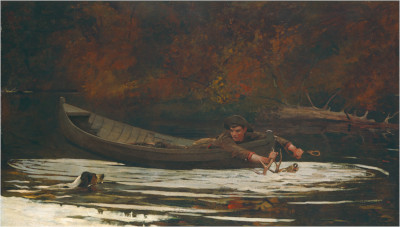
Winslow Homer's Hound and Hunter is a late hunting picture that turns pursuit into a moment of physical risk. Painted in 1892, it shows a young hunter stretched across a small boat, reaching toward the antlers of a stag almost submerged in dark water. A dog swims nearby. Behind them, autumn trees crowd the opposite bank. The scene is vivid, but it is not a simple trophy image. Homer places the viewer at the unstable edge between human skill, animal force and a landscape that refuses to stay still. [1]
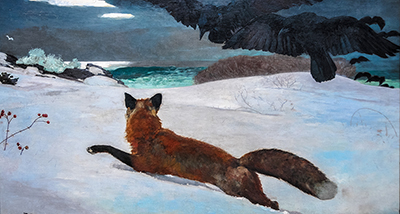
This article belongs in the Winslow Homer rescue because it gives the hunting and Adirondack cluster one of its most urgent scenes. A Huntsman and Dogs shows the aftermath of a deer hunt and the weight of a human figure in the landscape. Fox Hunt removes the human hunter and turns pursuit toward animal survival. Below Zero carries the winter edge of late nature. The Adirondack Guide, Two Guides and related outdoor works show knowledge of place as labor. Hound and Hunter sits among them as a river scene in which no figure has full control. [2]
What The Painting Shows
The first impression is action, but Homer builds the action through strain rather than spectacle. The hunter lies low in the boat, reaching forward with one hand toward the stag's antlers while holding a rope with the other. His face turns back toward the dog, so the viewer senses divided attention: the animal in front, the dog behind, the boat beneath him and the river pressing around all three bodies. [3]
The stag is nearly gone below the surface. Only parts of the head and antlers remain above water. That detail matters because it changes the emotional tone. The animal is not posed as a cleanly conquered quarry. It is still present, still bodily, and still difficult to handle. The dog is also not decorative. It is swimming into the same tense water, close enough to be part of the drama rather than a symbol of obedient sport. [4]
Homer's autumn setting sharpens the scene. The far bank is packed with gold, red and brown foliage, but the painting does not become a peaceful landscape. The color intensifies the season and gives the river a cold, living density. The fallen tree along the bank and the churned white strokes around the stag and dog keep the viewer aware of friction, resistance and danger. [5]
That is the key to the painting's force. Hound and Hunter is not only about a hunter catching a stag. It is about the awkward, dangerous second after success, when the practical problem begins. How does the hunter secure the animal? How does he manage the dog? How stable is the boat? Homer lets those questions hang in the composition. [1]
Hunting, Water And Control
Many hunting images celebrate mastery: the chase, the shot, the returned game, the confident sportsman. Homer is much less comfortable than that. He often finds meaning in the aftermath or in the compromised middle of an action. Here the hunter has reached the stag, but reaching is not the same as possessing. His body is almost horizontal, his arms are split between tasks, and the water absorbs the animal more quickly than the hunter can command it. [2]
The river is therefore more than setting. It is the painting's active pressure. It hides most of the stag, slows the dog and makes the boat precarious. Even the hunter's effort is shaped by water. He cannot stand, stride or pose. He has to flatten himself against the boat and negotiate the situation from a vulnerable position. [3]
That vulnerability connects Hound and Hunter to Homer's late nature subjects. In the marine paintings, people face weather, distance and an indifferent sea. In Fox Hunt, the fox becomes the pursued body in a winter landscape. In Below Zero, cold and coast matter as much as the human figures. Hound and Hunter brings the same pressure inland. Nature is not a backdrop for human action; it is the medium through which action must pass. [4]
The stag's near-submergence also keeps the article from treating the hunt as easy sport. Homer presents the animal at the boundary between life, death and retrieval. The painting does not need graphic violence to register mortality. The antlers, muzzle, water and human grip carry enough evidence. [5]
Adirondack And Outdoor Context
This is where Hound and Hunter helps the cluster do something more than list famous paintings. It shows that Homer's late career was not only a movement toward open seascape. His interest in force, exposure and survival also entered inland subjects. A river could become as charged as the sea when body, animal and weather were put under pressure. [1]
The painting also belongs near the guide pictures. The Adirondack Guide and Two Guides are less violent in mood, but they share the idea that outdoor experience depends on knowledge of place. Homer does not treat wilderness as empty scenery waiting to be admired. Boats, rivers, dogs, guns, guides and game all belong to a world of skill. In Hound and Hunter, that skill is tested at close range. [2]
Compared with A Huntsman and Dogs, the emphasis shifts from aftermath on land to struggle in water. Compared with Fox Hunt, the human agent is restored, but not made heroic in a simple way. Compared with Below Zero, the cold edge is less explicit, but the viewer still feels the environment's resistance. These differences make the article useful as an internal bridge across Homer's hunting and late-nature route. [3]
Why This Work Belongs In The Homer Cluster
Hound and Hunter remains a standard artwork page, not a split or a flagship expansion. Its strongest value is connective. It gives readers a compact way to understand the late Homer who found drama in the meeting of human action and natural force, whether that meeting happened at sea, on snow, in the woods or on a river. [4]
For a public page, the safest approach is to stay close to the NGA object record and use the broader Homer packets only for context. The facts are firm: title, artist, date, medium, dimensions, credit line, accession number, public-domain media route and provenance record. The interpretation is best equally disciplined. The painting can be described as a tense hunting scene, a late outdoor subject and a link between the Adirondack/hunting pages and the larger late-nature cluster. It does not need to be inflated into a conservation thesis, a full Adirondack history or a psychology of the hunter beyond what the image supports. [5]
The article links to Biography for career context, Paintings for the painted oeuvre, The Fox Hunt for the strongest late-hunting comparison, and A Huntsman and Dogs, Below Zero, The Adirondack Guide and Two Guides as related outdoor routes where available. It also be available to the paintings hub as part of the late hunting and nature corridor. [1]
The result is best a lean, source-led page that respects the painting's size inside the cluster. Hound and Hunter does not need padding. The picture already has enough: a boat, a young hunter, a swimming dog, a sinking stag, a riverbank in autumn and a moment when triumph has not yet become control. [2]
Discussion
Winslow Homer rewards close looking because his strongest images rarely close down into one easy meaning. Use the prompts below to test how the work changes as you move between subject, place, medium and history.
Reader Insights
First Look
What detail in Hound and Hunter changes how the whole work feels?
Homer's Method
Where do you see Homer's balance between clear observation and unresolved meaning?
Cluster Context
Which related Homer work helps you read this page more carefully?
Join the Conversation
Share a thoughtful observation below, especially if a detail, source connection or related Homer page changed the way you read the work.
References
- National Gallery of Art object record, Hound and Hunter, Winslow Homer, 1892, accession
1947.11.1: https://www.nga.gov/artworks/33970-hound-and-hunter - National Gallery of Art artist record for Winslow Homer: https://www.nga.gov/artists/1401-winslow-homer
- National Gallery of Art catalogue/publication route referenced from the object record, American Paintings of the Nineteenth Century, Part I, pages 322-327.
- Local Winslow Homer Phase 1 approval brief, URL decision matrix, homepage/biography packet, medium-hub packet, internal-link ledger, quote ledger, glossary ledger and Tom image-policy ledger dated 2026-07-20.
- Related local manuscripts/QA context for A Huntsman and Dogs, Fox Hunt, Below Zero, The Adirondack Guide, Canoe in the Rapids, Biography and Paintings hub.
 Winslow Homer.jpg)