 by Tom Gurney
Tom Gurney BSc (Hons) is an art history expert with over 20 years experience
Published on June 19, 2020 / Updated on August 2, 2026
Email: tomgurney1@gmail.com / Phone: +44 7429 011000
Contents
- Introduction
- A Modern Beach Subject
- Sand, Sea And Sky
- The Lost `Low Tide`
- Why The Work Belongs In The Homer Cluster
Introduction
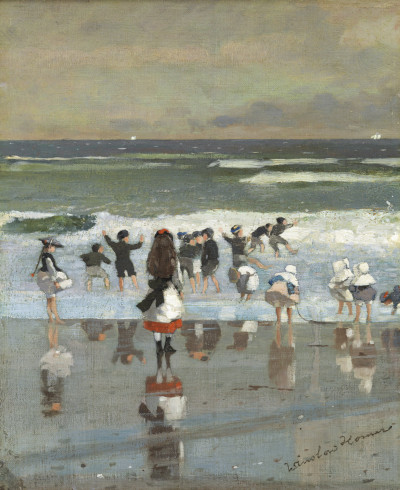
Winslow Homer's Beach Scene is a small surviving fragment from one of the most revealing experiments of his early painting career. The Museo Nacional Thyssen-Bornemisza records the work as oil on canvas mounted on cardboard, about 29.3 x 24 cm, in the Carmen Thyssen Collection, inventory number CTB.1985.12. The museum dates it to around 1869 and displays it in Room E, among nineteenth-century North American painting and related material. [1]
At first glance, the painting looks simple: children play near the water, a young woman stands close to the surf, and the beach is organized into flat bands of sand, sea and sky. Its modest size can make it feel like a finished little beach picture. The Thyssen record, however, makes clear that the work is probably not complete in the usual sense. It is one surviving section of a much larger painting known as Low Tide, a work Homer exhibited in New York in 1869 and later appears to have cut apart. [2]
That history changes how the article should read. Beach Scene is not a minor shoreline view detached from Homer's larger development. It sits at the point where he was testing modern leisure, beach culture, figure scale, wet sand, reflection and broad horizontal structure in oil paint. It also records a moment when criticism could be harsh, and when an ambitious painting might survive only as fragments, engravings and related evidence. [1]
A Modern Beach Subject
The subject belongs to Homer's late-1860s interest in watering places and coastal leisure. The Thyssen record connects the larger Low Tide project with Long Branch, New Jersey, a fashionable beach resort. That context matters because the beach was not only scenery. It was a modern public stage where class, costume, age, spectatorship and outdoor recreation could all be seen at once. [2]
Homer had begun as an illustrator, and his eye for public behavior did not disappear when he turned more seriously toward painting. In Beach Scene, the figures are not arranged as a formal history painting or a sentimental family group. They appear scattered across a shallow band of shore, absorbed in bathing, watching and play. The scene feels casual, but it is also deliberately observed. Homer is studying how people occupy a beach, how bodies look against water, and how wet sand can carry reflections that feel livelier than the figures themselves. [1]
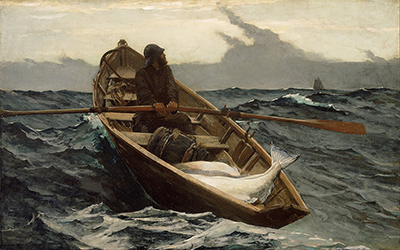
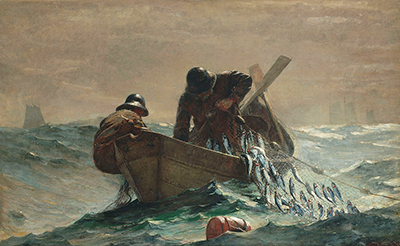
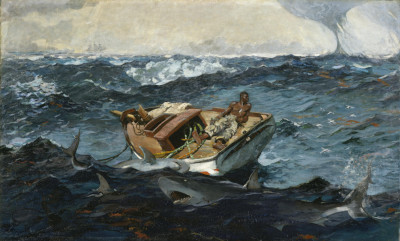
This gives the work a different value from Homer's later marine paintings. In The Fog Warning, The Herring Net and The Gulf Stream, the sea becomes a place of labor, distance and danger. In Beach Scene, the coast is social and recreational. Yet the painting still belongs to Homer's larger coastal imagination. It shows him discovering that the shoreline could hold modern American life without needing a dramatic shipwreck, storm or heroic fisherman. [2]
Sand, Sea And Sky
The Thyssen interpretation emphasizes the painting's broad horizontal organization. Homer sets the canvas parallel to the shore and builds the image from bands: beach below, water across the middle, sky above. The effect is spare and compressed. The painting has little incidental detail, and the perspective feels flattened rather than deep. [1]
That flattening is part of the work's interest. Homer is not trying to lead the viewer through a deep, theatrical space. He places the eye close to the shore and lets the picture read almost as a set of stacked color fields animated by small figures and reflections. The wet sand becomes especially important because it doubles and unsettles the figures. Their reflections flicker below them, turning a beach activity into a study of light, surface and motion. [2]
This is why Beach Scene can feel more experimental than its small scale suggests. The museum notes that among Homer's works, this one comes close to Impressionist concerns in its brightness and lively handling, while also stating that there is no evidence Homer met the future Impressionists during his 1867 trip to Paris. That distinction is useful. The painting does not need to be forced into a simple influence story. It is better understood as Homer responding to some of the same modern problems: outdoor light, contemporary leisure, abbreviated form and the quick visual experience of a scene. [1]
The Lost Low Tide
The most important source point is the connection between Beach Scene and Low Tide. According to the Thyssen record, Homer exhibited Low Tide at the National Academy of Design winter exhibition in New York in 1869. Contemporary reviewers attacked the larger painting, criticizing its awkward scale, horizontal layers and bathing figures. No complete painting matching that exhibited work is known today. [2]
Instead, the evidence survives in parts. The Thyssen Beach Scene appears to be one fragment. Another related section, On the Beach, is in the Arkell Museum at Canajoharie, New York. The two fragments fit together visually, with the Thyssen section at the left. A wood engraving titled Low Tide, published in Every Saturday on 6 August 1870, preserves figure groups from both surviving paintings and helps reconstruct the lost composition. An oil sketch, The Beach, Late Afternoon, also preserves Homer's larger conception. [1]
This reconstruction gives the small Thyssen panel a much larger role. It is not just an attractive remnant. It is evidence of Homer's willingness to dismantle, rework or abandon an ambitious painting after negative response. The museum record notes that the reason Homer cut up the painting is unknown. It also suggests one plausible context: critics disliked the whole, but some singled out smaller passages as more successful. The surviving fragment may therefore show the kind of passage that could be rescued from a failed or controversial larger canvas. [2]
For readers, this is the central drama of the article. Beach Scene asks us to look at a fragment as both picture and document. The children, water and reflections matter visually, but the cut-down state matters historically. The work tells us about Homer's early ambition, the risks of modern subject matter and the unstable afterlife of a painting that did not remain intact. [1]
Why The Work Belongs In The Homer Cluster
Beach Scene is a support page, but it is not filler. It helps the Winslow Homer cluster show a side of the artist that can disappear when the story jumps too quickly from Civil War illustration to late marine severity. Before the Prouts Neck breakers, before Cullercoats fishing women and before the great sea-risk paintings, Homer was already using beaches as places where modern life could be studied. [2]
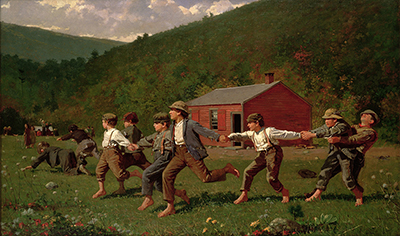
The article connects carefully to Biography for Homer's shift from illustration into painting, Paintings for the broader painted-work route and Long Branch, New Jersey if that page is retained as a related resort-life subject. It can also point forward to Breezing Up, where children, boating and coastal confidence take a more resolved form. More dramatic links to The Fog Warning or The Gulf Stream is best used sparingly, as broad coastal contrasts rather than direct development claims. [1]
Beach Scene survives because a larger painting did not. That makes it unusually alive as evidence. It shows Homer experimenting with a modern beach subject, testing flattened bands of color, making reflections carry visual energy and confronting the hard reception of an ambitious work. [2] Small as it is, the fragment opens a large question: how much of an artist's development can remain visible in what was cut away?
Discussion
Winslow Homer rewards close looking because his strongest images rarely close down into one easy meaning. Use the prompts below to test how the work changes as you move between subject, place, medium and history.
Reader Insights
First Look
What detail in Beach Scene changes how the whole work feels?
Homer's Method
Where do you see Homer's balance between clear observation and unresolved meaning?
Cluster Context
Which related Homer work helps you read this page more carefully?
Join the Conversation
Share a thoughtful observation below, especially if a detail, source connection or related Homer page changed the way you read the work.
References
- Museo Nacional Thyssen-Bornemisza object record, Beach Scene, Winslow Homer, ca. 1869, Carmen Thyssen Collection, inventory number
CTB.1985.12: https://www.museothyssen.org/en/collection/artists/homer-winslow/beach-scene - Local Winslow Homer active-url baseline audit, provisional URL decision matrix, medium-hub source packet, internal-link ledger, image ledger and source-leads ledger dated 2026-07-20.
 Winslow Homer.jpg)