 by Tom Gurney
Tom Gurney BSc (Hons) is an art history expert with over 20 years experience
Published on June 19, 2020 / Updated on August 2, 2026
Email: tomgurney1@gmail.com / Phone: +44 7429 011000
Contents
Introduction
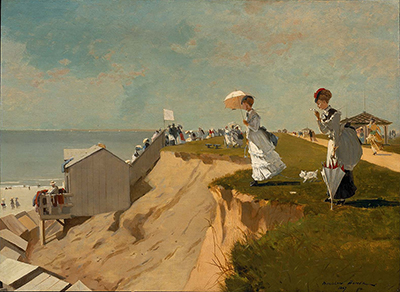
Winslow Homer's Long Branch, New Jersey is an 1869 oil painting in the Museum of Fine Arts, Boston. The MFA records the work as oil on canvas, 40.64 x 55.24 cm, or 16 x 21 3/4 inches. It belongs to The Hayden Collection--Charles Henry Hayden Fund, carries accession number 41.631, and is recorded as on view. The inscription recorded by the museum places Homer's name and the date in the lower right. [1]
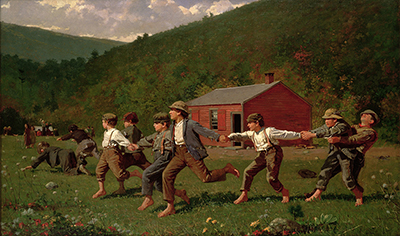
Those facts make the painting a useful concise page in the Homer cluster. It is not a flagship on the scale of Breezing Up, Snap the Whip or the later marine works. Its value is connective. It shows Homer in the late 1860s turning from Civil War and illustration subjects toward modern outdoor life: beaches, resort visitors, wind, costume, children, women and public leisure. [2]
The title matters. Long Branch was not a generic shore. It was a New Jersey seaside resort, part of the expanding nineteenth-century culture of coastal travel and summer recreation. The Met's Homer chronology places the late 1860s and 1870s among his most varied years, when he found subjects in seaside resorts in Massachusetts and New Jersey, rural New York, the Adirondacks and the White Mountains. Long Branch, New Jersey belongs to that search for modern American subjects away from the battlefield and the studio interior. [3]
The painting is best read as a seaside leisure scene rather than a marine-peril picture. The figures are close to the coast, but they are not fishermen fighting weather or families waiting for a boat to return. They occupy a public resort environment, where the sea becomes a place to look, walk, socialize and measure class behavior. Homer's attention to clothing, wind and posture makes leisure physical. The figures are not just "at the beach"; they are managing the exposed conditions of the shore. [4]
That is why the article should avoid turning the picture into empty prettiness. Homer often made apparently relaxed subjects carry more structure than they first suggest. In Croquet Scene, a fashionable game becomes a pattern of social spacing. In Boys in a Pasture, rest becomes a way of thinking about childhood and rural time. In Long Branch, New Jersey, resort leisure becomes a study of people at the edge of the Atlantic, balanced between cultivated dress and open air. [5]
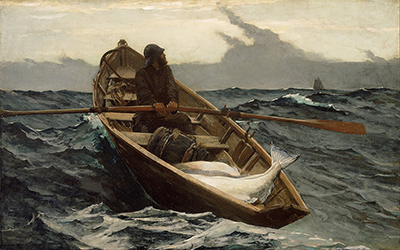
The painting also helps readers move toward Breezing Up (A Fair Wind) and Dad's Coming!. All three works belong to the broad 1870s coastal route, but they handle the shore differently. Breezing Up turns wind and water into skill, confidence and group coordination. Dad's Coming! makes the shore a place of family waiting and maritime work. Long Branch, New Jersey is more social. It is about beach culture, fashionable presence and the seaside as a modern leisure space. [6]
Related print records strengthen that context. The Smithsonian American Art Museum records Homer's 1870 wood engraving On the Bluff at Long Branch, at the Bathing Hour as a Harper's Weekly image connected with Long Branch Beach, wind, swimming and a female figure group. The National Gallery of Art also records an 1870 On the Beach at Long Branch wood engraving after Homer from Harper's Bazar. These are not the same object as the MFA oil painting, but they show that Long Branch was part of Homer's wider illustrated and painted resort material around 1869-1870. [7]
The Newport Art Museum's America at Play exhibition route adds broader support for the leisure and childhood corridor. Its exhibition framing places Homer's post-Civil War images of children and adolescents in rural and beach settings, including Long Branch, within a wider culture of nineteenth-century visual publication. For this article, that context remains light. The MFA object record is the authority for the painting itself; related institutional records simply confirm that Long Branch and seaside recreation were real parts of Homer's subject world. [1]
Handled at the right scale, Long Branch, New Jersey gives the Homer rescue a compact coastal-resort stop. It is earlier and less severe than the Prouts Neck marine paintings. It is more public and social than the quiet rural-childhood works. It shows Homer finding modernity in ordinary recreation: not in machinery or urban crowds, but in the changing habits of Americans who came to the shore to look at the sea, perform ease and feel the wind. [2]
Discussion
Winslow Homer rewards close looking because his strongest images rarely close down into one easy meaning. Use the prompts below to test how the work changes as you move between subject, place, medium and history.
Reader Insights
First Look
What detail in Long Branch, New Jersey changes how the whole work feels?
Homer's Method
Where do you see Homer's balance between clear observation and unresolved meaning?
Cluster Context
Which related Homer work helps you read this page more carefully?
Join the Conversation
Share a thoughtful observation below, especially if a detail, source connection or related Homer page changed the way you read the work.
References
- Museum of Fine Arts, Boston object record, Long Branch, New Jersey, Winslow Homer, 1869, object
32801, accession41.631: https://mfaboston6.emuseum.com/objects/32801/long-branch-new-jersey - MFA Boston exhibition page, Of Light and Air: Winslow Homer in Watercolor, used only for MFA collection context and the exhibition listing of Long Branch, New Jersey: https://www.mfa.org/exhibition/of-light-and-air-winslow-homer-in-watercolor
- The Metropolitan Museum of Art Timeline essay,
Winslow Homer (1836-1910), used for broad late-1860s and 1870s context around seaside resorts and leisure subjects: https://www.metmuseum.org/essays/winslow-homer-1836-1910 - Smithsonian American Art Museum object record,
On the Bluff at Long Branch, at the Bathing Hour, from Harper's Weekly, August 6, 1870, used as related Long Branch print context: https://americanart.si.edu/artwork/bluff-long-branch-bathing-hour-harpers-weekly-august-6-1870-37022 - National Gallery of Art object record, On the Beach at Long Branch, used as related Harper's Bazar print context: https://www.nga.gov/artworks/67275-beach-long-branch
- Newport Art Museum exhibition page, America at Play: Winslow Homer, used only for broad post-Civil War beach/children/leisure framing: https://newportartmuseum.org/exhibitions/winslow-homer-america-at-play/
- Local Winslow Homer Phase 1 approval brief, provisional URL decision matrix, medium-hub source packet, homepage/biography source packet, internal-link ledger, quote ledger, glossary ledger and Tom image-policy ledger dated 2026-07-20.
 Winslow Homer.jpg)