Winslow Homer.jpg)
 by Tom Gurney
Tom Gurney BSc (Hons) is an art history expert with over 20 years experience
Published on June 19, 2020 / Updated on August 2, 2026
Email: tomgurney1@gmail.com / Phone: +44 7429 011000
Contents
Introduction
Winslow Homer's Eagle Head, Manchester, Massachusetts (High Tide) is an 1870 oil painting in The Metropolitan Museum of Art. The Met records the work as oil on canvas, 26 x 38 inches, or 66 x 96.5 cm. It entered the museum as a 1923 gift of Mrs. William F. Milton and carries object number 23.77.2. The painting belongs to The American Wing and was recorded as on view in Gallery 763 at manuscript review. [1]
Those facts make the article more than a minor coastal stop. Eagle Head sits at a charged point in Homer's post-Civil War career: after his wartime illustration and early exhibition paintings, before the celebrated Prouts Neck marines, and during the years when women, children, resort culture and seaside recreation became central subjects. The painting is easy to mistake for a casual beach scene. It is better understood as one of Homer's most concentrated studies of modern leisure, bodily exposure and social looking. [2]
The named place matters. Eagle Head is in Manchester, Massachusetts, north of Boston on the coast. Homer did not title the painting as an anonymous beach. He attached it to a real shore, a tide state and a local geography associated with summer recreation. The Met's broader Homer chronology places the late 1860s and 1870s among the artist's most varied years, when he found subjects in Massachusetts and New Jersey seaside resorts, rural New York, the Adirondacks and the White Mountains. Eagle Head belongs to that search for modern American subjects after the battlefield. [3]
The scene shows women bathers at the water's edge after a swim. One figure wrings water from her clothing and hair; another sits low near the shore; another adjusts herself beside them. A small dog reacts nearby. The shore bends back toward the distance, with water, sand, figures and coast held in a clear but unsettled arrangement. The subject is public leisure, but the mood is not simply relaxed. Homer makes the viewer aware of looking at figures who may not be posing for the viewer. [4]
That tension explains why the painting puzzled and troubled some contemporary viewers when it appeared in New York in 1870. The Met frames the work as a modern leisure subject that confused critics because of its mystery, voyeuristic pressure and issues of decorum. The women are not nude; they wear bathing clothes typical of the period. Yet wet fabric, undone hair, bare legs and awkward postures made the scene feel unusually direct for an exhibition painting. Homer did not smooth that directness into a polite resort anecdote. [5]
This is why the article should avoid two easy reductions. The painting is not merely pretty coastal nostalgia, and it is not simply a scandal picture. Its force comes from how ordinary the activity is and how strange it becomes under observation. The women are doing practical things after swimming: drying, adjusting, recovering balance, managing sand and wet clothing. Homer turns those actions into a problem of visibility. [1] Who is allowed to look? What kind of looking turns recreation into discomfort? How does a fashionable modern beach make private bodily routines partly public?
Homer's earlier graphic career helps explain the clarity of the scene. He had trained in commercial image-making and worked for illustrated publications before becoming known primarily as a painter. That background did not make his paintings simplistic. It sharpened his ability to place bodies, gestures and setting so that a situation could be read quickly and then questioned more slowly. In Eagle Head, the viewer can identify the beach, the bathers, the dog and the tide, but the social meaning remains unsettled. [2]
The print after the painting is important for that reason. The National Gallery of Art records an 1870 wood engraving on newsprint titled High Tide, made after Winslow Homer and published in Every Saturday on August 6, 1870. The NGA record gives the medium as wood engraving on newsprint, notes the Avalon Fund credit line, records the accession number 1986.31.187, and identifies the printed image as from a painting by Homer. That record confirms that the subject moved from an oil painting into periodical circulation. [3]
The print route is best handled carefully. The NGA object is not the Met painting, and the engraving does not need to be used to rewrite the painting without a checked comparison image and source packet. But it does show that Eagle Head belongs to Homer's wider world of reproducible public images. A painting seen by an exhibition audience could also become a black-and-white image for readers of a magazine. That shift matters because decorum, legibility and audience all change when a modern bathing subject leaves the gallery wall and enters the printed page. [4]
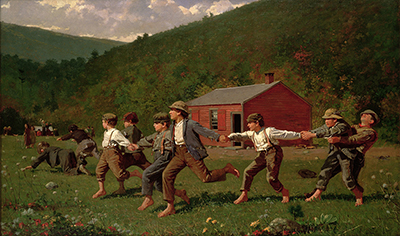
Within the Homer cluster, Eagle Head links naturally to the prints page, but it also belongs beside the 1870s leisure and coastal works. Long Branch, New Jersey presents seaside resort culture as social performance on a named shore. Croquet Scene turns fashionable recreation into an arrangement of stance, distance and attention. Snap the Whip and Breezing Up (A Fair Wind) show children and young people in active outdoor settings, where play, skill and public meaning overlap. Eagle Head is different because the body itself, wet from the sea, becomes the center of social pressure. [5]
The painting also prepares readers for later Homer without pretending that it already is a late marine painting. In the Prouts Neck works, surf and rock often take over the drama; human figures may disappear or become small before weather and sea. In Eagle Head, the sea is close, but people remain the problem. The tide, shore and water matter because they create the setting in which modern viewers confront bathing, class, gender and decorum. Nature is present, but social life is still exposed. [1]
That distinction is useful for readers who arrive at Homer through his famous waves and shipboard subjects. Eagle Head shows that the coast was already important to him before it became elemental. Here the Atlantic is not yet the overwhelming force of later pictures; it is the boundary that makes a social scene possible. The bathers have come out of the water, but the water still clings to clothing, hair and posture. Homer lets the sea alter behavior before it becomes the main drama. [2]
The best reading of Eagle Head therefore keeps several things in view at once: the specific Massachusetts place, the 1870 date, Homer's movement from illustration into painting, the modern beach as a social environment, and the fact that the same subject also entered print culture. It is a compact painting with a surprisingly large role in the cluster. It shows Homer learning how much tension could be held inside a scene of leisure, before his art became famous for the harsher drama of fishermen, storms and open sea. [3]
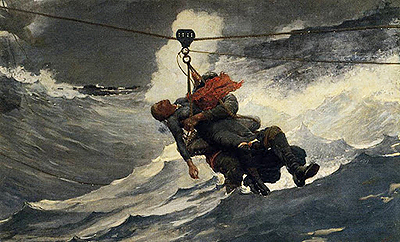
Handled at the right scale, this article gives readers a clear answer to why Eagle Head matters. It is an early, public, uneasy coastal painting by an artist often remembered for later marine power. Its subject is not a shipwreck or a heroic rescue, but a moment after swimming, when ordinary bodies, wet clothing and social scrutiny meet at the edge of the Atlantic. That is enough. Homer did not need catastrophe to make the shore feel charged. [4]
Discussion
Winslow Homer rewards close looking because his strongest images rarely close down into one easy meaning. Use the prompts below to test how the work changes as you move between subject, place, medium and history.
Reader Insights
First Look
What detail in Eagle Head, Manchester, Massachusetts (High Tide) changes how the whole work feels?
Homer's Method
Where do you see Homer's balance between clear observation and unresolved meaning?
Cluster Context
Which related Homer work helps you read this page more carefully?
Join the Conversation
Share a thoughtful observation below, especially if a detail, source connection or related Homer page changed the way you read the work.
References
- The Metropolitan Museum of Art object record, Eagle Head, Manchester, Massachusetts (High Tide), Winslow Homer, 1870, object
11117, object number23.77.2: https://www.metmuseum.org/art/collection/search/11117 - The Metropolitan Museum of Art Timeline essay,
Winslow Homer (1836-1910), used for broad late-1860s and 1870s chronology around seaside resorts, women at leisure, children at play, printmaking and watercolor: https://www.metmuseum.org/essays/winslow-homer-1836-1910 - National Gallery of Art object record, High Tide, wood engraving on newsprint after Winslow Homer, published 1870, accession
1986.31.187: https://www.nga.gov/artworks/67251-high-tide - Smithsonian Institution inventory record, Eagle Head, Manchester, Massachusetts (High Tide), (painting), used as a secondary object-location and subject-index check: https://www.si.edu/object/eagle-head-manchester-massachusetts-high-tide-painting%3Asiris_ari_42226
- Local Winslow Homer active baseline audit, provisional URL decision matrix, source leads ledger, image ledger, internal-link ledger, paintings hub manuscript, prints manuscript, homepage/biography source packet and medium-hub source packet dated 2026-07-20.
 Winslow Homer.jpg)