 by Tom Gurney
Tom Gurney BSc (Hons) is an art history expert with over 20 years experience
Published on June 19, 2020 / Updated on August 2, 2026
Email: tomgurney1@gmail.com / Phone: +44 7429 011000
Contents
- Introduction
- What The Painting Shows
- Navigation, Measurement And Control
- Prouts Neck And Homer's Mature Marine World
- The Etching Versions
- Looking, Waiting And The After-Storm Moment
- Why This Painting Matters
Introduction
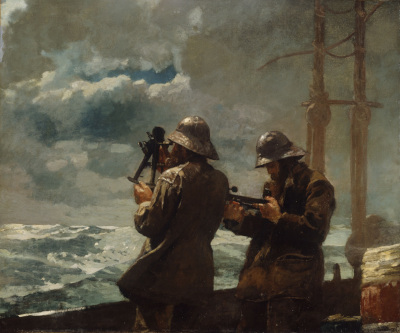
Winslow Homer's Eight Bells is one of the most concentrated marine paintings of his Prouts Neck years. Painted in 1886, it shows two sailors standing on a ship's deck after heavy weather, using navigational instruments to work out their position. The sea is still active, the sky is still unsettled, and the men are wet from the conditions they have just endured. Yet the scene is not a disaster picture. Homer turns the moment after danger into a test of judgment, discipline and human steadiness. [1]
The painting belongs to the Addison Gallery of American Art at Phillips Academy in Andover, Massachusetts. Addison records it as an oil on canvas from 1886, measuring 25 3/16 x 30 3/16 inches. It entered the collection as the gift of an anonymous donor and carries accession number 1930.379. In the Homer cluster, the painting is best treated first as this Addison oil painting. Later etchings are related versions and support material, not replacements for the painting's identity. [2]
The title refers to a nautical time signal. In the bell system used aboard ship, eight bells marks the end of a watch; PMA's etching record connects this subject specifically with the noon observation, when sailors could use the sun to determine position. That practical detail matters. Homer is not showing sailors passively admiring the sea. He is showing trained men reading light, weather, time and instrument data in order to locate themselves. [3]
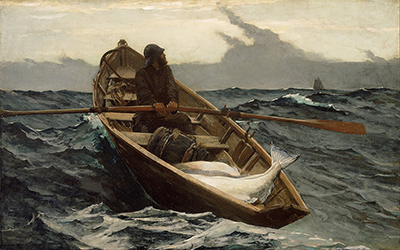
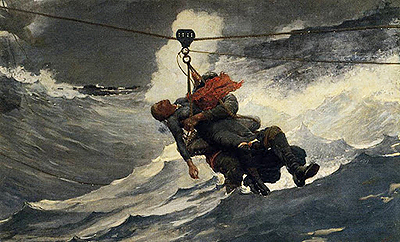
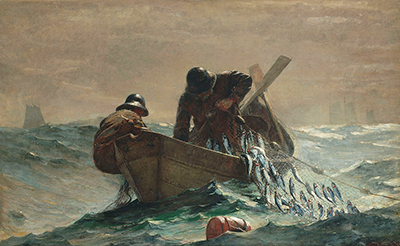
This makes Eight Bells different from some of Homer's better-known marine peril pictures. The Fog Warning focuses on uncertainty and return. The Life Line turns rescue technology into dramatic action. The Herring Net makes fishing labor monumental inside a small dory. Eight Bells is quieter and more controlled. Its drama lies in the moment when the storm has eased enough for measurement, but not enough for the sea to feel fully safe. [4]
What The Painting Shows
The composition is dominated by two figures in oilskins and sou'wester hats. They stand close together, but they do not perform the same action. One raises an instrument outward, reading the horizon and the sun. The other looks down toward his own instrument or record. Homer builds the scene around this pairing of outward and downward looking. The sailors' attention runs in two directions at once: one toward the world, the other toward calculation. [5]
That dual focus gives the painting its unusual stillness. There is movement everywhere around the men: cloud, water, wet clothing, ship deck and broken light. But the sailors hold themselves with professional concentration. They do not look heroic in a theatrical sense. They look absorbed. Their bodies tell the viewer that the important action is mental and practical as much as physical. [1]
The deck is a crucial stage. Homer is not placing the men in a dory, where vulnerability would be obvious. They stand on a larger vessel, which gives them a firmer platform than the fishermen in many of his small-boat scenes. But the deck is still exposed. The rail, mast elements and tilted lines keep the viewer aware that this is not a calm laboratory. Navigation happens in weather, after pressure, with the sea still close. [2]
The men's clothing makes the recent conditions visible. Their oilskins and hats are not decorative costume. They are evidence of work at sea. Homer lets them catch the light, so that the figures appear almost burnished by the clearing weather. The effect is not sentimental. It suggests survival, wetness and endurance: the men have come through the storm and now must turn experience into knowledge. [3]
The background reinforces that shift. The sky is opening, but it has not become serene. The light breaks through as an opportunity. It allows measurement, not leisure. The sea remains heavy enough to remind us that calm is temporary. Homer is very good at this kind of threshold: not the height of catastrophe, not complete safety, but the charged interval when people must decide what the changed conditions allow. [4]
Navigation, Measurement And Control
Eight Bells is a painting about looking with purpose. Many seascapes ask the viewer to admire weather and water as visual spectacle. Homer does something sharper. He makes the sailors' act of seeing part of the subject. They are looking in order to measure. Their instruments turn vision into position, and position into the possibility of safe movement. [5]
This practical intelligence is central to the painting's dignity. The men are not merely victims of nature. They are not masters of it either. Homer places them between those two extremes. They have skills, tools and routines, but those skills only matter because the sea remains larger than them. The painting respects human control while refusing to exaggerate it. [1]
The noon observation gives that balance a precise form. The sun, which might appear in another painting as pure atmosphere, becomes useful data. The break in the clouds is beautiful, but it is also functional. Homer lets natural light serve a sailor's calculation. That is why the picture feels calmer than The Fog Warning while still belonging to the same world of risk. Fog frustrates measurement; a clearing sky restores it. [2]
The two sailors also make measurement social. One man alone could become an emblem of isolation. Two men turn the scene into a small working system. One reads outward, the other attends to the instrument or result. The pairing suggests procedure, cross-checking and shared discipline. The sailors are not posing for the viewer; they are participating in a task that has rules older than the painting. [3]
The title helps keep the article grounded in maritime practice rather than loose symbolism. Eight Bells is not only a poetic phrase. It points to the structure of shipboard time. Homer uses that structure to give the painting a hidden order. Even after the storm, the watch system, instruments and routine of noon observation remain in place. The sea interrupts human plans, but sailors answer with repeated forms of knowledge. [4]
This is why the painting does not need to be reduced to a general idea of "man versus nature." Homer is more exact than that. The painting is about people who depend on nature's signals while also being threatened by nature's force. The sun can guide them; the storm can endanger them; the sea can carry them or resist them. Human control exists, but it is conditional and temporary. [5]
Prouts Neck And Homer's Mature Marine World
Eight Bells belongs to the marine turn that followed Homer's 1883 move to Prouts Neck, Maine. The local source packets identify Prouts Neck as one of the essential late-career contexts for the cluster. It was not merely a picturesque home base. It gave Homer a place from which to study the Atlantic as weather, force, workplace and recurring problem. [1]
By the mid-1880s, Homer had already passed through several major phases: commercial illustration, Civil War observation, postwar rural and leisure subjects, watercolor travel, and the Cullercoats experience on the northeast coast of England. Those earlier phases remain present in Eight Bells in compressed form. The clarity of action owes something to the discipline of illustration. The marine seriousness follows from Cullercoats and Prouts Neck. The interest in weather and light connects oil painting with the observational habits sharpened in watercolor. [2]
The Addison record's interpretive route places the painting among Homer's important 1880s marine works concerned with the relation between people and the sea. That is the right public frame, provided the article keeps the relation specific. Eight Bells is not about anonymous mankind set against a generic ocean. It is about sailors in foul-weather clothing, on deck, at a navigational moment after storm. The more specific the painting becomes, the more powerful its larger theme feels. [3]
The 1880s are especially important because Homer was repeatedly testing different kinds of marine narrative. A fisherman hauling a catch, a lifeline rescue, a sailor reading weather, a hunter or animal facing winter conditions: each subject asks how living beings survive inside environments they cannot fully command. Eight Bells answers through training and calculation rather than rescue or struggle. [4]
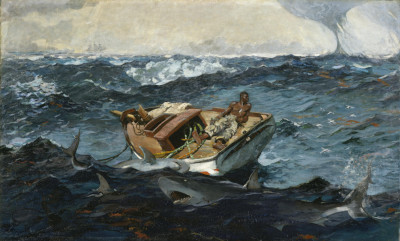
That makes it a useful page in the cluster. It links marine labor, printmaking and late seascape without pretending to be the same kind of painting as The Gulf Stream or The Fog Warning. It also opens a path toward the Prints page because Homer made an etching after the painting in 1887. For readers, the painting is the main event; the etching shows how Homer translated the subject into another medium and how the image circulated beyond the single canvas. [5]
The Etching Versions
The version question must be handled carefully. The public page for Eight Bells should lead with the 1886 oil painting at the Addison Gallery. The Philadelphia Museum of Art and National Gallery of Art records concern Homer's 1887 etching after that painting. They are excellent support records for version history and print context, but they does not need to become the main image identity of the article. [1]
PMA's object record identifies Eight Bells as an 1887 work by Homer and explicitly describes it as an etching after the 1886 painting, with the original canvas at Addison. PMA's interpretive note is useful because it explains the navigational moment: after a storm, the sailors can measure their location at noon. It also places the print against Homer's darker marine subjects from the same decade, where wreck, danger or uncertainty become more prominent. [2]
The NGA record gives more detailed print metadata. It records Eight Bells as an etching from 1887, with a sheet trimmed within the plate measuring 48.3 x 61 cm, or 19 x 24 inches. Its accession number is 1964.4.7, and the credit line is the gift of John W. Beatty, Jr. NGA also records the print as not on view and marks the image media as free and in the public domain. [3]
The NGA provenance is especially useful for a version note: the print was given by Homer to John Wesley Beatty in 1903, then descended through the family before entering the National Gallery of Art in 1964. That does not change the Addison painting's primacy for this article, but it does add a meaningful afterlife. The subject mattered enough for Homer to return to it in print and to give an impression as a personal gift. [4]
An etching changes the experience of the image. The oil painting can use color, wet light and the tonal weight of the sea to suggest storm-clearing atmosphere. The etching must work through line, value and paper. That translation is not a secondary footnote; it shows Homer thinking in another graphic language. It also connects Eight Bells to his long history with printed images, from commercial illustration to mature printmaking. [5]
Looking, Waiting And The After-Storm Moment
One reason Eight Bells continues to hold attention is that it transforms a quiet task into a scene of suspense. The suspense does not come from whether a wave will overturn the ship in the next instant. It comes from whether knowledge can be regained after disorder. The sailors have survived weather; now they need to know where they are. [1]
That question is both literal and emotional. A ship at sea must locate itself. The people aboard must convert sky and instrument into bearings. But the painting also makes location feel like a broader human need. After a storm, the first clear measurement carries reassurance. It says that the world has become readable again, at least briefly. [2]
Homer keeps the scene from becoming too comforting. The men are not at rest. They are performing. The sky is not empty blue. The sea has not disappeared into decorative calm. The deck remains wet and exposed. The viewer senses that the measurement may be accurate and still incomplete, because the sea will keep changing. [3]
The two figures intensify this feeling because they seem similar but not interchangeable. Their clothing links them as mariners; their separate gestures divide their labor. The painting becomes a study of coordinated attention. One man looks into distance; the other concentrates close to hand. Distance and closeness, horizon and instrument, weather and calculation all meet between them. [4]
This is where the painting's emotional restraint matters. Homer does not need faces full of expression to tell us what is at stake. He trusts posture, equipment and setting. The sailors' seriousness carries the narrative. They have no time to dramatize themselves because the work requires concentration. [5]
That restraint also makes the painting modern in feeling. It does not explain itself through an anecdote. It offers an exact moment and lets the viewer infer the pressure around it. The result is less theatrical than a shipwreck and less idyllic than a harbor scene. It is a painting of professional attention under unsettled conditions. [1]
Why This Painting Matters
Eight Bells matters because it gives Homer's mature marine art a different emotional key. It is not only about danger, loss or struggle. It is about competence after danger. The sailors are wet, exposed and dependent on weather, but they are also skilled. They know what the break in the clouds allows them to do. [2]
The painting also matters because it joins several Homer strengths in a compact form. It has the directness of illustration without becoming anecdotal. It has the atmosphere of late marine painting without turning the sea into empty spectacle. It has the discipline of a work scene without losing mystery. The viewer understands the action but still feel the uncertainty around it. [3]
Within the Winslow Homer cluster, the article should sit near The Fog Warning, The Herring Net, The Life Line, Prints and Paintings. Those links let readers compare different kinds of marine knowledge: finding the way home, hauling a catch, rescuing a body, making a print and building a painted career around the sea. [4]
The version history adds another reason to keep the article. The Addison oil painting is the primary object, but the 1887 etchings at PMA and NGA show that Homer did not leave the image fixed in one medium. He reworked the subject graphically, preserving the sailors' concentrated act of measurement in a form that could circulate as a print. [5]
For a modern reader, Eight Bells is valuable because it resists the simplest Homer stereotype. It is not just a storm picture, not just a sailor picture, not just a technical illustration of navigation. It is an image of the moment when danger has opened into decision. The weather has shifted, the sun has become readable, and two sailors use trained attention to place themselves in a world that will not hold still. [1]
That is the achievement of the painting. Homer makes survival look thoughtful. He gives control its dignity, but he also shows its limits. The men can measure their position, but they cannot command the sea. They can read the light, but they cannot own it. Eight Bells holds that balance with unusual calm, making the after-storm interval feel as serious as the storm itself. [2]
Discussion
Winslow Homer rewards close looking because his strongest images rarely close down into one easy meaning. Use the prompts below to test how the work changes as you move between subject, place, medium and history.
Reader Insights
First Look
What detail in Eight Bells changes how the whole work feels?
Homer's Method
Where do you see Homer's balance between clear observation and unresolved meaning?
Cluster Context
Which related Homer work helps you read this page more carefully?
Join the Conversation
Share a thoughtful observation below, especially if a detail, source connection or related Homer page changed the way you read the work.
References
- Addison Gallery of American Art collection/search record for Eight Bells, Winslow Homer, 1886, oil on canvas, 25 3/16 x 30 3/16 in., gift of anonymous donor, accession
1930.379. - Philadelphia Museum of Art object record, Eight Bells, Winslow Homer, 1887, object
206316, used for etching-after-painting context and noon/eight-bells navigation framing. - National Gallery of Art object record, Eight Bells, Winslow Homer, 1887, etching, accession
1964.4.7, used for public-domain print metadata, dimensions, provenance and version support. - National Gallery of Art artist record and 1995 Winslow Homer catalogue route, used through the local packets for career context and Homer cluster structure.
- Winslow Homer Phase 1 local source packets, URL decision matrix, internal-link ledger, quote ledger, glossary ledger and Tom image-policy ledger, 2026-07-20.
 Winslow Homer.jpg)