 by Tom Gurney
Tom Gurney BSc (Hons) is an art history expert with over 20 years experience
Published on June 19, 2020 / Updated on August 2, 2026
Email: tomgurney1@gmail.com / Phone: +44 7429 011000
Contents
Introduction
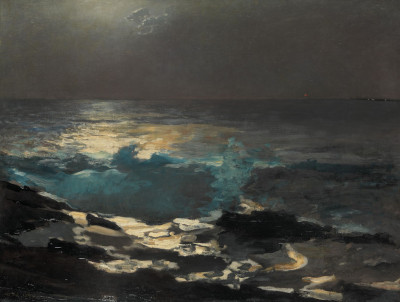
Winslow Homer's Moonlight, Wood Island Light is an 1894 oil on canvas in the Metropolitan Museum of Art. The Met records the painting as 30 3/4 x 40 1/4 inches, or 78.1 x 102.2 cm. Its credit line is Gift of George A. Hearn, in memory of Arthur Hoppock Hearn, 1911, and its object number is 11.116.2. The museum identifies the image as Public Domain and currently places the work on view at The Met Fifth Avenue in Gallery 770. [1]
Those facts put the painting squarely inside Homer's late marine world. In the early 1890s, Homer was no longer relying on anecdotal figures to carry every coastal subject. He had moved toward pictures in which sea, sky, rock, weather and light could become the whole event. Moonlight, Wood Island Light belongs to that turn. It is not a rescue scene, a fishing scene or a narrative of maritime labor. It is a nocturne organized around distance, water, reflection and a coastal signal seen under moonlight. [2]
The title matters because it gives the image a point of orientation. Wood Island Light is not simply a decorative lighthouse motif in the text of the article; it is the named marker that fixes the scene within the Maine coast. Yet Homer does not turn the painting into a crisp architectural portrait. The lighthouse is part of a broader arrangement of darkness and illumination. The work asks the viewer to look across water, toward a light that is distant enough to feel both specific and unreachable. [3]
Moonlight As Structure
The painting's central subject is light under pressure from darkness. Moonlight does not brighten the scene evenly. It separates masses, catches the water and lets the lighthouse register across distance. Much of the power of the painting comes from that restraint. Homer lets the viewer feel the limits of vision at night rather than describing every form with daylight clarity. [4]
That makes Moonlight, Wood Island Light different from a conventional marine view. The sea is present, but it is not presented as a storm climax. The lighthouse is present, but it does not dominate the image like a monument. The night is present, but it is not empty. The painting works through relation: dark water against pale reflection, far light against near shadow, horizon against the open surface between viewer and beacon. [5]
The Met record preserves a useful anecdote from Homer's first biographer. In that account, Homer saw the idea for the painting on a summer evening in 1894, quickly gathered his materials, went down over the rocks near his seaside studio and produced the picture in only a few hours. The exact story is best handled carefully because it is an anecdote, not a studio log. Still, it helps explain how the painting has often been understood: as a work tied to direct observation, sudden perception and a late-career ability to simplify a marine subject without draining it of force. [1]
A Late Coastal Painting
Within the Winslow Homer cluster, this article belongs near the late Maine and Prouts Neck route. The local packets identify Prouts Neck as the place where Homer's marine art became increasingly concentrated on the Atlantic edge. Works such as Northeaster, High Cliff, Coast of Maine, Eastern Point and Sunlight on the Coast help readers see that late Homer often made the coast itself carry meaning. [2]
Moonlight, Wood Island Light adds a different note to that group. In Northeaster, the force is impact: wave against rock, spray against air. In High Cliff, Coast of Maine, the cliff and surf create a severe encounter between mass and motion. In Moonlight, Wood Island Light, the pressure is quieter. The sea does not need to explode to become serious. The distance between viewer, water and lighthouse creates its own tension. [3]
This is why the article does not need to be treated as a minor lighthouse postcard. Homer had used lighthouses and coastal signals before, and nearby pages such as Eastern Point Light can help readers compare how a beacon functions in different media and places. But the comparison must stay exact. Eastern Point Light is an 1880 watercolor connected to Gloucester Harbor and the Princeton University Art Museum. Moonlight, Wood Island Light is an 1894 oil at the Met. They share a concern with night, water and coastal signals, but they are not interchangeable. [4]
What To Notice
Readers is best guided toward the painting's restraint. The subject could invite overstatement: moonlight, lighthouse, coast, sea. Homer keeps the effect more controlled. The viewer is not asked to follow a story from beginning to end. Instead, the image holds one state of attention. Night changes how the coast is read. Forms become fewer, distances feel larger and light becomes a signal rather than a decoration. [5]
The lighthouse is important partly because it is small within the larger field. A lighthouse normally promises guidance, warning and orientation, but in this painting it does not eliminate uncertainty. It gives the eye a destination across dark water. That destination is enough to make the scene feel inhabited by human purpose, even without visible figures. [1]
The absence of figures matters. Homer had built major paintings around fishermen, rescuers, children, soldiers and laborers. Here, no body explains the mood for us. The viewer has to read the painting through atmosphere and placement. That is one of the late coastal strengths: Homer can make a sparse marine subject feel emotionally complete. [2]
The work's Met history also matters for the article. The painting entered the museum in 1911 as a gift from George A. Hearn in memory of Arthur Hoppock Hearn. It now belongs to the American Wing and is part of the Met's public-domain collection route. Those details should appear in the utility panel and caption draft after final verification, because they give readers a reliable institutional frame without crowding the interpretive copy. [3]
Why The Work Matters
Moonlight, Wood Island Light deserves a refreshed article because it fills a clear gap in the Homer cluster. The famous marine paintings often emphasize danger, labor, rescue or violent weather. This painting shows a quieter but still rigorous side of the same late coastal intelligence. It is about what happens when Homer gives nearly all the narrative work to light, distance and the sea at night. [4]
The article remains source-led. The Met record is strong enough for a 1,200-word public manuscript, but not for a speculative symbolic essay. The safest reading is also the strongest one: Homer turns a named coastal light into a study of perception. Moonlight limits the world and reveals it at the same time. The lighthouse fixes the scene but remains far away. The water carries reflection, darkness and distance. The result is a late marine painting whose quietness is not softness. It is concentration. [5]
Discussion
Winslow Homer rewards close looking because his strongest images rarely close down into one easy meaning. Use the prompts below to test how the work changes as you move between subject, place, medium and history.
Reader Insights
First Look
What detail in Moonlight, Wood Island Light changes how the whole work feels?
Homer's Method
Where do you see Homer's balance between clear observation and unresolved meaning?
Cluster Context
Which related Homer work helps you read this page more carefully?
Join the Conversation
Share a thoughtful observation below, especially if a detail, source connection or related Homer page changed the way you read the work.
References
- Metropolitan Museum of Art object record, Moonlight, Wood Island Light, Winslow Homer, 1894, object number
11.116.2: https://www.metmuseum.org/art/collection/search/11127 - Local Winslow Homer provisional URL decision matrix dated 2026-07-20, which records Moonlight, Wood Island Light as an active standard artwork route with a 563-word baseline and source-test note.
- Local Winslow Homer active URL baseline audit dated 2026-07-20, which records the current page title, slug, artwork type, local image filename and under-600-word status.
- Local Winslow Homer paintings hub manuscript dated 2026-07-20, used only for cluster placement among late coastal works and active internal-link context.
- Local Winslow Homer Eastern Point Light, High Cliff, Coast of Maine and Northeaster manuscripts/QA notes dated 2026-07-20, used only as nearby cluster context and internal-link caution.
 Winslow Homer.jpg)