 by Tom Gurney
Tom Gurney BSc (Hons) is an art history expert with over 20 years experience
Published on June 19, 2020 / Updated on August 2, 2026
Email: tomgurney1@gmail.com / Phone: +44 7429 011000
Contents
- Introduction
- A Coast Without A Story Figure
- Prouts Neck And The Late Marine Turn
- What To Notice
- Why The Work Matters
Introduction
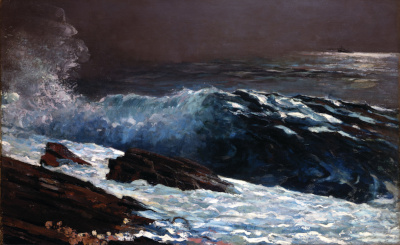
The painting belongs to one of the most important transitions in Homer's late career. By 1890 he had been based at Prouts Neck, Maine, for several years. Earlier marine works often turn on a human action: fishermen haul a net, a doryman watches fog, a rescue line carries a body through surf. Sunlight on the Coast is different. The subject is the coast itself under pressure: waves, rocks, weather, darkness and a break of light. [1]
The Toledo Museum label makes that shift central. It describes the painting as a crucial move toward Homer's oil seascapes without narrative figures, and it reads the title as deliberately uneasy because the light struggles against storm gloom rather than simply bathing the scene. That is enough evidence for a substantial support article. The article does not need to become a symbolic essay about sunlight in general. Its strength is more exact: this painting shows Homer allowing sea and weather to carry the drama directly. [2]
A Coast Without A Story Figure
The composition is built around impact. Dark rocks anchor the lower edge of the scene. The sea crashes against them, breaking into white and gray foam. The sky is not a calm backdrop. It presses down on the water and makes the light feel intermittent, something briefly forced through heavy weather. The title points toward illumination, but the picture does not offer an easy bright view. [3]
That tension is the article's best reader route. Sunlight on the Coast is not just a picture of sun on water. It is a picture of sunlight made difficult. The viewer sees light as an event within weather, not as a decorative coating over the landscape. Homer's brushwork can be read through that problem: broken forms for waves, dark masses for rock, and a surface that lets the sea feel restless rather than polished. [4]
There is no visible fisherman to organize the scene as labor. There is no rescue device to make the painting a crisis narrative. There is no group of figures on shore to reassure the viewer that the coast is mainly a place for spectators. That absence matters. Homer had already proved that he could make marine pictures intense through human action. Here he tests whether the same force can come from water and weather alone. [5]
The result is not emptiness. The sea becomes the actor. The rocks become resistance. The sky becomes pressure. Sunlight becomes the unstable sign that the weather is changing or has not yet settled. The painting works because those elements are enough. [6]
Prouts Neck And The Late Marine Turn
Local Homer source packets identify the move to Prouts Neck in 1883 as a central late-career fact. Prouts Neck gave Homer long contact with the Atlantic edge, and the late Maine works repeatedly return to surf, rock, horizon, coastal light and weather. Sunlight on the Coast belongs naturally in that group. [1]
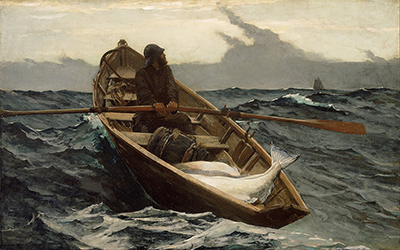
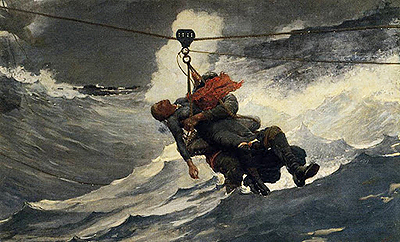
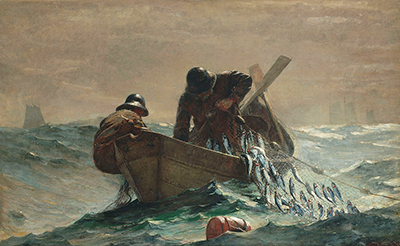
It also helps explain why the late marine route should include more than the famous narrative pictures. The Fog Warning, The Herring Net and The Life Line remain essential because they show human labor and risk at sea. But the late coast also includes paintings where Homer reduces the visible subject until natural force carries nearly everything. Northeaster, High Cliff, Coast of Maine, Eastern Point and Moonlight, Wood Island Light all help readers see that later movement. [2]
Sunlight on the Coast sits especially close to Northeaster and High Cliff, Coast of Maine, but it should keep its own identity. Northeaster is organized around storm impact and a known reworking history. High Cliff, Coast of Maine uses cliff, surf and small figures to set human scale against the coast. Sunlight on the Coast is more directly about the collision between illumination and storm atmosphere. Its title keeps light in the foreground, while the painting keeps weather from becoming benign. [3]
That combination makes the work a useful support page for Paintings. A paintings hub can easily become a list of famous scenes: Civil War soldiers, boys in boats, schoolchildren, fishermen, hunters and shipwrecked survivors. Sunlight on the Coast broadens that route. It shows the moment when Homer's oil painting could make a coast feel complete without anecdote. [4]
What To Notice
Readers is best guided toward the painting's controlled severity. The word sunlight can sound gentle, but the image resists that expectation. Light does not dissolve the rocks or calm the water. It catches in the scene while the sea keeps breaking and the weather remains heavy. This is why the title is productive rather than merely descriptive. [5]
The rocks are important because they give the sea something hard to meet. Homer often finds drama in such encounters. A wave becomes more than moving water when it strikes a fixed coast. Spray is the visible result of that collision. The shore is not a safe balcony; it is part of the event. [6]
The absence of people also changes the reader's role. Without a figure inside the image, the viewer cannot borrow a character's fear, effort or hope. The viewer has to read the painting through physical signs: the weight of water, the dark structure of rock, the pressure of sky and the uncertain break of light. This makes the scene feel less like a story and more like a condition. [1]
That condition is central to late Homer. He does not make nature vague or sentimental. He gives it specific forms and lets those forms hold emotional force. Sunlight on the Coast is therefore a strong concise page, not because it needs a long biographical apparatus, but because it clarifies one of the most important late-career shifts: from the sea as setting for human action to the sea as subject in itself. [2]
Why The Work Matters
The active URL deserves rescue because it fills a clear place in the Winslow Homer cluster. The Toledo Museum object record gives stable institutional facts, and the museum label supports the main public reading: this is a late coastal oil in which Homer moves toward pure seascape and lets weather, brushwork and natural force carry the picture. [3]
The article remains source-led. It says that the painting is a key late marine support work, that the title sets up a tension between light and storm, and that the absence of figures matters within Homer's broader career. It does not need to invent a personal mood, a specific weather report, a precise studio episode or a symbolic program not grounded in the record. [4]
In the rebuilt cluster, Sunlight on the Coast should send readers toward Homer's late Maine coast rather than stand alone as an isolated image. It belongs beside Northeaster, High Cliff, Coast of Maine, Eastern Point, Moonlight, Wood Island Light and the major marine narratives. Together those pages show Homer narrowing the visible subject and enlarging the force of looking. In this painting, light appears, but it does not conquer the coast. The sea and weather remain active, and that is the point. [5]
Discussion
Winslow Homer rewards close looking because his strongest images rarely close down into one easy meaning. Use the prompts below to test how the work changes as you move between subject, place, medium and history.
Reader Insights
First Look
What detail in Sunlight on the Coast changes how the whole work feels?
Homer's Method
Where do you see Homer's balance between clear observation and unresolved meaning?
Cluster Context
Which related Homer work helps you read this page more carefully?
Join the Conversation
Share a thoughtful observation below, especially if a detail, source connection or related Homer page changed the way you read the work.
References
- Toledo Museum of Art object record, Sunlight on the Coast, Winslow Homer, 1890, object number
1912.507: https://emuseum.toledomuseum.org/objects/55004/sunlight-on-the-coast - Toledo Museum of Art Image Resources / Copyright Policy page: https://toledomuseum.org/collection/image-resources
- Google Arts and Culture Toledo Museum object mirror for Sunlight on the Coast, used only as a secondary metadata check and not as an image-build approval.
- Local Winslow Homer provisional URL decision matrix dated 2026-07-20, which records Sunlight on the Coast as an active standard artwork route with a 490-word baseline and source-test note.
- Local Winslow Homer active URL baseline audit dated 2026-07-20, which records the current page title, slug, artwork type, local image filename and under-600-word status.
- Local Winslow Homer homepage/biography packet, paintings hub manuscript, internal-link ledger, image ledger, quote ledger and nearby late-coast manuscripts dated 2026-07-20, used for cluster placement and link caution.
 Winslow Homer.jpg)