



 by Tom Gurney
Tom Gurney BSc (Hons) is an art history expert with over 20 years experience
Published on June 19, 2020 / Updated on November 18, 2026
Email: tomgurney1@gmail.com / Phone: +44 7429 011000
Rodin and the Cambodian Dancers
On one of Auguste Rodin’s sheets from July 1906, a dancer faces forward. Her arms and the outer lines of her clothing are more immediately legible than her face. The pencil moves quickly where the body turns, and broad touches of colour give the costume a shape without spelling out every fold. This is one of many drawings made after Rodin saw the Royal Ballet of Cambodia during King Sisowath’s visit to France. The drawings can tell us a good deal about what the sculptor noticed. The dancers brought a practice of their own, developed over generations, in which the hands, the direction of the body and the timing of a gesture carried meaning. [1] [2] [3]
The performances in France
Sisowath travelled to France in 1906 with members of the royal troupe. The visit took place during French rule in Cambodia. At the colonial exhibition in Marseille, in which an extensive section was devoted to Indochina, a performance could be presented to French spectators within a display intended to promote colonial power. The ballet itself belonged to the Khmer court and had a much older history. The diplomatic setting and the organisation of the exhibition affected how French audiences could encounter it. They tell us less about how dancers learned their roles or what those roles meant within the court. [1] [2]
Rodin first saw the troupe in Paris during a July performance at the Pré Catelan. The Musée Rodin recounts that he followed the dancers to Marseille, where they were due to leave for Cambodia. The museum estimates that he made around a hundred and fifty drawings in the course of about a week. That estimate refers to the series as a whole. It cannot tell us how long Rodin spent with an individual sheet. A page combining pencil and washes also leaves open the possibility that he returned to it after setting down the first line. The short interval helps explain an important feature of the sheets. There can be a great deal of information in one contour even where there is almost none in the surroundings. The papers show how he selected a direction, an opening between the arms or the changing outline of a garment while the performance continued. [1]
What the dancers brought
Khmer classical dance has a repertoire in which movement can distinguish roles and carry stories. UNESCO’s account of the Cambodian Royal Ballet describes gestures and costumes as central to a practice associated with royal occasions and with narratives that matter in Cambodian cultural life. A trained hand has an expressive range extending across the fingers, the wrist and the relation of the palm to the body. Timing is part of that vocabulary. A wrist arriving at a curve and a wrist held briefly at that same curve may have quite different places in a dance. [2]
Rodin knew the practice as a visitor and an observer. The Musée Rodin describes his fascination with the movement of the dancers’ arms and hands and his tendency to relate what he saw to his own ideas about ancient art. Those comparisons belong to the history of his response. They give a way to ask why he took so much interest in the drawings and showed them publicly. The Cambodian tradition provides a separate source of understanding. Readers who encounter it first through Rodin’s sheets can also see performances and learn what the hands are doing within a sequence, something a drawing catches only in parts. [1] [2]
Watch Rodin’s sculpture up close
Five films explore Rodin’s sculpture, from his use of classical models and the figures on his monumental doorway to the work of his studio.
Auguste Rodin – Challenging Beauty
Six sculptures show how Rodin adapted classical models.
Watch on YouTubeA figure alone and figures on a sheet
The Musée Rodin records a July drawing titled Danseuse cambodgienne de face, inventory D.04437, made in graphite and watercolour on a sheet measuring 32.2 by 24.7 centimetres. The phrase describes its viewpoint, and there are other drawings with similar titles. Here the sense of a frontal dancer depends on how the shapes balance around the body. The two sides need very little descriptive detail to establish where the figure is facing. A sloping contour or a bend at the wrist can then suggest a change taking place within that position. When comparing a drawing reproduced in a book or online, the accession number helps establish which of the frontal figures is actually being shown. [3]
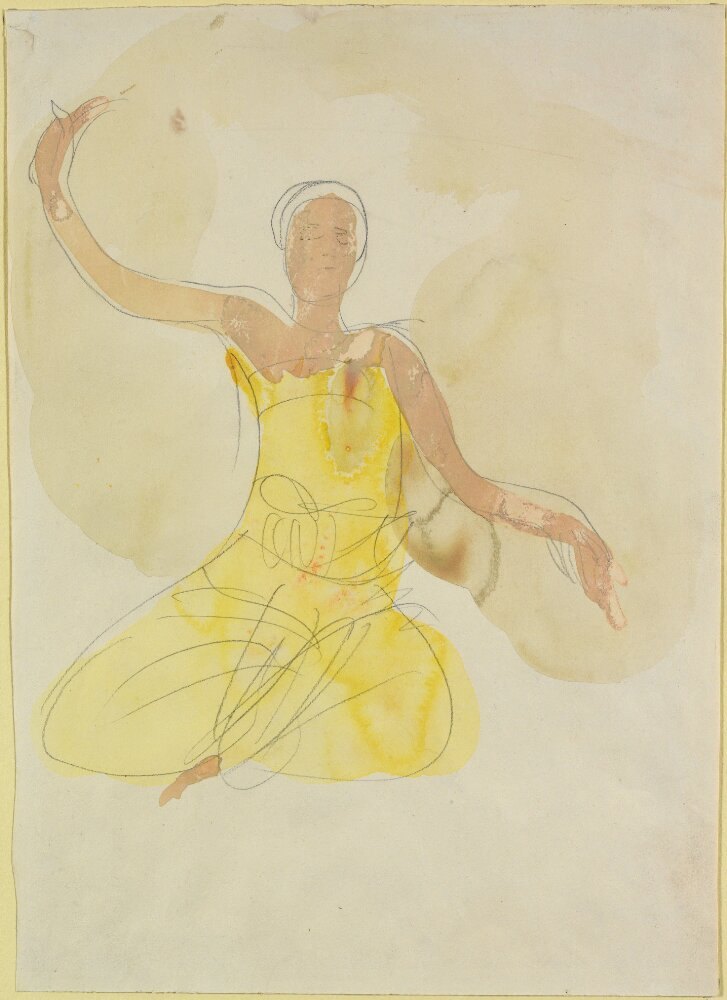
Rodin used individual sheets as well as multiple-figure studies. This example is in Nationalmuseum, Stockholm. Nationalmuseum, Stockholm, via Wikimedia Commons. Image source. Public domain. Resized for the web.
On Six Studies of Cambodian Dancers, D.05076, several figures share a smaller sheet. The Musée Rodin records graphite, watercolour, greasy pencil and gouache, as well as an annotation at the lower right. Look from one figure to the next and you can see more clearly what Rodin chose to record. A gesture that seems slight in isolation becomes conspicuous once you can compare it with another. There is no need to read the six figures as consecutive stages of a single step. The sheet gives the eye a set of positions to compare without establishing a precise sequence for the performance. [4]
Following the drawings into collections
The National Museum of Western Art has another drawing from the series, Cambodian Woman, D.1959-0055, from the Matsukata Collection. The record gives a specific place to start when comparing its paper and treatment with those of the Paris drawings. Other institutions preserve studies with related titles, and the resemblance between such titles can conceal differences in attribution. One drawing at Museum Boijmans Van Beuningen, for instance, was formerly attributed to Rodin. The museum catalogues it separately from its securely attributed sheet of seven dancers. The difference matters when using a drawing to argue for a particular feature of Rodin’s technique. [5] [6] [7]
The exhibition the Musée Rodin devoted to the series in 2006 brought the drawings together a century after the visit. A group of sheets makes the pace of the work easier to imagine. Some offer a single position with room around it. Others bring two or more bodies within the same field and let the eye compare the reach of their arms or the way their clothing changes direction. Begin with one drawing and look closely at a hand, then see what happens to the same part of the body when you move on to another sheet. The variation across the drawings gives a sense of the density of Rodin’s encounter. The dance itself carries on beyond the lines he was able to set down. [1] [2] [3] [4]
A photograph of the Marseille sessions
Émile Sanremo photographed Rodin seated on a bench in Marseille drawing one of the dancers. The Musée Rodin holds a 12 by 17 centimetre gelatin silver press print, Ph.14908. The photographer’s stamp is on the back. On the front, an annotation identifies Rodin and the dancers but gives the year as 1903. The museum dates the scene to July 1906, in keeping with the documented visit by King Sisowath and the royal ballet. In this case the writing on the print helps identify the subject while the date needs to be read alongside the event record. [1] [8]
The photograph records a working encounter as well as an episode in the tour. Its subject is a dancer and the artist drawing in her presence. The watercolors have their own evidence of what mattered to Rodin in the finished sheets. Put the photograph beside the drawings and the change in emphasis becomes apparent. The camera places the artist and performer in the same surrounding space. A drawing can leave that space almost entirely blank, allowing the bend of a wrist or the direction of a step to hold the page. [1] [3] [8]
Rodin artworks directory
Discussion
Look again at the images and ideas explored in Rodin and the Cambodian Dancers. These editorial prompts invite your observations.
Reader Insights
After reading “The performances in France”, what detail would you look for in the object or image?
What extra evidence would help you distinguish the artist’s choices from the effects of material, viewpoint or later display?
Join the Conversation
Share a detail, comparison or question about Rodin and the Cambodian Dancers below.
References
- Musée Rodin. Rodin and the Cambodian Dancers. View source.
- UNESCO. Royal Ballet of Cambodia. View source.
- Musée Rodin. Danseuse cambodgienne de face, D.04437. View source.
- Musée Rodin. Six études de danseuses cambodgiennes, D.05076. View source.
- National Museum of Western Art. Cambodian Woman, D.1959-0055. View source.
- Museum Boijmans Van Beuningen. Cambodjaanse danseres, formerly attributed to Auguste Rodin. View source.
- Museum Boijmans Van Beuningen. Seven Cambodian Female Dancers. View source.
- Musée Rodin. Émile Sanremo, Rodin drawing a Cambodian dancer in Marseille, Ph.14908. View source.

 Auguste Rodin.jpg)


