



 by Tom Gurney
Tom Gurney BSc (Hons) is an art history expert with over 20 years experience
Published on June 19, 2020 / Updated on November 18, 2026
Email: tomgurney1@gmail.com / Phone: +44 7429 011000
Rodin’s Public Monuments
When Auguste Rodin tried out a high position for The Burghers of Calais, he had scaffolding erected in his garden at Meudon. The structure stood about five metres high. From below, he could see how far the group’s silhouette would carry and how the intervals between the men read against the sky. Someone meeting the same figures near pavement level would see a different work in practice. Their hands would have more to say, and the gaps between their shoulders would open into views of the other men. Rodin’s commissions repeatedly brought him back to that question of where a viewer would stand, and what the city or institution wanted its monument to say from there. [1] [2]
A town remembers a group of citizens
The Calais commission began with an initiative to honour Eustache de Saint-Pierre. In the account of the siege of 1347 that informed the monument, Eustache and five other citizens offered themselves to Edward III to spare the town. Rodin developed the commission into a group in which each man could be studied on his own. Jean d’Aire carries a key, one of the signs that these are people preparing to surrender a town. Other figures turn away or bring their hands to their faces. The shared purpose is plain, while the men’s reactions differ enough for a viewer to follow them individually. [2] [3]
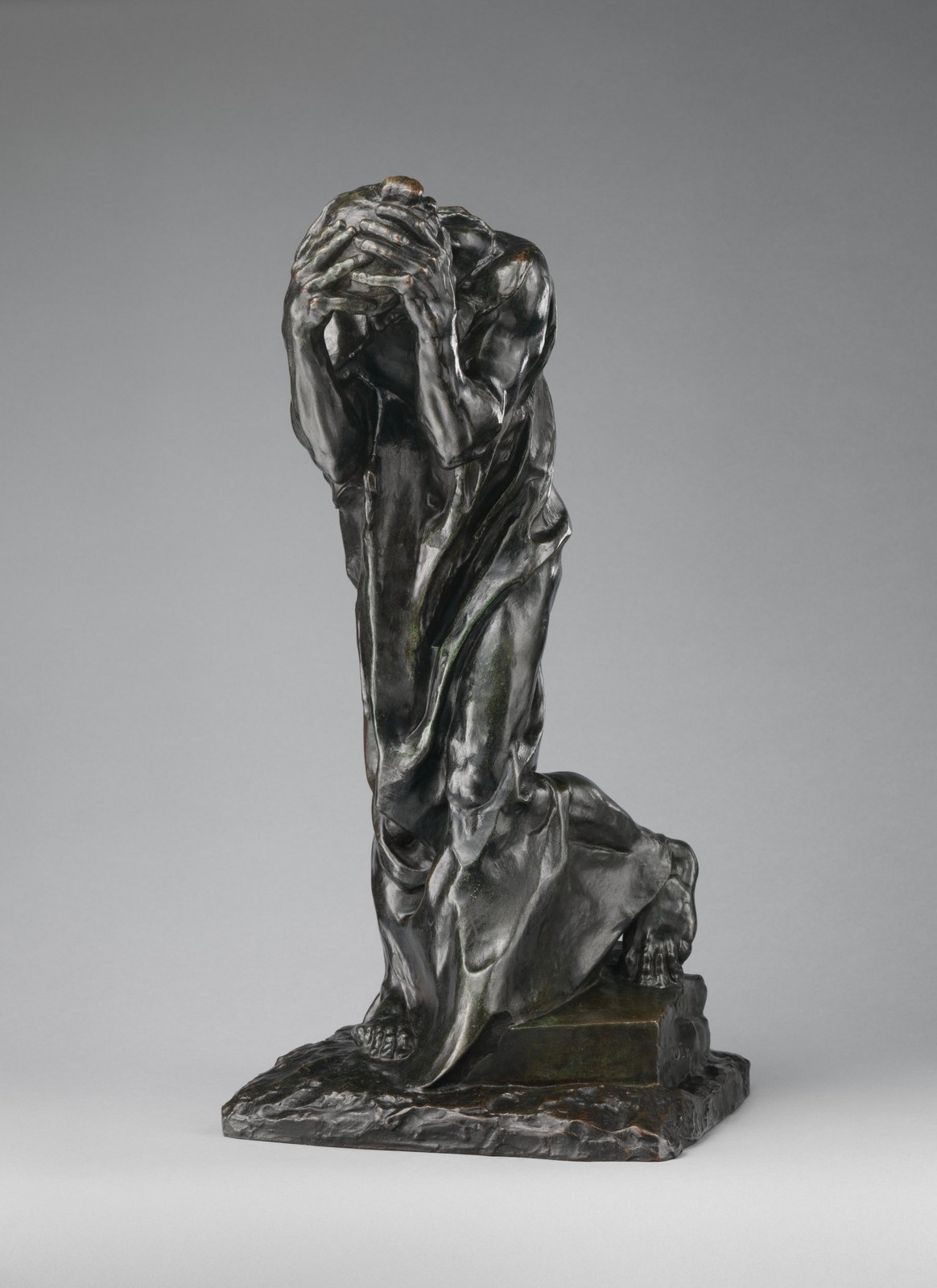
The Weeping Burgher isolates Andrieu d’Andres, one of the six figures in the Calais monument. The Metropolitan Museum of Art, Gift of Miss G. Louise Robinson, 1940, 40.12.6. Image source. CC0 / Public domain.
The monument was inaugurated in Calais in 1895. Rodin considered both a very high base and a position close to the ground. The town’s installation took a different course from either of those extremes. The decision affected what could be seen. Raising the group gives the six a broad outline and lets them announce the presence of a monument at a distance. Coming closer to their level allows the eye to pass between the bodies and notice where gestures fail to meet. In the early twentieth century the purchase of a bronze for London returned Rodin to the problem of how the group might hold its own against surrounding buildings. His test in Meudon was a practical response to the difference between seeing a model indoors and encountering a sculpture in a city. [1] [2]
Where to put Victor Hugo
The Panthéon commission for Victor Hugo invited Rodin to imagine how a writer and public figure might be commemorated inside a national monument. He began with a seated Hugo on rocks, an arrangement associated with the writer’s exile in the Channel Islands. The outstretched arm takes the eye beyond the outline of the figure. In some studies, muses rise around him. The posture, the stone and the added figures offered different ways to make Hugo’s writing and public life part of the same monument. After objections to that scheme, Rodin also worked on a standing Hugo intended for the Panthéon. [4] [5]
The seated marble eventually went to the Palais-Royal, where it was installed in 1909. In the finished marble, Hugo occupies the rock alone. The gap beyond his hand belongs as much to the garden around the statue as to the sculpture. Much later Paris installed a bronze with muses from one of Rodin’s other versions. It was a response to a new civic situation, after the earlier Hugo monument by Alexandre Falguière had lost its bronze figures during the Vichy regime. These works have a common history in Rodin’s studio, but their settings and even the number of figures in them belong to separate public decisions. [4] [6] [7]
How recognisable should a writer be?
The Société des Gens de Lettres commissioned Rodin’s Balzac in 1891. For years he pursued the resemblance through studies of the head and figure. He eventually concentrated the body within a large robe, hiding the writer’s hands and making the direction of the face especially important. The plaster exhibited in 1898 was rejected. The Musée Rodin records objections to its departure from expectations for a public monument and the difficulty some people had recognising the writer. Where the group at Calais used familiar elements of a story to locate each figure in an event, Balzac’s robe kept much of the body and its visible action out of reach. The scale gave the face room to carry something a pen, desk or book might otherwise have made explicit. [8] [9]
Its later bronzes give the work a public life beyond the original rejection. The garden bronze at the Musée Rodin was cast in 1935. A viewer approaching it outdoors can watch the robe emerge as a broad shape before seeing the break in the silhouette made by the head. That experience does not reproduce the encounter with a pale plaster at the Salon in 1898. It gives the model a new setting and a new material, just as Edward Steichen’s night photographs gave the plaster a different audience before there was a bronze monument to see. [8] [9]
Watch Rodin’s sculpture up close
Five films explore Rodin’s sculpture, from his use of classical models and the figures on his monumental doorway to the work of his studio.
Auguste Rodin – Challenging Beauty
Six sculptures show how Rodin adapted classical models.
Watch on YouTubeSarmiento in Buenos Aires
The Argentine state commissioned Rodin to commemorate Domingo Faustino Sarmiento in 1894. The bronze reached Buenos Aires in April 1900 and was installed in the Parque Tres de Febrero on land formerly occupied by the home of Juan Manuel de Rosas. The location brought its own associations to a monument to a former president. The unveiling took place on 25 May, a national holiday, with President Julio A. Roca present. According to the Museo Nacional de Bellas Artes, some critics objected that the figure bore too little resemblance to Sarmiento. Eduardo Schiaffino, the museum’s founding director, defended the work in the press. [10]
Sarmiento’s monument and the Balzac plaster both tested the expectations attached to a public likeness. Their histories took different courses. In Buenos Aires the bronze had already arrived and the ceremony proceeded. In France the commissioners rejected the Balzac before Rodin could see a bronze made. This is why the reception of one commission cannot stand in for the others. The Buenos Aires museum records that police guarded the bronze for eight days after its unveiling. That measure and Schiaffino’s defence in the press show that the ceremony settled where the work would stand while leaving its public reception open. A commissioner, a sculptor and the people who see a statue in a public place meet at different stages, and each has an opportunity to affect its future. The ground beneath the sculpture, the height at which it stands and the features that identify a person are often the places where those decisions remain visible. [8] [9] [10]
Claude Lorrain in Nancy
For the monument to the landscape painter Claude Gellée, known as Claude Lorrain, Rodin submitted a project in April 1889. The Met preserves a study from that project. The completed monument was inaugurated on 6 June 1892 in Nancy, in the presence of President Sadi Carnot. The Parc de la Pépinière gives the bronze a setting with paths along which spectators can approach it from several directions. The approach matters because the figure of the painter is only one part of the work. The pedestal has sculptural elements of its own, and its inscriptions identify the sitter and credit the committees whose subscriptions paid for the project. [11] [12]
The Musée des Beaux-Arts de Nancy preserves a study for the figure of Apollo associated with the monument. Its record credits Rodin and Jules Desbois and identifies Desbois as one of the practitioners who worked on the commission. The study and the inscriptions preserve different kinds of participation in the same work. The study documents a figure developed in the studio. The wording on the base locates the public initiative in Nancy and Paris. Both help explain how the painter’s monument acquired the form that was installed in the park. [12] [13]
A monument to Whistler that remained in the studio
The International Society of Sculptors, Painters and Gravers commissioned a memorial to James McNeill Whistler in 1905. Rodin developed a draped muse. The large plaster in the Musée Rodin retains a chin reworked in modelling clay and fresh plaster on the top of the head. The museum relates the pose and drapery to the Venus de Milo and identifies a cast of an antique altar from Rodin’s collection in the project. These details make it possible to trace the development of the figure even though no monument resulted from the commission. Léonce Bénédite submitted the project in 1918, after Rodin’s death, and the committee refused it. The surviving model gives a view into decisions about material and pose that would usually be difficult to recover from an installed bronze. [14]
Rodin artworks directory
Discussion
Look again at the images and ideas explored in Rodin’s Public Monuments. These editorial prompts invite your observations.
Reader Insights
After reading “A town remembers a group of citizens”, what detail would you look for in the object or image?
What extra evidence would help you distinguish the artist’s choices from the effects of material, viewpoint or later display?
Join the Conversation
Share a detail, comparison or question about Rodin’s Public Monuments below.
References
- Musée Rodin. Sculpture and architecture. View source.
- Musée Rodin. Monument to the Burghers of Calais. View source.
- The Metropolitan Museum of Art. The Burghers of Calais. View source.
- Musée Rodin. Model for the Monument to Victor Hugo, with Meditation and the Tragic Muse. View source.
- The Metropolitan Museum of Art. Rodin’s Monument to Victor Hugo. View source.
- Ville de Paris. Paris, un musée à ciel ouvert: les écrivains. View source.
- Musée d’Orsay. Monument à Victor Hugo. View source.
- Musée Rodin. Monument to Balzac. View source.
- Musée Rodin. Rodin and Steichen. View source.
- Museo Nacional de Bellas Artes. Rodin: centenario en Bellas Artes. View source.
- Metropolitan Museum of Art. Claude Lorrain: A study for the monument. View source.
- French Ministry of Culture. Monument à Claude Gellée, inventory IM54009105. View source.
- Musée des Beaux-Arts de Nancy. Le Génie de la Lumière, project for Apollo. View source.
- Musée Rodin. Draped Muse from the Monument to Whistler, large model. View source.

 Auguste Rodin.jpg)


