The Destruction of Pompeii and Herculaneum by John Martin: Introduction
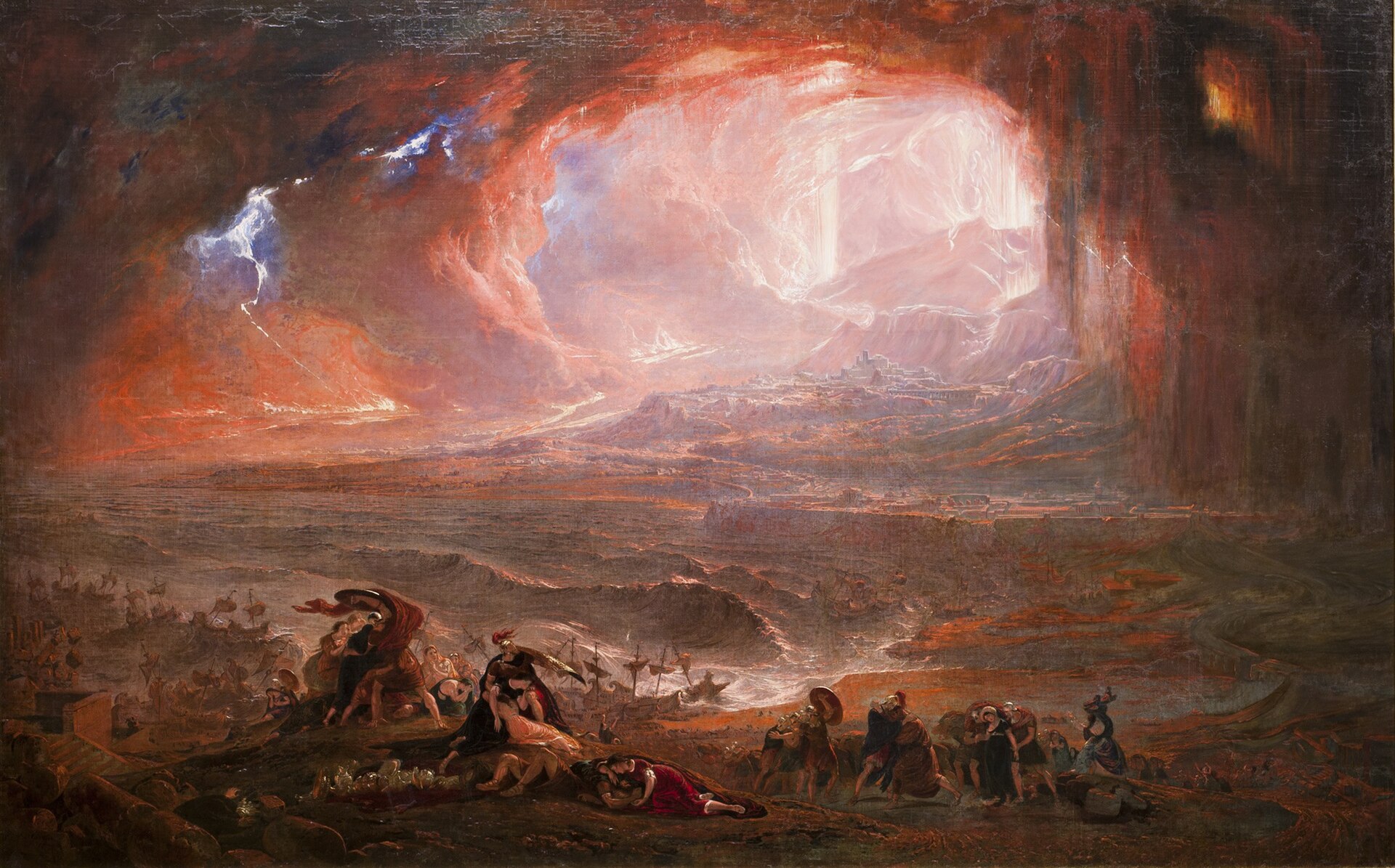
John Martin's The Destruction of Pompeii and Herculaneum turns an ancient catastrophe into a vast theatrical vision. Painted in 1822 and now owned by Tate, it imagines the eruption of Mount Vesuvius in 79 CE, when the Roman cities of Pompeii and Herculaneum were destroyed. Martin does not treat the disaster as a quiet archaeological reconstruction. He makes it a red, convulsed world of lava, ash, lightning, falling architecture and desperate crowds.
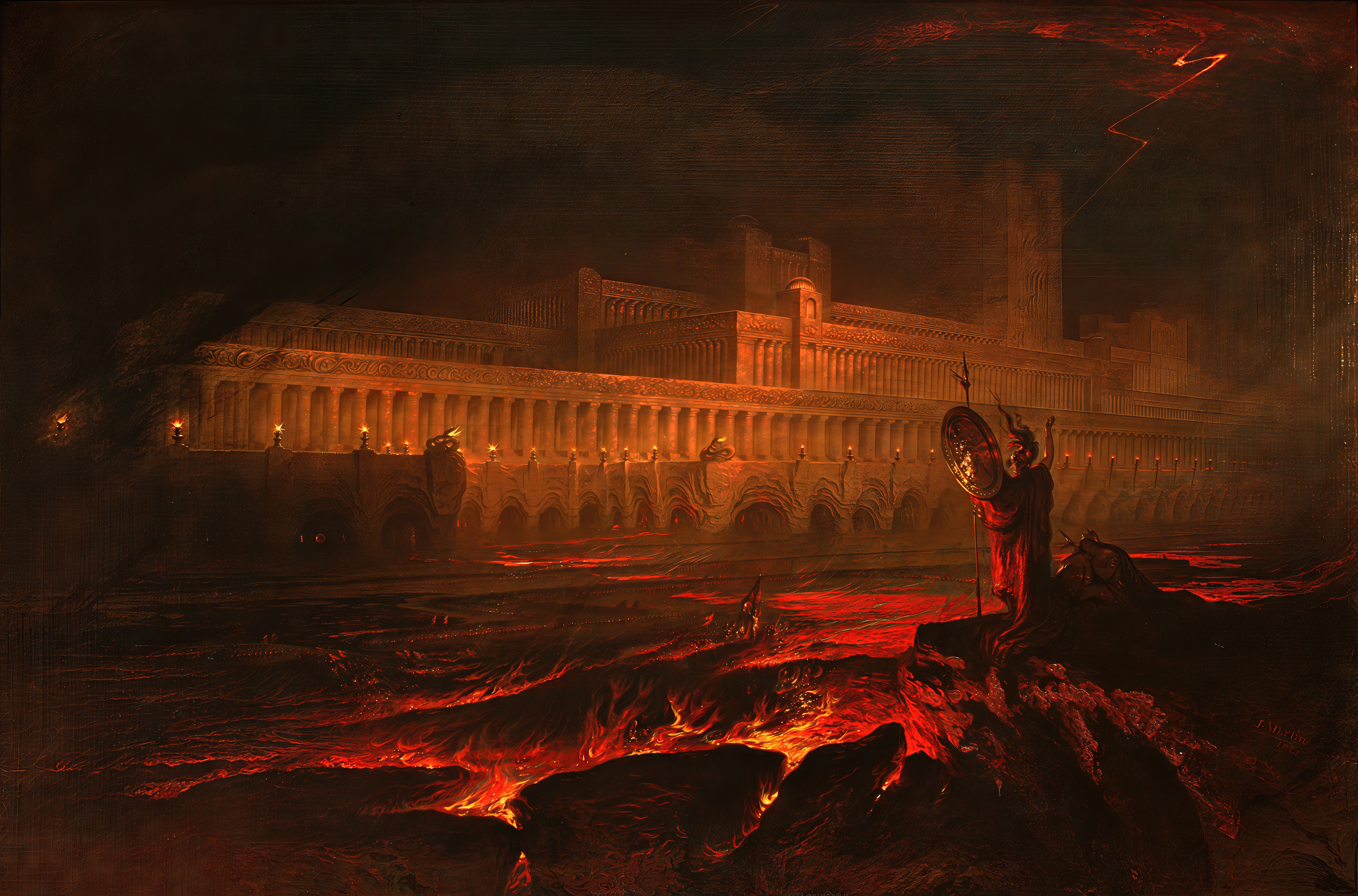
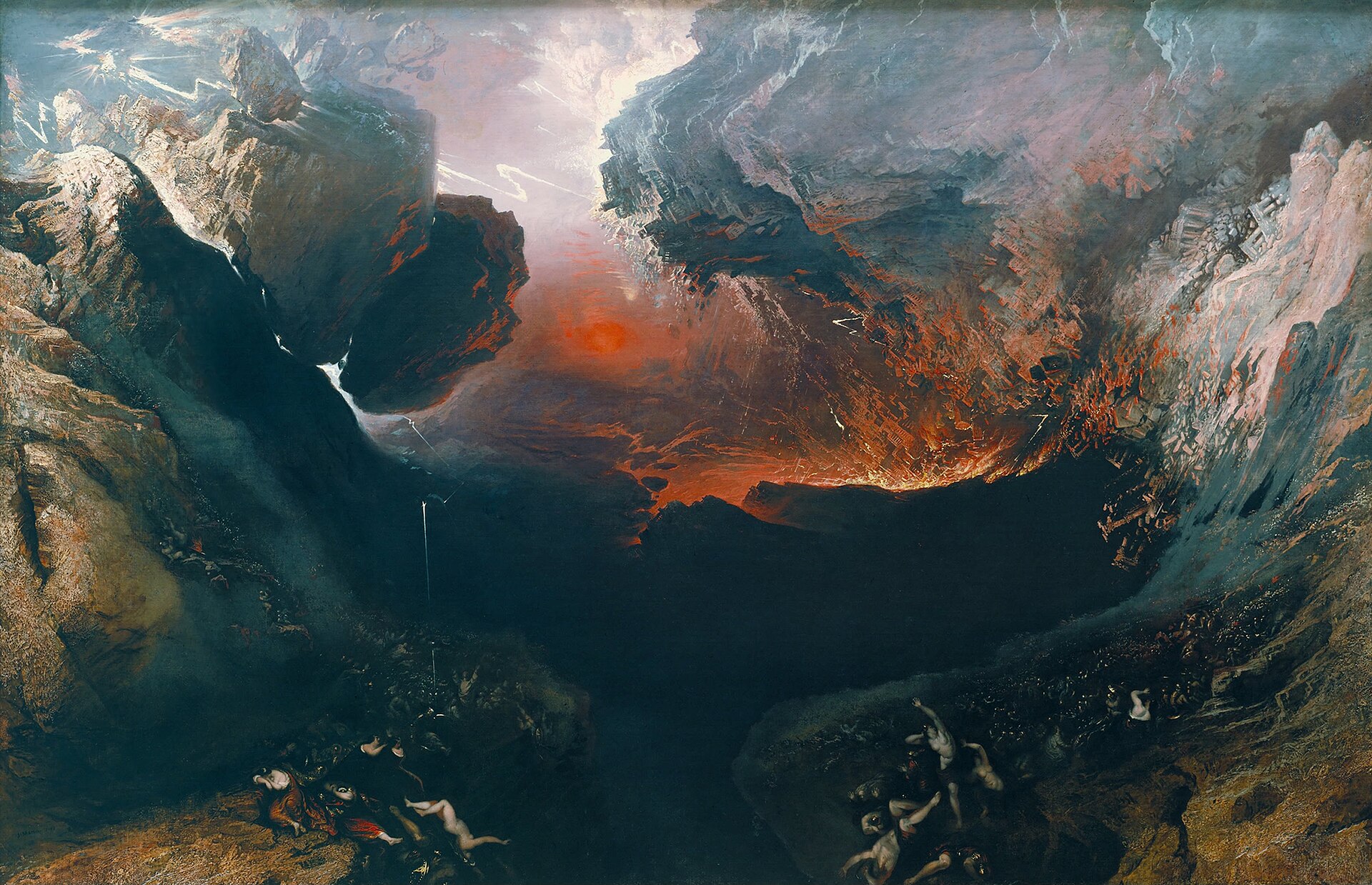
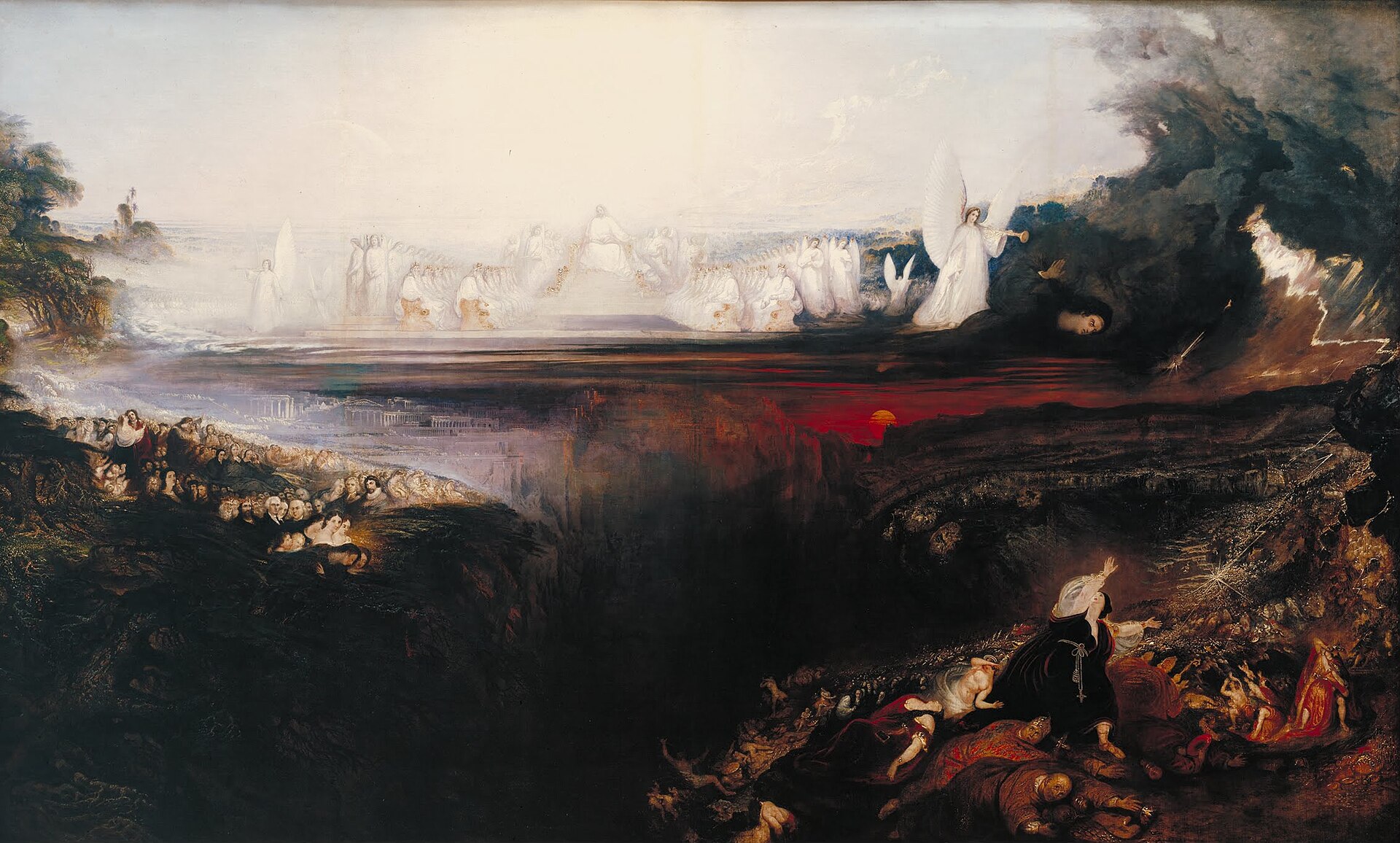
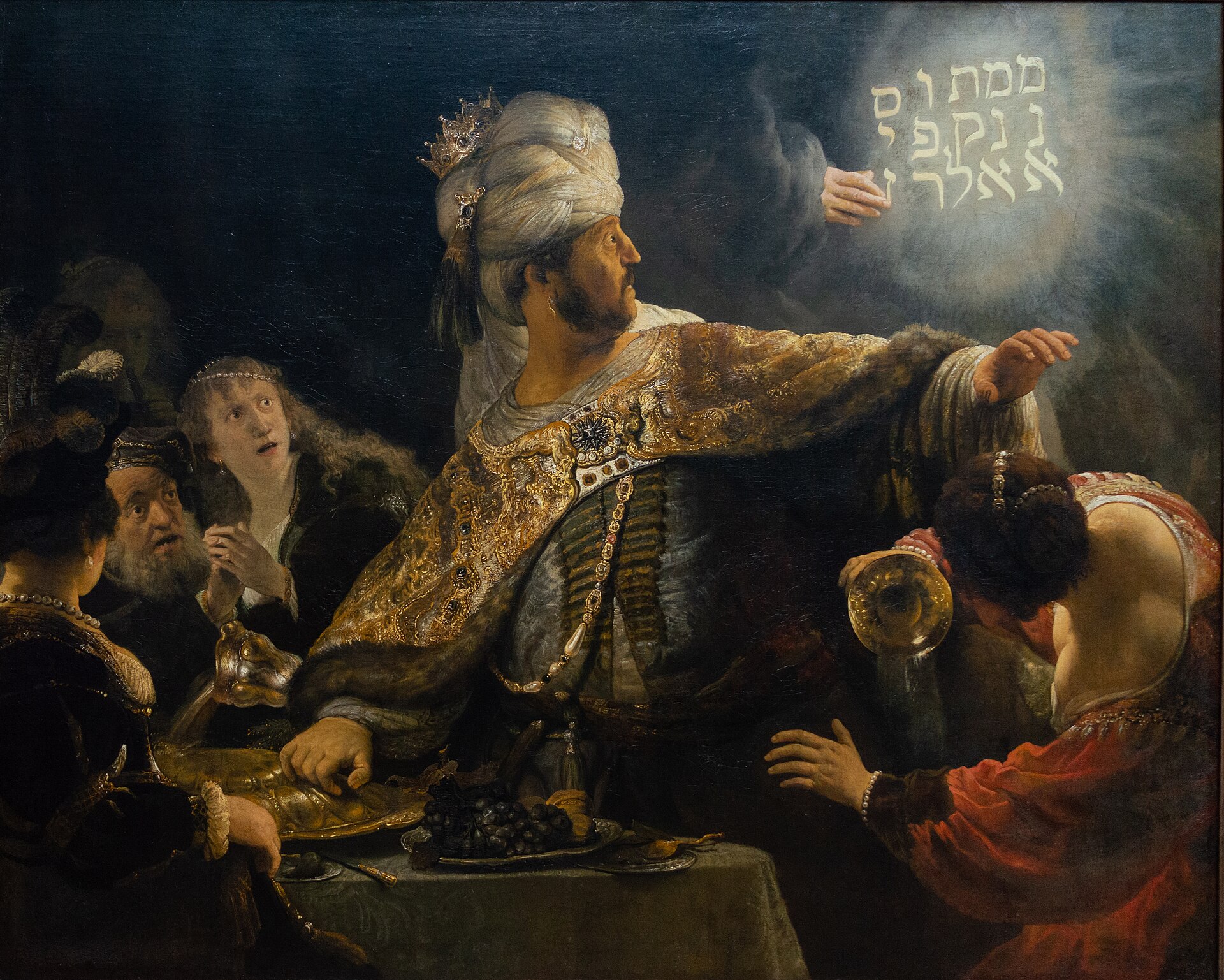
This is not one of Martin's Last Judgement paintings. It is a classical and historical disaster, rooted in the ancient story of Vesuvius rather than the Book of Revelation. Yet it belongs closely to his wider apocalyptic imagination. Like Pandemonium, Belshazzar's Feast and The Great Day of His Wrath, it uses architecture, tiny figures, violent light and overwhelming scale to show civilisation meeting a force it cannot control.
Pandemonium gathers Martin's Miltonic imagination, print-to-painting development and infernal architecture into one central image. The Destruction of Pompeii and Herculaneum is different. It shows Martin's catastrophe language turned toward ancient history, and its own modern story of damage and restoration is almost as dramatic as the subject it depicts.
At a Glance
- ArtistJohn Martin
- TitleThe Destruction of Pompeii and Herculaneum
- Date1822
- Mediumoil on canvas
- CollectionTate
- Tate accessionN00793 in Tate-linked and Victorian Web records
- Acquisition notepurchased in 1869 in ACMI and Victorian Web records
- Dimensions1616 mm by 2530 mm in ACMI and Victorian Web records
- SubjectMount Vesuvius destroying Pompeii and Herculaneum in 79 CE
- Modern historydamaged in the 1928 Tate flood and restored for renewed display in 2011
- Closest cluster comparisonsPandemonium for architecture and fire; The Great Day of His Wrath for catastrophic scale
Contents
- Introduction
- How to Read the Composition
- Pompeii, Herculaneum and Ancient Catastrophe
- Title, Versions and Visual Memory
- Classical Disaster and Modern Anxiety
- Public Spectacle and the Egyptian Hall
- Damage, Loss and Restoration
- Relationship to Martin's Apocalyptic Imagination
- Why the Painting Matters
What Is Happening in the Painting?
The painting shows Vesuvius in eruption. Herculaneum appears in the distance to the left, overwhelmed by lava. Pompeii lies closer to the foreground, where Martin gives more detail to the city, the fleeing people and the collapse of civic space. ACMI's account describes lava reddening the whole landscape while ash clouds and lightning convulse the sky.
Martin stages the scene from a sweeping viewpoint. The viewer looks across a broad theatre of disaster rather than into one narrow incident. The volcano, the cities, the sea, the sky and the figures all participate in the event. This is one reason the painting feels so large even before its actual dimensions are considered.
The subject had enormous imaginative power in Martin's period. Pompeii and Herculaneum were not simply ancient names. The rediscovery of buried Roman life had made them symbols of civilisation suddenly stopped. Martin seized on that idea. He shows a world in which houses, streets, crowds and familiar human movement are overtaken by fire, ash and geological force.
The painting's terror is not only in the figures. A contemporary viewer quoted by ACMI noted that Martin was less concerned with showing the terror of the people than with producing powerful contrasts through reflected light. That observation gets close to the painting's method. Martin makes disaster visible through atmosphere and illumination as much as through human expression.
How to Read the Composition
Begin with Vesuvius. The volcano is the source of the action, but Martin does not isolate it like a scientific diagram. Its glow spreads across the landscape and stains the entire world red. The mountain becomes both a physical source and a visual engine.
Then look at the sky. Ash clouds and lightning make the heavens feel as unstable as the earth. Martin's disaster is vertical: fire rises, ash falls, lightning cuts downward and smoke fills the air. The viewer feels trapped between eruption below and convulsion above.
Next, follow the diagonal movement toward the foreground. Guardian reporting on the restoration records that eye-tracking research found viewers moved from the volcano through the city toward the foreground figures. That path suits Martin's design. The eye descends from the volcanic source into human consequence.
The city is crucial. Pompeii is not just scenery. Its streets, buildings and crowds give the disaster cultural meaning. Martin's apocalyptic art often sets constructed human order against overwhelming force. Here the force is not demonic or divine in the same way as Pandemonium or The Last Judgement. It is volcanic, historical and natural, but Martin gives it the grandeur of doom.
Finally, look at the red light. It does not simply illuminate the scene. It unifies it. Lava, sky, architecture and bodies are all caught in the same fiery atmosphere. The colour turns the whole canvas into a single state of emergency.
Pompeii, Herculaneum and Ancient Catastrophe
The eruption of Vesuvius in 79 CE destroyed both Pompeii and Herculaneum, but the two cities were not destroyed in identical ways. ACMI's account gives a useful visual distinction inside Martin's painting: Herculaneum is seen in the distance, smothered by lava, while Pompeii is nearer and rendered in greater foreground detail.
That distinction helps the painting avoid becoming a generic volcanic scene. Martin gives the viewer a historical disaster with spatial organisation. The farther city is a vision of engulfment; the nearer city becomes the stage for human panic and civic collapse.
The nineteenth-century fascination with Pompeii also matters. The buried city had become a powerful image of interrupted life, where everyday Roman existence was preserved by catastrophe. Martin's painting takes that archaeological fascination and intensifies it into spectacle. He is less interested in small antiquarian accuracy than in the emotional scale of sudden destruction.
This separates the painting from the Last Judgement sequence. In the triptych, catastrophe belongs to Revelation and divine judgement. In Pompeii and Herculaneum, catastrophe comes through ancient history and volcanic force. The visual language overlaps, but the source world is different.
Title, Versions and Visual Memory
The title can appear in more than one order. The Tate-owned work is widely discussed as The Destruction of Pompeii and Herculaneum, while Art UK's shop record for the Tabley House Collection gives a related title, The Destruction of Herculaneum and Pompeii. That distinction matters because Martin's catastrophe subjects circulated through versions, reproductions and later image records. The safe way to read the Tate painting is to keep its object facts attached to Tate's N00793 record and not blend it casually with another version.
The most important difference is not only wording. It is the way Martin gives the two cities different visual functions. Pompeii is closer, more detailed and more available for human drama. Herculaneum is farther away, closer to disappearance. The title names both cities, but the composition separates them in depth.
This gives the painting a powerful memory structure. Pompeii stands for visible civic life at the moment of disaster: streets, buildings, movement, people and bodies caught in the foreground. Herculaneum stands for a more distant fate, already being swallowed. Martin makes the viewer feel that catastrophe has stages. One city is still being watched as it falls; the other is already nearly lost.
The spelling history around "Pompeii" and "Pompei" also appears in older image records and secondary reproductions. That is useful as a caution, but it should not distract from the artwork. Martin's subject is the double destruction of the Vesuvian cities, and the safest anchor for this cluster remains the Tate-owned 1822 painting.
Classical Disaster and Modern Anxiety
Victorian Web's commentary connects Pompeii's nineteenth-century power to its role as both social phenomenon and metaphor. The buried city allowed modern viewers to imagine ancient people interrupted in recognisable daily life. This helps explain why Pompeii was such a strong subject for Martin. It joined antiquity, archaeology, mortality and spectacle in a single scene.
Martin was not painting ruins after the event. He was painting the moment before memory becomes ruin. That choice gives the work its energy. The viewer sees the city as living and dying at once. Buildings still stand, people still move and the catastrophe is still unfolding.
That is different from a calm archaeological view. A ruined city invites reflection after destruction. Martin's city invites panic inside destruction. He wants the ancient world to feel immediate, not remote.
The painting therefore turns classical history into a modern emotional experience. Viewers did not need to live in Pompeii to recognise the terror of a familiar world becoming unstable. That is one reason the work remains persuasive. It uses an ancient event to express a fear that belongs to any age: that the ground, the city and the sky can all cease to protect us.
Public Spectacle and the Egyptian Hall
Martin's painting was made for public impact. Guardian reporting on the 2011 restoration notes that the work was the centrepiece of Martin's 1822 solo exhibition at the Egyptian Hall in Piccadilly. The Egyptian Hall was a natural setting for a picture like this: a place of exhibition, spectacle and public attraction rather than quiet private viewing alone.
This helps explain the painting's scale and intensity. Martin wanted viewers to feel surrounded by disaster. The subject, composition and lighting all work toward a public experience of awe. ACMI connects Martin's large apocalyptic paintings with the history of spectacle and even proto-cinematic experience, noting that visitors flocked to his epic scenes of destruction in ways that invite comparison with later blockbuster entertainment.
The cinema comparison should be used carefully. Martin was a nineteenth-century painter, not a film director. But the comparison is valuable when it points to real qualities in the painting: wide views, dramatic lighting, directed attention, disaster as visual event and a sense that the viewer is witnessing the whole collapse of a world.
The Destruction of Pompeii and Herculaneum is one of the best paintings through which to understand that public side of Martin. It is not only about the ancient disaster. It is about the experience of watching disaster.
Damage, Loss and Restoration
The painting's modern history gives it a second catastrophe. In 1928, the Thames flooded Tate's basement at Millbank. Guardian reporting describes The Destruction of Pompeii and Herculaneum as severely damaged by the flood, once regarded as beyond repair and missing a large section that included the erupting volcano.
For decades, the damage affected how the painting could be seen and valued. A work about destruction had itself been partly destroyed. That coincidence is hard to ignore, but it should not be turned into a gimmick. It matters because it shaped the object's visibility, conservation history and modern reception.
The restoration for Tate Britain's 2011 John Martin: Apocalypse exhibition was therefore a major event. The Guardian reported that the painting had undergone 18 months of difficult restoration before going back on view. Conservators cleaned and stabilised what survived and reconstructed the missing section in a way intended to recover Martin's overall impact while leaving the intervention reversible.
Another Guardian account by vision scientist Tim J. Smith explains that eye-tracking research informed the restoration decision. Viewers' attention was studied across different digital reconstructions, helping conservators understand how the missing volcanic section affected the painting's intended viewing pattern. Smith describes the important focal points as the volcano, the city and the foreground figures, connected by Martin's diagonal sightlines.
That conservation story is unusually relevant to close-looking. It confirms that Martin's composition was not just a mass of fiery spectacle. It directed the eye. The restoration sought to restore not only missing paint, but the movement of looking.
Relationship to Martin's Apocalyptic Imagination
The Destruction of Pompeii and Herculaneum belongs to Martin's larger world of catastrophe, but it should not be folded too neatly into the Last Judgement paintings. Its source is historical and classical, not Revelation. Its terror comes from Vesuvius, not from the final division of souls.
Still, the painting shares many of Martin's signature devices. Small figures measure the scale of disaster. Architecture stands for human order just as that order is overwhelmed. Light becomes an active force. The whole scene is organised as public spectacle.
The relationship to Pandemonium is especially useful. In Pandemonium, architecture rises out of fire as Satan calls Hell's capital into being. In Pompeii and Herculaneum, architecture is consumed by fire as an ancient city collapses. One is infernal construction; the other is historical destruction. Both show Martin thinking through fire, city and scale.
The relationship to The Great Day of His Wrath is also clear, but narrower. Both paintings picture worlds breaking apart. Yet The Great Day imagines cosmic judgement, while Pompeii and Herculaneum imagines a known ancient disaster. That difference keeps this painting grounded in history even when its visual language becomes almost apocalyptic.
Why the Painting Matters
The painting matters because it shows Martin at a crucial early height. Before the late Last Judgement sequence, before the 1841 Pandemonium, he was already able to make disaster feel like a complete world. The 1822 painting belongs to the same career that produced biblical and Miltonic spectacles, but it proves that ancient history could also serve his imagination.
It also matters because of its restoration. Many paintings have conservation histories, but few have one so closely tied to their subject. A canvas about the destruction of two cities was damaged by floodwater, stored for decades in compromised condition and later returned to public view through a bold conservation campaign.
The restored painting helps modern viewers see Martin more clearly. His reputation has often swung between admiration and embarrassment: visionary grandeur on one side, melodrama on the other. The Destruction of Pompeii and Herculaneum makes that tension productive. It is excessive because its subject is excessive. Martin gives catastrophe the size, colour and public force he believed it required.
Frequently Asked Questions
Discussion
What detail in The Destruction of Pompeii and Herculaneum changes how you read John Martin's use of scale, light or atmosphere?
Reader Insights
Which figure, architectural form or passage of light first anchors the scene for you?
How does the source story or subject change the emotional force of the image?
Where does this work feel closest to, or furthest from, Pandemonium?
Join the Conversation
Share your reading of The Destruction of Pompeii and Herculaneum below.
References
- ACMI, *The Destruction of Pompeii and Herculaneum*: View Source, accessed 2 August 2026.
- The Guardian, Mark Brown, restoration report for *The Destruction of Pompeii and Herculaneum*: View Source, accessed 2 August 2026.
- The Guardian, Tim J. Smith, vision-science restoration account: View Source, accessed 2 August 2026.
- Victorian Web, George P. Landow, *The Destruction of Pompeii and Herculaneum*: View Source, accessed 2 August 2026.
- Art UK Shop, Tabley House Collection version, *The Destruction of Herculaneum and Pompeii*: View Source, accessed 2 August 2026.
- Tate object URL for later direct recheck: View Source, accessed 2 August 2026.
- Tate Shop, Martin Myrone, *John Martin - Sketches of My Life*: View Source, accessed 2 August 2026.
- Wikisource transcription of William Cosmo Monkhouse, "Martin, John (1789-1854)", *Dictionary of National Biography*, 1893: View Source, accessed 2 August 2026.