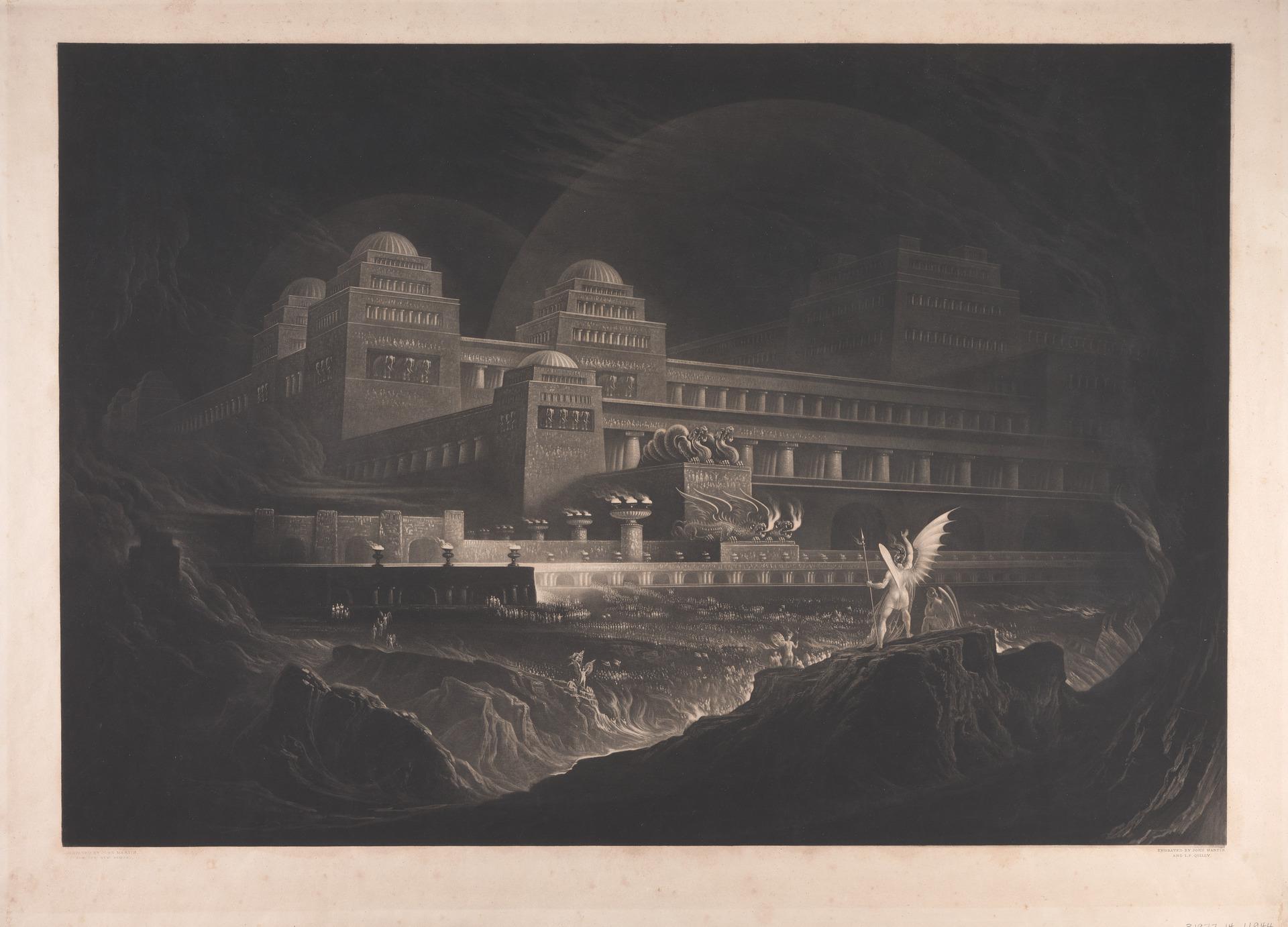
John Martin Prints and Paradise Lost: Introduction
John Martin's fame did not belong only to large paintings in exhibition rooms. It also belonged to paper, books, proofs, portfolios and mezzotints that carried his images into wider circulation. His prints helped turn biblical and literary spectacle into something viewers could study, buy, collect and remember long after a public display had closed.
This is especially important for Martin's relationship with John Milton's Paradise Lost. The poem gave him a world of heaven, hell, rebellion, light, darkness and cosmic architecture. Printmaking gave him a medium suited to that world. In mezzotint, Martin could make darkness luminous, build palaces out of shadow and send vast scenes across the page through tone rather than colour.
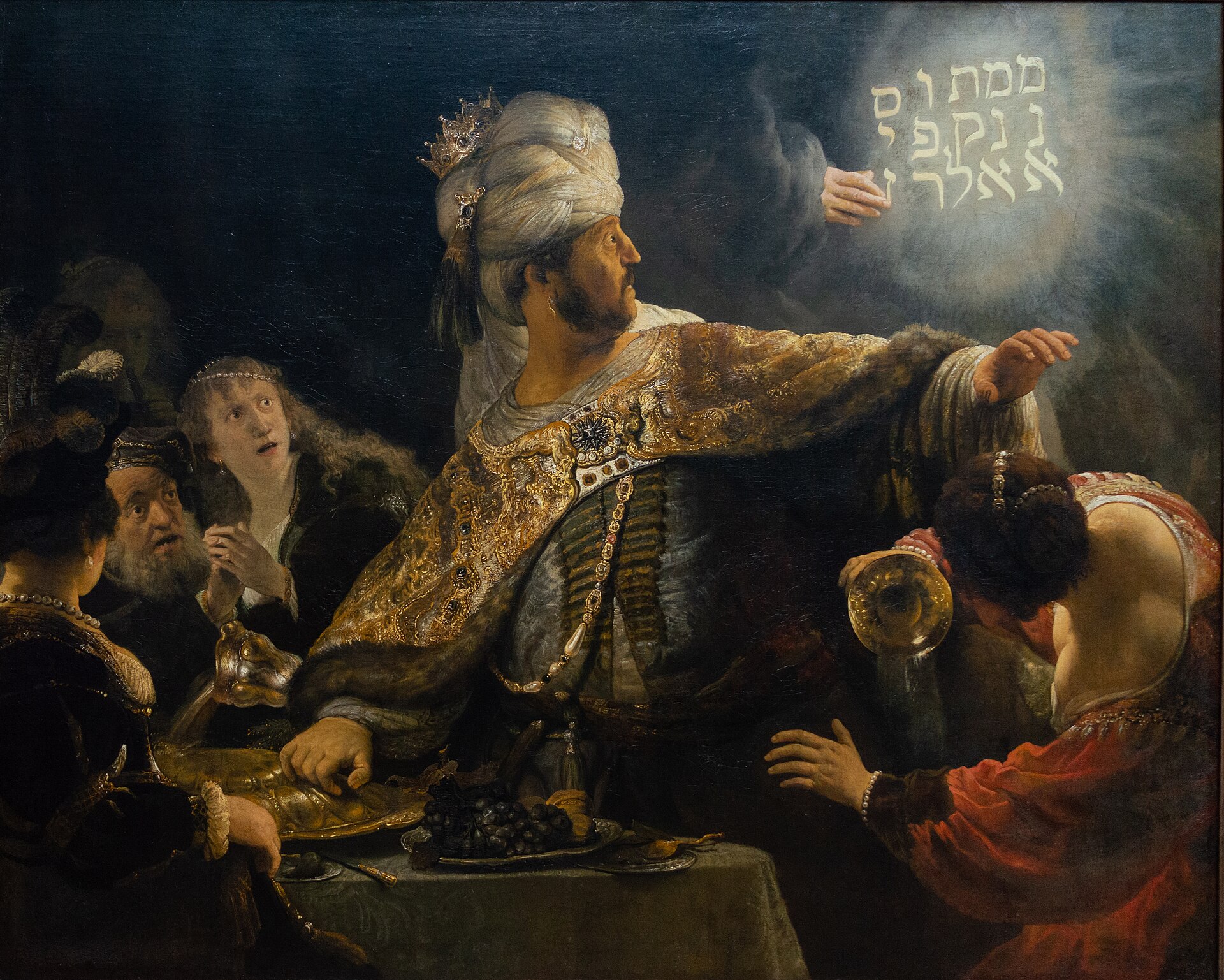
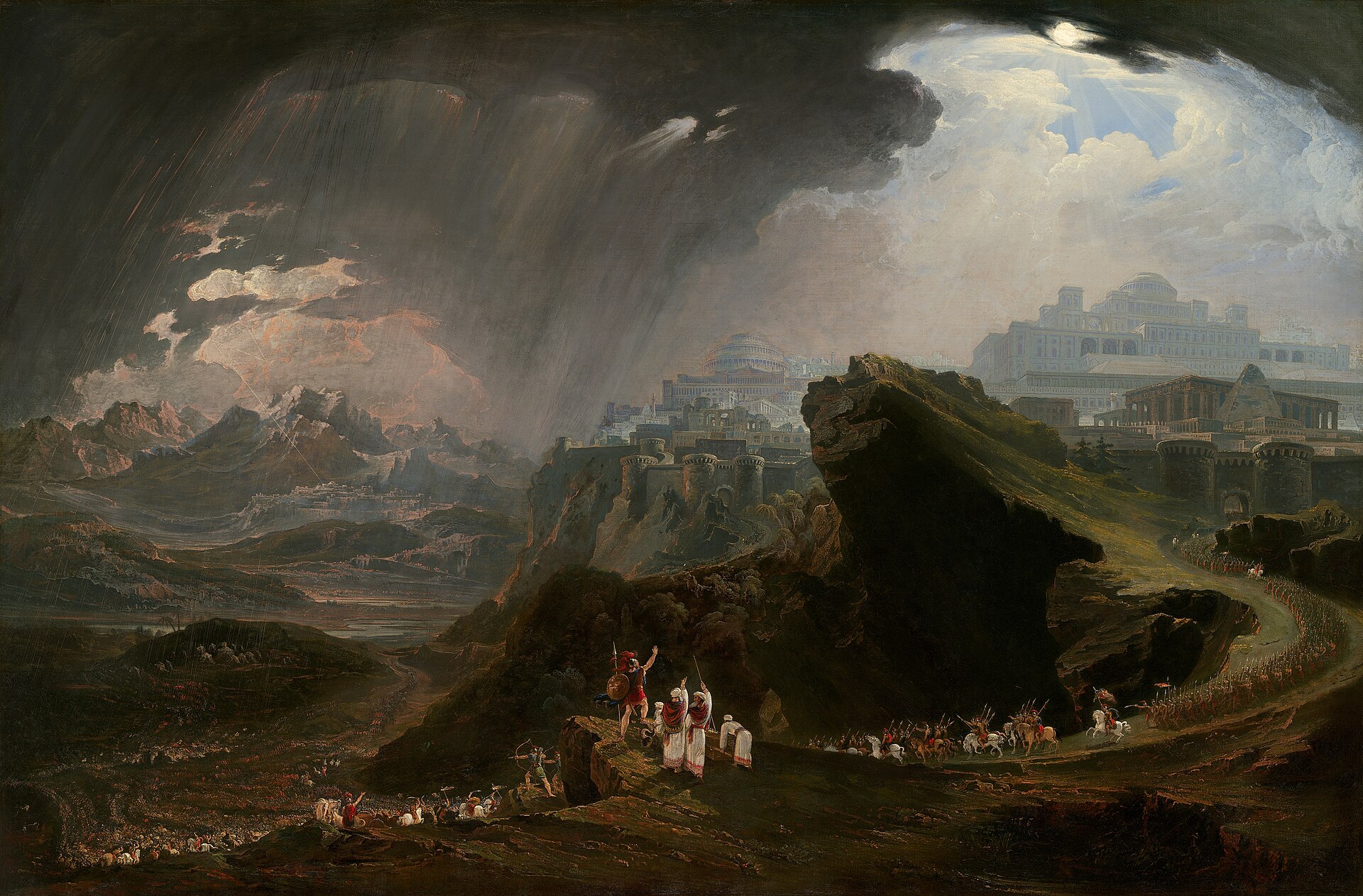
The print story is not a footnote to the paintings. It is one of the best ways to understand how Martin's imagination worked. A subject such as Pandemonium moved through print before it returned as the 1841 Louvre painting. Other paintings, including Belshazzar's Feast and Joshua Commanding the Sun to Stand Still, also gained public life through engraved versions. Martin's art was built for spectacle, but spectacle in his hands could be repeated, sold and re-seen.
At a Glance
- ArtistJohn Martin
- FocusPrintmaking, mezzotint and Milton's Paradise Lost
- Main mediumMezzotint and related print processes
- Key workPandemonium
- Reader pathFrom printed circulation to painted spectacle
Contents
- Introduction
- Why Prints Matter for John Martin
- Paradise Lost as a Visual World
- Books, Proofs and Single Sheets
- Pandemonium in Print
- Prints After the Paintings
- Print, Public Spectacle and Reputation
- Later Influence and Reassessment
- How to Look at Martin's Prints
- Where to Go Next
Why Prints Matter for John Martin
Martin's paintings often feel theatrical because they create a whole world before the viewer. Prints made that theatricality portable. They could not reproduce the size or colour of an oil painting, but they could preserve the structure of the vision: the plunging viewpoint, the tiny figures, the architectural masses, the storm-light and the sense of a scene opening far beyond ordinary scale.
The National Portrait Gallery notes that Martin's large dramatic panoramas were popularised through affordable mezzotint prints. That is a key fact. Martin's reputation was shaped not only by who stood before a canvas, but by who encountered the image in reproduced form. Prints helped his works reach audiences beyond the room where a painting hung.
The Dictionary of National Biography also records how many of Martin's works were engraved, including well-known images after Belshazzar's Feast, Joshua Commanding the Sun to Stand Still, The Fall of Nineveh and The Fall of Babylon. After Martin's death, the three great apocalyptic paintings attracted large crowds and subscribers for engravings published from them. His career therefore joins exhibition culture and print culture at almost every point.
That combination explains why Martin can feel surprisingly modern. He understood the power of an image that could become an event and then keep travelling. A large painting created the original shock. A print allowed that shock to circulate.
What Is Mezzotint?
Mezzotint is a printmaking technique especially suited to darkness, gradation and dramatic light. Instead of building an image mainly through fine linear outlines, mezzotint can produce rich tonal areas, from velvety black to pale illumination. For an artist like Martin, that mattered enormously.
His subjects often depend on light emerging from darkness: a palace of Hell glowing in volcanic depth, the creation of light in Milton's cosmos, supernatural illumination on a battlefield, writing on a wall, fires, storms and apocalyptic skies. Mezzotint let Martin make darkness active. It could carry atmosphere and scale without colour.
The British Museum's 1824 Pandemonium record identifies the work as a mezzotint with etching, made by Martin and published in London by Septimus Prowett as part of Illustrations to Paradise Lost. The Hammer Museum's 1824 Pandemonium proof records mezzotint and drypoint, a proof impression, and the publisher Septimus Prowett. Yale's 1831 Pandemonium records mezzotint on cream wove paper, while the Art Gallery of New South Wales records a large 1831 mezzotint reworking of the earlier subject.
Those records show Martin not simply as a painter whose images were copied by others, but as an artist deeply involved in printed design. The page, plate and proof were part of his imaginative field.
Paradise Lost as a Visual World
Milton's Paradise Lost, first published in 1667, offered Martin the kind of literary architecture his art needed. The poem moves between heaven, hell, Eden, chaos, angelic war, temptation, fall and judgement. It is a poem of vast settings and moral scale. Martin was unusually well equipped to turn that verbal immensity into image.
The National Gallery of Art records two 1827 volumes of Paradise Lost associated with John Milton as author and John Martin as artist, each described as a bound volume with text and mezzotints on wove paper. These volumes matter because they show Martin's Milton images not only as separate collectible prints, but also within a published book context.
The Hammer Museum's Paradise Lost series record is equally revealing. Its 1824 Pandemonium proof belongs to a larger series, and the collection page lists many related scenes: Satan presiding at the infernal council, Satan arousing the fallen angels, the creation of light, the fall of the rebel angels, the morning hymn of Adam and Eve, the expulsion from Paradise, and other episodes. Martin's Milton was therefore serial. He did not choose one dramatic moment and leave the poem behind. He built a sequence of visual episodes.
Cleveland's Paradise Lost: The Creation of Light, dated 1824 and published in 1825, shows the range of that sequence. The museum records it as a mezzotint and public-domain work. The subject is not Hell or demonic architecture, but creation itself: light emerging through cloud and darkness. Martin's printmaking could handle both infernal spectacle and cosmic beginning.
Books, Proofs and Single Sheets
Martin's Milton prints can be understood through three related forms: the bound book, the proof and the single sheet. Each form changes how the viewer meets the image.
In a bound volume, the image belongs to a reading experience. The National Gallery of Art's Paradise Lost volumes place Martin's mezzotints alongside Milton's text. The viewer does not encounter the image as an isolated spectacle alone, but as part of a poem that unfolds through language, theology and narrative sequence. The image becomes a pause in reading, a visual threshold into a scene the poem has already begun to build.
A proof belongs closer to the making and publishing process. The Hammer Museum's 1824 Pandemonium is identified as a proof impression from an edition of about fifty. Proofs are valuable because they can preserve a sense of experiment, testing and refinement. In Martin's case, they also remind us that the printed sublime was technical before it was public: scraped, bitten, inked, printed and inspected before it entered wider circulation.
A single sheet behaves differently again. It can be collected, displayed, handled and compared with other prints. A viewer may approach it not through the whole of Milton's poem, but through the force of one image. That is how Pandemonium could become both part of a literary sequence and an independent visual event.
These formats help explain why Martin's prints were so flexible. They could serve readers, collectors, publishers and exhibition-minded viewers at once. A Martin print could be an illustration, a commodity, a proof of technical skill and a miniature theatre of apocalypse.
Pandemonium in Print
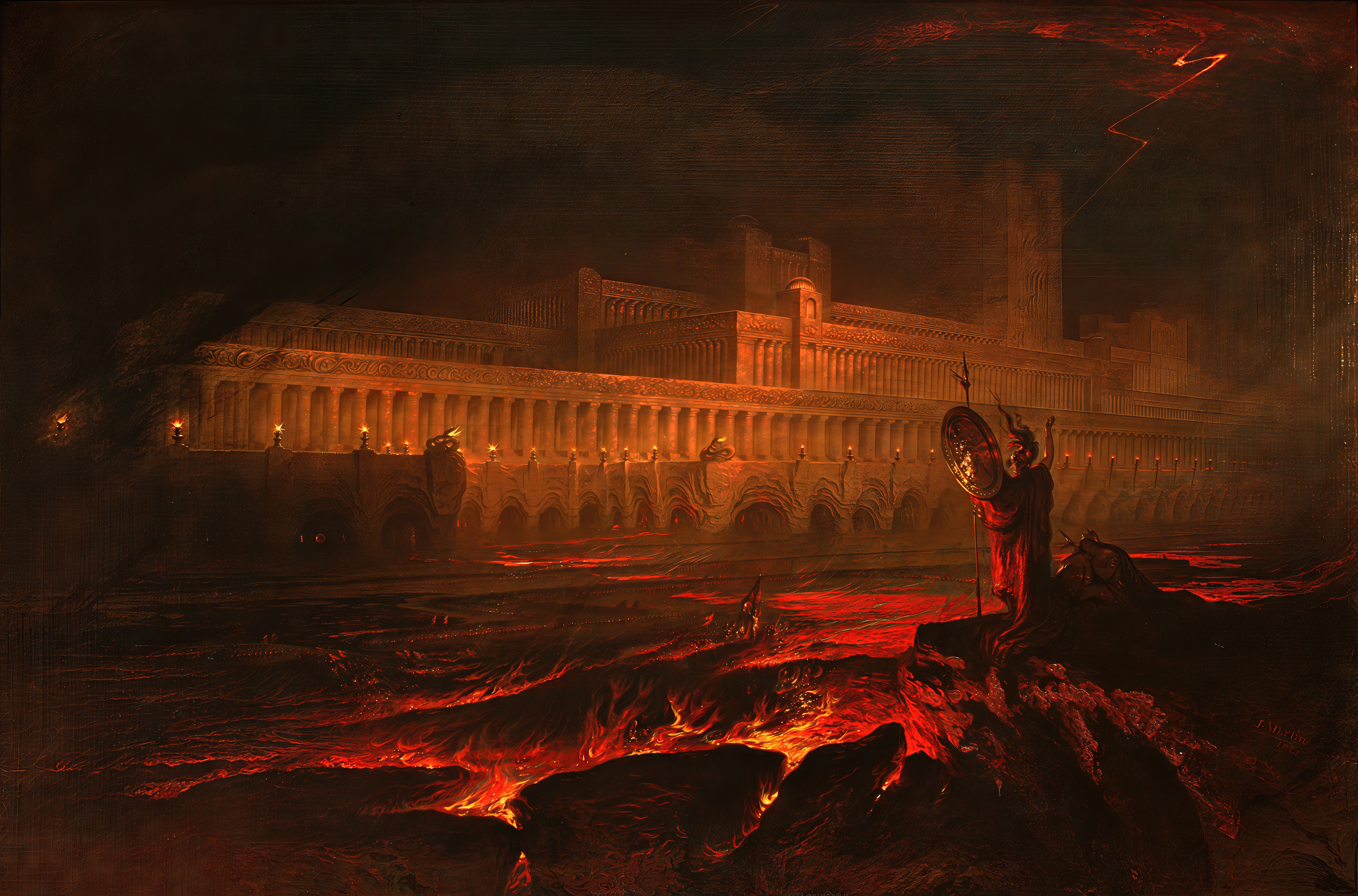
Pandemonium is the crucial bridge between Martin's print culture and his painting. The British Museum's 1824 record places Satan on a cliff addressing rebel angels, gesturing toward the city of Pandemonium, with a dome looming behind fortified walls. It identifies the subject as Book I, line 710 of Paradise Lost, and the work as an illustration to Milton's poem.
The Hammer Museum's 1824 proof strengthens that picture of early production. Its record identifies the sheet as a proof impression from an edition of about fifty, part of Paradise Lost, and names Septimus Prowett as publisher. The inscription evidence places the print in the world of designed, engraved and published images, not simply loose inspiration.
Then comes the larger 1831 reworking. Yale's 1831 Pandemonium is a public-domain mezzotint, made by Martin and J. P. Quilley after Martin, with lettering that names it as designed for a new series. The Art Gallery of New South Wales describes its 1831 Pandemonium as a large-scale reworking of the earlier engraving for the Paradise Lost series, based on Milton's description of the palace of Hell.
This sequence matters because the Louvre painting of 1841 did not appear from nowhere. The Louvre records that Martin had made engraved versions in 1824 and 1831 before reworking the subject in oil. The flagship painting therefore belongs to a long process of return. Martin tested the infernal city through print, enlarged its possibilities, and eventually transformed it into colour, canvas and an artist-designed frame.
Seen this way, Pandemonium is not only Martin's central Miltonic painting. It is also the clearest example of his print-to-painting imagination.
Prints After the Paintings
Martin's print culture also worked in the other direction: from painting into reproduction. Belshazzar's Feast and Joshua Commanding the Sun to Stand Still are two important examples.
The National Gallery of Art records an 1826 print of Belshazzar's Feast as a hand-coloured mixed media intaglio, with public-domain media. The visual description emphasises the enormous architectural space, banquet, crowds, statues, smoke, fire and the blazing writing on the wall. As a print, the image kept the spectacular structure of the painting available beyond the original canvas.
The NGA also records an 1827 print of Joshua Commanding the Sun to Stand Still as mezzotint and etching on chine colle, with public-domain media. Its inscription names Martin as both painter and engraver and gives a London publication date of 9 May 1827. That detail is especially useful: the print does not merely reproduce Martin's composition. It shows Martin presenting his own painted invention through a printed form.
The afterlife of the Last Judgement pictures belongs to the same pattern. The Dictionary of National Biography records that after Martin's death the three large apocalyptic paintings toured and attracted subscribers for engravings. Public spectacle did not end when the paintings were seen. It continued through printed subscription, ownership and memory.
Print, Public Spectacle and Reputation
Martin's reputation was built between two forms of public experience. One was immediate and theatrical: large pictures, dramatic lighting, crowds and exhibition excitement. The other was slower and repeatable: prints, books and sheets that could be handled, stored, sold and returned to.
That second form matters because Martin's images invite repeated looking. Their spaces are dense. A viewer can follow a road, scan a crowd, notice an inscription, trace a skyline or compare light sources. Prints made that kind of study possible for a broader audience. They also allowed Martin's compositions to move through networks of collectors, publishers and institutions.
Prints also shaped his later reputation. The Dictionary of National Biography, despite its mixed judgement of Martin's art, suggests that his Milton illustrations may be one of the best ways to appreciate his imaginative power because their smaller scale and absence of colour emphasise the grandeur of conception. That is a revealing point. Even a critic aware of Martin's weaknesses could recognise that print brought out something essential in him.
Modern museum records reinforce that view. The British Museum, Yale, Hammer, Cleveland, the Art Gallery of New South Wales and the National Gallery of Art all preserve Martin's printed work as a serious part of his legacy. These are not marginal souvenirs. They are evidence of an artist whose imagination was deeply reproductive, serial and public.
Later Influence and Reassessment
Martin's prints also help explain why his reputation has been able to recover. Large paintings can be difficult to move, display and compare, and some of Martin's greatest canvases have complicated histories of ownership, damage or touring. Prints preserve another record of his ambition. They show the architecture of his imagination even when colour, scale and painted surface are absent.
The Tate-linked modern reassessment of Martin, including Martin Myrone's work on Sketches of My Life and the 2011-2012 John Martin: Apocalypse exhibition context, has encouraged a fuller view of him as more than a melodramatic painter of disasters. His printmaking strengthens that fuller view. It shows discipline, design and a sophisticated understanding of image circulation.
The Milton prints are especially important here because they connect Martin to a longer history of British literary illustration. William Blake had brought a visionary, intensely personal imagination to Miltonic and biblical subjects. Later illustrators such as Gustave Dore would bring epic literature to huge popular audiences through dramatic engraved images. Martin sits in that wider tradition but keeps his own character: architectural, panoramic, tonal and public.
The prints also make his modern appeal easier to understand. Martin's worlds feel close to later visual cultures because they are already built for reproduction and return. They are not only singular artworks. They are scenes designed to live in memory, on paper and across audiences.
How to Look at Martin's Prints
Begin with tone. Martin's prints often ask the eye to move from darkness into light or from a dark foreground toward a luminous distance. The drama is not only in the subject. It is in the way blackness is organised.
Then look for architecture. Even in prints, Martin builds cities, palaces, walls, columns and cosmic spaces with astonishing confidence. The paper may be smaller than the painting, but the ambition is still architectural.
Next, look for sequence. A single Paradise Lost print is powerful, but the series matters because Milton's poem unfolds through episodes. Martin's images create a visual rhythm: rebellion, council, creation, temptation, expulsion, judgement and cosmic passage.
Finally, compare print and painting when both survive in the cluster. Pandemonium is the key comparison: 1824 print, 1831 reworking, 1841 oil painting. Joshua and Belshazzar also reward this kind of looking. The comparison teaches a useful lesson about Martin. His spectacle was not tied to one medium. It was an image system.
Where to Go Next
Start with Pandemonium to see the print-to-painting story at its most concentrated. The dedicated study of the Louvre painting follows the subject into Milton, the earlier engravings, the frame, the 1841 exhibition context and the close-looking detail.
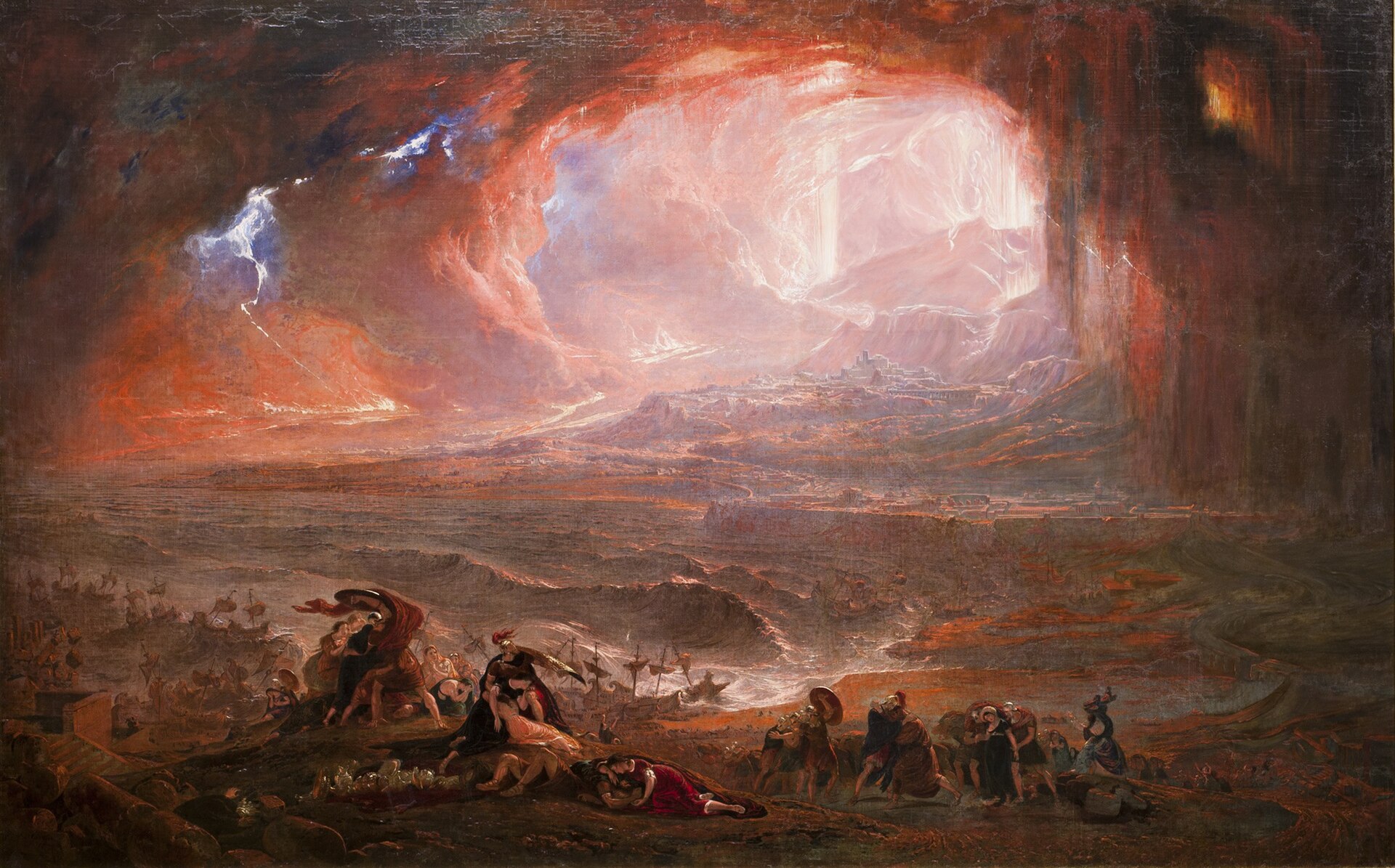
Then move to the paintings guide to understand how Martin's printed imagination connects with his larger painted worlds: the Last Judgement group, Belshazzar's Feast, Joshua, Pompeii and Herculaneum, Sadak and Macbeth.
The biography adds the career setting: practical training, exhibition conflicts, public fame, engraving, book illustration and later reassessment. The individual artwork studies can then be read with the print culture in mind, especially where a painting was reproduced or where a print prepared the way for a painting.
Martin's prints make one thing clear. His art was never just a set of large canvases. It was a circulating visual universe, built from Milton, scripture, theatre, publication and the public appetite for awe.
Frequently Asked Questions
Discussion
What detail in John Martin Prints and Paradise Lost changes how you read John Martin's use of scale, light or atmosphere?
Reader Insights
Which figure, architectural form or passage of light first anchors the scene for you?
How does the source story or subject change the emotional force of the image?
Where does this work feel closest to, or furthest from, Pandemonium?
Join the Conversation
Share your reading of John Martin Prints and Paradise Lost below.
References
- British Museum, *Pandemonium*, 1824: View Source, accessed 2 August 2026.
- Yale Center for British Art, *Pandemonium*, 1831: View Source, accessed 2 August 2026.
- Art Gallery of New South Wales, *Pandemonium*, 1831: View Source, accessed 2 August 2026.
- Hammer Museum, *Pandemonium*, 1824 proof from *Paradise Lost*: View Source, accessed 2 August 2026.
- Fitzwilliam Museum, *Pandemonium*, small-plate proof: View Source, accessed 2 August 2026.
- National Gallery of Art, *Paradise Lost (volume I)*: View Source, accessed 2 August 2026.
- National Gallery of Art, *Paradise Lost (volume II)*: View Source, accessed 2 August 2026.
- Cleveland Museum of Art, *Paradise Lost: The Creation of Light*: View Source, accessed 2 August 2026.
- National Gallery of Art, *Belshazzar's Feast*, 1826 print: View Source, accessed 2 August 2026.
- National Gallery of Art, *Joshua Commanding the Sun to Stand Still*, 1827 print: View Source, accessed 2 August 2026.
- National Portrait Gallery, John Martin person record: View Source, accessed 2 August 2026.
- Louvre Collections, *Le Pandemonium, 1841*, RF 2006 21: View Source, accessed 2 August 2026.
- Tate Shop, Martin Myrone, *John Martin - Sketches of My Life*: View Source, accessed 2 August 2026.
- Wikisource transcription of William Cosmo Monkhouse, "Martin, John (1789-1854)", *Dictionary of National Biography*, 1893: View Source, accessed 2 August 2026.